Privacy Policy
Terms of Service
Security
Status
Blogs & Guides
Dealership call tracking reveals what actually kills revenue: 31.8% hold abandonment, unreturned voicemails, missed connections. Here is how to fix it.
March 23, 2026
If you searched “dealership call tracking” or “automotive call tracking,” you probably aren’t looking for a way to count phone calls. You’re trying to answer harder questions. Which ads actually generate appointments? Where are callers dropping off before they ever talk to someone? Why does marketing say the phones are ringing, but the service board still has open bays?
Dealership call tracking is the measurement layer between “the phone rang” and “we made money.” For most stores, that layer is either missing, broken, or so thin it produces arguments instead of answers.
At Flai, we work inside dealership phone systems every day. We’ve seen what happens when stores finally get visibility into their calls, and we’ve seen what happens when they don’t. This guide is designed to be the resource you hand to a GM, Fixed Ops Director, BDC Manager, or Marketing Director and have them say: “Okay. Now we know what to do.”
We’ll cover what dealership call tracking actually means, how to set it up correctly, what to measure, what it costs, and how to turn data into revenue instead of just dashboards.

Most people think of call tracking as a marketing tool. Something to prove which ads work. That’s part of it. But in a dealership, the phone is not a side channel. It’s a revenue engine.
To put the scale in perspective: NADA reports that in 2024, franchised dealers wrote over 270 million repair orders and generated more than $156 billion in service and parts sales. In just the first half of 2025, that was already 137+ million repair orders and $81 billion in revenue.
That’s the backdrop. And now look at how fragile the phone experience actually is.
A Car Wars report, analyzing nearly 3,000 dealerships across 2024, found some uncomfortable numbers in line with dealership customer experience statistics we track at Flai:
That means roughly one in three callers who don’t get through are abandoning because they’re stuck waiting. Another third are leaving voicemails that may or may not get returned.
And here’s where the math gets painful. Benchmark data from Q4 2024 through April 2025 shows that 74% of phone leads turned into appointments, compared to just 40% of internet leads. Phone callers convert at nearly double the rate. So every missed call, every three-minute hold, every unreturned voicemail isn’t just a bad experience. It’s the highest-intent lead you have, gone. Our deep-dive on missed call statistics and the revenue lost at your dealership walks through exactly how much each dropped call costs.
This is why call tracking isn’t “analytics for marketing nerds.” It’s how you catch revenue that is currently evaporating.

Dealership call tracking is a system that does three things:
If your system connects source to conversation to outcome, you have call tracking. If it doesn’t, you have vanity metrics.
What call tracking is NOT:
Most dealerships do only the first job and wonder why nothing changes.
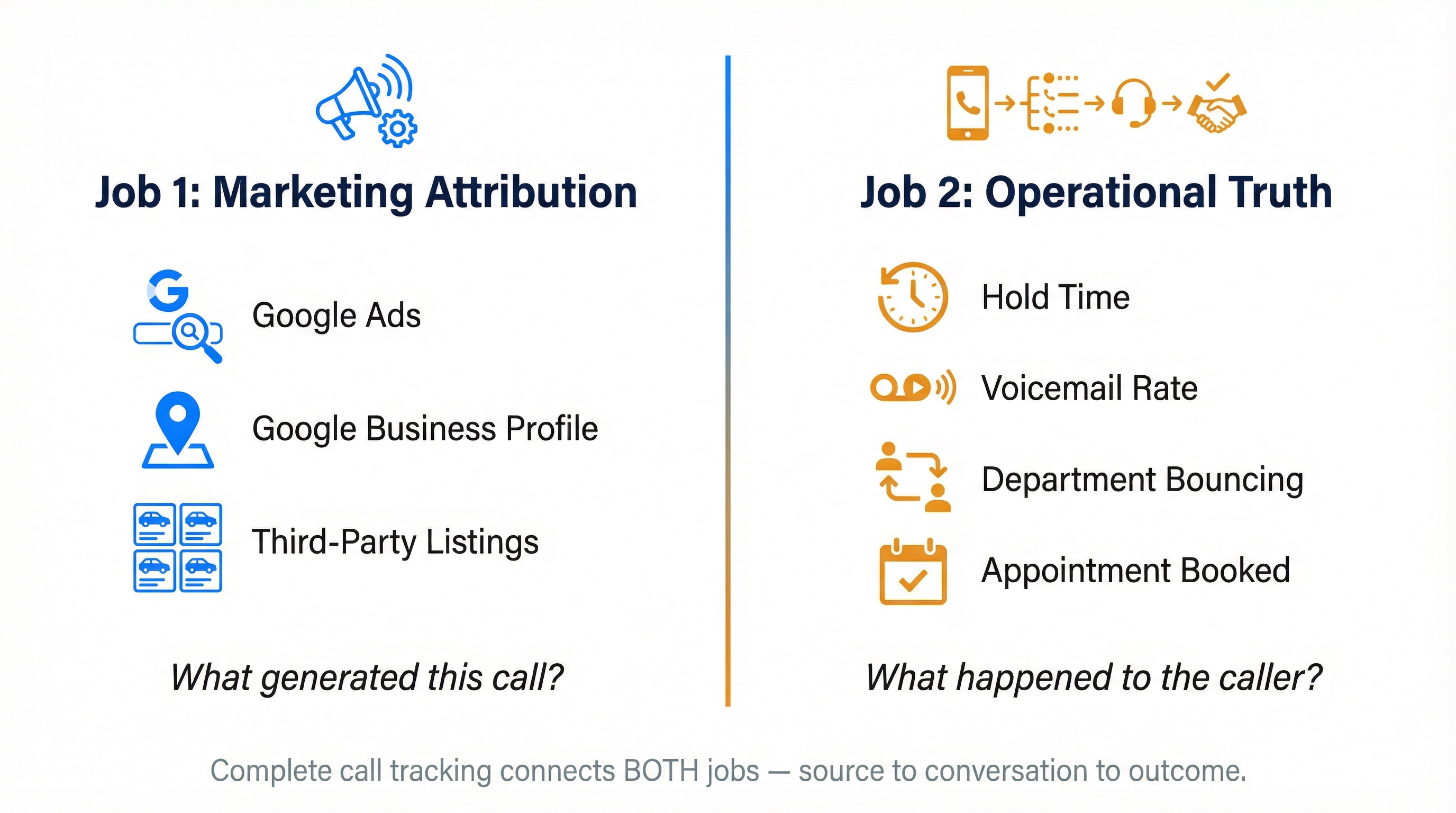
Job 1: Marketing attribution. Answer the question: “What generated this call?” Which Google Ads campaign drove service scheduling calls? Which third-party listing drove “is it still available?” calls? Which OEM incentive page drove inbound sales calls?
Job 2: Operational truth. Answer the question: “What happened to the caller?” How long did they wait? Did they hit voicemail? Did they get bounced between departments? Did anyone book the appointment? Was a callback promised and actually executed?
The data makes the operational side impossible to ignore. When nearly a third of unconnected calls come from hold abandonment and another third from voicemail, those aren’t marketing failures. They’re operational failures, the kind we explore in detail in our guide on call overflow solutions for dealerships.
Every dealership should model their call reporting after this funnel:
1. Inbound calls (total volume, unique callers)
2. Connected calls (answered by a human or automated system)
3. Qualified calls (real sales or service intent, not vendors, not spam)
4. Conversion event
5. Downstream outcome
Your call tracking system should let you compute conversion rates at every step. If you can only see “calls,” you’re flying blind. Our post on how AI is transforming dealership service departments covers how top-performing stores are closing the loop between call data and service bay revenue.

If you capture less than this, you’ll hit a ceiling fast.
Attribution fields:
Operational fields:
Outcome fields (disposition):
You need a dealership-specific disposition taxonomy. Generic “lead” vs “not lead” loses too much resolution to fix anything. A good one looks like this, and it maps directly to the BDC metrics every dealership should track:
| Service Dispositions | Sales Dispositions |
|---|---|
| Appointment booked | Appointment set |
| Appointment requested, no availability | Vehicle availability answered |
| Status check handled | Price/payment discussion |
| Recall inquiry handled | Trade-in discussion |
| Parts inquiry handled | Financing question |
| Escalation to advisor | Escalation to sales |
| Caller abandoned | Caller abandoned |
| Voicemail left | Voicemail left |
Even stores that “do” call tracking often miss the most important parts. Four blind spots come up over and over again.

Blind spot 1: “Call tracking is a marketing tool.” It’s also a process quality tool. The numbers showing 31.8% hold abandonment and 32.3% voicemail rates are operational failures, not marketing failures. Your marketing team didn’t put that caller on hold for three minutes. Read more about why dealership callers hang up and how to stop it.
Blind spot 2: “More calls means we’re winning.” Not necessarily. More calls can mean your ads improved. But it can also mean your staff got worse and people have to call twice, or your routing is broken and callers are bouncing around. You need unique callers and first-call resolution metrics to tell the difference.
Blind spot 3: “We track calls, so we know what’s happening.” If you don’t track missed calls, voicemails, hold time, and downstream outcomes, you don’t know what’s happening. You know what you want to be happening. Check out our guide on how to never miss a dealership call for the operational fixes.
Blind spot 4: “The CRM is the source of truth.” Research shows that a meaningful percentage of new sales leads never get logged into dealer CRMs, with website calls being a major contributor to those missed entries. If you only measure what shows up in the CRM, you’re blind to a meaningful portion of demand, and you’re understating what a more complete AI BDC platform could recover.
This is the implementation playbook. Follow it, and you get clean attribution, real operational insight, and fewer internal arguments about “whose fault” a bad month was.
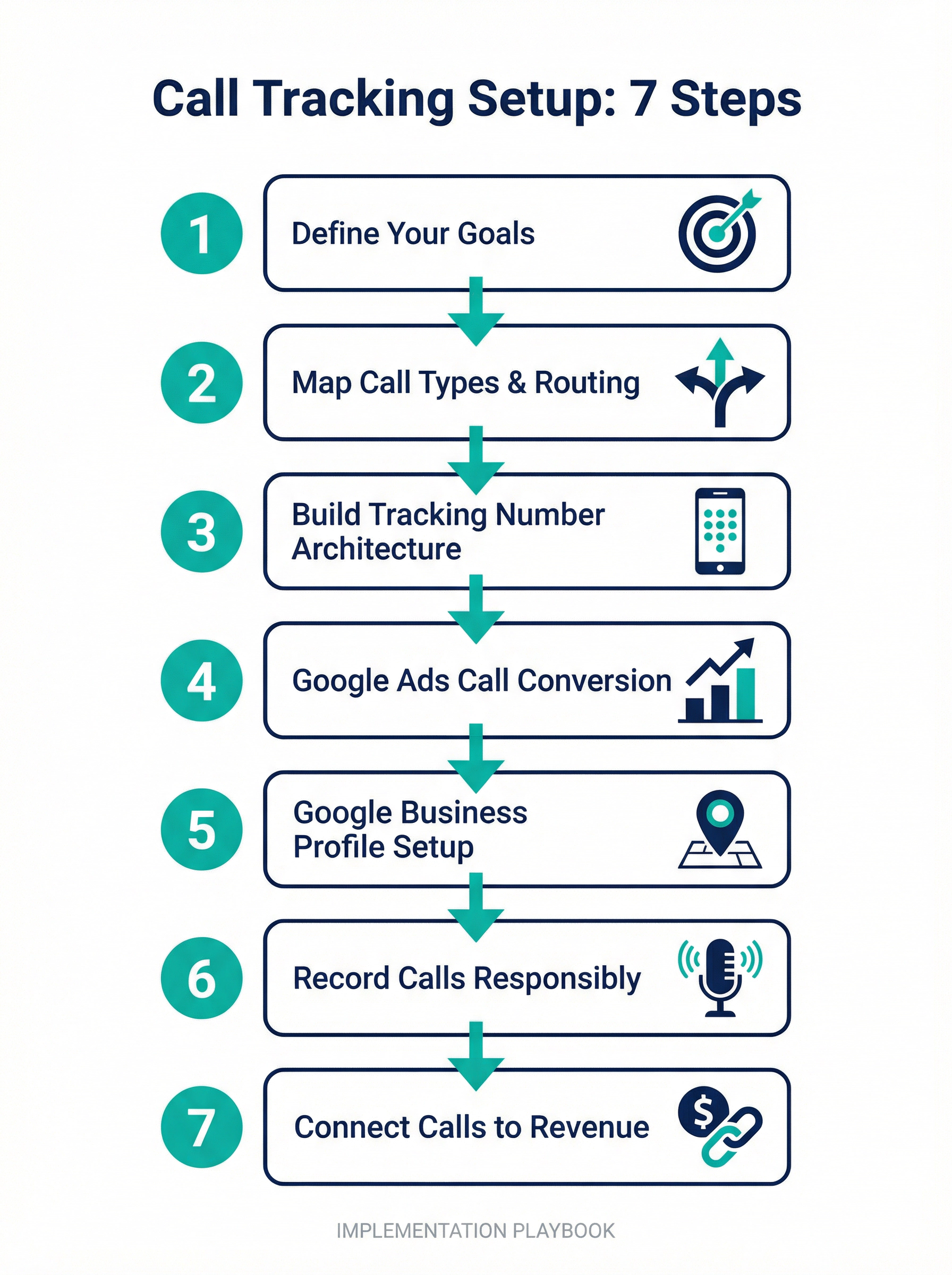
Before you buy anything, pick 3 to 5 north star outcomes you want to improve. Then work backward to the call funnel.
Examples: service appointments booked per day, service show rate, RO count and labor hours sold, sales appointments set, showroom visits from phone leads, close rate on phone-originated deals.
If you don’t define success first, you’ll drown in data and never change anything. Too many dealerships install call tracking, get a dashboard with 30 widgets, and then never open it again because nothing on the screen connects to a decision they need to make. Our guide on how to increase service appointments at your dealership walks through how to set up success metrics in fixed operations specifically.
Write down your real inbound call universe. That means every category you actually receive:
This isn’t busywork. It determines your routing rules, disposition tags, and reporting structure. Skip it and your data will be messy from day one. For service-side calls specifically, our playbook on how to automate service appointment scheduling at your dealership covers how intent mapping improves booking rates. Recall-related calls deserve their own routing category too. See our guide on dealership recall campaign best practices with AI for that layer.
There are two main approaches:
Static numbers per source (one number for Google Business Profile, one for service specials page, one for Cars.com listings, one for direct mail). Simple and stable, but weaker on keyword-level and session-level detail.
Dynamic Number Insertion (DNI) for website traffic. DNI uses a JavaScript snippet to swap the phone number displayed on your site based on visitor source (Google Ads, organic, etc.). Granular attribution, but needs careful implementation to avoid data and SEO problems.
For most dealerships, the best practice is: static numbers for major offsite sources (GBP, OEM, third-party) and DNI for website traffic, especially paid search.
Google Ads supports multiple phone call conversion types, including calls from ads (call assets, location assets, call-only ads), calls to a phone number on your website using a Google forwarding number, and clicks on a mobile number.
Three dealership-specific tips:
Set a realistic minimum call length.
Too short and you count junk calls as conversions. Too long and you miss real ones. Google only counts calls meeting your threshold.
Use “Call details” reporting.
If you can’t see call duration and metadata, you can’t debug attribution.
Don’t stop at “conversion.”
A 60-second call is not the goal. The goal is booked outcomes. Track past the call.
Google Business Profile allows one primary business phone number and up to two additional phone numbers.
This matters because it gives you a clean setup: keep your real dealership main number as the primary, and add a tracking number as an additional number. You get measurement without “changing your identity” across the web.
Call recording is essential for coaching, auditing, and improving. But you have to respect consent laws.
Key legal principles in the U.S.: federal law generally sets a one-party consent baseline (one party to the conversation consents). But states can impose stricter rules. About 11 states have all-party consent requirements, with some mixed rules depending on context.
Practical dealership-safe rule: If you operate across state lines or get callers from other states, default to a clear recording disclosure at the start of every call. A common pattern: “This call may be recorded for quality and training.” If the caller stays on the line, that’s often treated as implied consent, but you should confirm your specific setup with counsel.
This is where call tracking becomes a revenue tool, and it’s the step most dealerships never finish.
You want to join four pieces of data:
Without this linkage, you can’t answer: “Which campaigns create booked service appointments?” or “Which sources create sold deals?” or “Which departments leak calls the most?”
A $50/month tracking tool that feeds into a well-joined data pipeline will outperform a $500/month platform sitting in its own silo.
This is the step that separates dealerships that use call tracking from dealerships that just have call tracking installed. This is also where an AI BDC platform completes the data pipeline, because every AI-handled call automatically writes back into your scheduler and CRM, closing the data loop without manual entry.
A dashboard built around five categories, each answering a different question.
1) Demand
Total inbound calls, unique callers, calls by department (sales, service, parts), calls by hour and day. Research shows meaningful time patterns like Monday and 10am-12pm peaks. Our analysis of when dealerships get the most calls maps those patterns in detail. Your dashboard should surface these automatically.
2) Access
Answer rate, abandon rate, average time to answer, average hold time, voicemail rate. This is where data about hold abandonment and voicemail rates becomes your baseline. If your numbers look like the industry average, you’ve got work to do. The true cost of dealership hold times puts a dollar figure on that gap.
3) Quality
Transfer rate and transfer destinations, call scoring (see rubric below), and a “first-call resolution” proxy, which is repeat callers within 24-48 hours. If the same person calls twice in a day, your first call didn’t solve their problem.
4) Conversion
Appointment set rate (service and sales separately), show rate, outcome conversion rates by source. Phone lead appointment set rates hover around 75% for top-performing dealerships. If you’re well below that, your phone handling is the bottleneck, not your marketing. For service, our guide on how to increase service appointments covers proven conversion levers.
5) Value
Revenue per call (when tied to RO or deal), gross per call (if you can measure it), cost per booked appointment by channel. This is the number that ends arguments between sales and marketing. For a deeper framework, see our guide on the BDC metrics every dealership should track.
Dealerships love “call scoring” until it becomes vague and political. The fix is a points system tied to observable behaviors, not opinions.

Service call score example:
| Behavior | Points |
|---|---|
| Answered within 20 seconds | +2 |
| No hold (or hold under 30 seconds) | +2 |
| Captured name + phone | +1 |
| Captured vehicle and concern | +1 |
| Offered at least 2 appointment options | +2 |
| Booked appointment | +5 |
| If not booked, created callback task with time promise | +2 |
Sales call score example:
| Behavior | Points |
|---|---|
| Answered within 20 seconds | +2 |
| Confirmed vehicle availability or offered alternatives | +2 |
| Captured name + phone | +1 |
| Set appointment | +5 |
| If not set, sent follow-up text/email and scheduled next action | +2 |
Then report: average score by source, bottom 10% calls by score, and trends over time. This turns “we need to do better on phones” into a measurable operating system. For CSI implications of phone performance, see our breakdown on how to improve CSI scores at your dealership.
Pricing varies by vendor and feature set, but here are some anchored references you can use to sanity-check quotes.
Entry-level to mid-market: Entry-level call tracking tools list plans starting around $50/month with included tracking numbers and minutes, and mid-market tools around $65/month. These tools are solid for marketing attribution and often used by agencies managing ad spend.
Enterprise call intelligence: Enterprise call intelligence platforms position themselves around dynamic numbers, call recording, IVR, offline conversion import, and deep integrations. Pricing is typically quote-based, and some publish annual call conversion benchmark reports based on AI analysis of tens of millions of phone calls across multiple industries. For dealerships and dealer groups, enterprise tools can make sense when you have multi-rooftop complexity, need deeper analytics and integrations, or when call volume is so high that per-minute costs become material.
The reality check: If your call tracking reveals you’re losing calls to hold and voicemail, the ROI is often dominated by fixing the leak, not by perfecting attribution. Spending money on tracking and then ignoring the data is like buying a leak detector and refusing to patch the pipe. That’s where Flai comes in. It doesn’t just detect the leak, it plugs it by answering every call the moment it rings, 24/7. Dealerships replacing their outsourced call center setup often find why AI outperforms traditional outsourced call centers explains the economics clearly.
Data without a cadence is just a library no one visits. Here’s the simplest operating rhythm that actually works.

Weekly (30 minutes):
Monthly (60 minutes):
Quarterly:
The weekly review is the one that matters most. That’s where you catch problems before they compound into a bad month. A missed-call spike on Tuesday afternoons is easy to fix if you spot it on Thursday. It’s expensive if you don’t notice until the monthly P&L. This rhythm pairs especially well with AI-powered call handling, because instead of reviewing calls that went to voicemail, you’re reviewing calls that were handled, and then refining the AI’s responses to improve conversion. AI follow-up also helps with the sales side. See how AI follow-up is helping dealerships close more sales leads.
This isn’t legal advice. But it’s enough to have a smarter conversation with your counsel and IT team.
Start with clear disclosure. If you operate across state lines or receive calls from other states, use a recording disclosure at the start of every call. About 11 states have all-party consent requirements, and some have mixed rules depending on whether the conversation is in-person or over the phone.
Beyond disclosure:
For multi-language dealerships, compliance also extends to caller disclosures in other languages. Our guide on multilingual customer service for dealerships addresses how to handle disclosures and communication across language barriers.
Call tracking tells you where you’re losing money. It shows you the hold times, the voicemails, the after-hours dead zones, the peak-hour overflow problems. That’s essential. But tracking alone doesn’t stop the loss.
If your data shows the leak is after-hours calls, peak-hour overflow, or long holds and voicemails, the fix is coverage and execution, not more dashboards.
That’s where Flai comes in. We built our AI voice agents specifically for dealerships because we saw what the data revealed over and over: phones ring, nobody answers, customers call someone else. Our system picks up every inbound call instantly, 24/7, with zero hold time. It books service appointments and schedules test drives directly into your existing scheduler and DMS, including through our Tekion integration. And it handles overflow during peak hours so your human team can focus on the customers already in front of them.
Dealerships evaluating AI phone systems can consult our AI voice agents for dealerships buyers guide for a full comparison framework, or review the broader AI for car dealerships guide for teams evaluating automation across the board.
The Flai platform itself gives you a live view of what’s happening across every call — total calls handled, appointment booking rate, revenue impact, and call flow breakdowns, all in one dashboard.

The results speak for themselves:
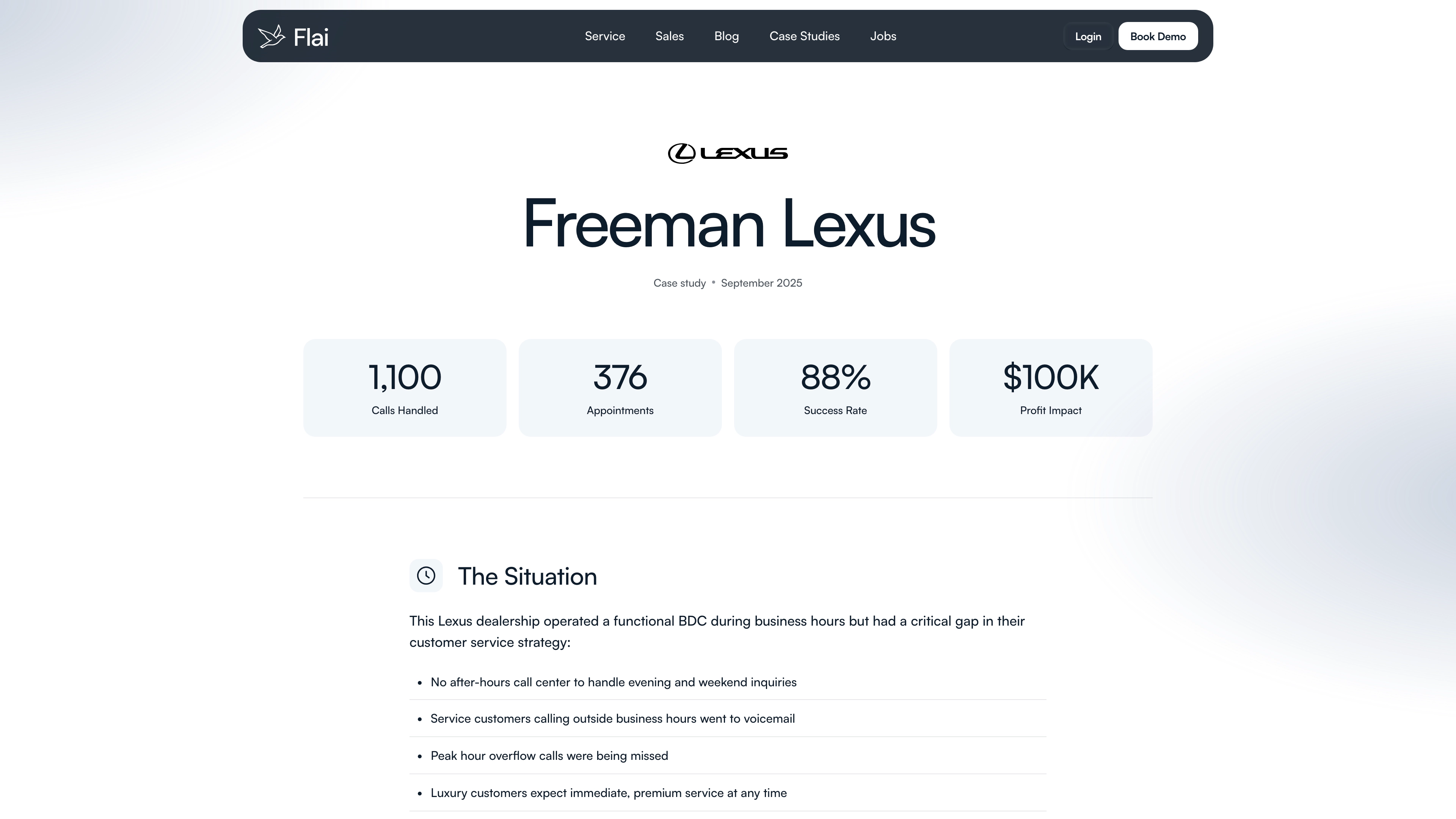
At a Lexus dealership in the Bay Area, Flai handled roughly 1,100 calls with zero missed, converted 88% of bookable calls into appointments, and generated an estimated $100,000 in profit impact.
At a CDJR dealership, monthly service appointments jumped from 205 to 448 in the first month, with Flai booking 304 of those appointments and generating roughly $83,000 in profit.
You can see the full picture across multiple stores in our case studies.

The pattern across our case studies is consistent: appointment profit clusters around $260 to $270 per booked appointment. Even with moderate conversion rates, the profit per incremental appointment is so high that you don’t need perfection. You just need to stop letting calls die.
For dealerships already running call tracking, we’ve published resources that bridge the gap between “seeing the problem” and “fixing it”: our guide on missed call statistics and revenue impact at dealerships, our playbook on how to never miss a customer call, and our virtual receptionist guide for car dealerships for teams exploring front-desk AI automation.
The top 20% of dealers already achieve 85% service call connection rates compared to the 65% industry average. Flai helps every store perform like a top-20% store, overnight, without adding headcount.
And because Flai integrates directly with your scheduler, CRM, and DMS, every call our AI handles feeds back into your call tracking data pipeline automatically. You don’t just fix the leak. You also get cleaner data on the calls that are now being answered, which makes your attribution, scoring, and conversion metrics more accurate across the board. Ready to see it in action? Book a demo and we’ll walk you through how it works for your specific setup.
This is already showing up in call data, and it’s going to change how dealerships think about phone interactions.
Research has tracked a sharp surge in pricing request phone calls coming from Google’s AI agent calling feature in late 2025, with platforms observing significant increases month-over-month.
What this means for your dealership call tracking setup:
This trend is still early, but dealerships that track it now will have a real advantage in understanding where their demand is coming from as AI-assisted search grows. If 5% of your inbound calls are from AI agents today, that number is likely going up. You want your tracking in place before it becomes a significant slice of your call volume, not after. Our piece on how AI is transforming dealership service departments covers how forward-thinking dealers are adapting their processes now.

Is dealership call tracking just for marketing teams?
No. Marketing attribution is half the job. The other half is operational truth: answer rate, hold time, voicemail rate, transfers, and conversion outcomes. The biggest sources of unconnected calls are hold abandonment and voicemail, which are operations problems, not marketing problems. Your BDC Manager and fixed ops director need this data just as much as your marketing director does.
Will call tracking mess up our SEO or Google Business Profile?
It doesn’t have to. Google Business Profile allows one primary number and up to two additional phone numbers. The best approach is to keep your real dealership number as the primary and add a tracking number as an additional number. That way you get measurement without changing the number customers and Google associate with your business.
What’s the fastest way to see ROI from call tracking?
Start with the basics:
-> Track the source for every call
-> Measure missed calls, hold times, and voicemail rates
-> Fix routing and add overflow coverage
-> Connect calls to booked appointments
Fixing hold and missed calls almost always pays back faster than micro-optimizing ad campaigns. The leak in your phones is probably bigger than the inefficiency in your ad spend. Our guide on call overflow solutions for dealerships covers the fastest paths to plugging the leak.
Can we rely on call length as a proxy for quality?
It’s a weak proxy. Google Ads lets you set a minimum call length for conversions, and that’s fine as a filter. But your dealership outcomes depend on what happened in the conversation, not how long it lasted. A two-minute call that books an appointment is worth more than a ten-minute call that goes nowhere. Use dispositions and outcomes, not duration alone.
How often should we review call tracking data?
Weekly, at minimum. A 30-minute review of missed calls, voicemails, and the lowest-scoring calls gives you enough signal to pick one process fix per week. Monthly, spend 60 minutes on channel ROI and staffing adjustments. Quarterly, refresh your disposition taxonomy and audit compliance. The weekly habit is the one that compounds.
What’s the difference between static tracking numbers and Dynamic Number Insertion?
Static numbers are fixed: one tracking number for Google Business Profile, another for your service specials page, another for direct mail. They’re simple but give you source-level attribution only. DNI swaps the phone number on your website dynamically based on how the visitor arrived (organic, paid, referral), giving you campaign-level and even keyword-level detail. Most dealerships use static numbers for offsite sources and DNI for website traffic.
Do we need call tracking if we already have an AI phone system like Flai?
Call tracking and AI phone systems solve different (and complementary) problems. Call tracking tells you where demand comes from and where it falls apart. An AI system like Flai makes sure that demand gets handled, every time, with zero hold and zero voicemail. The best setup is both: tracking to see the full picture and AI to make sure nothing falls through the cracks. If you’re evaluating options, our AI for car dealerships guide and AI voice agents buyers guide are good starting points. Or book a demo and we’ll walk through your specific setup with you.
As seen in