Multilingual Customer Service for Dealerships (2026)
1 in 4 new cars goes to a Hispanic buyer, yet only 8% of dealer websites have Spanish content. The 2026 multilingual playbook for dealerships.
If your store serves a diverse market and you’re still running English-only customer communication, you’re leaking revenue. And not in some abstract, hard-to-measure way. We’re talking about real calls that end in voicemail instead of booked appointments. Real customers who drive an extra 10 miles to your competitor because they saw “Se habla Espanol” on their website.
Multilingual support isn’t a “nice-to-have” anymore. It’s a conversion lever. The gap between dealerships that handle language well and those that don’t is widening fast. Nearly one in four new cars sold in the U.S. goes to a Hispanic buyer, yet only 8% of dealer websites have any Spanish content at all.
This guide is written for GMs, Fixed Ops Directors, BDC Leaders, and dealer group ops teams who want multilingual coverage that actually drives bookings. Not “we have someone who speaks Spanish… sometimes.” A real system.
Why Language Diversity Is Growing in Dealerships

The U.S. isn’t becoming multilingual. It already is.
According to U.S. Census Bureau data, 78.3% of people age 5 and older speak only English at home. That means roughly 21.7% speak a language other than English at home. In raw numbers, that’s tens of millions of potential customers.
The breakdown of that non-English population looks like this:
| Language | Share of Non-English Speakers |
|---|---|
| Spanish | 61.1% |
| Chinese | 5.1% |
| Tagalog/Filipino | 2.5% |
| Vietnamese | ~3% (among LEP) |
| Arabic | ~2% (among LEP) |
Spanish dominates because it covers both the largest “non-English at home” segment and the largest LEP (Limited English Proficiency) population. KFF research estimates roughly 26 million people in the U.S. have limited English proficiency, meaning they speak English less than “very well.”
So what does this mean for your dealership?
Even if only 5-15% of your inbound calls come from customers who prefer a non-English language, those aren’t random callers. They’re often family decision-makers and high-retention service customers. The Spanish-speaking population alone grew by approximately 1.9 million between 2018 and 2023. Over 42 million U.S. residents speak Spanish at home.
These customers are calling you. The question is whether anyone’s picking up in their language.
How Language Barriers Cost Dealerships Revenue
Language issues hit your bottom line through three mechanisms. None of them are “soft” or hard to measure.
How Language Friction Kills Phone Conversions
Dealership calls are high-intent. When someone picks up the phone, they want action: book a service appointment, check availability, handle a recall, solve a problem. They’re not casually browsing.
Now layer in a language mismatch:
- Longer call times while the customer struggles to explain
- More holds and transfers looking for “someone who speaks Spanish”
- More “can you repeat that?” loops
- More abandoned calls

Car Wars data puts hard numbers on how fragile phone patience is in dealership contexts. The average hold time is 3 minutes and 5 seconds, and 31.8% of unconnected calls are customers hanging up while on hold.
That’s not unique to dealerships. Research from Plum Voice shows that when callers are placed on hold, roughly 60% will hang up after just one minute. A third of callers won’t wait at all.
The key insight here: Language mismatch is basically hold time in disguise. Every second the customer spends confused, repeating themselves, or waiting for someone who can understand them is a second they’re not getting what they called for.
Why Trust Matters for High-Stakes Car Purchases
Cars and service repairs are expensive, emotional decisions. If a customer can’t communicate clearly, they feel vulnerable:
- “Am I being taken advantage of?”
- “Did they understand what’s wrong with my vehicle?”
- “Are they going to surprise me with costs?”
Consumer research consistently shows that language accessibility changes buying behavior:
- 72% of consumers are more likely to buy when information is in their native language
- 60% rarely or never buy from English-only sources
- Multilingual websites see conversion rates 55% higher than English-only sites
- 74% are more likely to repurchase from brands offering native-language support
It’s not about perfect grammar. It’s about confidence. When a Spanish-speaking customer calls and hears “Hola, en que le puedo ayudar?” they immediately relax. They know they’re in the right place.
How Communication Errors Create Downstream Problems
Language issues don’t just lose calls. They create downstream operational problems:
- Wrong appointment type booked
- Wrong date or time captured
- Wrong customer info (name, phone, VIN)
- Wrong expectations set (“loaner guaranteed” when it’s not)
Those errors cascade into bigger headaches:
- No-shows (because the customer didn’t understand when to arrive)
- Angry customers (because they expected something different)
- Rework for advisors and BDC staff
- CSI hits that ripple through your OEM relationship
The cost isn’t one lost booking. It’s the compounding damage from getting it wrong.
Why Hispanic Car Buyers Are Your Biggest Opportunity

Here’s the competitive reality that should make every GM pay attention.
According to DealerCentives research, Hispanic and Latino consumers make up roughly 18-20% of the U.S. population but account for an estimated 24% of all new car sales. Nearly one in four new cars sold goes to a Hispanic buyer.
Their economic influence is massive. WardsAuto reports that U.S. Latino GDP reached $3.6 trillion in 2022. Hispanic car buyers also tend to be younger and purchase vehicles more frequently than other demographic groups. That means more lifetime sales and service cycles per customer.
And yet, here’s the gap:
A nationwide analysis of ~28,000 dealer websites found that only about 8% had any Spanish-language content at all. Even in areas with large Hispanic populations, 89% of dealers had no obvious Spanish content. Only about 4% of U.S. advertising spend goes toward Hispanic marketing.
That’s a market mismatch you can actually exploit.
Which Dealerships Are Winning with Hispanic Customers
Downey Nissan in Los Angeles hired bilingual staff (about 90% of its sales team fluent in Spanish) and marketed directly to the local Hispanic community. The result? They doubled vehicle sales to Hispanic customers in a single year and became the #1 Nissan dealer in their region for Hispanic sales.
Toyota ran sustained Spanish-language advertising campaigns with culturally tailored messaging. Over time, their market share among Hispanic buyers nearly doubled, from 12% of Toyota’s U.S. sales in 2010 to roughly 24% in recent years.
Why Hispanic Customers Become Loyal for Life
Hispanic buyers tend to stay loyal to dealerships that make the effort to speak their language and understand their values. Surveys show that 100% of Hispanic women and 48% of Hispanic men said they’re “Very” or “Extremely Likely” to refer friends and family to a dealer who speaks Spanish.
74% of respondents said they would travel further to shop at a dealership that markets to them in Spanish. Language can literally pull customers past your competitors.
That word-of-mouth is marketing gold. In communities where car buying is a family affair, one satisfied customer can mean an entire extended family’s business.
Where Multilingual Support Drives the Most Revenue
“Multilingual customer service” is vague. Here’s where it’s concrete and monetizable.
| Department | ROI Potential | Why It Matters |
|---|---|---|
| Service | Highest | High-frequency, recurring, phone-heavy. Every kept appointment compounds (today's RO + future retention) |
| Sales | Highest competition | Sales calls are fragile. Customer can dial 3 other dealers immediately if you can't help them |
| Parts | Fastest easy win | Most calls are structured: "Do you have X?" "What's the price?" "When can I pick up?" |
| Finance | Highest risk | Compliance concerns. Needs guardrails and trained humans for contract explanations |

Why Service Is the Highest ROI Department
Service is where multilingual support prints money. It’s high-frequency, recurring, and overwhelmingly phone-driven.
What multilingual coverage should handle in service:
- Schedule, reschedule, cancel appointments
- Maintenance interval questions (“when is my next oil change due?”)
- Symptom descriptions (“there’s a noise when braking”)
- Recall inquiries (“is my VIN affected?”)
- Policies: shuttle availability, loaners, wait times
- Pickup and dropoff logistics
Every incremental kept service appointment has compounding value: the RO revenue today plus the retention benefit that leads to the next service visit and eventually the next vehicle purchase. Dealerships using AI-powered multilingual coverage have seen booking rates exceed 88% on bookable calls.
Why Sales Calls Are the Most Competitive
Sales calls are more fragile than service calls because the customer can call three other dealers within minutes if you can’t help them. Switching cost is zero.
Multilingual coverage in sales should handle:
- Availability checks
- Test drive scheduling
- Trade-in intake basics
- Financing handoff (with appropriate guardrails)
- Follow-up via SMS and email in the customer’s language
Why Parts Is the Fastest Easy Win
Most parts calls are highly structured:
- “Do you have X part?”
- “What’s the price?”
- “Can you order it?”
- “When can I pick up?”
Good multilingual support in parts reduces repeated calls and avoids order mistakes.
Why Finance Requires the Most Caution
Be careful here. Multilingual support helps, but you need guardrails:
- Do not improvise on legal or contract terms
- Do not “translate loosely” financial documents
- Route to trained humans for actual contract explanations
This is especially important in California (more on that below).
California Compliance: When Language Becomes a Legal Requirement

If you operate in California, you need to take Civil Code Section 1632 seriously.
In plain terms: if certain consumer contracts are negotiated primarily in Spanish, Chinese, Tagalog, Vietnamese, or Korean, businesses must provide a translation of the contract in that language before execution. The statute is explicit about the language list and translation requirements. LA County consumer guidance also describes these obligations.
Two practical takeaways (not legal advice):
- Multilingual sales conversations can trigger downstream obligations if you’re negotiating contract terms. Talk to your counsel and get a compliant process documented.
- “My cousin can translate” is not a strategy. You need a real, documented workflow.
The good news: having a systematic multilingual process actually makes compliance easier than ad-hoc translation attempts.
The 5-Layer Multilingual System That Actually Works
Most dealers do multilingual support like this: “We have a bilingual person.”
That’s not a system. It’s a single point of failure. What happens when that person is on lunch? On vacation? Handling another call?
Here’s the system that actually works.
Layer 1: How to Give Customers Language Access
You have two viable patterns:
Explicit choice (simple and reliable): “For English, press 1. Para Espanol, oprima 2.”
Language detection (faster, feels premium): Greet, listen, detect language, continue in that language.
Best practice: Combine them. If detection fails or is uncertain, offer the explicit choice.
Layer 2: Can You Handle Real Dealership Conversations?
Your system must handle:
- Accents and dialects (Mexican Spanish vs. Caribbean Spanish, regional variations)
- Code-switching (“I need an oil change para mi Camry”)
- Noisy environments (service drive calls with background noise)
Many generic translation tools fail here. Dealership vocabulary is specialized.
Layer 3: Does Every Call End with a Real Outcome?
Multilingual support that “takes a message” is not enough.
Your system should be able to:
- Book or reschedule appointments directly in the scheduler
- Write customer information back to CRM
- Send confirmation via SMS or email in the same language
If a customer has a complete conversation in Spanish but gets an English confirmation text, you’ve broken the experience.
Layer 4: How to Keep Customers In-Language Across Channels
A common failure mode:
Phone call is in Spanish -> Confirmation text comes in English -> Customer ignores it -> No-show risk increases
Keep everything consistent:
- Confirmation texts in the customer’s language
- Reminder texts in the customer’s language
- Follow-up emails in the customer’s language
Layer 5: When to Escalate to Human Staff
You need clear rules:
-> Angry customer -> Route to a human
-> Finance or legal questions -> Route to a trained human
-> Uncertainty threshold exceeded -> Warm transfer with context, or offer callback
AI can handle the volume. Humans handle the exceptions. The key is knowing when to hand off.
Which Languages Your Dealership Should Support
Don’t guess. Use a simple prioritization stack.
Step 1: Start with English and Spanish
English + Spanish is the baseline in virtually every U.S. market. Spanish is the largest non-English-at-home language and the largest LEP language by a wide margin.
Step 2: Add Languages Based on Your Local Market
KFF’s LEP language data gives you the “next set” to consider:
| Language | % of LEP Population | Where Common |
|---|---|---|
| Chinese | 7% | California, New York, Texas metros |
| Vietnamese | 3% | Texas, California |
| Arabic | 2% | Michigan, California |
| Tagalog | 2% | California, Hawaii |
Step 3: Audit Your Call Logs to Find Hidden Revenue
Run a 30-day audit:
- Count calls where the caller starts in another language
- Count calls where the caller struggles to explain their issue
- Tag “lost” outcomes (hang up, voicemail, no appointment) by language when possible
You’ll usually discover:
- The real language distribution is hyper-local to your specific zip codes
- A “small” language segment can still be high-value (like luxury import brands in specific communities)
Your call logs tell you where the money is. National averages are a starting point, not the answer.
How AI Solves Multilingual Communication at Scale
If you want multilingual coverage that doesn’t depend on staffing a bilingual team around the clock, AI is the force multiplier. But the system needs to actually finish the job: book appointments, confirm details, and write back to your systems. Not just talk.

At Flai, we built our AI communications platform specifically for dealerships, and multilingual support was part of the design from day one.
What Separates Real Multilingual AI from Basic Translation
Any language, any time: Our AI voice agents can speak Spanish, Mandarin, Vietnamese, Arabic, and more. The customer experience is the same whether they call at 2pm or 2am, whether they speak English or Spanish. No staffing gaps, no “call back when Maria is here.”
Not just message-taking: Most outsourced call centers and basic AI systems take messages. That’s not good enough. Flai actually books appointments directly into your scheduler, updates your CRM, and sends confirmations in the customer’s preferred language. The call ends with a result, not a promise of a callback.
Cross-channel consistency: Phone, SMS, and email all stay in the customer’s language. If they called in Spanish, their confirmation text is in Spanish. Their reminder is in Spanish. Their follow-up is in Spanish.
Integration depth: We connect directly to your DMS, CRM, and scheduler. That’s how we can actually take action during the call instead of creating handoff friction.
Built-in escalation: Complex situations, angry customers, and finance questions get routed to humans with full context. The AI handles the volume. Your team handles the exceptions.
Proven results: Our Freeman Lexus case study shows an 88% booking rate on bookable calls with $100,000 monthly profit impact. The San Leandro CDJR case study demonstrates how AI coverage eliminates missed calls entirely while maintaining high conversion rates.
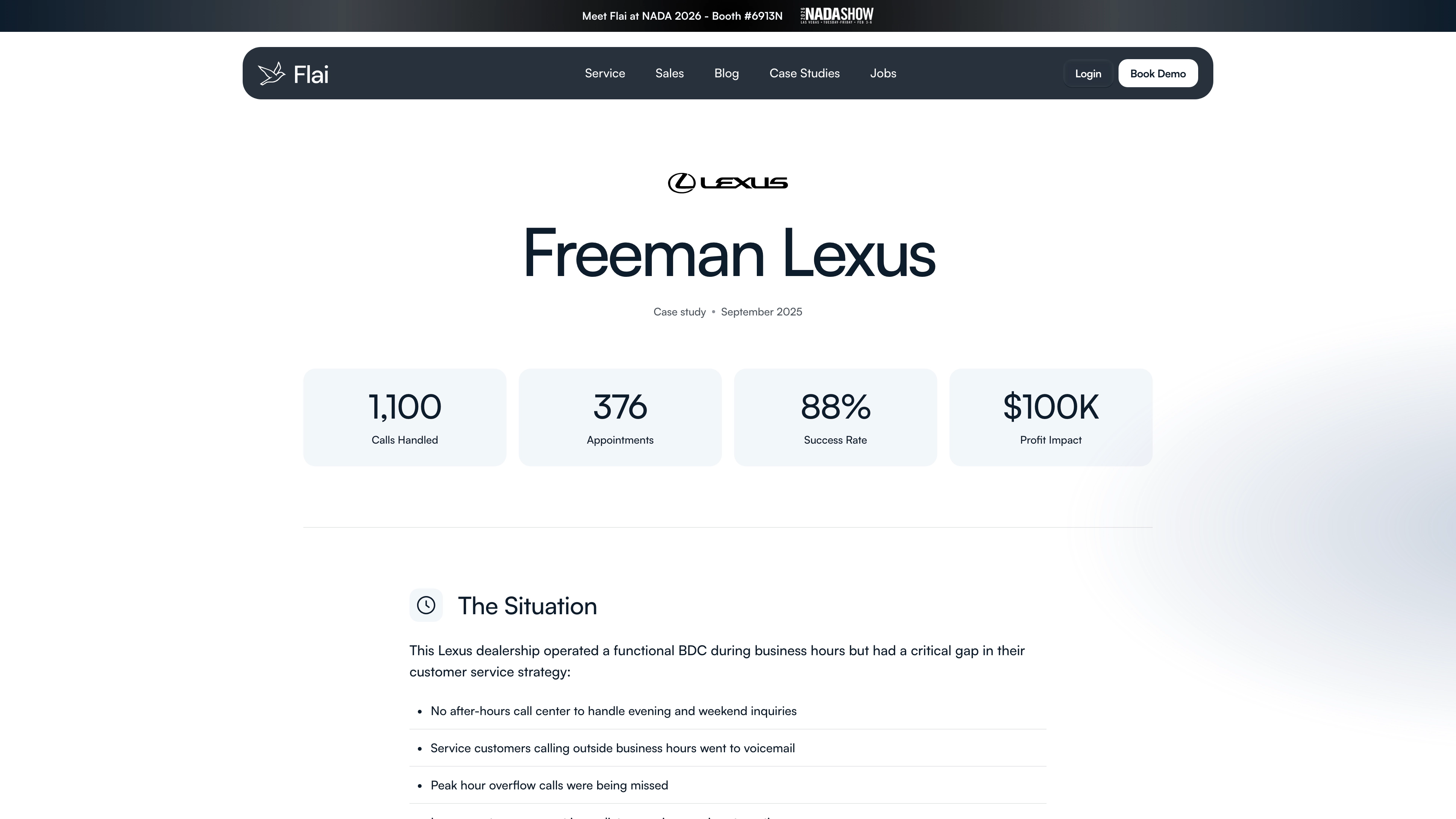
These aren’t hypothetical numbers. Flai handled over 1,100 calls with zero missed calls, converting 88% of bookable interactions into actual appointments. That’s what makes multilingual AI coverage a revenue driver, not just a cost center.
For a deeper look at how AI BDCs work (and what to demand from any vendor, including us), our guide to AI BDCs breaks down the category. And if you’re comparing AI to traditional outsourced call centers, this comparison piece covers the cost and performance dynamics.
Flai was founded by engineers from HappyRobot (a leading voice AI company) and Netflix, backed by Y Combinator and a $4.5M seed round. Multilingual support is core to what we do.
How to Roll Out Multilingual Support in 90 Days
You don’t need to solve everything at once. Here’s a phased approach that works.
Days 1-30: Make It Impossible to Lose Calls
Goal: Every caller can start and finish basic tasks in their language.
Do this:
- Implement language access (explicit choice + detection fallback)
- Deploy bilingual scripts for service scheduling and sales appointment setting
- Add in-language SMS confirmations (at minimum English + Spanish)
- Create a “preferred language” field in your CRM and actually use it
Example minimum script:
English: Thanks for calling [Dealership]. How can I help you today?

Espanol: Gracias por llamar a [Dealership]. En que le puedo ayudar hoy?
Days 31-60: Make Every Appointment Booking Correct
Goal: Reduce errors and prevent “we booked the wrong thing.”
Do this:
- Translate your core knowledge base: hours, shuttle policy, loaner rules, recalls, parts hours
- Enforce confirmation loops for critical details:
- Date and time
- Phone number
- Vehicle year and model
- Set escalation rules (finance/legal questions, angry calls)
Example confirmation loop (Spanish):
Solo para confirmar: su cita es el martes 5 de febrero a las 5:30 pm
para mantenimiento de rutina, correcto?
Days 61-90: Scale, Measure, and Expand
Goal: Prove ROI and expand languages only where justified.
Do this:
- Launch language-specific KPIs (see scorecard below)
- Expand beyond Spanish only if call volume and lost opportunity data justify it
- Implement weekly quality review:
- Failed bookings by language
- Failed transfers by language
- Top intents by language
- “Misunderstood” moments and fixes
KPIs to Track: How to Prove Multilingual Support Works
Track these metrics per language (English vs. Spanish vs. others). Otherwise you’re flying blind.
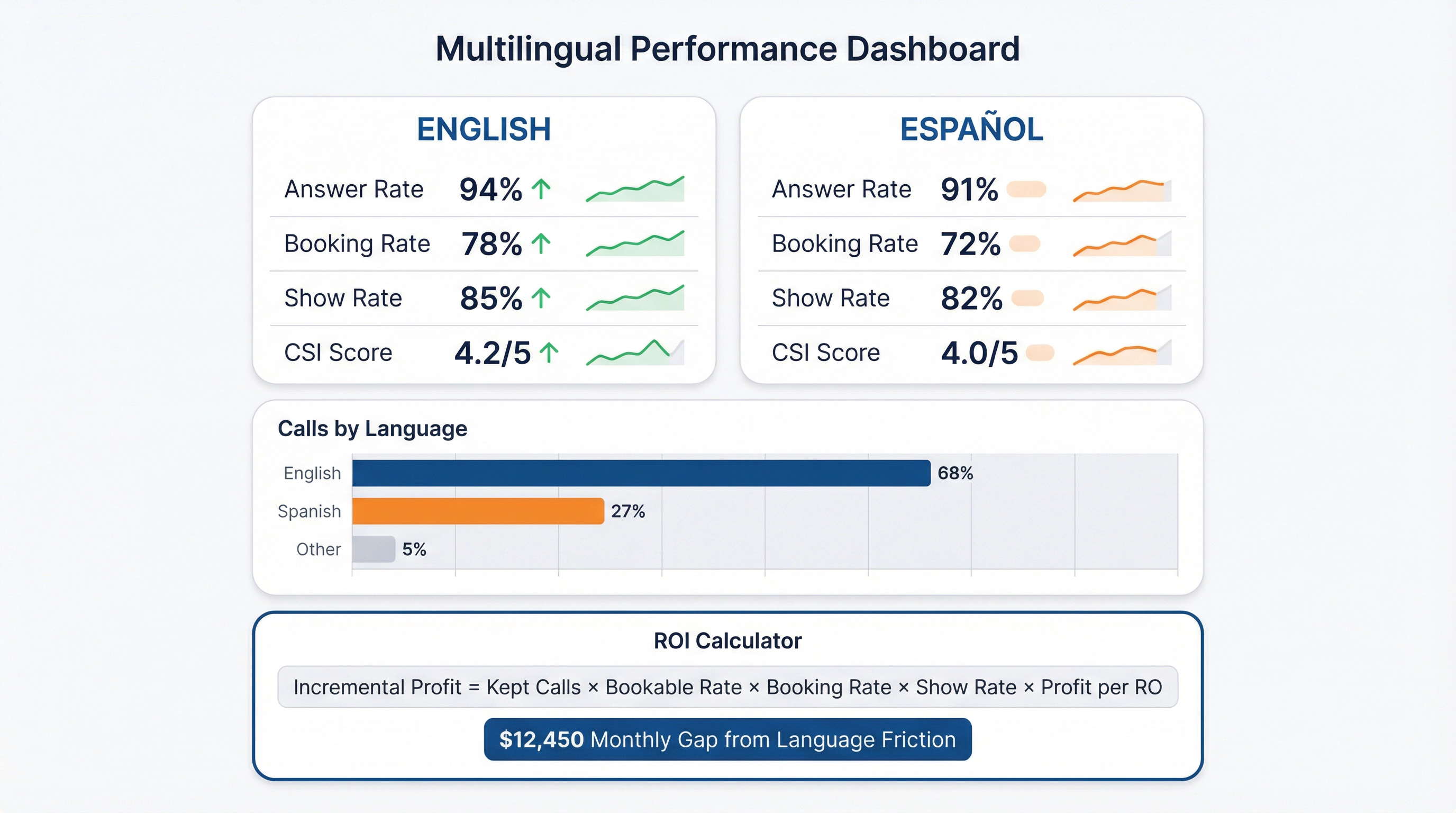
Speed and Access Metrics
| Metric | What It Measures |
|---|---|
| Answer rate (by language) | Are calls in Spanish being answered at the same rate as English? |
| Time-to-first-response | How quickly does the customer get help? |
| Hold time / transfer rate | Are non-English callers getting bounced around? |
Conversion Metrics
| Metric | What It Measures |
|---|---|
| Bookable call rate | Of calls that could result in an appointment, how many were handled completely? |
| Booking rate | Of bookable calls, how many actually got booked? |
| Show rate | Did booked appointments actually show up? |
Quality Metrics
| Metric | What It Measures |
|---|---|
| Error rate | Wrong appointment type, wrong time, wrong customer info |
| Repeat contact rate | Did the customer call back for the same issue? |
Customer Experience
| Metric | What It Measures |
|---|---|
| CSI/NPS by language | Are Spanish-speaking customers rating their experience equally? |
The Simplest ROI Formula
Incremental profit =
  (Incremental kept calls by language)
  x (Bookable rate)
  x (Booking rate)
  x (Show rate)
  x (Gross profit per RO or sale)
If your Spanish calls have a 50% booking rate instead of 75% because of language friction, that’s a calculable gap. Fix the friction, capture the revenue.
How to Evaluate Multilingual AI Without Getting Fooled
If you’re evaluating AI or technology for multilingual coverage, test these in live scenarios, not just polished demos.
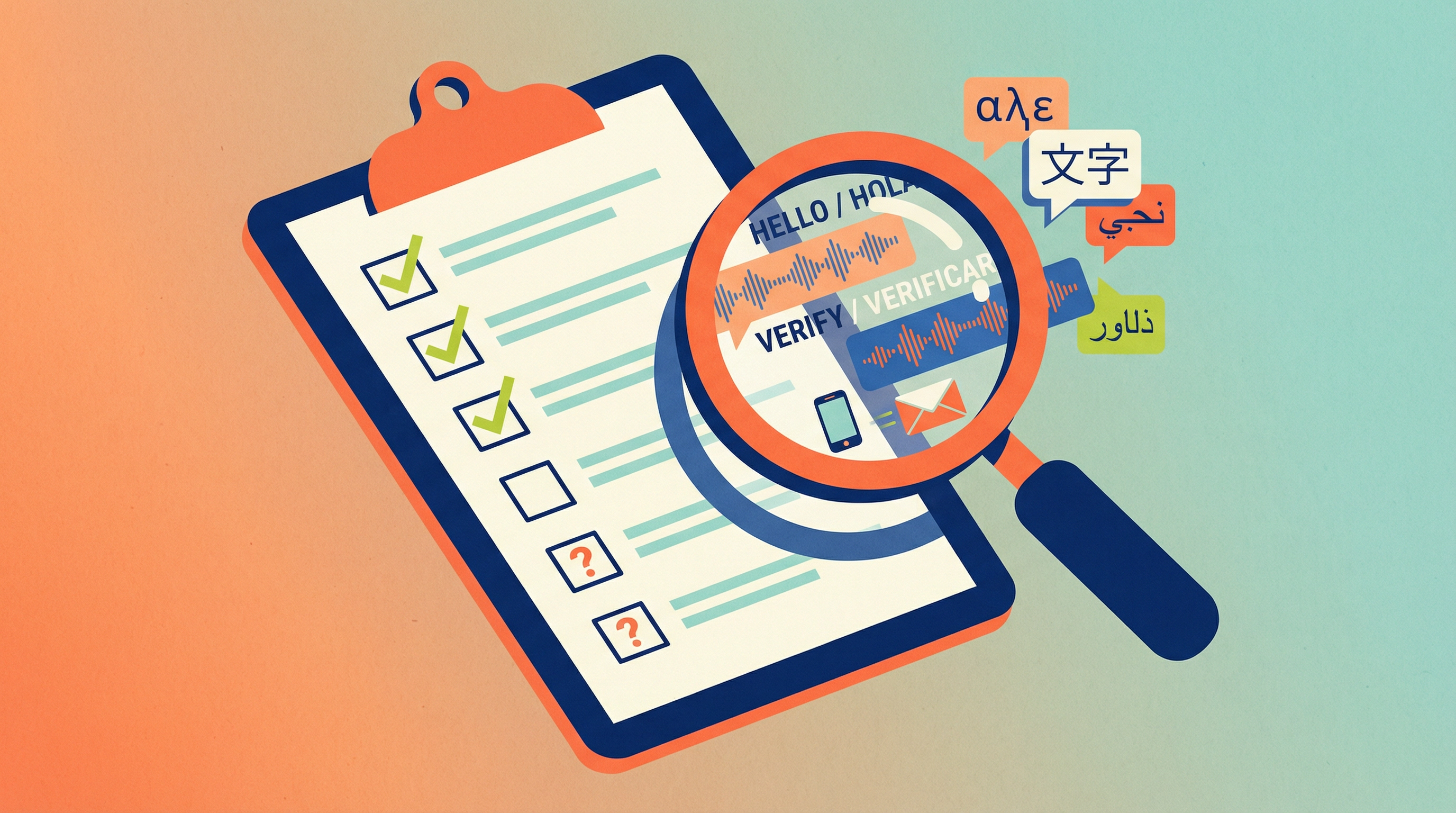
Seven things to verify:
- Language detection accuracy in the first 10 seconds. Can it identify Spanish without the customer having to press a button?
- Code-switching handling. Test with sentences that mix English and Spanish: “My check engine light is on y tambien escucho un ruido.”
- Numbers and entities. Can it accurately capture VINs, phone numbers, dates, and model names in a non-English conversation?
- Dealership vocabulary. Does it understand “the works,” “loaner,” op codes, recall terminology?
- Handoff behavior. What happens when the AI can’t handle the request? Is it a warm transfer with context or a cold dump?
- Cross-channel continuity. If the call is in Spanish, is the confirmation SMS also in Spanish?
- Auditability. Can you review transcripts and outcomes easily? Can you identify and fix problems fast?
Realistic test scenarios (not “hello, I want an appointment”):
- “My check engine light is on y tambien escucho un ruido cuando freno”
- “I need recall work but I don’t have my VIN with me”
- “I want to come Saturday after 6, do you have a loaner?”
- “Quiero hacer una cita para el servicio de 10,000 millas para mi RAV4”
The gap between demo AI and production AI shows up in messy, real-world scenarios.
Frequently Asked Questions
What languages beyond Spanish should dealerships prioritize?
Start with your local data. Nationally, KFF research shows the largest LEP populations after Spanish are Chinese (7%), Vietnamese (3%), Arabic (2%), and Tagalog (2%). But your market may differ. Run a 30-day call log audit to see which languages actually show up. A “small” segment nationally might be your biggest opportunity locally.
How does AI handle multilingual calls?
Modern AI voice agents like Flai detect the caller’s language and respond naturally. The AI handles the full conversation (scheduling, answering questions, taking details) and books directly into your systems. It’s native multilingual capability, not a translation layer on top of English. The key is verifying that the AI can actually complete tasks, not just chat.
What’s the realistic ROI of adding multilingual support?
It depends on your call volume, but here’s a framework: if you’re losing 20% of Spanish-speaking callers to language friction and the average booked appointment is worth $250-300 in service profit, even modest improvements pay for themselves quickly. Dealers who’ve invested in Spanish capability report significant increases in both traffic and conversion. Flai customers have documented $80,000-$100,000 monthly profit impact from improved call handling.
Do I need to hire bilingual staff, or can AI handle everything?
AI can handle the volume: 24/7 coverage, after-hours calls, overflow during peak times, routine scheduling, and FAQ responses. But you still want humans for complex situations, angry customers, and finance conversations. The ideal setup is AI handling most interactions with clear escalation paths to trained staff. Unlimited capacity without unlimited payroll.
What about California’s contract translation laws?
California Civil Code 1632 requires that if a contract is negotiated primarily in Spanish, Chinese, Tagalog, Vietnamese, or Korean, you must provide a translated version before signing. This applies to certain consumer contracts. Talk to your legal counsel to ensure your sales process is compliant. Having a documented multilingual workflow actually makes compliance easier than ad-hoc translation attempts.
How do I measure if multilingual support is actually working?
Track your KPIs by language: answer rate, booking rate, show rate, error rate, and CSI scores. If your Spanish-speaking customers have a 60% booking rate while English speakers hit 80%, that gap represents lost revenue. Also track qualitative signals: Are Spanish-speaking customers leaving positive reviews mentioning language support? Are referrals coming from multilingual communities?
What’s the difference between AI that “supports” multiple languages and AI that actually handles multilingual calls?
Demo AI often “supports” Spanish by having someone type scripted responses. Production AI handles real conversations with real accents, code-switching, noise, and the full range of messy human communication. The test is simple: call the system yourself with a realistic request in Spanish. Does it actually book the appointment and send a Spanish confirmation? Or does it just take a message?
The Bottom Line
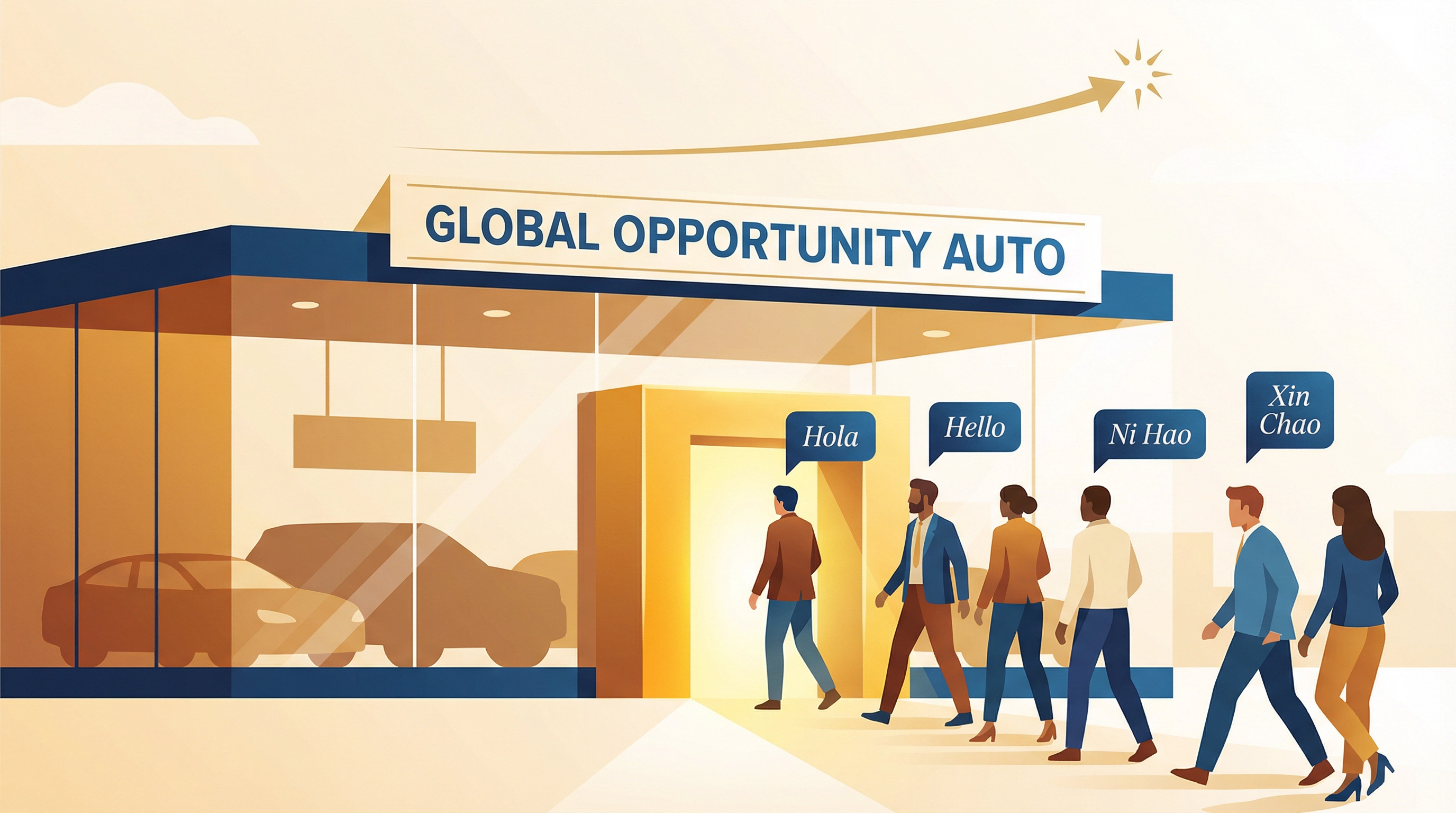
The U.S. is structurally multilingual, and that reality shows up in your phone lines every day. Census data confirms over 21% of Americans speak a non-English language at home. Industry research shows Hispanic buyers alone account for nearly a quarter of new car sales. Yet most dealerships haven’t adapted.
That gap is your opportunity.
The winners in 2026 will treat language as an operating system: access, conversation, action, continuity, escalation. They’ll track KPIs by language, staff multilingual coverage with AI for scale and humans for exceptions, and earn the loyalty of communities that competitors ignore.
If you’re ready to stop leaking revenue to language barriers, start with the 30-day basics: language access on your phone system, Spanish confirmations, and a preferred language field in your CRM. Scale from there based on what your data shows.
And if you want a partner who can deliver 24/7 multilingual coverage without the staffing complexity, talk to us at Flai. We built our AI specifically for dealerships, and helping you capture every customer regardless of language is exactly what we do.