Best After-Hours Answering for Dealerships (2026)
Dealership after hours answering service guide: Stop losing $1M+ yearly to missed calls. Book appointments 24/7, not just voicemail messages.
Your dealership could be losing over a million dollars a year right now, and you might not even realize it. That’s not hyperbole. Industry data shows that missed service calls alone can cost a single store upward of $1.17 million annually.
The culprit? The phone rings. Nobody answers. The customer hangs up.
It happens after hours. It happens during lunch rushes. It happens on Monday mornings when your team is slammed with walk-ins. And every time it happens, that customer doesn’t leave a voicemail. They don’t wait patiently for a callback. According to industry research, about 70% of people who hit voicemail will call a competitor within 30 minutes.
This guide is built to help you fix that problem. We’ll cover what a dealership after-hours answering service actually does (beyond just “taking messages”), walk through your realistic options in 2026, and give you a complete implementation playbook with scripts, KPIs, compliance requirements, and vendor evaluation criteria.
If you’re searching for a way to stop bleeding revenue when your store is closed, you’re in the right place.
Why Missed Calls Cost Dealerships Over $1 Million Per Year

A dealership is fundamentally a communications business that happens to sell and fix cars. Almost every dollar you make starts with someone trying to reach you. The phone is your front door.
And if that door is locked? People go next door.
How Much Money Do Dealerships Lose From Missed Calls?
A 2024 phone performance study covered by Car Dealership Guy found that dealerships average a 3 minute, 5 second hold time on calls. Nearly a third of unconnected calls (31.8%) were customers hanging up while waiting on hold.
That’s during business hours. After hours, the “hold” is usually just voicemail.
Here’s what the data actually looks like:
| Problem | Impact | Source |
|---|---|---|
| Service departments miss an average of 158 calls per month | $71,000-$97,000 in monthly lost revenue | Car Dealership Guy |
| 56-60% of dealership leads arrive after business hours | Majority of opportunities come when you're closed | Industry analysis |
| 80% of calls sent to voicemail don't result in a message | Customers just hang up | Industry research |
| 70% of voicemail callers contact a competitor within 30 minutes | Your lead becomes their customer | Industry research |
The scale is staggering. Industry analysis found that North American dealerships collectively missed 175 million calls in 2024, representing over $21 billion in lost potential revenue.
Why Are Dealerships Losing Service Customers to Competitors?
Cox Automotive research shows that only 54% of customers with vehicles 2 years old or newer returned to the selling dealer for service in 2025. That’s down from 72% in 2023.
Translation: customers aren’t as loyal as they used to be. If it’s annoying to book with you, they won’t. After-hours answering isn’t a nice-to-have anymore. It’s part of your retention defense.
The core insight: Leads are perishable. Phones don’t ring evenly throughout the day. Staff capacity is lumpy. And after-hours has traditionally been a dead zone. If you’re the only dealership in your market that actually answers the phone at 8 PM, you win the leads that everyone else drops.
What Does a Dealership After Hours Answering Service Actually Do?
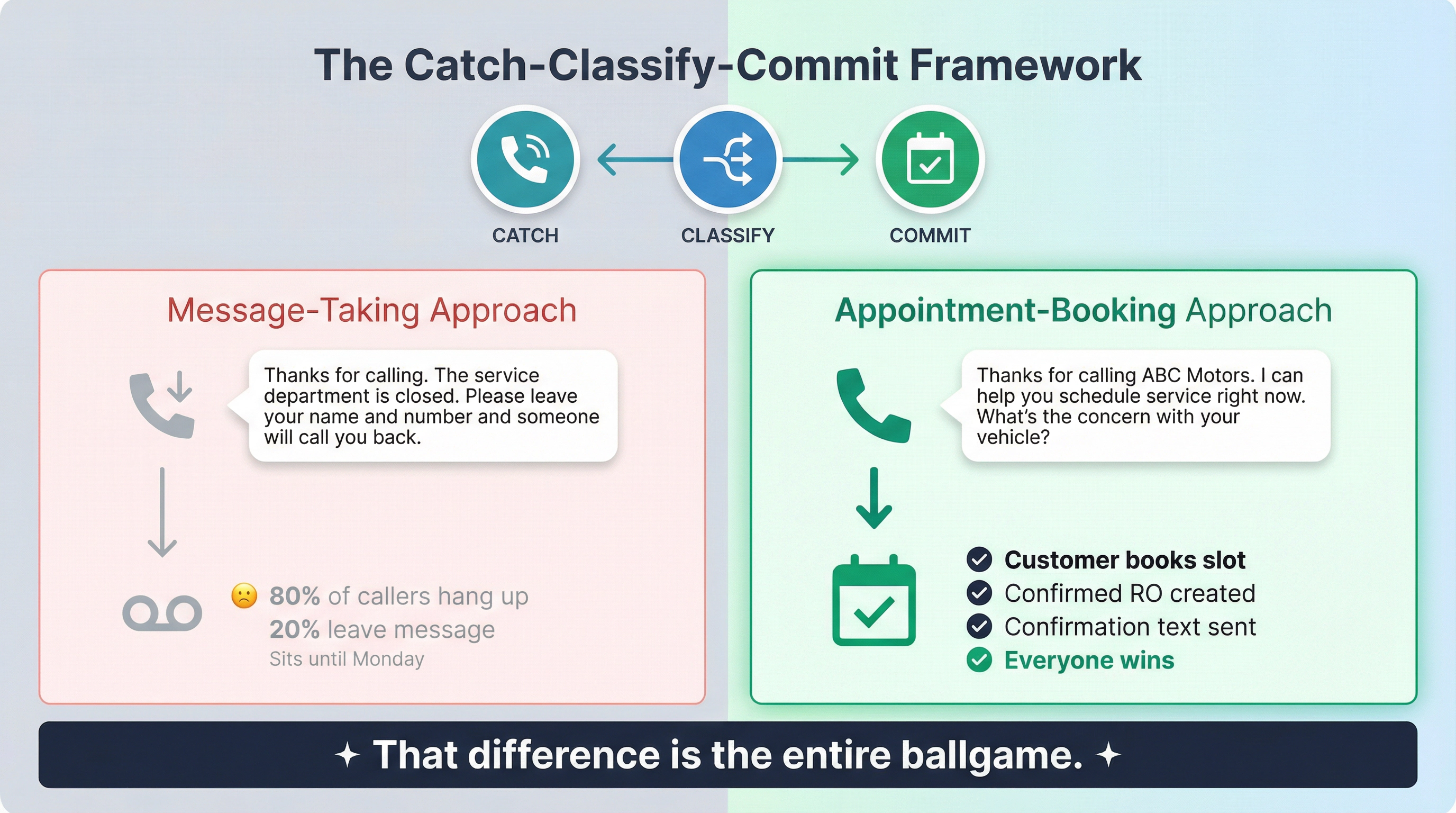
Ignore the marketing for a moment. An after-hours answering service has three jobs:
1. Catch: Pick up every call fast. No rings piling up. No hangups.
2. Classify: Figure out what the caller needs. Is this service? Sales? Parts? A status check? An angry customer?
3. Commit: Do the thing that moves revenue forward. Book the appointment. Capture the lead. Transfer the call warmly. Collect enough information for a same-day close.
Most solutions handle #1 reasonably well. Fewer do #2 effectively. And almost none do #3 unless they’re designed specifically for dealerships and tightly integrated with your systems.
How to Book Appointments (Not Just Take Messages)
Here’s what separates a valuable service from a glorified message-taker:
Message-taking approach: “Thanks for calling. The service department is closed. Please leave your name and number and someone will call you back.”
Result: 80% of callers hang up. The other 20% leave a message that sits until Monday.
Appointment-booking approach: “Thanks for calling ABC Motors. I can help you schedule service right now. What’s the concern with your vehicle?”
Result: The customer books a slot. You get a confirmed RO. They get a confirmation text. Everyone wins.
That difference is the entire ballgame.
Human Answering Service vs AI: Which Is Better for Dealerships?
Traditionally, dealerships used live answering services or outsourced BDC call centers for after-hours coverage. These involve trained human operators following scripts.
Modern AI-powered services use advanced voice recognition and natural language processing to handle the same conversations without a live agent. The best ones are essentially indistinguishable from humans.
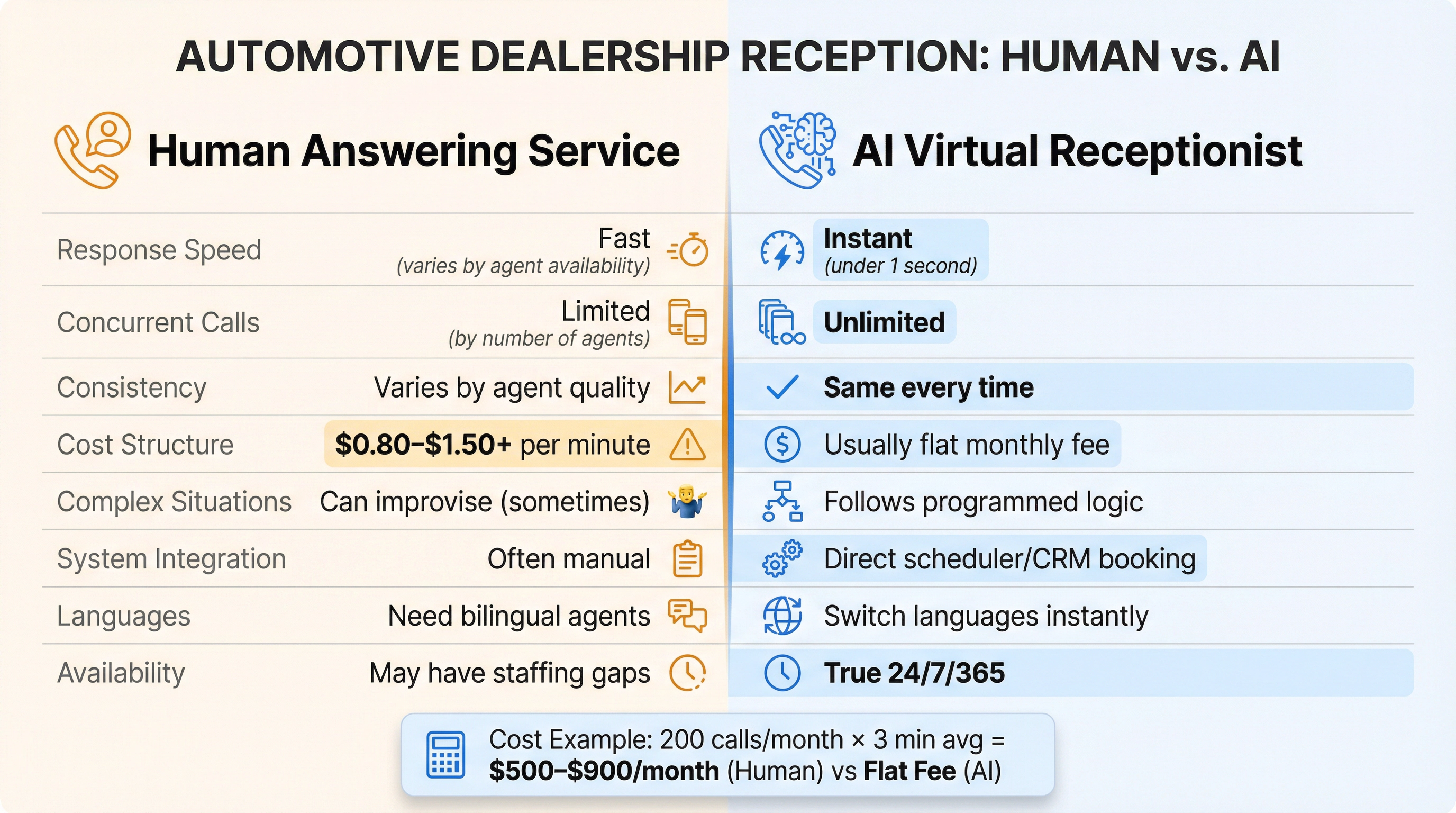
| Factor | Human Answering Service | AI Virtual Receptionist |
|---|---|---|
| Response Speed | Fast (but varies by agent availability) | Instant (under 1 second) |
| Concurrent Calls | Limited by number of agents | Unlimited |
| Consistency | Varies by agent quality | Same every time |
| Cost Structure | Per-minute ($0.80-$1.50+) | Usually flat monthly fee |
| Complex Situations | Can improvise (sometimes) | Follows programmed logic |
| System Integration | Often manual | Can book directly into scheduler/CRM |
| Languages | Need bilingual agents | Can switch languages on the fly |
| Availability | May have staffing gaps | True 24/7/365 |
Industry research shows human answering services typically charge $0.80 to $1.50+ per minute. For a dealership handling 200 after-hours calls averaging 3 minutes each, that’s around $500-$900 per month just in call time, plus setup fees and potential overages.
AI services often run on flat monthly pricing, which can be more predictable. And they scale to handle 10 simultaneous calls without anyone waiting.
Many dealerships are now using a hybrid approach: AI handles the first interaction, books straightforward appointments, and routes complex situations to a human when needed. This gives you the speed and scalability of AI with a safety net for edge cases.
What Are the Best After Hours Answering Service Options for Dealerships?
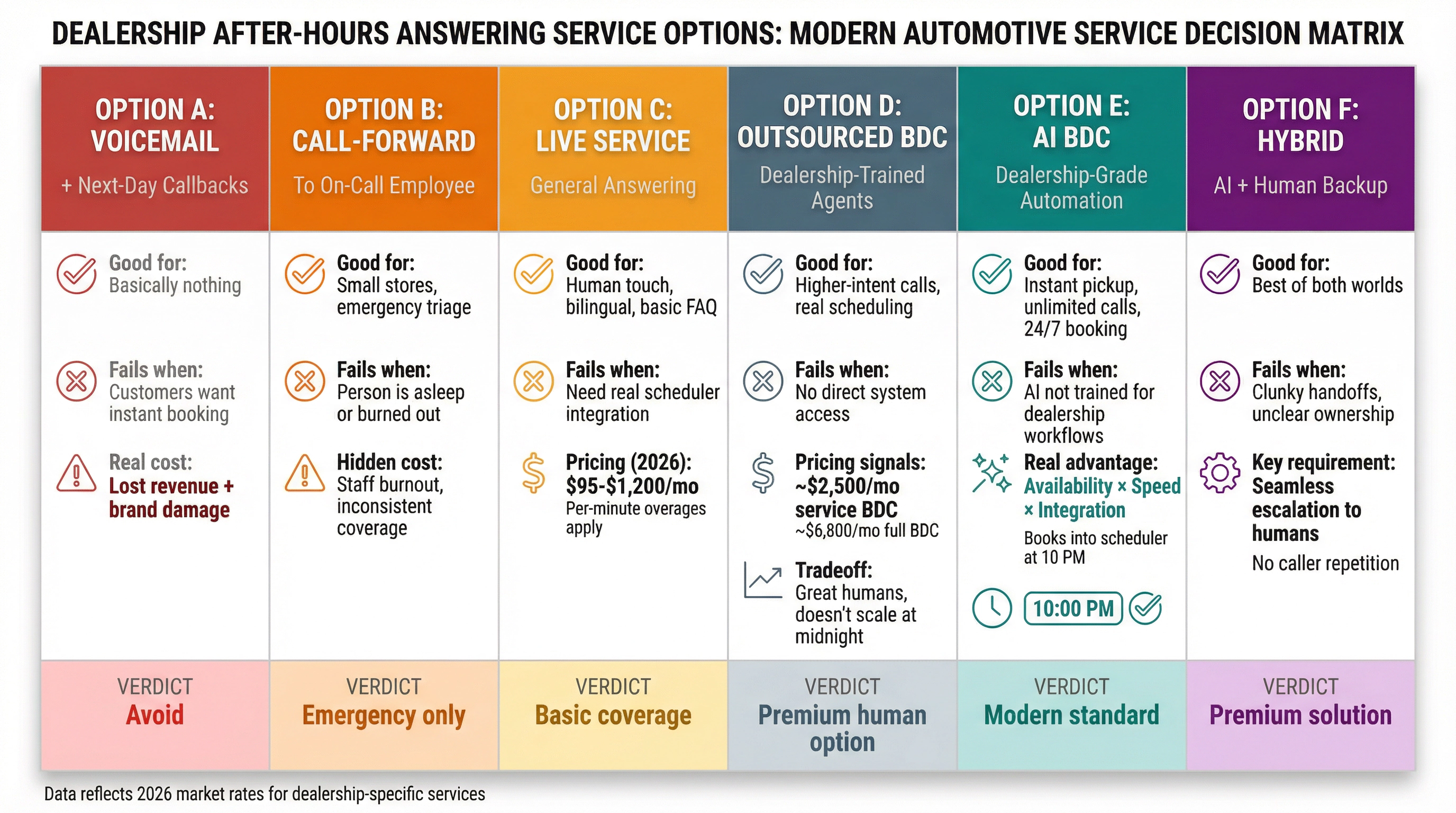
Option A: Voicemail + Next-Day Callbacks
Good for: Basically nothing, unless your call volume is tiny and you don’t care about growth.
Fails when: Customers want to book now. Which they do.
Real cost: Lost revenue plus brand damage.
Research shows that customers rate dealerships negatively when calls go unanswered or get routed through confusing phone trees. They prefer AI-powered scheduling tools over being sent to voicemail.
Option B: Call-Forward to an On-Call Employee
The “hero rep” model. Someone’s cell phone is the backup.
Good for: Small stores with emergency-only triage.
Fails when: You rely on one person who’s sometimes asleep, busy, or burned out.
Hidden cost: Your best people become an informal call center, which isn’t sustainable.
Option C: General Live Answering Service
Human operators who take messages, provide basic information, and route calls.
Good for: Covering every call with a human touch, basic FAQ handling, bilingual greetings.
Fails when: You need real appointment booking inside your scheduler, or detailed service write-up logic.
Pricing reality (2026):
Industry data puts most answering services between $95 and $1,200+ per month depending on volume and features. Basic plans start around $44-$145/mo but often mean per-minute overages, no dealership context, and “we’ll email you the message,” which isn’t the same as booking.
Option D: Outsourced Automotive BDC
Dealership-trained human agents who understand your workflows.
Good for: Higher-intent calls, real service scheduling, campaigns, and multi-rooftop standards.
Fails when: They don’t have direct system access or operate like a script factory.
Pricing signals:
Industry reports show average dealers spend ~$2,500/mo for service BDC specifically. For full BDC services, the average is around $6,800/mo.
The core tradeoff: Humans can be great, but they don’t scale cleanly at midnight or during peak-hour bursts without significant cost.
Option E: AI Receptionist / AI BDC
Dealership-grade automation that answers, understands, and books.
Good for: Instant pickup, unlimited concurrent calls, consistent process, true after-hours booking.
Fails when: The AI isn’t trained for dealership workflows or can’t gracefully escalate edge cases.
The real advantage isn’t just “AI.” It’s availability + speed + integration. An AI that books directly into your scheduler at 10 PM is worth far more than a human who takes a message.
Option F: Hybrid (AI + Human Backup)
AI handles most calls. Humans take edge cases and complex situations.
Good for: Best of both worlds when implemented correctly.
Fails when: Handoffs are clunky (caller repeats themselves) or nobody owns the outcome.
What Questions Should You Ask Before Choosing an After Hours Service?
Before you talk to vendors, answer these for yourself:
1. What do you want after-hours to actually do?
Taking messages is different from booking appointments. The latter requires system integration and changes everything about what you should buy.
2. Which department is the priority: service or sales?
Pick wrong and you’ll optimize the wrong scripts, train for the wrong outcomes, and measure the wrong KPIs.
3. Do you need direct scheduling?
If yes, require proof that the vendor can book into your specific scheduler without double-booking. Ask for a live demo with your system.
4. What volume and spike behavior do you have?
If 10 calls hit at once during a flash sale or Monday morning rush, can the system handle it? This is where many setups fall apart.
5. What languages do your customers actually speak?
Bilingual isn’t optional in many markets. Find out before you buy.
6. What’s your escalation rule?
When do you wake someone up vs. schedule a callback vs. let it go to voicemail? Define this explicitly.
7. How will you measure success?
If you can’t track booked appointments and show rates, you’re flying blind. Pick vendors that give you real data.
What Features Should a Dealership After Hours Service Include?
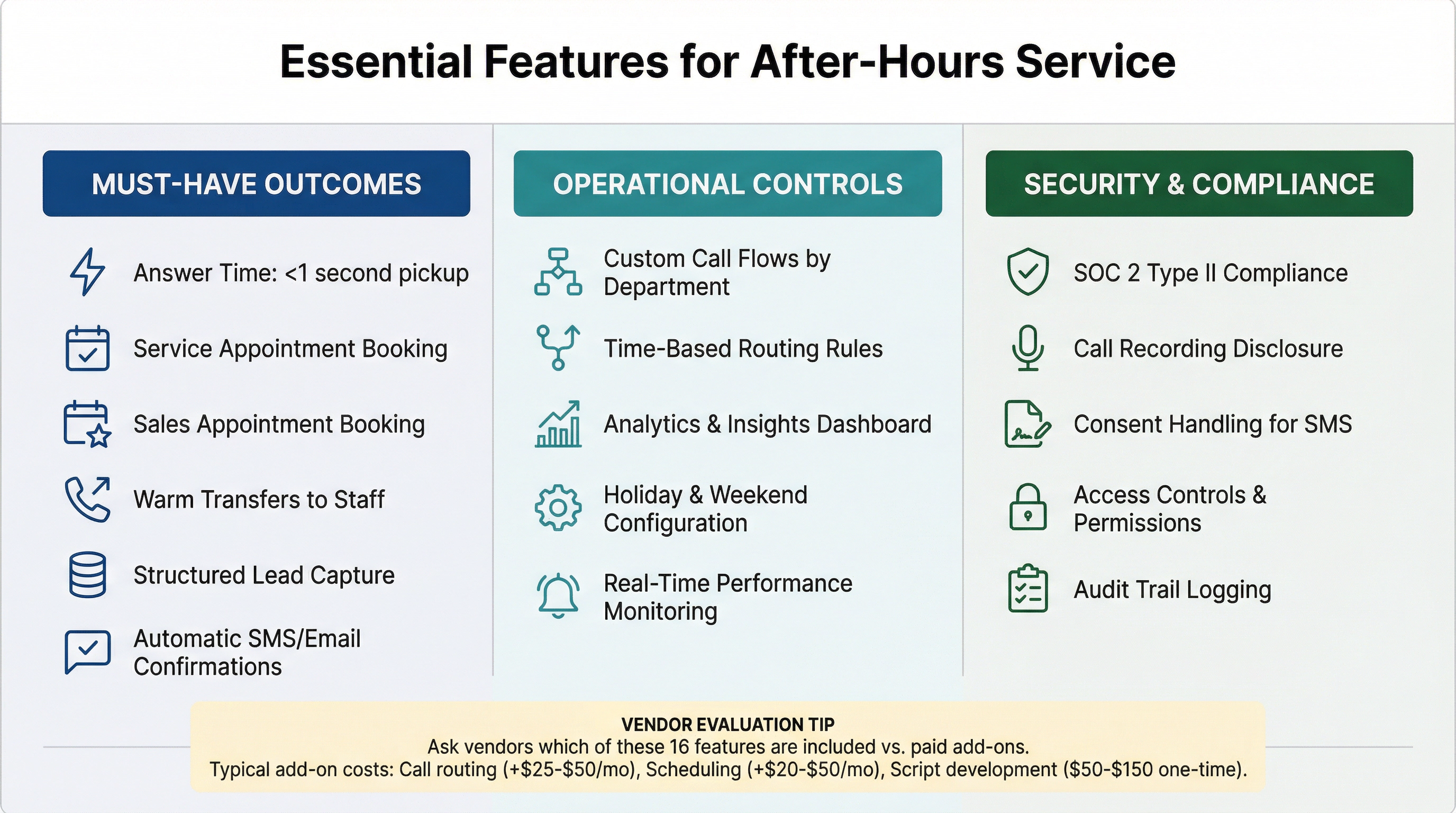
If you want something worth paying for, your solution should cover these bases:
Must-Have Outcomes
-> Answer time: Near-instant pickup. The best AI platforms pick up in under a second, and research shows 74% of callers hang up if not answered within 3 rings.
-> Service appointment booking: Not “request an appointment.” Actually book it in the system.
-> Sales appointment booking: Schedule test drives and showroom visits.
-> Warm transfers: When humans are available, transfer smoothly without making the caller repeat themselves.
-> Structured lead capture: Fields your CRM can use, not a wall of text.
-> Automatic confirmations: SMS/email follow-ups after booking.
Must-Have Operational Controls
- Custom call flows by department (service is different from sales is different from parts)
- Routing rules by time and day (weekends, holidays, closing hour)
- Analytics that tell you why people call, what happened, and where things break
Industry pricing guides note that add-ons like call routing (+$25-$50/mo), scheduling (+$20-$50/mo), and script development ($50-$150 one-time) can change your total cost significantly. Factor that in.
Security and Compliance Basics
Non-negotiable: Any service handling customer data needs proper security. Look for SOC 2 compliance, call recording disclosure support, consent handling for texts, and access controls with audit trails.
Purpose-built dealership AI platforms typically maintain SOC 2 Type II compliance, which is the standard for enterprise-grade security controls. If a vendor can’t tell you their security posture, that’s a red flag.
How to Implement a Dealership After Hours Answering Service (Step-by-Step)
Here’s how you stop buying “coverage” and start buying “appointments.”
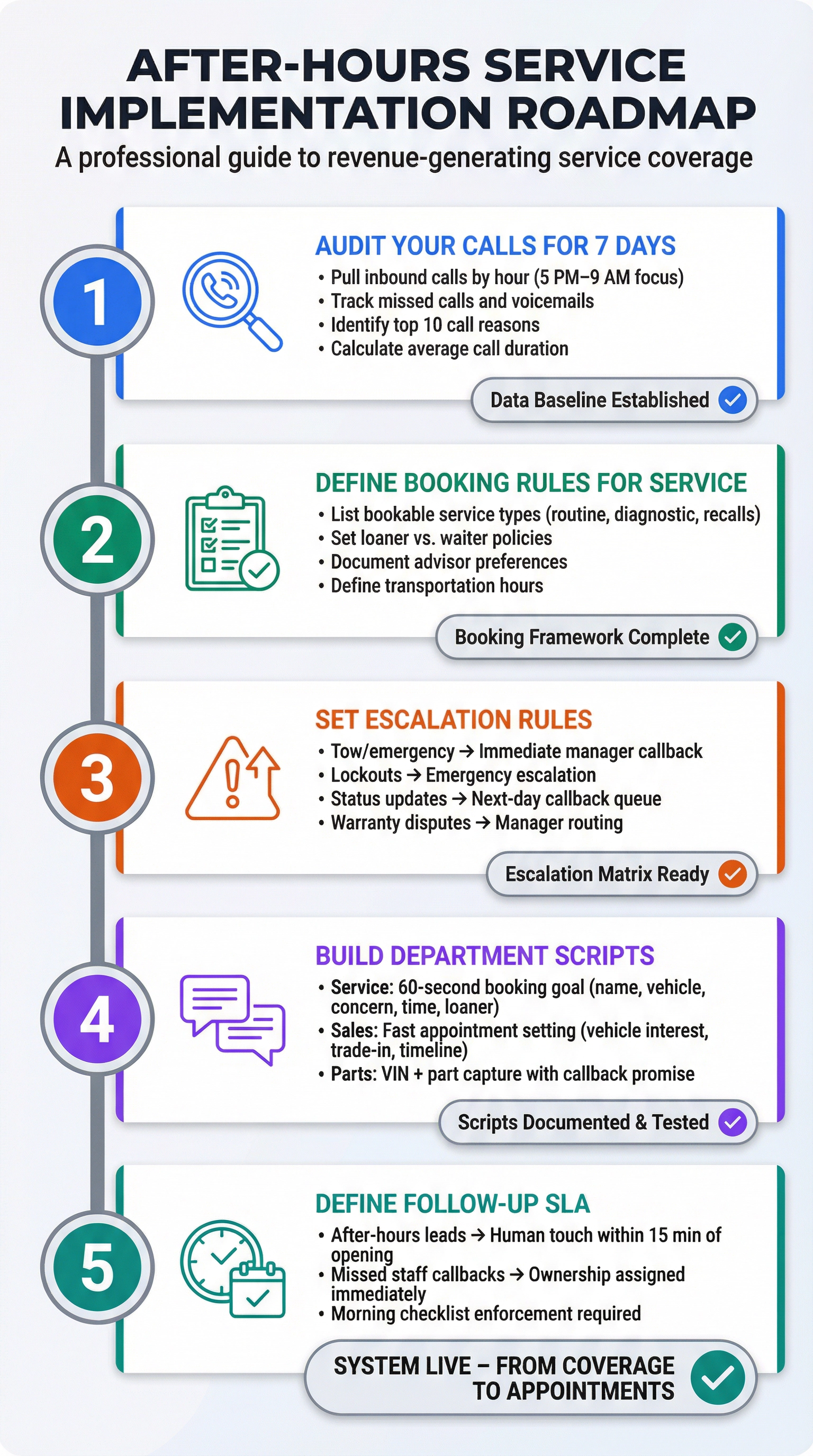
Step 1: Audit Your Calls for 7 Days
Before you buy anything, understand your current situation. Pull:
- Inbound calls by hour (especially 5 PM to 9 AM and weekends)
- Missed calls and voicemails
- Average call duration
- Top 10 call reasons (service scheduling, status checks, recalls, inventory questions)
If you don’t have this data, you’re guessing. Most phone systems can generate this report. Run it.
Step 2: Define Your Booking Rules for Service
Write down (literally) what qualifies as bookable:
- Routine maintenance (oil changes, 10k/20k/30k service)
- Diagnostic appointments (check engine lights, noises, concerns)
- Recall work
- Tires and brakes
- Loaner car vs. waiter policies
- Transportation hours
- Advisor preferences (if any)
Your after-hours solution is only as good as these rules. Garbage in, garbage out.
Step 3: Define Escalation Rules
Be explicit about what gets escalated and how:
| Situation | Escalation Action |
|---|---|
| Tow/roadside emergency | Immediate callback to on-call manager |
| Customer locked out at dealership | Emergency escalation |
| Vehicle status update request | Capture info, promise first-call next business day |
| Warranty dispute or angry caller | Route to manager callback queue |
| Complex technical question | Capture details, schedule callback with specialist |
Step 4: Build Department-Specific Scripts
These don’t need to be long. They need to be structured and focused on booking.
Service Script (After-Hours)
Goal: Book a slot or capture everything needed to book in under 60 seconds.
- Greeting + dealership name
- “Are you looking to schedule service, check on a vehicle, or something else?”
- If scheduling:
- Name + best callback number
- Vehicle (year/make/model) + mileage
- What’s the concern? (routine vs. specific issue)
- Preferred day/time window
- Loaner or waiter?
- Confirm appointment + send confirmation
Sales Script (After-Hours)
Goal: Set an appointment fast.
- “Are you calling about a specific vehicle or just starting your search?”
- Capture:
- Vehicle of interest + stock number if known
- Trade-in situation
- Financing needs
- Timeline
- Set appointment (offer two times)
- Send directions and confirmation
Parts Script (After-Hours)
Goal: Capture VIN + part request and promise a fast callback.
- Vehicle + VIN (last 8 digits is fine)
- What part do they need?
- Urgency level
- Confirm callback time window
Step 5: Define Your Follow-Up SLA
This is where “we took a message” becomes actual money.
- Every after-hours lead gets a human touch within 15 minutes of opening
- Every “couldn’t reach staff” call triggers a callback task with ownership assigned
If your vendor can’t help enforce this, you have to do it yourself with morning checklists.
What KPIs Should You Track for After Hours Call Performance?
Don’t drown in dashboards. Track what moves profit.
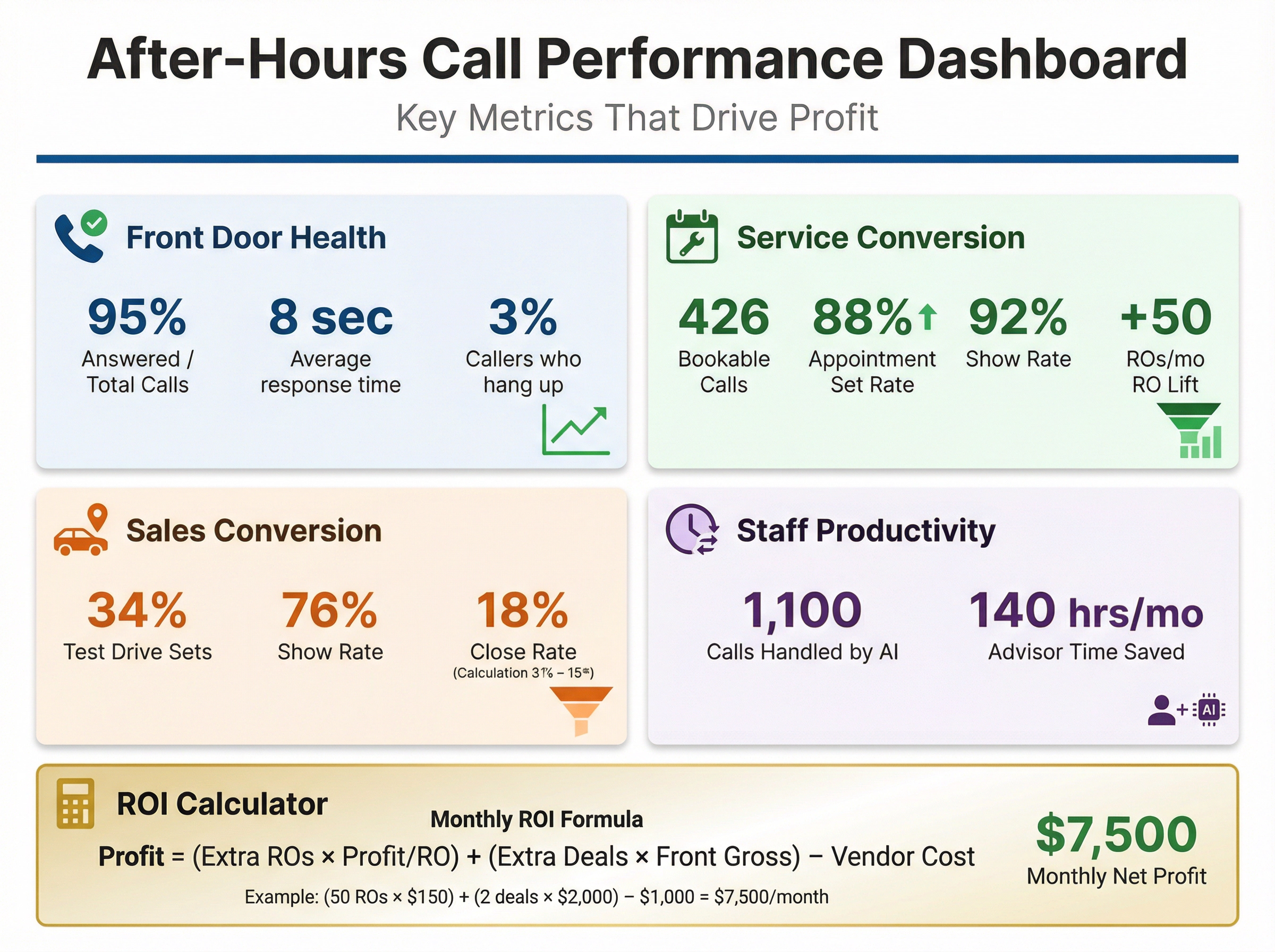
Front Door Health
- Answer rate = Answered calls / Total inbound calls
- Speed to answer (in seconds)
- Abandonment rate = Callers who hang up before talking to anyone
Car Wars data shows that hangups while on hold are a massive chunk of unconnected calls. Lowering wait time isn’t cosmetic. It’s conversion.
Service Conversion
- Bookable service calls = Callers who actually want to schedule
- Appointment set rate = Appointments booked / Bookable calls
- Show rate = Showed appointments / Booked appointments
- Effective RO lift = Incremental repair orders from after-hours capture
Sales Conversion
- Appointment set rate (test drives and showroom visits)
- Show rate
- Close rate (if you can attribute it)
Staff Productivity
- Advisor interrupt rate (proxy: service calls handled by the system instead of advisors)
- Time saved (measure calls transferred to advisors vs. handled completely by the system)
A Simple ROI Model
Use contribution profit, not revenue:
Monthly profit from after-hours coverage = (Incremental service ROs x Profit per RO) + (Incremental sales deals x Front-end gross) - Monthly vendor cost
If you don’t know your profit per RO, start with industry averages. Car Dealership Guy references an average RO value around $450, though your profit margin will vary by service mix.
Even conservative math usually works out: if your after-hours solution captures 50 extra ROs per month at $150 profit each, that’s $7,500. If the service costs $1,000/month, the ROI is obvious.
What Compliance Rules Apply to Dealership Answering Services?
This isn’t legal advice. But it is practical reality.

Call Recording Consent
Recording laws vary by state. Legal experts note that as of 2024, there are 11 all-party consent states (California, Florida, Pennsylvania, Washington, and others).
The safest approach: always disclose and get consent at the start of the call. You don’t control where the caller is calling from.
Simple disclosure script:
“For quality and training purposes, this call may be recorded. Is that okay?”
If they say no, offer a non-recorded path or note it in the system.
TCPA Texting Basics
If your after-hours system sends texts (confirmations, reminders, follow-ups), you need consent and opt-out handling.
TCPA compliance guides remind dealers that TCPA penalties can hit $500-$1,500 per message in statutory damages if you get it wrong.
Practical safeguards:
- Treat every automated message as TCPA-governed
- Include “Reply STOP to opt out”
- Keep proof of consent in your CRM/DMS
Consent Revocation Rules
The rules around consent revocation are evolving. Recent FCC updates have delayed some requirements, but the direction is clear: build processes that respect opt-outs fast, across every channel.
How to Evaluate After Hours Answering Service Vendors
Use this during demos. Score each vendor 1-5 on each category.
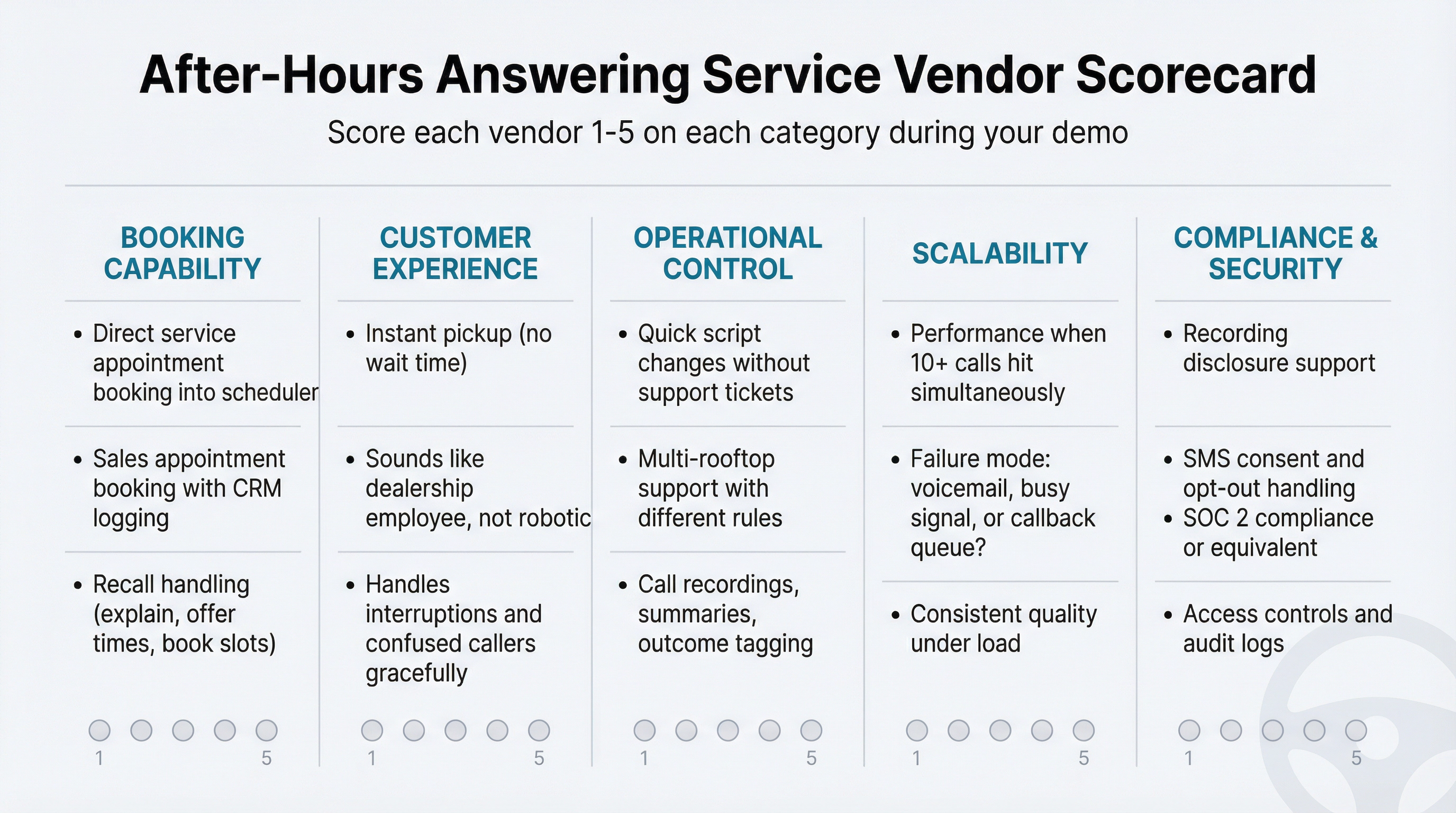
Booking Capability
- Can it book service appointments directly into your scheduler?
- Can it book sales appointments and log to your CRM?
- Can it handle recalls correctly (explain, offer times, book appropriate slots)?
Customer Experience
- Does it pick up instantly?
- Does it sound like a dealership employee (not a robot reading a script)?
- Can it handle interruptions and confused callers gracefully?
Operational Control
- Can you change scripts quickly without a support ticket?
- Does it support multiple rooftops with different rules?
- Does it provide call recordings, summaries, and outcome tagging?
Scalability
- How does it behave when 10 calls hit at once?
- What’s the failure mode: voicemail, busy signal, or graceful callback queue?
Compliance and Security
- Recording disclosure support
- Consent and opt-out handling for SMS
- SOC 2 compliance or equivalent
- Access controls and audit logs
How AI Answering Technology Works for Dealerships
If you’ve read this far, you’re serious about fixing your after-hours problem. So let’s talk about what a purpose-built solution looks like.

Flai is an AI communications platform built specifically for car dealerships. We answer calls, texts, and emails 24/7 with AI that sounds like your best BDC rep. But more importantly, we book appointments directly into your systems.
What Sets Purpose-Built AI Apart
Built from scratch for dealerships. We didn’t bolt dealership features onto a generic voice AI. Our team includes former HappyRobot engineers (YC S23) and a Netflix data scientist. Before we wrote a line of code, we visited over 400 dealerships in person to understand how calls actually work in service bays and showrooms.
True omni-channel coverage. The platform handles voice calls, SMS, and email with the same intelligence. A customer can start on the phone and follow up via text, and the AI stays aware of the full conversation.
Direct system integration. We connect with schedulers, DMS platforms, and CRMs. When an appointment is booked, it shows up in your system exactly like a human booked it.
Any language. The AI can speak any language your customers speak, switching seamlessly mid-call if needed.
SOC 2 Type II compliant. Our privacy policy details our security practices. We take data protection seriously because we know your customer data is sensitive.
No hardware or training required. Implementation is software-based. We plug into your existing phone system. You don’t need to buy equipment or train staff on a new interface.
The Results Speak for Themselves
We’ll cover specific case studies in the next section, but the pattern is consistent:
- $80,000 to $100,000+ monthly profit impact for dealerships that were previously missing after-hours and overflow calls
- Appointment conversion rates above 85% on bookable calls
- Zero missed calls during coverage periods
- Doubled service appointments at stores that previously had no after-hours solution
This isn’t just an answering service. It’s an AI BDC that never sleeps.
Dealership After Hours Answering Service Results and ROI

These numbers come directly from real-world case studies. They’re not projections. They’re actual results.
Freeman Lexus (California)
Before: No after-hours coverage. Calls went to voicemail. Leads disappeared.
After: The AI platform handled approximately 1,100 calls with zero missed. Out of 426 bookable opportunities, it converted 376 into firm appointments, an 88% conversion rate.
Estimated profit impact: $100,000 in one month.

The GM noted that the solution helped meet the premium service expectations of Lexus customers while providing coverage they didn’t have before.
San Leandro CDJR (California)
Before: No BDC. Service advisors were tied up answering phones. Customer experience suffered.
After: The AI system handled 1,563 calls in 30 days and booked 304 appointments. Monthly service appointments jumped from 205 to 448, more than doubling their booked business.
Estimated profit impact: $83,000 in the first month.
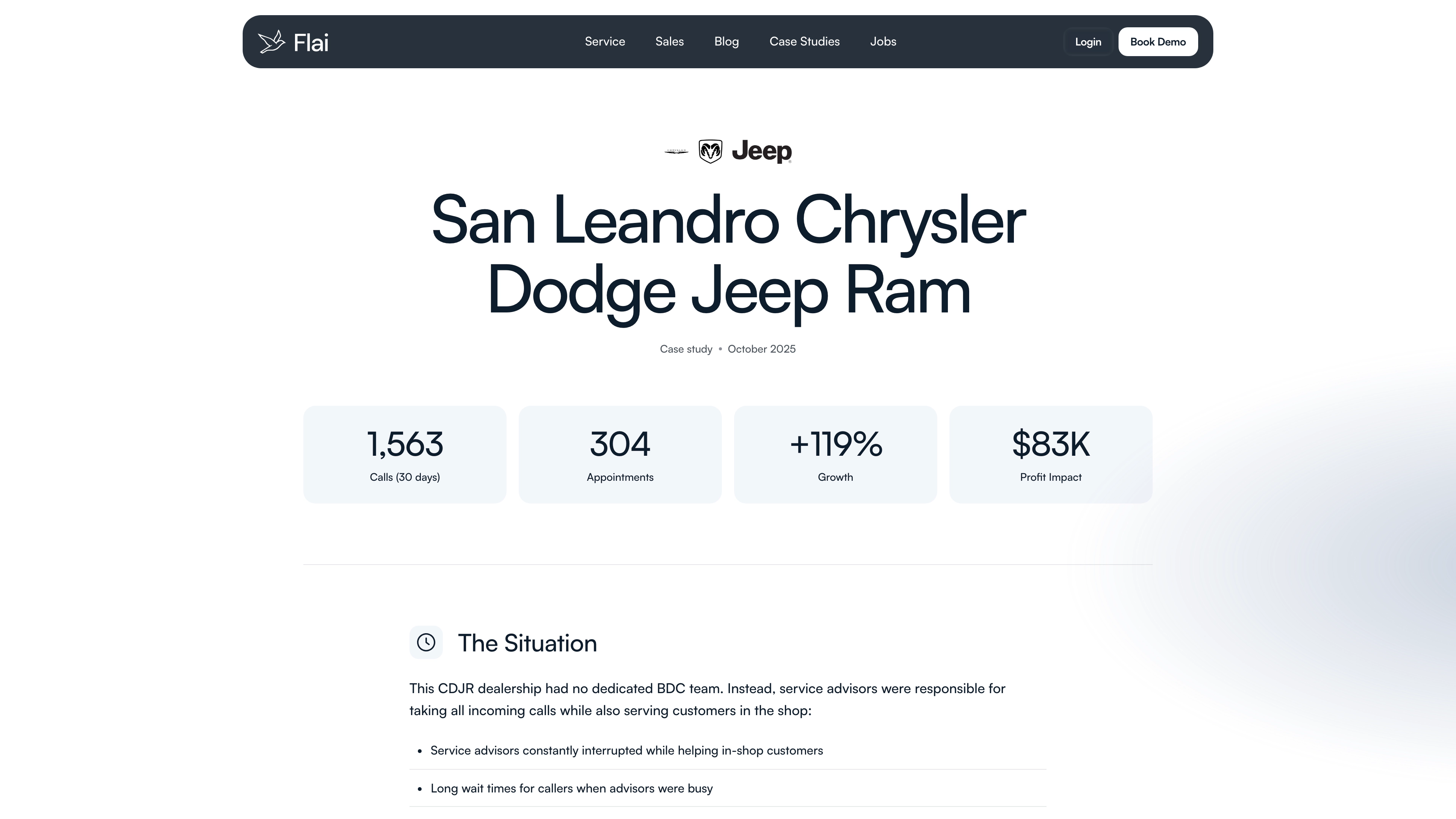
For the first time ever, this dealership captured evening and weekend appointment requests. And because advisors weren’t constantly on the phone, in-person customer satisfaction improved.
Freeman Toyota (California)
Before: Existing 6-person BDC, but needed after-hours and overflow help.
After: The AI solution handled 1,053 calls and set 358 appointments. The system also saved over $5,000 in operational costs by reducing overtime and allowing the human team to focus on complex tasks.
Estimated profit impact: $93,870 in one month.
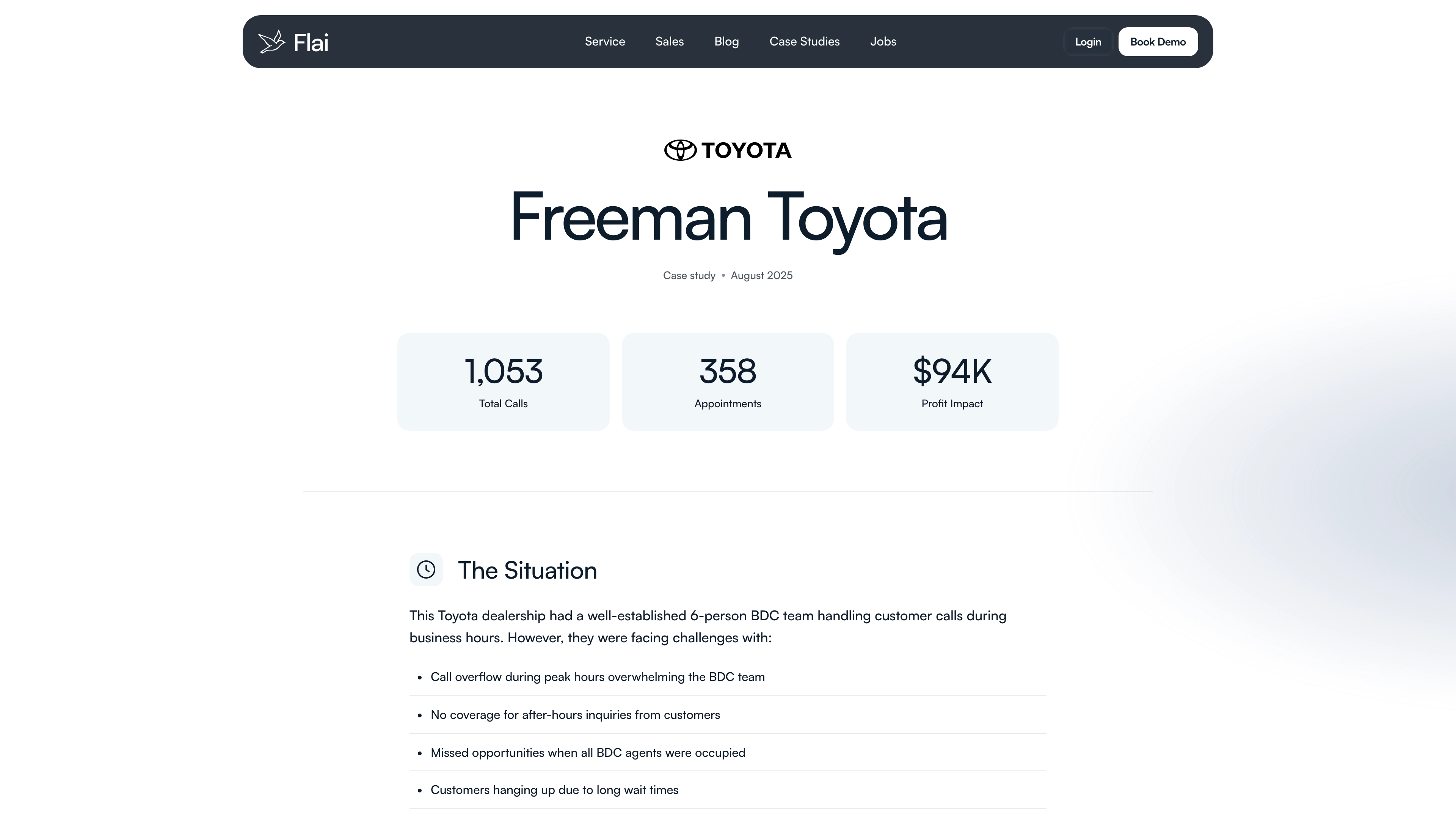
Glendale Infiniti
Before: Common call handling problems across departments.
After: The AI platform processed 1,800+ calls per month, booked 160+ service appointments, achieved zero missed calls, and saved staff 20% of their time previously spent on phone interruptions.
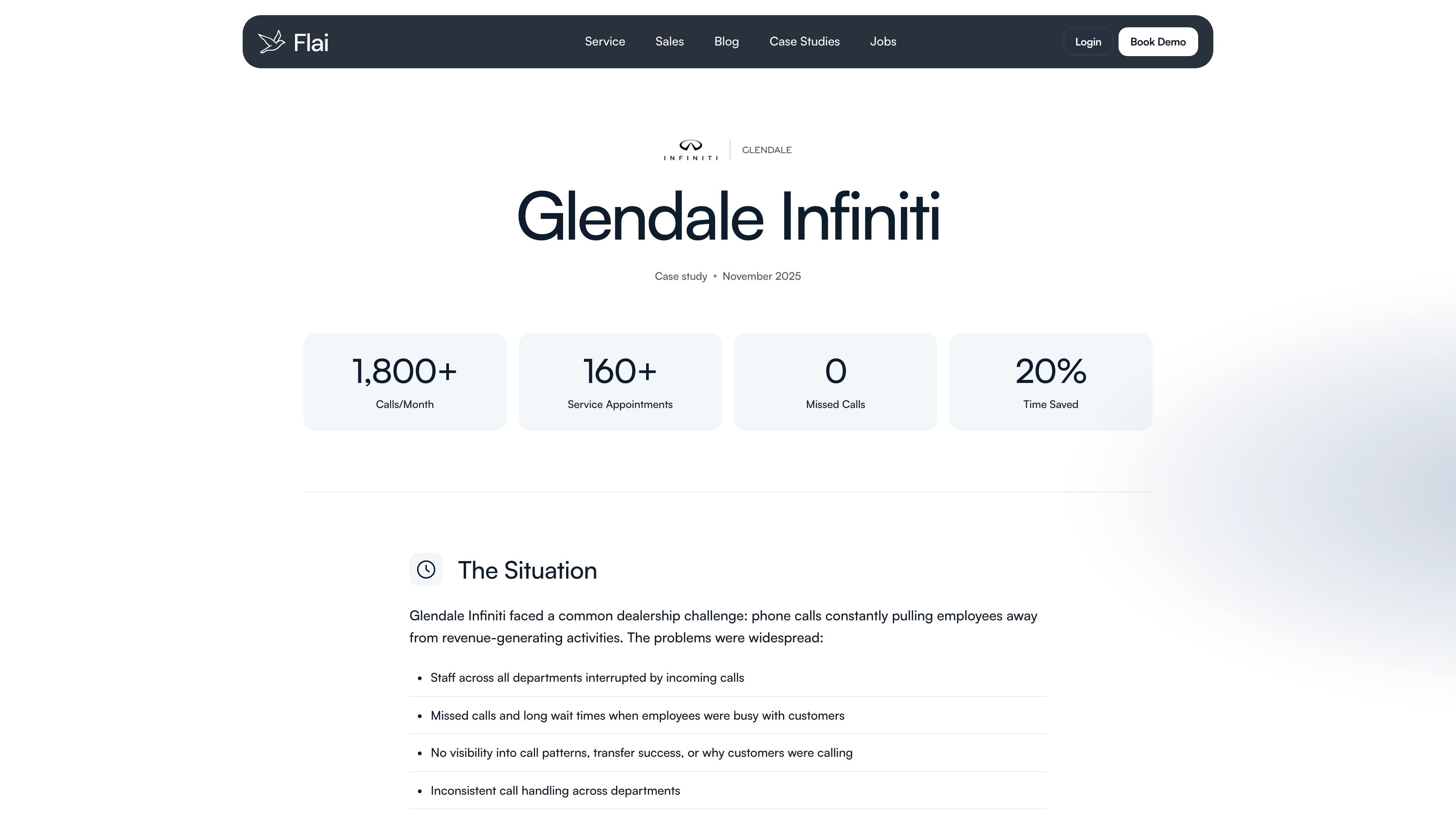
The Pattern
Across all these dealerships:
| Metric | Typical Range |
|---|---|
| Monthly calls handled | 1,000-1,800 |
| Appointment conversion rate | 85-90% of bookable calls |
| Monthly profit impact | $80,000-$100,000+ |
| Missed calls | Zero |
The profit per appointment clusters around $260-$270. Even if your conversion isn’t perfect, the math works because every captured call is incremental. You’re not replacing revenue. You’re adding revenue that would have been lost.
After Hours Answering Service FAQ

Do customers hate talking to an answering service?
Customers hate waiting and repeating themselves. If the interaction ends with a confirmed appointment and a text confirmation, most people don’t care whether they talked to a human, AI, or hybrid. What they care about is getting their problem solved. Studies show customers are 2.4x more likely to stay loyal when businesses solve their issues quickly.
What’s the minimum viable setup if I’m starting from zero?
Start with service after-hours coverage. It has the fastest ROI because service ROs are more predictable than sales. Implement clean scripts and a follow-up SLA. Measure your appointment set rate and show rate. Once you’ve validated it works, expand to sales, parts, and overflow during business hours.
How do I prevent “we took a message” from becoming useless?
Three things:
- Require structured lead capture fields (not free-text notes)
- Set up automated confirmations via SMS/email
- Create a next-business-day callback queue with assigned ownership and tracked completion
How much should I expect to pay?
Broad market ranges:
- Basic answering services: $95-$1,200+/month depending on volume
- AI answering services: $50-$300/month
- Dealership-specific human BDC: $2,500-$6,800+/month
The right question isn’t just cost. It’s cost vs. captured revenue. If a $1,000/month service captures $50,000 in incremental business, the ROI is 50x.
Can AI really book appointments?
Yes. Modern AI BDC platforms integrate directly with scheduling systems. The AI checks availability, offers times, books the slot, and sends confirmation. It’s not “requesting” an appointment. It’s booking it live, exactly like a human BDC agent would.
What happens when the AI gets confused?
Good AI systems are designed to recognize uncertainty and escalate gracefully. If a caller has an unusual request or gets frustrated, the AI can transfer to an on-call staff member, queue a callback, or capture the situation for immediate human review. The goal is never to leave a caller stranded.
How fast is the ROI typically?
Many dealers see the service pay for itself within the first week or month. With average appointment values in the $260-$270 range and services running $500-$1,500/month, you only need to capture a handful of incremental appointments to break even. After that, it’s pure profit.
What if I already have a BDC?
An after-hours AI complements a human BDC. Your team handles complex situations, builds relationships, and works high-value leads. The AI handles overflow, after-hours, and routine bookings. Freeman Toyota had a 6-person BDC and still added $93,000/month by layering in AI for after-hours and peak-time coverage.
Stop Letting Leads Walk Out the Door

Every missed call is money walking to your competitor. And with 56-60% of leads arriving after hours, you can’t afford to let your phone go to voicemail when the lights are off.
The fix isn’t complicated. Get after-hours coverage that actually books appointments, not one that just takes messages. Integrate it with your systems. Train it with your scripts. Measure the results.
If you want to see what a dealership-grade AI solution looks like in action, book a demo with Flai. We’ll show you exactly how our AI handles calls, books appointments, and captures the leads you’re currently losing.
Your customers are calling. The only question is whether you’re going to answer.