Privacy Policy
Terms of Service
Security
Status
Blogs & Guides
An AI BDC automates dealership calls, texts, and emails 24/7. Learn what makes it different from chatbots and how it actually books appointments.
January 22, 2026
If you run a dealership, your real product isn’t cars. It’s answered conversations that turn into appointments.
An AI BDC (AI Business Development Center) is the technology that makes this happen at scale. It’s a system that answers, qualifies, schedules, follows up, and routes customer conversations across phone, SMS, and email. Ideally around the clock. And it writes everything back into your existing tools: scheduler, CRM, DMS.
This guide is built for fixed ops directors, BDC leaders, GMs, and dealer principals who want to understand the category and actually deploy it without breaking the customer experience.
They’re usually trying to solve one of these problems:
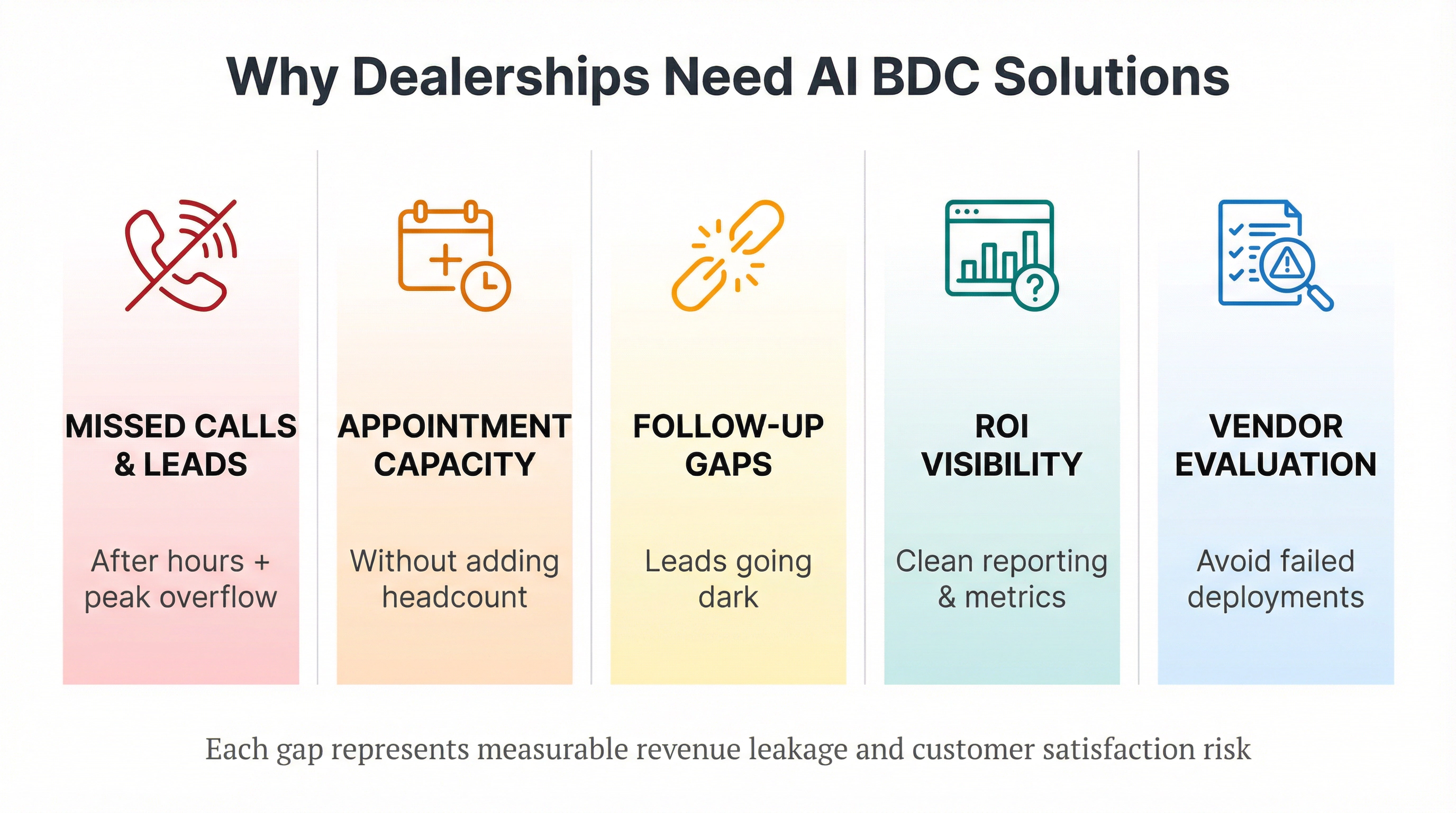
Success looks like this: you can clearly explain AI BDC to your team and leadership, you know what capabilities actually matter (versus marketing fluff), you have a practical evaluation and rollout playbook, and you can estimate impact on appointments, CSI, and revenue with realistic assumptions.
Traditional BDC: Humans who respond to inbound leads (calls and forms), set appointments, and follow up.
AI BDC: The same mission, but software agents handle a large share of the conversations. Especially the repetitive, time-sensitive, high-volume ones: schedule service, basic availability questions, status updates, reschedules, lead capture, reminders. When a human is needed, the system escalates with context.
Here’s the key difference versus “chatbots” and “IVR”:
| System Type | What It Does | Key Limitation |
|---|---|---|
| IVR | Menus plus routing | No conversation, just button presses |
| Chatbot | Usually web-only responses | Often disconnected from real scheduling |
| AI BDC | Conversational plus action-taking plus integrated | It should actually book, confirm, update, and follow up |
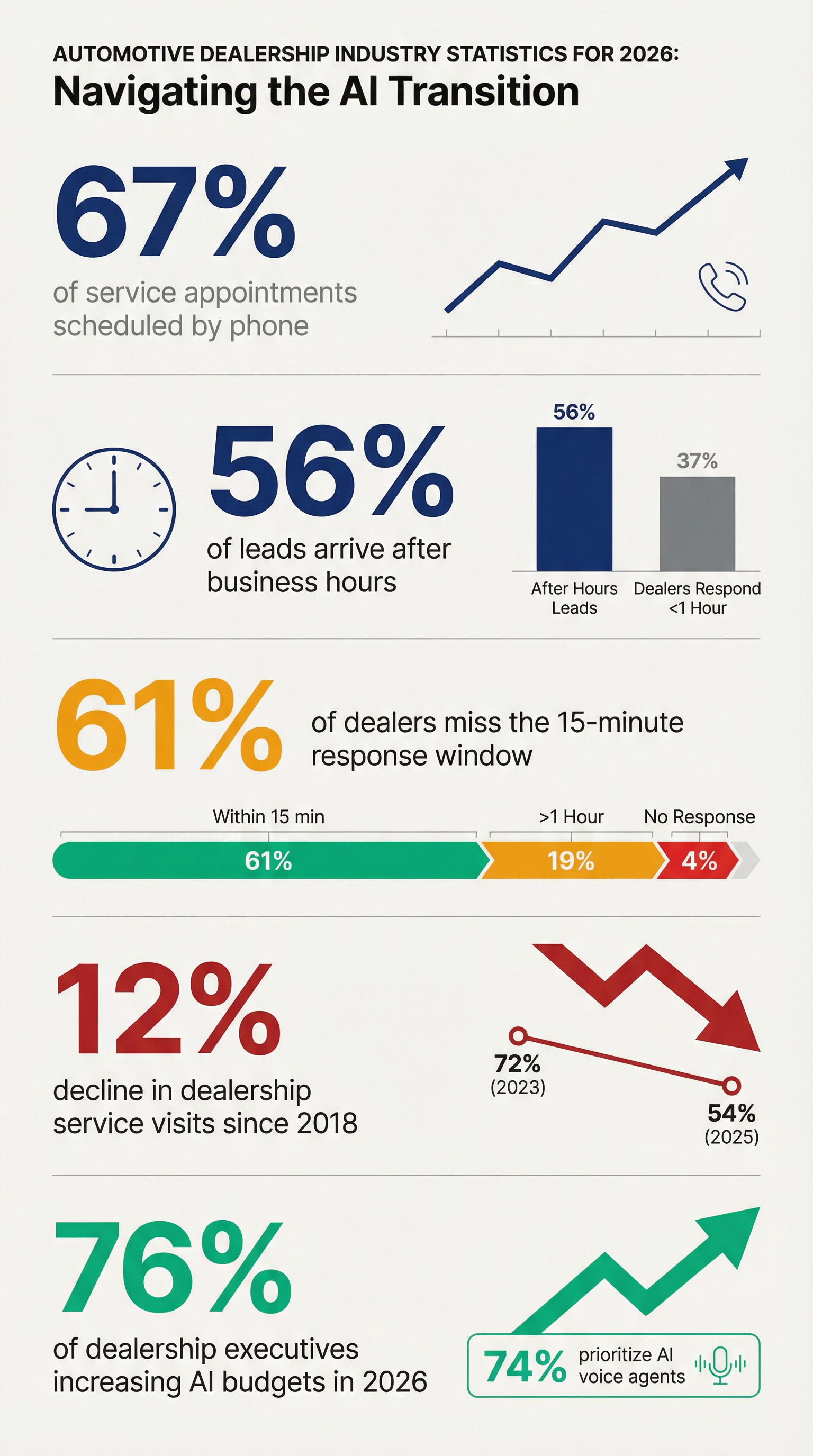
Even with online scheduling pushes, two-thirds of service appointments are still scheduled by phone according to WardsAuto reporting on Pied Piper’s 2025 study.
That means “we’ll fix it later” on phones is basically choosing to leak fixed ops revenue.
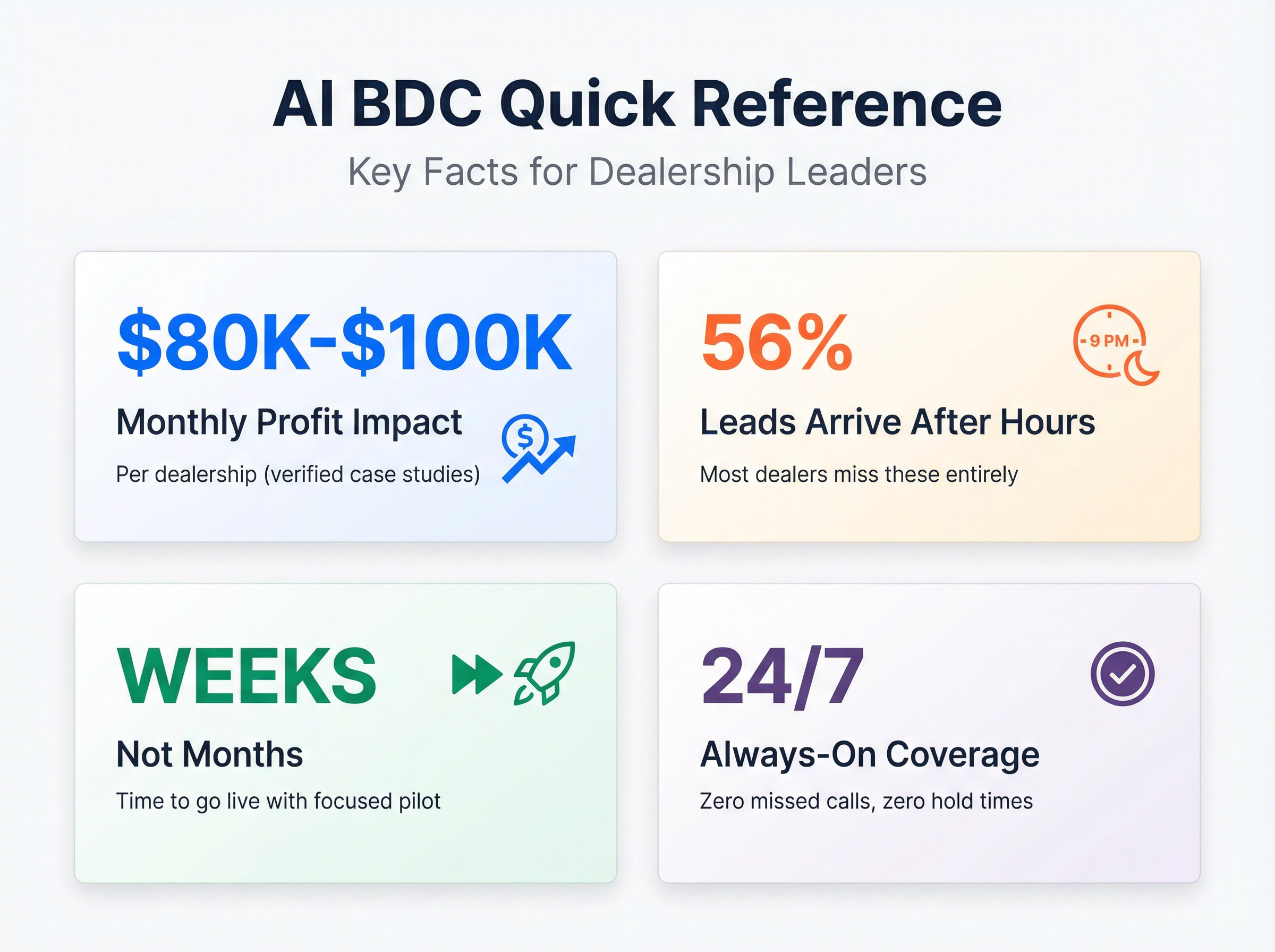
Industry research shows 56% of new leads are submitted after business hours, yet only 37% of dealerships address after-hours leads within one hour.
AI BDC solutions are largely an “availability arbitrage” play. You win because you answer when competitors don’t.
A 2025 lead response study (Q3 to Q4 2024 data) reported:
And even when teams respond, “generic, unhelpful” responses are common. So the issue isn’t only speed. It’s execution quality.
Cox Automotive reported in November 2025 that:
Dealerships handle 12% fewer service visits than in 2018. In 2025, only 54% of owners with cars two years old or newer returned to the selling dealership for service (down from 72% in 2023). And 45% of vehicle owners are dissatisfied with dealership service experiences, driven mainly by unexpected costs and poor communication.
That last point is the quiet killer. Good wrench work plus bad communication still loses customers.
Auto Remarketing summarized a Spyne survey of nearly 1,200 dealership executives: 76% plan to increase their AI budgets for 2026, with 74% citing AI voice agents as their top investment priority for lead response, inbound call management, and service scheduling.
If you’re evaluating this now, you’re not early. You’re catching up.
Think of it as three systems working together:
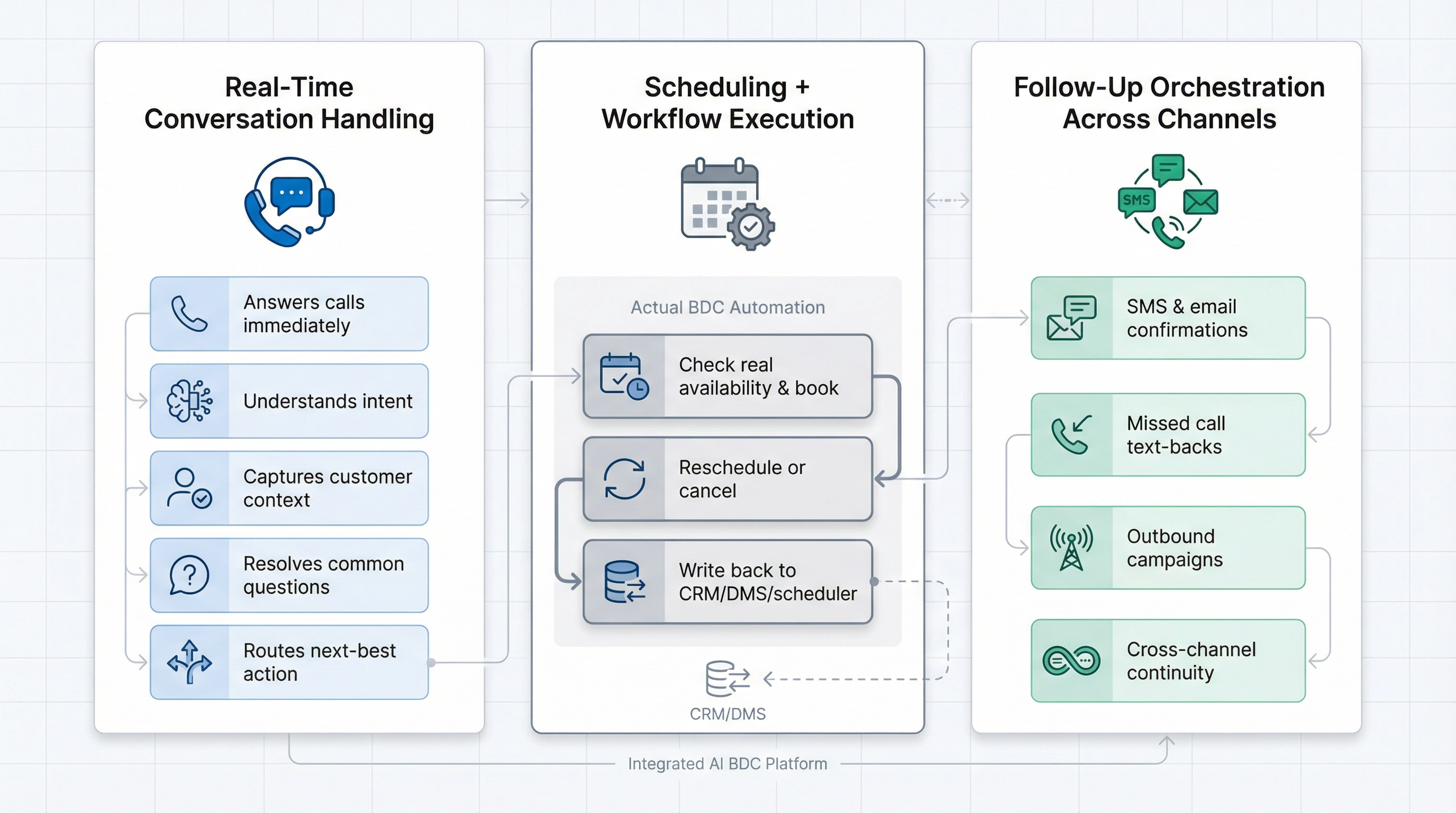
-> Answers inbound calls immediately
-> Understands intent (service versus sales versus parts versus general)
-> Captures identity plus context (name, phone, vehicle, VIN when available, concern)
-> Resolves common questions (hours, directions, basic policy)
-> Offers next-best action (book now, warm transfer, callback, text confirmation)
For service and sales, the difference between “cute AI demo” and “actual BDC automation” is:
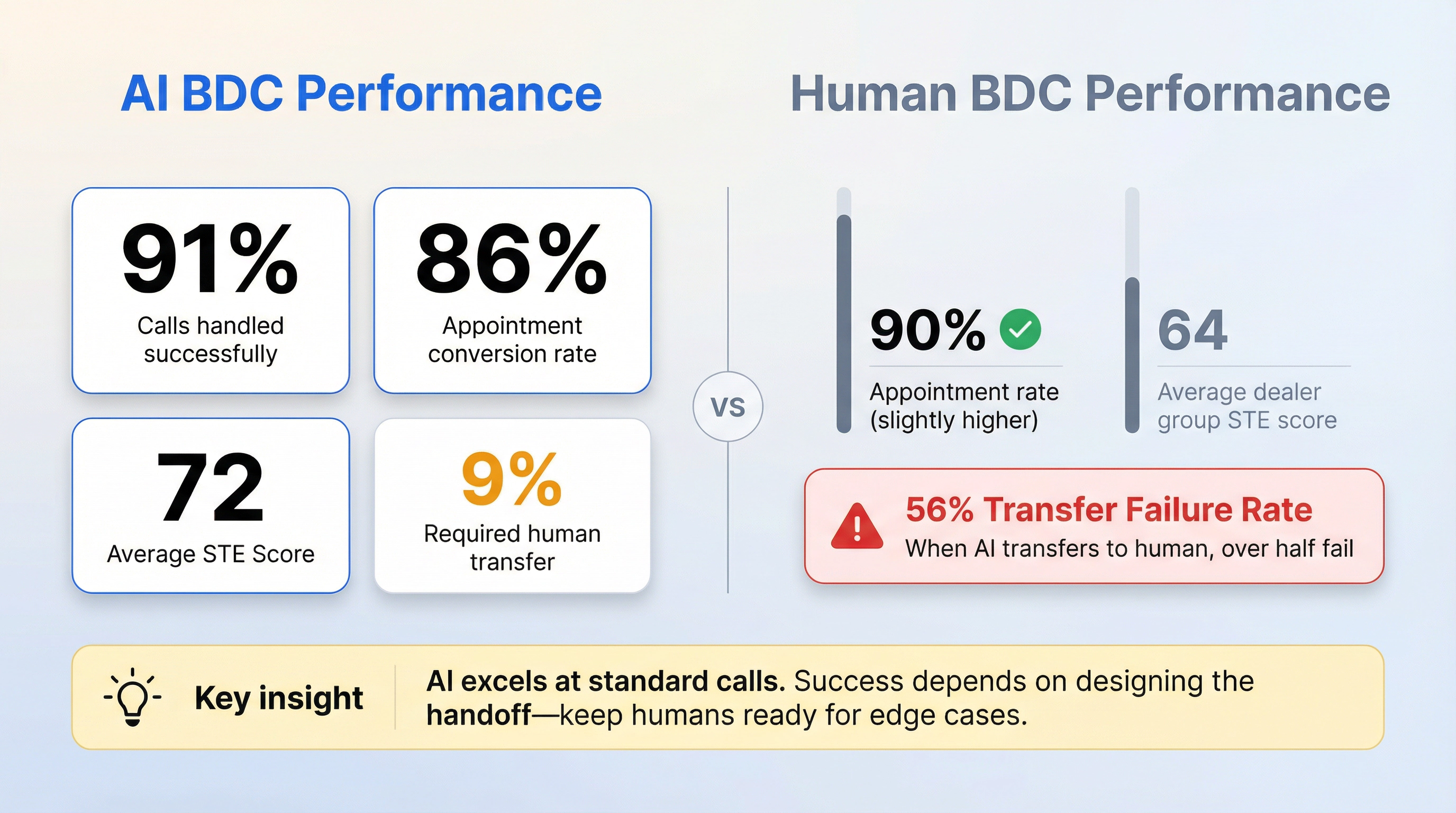
Pied Piper’s 2025 Service Telephone Effectiveness study is one of the clearest “reality checks” in the space:
What this means in plain terms:
AI is often great at the “standard” calls. But the moment you need a human, your operation has to be ready. Or you lose the customer after wasting their time.
So an AI BDC is not “install bot, delete staff.” It’s install bot, design the handoff, and keep humans focused on the edge cases.
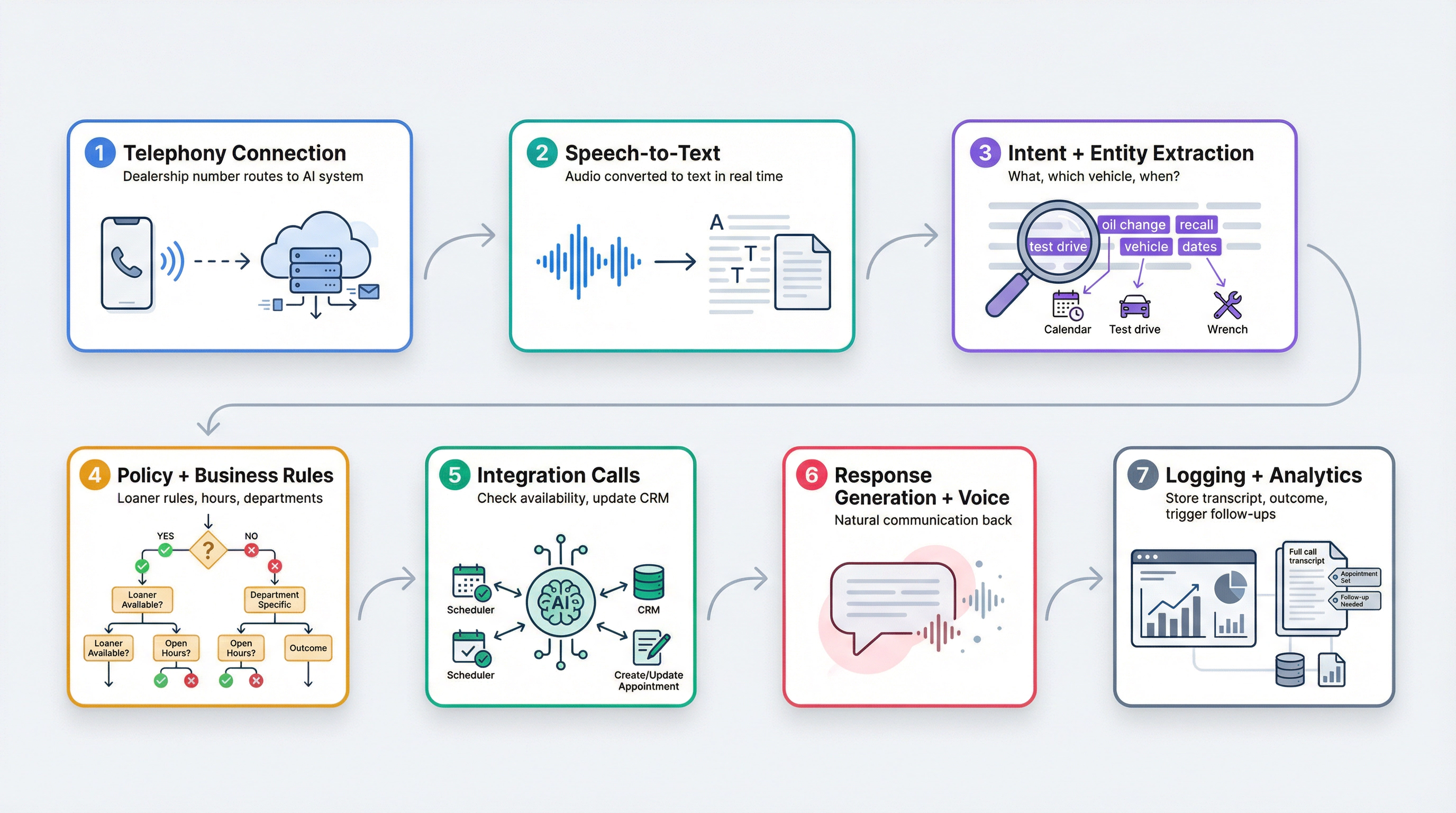
When a customer calls:
① Telephony connection (your dealership number routes to the AI system)
② Speech-to-text converts audio to text in real time
③ Intent plus entity extraction (what do they want? oil change versus recall versus test drive; what vehicle; what dates)
④ Policy plus business rules decide what’s allowed (loaner rules, hours, which department handles what)
⑤ Integration calls (scheduler availability, CRM lookup, create or update appointment)
⑥ Response generation plus voice communicates back naturally
⑦ Logging plus analytics stores transcript, outcome, tags, and triggers follow-ups (SMS and email)
The only part that really matters to your store: does it take action reliably, or does it “take a message” and create more work?
Use these metrics to evaluate any AI BDC (including your current setup).

| Metric | What It Measures | Why It Matters |
|---|---|---|
| Answer rate | % of calls answered (AI plus humans) | Missed calls equal missed revenue |
| Time-to-first-response | How fast the system speaks after pickup | First impressions set expectations |
| Hold time | How often callers sit on hold | Pied Piper found hold times over 2 minutes happened only 2% of the time in 2025 (down from 13% in 2024) |
That 56% failed transfer rate from Pied Piper is your warning sign. Measure this obsessively.
You want dashboards that answer:
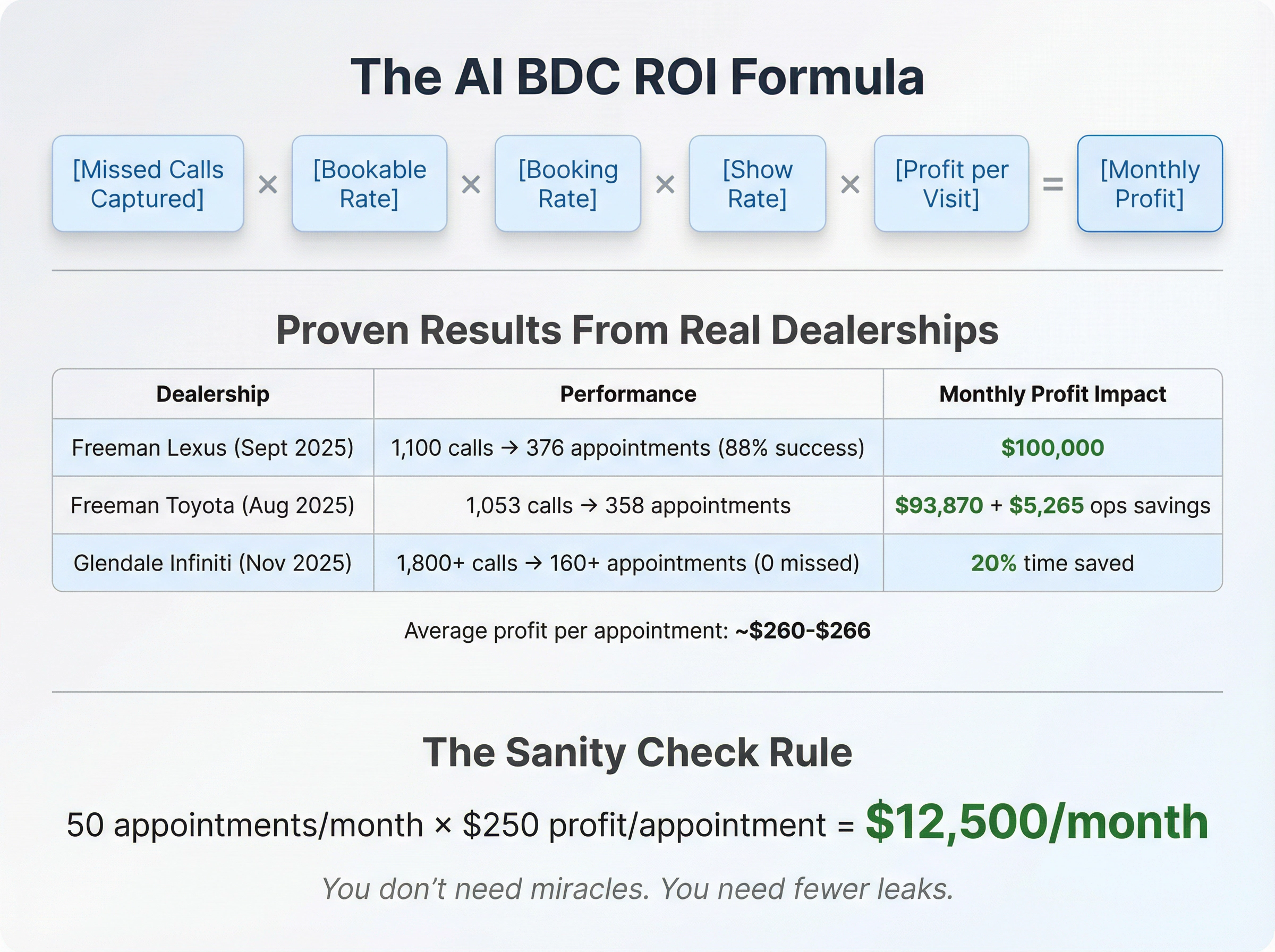
AI BDC ROI is usually not magic. It’s math.
Incremental profit equals: (missed plus after-hours plus overflow calls captured) multiplied by (bookable rate) multiplied by (booking rate) multiplied by (show rate) multiplied by (gross profit per RO or sale)
From Flai’s published case studies:
| Dealership | Calls | Appointments | Success Rate | Profit Impact |
|---|---|---|---|---|
| Freeman Lexus (Sept 2025) | 1,100 | 376 | 88% | $100K |
| Freeman Toyota (Aug 2025) | 1,053 | 358 | N/A | $93,870 (plus $5,265 ops savings) |
| Glendale Infiniti (Nov 2025) | 1,800+ | 160+ | 0 missed calls | 20% time saved |
If you back into “profit per appointment” from those service-heavy examples:
That’s why this category works even with imperfect conversion. Each incremental kept appointment is worth real money.
If an AI BDC reliably adds 50 incremental service appointments per month (not crazy if you currently miss calls), and your incremental gross profit is $250 per RO, that’s $12,500 per month.
The store doesn’t need miracles. It needs fewer leaks.
Flai offers an instructive example of what a purpose-built AI BDC can achieve when the technology is designed specifically for dealership workflows.
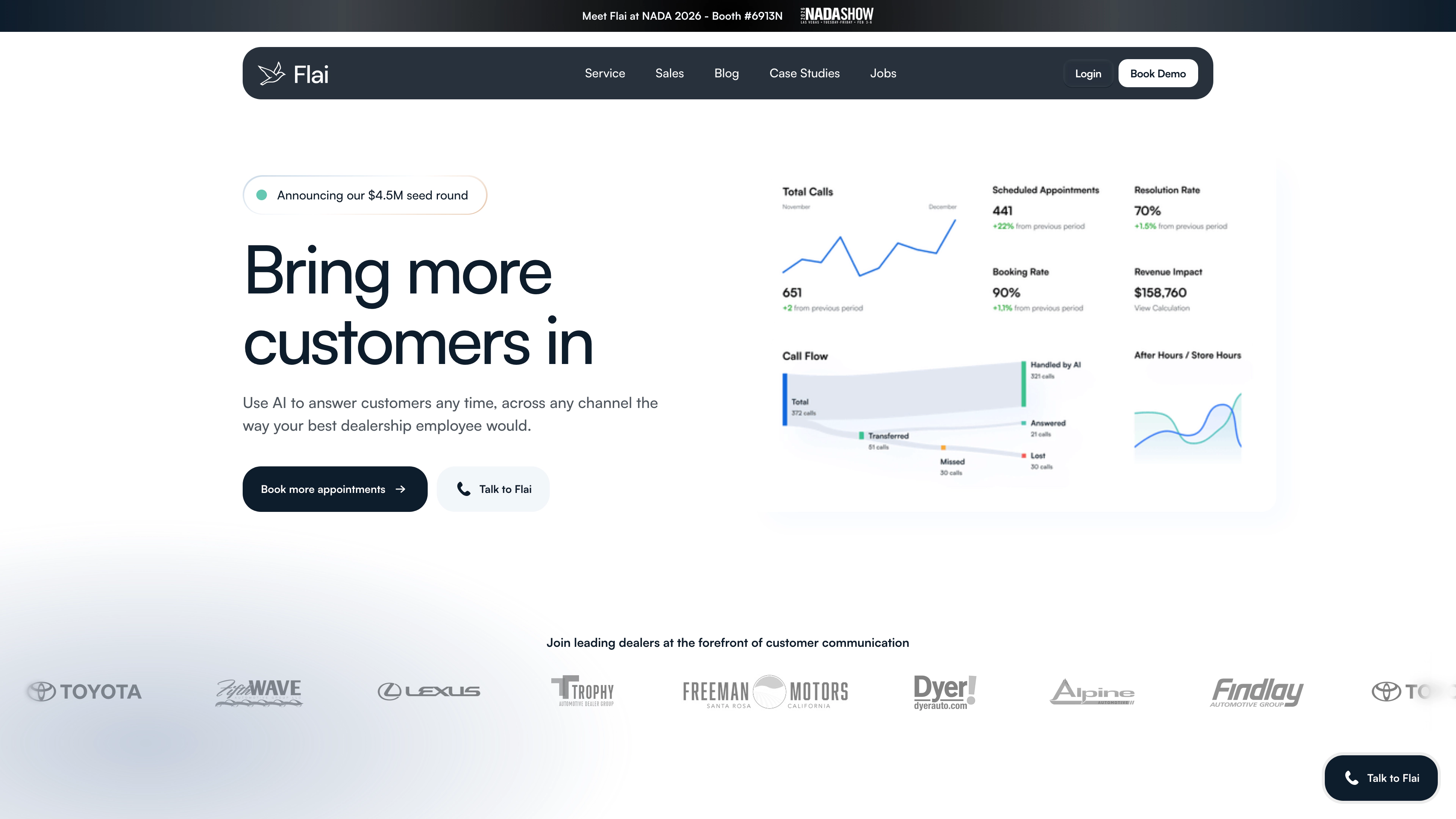
The founding team includes engineers from HappyRobot (a leading voice AI company in logistics) and a former Netflix data scientist. The company graduated from Y Combinator’s Summer 2025 batch after visiting over 450 dealerships in person before writing a single line of code. The team literally worked from service bays and back offices to understand the chaos they were trying to fix.
Superior voice quality. The platform uses custom-built voice AI infrastructure rather than stitching together off-the-shelf components. The result is faster responses, fewer awkward pauses, and conversations that actually feel human.
Real integrations that book. The system connects directly to schedulers, CRMs, and DMSs. When a customer calls to book service, it checks real availability and creates real appointments. No message-taking. No “someone will call you back.”
Omni-channel from day one. Phone, SMS, and email all use the same AI and share the same context. A customer can start a conversation on the phone and finish it over text without repeating themselves. The platform also runs outbound campaigns for recalls, reactivation, and unsold lead follow-up.
24/7 coverage with smart handoffs. The system handles after-hours calls, peak-time overflow, and everything in between. When a human is truly needed, it warm-transfers with full context (who’s calling, what they want, vehicle details, preferred time). If nobody picks up, it immediately offers callback or text follow-up instead of bouncing the customer.
At one CDJR dealership in the Bay Area, the platform handled 1,563 calls in the first month. Monthly service appointments jumped from 205 to 448. Zero missed calls. Zero wait times. Estimated profit impact: $83,000 in 30 days.
Some dealers report the system “paid for itself on a single Sunday.”
If you want to see how this works at your store, book a demo with the Flai team.
NADA’s guidance on using AI is refreshingly practical: start small, pick one frustrating process, and expand once it’s working.
Here’s the rollout pattern that minimizes risk:
Best first pilots (highest ROI, lowest complexity):
-> After-hours service scheduling
-> Peak-time overflow for service (Monday morning spikes are common)
-> Missed-call text back plus callback
-> Basic sales lead capture plus appointment setting
Avoid starting with: complicated pricing negotiations, finance, warranty disputes.
Make a one-page policy:
AI owns: oil change scheduling, basic maintenance, hours and directions, reschedules, basic inventory inquiry, appointment confirmations
AI escalates: angry customers, safety issues, warranty fights, complex multi-symptom diagnostics, anything involving refunds or complaints
Because transfers are where experiences die (remember the 56% failure stat from Pied Piper).
Minimum viable rules:
① If transferring, send context (who, what, vehicle, desired time)
② If no answer, offer callback or SMS immediately
③ Never “bounce” the customer back to the main menu
The booking loop must be bulletproof before you automate everything else.
Test for:
This is where generic voice bots fail.
Include:
Every week, review:
An AI BDC is a system, not a one-time install.
Use these in every vendor call.
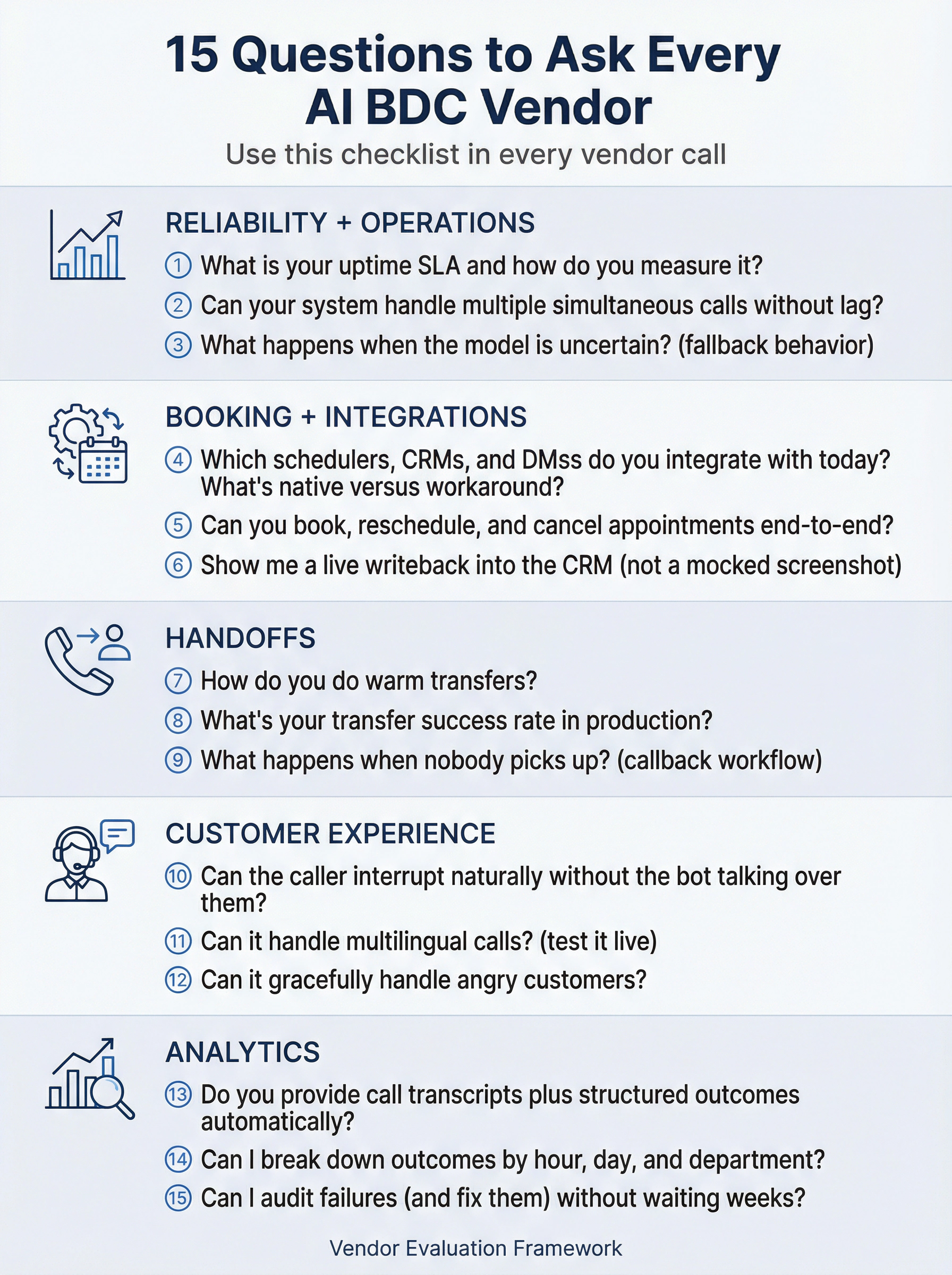
① What is your uptime SLA and how do you measure it?
② Can your system handle multiple simultaneous calls without lag?
③ What happens when the model is uncertain? (fallback behavior)
④ Which schedulers, CRMs, and DMSs do you integrate with today? What’s native versus workaround?
⑤ Can you book, reschedule, and cancel appointments end-to-end?
⑥ Show me a live writeback into the CRM (not a mocked screenshot)
⑦ How do you do warm transfers?
⑧ What’s your transfer success rate in production?
⑨ What happens when nobody picks up? (callback workflow)
⑩ Can the caller interrupt naturally without the bot talking over them?
⑪ Can it handle multilingual calls? (test it live)
⑫ Can it gracefully handle angry customers?
⑬ Do you provide call transcripts plus structured outcomes automatically?
⑭ Can I break down outcomes by hour, day, and department?
⑮ Can I audit failures (and fix them) without waiting weeks?
AI BDCs touch regulated areas: calling, texting, recording, and customer data. This is not legal advice. Consult with counsel for your specific situation.
The FCC ruled in February 2024 that AI-generated voices are considered an “artificial or prerecorded voice” under the TCPA, meaning TCPA consent rules apply.
Practical implication:
If your AI BDC records and transcribes calls, you’re storing sensitive personal data.
Flai’s privacy policy states it collects call content, recordings, appointment data, and integrates with dealership systems. It also states SOC 2 Type II compliance and describes retention in line with legal and business needs.
Whatever vendor you use, demand:
State laws differ (one-party versus two-party consent). Your safest default is:
The next wave isn’t just “a bot that talks.”
It’s an operating layer that:
-> Answers instantly
-> Books directly
-> Keeps customers updated proactively (so they don’t call for status)
-> Coordinates across phone, SMS, and email without dropping context
-> Gives managers visibility into where the operation is leaking
And the competitive pressure is real. Cox Automotive notes customers want easy scheduling and better communication. Dealers are losing service loyalty even while service becomes more financially important.
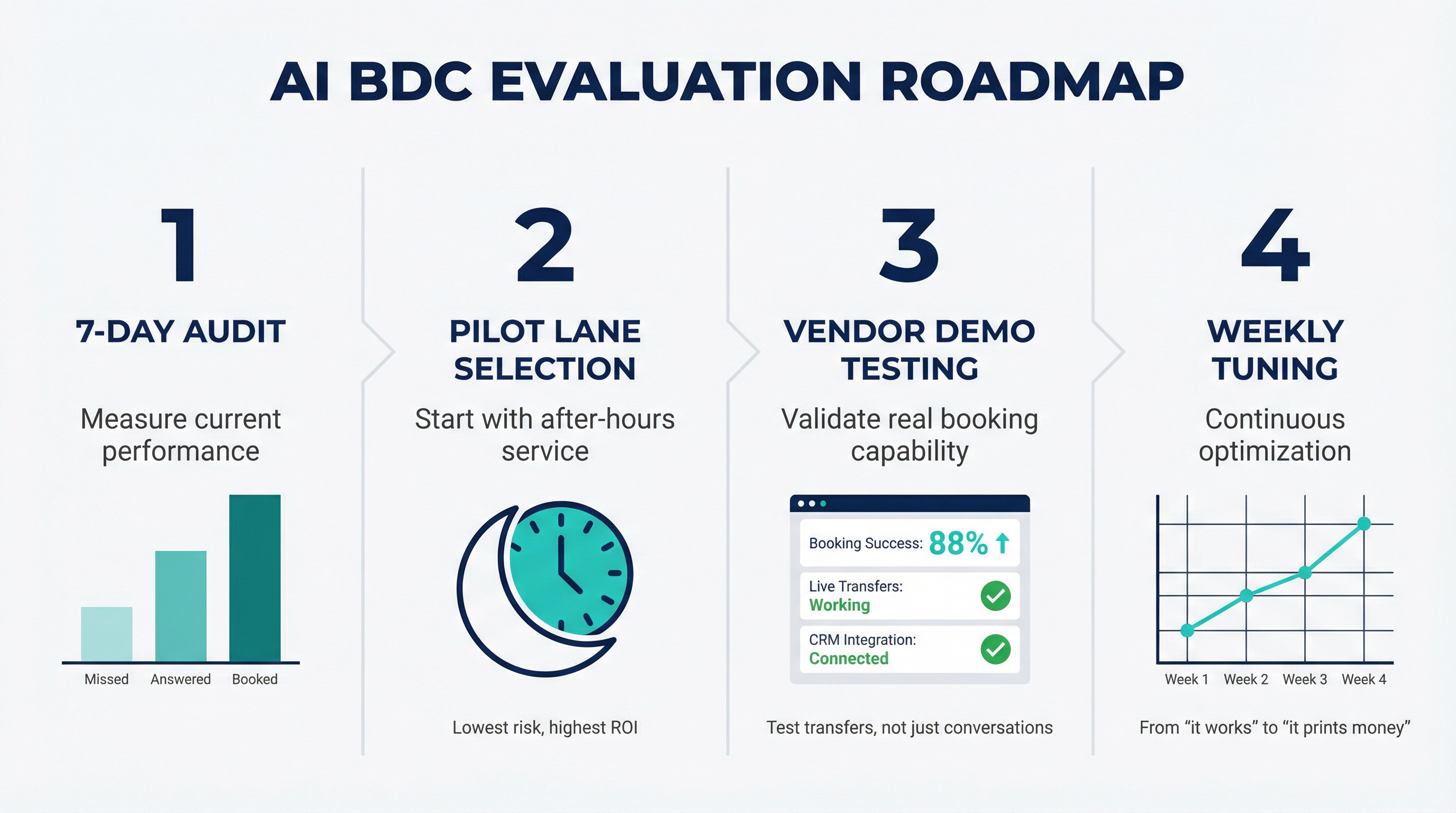
① Run a 7-day audit of your calls and leads: how many calls hit voicemail, how many go unanswered, how many get booked
② Pick one pilot lane (after-hours service is usually the cleanest win)
③ In vendor demos, test transfers and actual booking (not just “it sounds human”)
④ Commit to weekly tuning. That’s how you get from “it works” to “it prints money”
Ready to see what an AI BDC can do for your dealership? Schedule a demo with Flai to experience the difference.
What exactly is an AI BDC?
An AI BDC (AI Business Development Center) is an AI-powered system that handles customer communications for car dealerships. It answers phone calls, responds to texts and emails, schedules appointments, and follows up with leads. Unlike basic chatbots or IVR systems, an AI BDC integrates with your scheduler, CRM, and DMS to actually take action (like booking a real appointment) rather than just collecting information.
How is an AI BDC different from an outsourced call center?
An outsourced call center uses human agents who may lack dealership context and often just take messages. An AI BDC can actually check availability and book appointments in real time, 24/7, without the quality inconsistencies that come with third-party staff. Plus, AI BDCs typically cost less per call and can handle unlimited simultaneous conversations.
Will AI replace my BDC team?
No. AI BDCs work best when they handle the repetitive, high-volume calls (basic scheduling, hours and directions, appointment confirmations) so your human team can focus on complex situations, upset customers, and high-value sales conversations. The goal is to make your existing team more effective, not eliminate them.
What kind of ROI can I expect from an AI BDC?
Based on published case studies, dealerships using AI BDCs see profit impacts of $80,000 to $100,000+ per month. The math is straightforward: each incremental service appointment is worth roughly $250 to $270 in gross profit. If your AI BDC captures 50 appointments per month that would have otherwise been missed, that’s $12,500+ in additional monthly revenue.
How long does it take to deploy an AI BDC?
Most AI BDC solutions don’t require hardware or extensive training. Leading platforms like Flai can typically get dealerships live within weeks, not months. The key is starting with a focused pilot (like after-hours service calls) rather than trying to automate everything at once.
What happens when the AI can’t handle a call?
Good AI BDCs have warm transfer capabilities. When the AI encounters something it can’t handle, it should transfer to a human with context (who’s calling, what they want, vehicle details). The challenge is making sure someone actually picks up. Pied Piper’s research shows that 56% of transfers fail, which is why designing your fallback process matters as much as the AI itself.
Is using AI for phone calls legal?
Yes, but with important caveats. The FCC has ruled that AI-generated voices fall under TCPA regulations, so you need appropriate consent for marketing calls. For service communications (appointment reminders, recall outreach), you should still follow best practices for consent and opt-out. Always consult with legal counsel for your specific situation.
Can AI BDCs handle multiple languages?
Yes. Modern AI BDC platforms support multilingual conversations. This is especially valuable in diverse markets where Spanish-speaking (or other language) customers may prefer to communicate in their native language. During vendor evaluation, test multilingual capability live rather than taking claims at face value.
What integrations do I need for an AI BDC to work?
At minimum, you need integration with your scheduler so the AI can book real appointments. Integration with your CRM and DMS adds additional value: the AI can look up customer history, create or update lead records, and ensure nothing falls through the cracks. Ask vendors which systems they integrate with natively versus through workarounds.
How do I know if my dealership is ready for an AI BDC?
If you’re missing calls (especially after hours), experiencing long hold times during peak periods, or struggling with inconsistent lead follow-up, you’re ready. Start by auditing your current call performance for a week. Count how many calls go to voicemail, how long customers wait on hold, and how many leads don’t get responses within an hour. If those numbers look bad, an AI BDC will help.
As seen in