Privacy Policy
Terms of Service
Security
Status
Blogs & Guides
Why dealerships are replacing outsourced call centers with AI: real numbers, ROI analysis, and the practical playbook for making the switch.
January 23, 2026
Something shifted in 2024 and 2025. Dealerships that had been using outsourced call centers for years started pulling the plug. Not because the call centers got worse. The math changed.
Outsourced BDCs solved one problem: someone picks up the phone. That felt like progress when the alternative was voicemail at 7pm and busy signals during Monday morning rushes. But coverage isn’t the same as conversion. And dealerships finally have a better option.
This article is for:
What we’re covering: the real reasons this shift is happening (not marketing fluff), the economics that make AI make sense, the genuine risks you should worry about, and a practical 30-day playbook for making the switch without breaking your store.
Three things came together between 2024 and early 2026 that made AI a legitimate replacement for outsourced call handling.
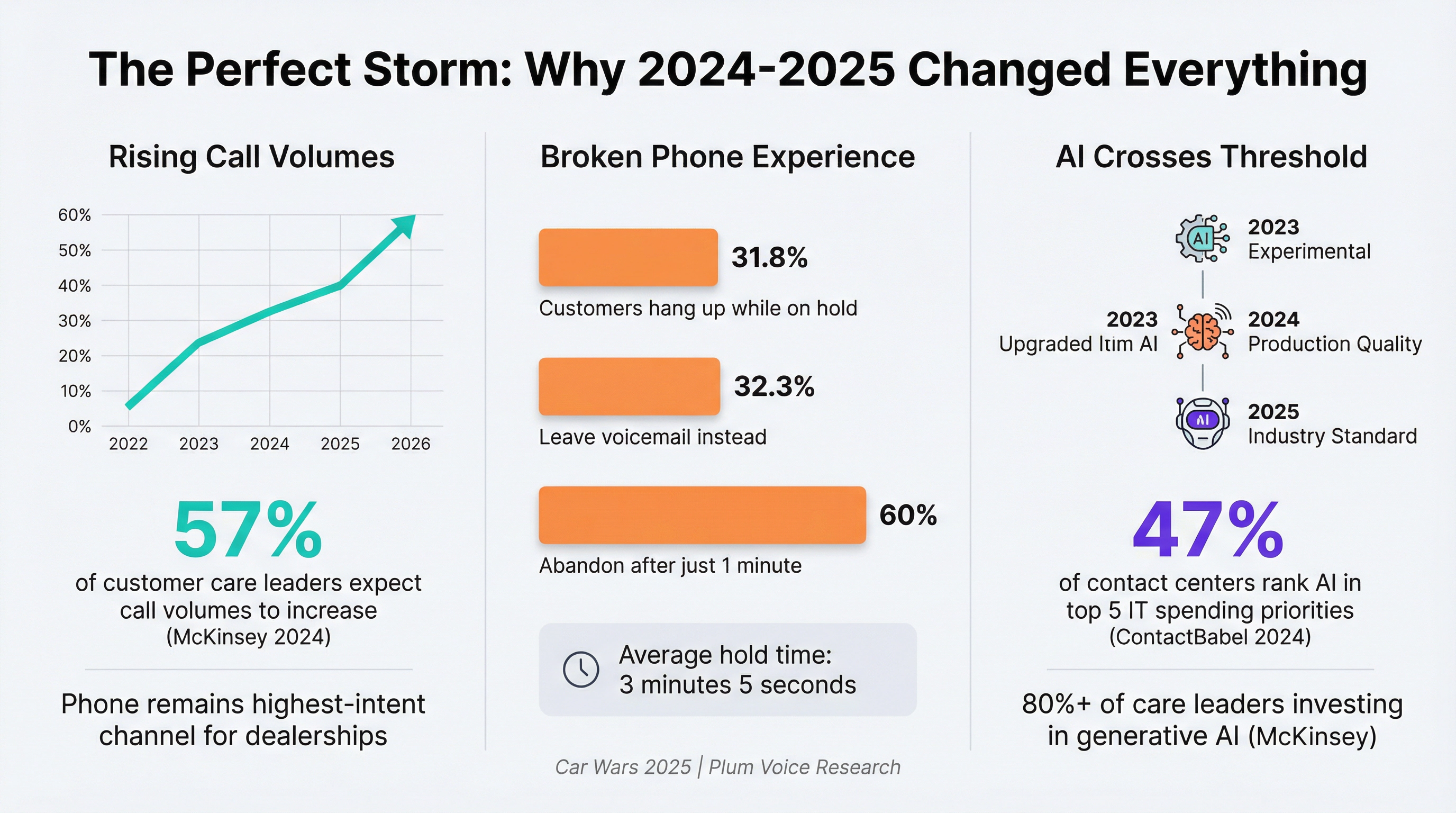
The phone never stopped being important. McKinsey’s global survey of customer care leaders (March 2024) found that 57% expect call volumes to increase over the next one to two years. Nothing since has suggested they were wrong.
In dealerships specifically, the phone remains the highest-intent channel. People calling aren’t browsing. They’re trying to do something: book service, check availability, confirm pricing, solve a problem. And they’re impatient.
Here’s what the data actually shows. A Car Wars analysis (published February 2025) found:
| Metric | What It Means |
|---|---|
| 31.8% of unconnected calls | Customers hanging up while on hold |
| 3 minutes 5 seconds | Average hold time |
| 32.3% of non-connected calls | Customers leaving voicemails |
Three minutes is an eternity when the caller can tap another dealer in three seconds.
Additional research from Plum Voice puts this in even sharper relief: 60% of customers hang up after just one minute on hold, and 32% won’t wait at all. A third of your callers will hang up the second they hear hold music.
Contact center leaders aren’t treating AI as experimental anymore:
So this isn’t just a dealership phenomenon. The entire contact center industry is moving, and dealerships are catching up.
Outsourced BDCs usually enter the picture as a fix for after-hours coverage, overflow during peaks, staffing headaches, or cost containment. All valid reasons. The problem is the trade you make: coverage for conversion.
Here’s what actually goes wrong.
Outsourced agents often can’t book directly into your scheduler or DMS workflow. So they take a request, promise a callback, and send a note to the store. That creates a second bottleneck: your people still have to chase it down later, usually when the lead has gone cold.
The appointment never actually got set. It got requested.
Dealership calls are routing nightmares. Service versus sales versus parts versus finance versus status checks. Outsourced agents frequently ask a few questions, put the caller on hold, try a transfer, and bounce to voicemail.
We already know what happens next. That Car Wars data showed 31.8% of unconnected calls were customers hanging up while on hold.
Car Wars mystery shop findings (September 2024) found that only 15.77% of agents asked about vehicle preferences, and only 4.88% created any sense of urgency.
That’s not a training problem. It’s what happens when a workforce runs on generic scripts, gets measured on handle time, and lacks real dealership context.
Your store has a tone. Outsourced agents have a script. Those aren’t the same thing. This matters especially for luxury stores where customers expect a premium experience. If the agent feels like a third party, customers feel it.
For many dealerships, Spanish support is the difference between a booked appointment and losing a family forever. Outsourced multilingual staffing exists, but it’s costly and hard to scale.
When conversion is bad, the blame bounces around:
And nobody can prove anything because the data lives in different systems.
Even with cheaper labor, outsourcing is still human staffing. You pay for people waiting during slow hours, training new agents to replace the ones who left, and management overhead baked into your contract.
ContactBabel reports the mean cost per inbound call in 2023 was $6.91. Their same report shows mean annual agent attrition of 31% (median 24%). Turnover isn’t a bad-manager problem. It’s structural.
AI beats outsourced call centers because it changes the physics of the problem, not just the staffing model.
Humans scale linearly. One agent equals one call at a time. AI scales with compute. One “agent” can handle many calls at once, limited by infrastructure rather than headcount.
This matters because dealership call volume is spiky. Monday mornings, lunch hour, end of day, promotion weeks. When six calls hit at once, outsourcing still queues them. AI can answer all six.
Car Wars’ 2024 annual report cited an average hold time of 3:05. AI wins because it picks up immediately and keeps the caller moving forward.
The fundamental difference: Outsourcing gives you coverage. AI gives you resolution. The customer doesn’t want someone to answer. They want their problem solved.
The real win isn’t “we answered the phone.” It’s:
Car Wars claimed that in 2024, the average service appointment call lasted 4 minutes 32 seconds. Their AI scheduler reduced that to under 2 minutes.
Shorter calls aren’t just about efficiency. They mean fewer holds, fewer transfers, more calls handled during peaks, and less distraction for advisors in the drive.
Humans drift. They have bad days, skip questions, forget the offer structure. AI doesn’t. You can enforce the exact questions required to schedule correctly, compliance language, offer structures (“Tuesday at 5:30 or Thursday at 6?”), and escalation rules.
The Car Wars mystery shop concept is essentially this: grading phone-ups at scale using AI to evaluate conversations.
The best AI systems don’t stop at the phone call. McKinsey points out that generative AI is valuable partly because it’s always on and can do live translation and summarization. Gartner’s analysis includes self-service and agentic workflows, not just “a bot that talks.”
In dealership terms: the phone call is just the start. The best systems finish the job via SMS and email.
You don’t need a complex spreadsheet. You need a clean model that connects phone performance to gross profit.
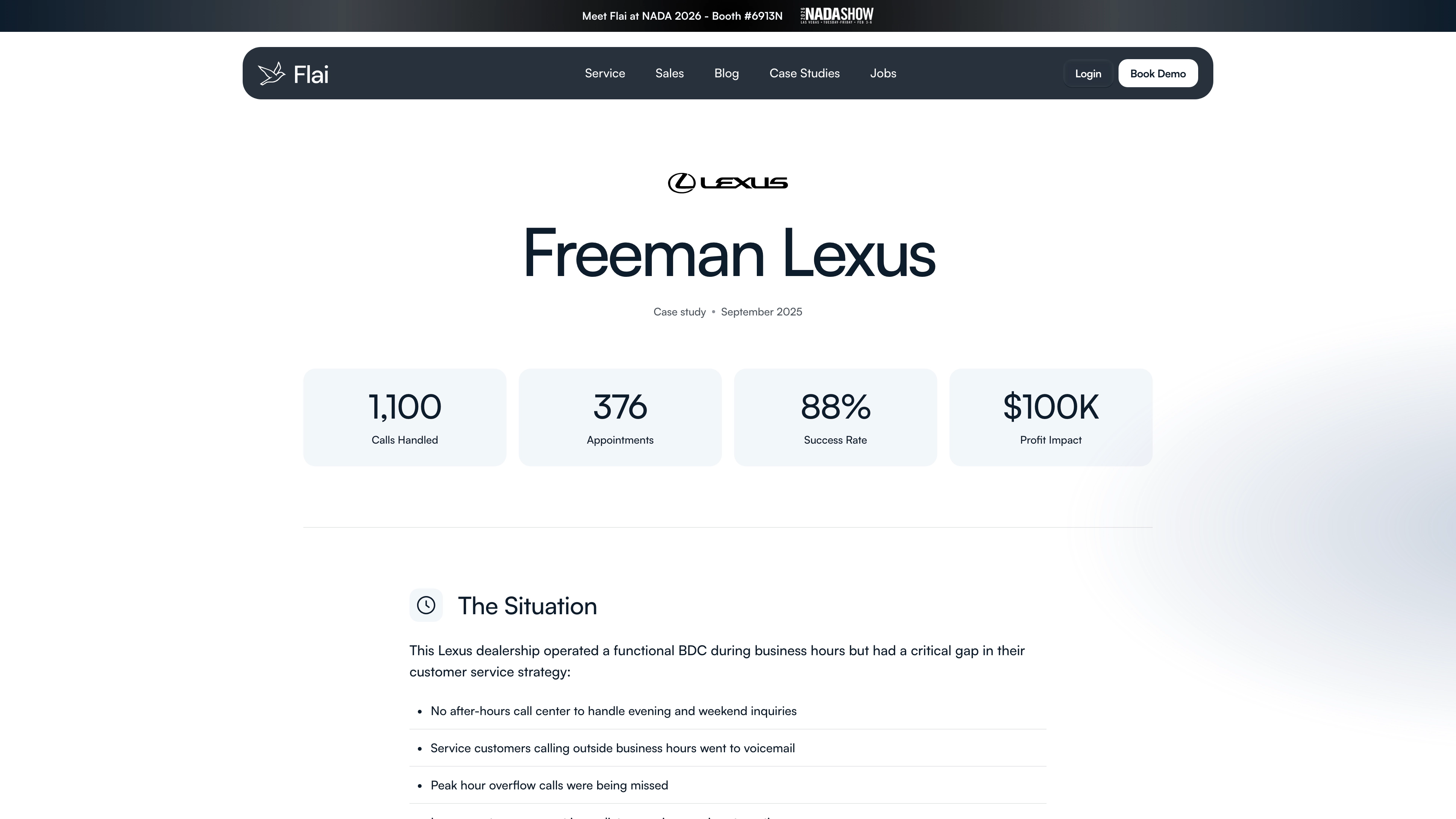
The actual Freeman Lexus case study page demonstrates the real-world impact of AI call handling in dealerships. These aren’t projected numbers—they’re verified results from a live deployment.
Incremental profit = (incremental kept calls) x (book rate) x (show rate) x (profit per RO or sale)
“Incremental kept calls” is the difference between calls that end in resolution (booked, answered, routed correctly) versus calls that die (hang up, voicemail, “we’ll call you back”).
Think of it this way: every call that converts to a booked appointment has a direct dollar value. Every call that dies is revenue walking out the door.
Before comparing solutions, measure what you’re dealing with:
That Car Wars data gives you a benchmark. If a third of your unconnected calls are hang-ups on hold, there’s a big opportunity.
Flai’s Freeman Lexus case study (September 2025) reports:
| Metric | Result |
|---|---|
| Total calls handled | ~1,100 |
| Appointments booked | 376 |
| Success rate on bookable calls | 88% |
| Estimated profit impact | $100,000 |
Divide $100,000 by 376 appointments and you get roughly $266 profit per booked appointment. This is vendor-reported data, but it’s useful as a sanity check.
Even if your actual profit per service RO is half that, the leverage is still massive. A single missed call can mean a lost repair order plus future retention.
Outsourcing costs vary by geography and service level. Industry estimates put US-based outsourced support at roughly $28 to $40 per agent-hour in 2025. ContactBabel’s 2024 guide shows the mean cost per inbound call at $6.91 across contact centers.
The comparison isn’t perfect, but the framework is simple: compare the cost of paying humans to wait (outsourcing) versus the cost of software that answers instantly and scales (AI).
Practical rule: If AI saves or creates even a handful of incremental service appointments per week, it usually clears the cost hurdle fast. Fixed ops profit compounds.
Replacing your outsourced call center with AI isn’t “set it and forget it.” Here’s what can go wrong and how to prevent it.
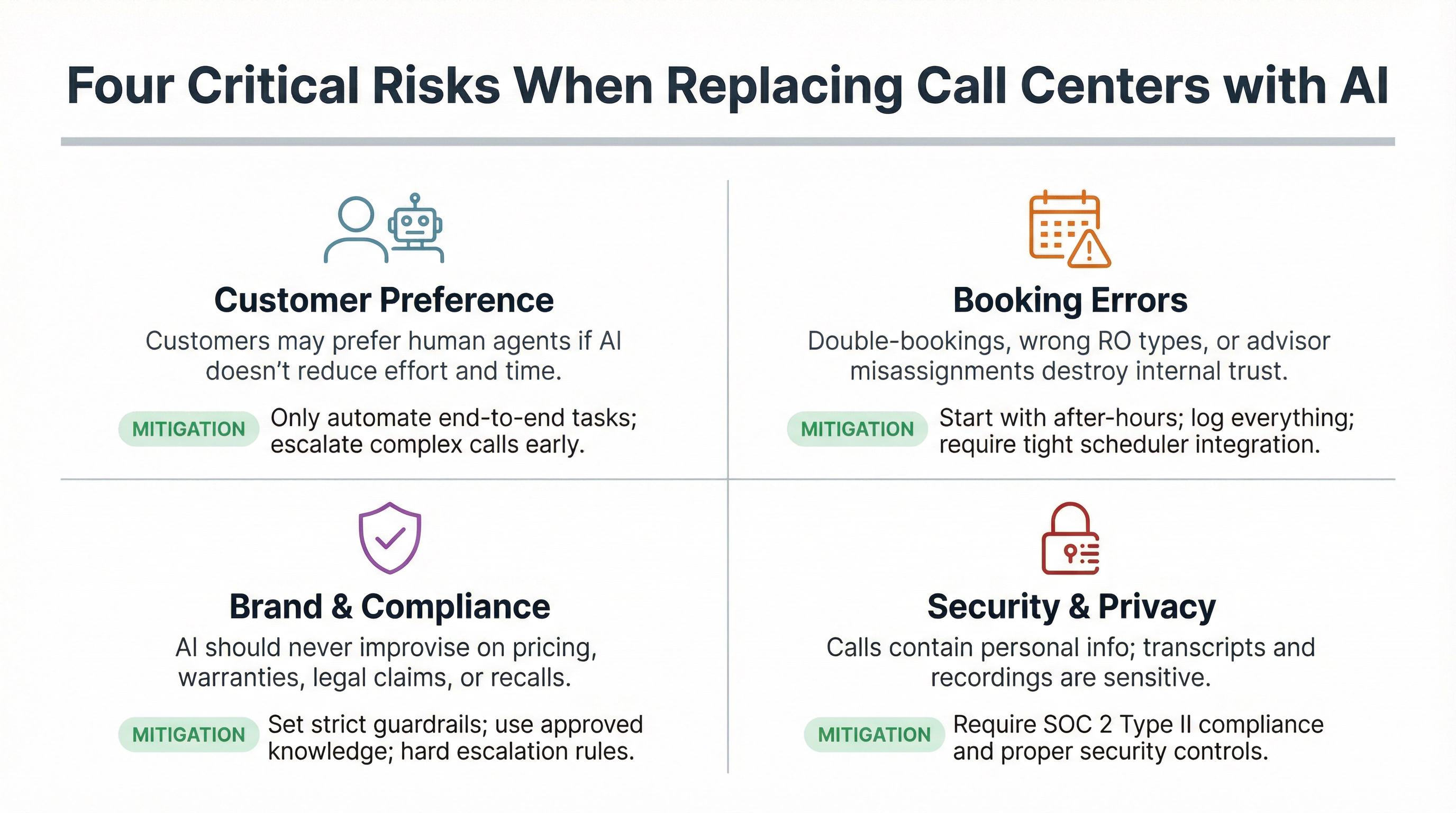
ContactBabel’s 2024 report has an interesting split. Businesses believe customers will accept AI if it resolves issues quickly, with 60% of respondents believing customers won’t always prefer human interactions. But when ContactBabel surveyed 1,000 US consumers and asked whether they’d prefer automation or a human if the time and outcome were identical, consumers still favored human help. Younger customers were more open to automation.
The translation: AI must actually reduce effort and time. If it’s just a bot with the same friction, people will hate it.
Mitigation: Only automate what the AI can reliably finish end-to-end, especially scheduling. Escalate early on emotional or complex calls.
Double-booking bays, wrong RO type, wrong advisor assignment. These mistakes destroy internal trust fast.
Mitigation: Start with after-hours and overflow. Log everything. Require tight scheduler integration (not just “request forms”).
AI shouldn’t improvise on pricing, warranties, legal claims, or recall details.
Mitigation: Set strict guardrails, use approved knowledge sources, and build hard escalation rules for anything sensitive.
Calls include personal information. Transcripts and recordings are sensitive.
Mitigation: Require proper security controls. Flai, for example, states it is SOC 2 Type II compliant in its privacy policy (updated November 2025).
This is the rollout that avoids the “big bang” failure where you flip the switch and chaos ensues.

Pull 30 days of call logs and recordings for both service and sales. Then bucket them by intent:
Calculate your baseline metrics:
If your holds are anywhere near three minutes, you’re bleeding calls.
Pick one wedge that has high volume, low complexity, and huge leakage:
After-hours service scheduling is usually the winner. Most dealerships have no coverage after 7pm, and that’s when a lot of calls come in.
Monday 10am to noon overflow is another strong candidate. That’s when call volume peaks according to the Car Wars data.
Minimum integrations that matter:
Run AI on your chosen wedge only. Review 100% of calls for the first week. Classify failures into buckets:
Fix what’s broken, then expand.
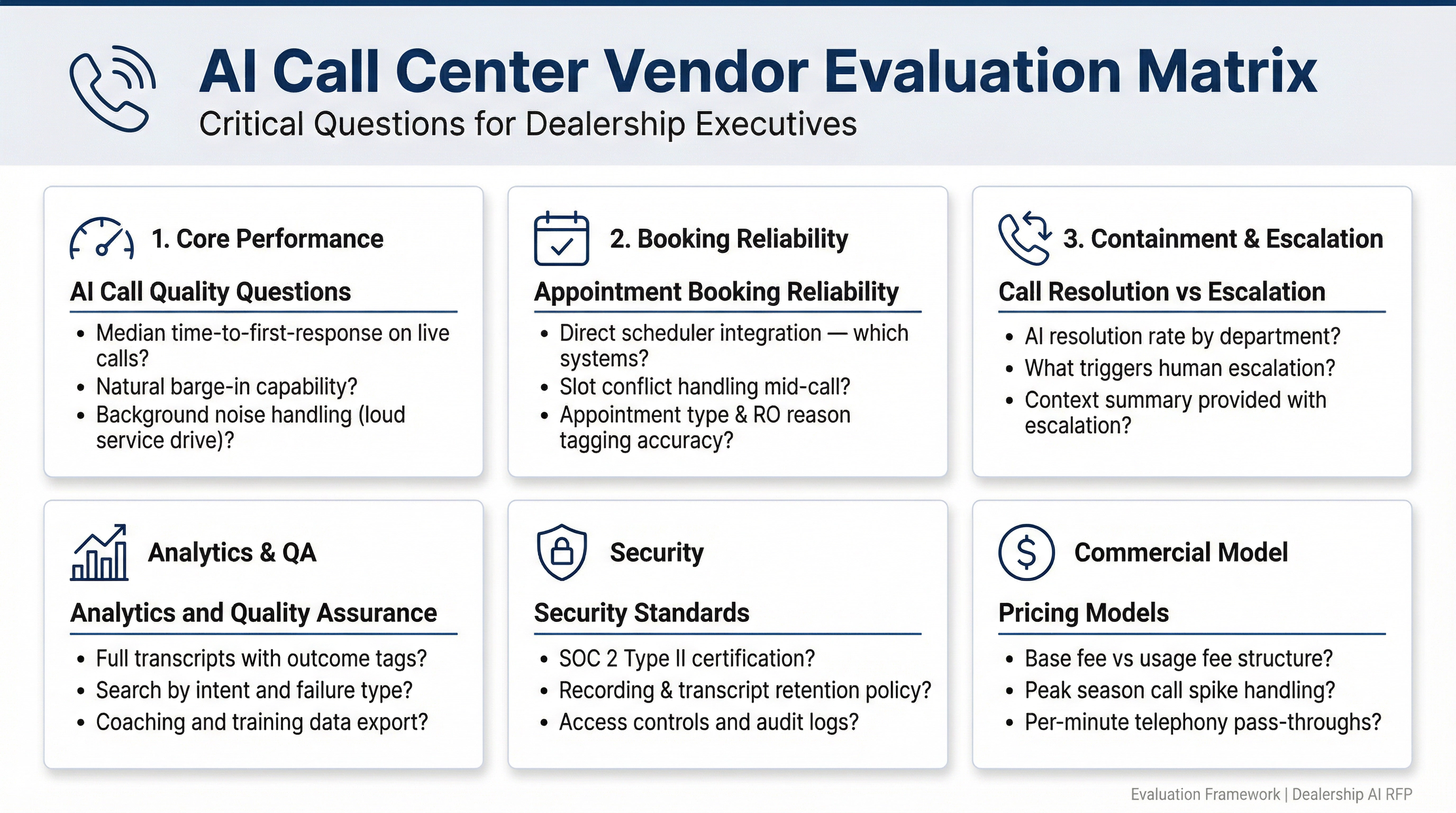
If you’re evaluating an AI replacement for your outsourced call center, don’t get hypnotized by a demo. Ask for proof.
At Flai, we built an AI communications platform specifically for car dealerships. Not a generic call center bot adapted for automotive. A system designed from the ground up for how dealerships actually work.

The Flai platform integrates directly with your existing dealership systems to handle every customer communication touchpoint before they walk in the door.
We answer every inbound phone call immediately, 24/7, for both service and sales. No call goes to voicemail. Our AI books appointments directly into your scheduler and DMS, pushes leads to your CRM, handles FAQs (hours, directions, recall checks, service status), and follows up with leads via SMS and email.
We also run outbound recall campaigns and re-engagement outreach. The goal is simple: handle all the communication before a customer walks in the door so your team can focus on the people standing in front of them.
Our Freeman Lexus case study (September 2025) showed:
| Metric | Result |
|---|---|
| Total calls handled | ~1,100 |
| Missed calls | Zero |
| Bookable calls | 426 |
| Appointments booked | 376 |
| Conversion rate | 88% |
| Estimated profit impact | $100,000 |
A CDJR dealership in the Bay Area saw monthly service appointments jump from 205 to 448 in the first month, with 304 appointments booked by the AI and an estimated $83,000 profit impact.
We integrate with your existing DMS, CRM, and scheduler. No new hardware, no complex rollout. We plug into your phone system, and calls start routing to our AI. When a human needs to take over, we do a warm transfer with full context.
The AI sounds natural because we built our own voice infrastructure instead of stitching together off-the-shelf components. Most competitors use generic voice APIs. We built the stack specifically for dealership environments: background noise in service drives, customers interrupting mid-sentence, conversations that jump between topics.
We’re SOC 2 Type II compliant, which you can verify in our privacy policy. We take data handling seriously because we know your customers’ information is on the line.
Our privacy policy details the comprehensive security measures we maintain, including encryption, firewalls, SSL, and physical, technical, and organizational safeguards that meet enterprise-grade standards.
We recently announced our integration with Tekion (December 2025), joining our existing integrations with major DMS and scheduling platforms. The goal is always the same: book real appointments in real systems, not take messages.
Will customers hate talking to AI?
They’ll hate bad AI. They’ll accept (and often prefer) AI if it’s faster and actually solves their problem. ContactBabel’s consumer research shows people still prefer humans when the time and outcome are identical. That’s exactly why AI has to win on effort and time, not just exist.
Does this mean I don’t need humans anymore?
No. The best model is AI handling high-volume, structured work (scheduling, routing, basic Q&A, follow-up) while humans handle angry customers, complex diagnostics, negotiation-heavy sales, and relationship moments. McKinsey explicitly frames the future contact center as a mix of humans and AI, not a full replacement.
Is outsourcing completely dead?
No. Outsourcing is moving “up the stack” toward more specialized, higher-complexity work. McKinsey notes many companies are migrating to vendors that blend AI with human support. Dealerships can do hybrid models too. The key is not outsourcing the core moment (booking and conversion) to a system that can’t actually resolve the call.
How long does implementation take?
Most dealerships can go live on a first use case in two to four weeks. After-hours service scheduling is usually the fastest to deploy because the scope is clear and you’re not disrupting existing workflows during the day.
What integrations are required?
At minimum: your scheduler (so AI can book real slots) and your CRM (so leads get captured). Telephony routing matters too, so calls can failover correctly.
How do I measure success?
Track these metrics before and after:
If you’re evaluating whether AI makes sense for your dealership, we’d be happy to show you what it looks like with your actual call data. Book a demo with Flai and see the difference for yourself.
As seen in