Privacy Policy
Terms of Service
Security
Status
Blogs & Guides
Dealerships miss ~35% of calls and voicemail kills most of them. The 6 reasons it destroys revenue, a 7-step fix plan, and ready-to-use scripts.
January 26, 2026
It’s Monday at 10:15 AM. Your service drive is packed. Two advisors are handling check-ins while three phones ring simultaneously. The receptionist transfers a call to service, but nobody can grab it. The customer hears four rings, then: “Please leave a message and we’ll return your call as soon as possible.”
That customer wanted to book a brake inspection. They were ready to come in this week. But they just hit your voicemail, and you’ve now entered a race against the competition. You just don’t know it yet.
If you’re a GM, Fixed Ops Director, BDC Manager, or GSM, this scenario isn’t hypothetical. It’s happening right now at your store. And it’s costing you real money.
This guide breaks down exactly why voicemail destroys dealership revenue (with specific data), what customers actually do when they can’t reach you, and a practical playbook for building a phone operation that never lets another call die.
A voicemail isn’t just “a missed call you’ll return later.” It’s a broken buying moment.
Think about what a phone call actually represents. When someone calls your dealership, they’ve already committed to:
That’s a high-effort action. This person wants to do something right now. Maybe they need to book service, confirm if a car is still available, schedule a test drive, or ask about financing. They’re not browsing. They’re acting.
When that person’s call goes unanswered, you’ve essentially told them: “Your effort doesn’t get rewarded here.”
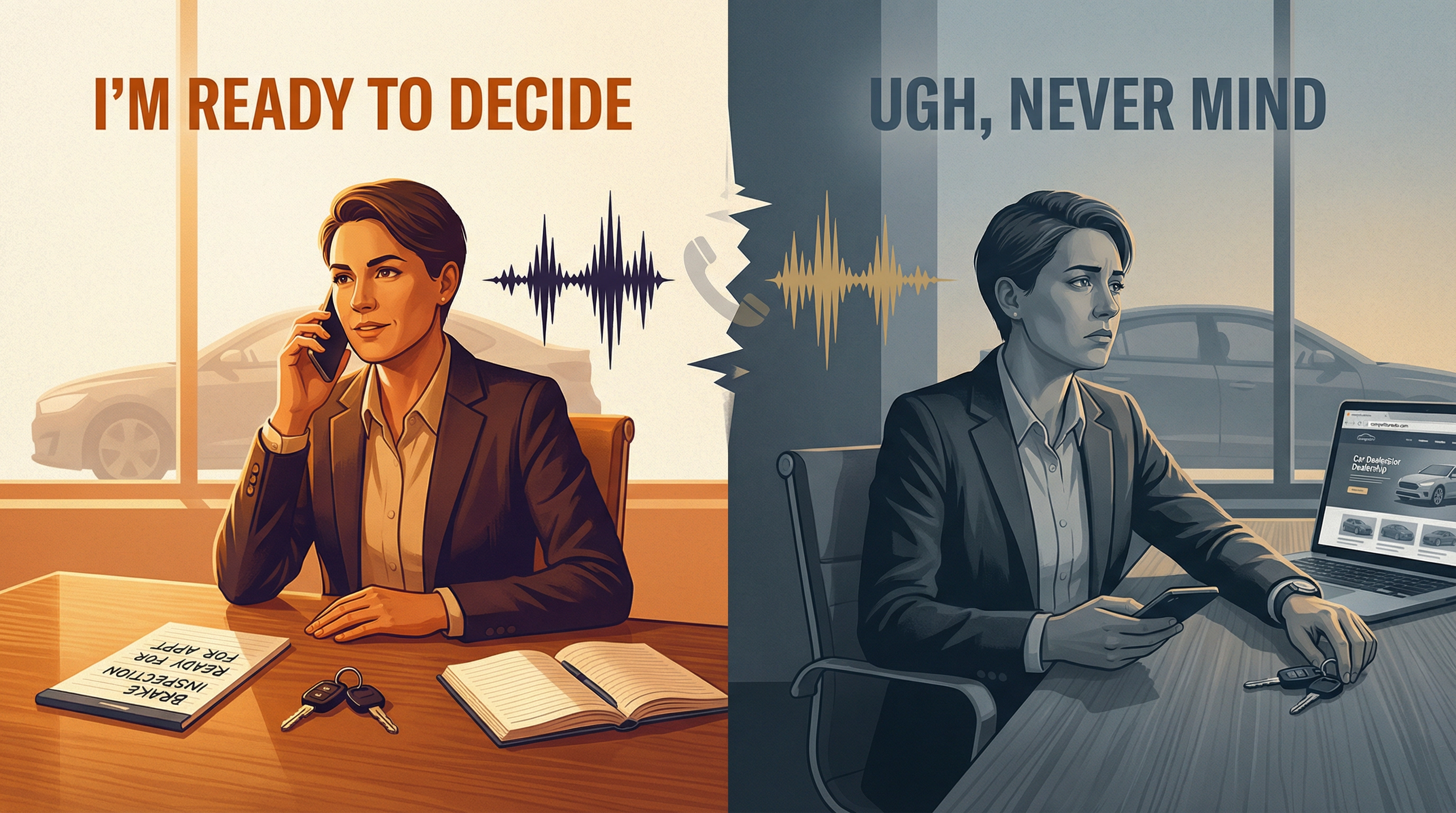
The emotional state shifts from “I’m ready to decide” to “Ugh, never mind.” And most dealerships miss this part: even if you call them back 20 minutes later, you’re not talking to the same person. The motivated buyer became a lukewarm lead. The conversion math changes dramatically.
Voicemail forces “right now” into “later.” And later almost never happens.
Industry data on dealership phone performance tells a consistent story, and it’s not a pretty one.
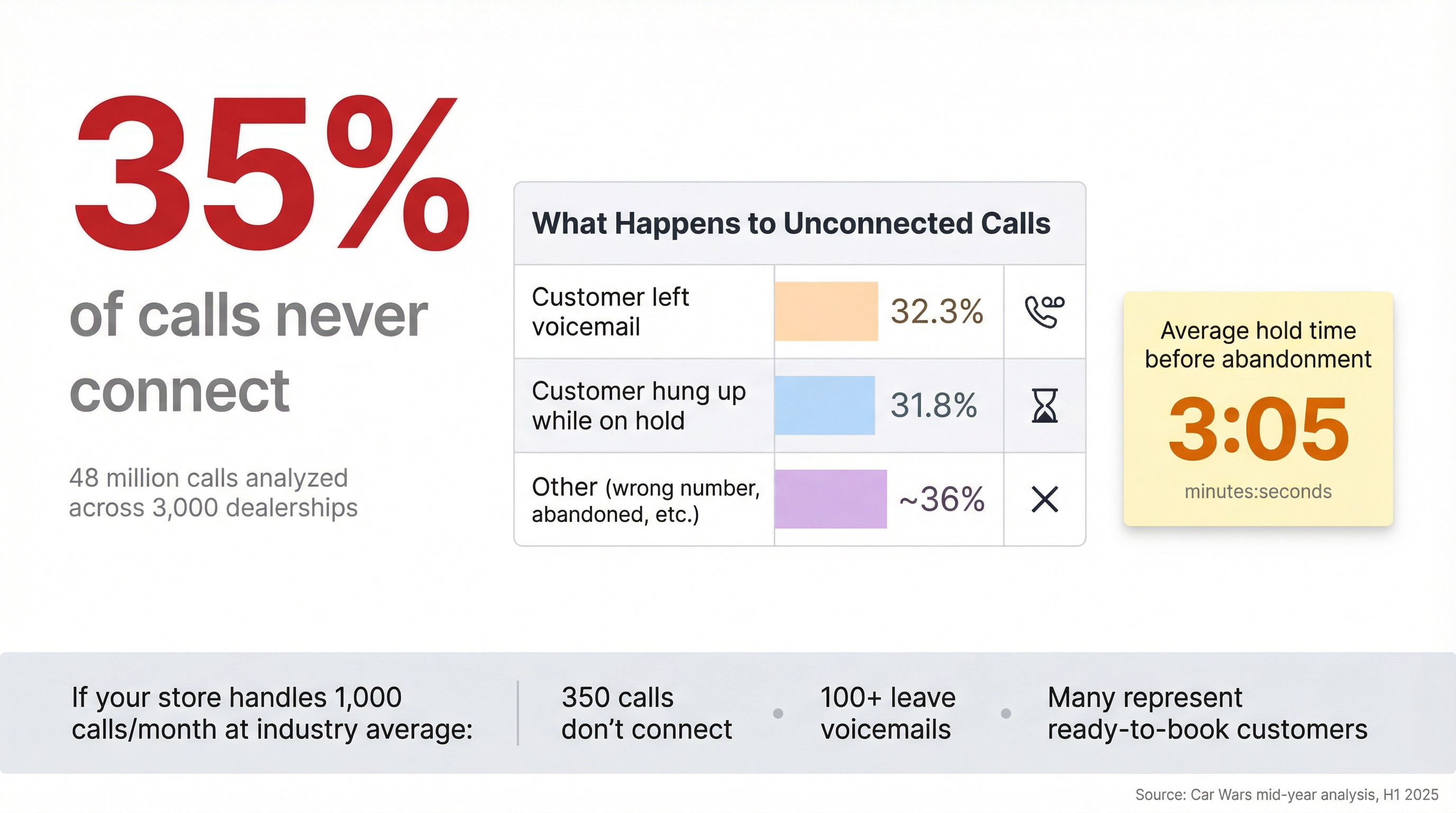
According to Car Wars’ mid-year analysis of 48 million inbound calls across nearly 3,000 dealerships (first half of 2025), the average dealership connected only about 65% of inbound calls to a qualified staff member.
That means roughly 1 in 3 calls didn’t reach someone who could help.
What happened to those unconnected calls?
| Outcome | Percentage |
|---|---|
| Customer left voicemail | 32.3% |
| Customer hung up while on hold | 31.8% |
| Other (wrong number, abandoned, etc.) | ~36% |
The average hold time before abandonment? 3 minutes and 5 seconds.
The translation is blunt: A massive share of your inbound phone demand ends in “nothing happens.” Voicemail is a major contributor, and hold abandonment is basically the same outcome with extra frustration.
This isn’t theoretical. If your store handles 1,000 calls a month and you’re at the industry average, roughly 350 of those calls aren’t connecting. Over 100 are landing in the message inbox. And many of those represent customers who were ready to book, buy, or commit.
Missed calls don’t kill deals because customers are lazy or your team doesn’t care. They kill deals because they break the mechanics of how buying decisions happen.
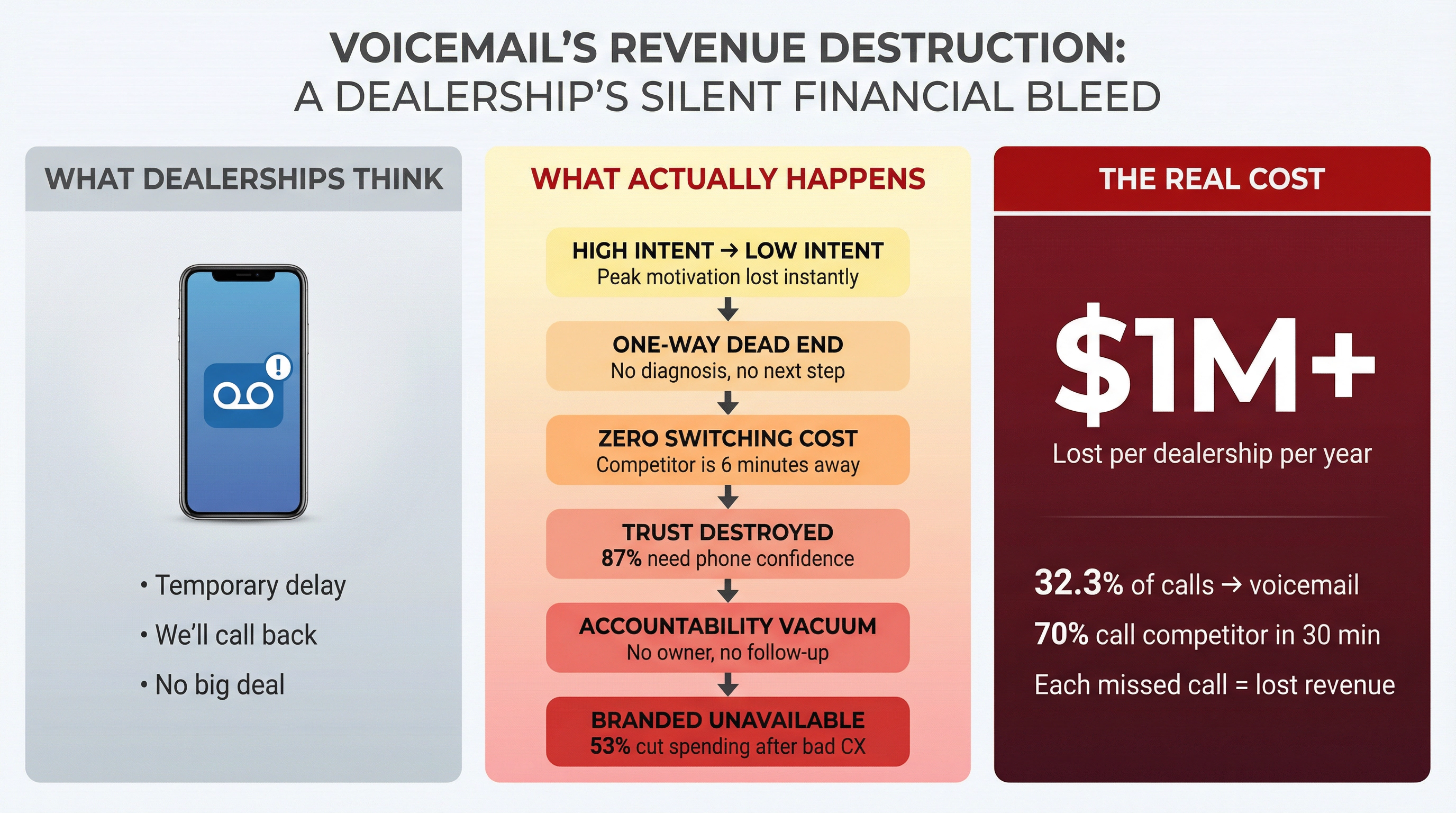
When someone calls, they’re at peak motivation. They’ve overcome inertia and picked up the phone. Hitting the message system tells them: your effort was wasted.
The psychological shift is immediate. They go from “I’m ready to book” to “I’ll deal with this later.” That “later” version of the customer is dramatically harder to convert, even if you call them back within the hour. The urgency is gone.
A live conversation can do two things a message inbox can’t:
Voicemail just collects a blob of audio. There’s no structure, no classification, no guaranteed action. When you finally call back, you’re essentially making a cold call to someone who’s already moved on mentally.
If a customer wants a Honda Accord and you don’t answer, they can call the next dealer six minutes away. Or twenty miles away. Or a broker. Or CarMax. Or an independent shop for service.
The gap between top-performing stores and average stores is massive. Car Wars and other industry analyses consistently show the same thing: the winners are the stores that simply connect.
For big decisions (and car purchases and major repairs count), people use phone calls to build confidence. Invoca’s 2024 CX research found that 87% of consumers said talking to a person on the phone made them feel more confident about high-consideration purchases.
Going to message gives them the opposite of confidence. It signals: this is going to be painful.
This is the part most dealerships miss. The message system fails not just because customers leave. It fails because dealerships don’t operationalize missed calls.
The common reality looks like this:
Missed calls become a task without an owner. And tasks without owners don’t get done.
A 2025 NADA report explicitly called this out: dealerships lose approximately $1 million each year by not following up on voicemails or transferring customers to dead extensions.
That’s not a phone system problem. That’s an ops problem.
People don’t interpret going to message as “they’re busy helping other customers.”
They interpret it as:
And that perception matters. Qualtrics’ contact center trends research (published December 2024) found that consumers are 2.6x more likely to purchase more when wait times are satisfactory, and 53% of bad experiences result in customers cutting spend.
Going to message and “sorry we missed you” is not satisfactory wait time. It’s the opposite.
This is the part that should make you uncomfortable.
CallRail’s 2025 survey of 1,000 U.S. consumers asked what happens when businesses don’t answer:
But the bigger numbers are these:
78% of consumers have taken their business elsewhere after failing to reach a company by phone.
82% say they’ll call a competitor if you don’t answer.
Read those again. Most people are not waiting around.
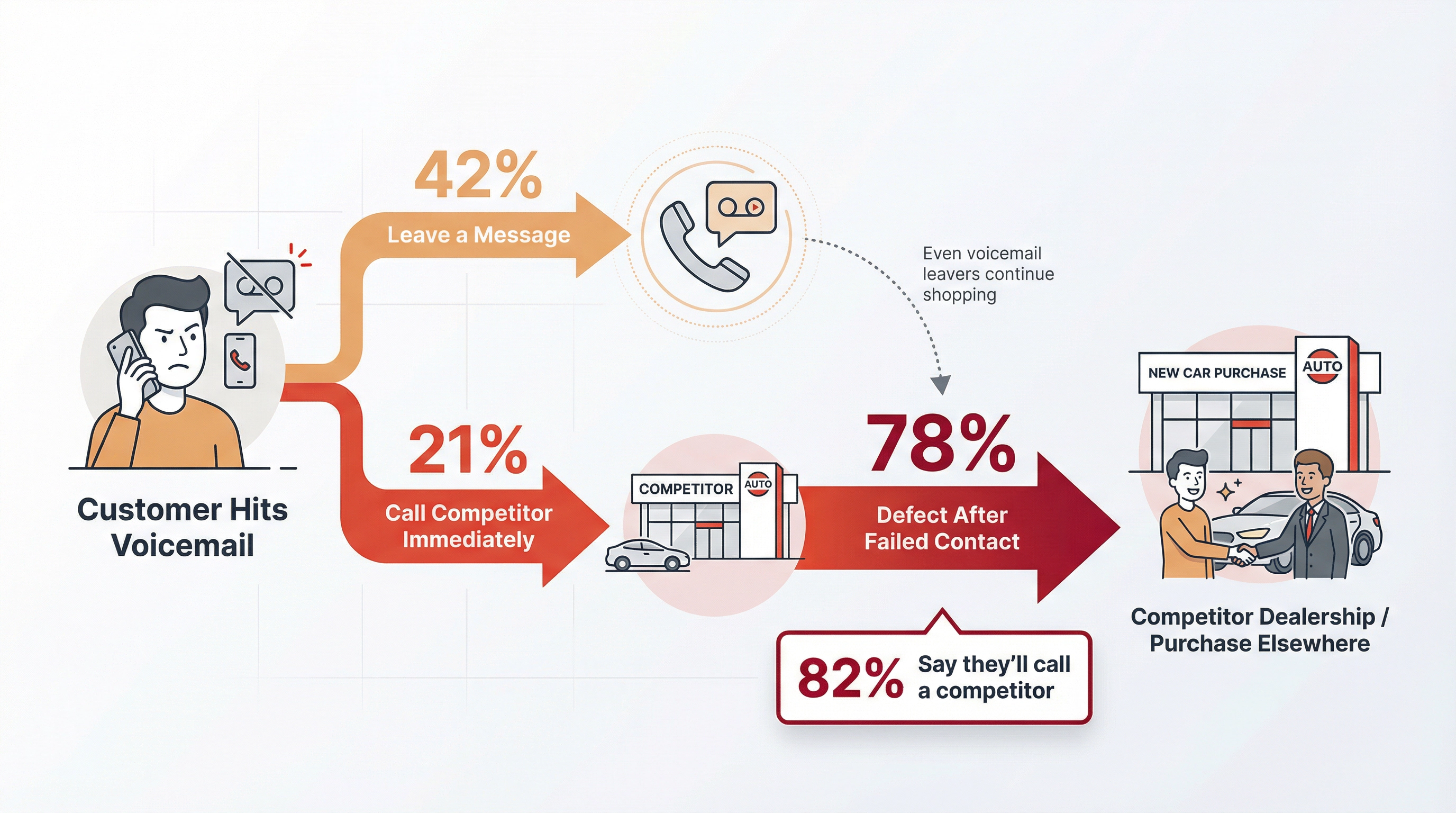
Even when customers do leave a message, you’re often just their “first attempt” before they continue shopping. This is why unanswered calls feel fine internally (because you got a message) but are catastrophic externally (because the customer is already moving to your competitor).
Most industries can survive missed calls going to message because their purchase cycles are slower. Someone shopping for software might wait a day for a callback. Someone researching a vacation can check email.
Dealerships can’t afford that slack. Phone calls are simultaneously the highest-intent channel AND the most operationally constrained channel.
Your marketing spends money to make the phone ring. But your busiest moments are exactly when you can’t answer.
And the missed-call windows aren’t random. Industry analysis shows that peak missed-call pressure happens in the morning hours (8:00 to 11:30 AM), accounting for about half of appointment-related calls.
So the worst time for phones going unanswered (high intent, high urgency) is also the most common time for it (peak volume, staff overwhelmed).
Your marketing is working. Your phone system is breaking.
You’ll recognize this pattern. It happens in most rooftops.
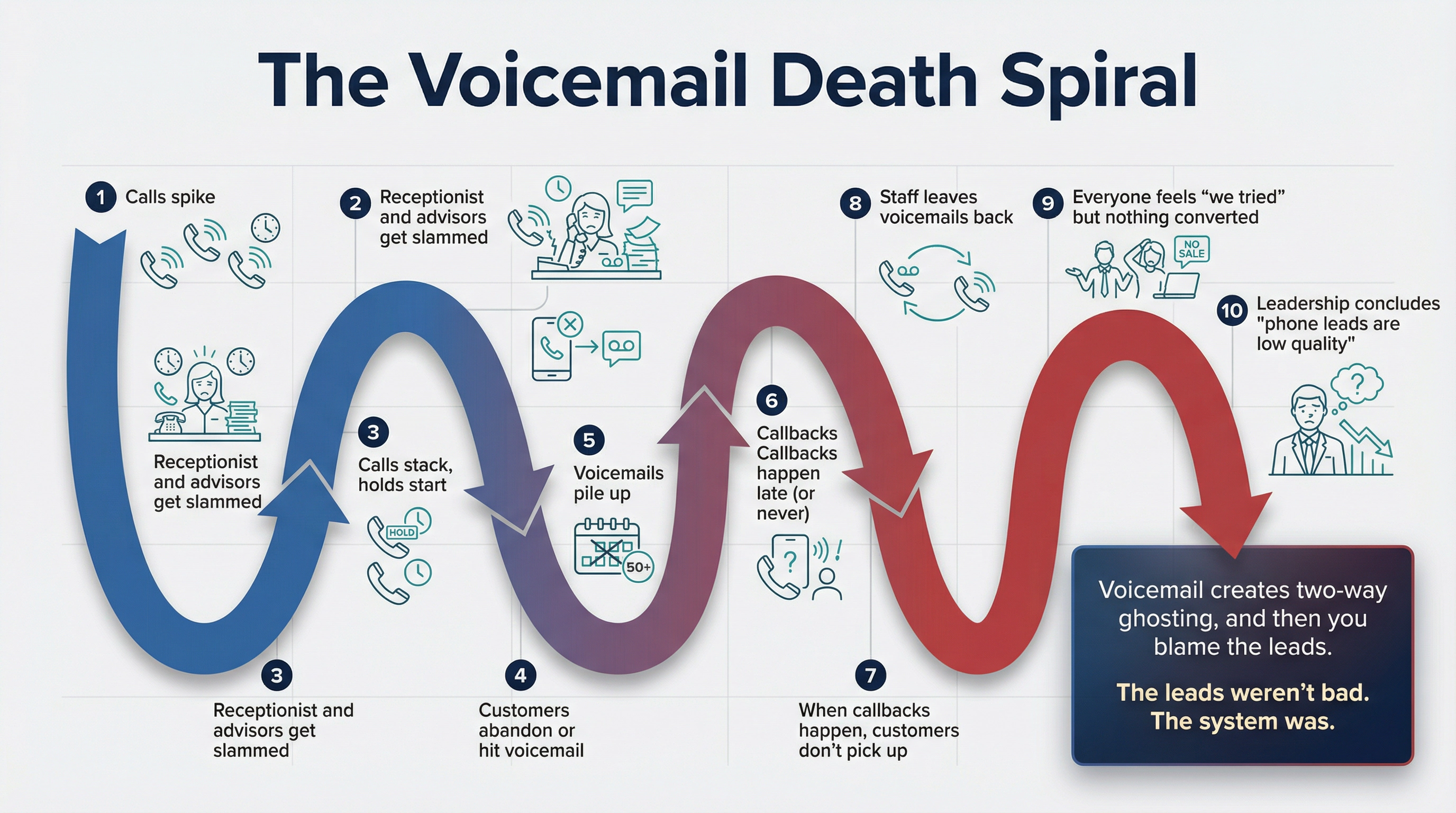
Missed calls create two-way ghosting, and then you blame the leads.
The leads weren’t bad. The system was.
If you’re serious about fixing this, here’s the playbook. These aren’t theoretical suggestions. They’re specific actions you can take this week.
The message inbox is a fallback you tolerate when you don’t have a system. The goal is to build a system where calls going to message basically never happens.
Before you fix anything, you need numbers you can track weekly. Most dealerships can’t answer basic questions like “what’s our connection rate?” or “how many unanswered calls did we get yesterday?”
Track these 7 metrics:
If you don’t measure it, unanswered calls become background noise. And that’s how they keep killing your revenue without anyone noticing.
NADA’s reporting explicitly flags lost revenue from transfers to bad extensions. This is one of the easiest fixes you can make.
Do this audit:
Then enforce these rules:
Most dealerships have transfer paths that end in a dead message box, and nobody’s audited them in years. Find them and kill them.
Most dealerships do “leave a message and we’ll call you back.” That’s not a promise. It’s a vibe.
You need scheduled callbacks with a specific time commitment.
Medallia research found that scheduled callbacks could solve long wait issues, but only 1 in 5 consumers report being offered that option.
That gap is your opportunity.
Minimum viable version:
Example script:
“I’m sorry, we’re helping customers in the drive right now. I can call you back in 10 minutes or today at 4:30. Which works better?”
This transforms a missed call from “hope they call back” into “scheduled phone appointment.” And that changes conversion rates dramatically.
Dirty secret: even when you call back fast, people often miss your callback.
SMS fixes that.
The workflow:
→ Missed call happens
→ Within 30-60 seconds, caller gets a text
Template:
"Hey, we just missed your call. What were you calling about? Reply:
Or just tell us in a sentence."
This does two things:
Car Wars’ hold-time data (3:05 average) confirms what you already feel: customers are waiting long enough to quit. And CallRail’s research found that 41% hang up after just 1-2 minutes on hold.
If you routinely put people on hold, you’re literally training customers to leave.
Practical solutions:
Pick a specific standard your team can actually execute. Not a goal. A standard.
Examples:
Then enforce it like a financial control. Because it literally is one.
There are four real options for handling phone coverage. And honestly, each one has clear tradeoffs.
| Model | Best For | Strengths | Where It Fails |
|---|---|---|---|
| In-House BDC | Groups with scale and strong ops leadership | High empathy, brand fit | Turnover, weekends, peaks, after-hours |
| Outsourced Call Center | Stores needing immediate 24/7 coverage | Predictable availability | Quality varies, often just "message taking" |
| Voicemail + "We'll Call Back" | Nobody | It's free? | Everything else |
| AI Voice Receptionist | Stores wanting 24/7 coverage + real outcomes | Instant answer, can book, never tired | Requires quality AI (bad AI hurts you) |
The “leave a message” option is the default, and it’s the worst option. If you’re relying on it as your after-hours or overflow strategy, you’re choosing to lose revenue.

At Flai, we built our platform specifically for the failure modes this article is about:
What Flai actually does:
We didn’t bolt together off-the-shelf voice components. Our founding team (ex-HappyRobot engineers who built voice AI for logistics, plus a Netflix data scientist) built our voice stack from scratch specifically for dealership environments. That’s why conversations sound natural and booking actually works. Flai is part of Y Combinator’s S25 batch and has raised $4.5 million in seed funding led by First Round Capital.
San Leandro CDJR (October 2025):
Freeman Lexus (September 2025):
Glendale Infiniti (November 2025):
The common thread: these stores stopped letting calls die. And the revenue followed.
You probably need Flai if:
You might not need AI voice solutions if:
For most dealerships, you’re leaving money on the table right now. And you probably know it.
If you want a simple framework, here it is:
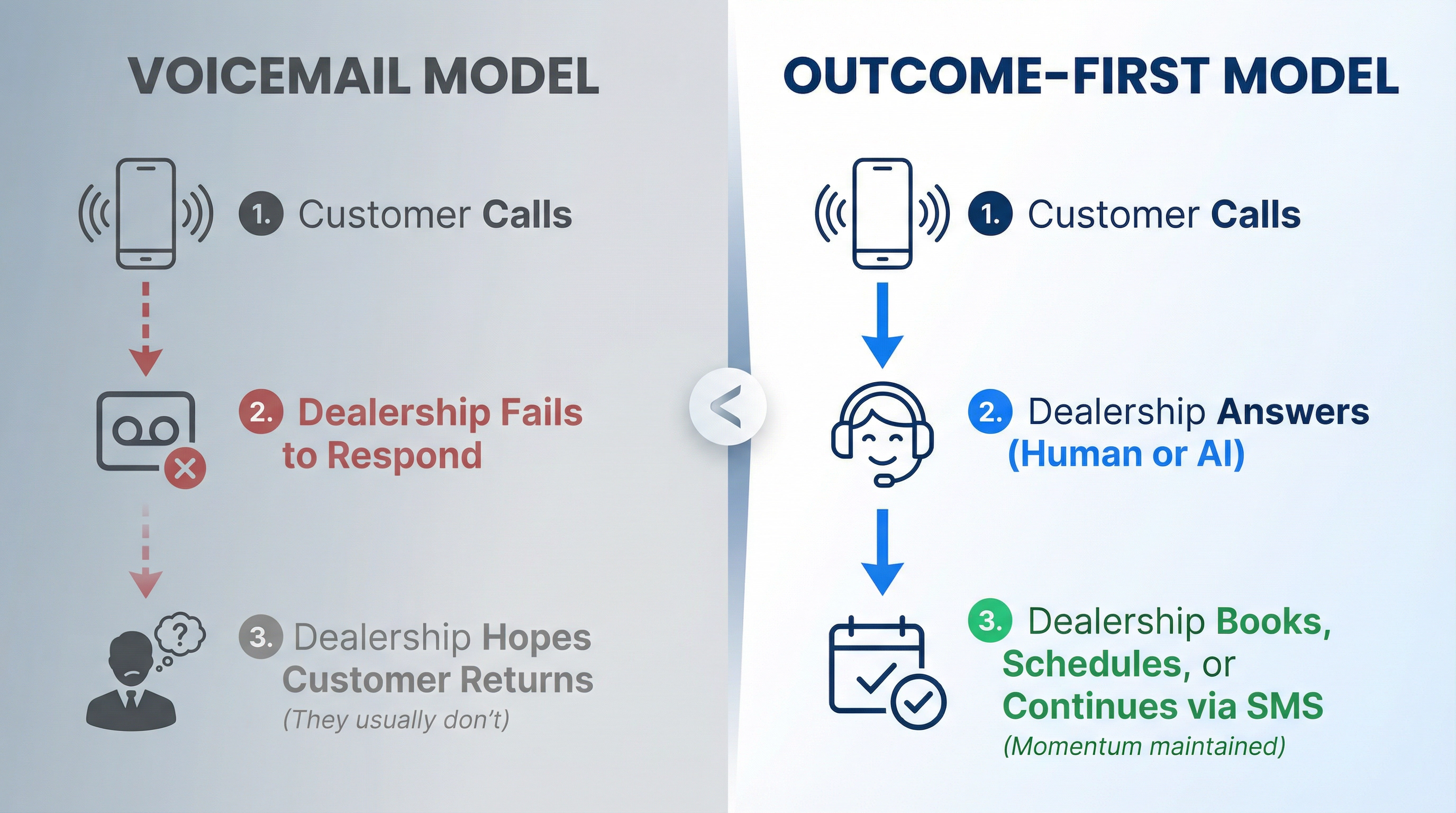
| Voicemail Model | Outcome-First Model |
|---|---|
| Customer calls | Customer calls |
| Dealership fails to respond | Dealership answers (human or AI) |
| Dealership hopes customer returns | Dealership books, schedules, or continues via SMS |
The outcome-first model matches what customers actually want: momentum.
And momentum is basically the entire game in dealership sales and service. People want to get things done. Help them get things done.
These are ready to deploy. Modify the language to fit your store’s voice.
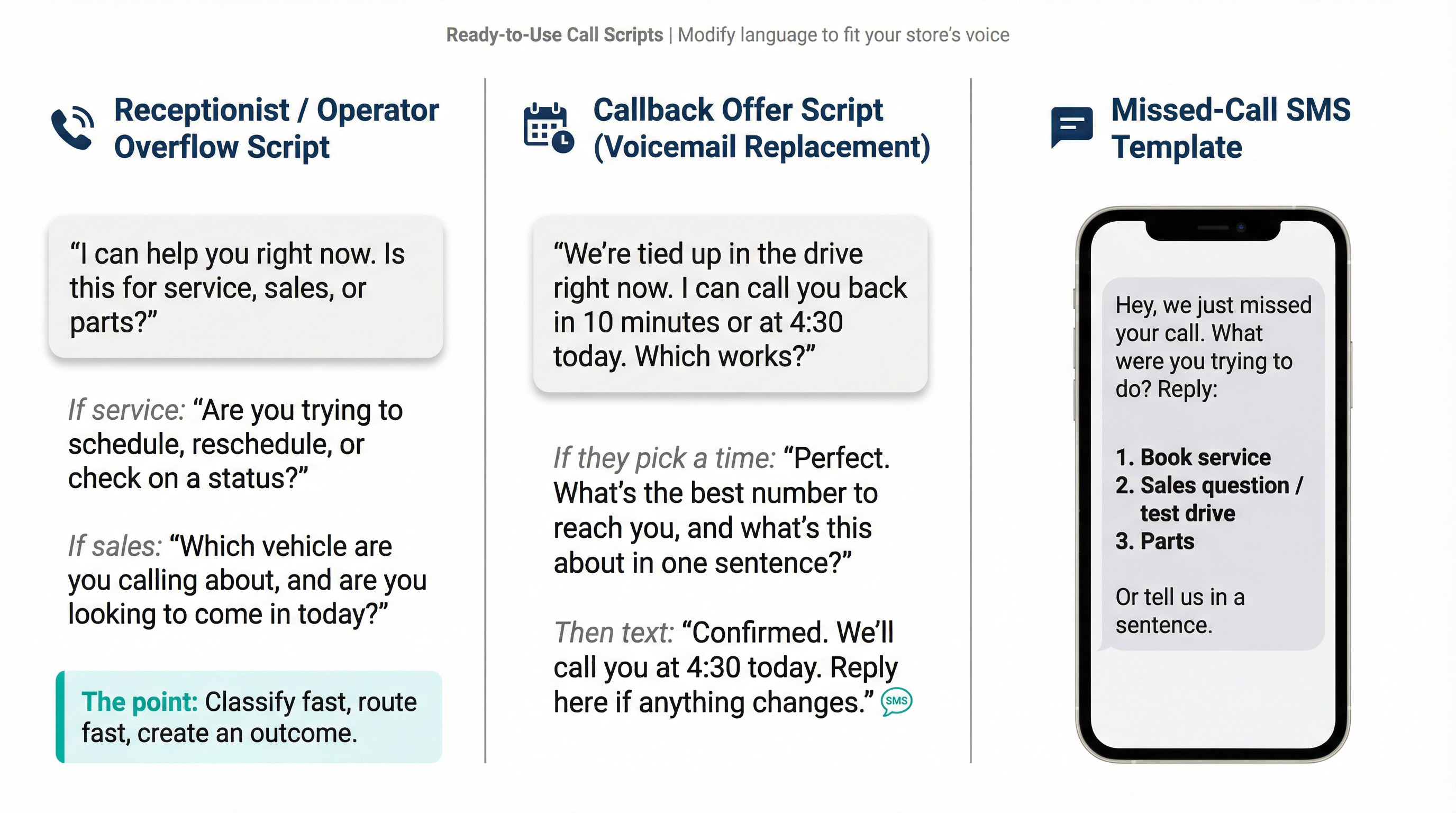
“I can help you right now. Is this for service, sales, or parts?”
If service: “Are you trying to schedule, reschedule, or check on a status?”
If sales: “Which vehicle are you calling about, and are you looking to come in today?”
The point: Classify fast, route fast, create an outcome.
“We’re tied up in the drive right now. I can call you back in 10 minutes or at 4:30 today. Which works?”
If they pick a time: “Perfect. What’s the best number to reach you, and what’s this about in one sentence?”
Then text: “Confirmed. We’ll call you at 4:30 today. Reply here if anything changes.”
"Hey, we just missed your call. What were you trying to do? Reply:
Or tell us in a sentence."
You don’t need perfect attribution. You need reasonable ranges.
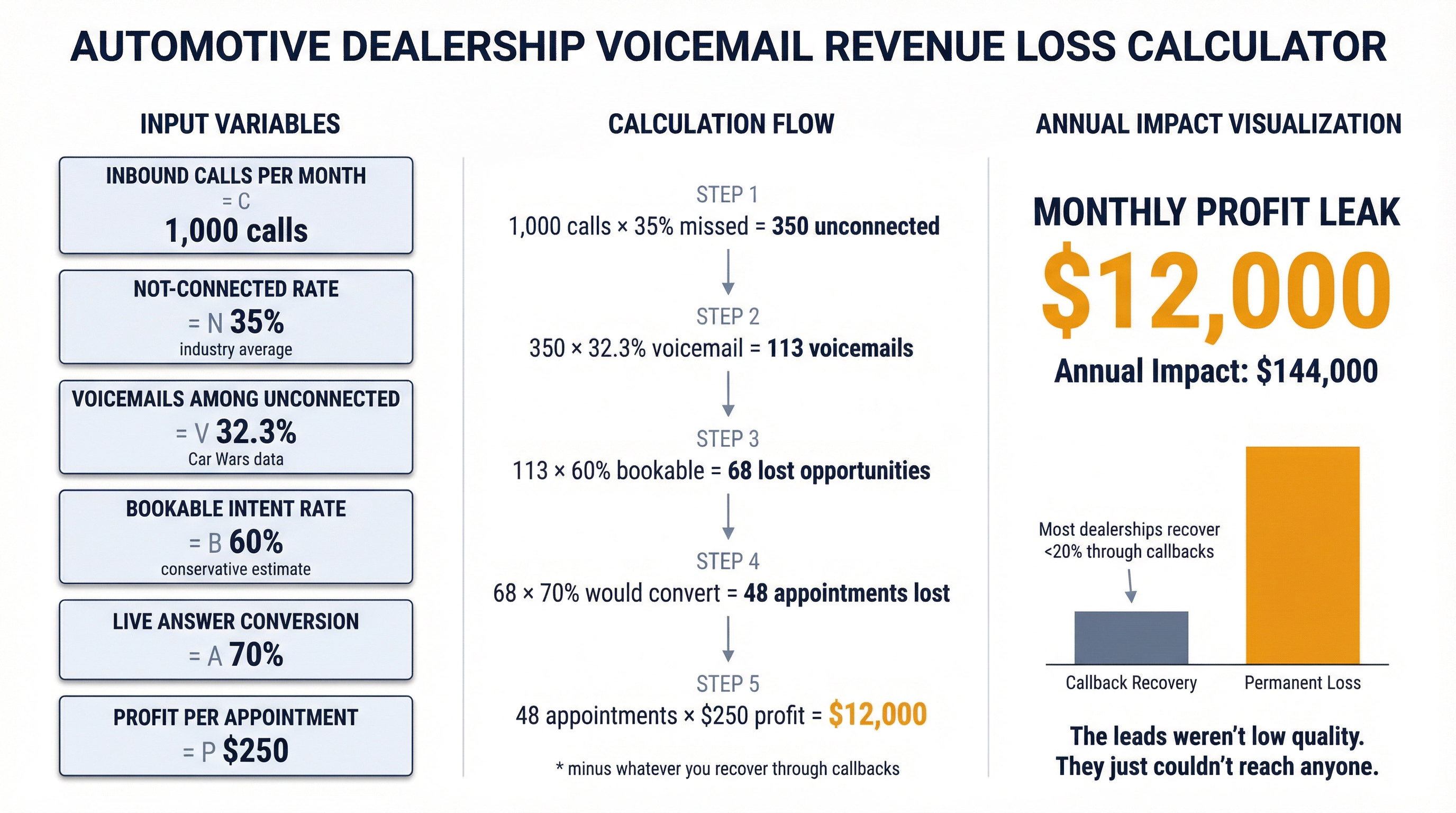
Estimated monthly profit leak:
(C x N x B x A x P) minus whatever you actually recover through callbacks
Even with conservative assumptions, you’ll usually hate the number.
And it gets worse when you realize: you’re paying for marketing to generate these calls, then letting the calls die, then blaming marketing for “low quality leads.”
The leads weren’t low quality. They just couldn’t reach anyone.
This comes up a lot, so let’s address it directly.
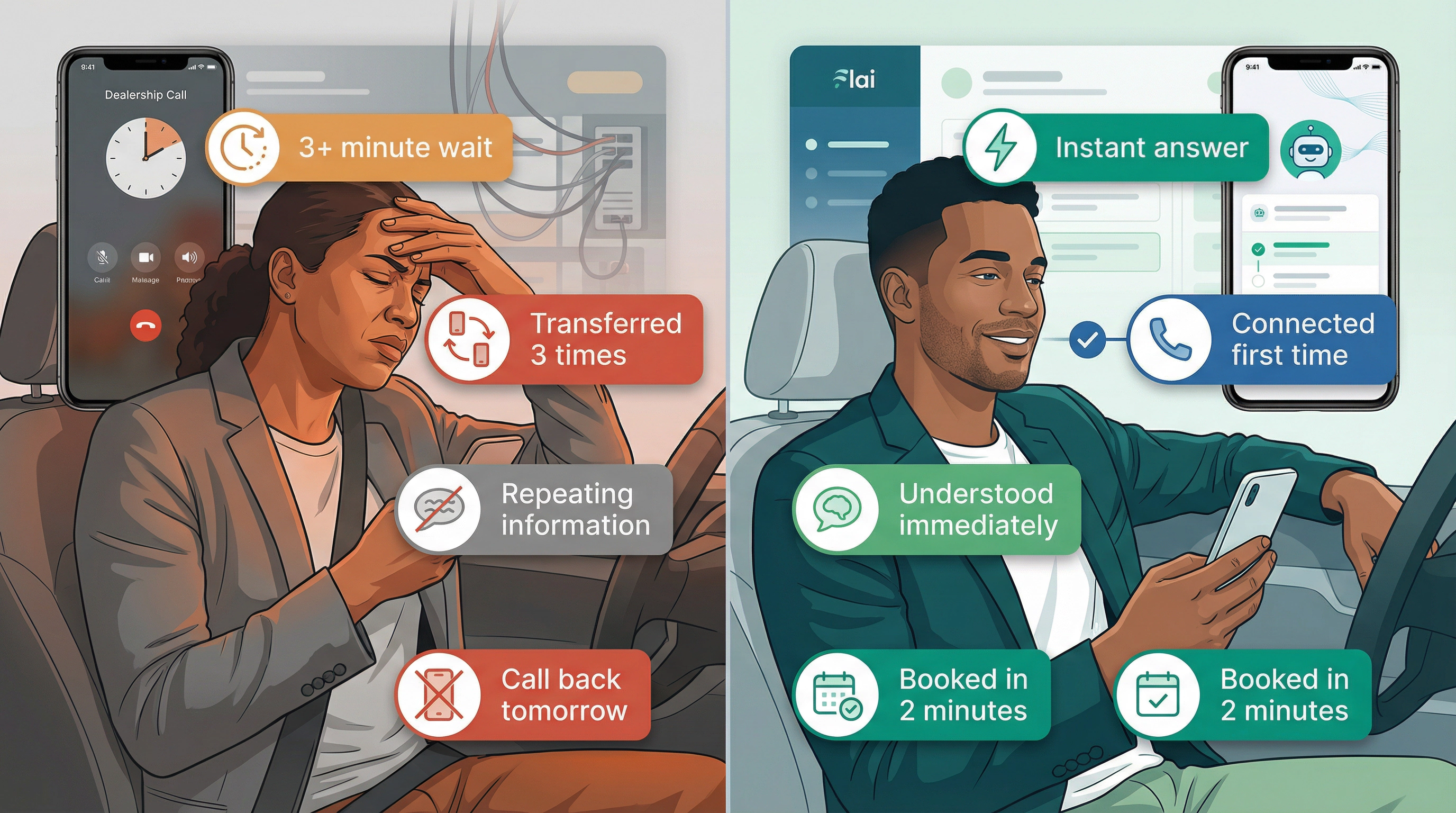
Customers don’t hate bots. Customers hate:
When an AI solves those problems, customers actually prefer it.
CallRail’s 2025 survey found:
The question isn’t “human vs. robot.” The question is: Does it answer instantly? Does it route correctly? Can it actually book into real systems? Does it escalate cleanly when needed?
If the answer to all four is yes, most customers will prefer that over a message system and hold music.
But there’s an important caveat: Qualtrics’ research emphasizes that AI has to be great or it will hurt your brand. Bad AI (awkward pauses, misunderstandings, dead ends) is worse than voicemail because it actively frustrates people.
That’s why we built Flai from scratch with dealership-specific voice AI, not generic chatbot technology. The quality bar matters.
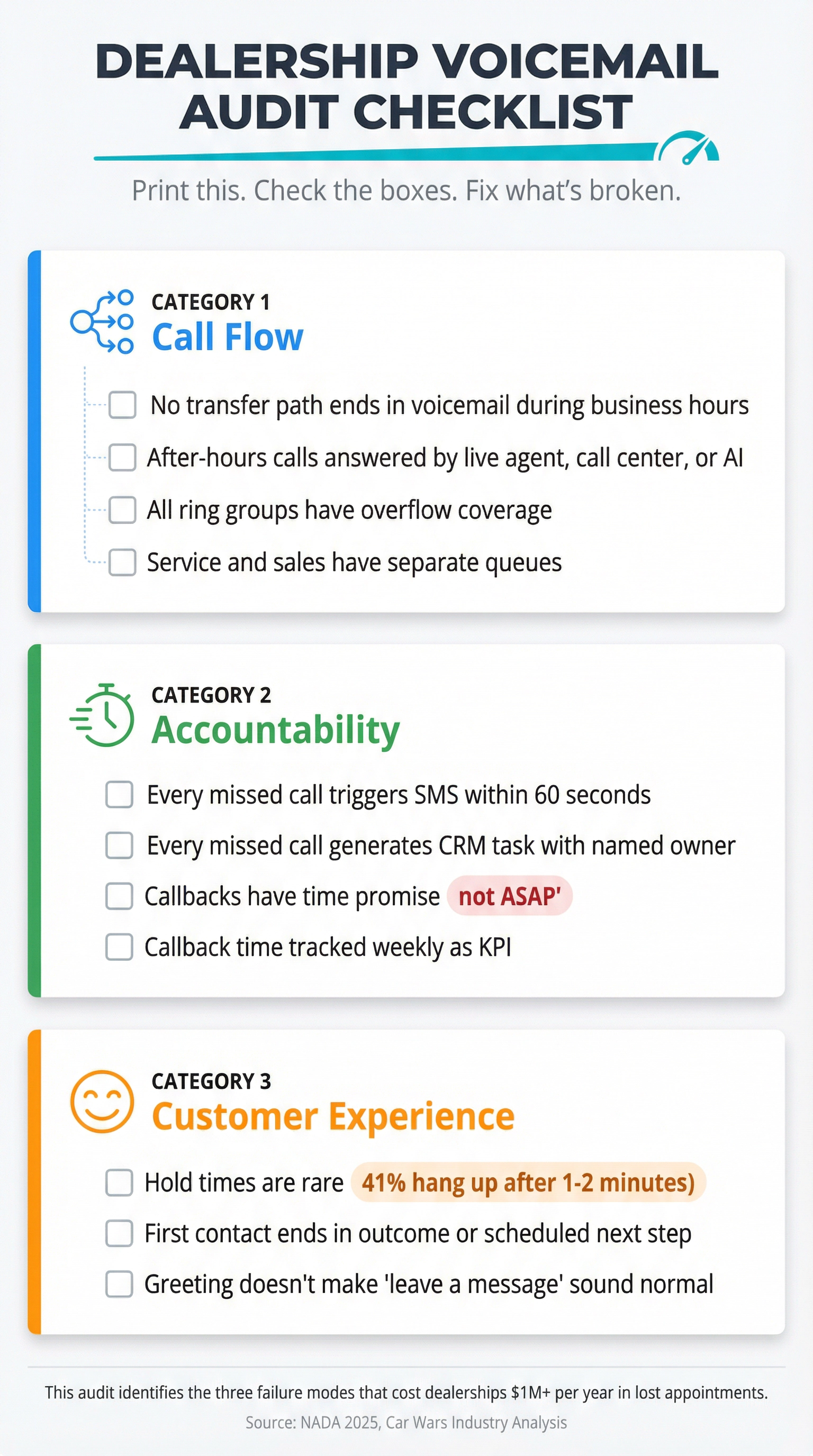
If you do nothing else from this guide, run this audit. Print it out and check the boxes.
CallRail’s research shows that 21% of customers immediately call another business when their first call isn’t answered. And 82% say they’ll call a competitor if you don’t pick up. The window is measured in minutes, not hours.
It depends on your call volume and current connection rate, but here’s a rough frame: if you’re at the industry average (65% connection rate), about 35% of your inbound calls aren’t reaching anyone. If even a fraction of those are bookable appointments worth $200-300 in profit, the math adds up fast. Flai case studies show $80,000-$100,000 monthly profit impact at individual rooftops.
Yes, but only if the AI is properly integrated. Generic voice bots often just take messages. Purpose-built AI voice platforms integrate directly with your DMS, CRM, and scheduler, which means they can check real availability and book appointments that actually show up in your system. That’s a critical difference.
Flai warm-transfers to your team with full context (why the customer called, what they need, relevant details). It’s not a blind transfer where the customer has to repeat everything. If no one is available, Flai schedules a specific callback time and sends a confirmation. The goal is never to dead-end a customer.
A BDC is great during staffed hours when volume is manageable. But most BDCs can’t cover 24/7, struggle during peak spikes, and face turnover challenges. AI voice solutions work alongside your BDC as overflow and after-hours coverage, catching what humans can’t. It’s not replacement. It’s reinforcement.
Modern AI voice platforms are designed to plug into your existing phone system without hardware changes. Implementation is typically fast (days, not months) because the AI just needs to be connected to your phone lines and integrated with your scheduler. The founders have visited 400+ dealerships in person and built the product to work with real dealership chaos, not idealized scenarios.
The “voicemail problem” isn’t a phone system quirk or a staffing inconvenience. It’s a revenue system failure.
And the fix isn’t telling people to call back faster. The fix is building a machine where every call becomes one of three things:
Anything else is just politely losing customers to competitors who figured this out.

The stores that win on phones aren’t doing anything magical. They just decided voicemail isn’t acceptable. They built systems where calls don’t die.
Flai can be that system for you. Or you can build something else. But the status quo of hoping voicemails get returned, hoping customers call back, hoping leads don’t defect?
That’s a choice to leave money on the table. And you don’t have to make it.
As seen in