Privacy Policy
Terms of Service
Security
Status
Blogs & Guides
Your dealership loses $1M yearly from missed calls. This 2026 AI guide shows how to capture every lead, book 24/7, and add $80-100K monthly profit.
April 16, 2026
Your dealership is probably losing over a million dollars a year from missed phone calls alone. And that number doesn’t even account for leads slipping through on nights, weekends, and lunch rushes.
This isn’t speculation. Industry data from Car Wars shows the average hold time at dealerships hit 3 minutes and 5 seconds in 2024. Nearly a third of unconnected calls? Customers hanging up while on hold. Another third? Voicemails that often go unheard.
The fix isn’t more headcount. It’s smarter systems.
This guide covers everything you need to know about deploying AI in your dealership in 2026. We wrote it for the people who actually have to make this work: dealer principals, fixed ops directors, BDC managers, GSMs, and ops leaders who are tired of watching revenue walk out the door.
If any of these describe you, keep reading:
By the end of this guide, you’ll have:
A dealership runs on two revenue engines:
| Revenue Engine | What Drives It |
|---|---|
| Service | Recurring, high-margin, scheduling and communication intensive |
| Sales | Lead-driven, dependent on speed-to-contact and follow-up discipline |
AI “works” in dealerships when it accomplishes one of two things:
Removes latency. Answers instantly. Responds instantly. Schedules instantly.
Removes inconsistency. Follow-ups don’t slip. Callbacks don’t get forgotten. Processes don’t depend on one hero employee who happens to care more than everyone else.
Everything else is noise.
The Cox Automotive 2025 Service Industry Study dropped a stat that should concern every dealer: general repair shops are now slightly ahead as the most preferred service provider. We’re talking 33% general repair versus 31% dealership preference.
The brutal part? It’s not primarily about price.
The takeaway: If you can win on convenience and communication, you can win back share. This is exactly where AI creates an edge.
JD Power’s 2024 CSI study found mass-market owners waited an average of 5.2 days for a service appointment (up from 4.8 days in 2023).
Also notable: customers now prefer text updates (68%) over phone calls (16%).
You can’t “phone only” your way through 2026. Multi-channel communication that doesn’t collapse under load is table stakes.
Car Wars data from their 2024 analysis:
Lost revenue from phones isn’t complicated. It’s just lost conversations.
Digital Dealer’s December 2025 report found 74% of dealers are investing in AI voice agents. The targets: lead response, inbound call management, and service scheduling.
CDK Global’s January 2026 analysis reinforces this:
Your competitors are buying capacity and speed. Doing nothing is a strategy. You just won’t like where it leads.
People mix up four distinct categories constantly. Here’s how to think about them:
This is the money bucket. Direct revenue impact in days or weeks.
-> Inbound phone answering (service and sales)
-> SMS and email follow-up
-> Scheduling and rescheduling
-> Recall outreach
-> Status updates and two-way messaging
-> Triage and warm transfer to humans when needed
This guide focuses on Bucket A because that’s where most dealerships get immediate, compounding returns. The other buckets matter too. But communications is where you stop the bleeding first.
If we were running a dealer group, this is the order we’d implement them.
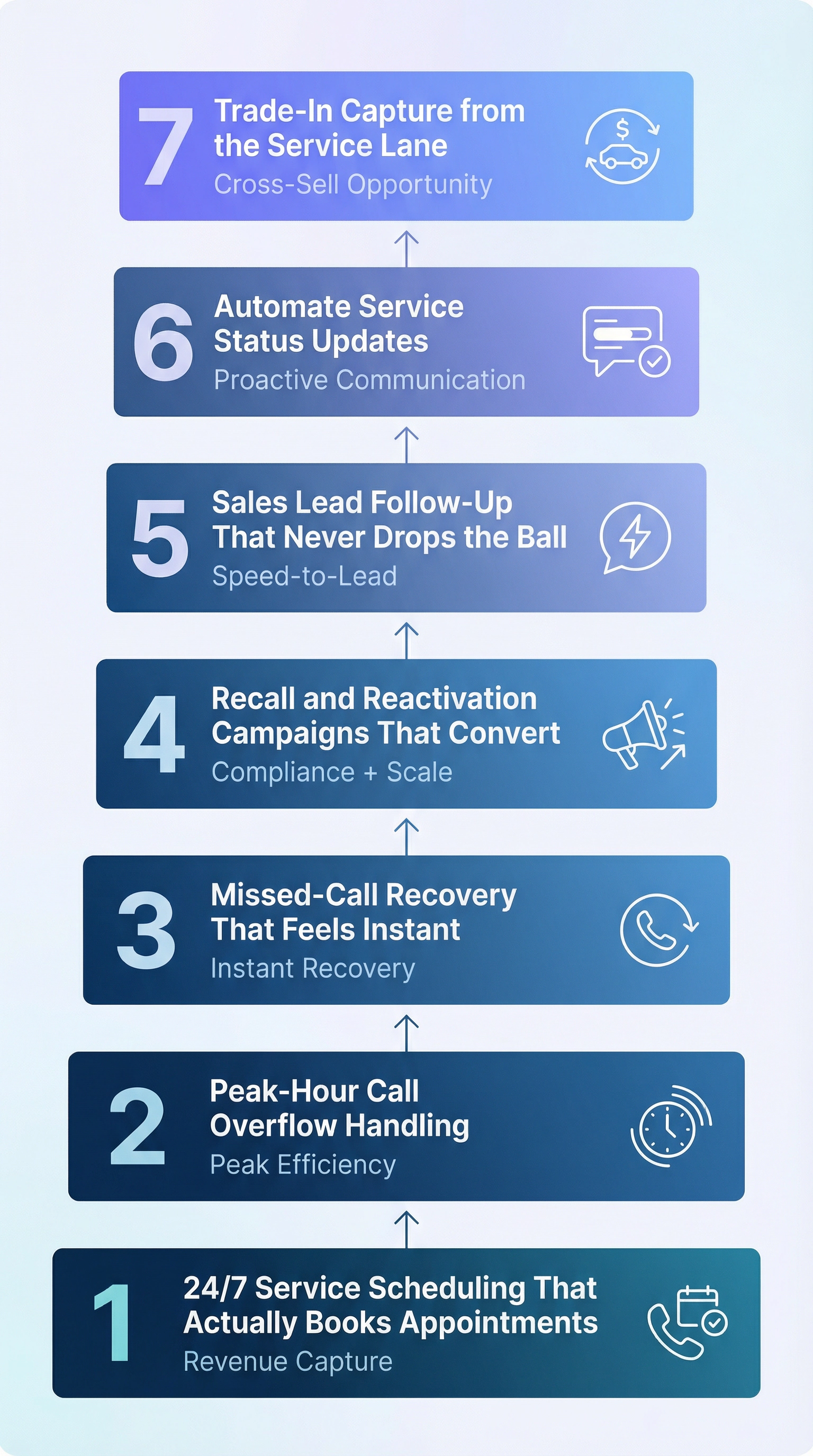
Why it prints money: Most service demand arrives when staff isn’t perfectly available. Early mornings. Lunch spikes. Evenings. Weekends. If you answer and schedule instantly, you capture customers before they defect.
What “good” looks like:
Pied Piper’s 2025 study found AI-handled calls at dealerships scheduled appointments successfully 86% of the time (versus 90% for human-handled calls). The AI successfully handled the call 91% of the time.
The catch: When AI couldn’t handle a request and attempted to transfer to a human, those handoffs failed 56% of the time.
So the lesson isn’t just about the bot. It’s about handoff design.
This covers the “Monday 10 AM to noon” and “everyone is slammed” scenarios. AI doesn’t need to replace humans here. It catches the second and third ring lines so you stop bleeding calls. For a vendor-by-vendor breakdown of options here, see our guide to call overflow solutions for dealerships.
Best practice setup:
Even with solid staffing, you’ll miss calls. That’s just math.
AI can call or text back within seconds, collect intent and details, schedule or route appropriately, and log everything for humans to follow up.
This becomes especially powerful after hours. “Call back tomorrow” is functionally “lose the customer.”
Most recall work fails because it’s operationally annoying. Lists, compliance concerns, manual dialing, voicemails, low pickup rates.
AI makes it a pipeline:
(1) Outbound SMS or calls in batches Run campaigns at scale without burning advisor time.
(2) Plain language explanation Explains the recall clearly, without jargon or legalese.
(3) Direct booking Offers appointment times and books directly into the scheduler.
(4) Automated follow-up Follows up if no response, with appropriate spacing.
(5) Smart escalation Escalates edge cases to staff with full context.
Speed-to-lead matters. But consistency matters more.
The common failure pattern:
AI can respond immediately via SMS, email, or phone. It answers basic inventory questions, sets test drives, and pushes qualified leads to CRM with full context.
Cox’s study shows frustrations are heavily communication-driven. Among people who experienced frustration at the dealership, top issues include “service took longer than expected” (24%) and various pricing and communication gaps.
AI helps by:
Cox’s data reveals a major underused opportunity:
| Opportunity | Data Point |
|---|---|
| Consumers receiving trade-in value during service | Only 14% |
| Consumers highly interested in getting trade-in value | 33% |
| Repair cost level triggering trade-in consideration | $3,195 |
AI can detect “big repair” conversations, offer a quick trade-in value estimate, and route hot trade-in interest to sales with context.
This loop is underused at almost every dealership.
Use this framework to avoid buying random tools that don’t stack together coherently.
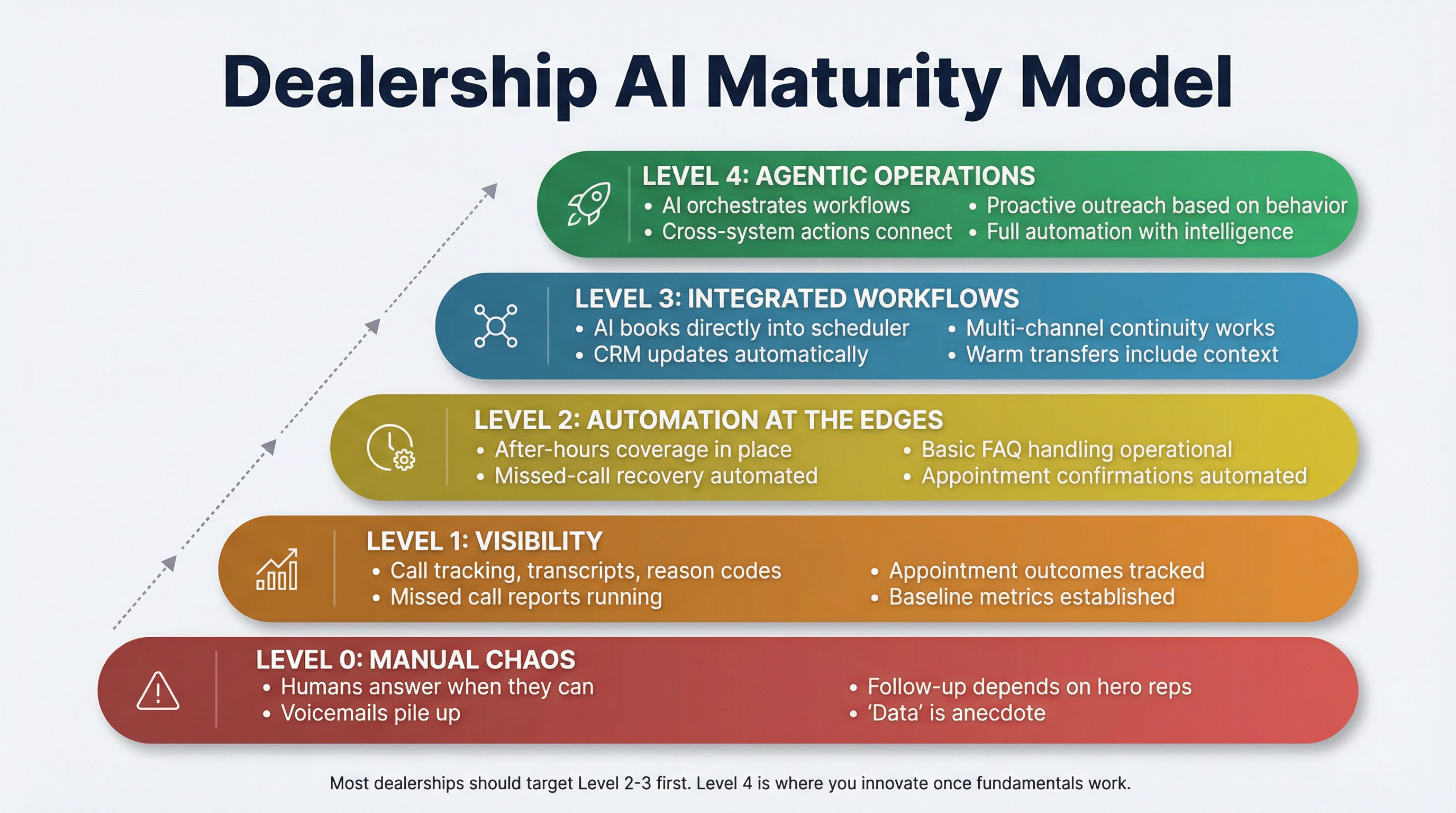
Most dealerships should aim for Level 2 to Level 3 first. Level 4 is where you get creative once the fundamentals work.
Here’s the scorecard we’d actually use. Feel free to drop this into an RFP.
| Question | What "Good" Looks Like |
|---|---|
| Median time to answer? And P95? | Immediate, consistently |
| Median time-to-first-spoken-token? | No awkward multi-second dead air |
| Outage handling and failover? | Degrades gracefully (callback, route to human) |
| Can it handle 10+ concurrent calls? | Yes, without quality degradation |
Define “containment rate” as the percentage of calls fully resolved without a human.
Questions to ask:
Reality check: Use Pied Piper’s data as a benchmark. AI can perform extremely well, but handoffs to humans often break. Test handoffs aggressively.
This is where most “AI for dealerships” solutions die.
Must-have integrations:
Example of real integration: Flai announced an integration with Tekion so dealers can connect Flai’s communications platform with Tekion’s Automotive Retail Cloud. The goal: reduce manual data entry and improve data flow.
Questions to ask:
If your store lives on phone plus text, your AI should too.
JD Power’s data is the hint: customers prefer text updates. Your system should not be phone-only.
If your AI does outbound calling or texting, this isn’t optional.
The FCC explicitly confirmed that TCPA restrictions on “artificial or prerecorded voice” cover current AI technologies that generate human voices. Calls using such technologies generally require prior express consent (absent emergency purpose or exemption).
Questions to ask:
Note: This guide isn’t legal advice. Involve counsel for your specific outbound programs.
You want “appointments, revenue, and show rate.” Not “AI interactions.”
Minimum dashboard requirements:
We built Flai specifically for this challenge. Our AI communications platform handles everything before the customer walks in the door: phone calls, SMS, email, recall outreach, and sales follow-up.

What makes us different:
We built our voice AI from scratch. Most competitors stitch together off-the-shelf components. We built our own infrastructure to keep conversations fast and natural. Fewer awkward pauses. Fewer moments where the AI talks over the customer. That’s why calls feel smoother and customers respond better.
Deep integrations that actually work. Flai connects to your DMS, CRM, scheduler, and phone system. When a customer calls to book service, we check real availability, book the slot, confirm the details, and write it back to your systems. This is what produces industry-leading bookable rates.
Multi-channel orchestration. If a human is needed, the platform warm-transfers with context. If a callback is required, it triggers and tracks it. For sales leads and service outreach, we follow up by phone, text, and email as actual two-way conversations.
Real results from the Freeman Lexus case study:
| Metric | Result |
|---|---|
| Total calls handled | ~1,100 |
| Missed calls | Zero |
| Bookable calls | 426 |
| Appointments booked | 376 |
| Success rate | 88% |
| Estimated profit captured | $100,000 |
The math is simple. When you stop missing calls and book directly into the scheduler, revenue moves.
This playbook avoids “we turned it on and chaos happened.”
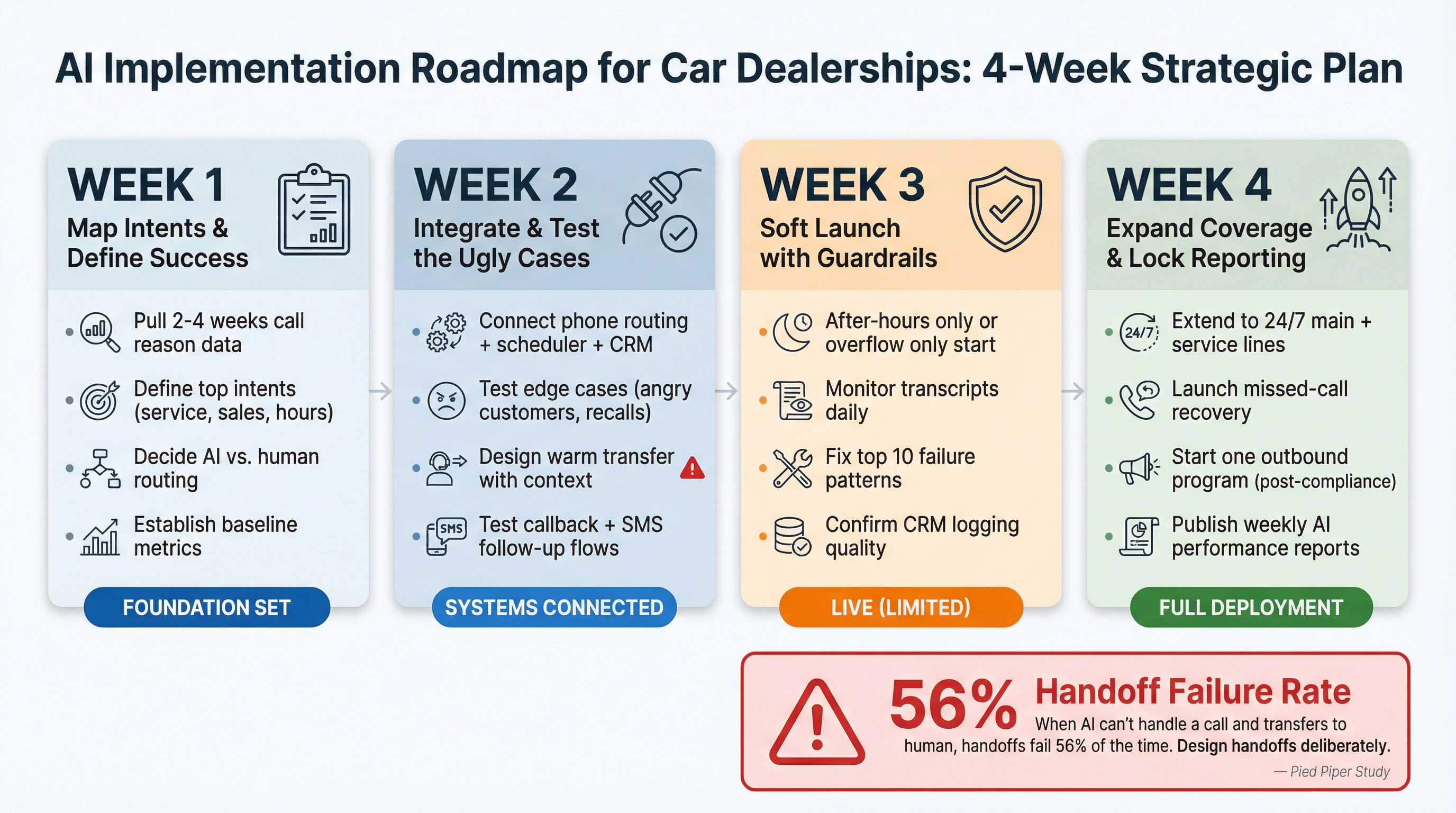
Connect phone routing (main line, service line, overflow) plus scheduler and CRM at minimum.
Test these edge cases:
Design handoffs deliberately:
Warning: Remember Pied Piper’s finding: handoffs fail 56% of the time if you don’t design them deliberately. Don’t skip this.
| Metric | Definition |
|---|---|
| Answer rate | Answered calls / total calls |
| Time to answer | Ring to pickup |
| Abandonment rate | Hangups before conversation starts |
| Transfer success rate | Successful warm transfers / attempted transfers |
| Containment rate | Calls fully resolved by AI / total calls |
| Appointment set rate | Appointments set / bookable calls |
You don’t need perfect attribution. You need a reasonable model.
Industry analysis reports dealerships miss an average of 158 calls per month, with the 75th percentile at 216 missed calls. Using an average repair order of $450, that implies approximately $1.17 million in annual lost revenue at the 75th percentile.
Replicate this with your own numbers:
Annual revenue at risk = Missed service calls per month x Average $ per RO x 12
Not every missed call becomes an RO. But you don’t need 100%.
Recovered revenue = Annual revenue at risk x Recovery rate
Recovery rate could be 10% to 40% depending on:
Breakeven RO count per month = Monthly platform cost / Gross profit per incremental RO
The Freeman Lexus case study shows roughly $266 profit per appointment ($100,000 from 376 appointments).
If profit per incremental appointment is ~$266, every 10 additional kept appointments generates ~$2,660 in profit.
AI isn’t magic. It’s a system. And systems fail in specific ways.
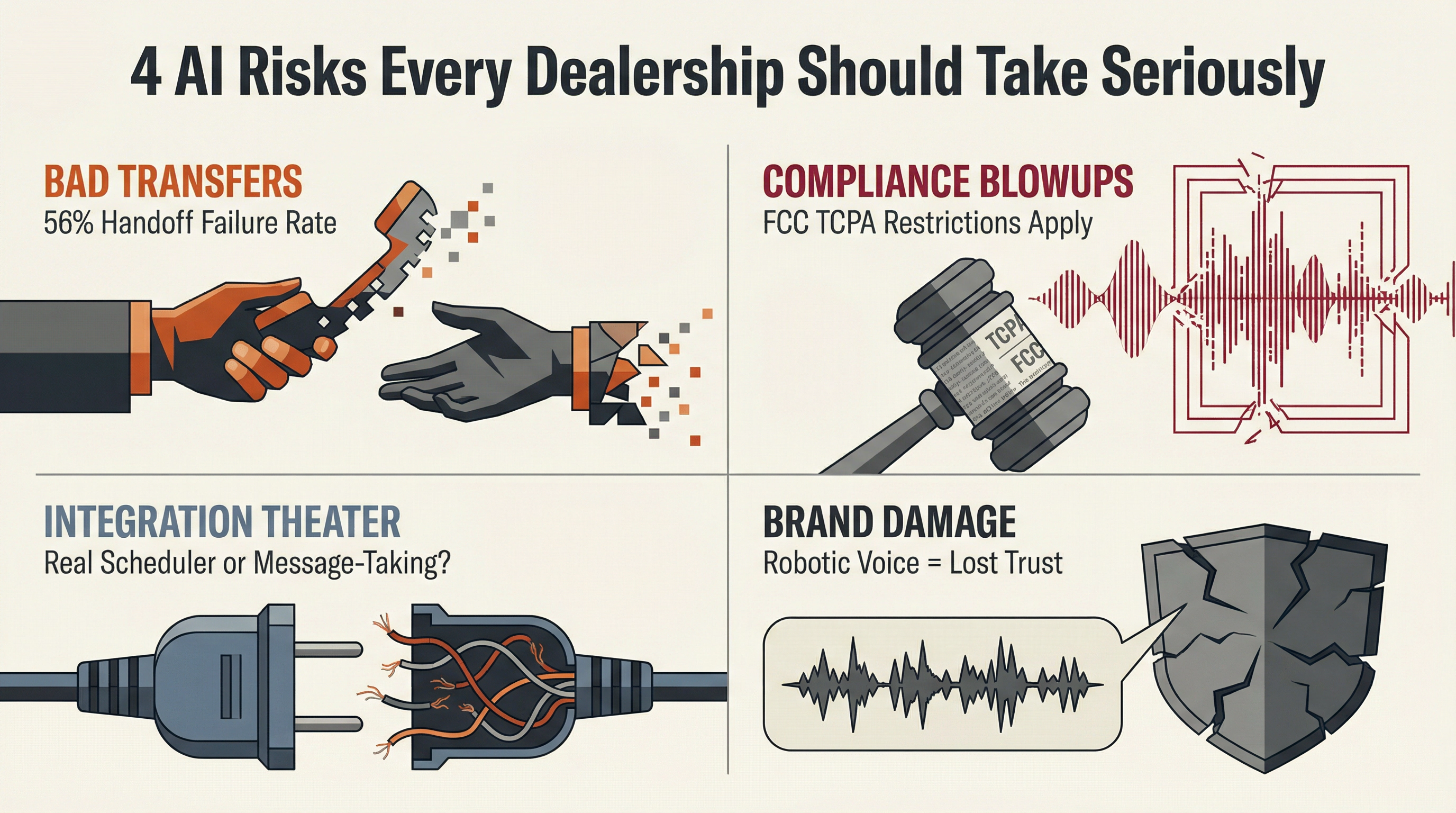
Pied Piper found that when AI couldn’t handle a request and attempted to transfer to a human, handoffs failed 56% of the time.
The fix: Treat handoff design as a first-class feature. Measure transfer success the same way you measure appointment rate.
The FCC clarified that AI-generated human voices are covered under TCPA restrictions on artificial and prerecorded voice. Prior express consent is required absent an exemption.
The fix: Consent, DNC lists, disclosures, opt-out methods, and audit logs. Get counsel involved before scaling outbound.
A bot that can’t book in the real scheduler will devolve into message-taking. Message-taking is not what you’re paying for.
The fix: Demand references for your exact stack (scheduler, CRM, DMS) and test live booking.
If the AI sounds robotic, talks over customers, or can’t handle upset callers, it can harm trust.
The fix: Test with real calls. Include service managers in the pilot. Require escalation paths.
Customers hate three things more than they hate AI:
Your job is to make the experience faster and more effective than the current mess. If you accomplish that, acceptance is usually fine.
Usually it changes your BDC, not eliminates it.
AI handles the repetitive, high-volume work. Humans handle the complex, emotional, or high-value situations. Your BDC becomes more like “deal closer plus exception handler” than “call grinder.” For a side-by-side cost and ROI comparison, see AI vs traditional BDC.
Start where you have:
For many rooftops, that’s service scheduling plus overflow.
Pricing varies widely and changes fast. The better question:
How many incremental appointments do I need to break even?
Use the breakeven formula above, then pressure-test vendor claims with your own call logs.
With proper planning, most dealerships can go live with basic coverage in 2 to 4 weeks. Full integration with all edge cases handled typically takes 30 to 60 days.
Every system makes mistakes. The question is how you handle them. Good AI platforms provide:
Yes. Platforms like Flai support multilingual conversations, which is critical for diverse markets and improving CSI scores.
If you’ve read this far, you have a decision to make.
Option 1: Continue with the current system. Hope hold times improve. Hope follow-up discipline gets better. Hope customers don’t defect while on hold.
Option 2: Treat communications as the infrastructure problem it is. Deploy AI that answers every call, books directly into your scheduler, and follows up consistently.
The dealers making the second choice are capturing revenue that the first group is losing. Every day you wait, someone else answers those calls.
Ready to stop the leak? Talk to Flai.
As seen in