Privacy Policy
Terms of Service
Security
Status
Blogs & Guides
Buying AI voice agents for your car dealership? This guide covers the 12 critical questions, ROI math, and red flags to avoid before you sign anything.
January 27, 2026
If you’re searching for the best AI voice agent for your car dealership in 2026, you’re not looking for “cool AI.” You’re trying to buy reliability. Every caller gets answered, every bookable call turns into an appointment, and every interaction logs cleanly into your existing stack without creating compliance or customer-experience disasters.
This guide is for fixed ops directors, GMs, BDC leaders, and dealer group ops teams who want a buying decision that survives real traffic: Monday mornings, after-hours, irate customers, Spanish calls, and the inevitable “the scheduler is down” day.
A dealership voice agent purchase succeeds if it does these 5 things consistently:
1. Answers fast (every time)
Not “usually,” not “unless it’s busy.” Calls are perishable. If someone waits, they call another store.
2. Resolves the call to a real outcome
Priority order: book appointment, warm transfer, callback with commitment, capture lead and close the loop.
3. Books into the real system of record
If it can’t book into the same scheduler your store actually uses, it’s mostly message-taking with a nicer voice.
4. Protects the brand during edge cases
Angry customers, warranty questions, pricing disputes, safety issues, or “I’m stranded” calls need careful handling.
5. Doesn’t create new legal or security risk
Outbound consent, opt-outs, call recording rules, and vendor security controls are non-negotiable in 2026. The FTC explicitly expects auto dealers to oversee service providers that handle customer information.
Dealership phones are different from most businesses:
Spiky demand: You don’t get “steady call volume.” You get bursts (10 AM to 12 PM, lunch, end-of-day).
Multiple intents: Service scheduling, sales leads, parts, status checks, recall, roadside, billing.
High cost of delay: The customer can call another store in seconds. Your marketing spend turns into competitor appointments when phones force people to wait.
Complex routing: The call needs the right person or the right action, fast.
And the data is ugly.

A 2024 study summarized by DealershipGuy (drawn from around 3,000 dealerships) reported:
| Metric | Result |
|---|---|
| Unconnected calls from customers hanging up on hold | 31.8% |
| Average hold time | 3 minutes 5 seconds |
| Non-connected calls that were voicemails | 32.3% |
Industry data from 2024 dealership call center analytics cited the same 3:05 average hold time and reported average service call duration of 4 minutes 32 seconds (based on approximately 4.1 million firm service appointments tracked in 2024).
Separately, a Spectrum Business article cites survey findings showing around 60% of customers aren’t willing to be on hold more than a minute.
First-principles translation: When your phone system forces people to wait, your marketing budget funds your competitors’ schedules.

A real-time system that:
Buying this category means buying orchestration, integrations, and reliability, not just a voice. Modern AI voice agents for dealerships handle these orchestration challenges end-to-end.
The FCC ruled that AI-generated voices are an “artificial or prerecorded voice” under the TCPA. Meaning: if you use AI voice for certain outbound calls/texts, you’re in TCPA land (consent, opt-out, etc.).
The FCC also issued a 2024 order strengthening consent revocation: consumers can revoke consent by any reasonable means, and callers must honor revocation requests within a reasonable time (the order discusses a 10 business day ceiling). A later FCC order notes a compliance effective date of April 11, 2025 for the revocation requirement.
Practical takeaway: If your vendor does outbound calling/texting, you must ask how they handle consent, revocation, and logs. “We’ll figure it out later” is not acceptable.
Real incidents that made headlines:
Practical takeaway: Your voice agent vendor is a “service provider” in the FTC sense if they touch customer info. You need real security due diligence, not vibes.
Before evaluating any AI voice agent solution, define your exact requirements using this framework.

Don’t buy “AI for everything.” Buy coverage for specific, high-volume, high-value workflows.
Most dealerships start with:
Write down your current call buckets:
If a vendor can’t tell you what they’re not good at, they’re not ready.
Define resolution rules like this:
Example from a published case study: one dealership reports 1,100 calls handled, 426 bookable calls, 376 appointments booked (88% success rate), and $100k profit impact (vendor-reported).
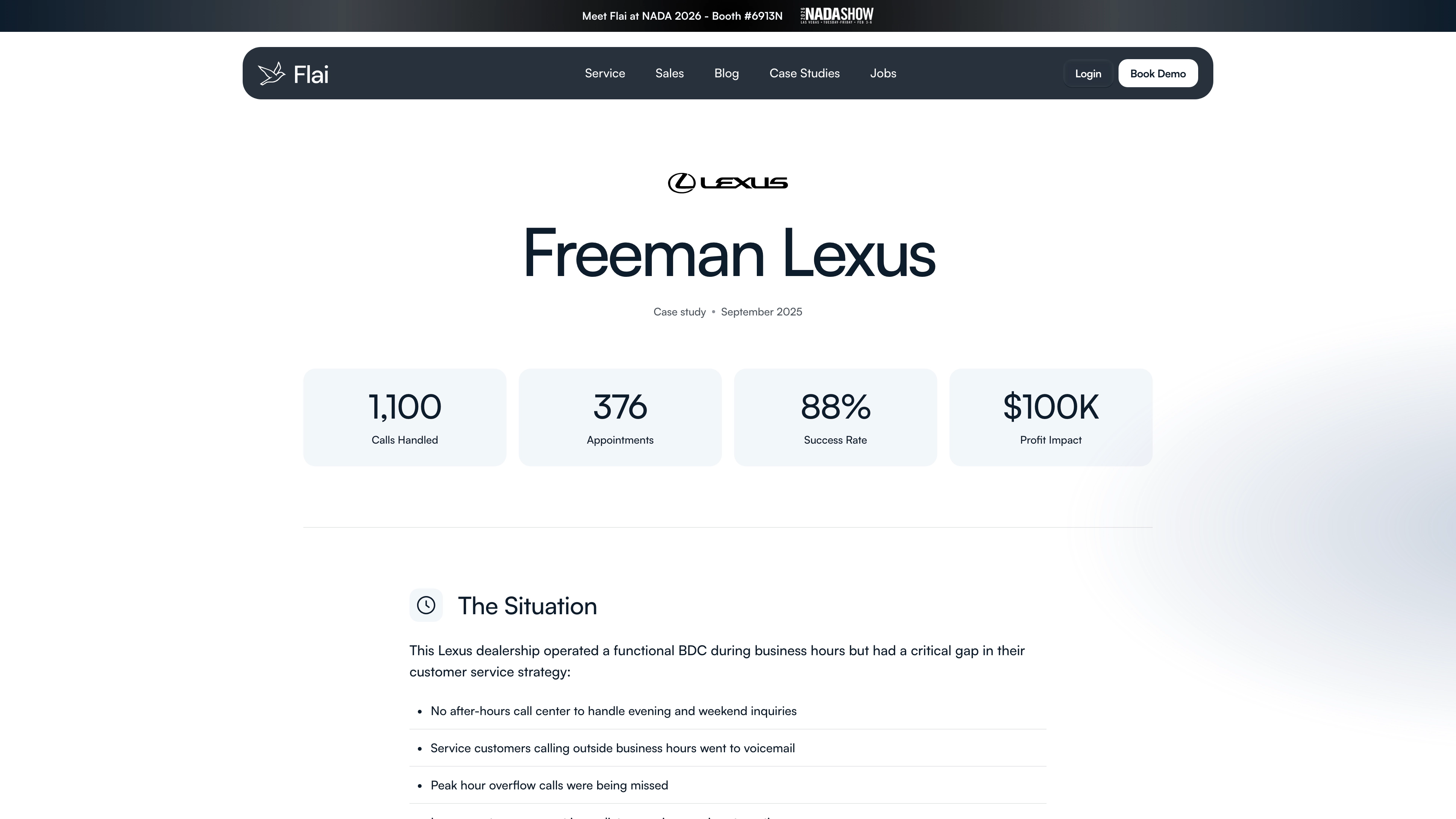
Whether you use a purpose-built dealership AI platform or not, that’s the right metric framing: bookable calls turned into booked appointments, not just “calls answered.”
This is where most “AI receptionists” quietly fail.
You need proof of:
Ask for a live demo against your environment (or a sandbox that matches your vendor stack).
If you’re on Tekion: some vendors have announced integrations with Tekion’s ecosystem (useful as a signal that real integration work exists).
Customers judge “human-ness” mostly by timing.
You should measure:
Industry research from 2025 shows that eliminating hold time and reducing service call duration from over 4 minutes to under 2 minutes represents a significant customer experience improvement.
You don’t have to believe every claim, but the direction matters: speed is the product.
You want a voice agent that:
Ask vendors for their “edge case policy.” If they don’t have one, you’re the beta tester.
Multilingual isn’t “nice.” It’s conversion.
But test it. Don’t accept “we support any language” without:
Dealership ops reality: integrations go down. Phone carriers glitch. The internet dies.
Require:
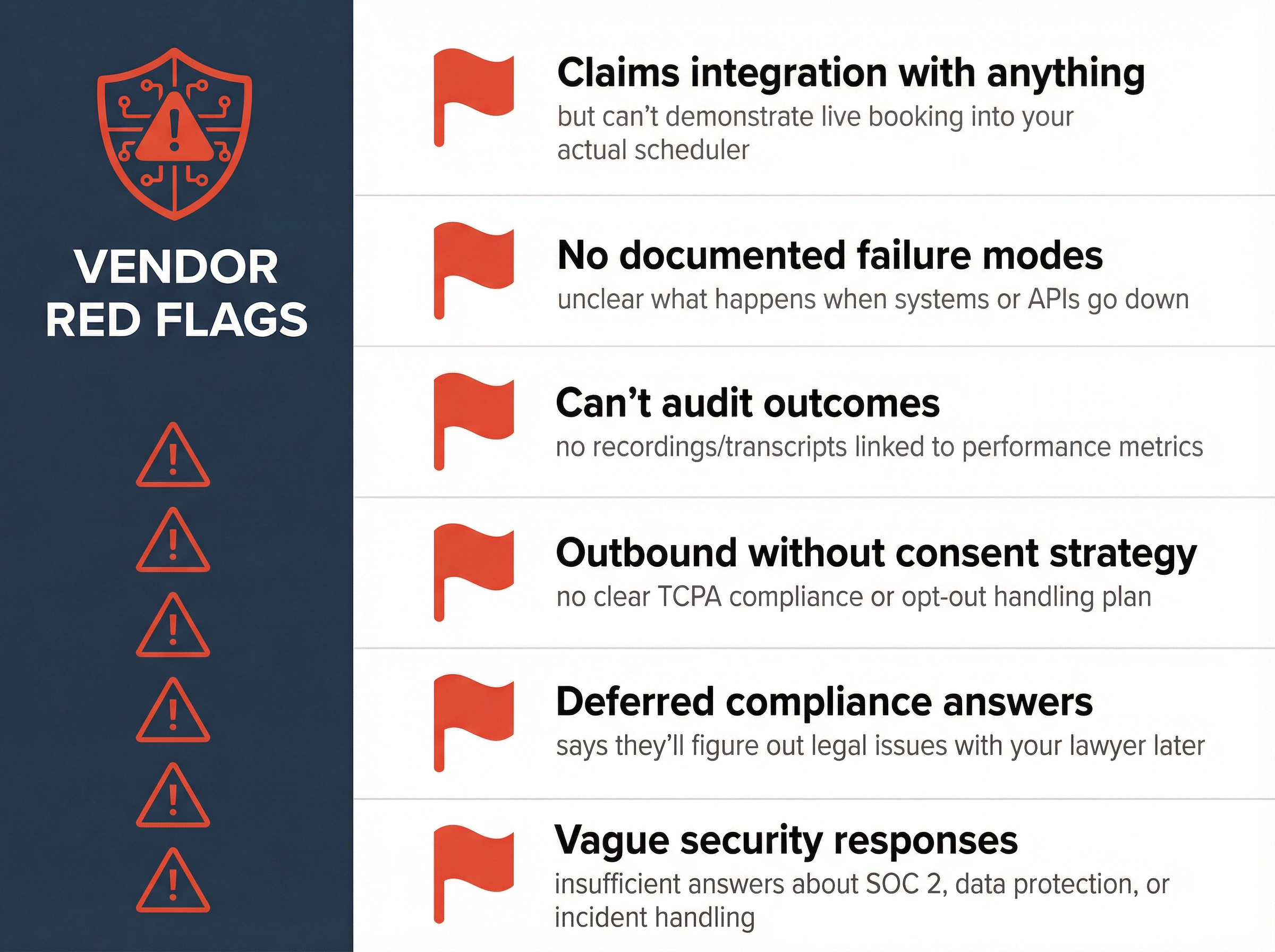
If the vendor can’t tell you what happens when the scheduler API is down, don’t buy.
You need at minimum:
And you need to be able to audit: “show me 20 calls where the system claims it booked.”
This is where dealerships get exposed.
Key point: The FCC has said AI-generated voices count as “artificial/prerecorded voice” under the TCPA.
So outbound campaigns (sales follow-up, service reminders, recall outreach) need:
Also: The FTC’s Do Not Call Registry compliance requires scrubbing numbers at least every 31 days, and sellers/telemarketers have other obligations.
I’m not your lawyer. But if your vendor can’t clearly explain how they keep you out of trouble here, walk.
Call recording rules vary by state (one-party vs all-party consent), and multi-state calls create messy conflicts.
A practical, dealer-friendly move: always disclose recording at the start of the call (“this call may be recorded for quality and training”), and provide an alternative path if someone objects.
If you want a detailed state-by-state reference, the Matthiesen, Wickert & Lehrer chart (last updated 2/14/22) is widely circulated, but you should still confirm with counsel because state laws change and “mixed” states have nuance.
Minimum bar for a vendor touching customer conversations and appointments:
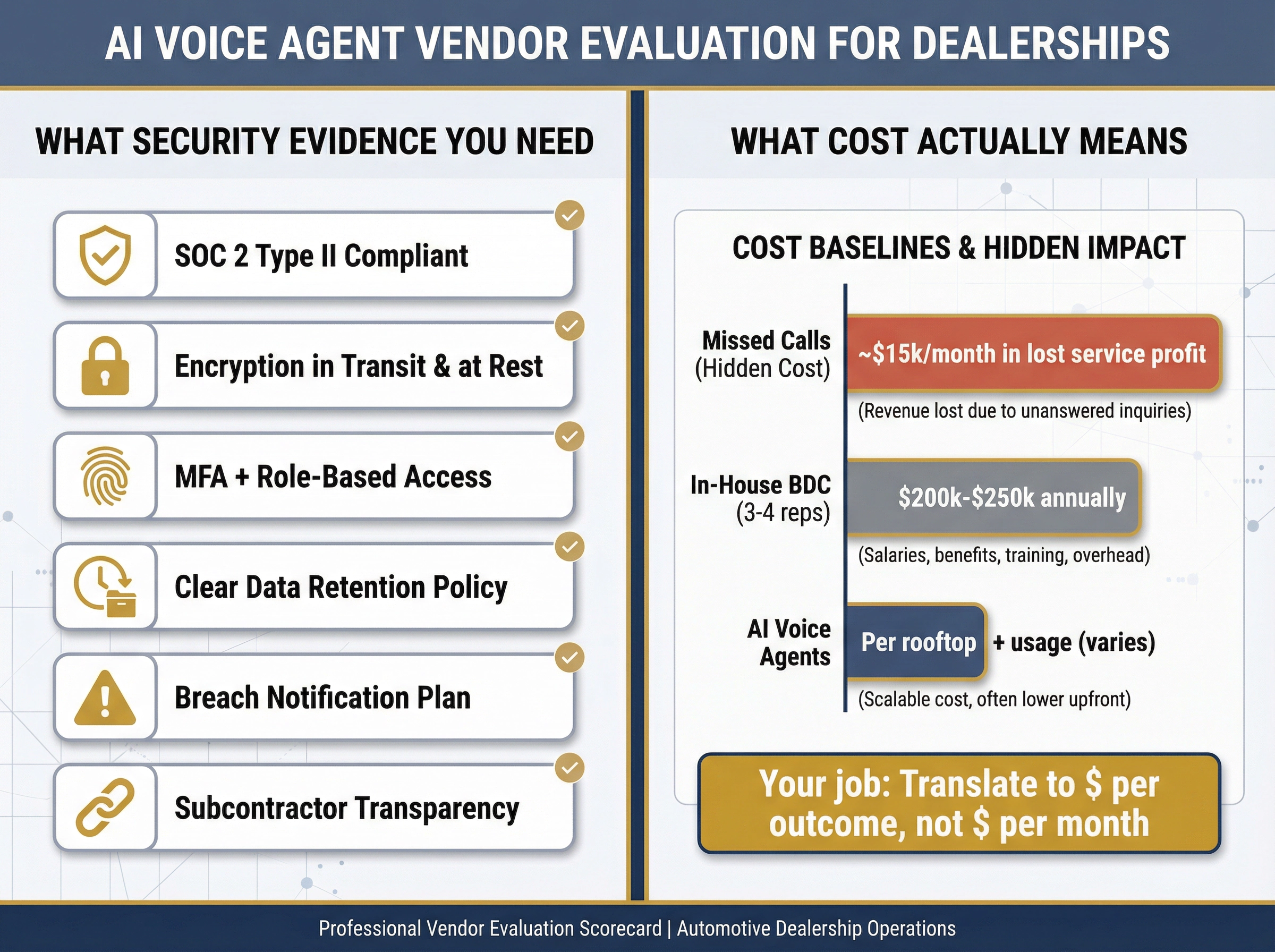
One leading vendor states in its privacy policy that it is SOC 2 Type II compliant (accessed January 2026).
Whether you choose that vendor or someone else, the point is: this is the level of specificity you should demand.
And remember the FTC guidance: you’re expected to oversee service providers that handle customer info.
Dealers often compare AI voice agents to the wrong baseline.
Here are the real alternatives:
For context:
AI voice agents for dealerships typically price like enterprise software: per rooftop plus usage, and sometimes implementation/integration fees. Many vendors won’t publish pricing because it depends on call volume and integration scope.
Your job is to translate pricing into dollars per outcome, not dollars per month.
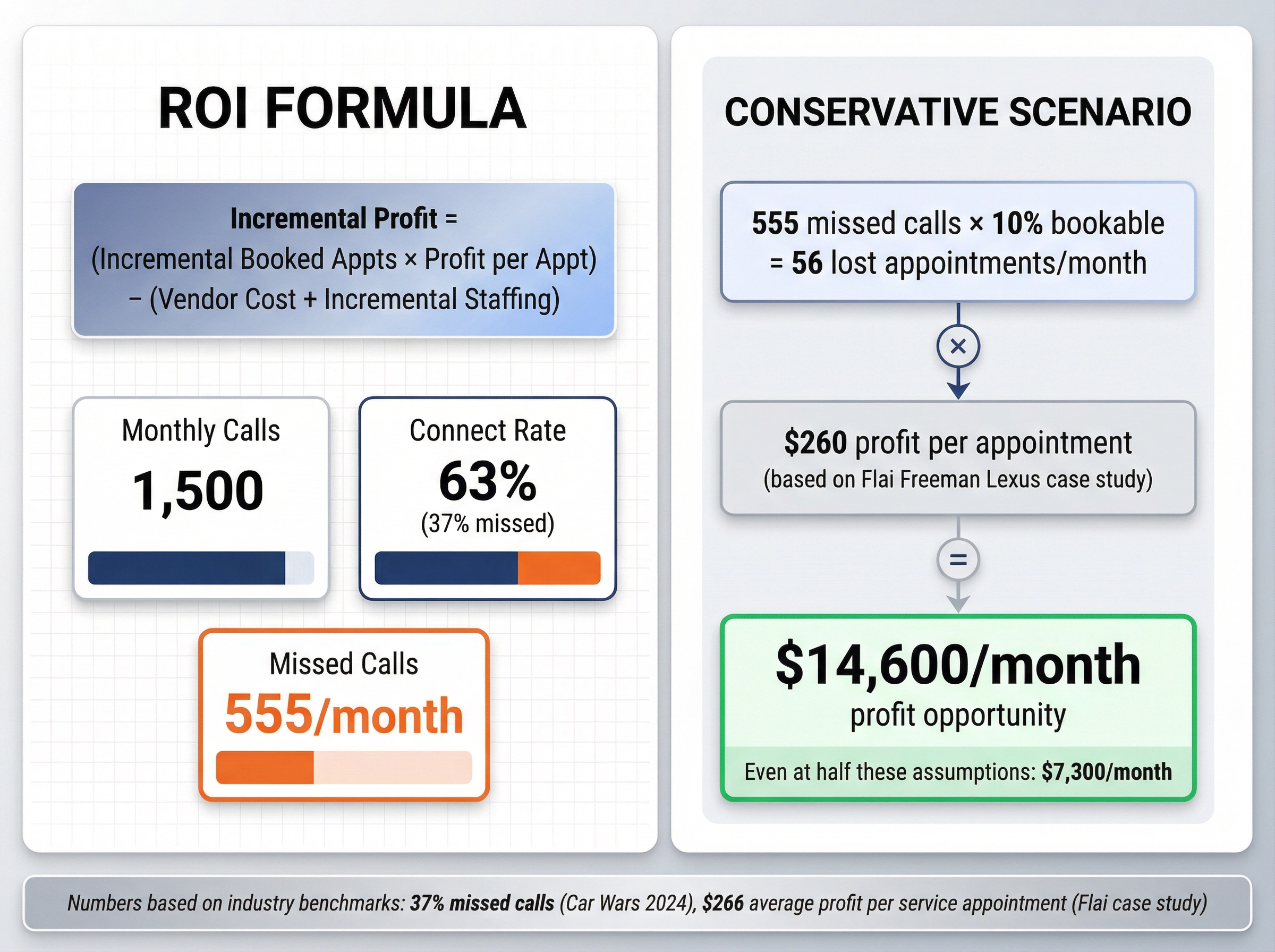
Use a simple structure:
Incremental profit = (incremental booked appts × profit per appt) - (vendor cost + incremental staffing)
If you don’t know profit per appointment, start with a range and tighten later.
Example (using vendor-reported case study math as a proxy for profit per booked appointment):
Freeman Lexus: $100k profit impact divided by 376 appointments equals approximately $266 per appointment (vendor-reported).
Even if you think those assumptions are aggressive, cut them in half and it can still pay.
A pilot should not be “turn it on and hope.” It should be a controlled test with auditability.
Track:
Require a weekly “call review” with the vendor: 20 calls pulled randomly, not cherry-picked.
Use this to compare vendors without getting hypnotized by demos.

| Category | What "Good" Looks Like | How to Test |
|---|---|---|
| Booking | Books into your real scheduler with correct types | Live demo and audit created appts |
| Speed | Answers fast, responds fast, natural barge-in | Stopwatch test on 20 calls |
| Containment | Resolves without humans when appropriate | Outcome reports plus call sampling |
| Escalation | Warm transfers with context, safe failure modes | Roleplay angry plus complex calls |
| Multilingual | Real fluency plus correct dealer vocabulary | Demo with native speakers |
| Reliability | Clear uptime plus failover when integrations break | Ask for incident runbooks |
| Reporting | Bookable to booked, recordings, transcripts, reason codes | Dashboard review |
| Compliance | TCPA plus opt-out plus DNC plus recording disclosure | Ask for written compliance docs |
| Security | SOC 2 Type II or equivalent, vendor management support | Request report plus controls list |
| Economics | Pricing tied to outcomes, clear usage billing | Run your own ROI model |
Remember: The FTC explicitly expects auto dealers to oversee service providers handling customer info.

Flai positions itself as an AI communications platform for dealerships focused on answering calls 24/7, booking appointments, and orchestrating follow-up across voice/SMS/email.
What makes this platform different:
Founded by former HappyRobot engineers and a Netflix data scientist, Flai emerged from Y Combinator’s Summer 2025 batch. The team visited approximately 400 to 450 dealerships in person to deeply understand workflows and gather data. They didn’t design in an office; they built the product inside the chaos they were trying to fix.
The platform was built with its own voice infrastructure from scratch rather than bolting together off-the-shelf voice components. This gives them lower latency, lower variable cost, and more control over edge cases and interruptions.
Key capabilities:
-> Inbound voice AI: Answers inbound calls instantly, 24/7. Books service and test-drive appointments, answers questions, collects lead details, routes calls to staff when needed. Can speak any language.
-> Outbound AI assistant: Runs recall outreach campaigns, sends appointment reminders and follow-ups, calls customers back when needed.
-> Multi-channel orchestration: Phone, SMS, and email all share the same NLU and business logic. Customers can start on one channel and finish on another while the AI remains aware of the customer and their history.
-> Direct integrations: Connects to your scheduler, DMS, and CRM. Flai announced an integration with Tekion’s ecosystem on December 2, 2025.
Reported results:
In the September 2025 Freeman Lexus case study, the platform reports:
| Metric | Result |
|---|---|
| Total calls handled | 1,100 |
| Bookable calls | 426 |
| Appointments booked | 376 |
| Success rate on bookable calls | 88% |
| Estimated profit impact | $100,000 |
Flai also states it is SOC 2 Type II compliant in its privacy policy (accessed January 2026).
Use these as due diligence starting points, not as substitutes for testing. Whether you choose Flai or another vendor, the questions in this guide apply universally.
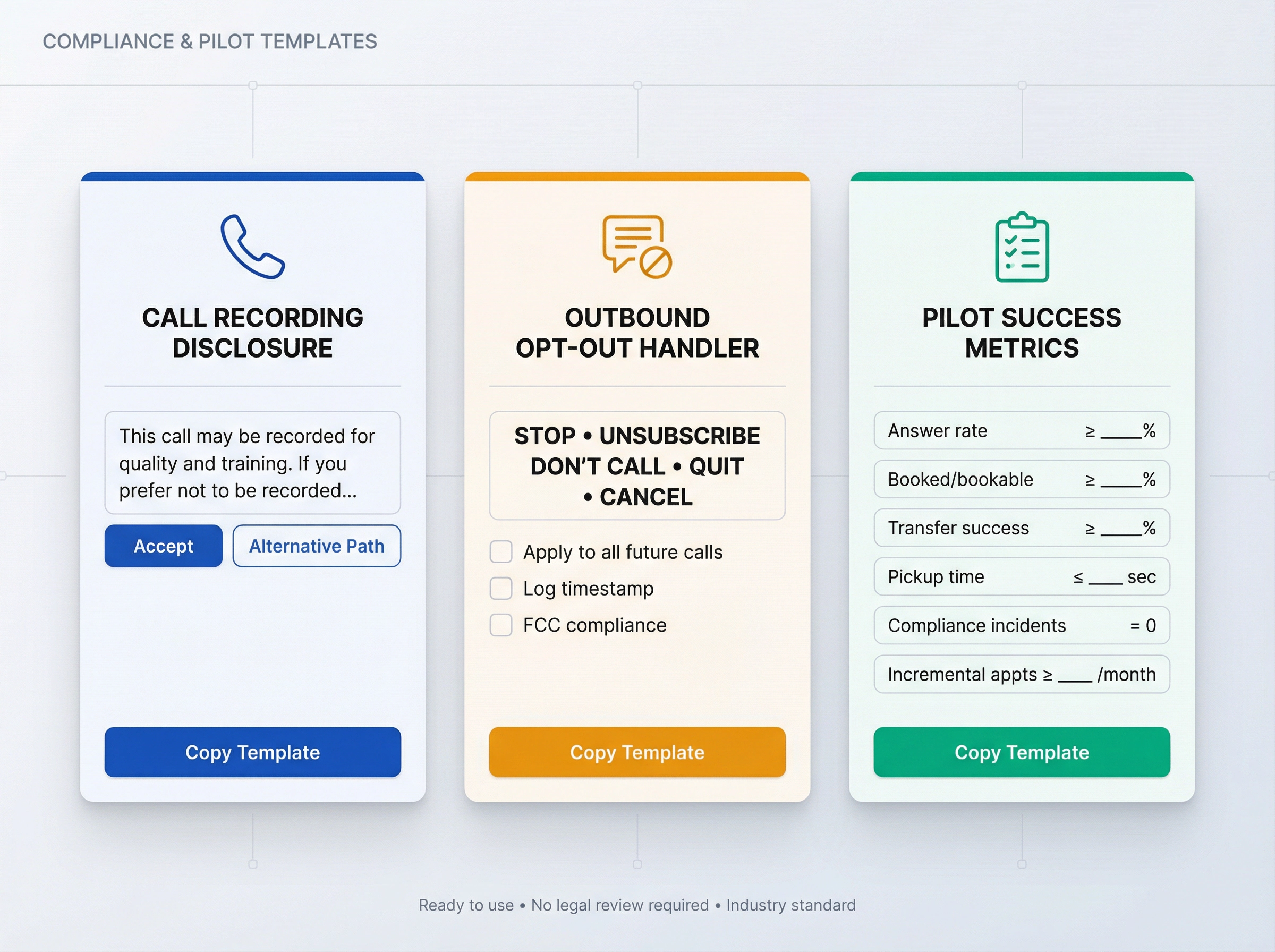
“This call may be recorded for quality and training. If you prefer not to be recorded, let me know and we can provide another option.”
(Then actually provide another option: callback from a non-recorded line, or a direct text link, etc.)
The FCC’s 2024 order emphasizes revocation by any reasonable means.
Traditional call centers use humans working in shifts, which means limited hours, variable quality depending on who’s working, and high per-call costs. AI voice agents answer 24/7 with consistent quality and can handle unlimited calls simultaneously. But humans still handle complex escalations better. The best setups use both: AI for routine calls and overflow, humans for complex situations.
Implementation typically takes 2 to 4 weeks. This includes integrating with your scheduler, CRM, and DMS, configuring call flows, setting up escalation rules, and training the AI on your specific workflows. Some vendors offer faster “plug and play” setups for after-hours coverage only, which can go live in days.
Modern AI voice agents sound remarkably human with natural conversation flow, appropriate pauses, and the ability to handle interruptions. Many customers don’t realize they’re talking to AI. That said, some dealerships choose to disclose upfront (“You’ve reached our AI assistant”), while others let the interaction speak for itself. There’s no legal requirement to disclose in most states, but transparency can build trust.
Good AI voice agents have escalation protocols. If they can’t understand the customer after a few attempts, they’ll either warm transfer to a human with context about what was discussed, or they’ll capture contact details and promise a callback. The key is graceful failure modes. Bad systems just loop in confusion or disconnect.
AI can recognize escalation cues (raised voice, certain keywords, frustration patterns) and respond with empathy scripts. But for truly angry customers, especially those involving complaints about service quality or billing disputes, the AI should transfer to a human quickly. The best systems transfer with context so the human knows what happened before they pick up.
Most vendors use API integrations to connect with your DMS (like CDK or Reynolds & Reynolds), scheduler (like Xtime or Tekion), and CRM. The AI queries these systems in real time to check availability, book appointments, and log interactions. Setup requires API access and sometimes involves working with your existing vendors to enable the connections.
This is critical. Look for vendors with SOC 2 Type II compliance, encryption in transit and at rest, clear data retention policies, and documented incident response procedures. Remember: under the FTC Safeguards Rule, you’re responsible for overseeing your service providers. Ask for security reports, get them under NDA if needed, and verify their subprocessors.
Yes, modern AI voice platforms can handle multilingual conversations. But test it with your specific market’s dialects. Spanish in Miami is different from Spanish in Los Angeles. Make sure the AI can pronounce vehicle makes/models correctly, understands local street names, and can send confirmations in the right language via SMS.
Most dealerships see positive ROI within 30 to 60 days. If you’re missing calls after hours or during peak times, the incremental appointments from those captured calls usually cover the vendor cost quickly. Use the formula: incremental booked appointments times profit per appointment minus vendor cost. If you’re booking even 20 extra service appointments per month at $260 profit each, that’s $5,200 in monthly profit.
Not necessarily. Think of AI as augmentation, not replacement. AI handles after-hours, overflow, and routine scheduling, freeing your BDC to focus on complex leads, follow-ups that need a human touch, and customer relationships. Some dealerships reduce BDC headcount, others keep staff levels the same but see higher conversion because staff focus on high-value activities.
Focus on these:
Use the scorecard from this guide. Don’t get hypnotized by demos. Ask hard questions about scheduler integration, failure modes, compliance documentation, and security. Ask to see their worst calls, not their best. Ask for references from dealerships similar to yours. Run a controlled pilot with clear success metrics before committing long-term.
As seen in