Privacy Policy
Terms of Service
Security
Status
Blogs & Guides
Missed call statistics reveal dealerships lose $850K-$1.17M yearly in service revenue. Calculate your actual cost with real industry data.
January 26, 2026
You’re not reading this because you’re curious about phone statistics. You’re reading it because you suspect your phones are leaking money, and you want two things: proof (real numbers, not vibes) and a way to calculate the damage at your store so you can fix it and justify the spend.
This post delivers both. We’ll walk through the most current industry data on dealership missed calls, give you a calculator you can run on your own numbers today, and show you exactly where the leaks happen and how to plug them.
The short version? Service departments are sitting on $850,000 to $1.17 million per year in revenue at risk from missed appointment calls alone. And that’s before we even talk about sales.
Phone performance at dealerships is still bad enough that it creates mid-six to seven figures of service revenue at risk per rooftop.

According to industry research analyzing 600+ franchise service departments:
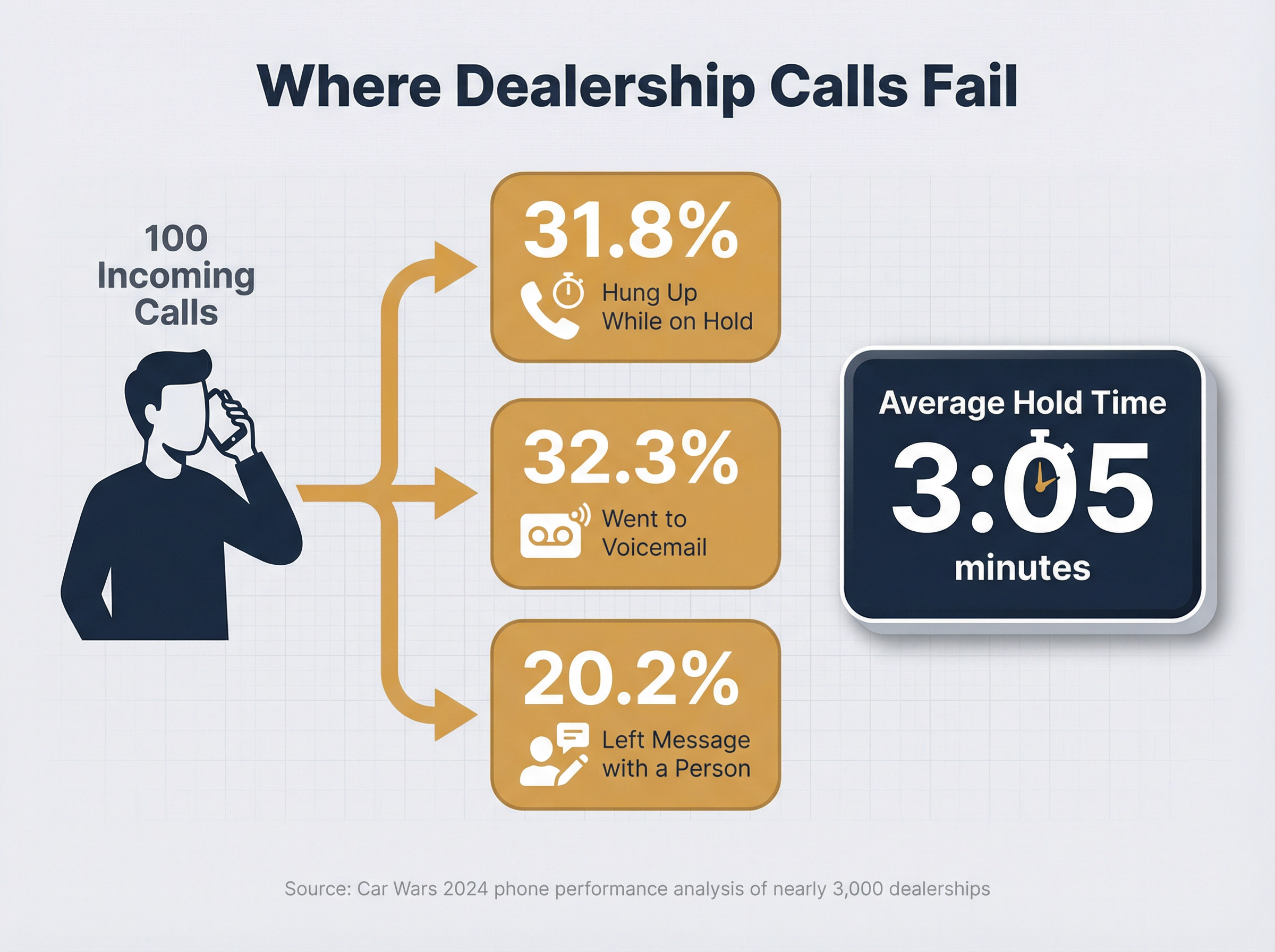
Meanwhile, a separate 2024 phone performance analysis covering nearly 3,000 dealerships found that 31.8% of unconnected calls were customers hanging up while on hold. The average hold time sits at a painful 3 minutes and 5 seconds.
To understand why these numbers matter so much, consider the scale of the industry. According to NADA’s 2024 data, franchised dealers wrote 270+ million repair orders and generated $156+ billion in service and parts sales. The average service and parts sales per customer repair order hit $466 in 2024, climbing to $470 in the first half of 2025.
“Just answer the phone” isn’t cute advice. It’s a profit strategy backed by nine figures of industry data.
Most dealers undercount missed calls because their phone systems hide them. If your definition of “missed” only includes calls that literally went unanswered, you’re measuring maybe half the problem.
A call is “missed” if the customer didn’t successfully complete the job they called to do.
That includes:
The Car Wars 2024 phone performance data breaks down exactly how calls fail to connect:
| Where Calls Fail | Percentage |
|---|---|
| Hung up while on hold | 31.8% |
| Went to voicemail | 32.3% |
| Left message with a person | 20.2% |
| Average hold time | 3:05 |
Notice what’s dangerous here: a dealership can technically “respond later” and still have already lost the customer. If someone calls to book service, sits on hold for three minutes, hangs up, and calls the shop down the road, your callback an hour later doesn’t undo the damage.
This is why we emphasize that the real metric isn’t “answer rate” from your phone system. It’s whether customers actually complete their intended task. Solutions like AI-powered dealership communications focus on task completion, not just call answering.
You don’t need fancy software to estimate your revenue at risk. You need an honest funnel and about ten minutes.
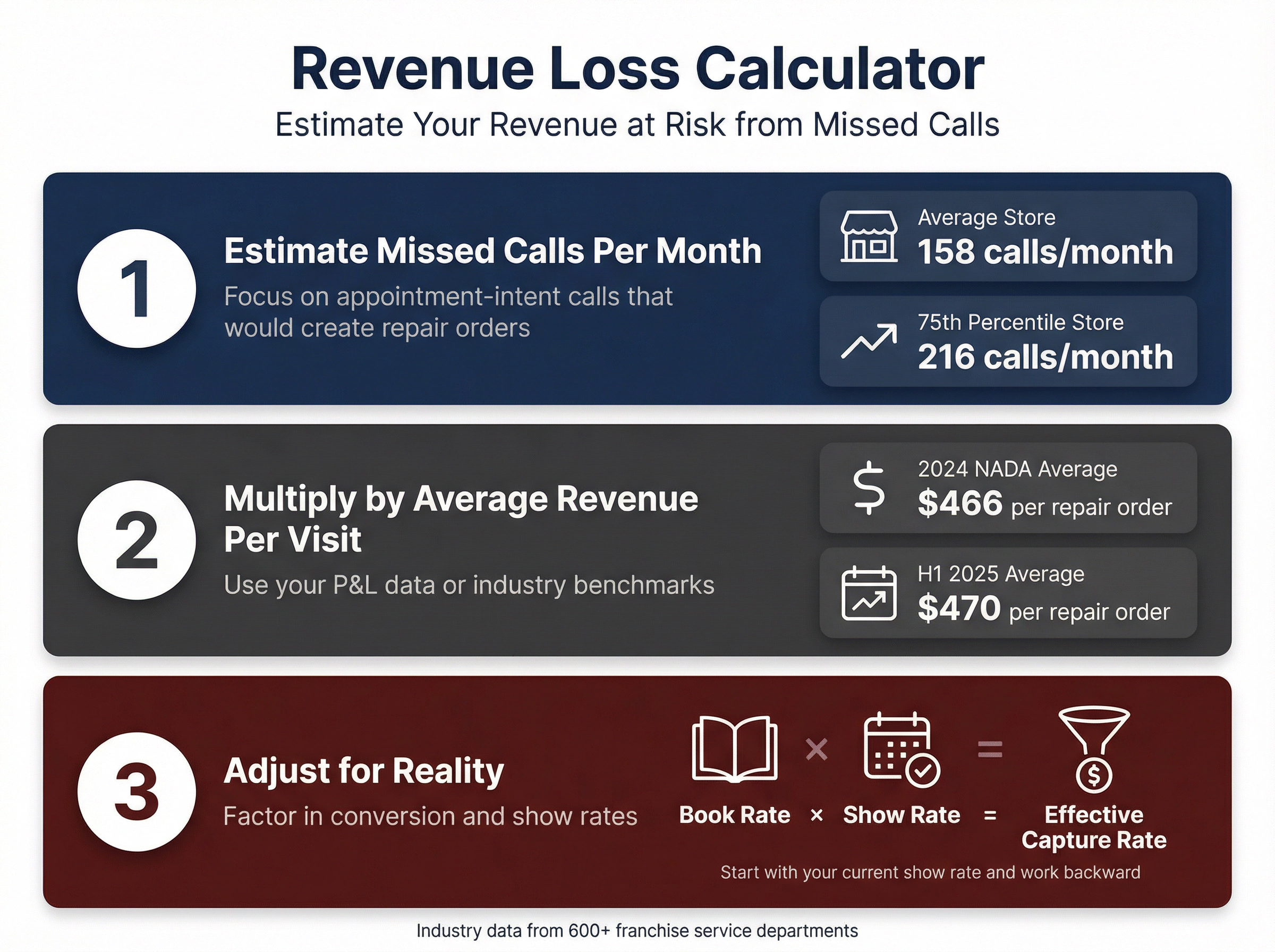
Not every call is revenue-intent. Your focus should be on calls that would reasonably create a repair order or booked appointment if handled well.
If you don’t have clean call tracking yet, use these benchmarks from industry analysis of 600+ service departments:
Check your own P&L if you have the data. If you need an external baseline:
Not every missed call would have converted to a completed repair order. Some would have been no-shows, wrong numbers, or reschedules. To be conservative, factor in:
If you don’t know your exact numbers, start with your current appointment show rate and work backward. Better to be roughly right than precisely wrong.
Let’s run two scenarios using current industry data.

| Input | Value |
|---|---|
| Missed appointment calls/month | 158 |
| Revenue per customer RO | $466 (2024 NADA) |
Monthly revenue at risk: 158 x $466 = $73,628
Annual revenue at risk: $73,628 x 12 = $883,536
Using first-half 2025’s $470 per repair order: 158 x $470 x 12 = $891,120
| Input | Value |
|---|---|
| Missed appointment calls/month | 216 |
| Revenue per customer RO | $466 (2024) |
Annual revenue at risk: 216 x $466 x 12 = $1,207,872
Industry estimates for this scenario (using a slightly more conservative $450/RO) come to ~$1.17 million/year.
Different assumptions, same conclusion: this is not pocket change.
The obvious loss from a missed call is one visit. The real loss is that you’re pushing customers toward independents, and many of them don’t come back.
Cox Automotive’s 2025 service study highlights just how fragile retention has become:
A missed call is essentially a forced experiment: what happens if we make it slightly annoying to give us money?
The answer, increasingly, is that customers try somewhere else. And once service loyalty drops, sales loyalty follows. The customer who got ignored when booking an oil change isn’t likely to think of you first when they’re ready to trade in.
Missed calls don’t happen randomly. They cluster at predictable times, which means you can prepare for them.

The data is consistent across multiple studies:
If you staff evenly, you’ll miss calls unevenly. Monday and Tuesday mornings are where your week is won or lost.
When calls don’t connect, 31.8% of the time it’s because the customer hung up while on hold.
That hold time isn’t neutral. It’s a conversion funnel where customers actively decide whether you’re worth the wait. Three minutes might not sound long, but try sitting through it when you have other options.
Based on industry analysis, roughly 70% of customers who hit voicemail call a competitor within 30 minutes.
Your exact number may differ, but the direction is right: voicemail turns high-intent customers into a race, and you usually don’t win races you start late. This is precisely why AI voice solutions eliminate voicemail entirely.
You can learn a lot about your phone problems without any new software. Here’s a quick audit you can run this week:
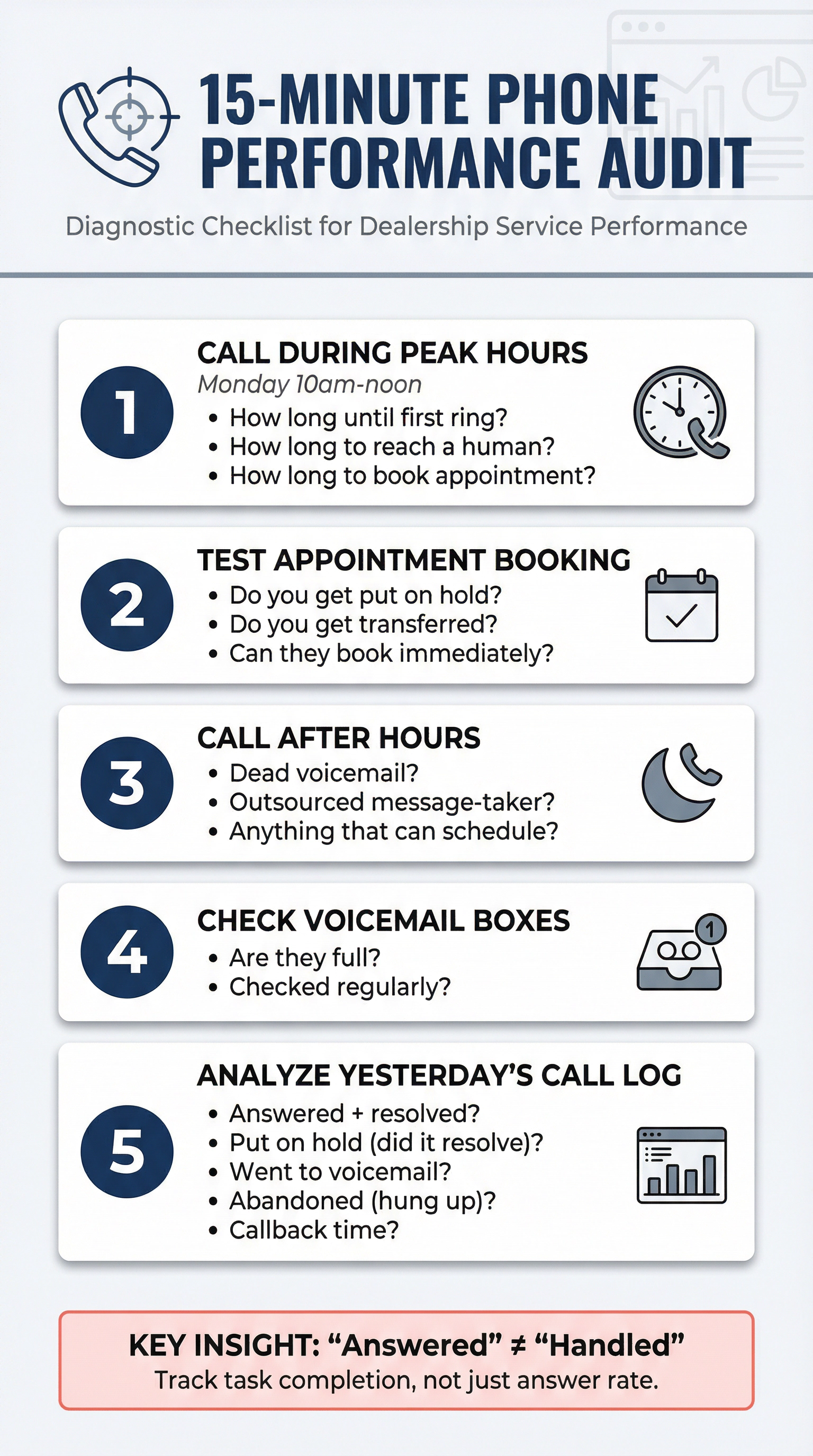
1. Call your main line and service line during peak hours (try Monday between 10am and noon)
2. Ask to book a service appointment
3. Call after hours and see what happens
4. Check voicemail boxes across the store
5. Pull yesterday’s inbound call log and categorize each call:
The single biggest takeaway from this exercise: Stop treating “answered” as “handled.” They’re not the same thing.
You can attack this problem with process changes, staffing adjustments, technology, or some combination. The fastest wins usually stack multiple approaches.
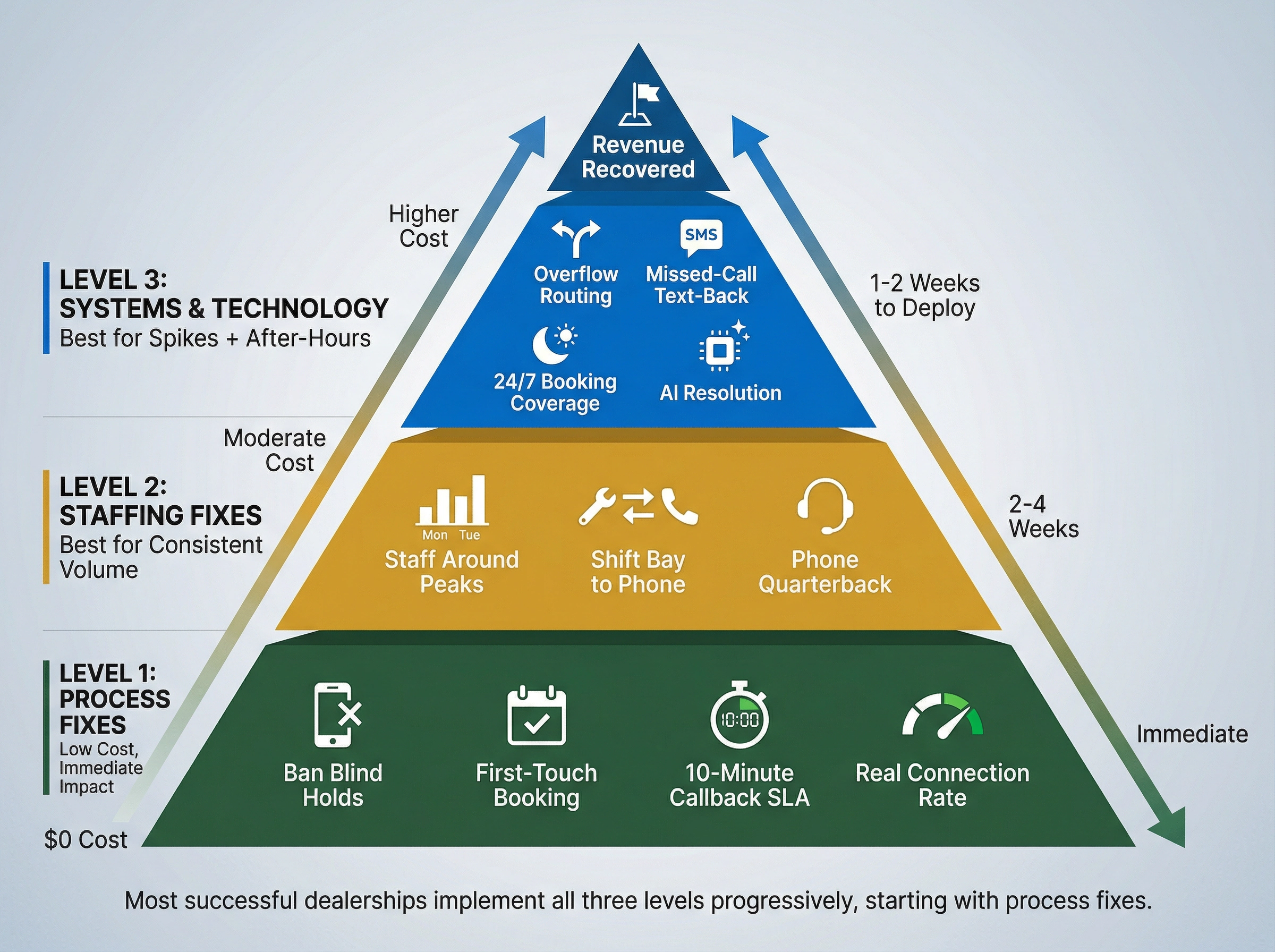
These cost nothing but require discipline:
This is where modern dealerships are heading, because humans don’t scale cleanly to call spikes or late-night demand.
Options include:
The key word in that last point isn’t “AI.” It’s resolution. Can the system get the customer to a booked appointment or a warm transfer right now? If it just takes messages, you’re still in a race you might lose.
Track these the same way you track sold units:
Why obsess over these? Because JD Power’s 2025 Customer Service Index study specifically calls out that long appointment wait times and communication shortfalls are still limiting customer experience gains at dealerships.
Your phones are where those communication shortfalls begin. AI communications platforms can help track and improve these metrics automatically.
At Flai, we built an AI communications platform specifically for car dealerships to solve this problem at the root.

What we do:
The AI itself sounds natural because we built our voice infrastructure from the ground up rather than stitching together off-the-shelf components. And because we integrate directly with your scheduler, CRM, and DMS, the system can actually book appointments, not just take messages.
Real results from dealerships using Flai:
Our Lexus Bay Area case study shows $80,000 to $100,000+ in monthly profit impact per store when calls are answered instantly and booked directly. That includes after-hours capture, overflow during peak times, and consistent follow-up that doesn’t slip through the cracks.
You shouldn’t assume you’ll get the exact same number. But it’s a useful sanity check that going from “lots of leaks” to “tight funnel” can be worth five figures per month at a single rooftop.
For more insights on AI in dealerships, check out the Flai blog.

We already call people back. Isn’t that enough?
Sometimes, but not usually. The data shows the drop-off happens during the initial attempt, not after you’ve had time to react. Car Wars’ hold-time and hang-up stats make it clear: if someone hangs up on hold, they’re often gone before you even know they called. Callbacks help, but they don’t fully repair the damage of making customers wait.
Is this mostly a service problem or a sales problem?
Both, but service is usually the bigger and more measurable leak. Service call volume is higher, the transactions are more predictable, and the lost revenue is easier to calculate. That said, a missed sales call tied to a potential $40,000 vehicle purchase is obviously more expensive per instance. Most stores should start by fixing service, then apply the same discipline to sales. AI platforms like Flai handle both service and sales calls with equal precision.
What’s the one metric I should obsess over?
Call connection rate for appointment-intent calls during peak windows (Monday and Tuesday mornings). That’s where the highest volume of service revenue lives, and it’s where missed calls cluster most heavily.
How quickly can we see results?
Process fixes (banning blind holds, enforcing callback SLAs) can show impact within days. Staffing changes typically take a few weeks to stabilize. Technology solutions like AI voice agents can be live within a week or two and start capturing calls immediately.
Does AI work for luxury brands?
Yes. We work with Lexus, BMW, and other premium brands where the customer experience bar is higher. The key is voice quality and conversational accuracy. A robotic-sounding AI would hurt brand perception, which is why we invested in building our own voice infrastructure rather than using generic tools.
How do I know if my store is “bad” or “normal”?
If you’re missing more than 158 appointment-related calls per month, you’re above the average. If you’re missing more than 216, you’re in the 75th percentile of worst performers. Either way, there’s revenue to capture.
If you take one thing from this article, make it this:
The industry data says many service departments are sitting on $850,000+ per year in service revenue at risk from missed appointment calls. The cause is boring (holds, voicemail, and peak-time overload), and the fix is equally boring: answer fast, don’t dump customers to voicemail, and book on the first contact.
Because fixed ops represents such a massive piece of the franchised dealer economy (270+ million repair orders and $156+ billion in service and parts sales), small improvements compound fast. A 10% reduction in missed calls at a store losing $1 million annually is worth $100,000 in recovered revenue.
Your phones are either a profit machine or a profit leak. The numbers in this post should help you figure out which one you’re running, and what to do about it.
Ready to stop losing revenue to missed calls? See how Flai can help your dealership.
As seen in