Privacy Policy
Terms of Service
Security
Status
Blogs & Guides
Nearly 1 in 3 unconnected dealership calls end in hangups on hold. Learn why it happens, how to diagnose it fast, and the fixes that cut abandonment.
January 23, 2026
You’re not here to learn call center theory. You’re here because customers are bailing before anyone picks up, and that’s costing you appointments, CSI points, and revenue.
This is the complete playbook for dealerships: what that “32%” stat actually means, why it happens at a fundamental level, how to diagnose your store fast, and the fixes that reliably cut hangups. Everything here is grounded in 2024-2025 data because we’re talking about real patterns, not outdated assumptions.
Let’s get precise about this number. The headline is often misunderstood.
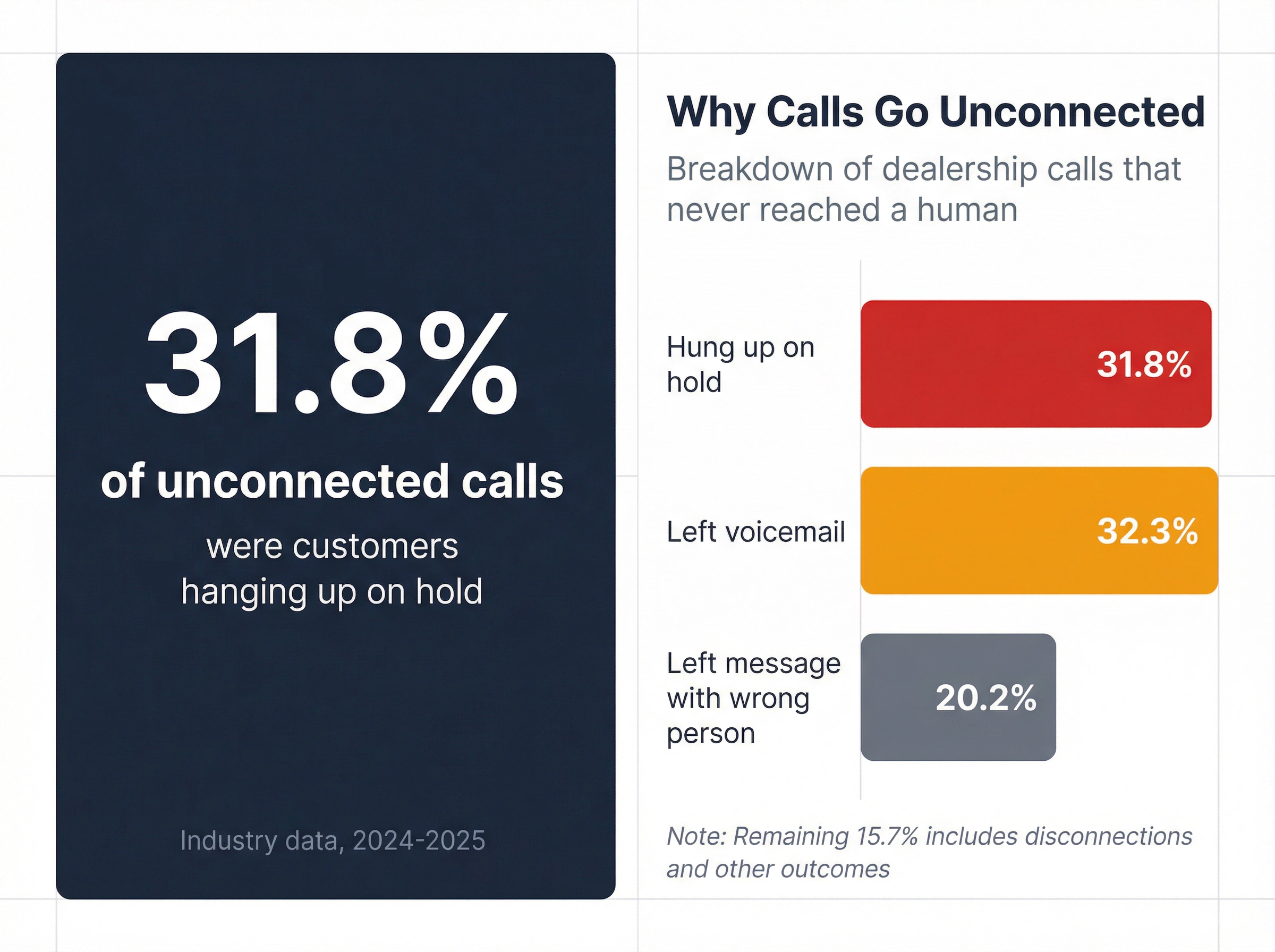
According to dealership call performance data, 31.8% of unconnected dealership calls were customers hanging up while on hold. That’s not 32% of all calls. It’s 32% of the calls that never connected to a human. The distinction matters.
When you break down why calls go unconnected, the picture gets clearer:
| Outcome | Percentage of Unconnected Calls |
|---|---|
| Hung up on hold | 31.8% |
| Left voicemail | 32.3% |
| Left message with wrong person | 20.2% |
So the “32% problem” is really the “hold problem” sitting inside a bigger “we didn’t connect the call” problem. Your callers are giving you multiple chances to fail them.
Industry research shows the average hold time in 2024 was 3 minutes and 5 seconds.
That’s not a rough day. That’s a system. Three minutes of hold music isn’t a temporary spike. It’s baked into how most dealerships operate.
And here’s what makes it worse: the highest inbound call traffic window is Monday 10am to 12pm. The exact time when your service advisors are juggling walk-ins, your BDC is catching up from the weekend, and your queue is already building.
Callers aren’t irrational. Your phone experience is.
If you want to fix hangups, you need to understand the core physics of why they happen. Not the surface symptoms. The actual mechanics.
When someone calls a dealership, they aren’t committed. They’re shopping for an outcome: book service, get a price, confirm inventory, talk to parts.
If they wait and get nothing, the next dealership is one tap away.
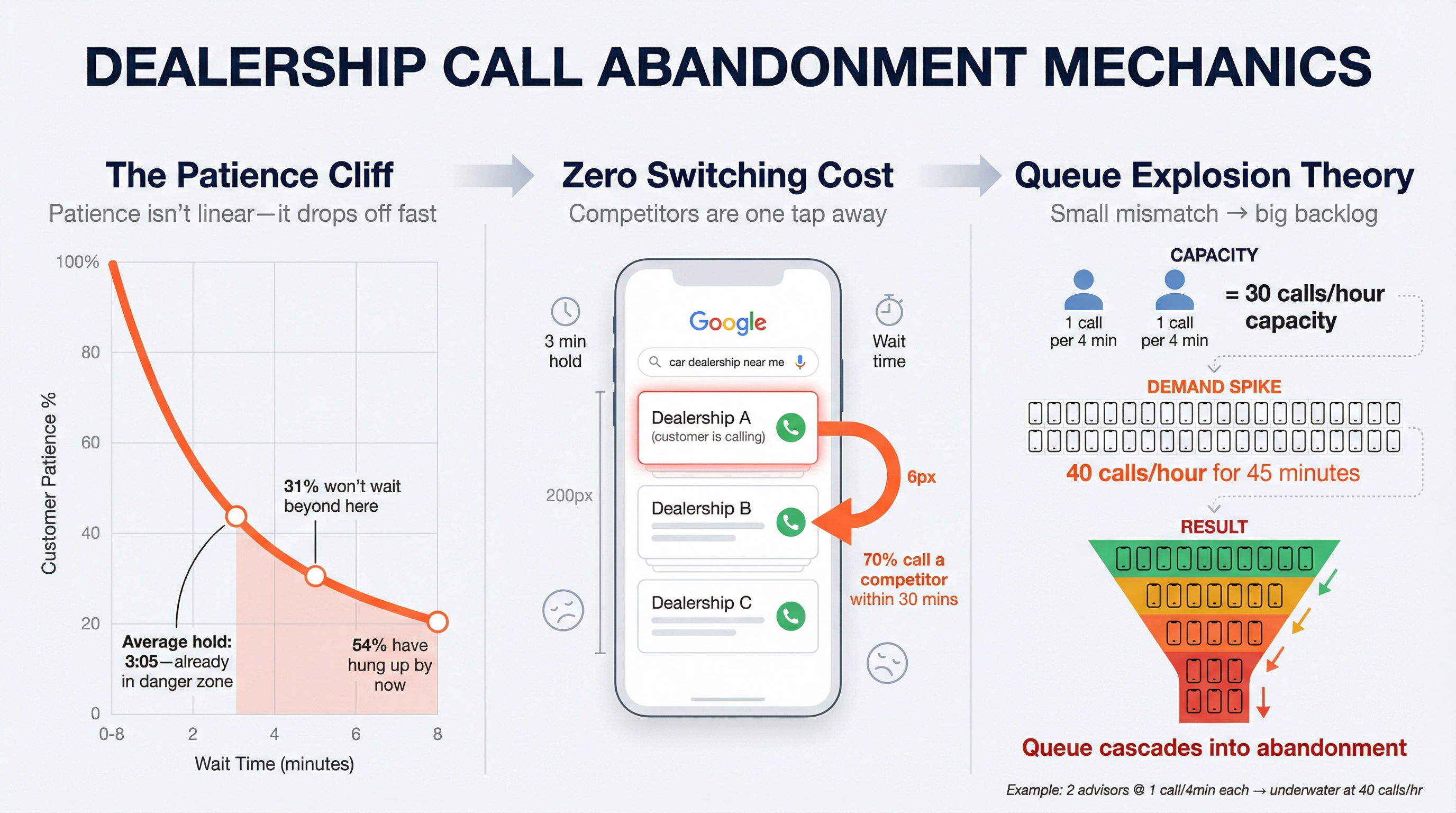
Industry observation suggests 70% of people who hit voicemail call a competitor within 30 minutes. Customers aren’t patient because they have no reason to be. Your competitors are literally one Google search away.
Hold is just voicemail with extra steps.
Wait time isn’t linear. Customers don’t get 10% more annoyed with 10% more wait. Patience drops off fast once they feel stuck.
A 2025 consumer survey found:
Even if your average hold is 3:05, you’re already inside the danger zone. For almost a third of your callers, three minutes is already too long.
This is basic queueing theory, dealership edition. And it explains why “just a little busy” turns into “abandoned call disaster” so fast.
Here’s how it works:
A tiny mismatch creates a big hold.
Example: If two people can answer one call every four minutes each, that’s about 30 calls per hour capacity. Get 40 calls per hour for 45 minutes, and you’re underwater. The queue doesn’t “smooth out.” It cascades into abandonment.
In dealerships, hangups aren’t just “we were too busy.” They’re usually one of these predictable failure modes. Identifying which ones apply to your store is half the battle.
People will wait a short, explicit amount of time. They won’t wait in uncertainty.
If your team says “please hold” with no timeframe, you’re basically telling them: “This could be forever.” And they leave.
A blind transfer destroys caller confidence:
Studies show that when AI systems can’t handle a request and try to transfer to a human, those handoffs fail 56% of the time. Issues include voicemail, endless hold, dropped transfers, and “call back later.” That’s the same failure pattern as blind transferring. The technology doesn’t matter; the failure mode is identical. This is why warm transfers and clean handoffs matter so much, and why Flai focuses heavily on getting them right.
Customers don’t know (or care) if their issue is “service,” “express,” “warranty,” or “recall.” They just want help.
Too many menu options leads to: wrong choice, transfer, hold, hang up. Every option you add is another chance to lose them.
This one is underrated. Callers hang up when the person who answers can’t complete the transaction.
If the call handler lacks access to the scheduler, authority to book, or system integration, you force a second step. Second steps leak. Every “let me take a message” is a missed appointment. This is why modern AI BDC platforms integrate directly with your scheduler, CRM, and DMS to book appointments in real-time.
Industry data explicitly identifies Monday 10am-12pm as the biggest call volume window.
If you’re scheduling meetings during that time, or running with the same staffing as a slow Tuesday afternoon, you’re choosing abandonment. Not accidentally. Deliberately.
If you’re closed, callers still call. If you answer with voicemail, you’re betting they’ll try again.
They usually don’t. The 70% competitor stat applies here too. After-hours isn’t “low intent” traffic. It’s often high intent from people with time constraints. AI coverage solves this with 24/7 availability that answers every call instantly.
This is the subtle one. Repeated holds. “What was your number again?” “Can you repeat that?” “I don’t handle that.” Each friction event tells the caller: “This store will be painful to deal with.”
They’re not abandoning the call. They’re abandoning the relationship.
If you want to fix hangups, start with where they happen. Not with training. Not with technology. With data.
Do this in 30-60 minutes:
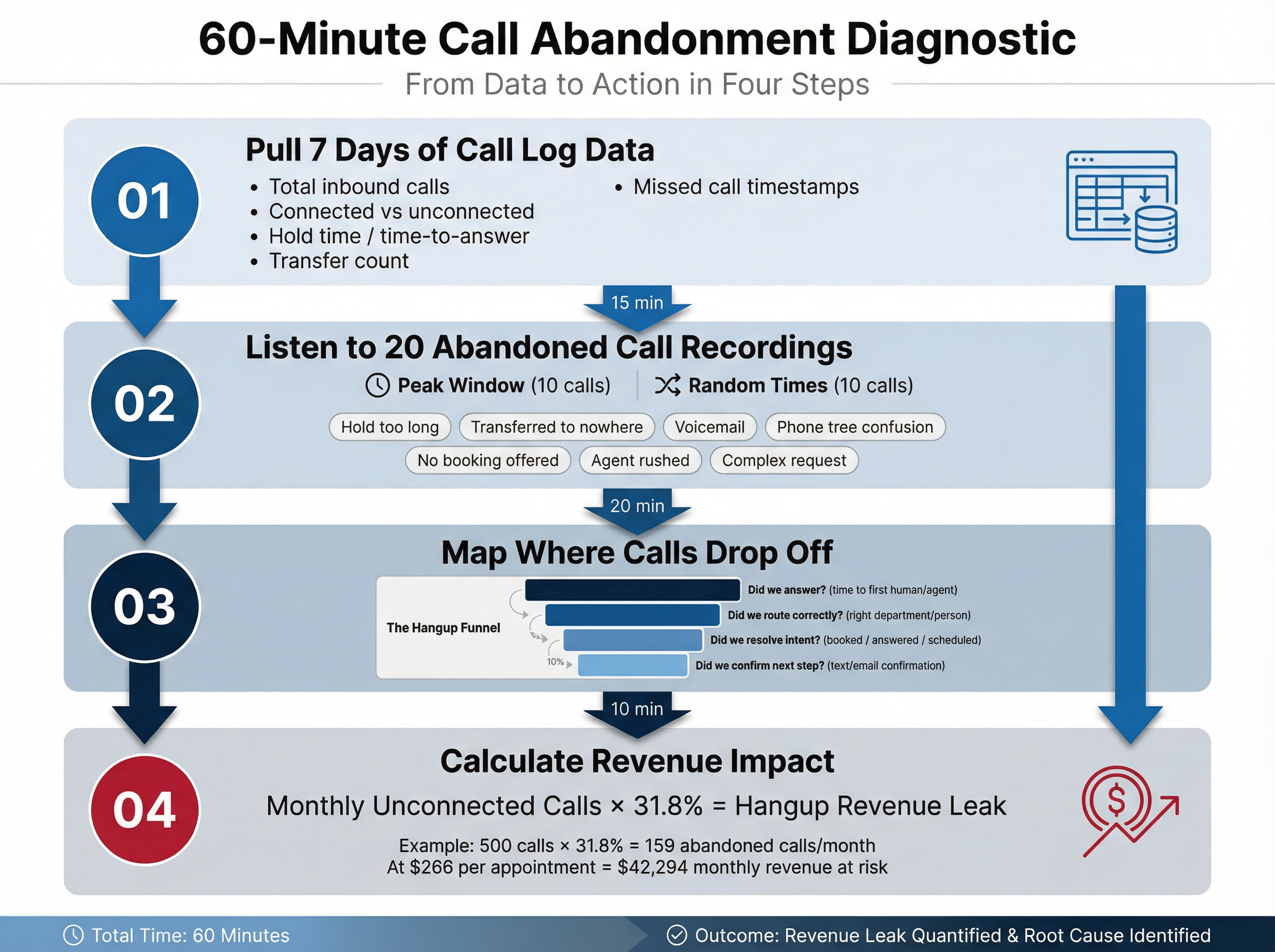
You need:
If you don’t have this data, you’re flying blind. And yes, most stores are.
Pick:
Tag each with one reason:
You’ll see the pattern immediately. Most stores have two or three dominant failure modes, not a dozen random problems.
Don’t overcomplicate it. Use four buckets:
The Hangup Funnel:
Hangups almost always happen in buckets 1 and 2. That tells you where to focus.
You don’t need perfect math. You need directional truth.
Use this formula:
Monthly unconnected calls x 31.8% = Monthly “hung up on hold” calls
Then multiply by your rough value per saved call.
For service, use your store’s average gross per repair order. For a reference point: Flai reported $100k profit impact from 376 booked appointments at a Lexus dealership in the Bay Area. That’s about $266 per appointment. Even if your number is half that, the leak is still huge.
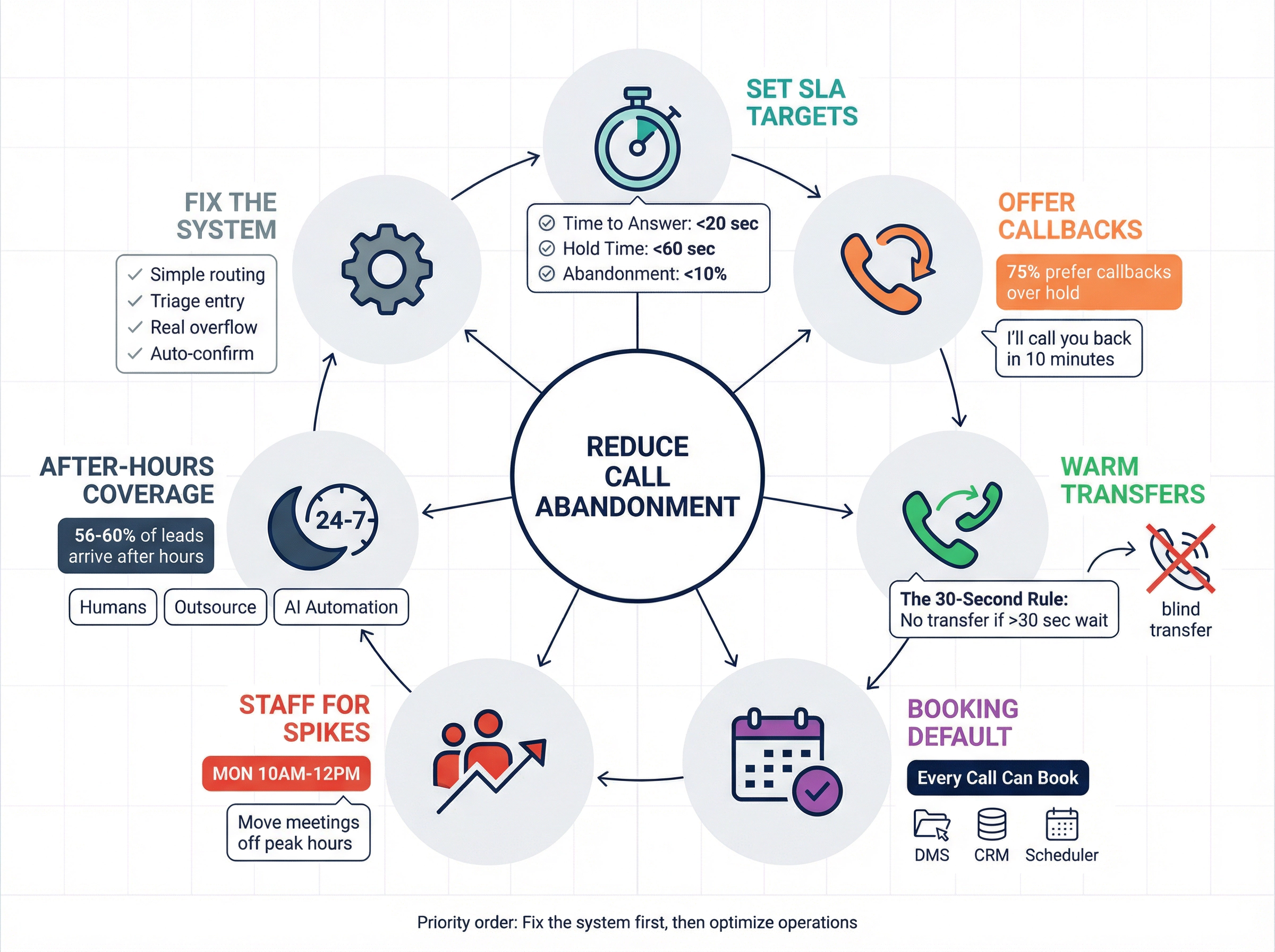
Here’s the playbook, in priority order. Most dealerships try to “train harder” first. That’s backwards.
Fix the system first.
Pick targets and enforce them:
| Metric | Target | Failure Threshold |
|---|---|---|
| Time to answer | Under 20 seconds | Over 30 seconds |
| Hold time | Under 60 seconds | Over 2 minutes |
| Abandonment rate | Under 10% | Over 15% |
Why the 2-minute threshold? Because industry studies found service customers were placed on hold more than two minutes only 2% of the time on average. Mission failures averaged 9%, down from 13% the prior year.
Sub-10% failure is achievable. It’s not fantasy.
How to hit these targets:
Your default should be: move the call forward right now.
When you genuinely can’t:
Customers want control. Survey data showing 75% prefer callbacks over waiting isn’t surprising. People would rather be called back in 10 minutes than sit in hold limbo.
Callback Script (Steal This): “I can get this handled for you. I’m seeing a brief wait right now. Would you rather hold, or should I call you back in about 10 minutes? I’ll text you to confirm either way.”
Then actually honor it. “We’ll call you back” with no timeframe is just delayed abandonment.
A warm transfer means: you confirm the destination can take the call, and you pass context.
A blind transfer means: you toss the customer into the void.
The 30-Second Rule: If you can’t get the person or department within 30 seconds, don’t transfer. Schedule a callback instead.
This aligns with research findings: AI can perform well, but handoffs to people frequently fall apart, and those failures leave customers feeling like they wasted time. Humans do this too. The fix is the same: clean handoffs with full context passed to the next agent.
If the call intent is schedulable (service, test drive, appointment), the handler must be able to book. Right then.
Studies repeatedly show the customer’s mission is “quickly speak with someone who can schedule an appointment.” When that’s hard, customers defect.
What this requires:
If your front line can’t book, you are structurally forcing hangups. A well-integrated AI BDC connects with your DMS, CRM, and scheduler so every call can end with a booked appointment.
Stop pretending calls are random.
Build a coverage plan around:
Industry data explicitly identifies Monday 10am-12pm as the worst window.
Easy win: Move advisor meetings off Monday morning. You just bought back calls without hiring anyone.
After-hours callers aren’t low intent. They’re often high intent with time constraints. Working parents. Commuters. People who finally have a moment to call.
If they hit voicemail, they go elsewhere.
You can solve after-hours three ways:
The winning pattern is: answer immediately + book immediately. This approach works in practice: at a Lexus dealership in the Bay Area using Flai, the system handled ~1,100 calls with zero missed and booked 376 appointments using 24/7 coverage and overflow handling.
Even great advisors will fail if the system is wrong.
System fixes usually look like:
Two useful benchmarks from service scheduling call studies:
2024 results:
2025 results:
The industry can improve quickly. The gap between 2024 and 2025 proves it.
And AI is no longer a toy for service calls. But handoffs remain the danger zone, so design them intentionally.
You don’t have to fix everything at once. Here’s a phased approach that works.
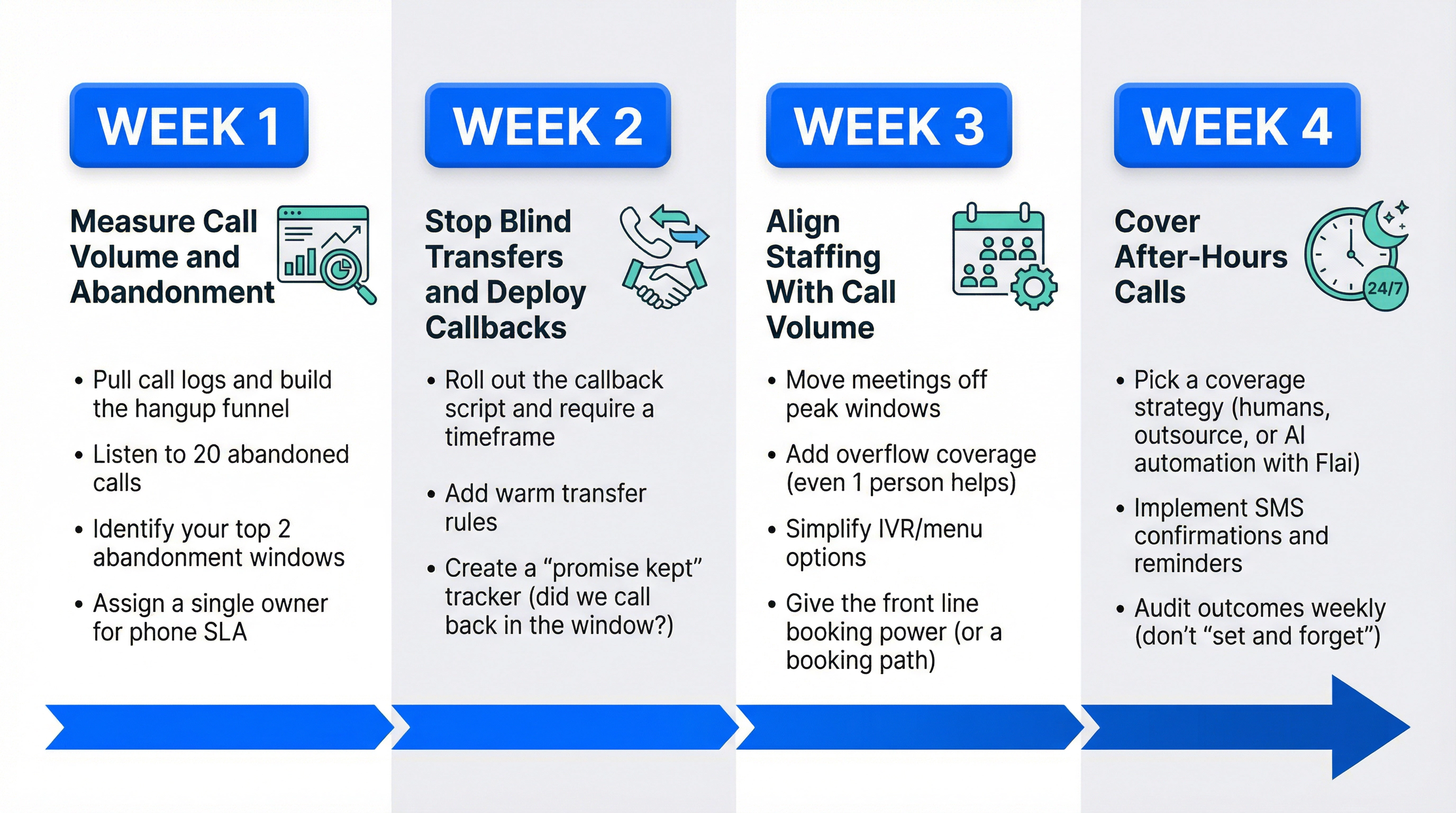
Focus: Get visibility into your actual problem.
Focus: Stop the bleeding on handoff failures.
Focus: Align capacity with demand.
Focus: Capture the high-intent callers you’re currently losing.
“I can help with that. Can I place you on a quick hold for about 30 seconds while I check availability? If you’d rather not wait, I can call you back in about 10 minutes.”
Key: timeframe + control.
“I can get you to the right place. If they don’t pick up right away, I’ll stay with you and we’ll schedule a callback so you’re not stuck on hold.”
“Perfect. I’m going to text you the details right now. If anything changes, you can reply to that text.”
If your core problem is “we can’t answer fast enough,” you have two levers:
At Flai, we built that scalable layer. Our AI voice agents answer instantly, handle routine calls end-to-end, book appointments directly into your scheduler, and do warm transfers when a human is genuinely needed.
What this looks like in practice:
In a Lexus Bay Area deployment documented by Flai:
| Metric | Result |
|---|---|
| Total calls handled | ~1,100 |
| Missed calls | Zero |
| Bookable calls | 426 |
| Appointments booked | 376 |
| Conversion rate | 88% |
| Estimated profit impact | $100,000 |
The system covered all after-hours service calls 24/7, handled overflow during peak times, and booked appointments with no wait time.
The point isn’t “AI is magic.” The point is: instant answer + real booking + clean handoff is what stops hangups. Flai delivers all three because we built our own voice infrastructure specifically for dealerships. We integrate with your scheduler, CRM, and DMS so we can actually take action, not just take messages.
If you’re ready to stop losing 32% of your unconnected calls to hold abandonment, book a demo with Flai.
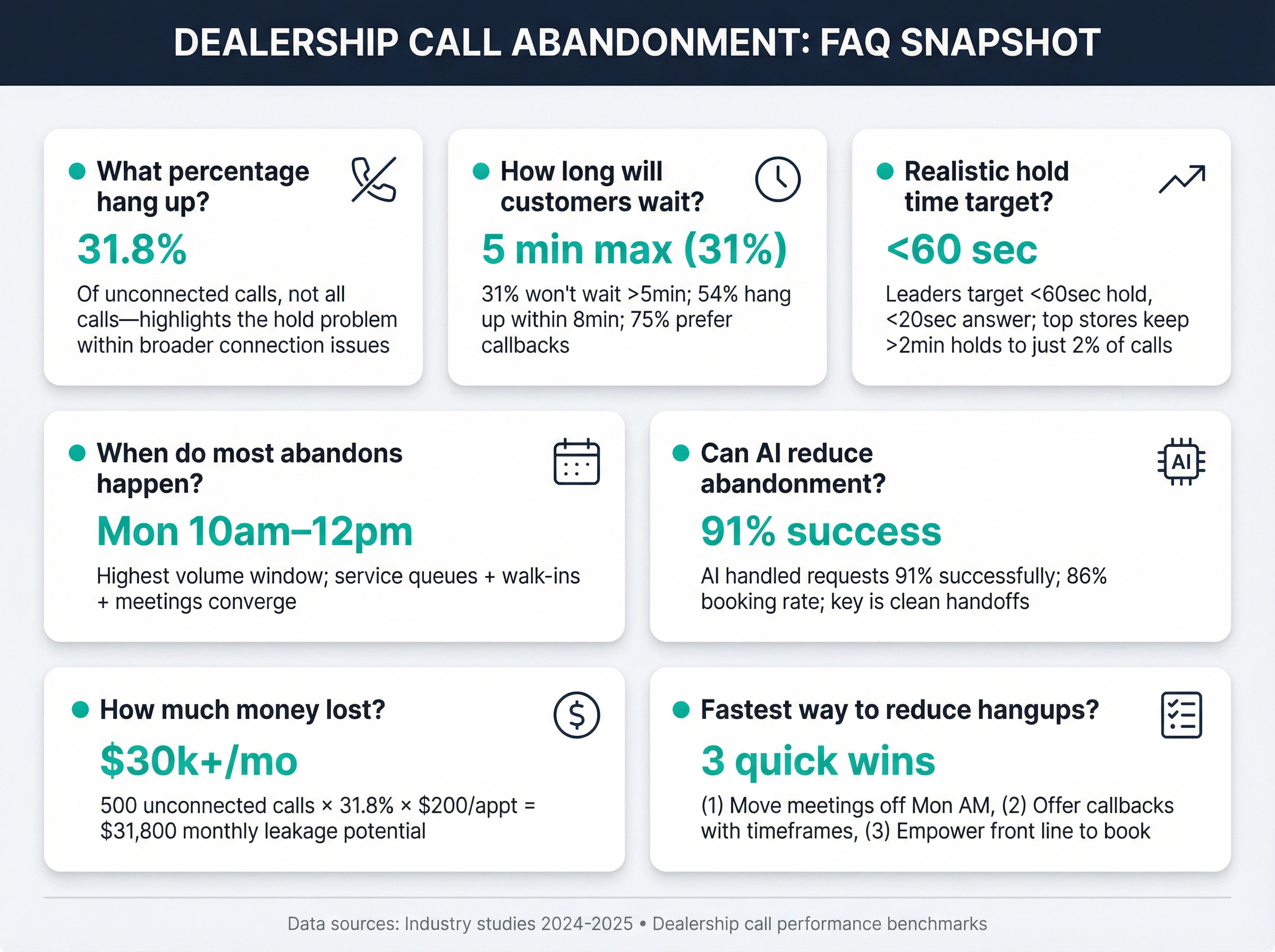
According to industry data, 31.8% of unconnected dealership calls are customers hanging up while on hold. This isn’t 32% of all calls. It’s 32% of calls that never connected to a human. The distinction matters because it highlights the specific hold problem within a broader connection problem.
Not long. Consumer surveys found 31% of customers won’t wait more than 5 minutes, 54% hang up within 8 minutes, and 75% would prefer a callback over waiting. The average dealership hold time is over 3 minutes, which puts you squarely in the danger zone for almost a third of callers.
Industry leaders target under 60 seconds for hold time and under 20 seconds for time-to-answer. Research shows that top-performing stores keep customers on hold for more than 2 minutes only 2% of the time. Sub-10% abandonment is achievable.
The Monday 10am-12pm window consistently shows the highest call volume and highest abandonment rates. This is when service queues from the weekend converge with walk-in traffic and morning meeting schedules. Staffing and process changes during this window have the biggest impact.
Yes. Studies found AI handled service scheduling requests successfully 91% of the time, with customers booking 86% of the time. The key is designing clean handoffs. When AI-to-human transfers fail (which happens 56% of the time in poorly designed systems), you recreate the same abandonment problem. Well-designed AI systems handle these handoffs cleanly.
It varies by store, but the math is significant. If you have 500 unconnected calls per month and 31.8% hang up on hold, that’s 159 abandoned calls. At even $200 per potential service appointment, you’re looking at over $30,000 in monthly revenue leakage. AI voice agents have documented profit impacts of $80,000-$100,000 per month from fixing this problem at various dealerships.
Start with three quick wins: move meetings off Monday morning, implement a callback option with committed timeframes, and make sure whoever answers can actually book appointments. These system changes often have more impact than training because they address structural problems, not individual behavior. For maximum impact, consider implementing AI voice agents that answer instantly and book directly.
The playbook here (reduce time-to-answer, eliminate blind transfers, offer callbacks, make booking immediate) stays stable even as industry stats evolve. If you want to implement these fixes with AI that actually works, talk to Flai.
As seen in