Best AI Receptionist for Car Dealerships (2026)
See how AI receptionists help car dealerships answer every call, book more appointments, and capture up to $100K monthly profit.

Your dealership phone system is probably losing you money right now. Maybe phones ring after hours with nobody to answer. Service customers sit on hold during Monday morning spikes. Potential buyers hit voicemail and call your competitor within 30 minutes.
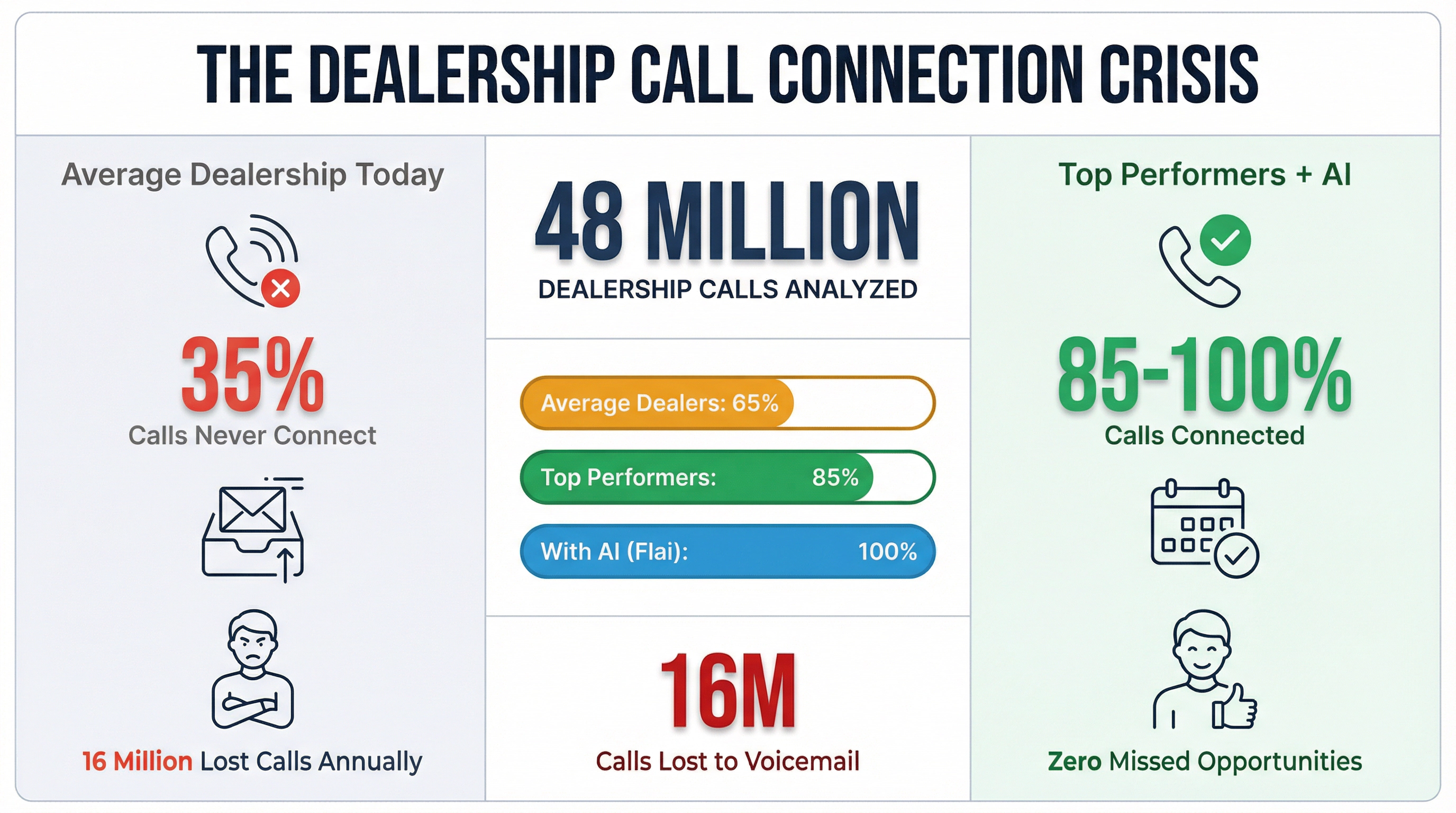
The numbers tell a stark story. Analysis of 48 million dealership calls in early 2025 found that 35% never connected to a live agent. That’s roughly 16 million calls ending in voicemail, dead transfers, or customers hanging up in frustration. Top-performing stores connect over 85% of their calls, proving the gap is fixable.
The problem isn’t just about answering the phone. It’s about completing the transaction. A system that actually books the appointment, confirms the details, and logs it in your DMS? That’s revenue.
This guide covers how to fix your dealership’s phone handling, compare your real options, implement without chaos, and measure what actually matters.
What Problem Are You Actually Trying to Solve?
People don’t search for “virtual receptionist for car dealerships” because they want a fancy phone tree. They search it because they’re trying to fix real problems:
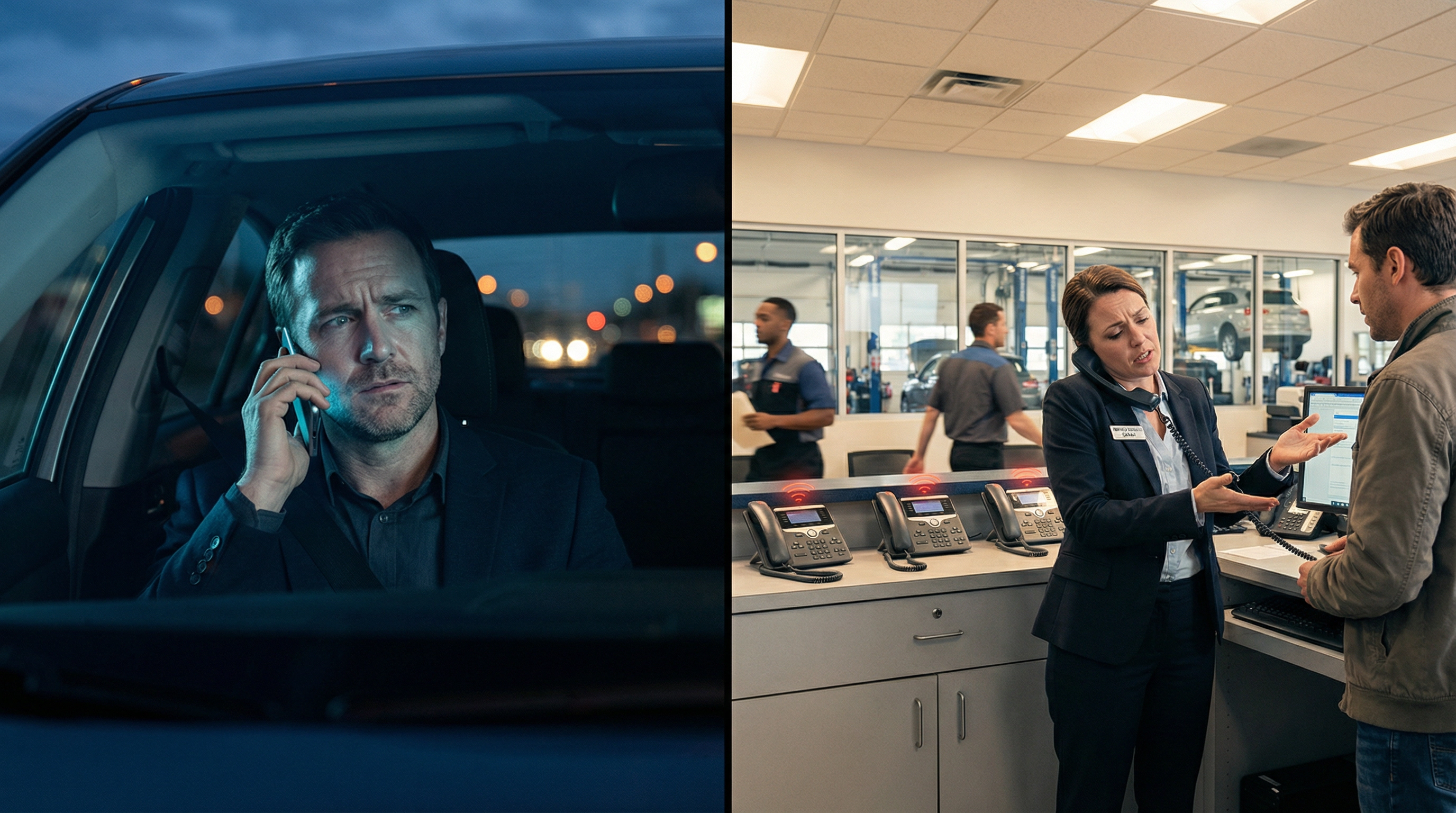
1. Stop losing high-intent customers to voicemail, holds, and transfers.
Car Wars’ 2025 phone analysis, as publicly summarized across industry publications, suggests that across 48 million inbound calls, 35% were unconnected. Roughly 16 million calls ended up misrouted, stuck on hold, or sent to voicemail.
2. Turn “phone-ups” into booked appointments, not “we’ll call you back.”
Virtual receptionist success isn’t “answered the phone.” It’s “completed the job.” Booking the service slot. Scheduling the test drive. Getting the customer on your calendar.
3. Cover after-hours and peak-hour spikes without hiring your way out.
Industry research indicates that 56% to 60% of dealership leads arrive after business hours. Missed after-hours calls alone can cost the average dealership over $1 million annually in lost service revenue.
4. Raise CSI by reducing friction.
If customers call multiple times, get bounced around departments, or wait on hold for three minutes, CSI takes the hit. That shows up as retention loss and negative reviews.
Why Missed Calls Cost Dealerships Money
The phone is still a main lifeline for dealership sales and service. Every call represents potential revenue, and many dealerships struggle to handle the volume.
The Call Connection Crisis
Roughly one-third of customer calls aren’t getting through. Recent analysis of 48 million dealership calls found the average dealership connected only about 65% of inbound calls to a qualified staff member. Top performers hit 80-85%, proving the gap is fixable.
| Dealership Performance | Call Connection Rate | Result |
|---|---|---|
| Average Dealership | 65% | 1 in 3 callers never reach anyone |
| Top Performers | 80-85% | Minimal missed opportunities |
| With AI Virtual Receptionist | Near 100% | Zero missed calls, 24/7 coverage |
The Hold Time Disaster
When customers DO connect, they’re often on hold for nearly 3 minutes. Studies show that:
- 60% of customers hang up after just one minute on hold
- 32% won’t wait at all (they hang up immediately if told to hold)
- 31.8% of missed dealership calls are due to customers quitting while stuck on hold
The After-Hours Black Hole
Many consumers call outside of normal 9-7 business hours. Several studies indicate 50-60% of dealership leads arrive after hours. If your store is closed, those leads call the next dealership that picks up.
Industry estimates suggest the average dealer loses over $1 million in revenue annually from missed after-hours calls alone. During business hours, 8-11:30 AM accounts for about half of daily service calls, and Mondays see the highest volumes.
The First-Attempt Failure Problem
Car Wars research suggests 89% of customers calling service departments didn’t reach a live person on their first attempt. Nearly nine out of ten service callers have to try again, leave a voicemail, or give up entirely.
Bottom line: Dealers are literally losing money and goodwill because they can’t consistently answer the phone fast enough.
Why Virtual Receptionists Matter More in 2026
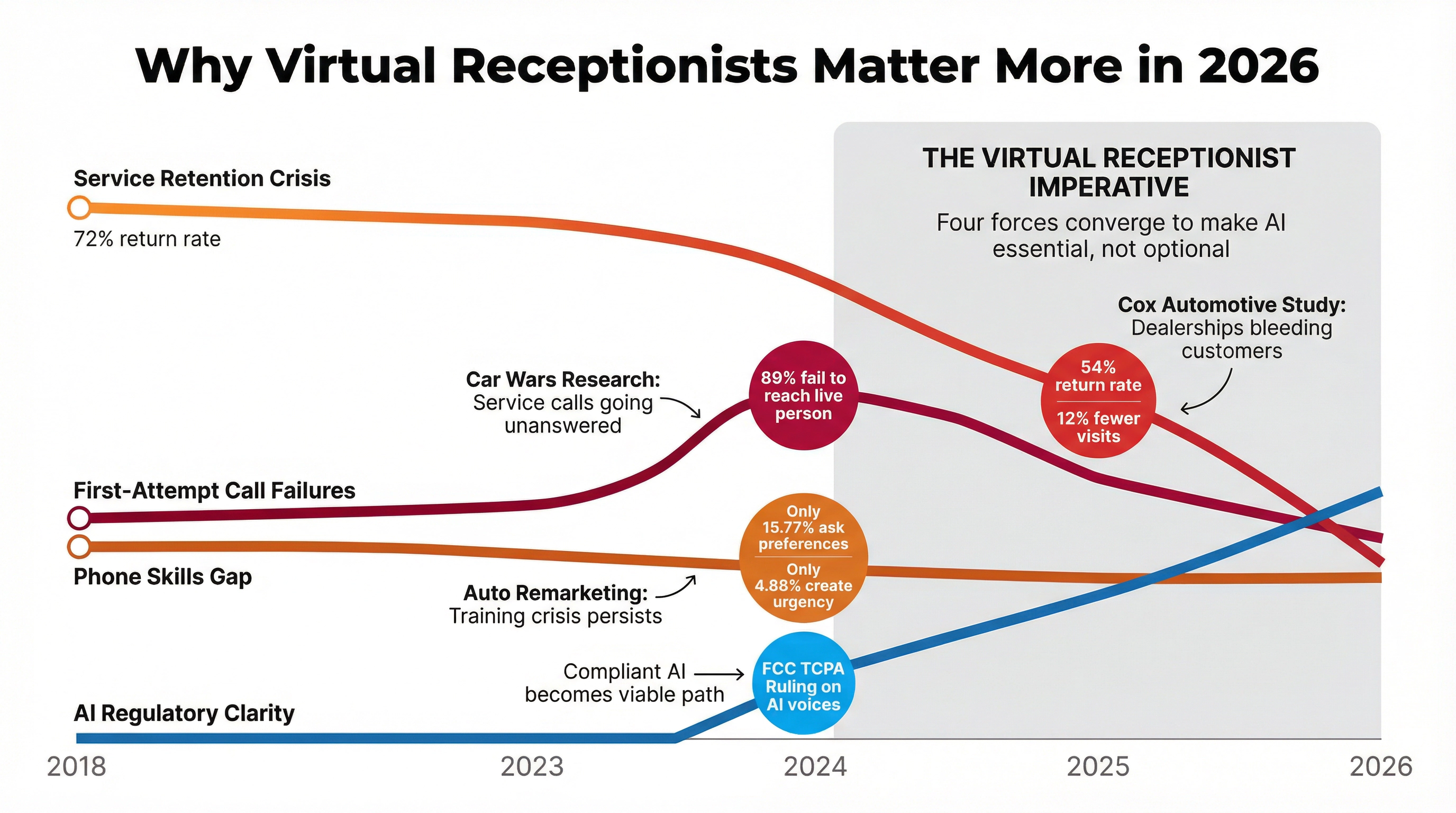
Four major shifts have made virtual receptionists essential right now, not optional for later.
1. Dealerships are leaking service retention
Cox Automotive’s Service Industry Study, announced November 11, 2025, reports that dealerships handle 12% fewer service visits than in 2018. In 2025, only 54% of owners with vehicles two years old or newer returned to the selling dealer for service, down from 72% in 2023.
2. Phone handling is still a mess at scale
Car Wars data points to huge volumes of calls failing to reach the outcome customers want. Their research suggests 89% of customers did not reach a live person on their first attempt calling a service department.
3. “Good phone skills” are not consistently happening
Car Wars research covered by Auto Remarketing (September 10, 2024) found only 15.77% of agents asked about vehicle preferences over the phone, and only 4.88% of calls created a sense of urgency. That’s a training and consistency problem, not just a staffing problem.
4. AI changed customer expectations (and regulators reacted)
In 2024, the FCC unanimously adopted a Declaratory Ruling clarifying that calls made with AI-generated voices are considered “artificial” under the TCPA, meaning existing robocall restrictions apply. “Voice automation” is not a free-for-all anymore.
What Does a Virtual Receptionist Do for Car Dealerships?
A dealership virtual receptionist answers inbound calls (and sometimes texts/emails), figures out what the customer wants, and either completes the task (book, reschedule, answer, route) or hands off to the right human with context.
It is NOT:
- A basic auto-attendant (“Press 1 for Sales, Press 2 for Service…”)
- A voicemail box
- A call center that mostly takes messages
- A receptionist who answers but cannot book because they’re not connected to your scheduler
The dealership-specific requirement most people underestimate
In automotive, calls are rarely “just information.” They’re transactions: “Book my service appointment.” “Is this vehicle available?” “I got a recall notice.” “Transfer me to parts.”
If your virtual receptionist cannot complete the transaction, you’re still leaking revenue and CSI.
Two Main Flavors
Live Virtual Receptionist Service (Human-Staffed)
An outsourced 24/7 call answering service where live agents answer on behalf of the dealership. They follow a script, collect basic info, and sometimes schedule appointments. Their capabilities are limited by what information and authority you give them. Many end up simply taking messages. Quality varies since agents handle calls for many businesses. Still, it beats voicemail.
AI-Powered Virtual Receptionist (Automated/Voice AI)
An AI-driven voice assistant that converses with callers and performs tasks like a capable human receptionist would. It uses advanced speech recognition to have a real conversation. It can answer questions, look up information, schedule appointments directly in your DMS, collect contact details, and transfer calls to the appropriate staff member.
The best AI receptionists integrate with dealership databases, recognizing callers by phone number and checking the service calendar in real time. A customer says, “I need to book my 10,000-mile service,” and the AI responds, “Sure, are you calling about your 2021 Toyota RAV4? I have openings Tuesday at 5:30 or Thursday at 6:00.”
If the caller asks something complex, the AI can warm-transfer to a staff member with a summary. These systems handle multiple calls at once with no wait time and never have an off day.
7 Things a Dealership Virtual Receptionist Must Do
Score any solution against these seven jobs.
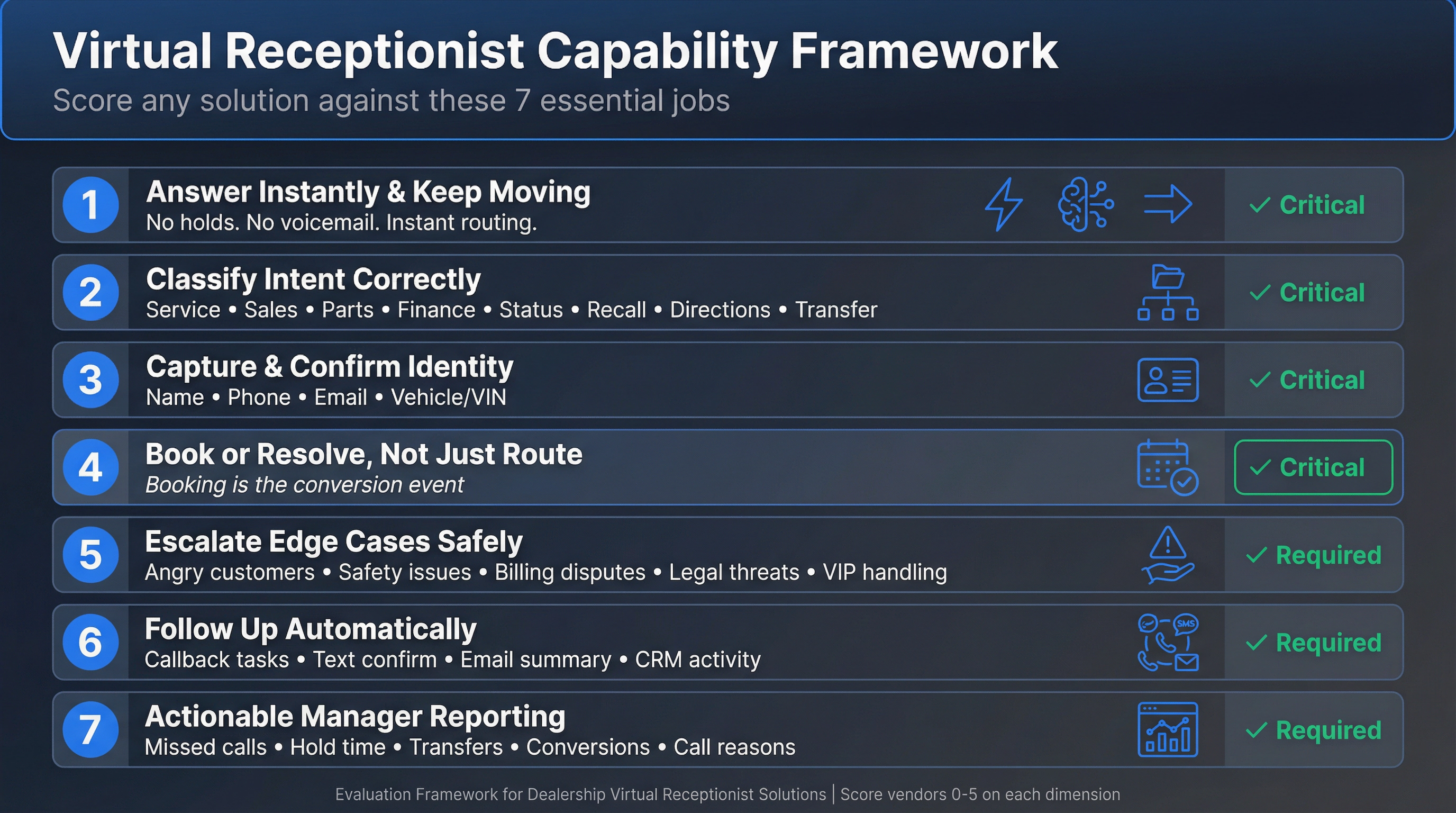
Job 1: Answer instantly and keep the caller moving. Not “please hold.” Not “leave a message.” Answer fast, identify intent fast, move toward a concrete next step.
Job 2: Classify intent correctly. Service scheduling, sales appointment/test drive, parts, finance, status checks, recall, directions/hours, transfer requests.
Job 3: Capture and confirm identity. Name, phone number, email (if needed), vehicle details when relevant.
Job 4: Book or resolve, not just “route.” For service and sales, booking is the core conversion event. Deep integrations with schedulers, CRMs, and DMS systems enable real booking.
Job 5: Escalate edge cases safely. Angry customers, safety issues, billing disputes, legal threats, VIP customers.
Job 6: Follow up automatically. If the call cannot complete: trigger a callback task, text confirmation, email summary, or CRM activity.
Job 7: Produce reporting that managers can actually use. Missed calls, abandoned calls, hold time, transfers, appointment conversions, outcomes by hour/day, and call reasons.
Benefits of Virtual Receptionists for Car Dealerships
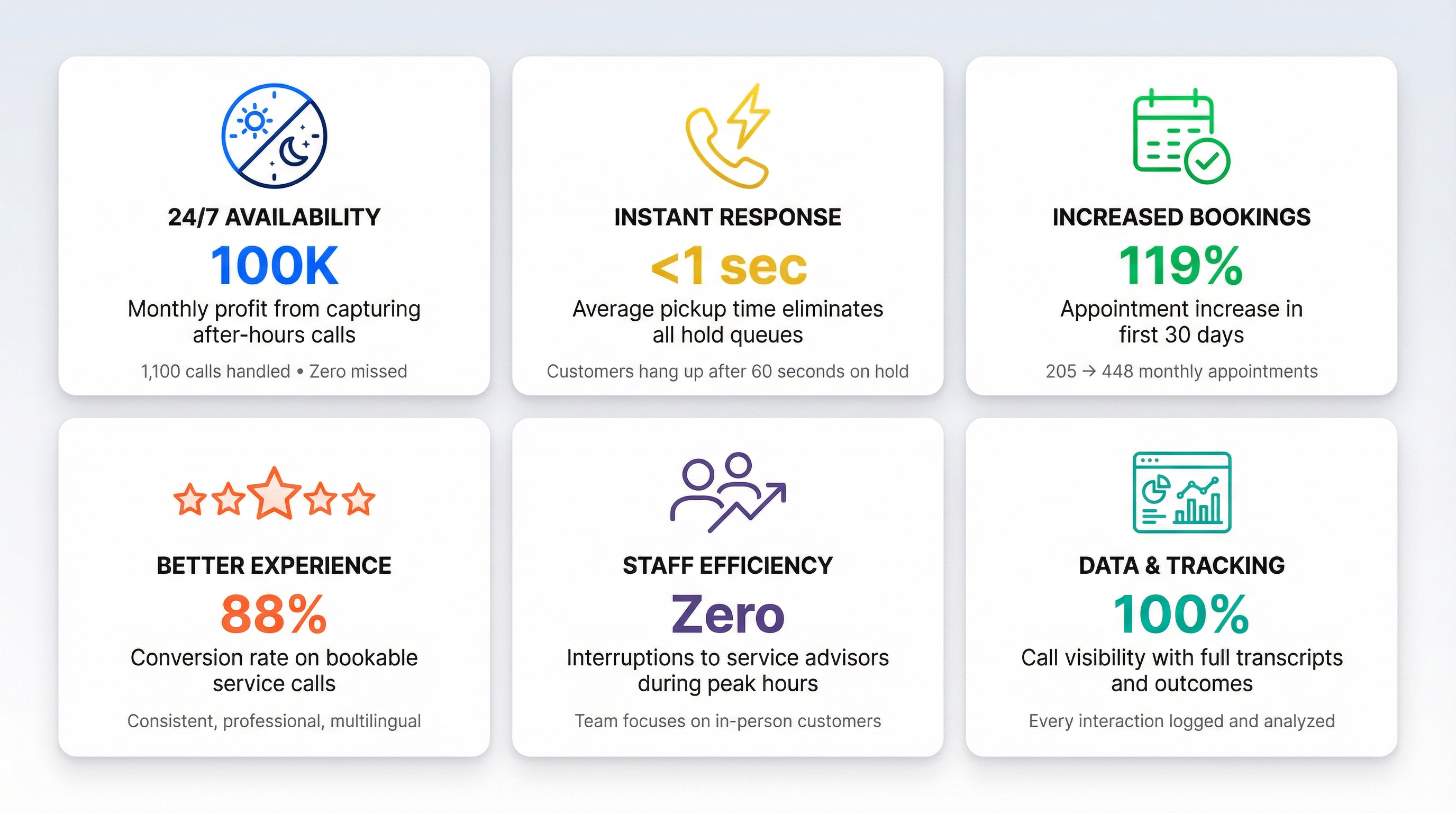
1. 24/7/365 Availability
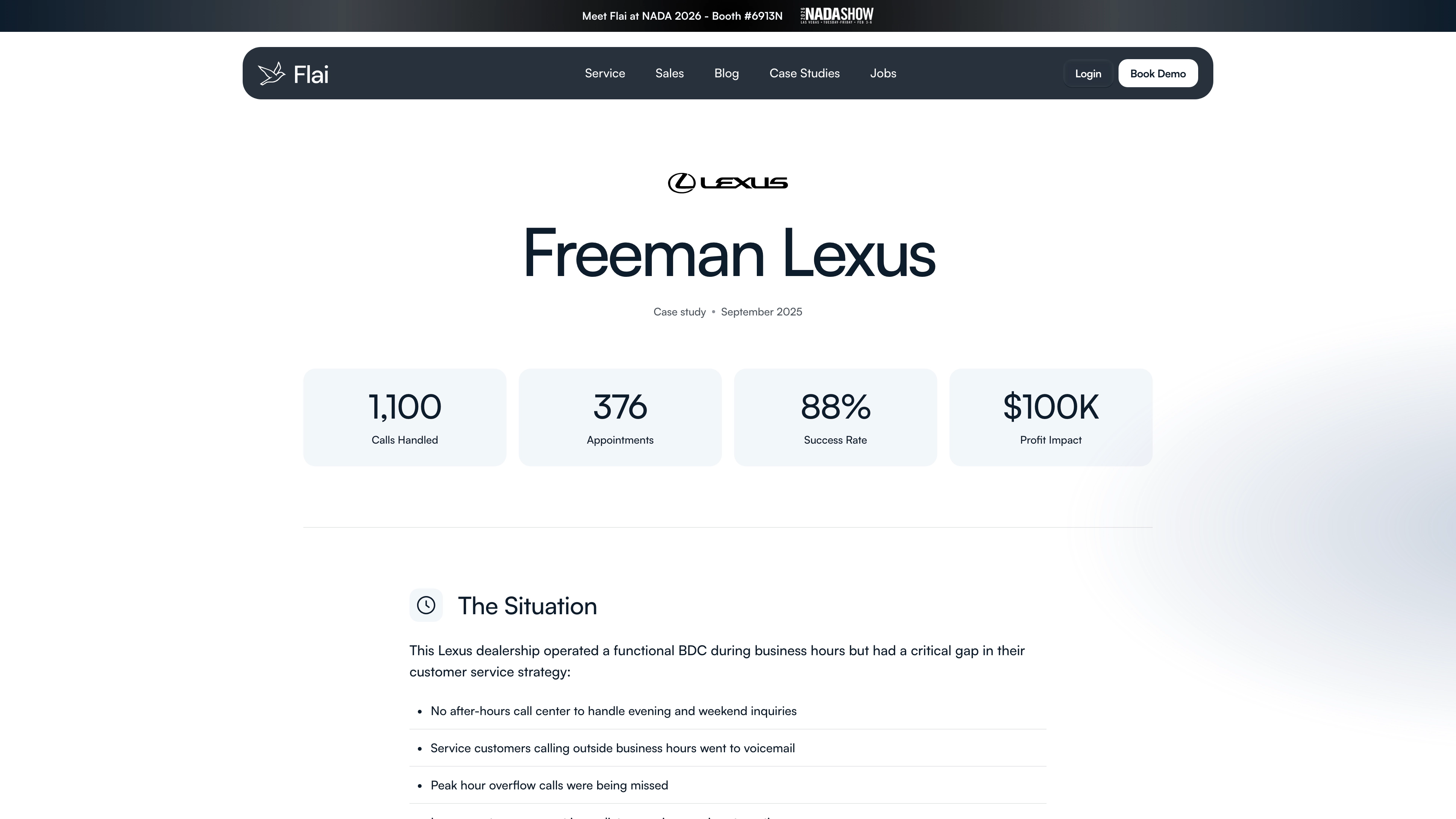
A virtual receptionist ensures every call gets answered, no matter when it comes in. A Lexus dealership using AI virtual receptionist technology reported handling approximately 1,100 calls in a month with zero missed calls. They booked 376 additional service appointments (88% conversion), yielding about $100,000 in incremental profit.
2. Instant Response
AI voice assistants pick up within one or two rings and don’t put callers on hold. They handle multiple conversations simultaneously. Long hold times were found to be the number one cause of failed call connections. Industry research shows caller abandonment shoots up after just 30 seconds on hold.
3. Increased Appointment Booking
A Chrysler-Dodge-Jeep-Ram store in California deployed an AI virtual receptionist. Monthly service appointments jumped from 205 to 448 (a 119% increase). The AI handled 1,563 calls, booking 304 into service slots, translating to roughly $83,000 in additional profit in one month.
In the Freeman Lexus case study, out of 426 calls where the customer wanted to book service, 376 appointments were successfully booked (an 88% success rate).
4. Better Customer Experience
- Consistent courtesy: An AI doesn’t have a bad day and greets every person with the same friendly tone
- No phone tag: The AI identifies intent and either handles it end-to-end or brings in the correct person right away
- Multilingual support: Many platforms converse in multiple languages on the fly
5. Improved Staff Efficiency
By offloading calls to an automated system, service advisors can focus on customers in front of them instead of juggling ringing phones. Routine calls (oil changes, recall checks, hours/directions) get handled without pulling skilled humans away from higher-value activities.
6. Data, Tracking, and Continuous Improvement
Every call can be logged, transcribed, and categorized. Management gains visibility into call volumes, peak times, and booking rates. You can directly see “we booked X appointments via the virtual receptionist this month.”
Virtual Receptionist Options for Car Dealerships
Think in “categories,” not vendors first.
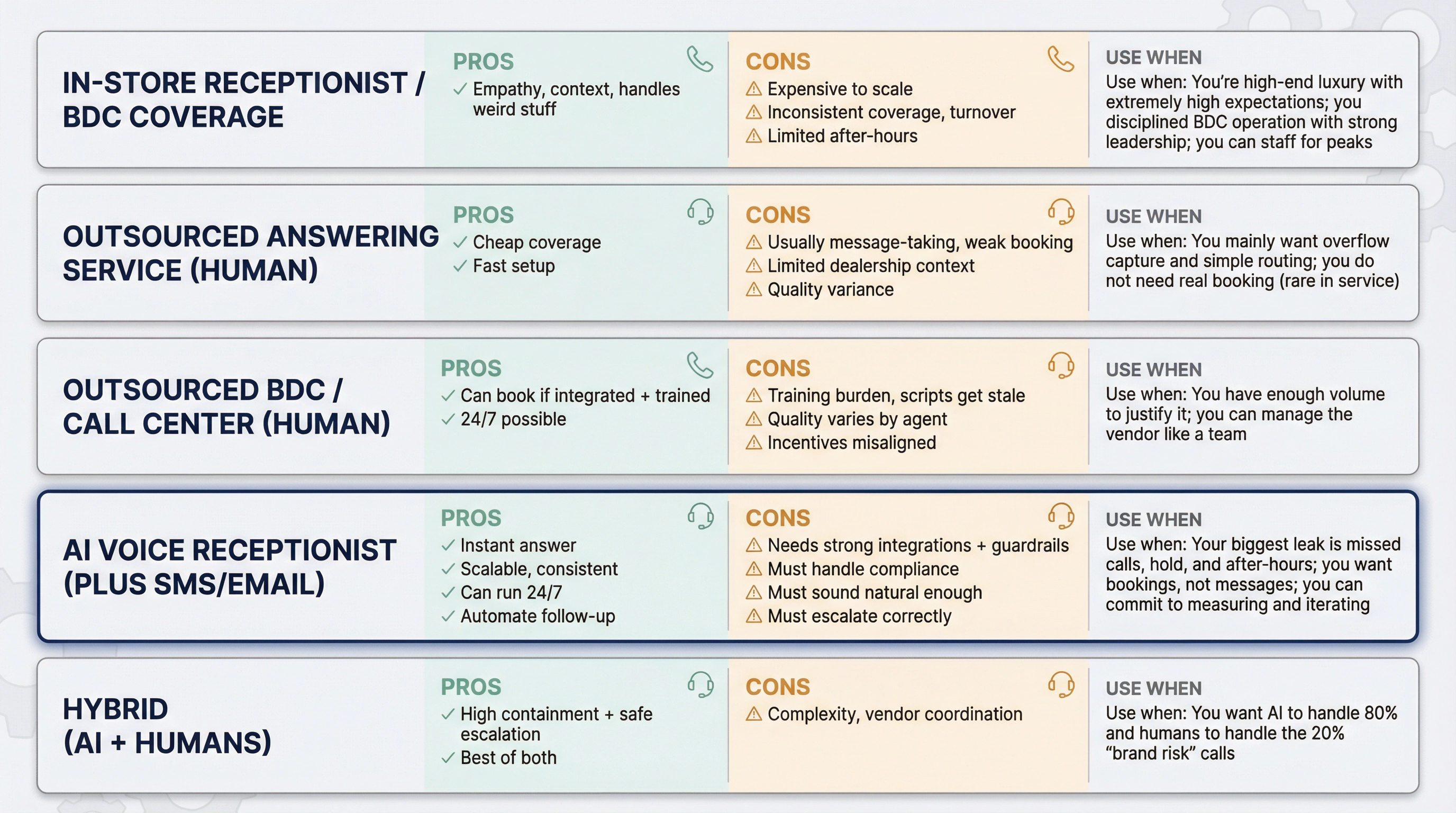
| Category | Pros | Cons | Use When |
|---|---|---|---|
| In-store receptionist / BDC | Empathy, context, handles edge cases | Expensive to scale, turnover, limited after-hours | High-end luxury; strong existing BDC operation |
| Outsourced answering service | Cheap coverage, fast setup | Message-taking only, weak booking, quality variance | Overflow capture and simple routing |
| Outsourced BDC / call center | Can book if integrated + trained | Training burden, scripts get stale, quality varies | Enough volume to justify; can manage vendor like a team |
| AI voice receptionist | Instant answer, scalable, consistent, 24/7, automated follow-up | Needs strong integrations + guardrails, must handle compliance | Biggest leak is missed calls and after-hours; you want bookings, not messages |
| Hybrid (AI + humans) | High containment + safe escalation | Complexity, vendor coordination | AI handles 80%, humans handle 20% "brand risk" calls |
How to Choose a Virtual Receptionist Solution
Score each dimension 0 to 5 and do not let vendors dodge specifics.
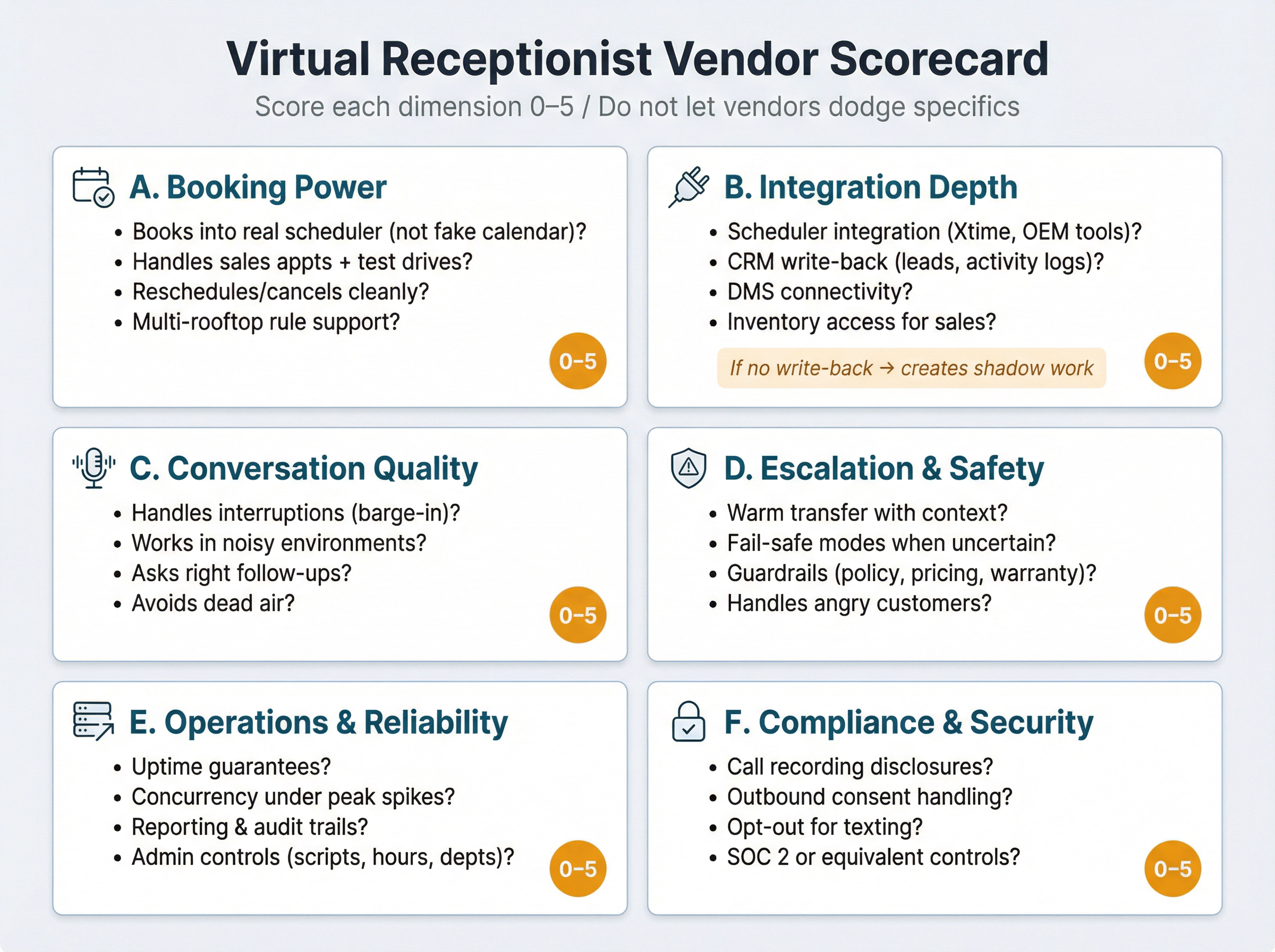
| Evaluation Dimension | What to Look For |
|---|---|
| A. Booking Power | Can it book service appointments into the real scheduler? Can it handle sales appointments, reschedules, and cancellations? Multiple rooftops with different rules? |
| B. Integration Depth | Scheduler integration (Xtime, dealer scheduler, OEM tools) CRM write-back DMS connectivity Inventory access for sales questions |
| C. Conversation Quality | Handles interruptions ("barge-in")? Noisy environments? Right follow-up questions? No dead air? |
| D. Escalation and Safety | Warm transfer with context "Fail safe" modes Guardrails for policy, pricing, warranty, legal Angry customer handling |
| E. Operations and Reliability | Uptime guarantees Concurrency under peak spikes Reporting and audit trails |
| F. Compliance and Security | Call recording disclosures Outbound consent handling SOC 2 or equivalent controls |
How to Implement a Virtual Receptionist (Step by Step)
This is the part most content on the internet skips. It’s also where ROI is won or lost.
Step 1: Map your call reasons. Pull 2-4 weeks of call logs and tag: service booking, sales lead, parts, status, recall, general. If you cannot tag, sample 200 calls manually.
Step 2: Define the dealership “promise.” Write it like rules: “AI can book for these RO types, not these.” “Escalate immediately if customer says Y.” “If customer requests a person twice, transfer.”
Step 3: Decide your escalation policy. Contain easy calls fully. Escalate hard calls fast. Never trap a customer in loops.
Step 4: Configure disclosures. Recording disclosure (if you record), clear identity disclosure, consent and opt-out handling for outbound campaigns.
Step 5: Start narrow, then expand.
- After-hours service calls only
- Overflow during peak hours
- All service calls
- Sales calls
- Outbound campaigns
Step 6: Weekly performance review (non-negotiable). Review: failed calls, transfers, abandonment, booking conversion, customer complaints, top intents. Then update scripts, routing, and training data.
How to Measure Virtual Receptionist Performance
Track these (and ignore vanity metrics).
| Metric | What It Measures | Target |
|---|---|---|
| Answer Rate | % of inbound calls answered | Close to 100% after-hours |
| First-Attempt Resolution | Customer resolved without calling again (Car Wars data suggests 89% failure rate in service) | Improvement over baseline |
| Appointment Conversion | Appointments booked / "bookable" calls | Track for service and sales separately |
| Abandonment Rate | Customers who hang up before outcome | Minimize |
| Time to First Response | How fast you start talking after ring | Under 2 seconds |
| Transfer Quality | Clean warm transfers vs. cold | Cold transfers = disaster |
| Retention Signals | Service retention and repeat visits | Long-term proof of value |
Cox Automotive’s retention findings are a warning sign that small friction compounds into lost market share.
Virtual Receptionist ROI Calculator
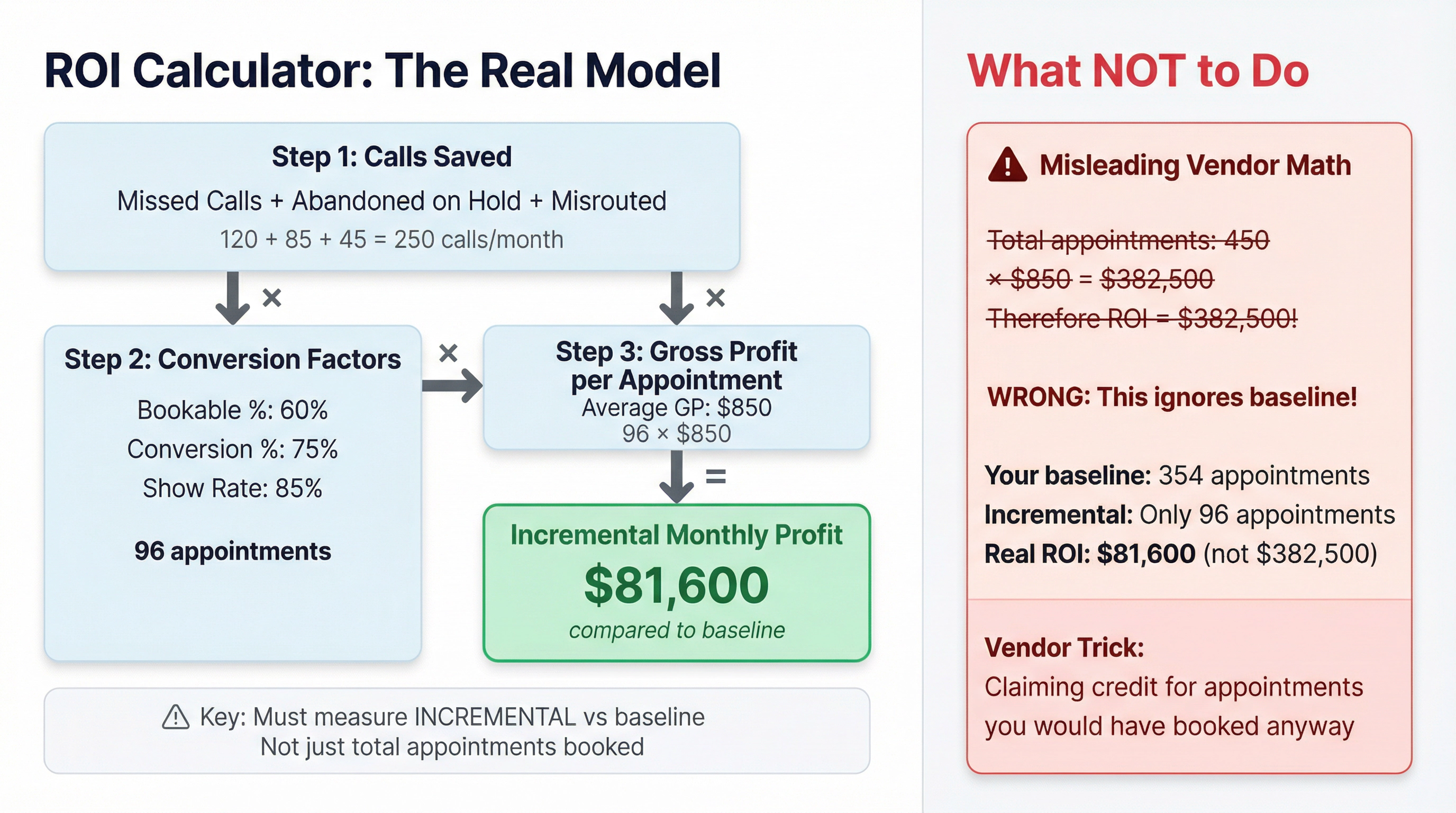
Here’s the real model (no hype, just mechanics).
Incremental appointments = (Calls saved from voicemail/hold) x (Bookable %) x (Conversion %) x (Show rate)
Incremental gross profit = Incremental appointments x Gross profit per appointment
Estimating “calls saved”
Use: missed calls, calls abandoned while on hold, and calls misrouted and lost. Public summaries of Car Wars data suggest misroutes, holds, and voicemail represent a massive chunk of inbound volume.
What NOT to do: Don’t let vendors sell you ROI using only “appointments booked.” You need “incremental compared to baseline,” otherwise you might just be shifting bookings between teams.
Virtual Receptionist Compliance Guide for 2026
I’m not your lawyer. Treat this as an operational checklist and confirm with counsel.
1. TCPA and AI Voice. The FCC clarified in 2024 that AI-generated voices fall under the TCPA’s “artificial or prerecorded voice” restrictions. Be extremely careful with outbound voice campaigns. Make sure consent and opt-out processes are real.
2. Impersonation Rules. The FTC’s Impersonation Rule went into effect April 1, 2024. Your system should not mislead customers about who (or what) they are talking to.
3. Call Recording Consent. Federal law generally allows one-party consent, but state laws can be stricter. Some sources summarize that 11 states use all-party consent rules. If you record calls, implement an upfront disclosure.
4. Data Security. Even if you’re “just answering calls,” you’re handling phone numbers, names, vehicle info, and appointment details. Treat it like real customer data, because it is.
Common Virtual Receptionist Mistakes to Avoid
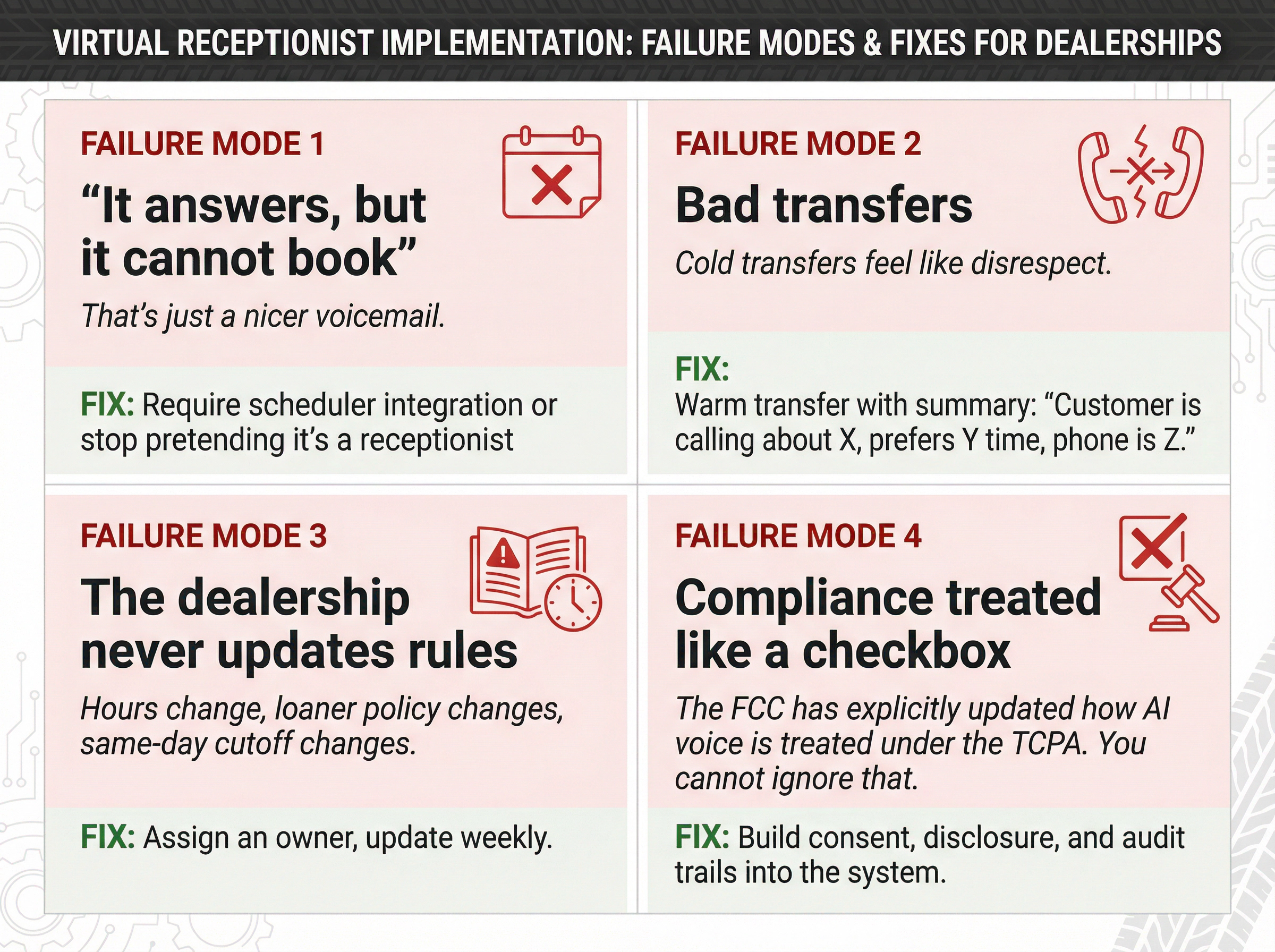
Failure Mode 1: “It answers, but it cannot book.” That’s just a nicer voicemail. Fix: Require scheduler integration or stop pretending it’s a receptionist.
Failure Mode 2: Bad transfers. Cold transfers feel like disrespect. Fix: Warm transfer with summary: “Customer is calling about X, prefers Y time, phone is Z.”
Failure Mode 3: The dealership never updates rules. Hours change, loaner policy changes, same-day cutoff changes. Fix: Assign an owner, update weekly.
Failure Mode 4: Compliance treated like a checkbox. The FCC has explicitly updated how AI voice is treated under the TCPA. Fix: Build consent, disclosure, and audit trails into the system.
Virtual Receptionist Case Studies and Results
Freeman Lexus (California)
This Lexus dealership had no after-hours service answering and struggled with overflow. After deploying an AI receptionist, in one month they handled approximately 1,100 service calls with zero missed, booked 376 service appointments (88% conversion), and generated estimated $100,000 in additional monthly profit.
San Leandro CDJR (California)
A midsize Chrysler-Dodge-Jeep-Ram store used to book approximately 205 service appointments a month. With a virtual receptionist handling 100% of inbound calls, appointments leaped to 448 in the first month (a 119% increase). The system answered 1,563 calls, booked 304 into real appointments, and generated $83,000 in additional gross profit. The manager noted it “paid for itself on a single weekend.”

Industry-Wide Trends
Dealerships adopting AI voice agents were handling on average 16,500 calls per year via AI by 2024, growing rapidly. Customers are spending 16% longer on AI calls in 2024 vs 2022, indicating greater engagement and trust.
How AI Virtual Receptionists Work

We built Flai specifically to solve the dealership communication problem from the ground up. Not by stitching together off-the-shelf voice components, but by creating a purpose-built AI platform that handles voice, SMS, and email as one unified system.
Core Capabilities
For service: Instantly answers inbound calls 24/7, books appointments directly into your scheduler, runs recall and re-engagement outreach campaigns.
For sales: Follows up fast and consistently by phone, text, and email. Converts more leads into booked test drives. Captures after-hours sales inquiries.
What Sets Top Platforms Apart
1. Custom-built voice AI. The best platforms build their own stack to keep conversations fast and natural, achieving the highest bookable rate in the industry.
2. Integrations that actually work. They connect to your DMS, CRM, scheduler, and phone system. When the AI books an appointment, it checks real availability, books the slot, and writes it back into your systems.
3. End-to-end follow-up. If a human is needed, the best systems warm-transfer and pass context. For outreach, they follow up by phone, text, and email as a two-way conversation.
4. Results-focused operation. Appointments go up and customers get taken care of faster. Open analytics to see calls handled, appointments booked, and outcomes.
Proven Results
- CDJR dealership: 205 to 448 monthly service appointments (+119%), $83,000 additional gross profit in 30 days
- Freeman Lexus: 1,100 calls handled, 376 appointments booked (88% conversion), $100,000 incremental profit
- Glendale Infiniti: Proven results in luxury automotive segment
Don’t take any vendor’s word for it. Test it against your actual call volume and measure what matters.
Next Steps: Getting Started
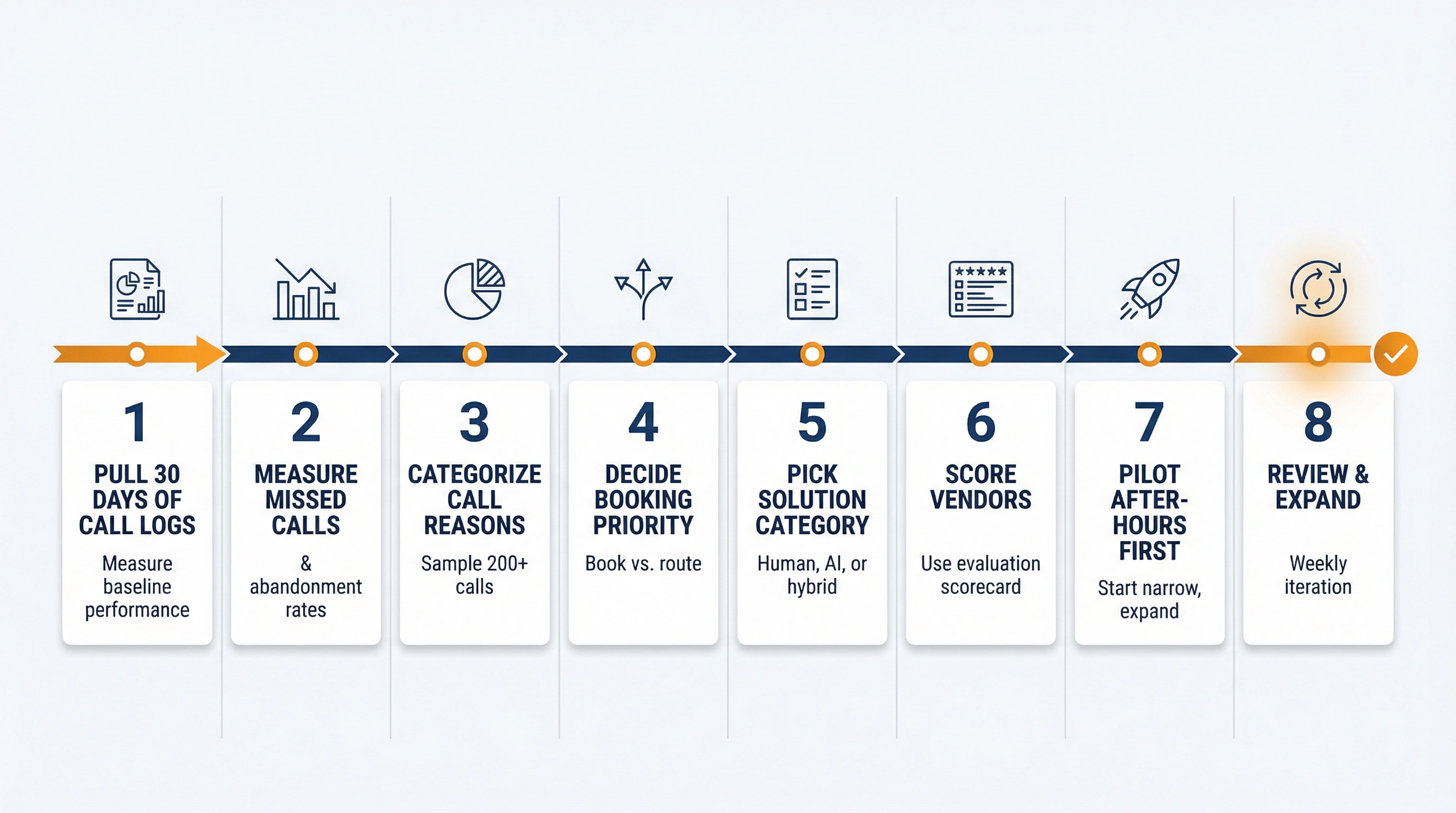
- Pull 30 days of inbound call logs
- Measure missed calls and abandonment
- Categorize call reasons (sample at least 200 calls)
- Decide which calls must be booked, not just routed
- Pick a solution category (human, outsourced, AI, hybrid)
- Score vendors using the evaluation scorecard
- Pilot after-hours service first
- Review weekly and expand systematically
Want to see how AI virtual receptionists handle your dealership’s phone volume? Explore proven case studies or reach out to learn more.
Virtual Receptionist FAQ
How much does a virtual receptionist cost?
Outsourced human answering services run $200-$500/month for basic coverage. Dedicated BDC services can be $2,000-$5,000+ per month. AI-powered platforms typically charge based on call volume or a flat monthly fee per location. When evaluating cost, ask: “How many additional appointments do we need to break even?” For most dealerships, that number is surprisingly small.
Can AI really book into our existing scheduler?
Yes, but only with strong integration. The best AI platforms integrate directly with common dealership schedulers (Xtime, CDK, Reynolds, OEM-specific tools) and check real-time availability. Before committing, verify they have a proven integration with YOUR specific scheduler.
What happens when AI can’t handle a call?
A well-designed system warm-transfers to an available staff member, passing along all context. The best systems never trap a customer in a loop. If in doubt, they escalate to human help.
What’s the difference between an AI receptionist and an IVR?
IVR is the old-school “Press 1 for Sales, Press 2 for Service” menu. Rigid, frustrating, limited. An AI receptionist uses natural language understanding for real conversation. Customers speak naturally, and the AI understands intent, asks follow-up questions, and completes tasks.
How do I measure ROI?
Focus on incremental appointments and revenue. Measure missed calls and appointments before implementation, then track the improvement after. Formula: (Incremental appointments x Gross profit per appointment) - Monthly platform cost = Monthly ROI. See real examples showing $83,000-$100,000 monthly profit impact.
Conclusion
In the car dealership world, success often comes down to being first, fastest, and most reliable in responding to customer needs. A virtual receptionist gives your dealership the ability to be there for every customer, at any time, with consistent excellence.
This isn’t about replacing your human team. It’s about giving your dealership coverage so that your people can shine where they’re needed most. Your sales team and service advisors focus on delivering a top-notch in-person experience while the phones handle the routine stuff in the background.
The results speak clearly: higher appointment volumes, higher customer satisfaction, and more revenue captured. Don’t let your competition answer that next call first.
Ready to see what Flai can do for your dealership? Explore our proven results or reach out to discuss your specific needs.