Dealership Recall Campaigns: AI Best Practices (2026)
Most dealership recall campaigns fail because of friction, not logistics. Learn how to run campaigns that actually bring customers in.
Recall campaigns sit in a strange spot for dealerships. The customer has to get the repair done (it’s a safety issue). The OEM pays you to do the work (warranty labor at around $350 per completed repair). And yet, completion rates remain stubbornly low because getting humans to take action on anything requires overcoming friction.
This isn’t a logistics problem. It’s a behavior-change problem. And the dealerships that understand this distinction are the ones consistently bringing cars back through their service lanes.
Before we get into AI tools, you need to understand why recalls fail in the first place and what operational best practices actually make a difference. This guide covers both.
How Many Vehicle Recalls Are Issued Every Year?
Let’s establish what we’re working with.
According to NHTSA’s 2024 Annual Recall Report, published in April 2025, calendar year 2024 saw 950 vehicle recalls affecting 29.3 million vehicles. That’s not abstract. That’s millions of owners who need to visit a dealership for a free safety repair.
The backlog is even more alarming. Carfax reported in September 2025 that 54.6 million vehicles on U.S. roads have at least one unrepaired recall. About 725,000 of those are under “do not drive” guidance from the manufacturer. That number jumped 65% since summer 2024.
One in four vehicles on U.S. roads has at least one open recall. That’s your customer base, driving around with known safety issues.
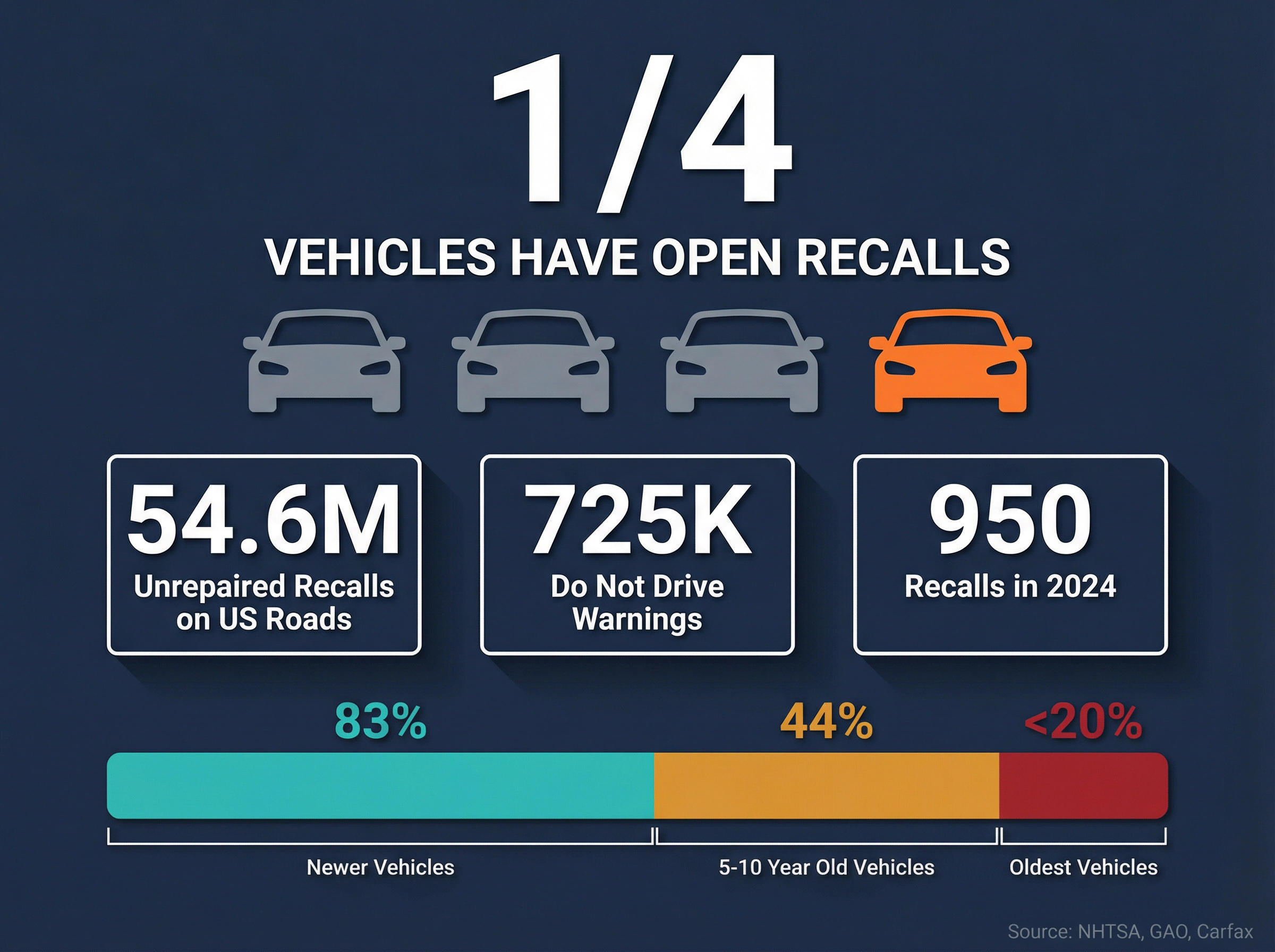
And here’s the uncomfortable truth about completion rates: the GAO’s Vehicle Safety Recall Repair Rates report shows they vary wildly by vehicle age. Newer cars see completion rates around 83%. For vehicles 5 to 10 years old, that drops to roughly 44%. And for the oldest vehicles in a recall population, completion can fall below 20%.
Why? Because the math in a customer’s head is simple: if the perceived hassle outweighs the perceived risk, they won’t come in.
Your recall campaign has one job. Raise the perceived risk (honestly) and crush the friction (operationally).
Why Do Dealership Recall Campaigns Fail?
A recall campaign is a behavior-change funnel. Customers only show up when four conditions are met:
- Awareness: They know the recall exists and applies to them
- Perceived Risk: They believe the issue matters enough to address
- Trust: They believe your dealership will handle it professionally
- Low Friction: The process is easy enough to actually complete
The GAO’s January 2024 report identified the key factors that drive (or block) recall completion: convenience, owner perception of safety risk, owner awareness, parts availability, vehicle age, contact info quality, relationship with the dealership, quality of recall communications, and fear of upselling at the dealership.
That last one matters more than most dealers realize. Customers often expect that “free recall visit” will turn into a $2,000 maintenance bill once they’re in the service lane. If your messaging or in-store behavior feeds that fear, you’re working against yourself.
The friction killers that stop customers:
- Parts not available (they call, you can’t help them)
- Long hold times when they try to schedule
- Inconvenient appointment options (no evenings, no weekends)
- No transportation alternatives (loaner, shuttle, pickup)
- Distrust of what will happen once they’re there
Before you ever message a customer, you need to solve for these operationally. Otherwise, your campaign just creates frustrated people who tried and failed to complete the recall.
How to Prioritize Dealership Recall Campaigns by Urgency
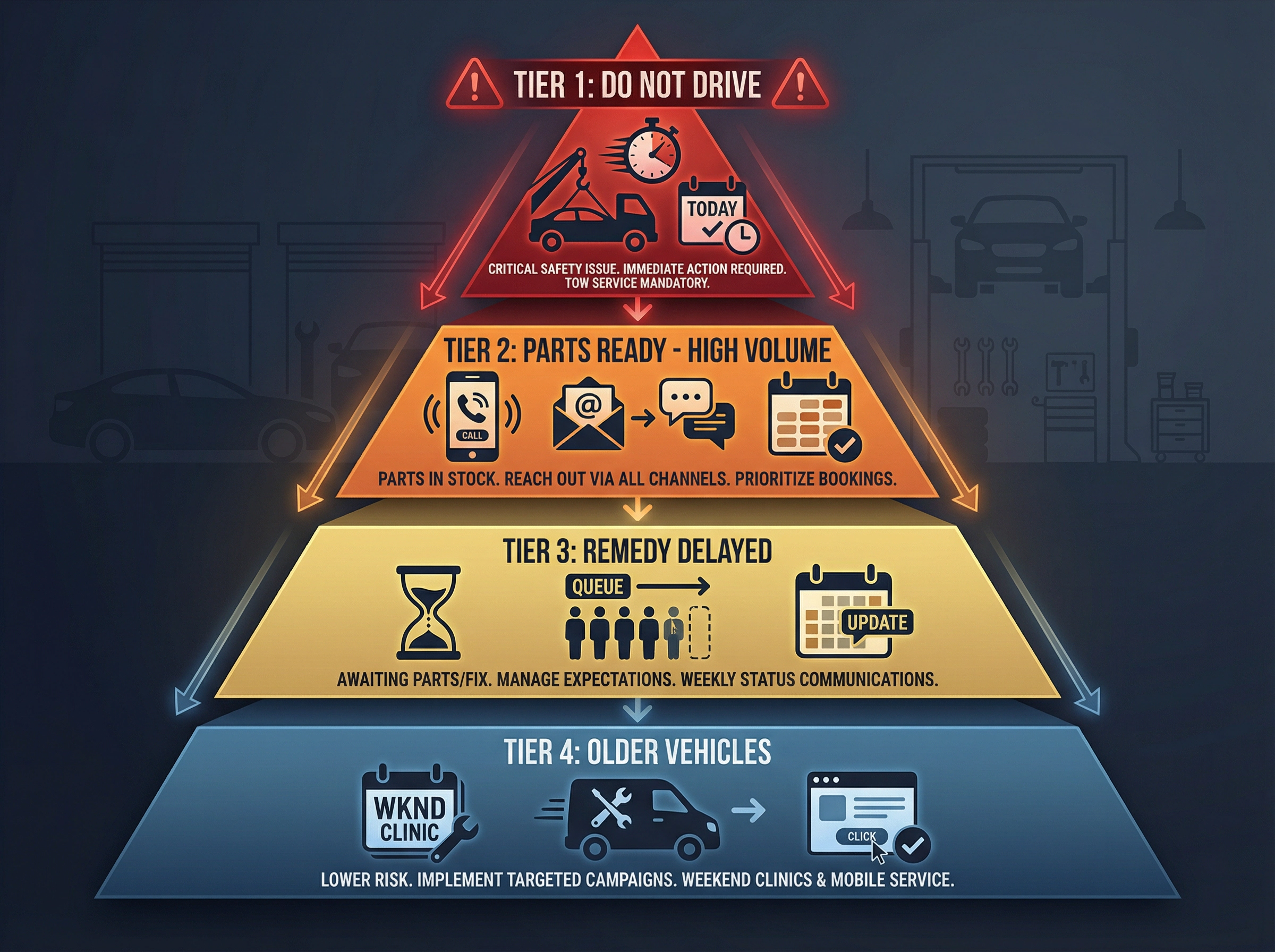
Don’t run one campaign and treat all recalls the same. You’ll waste resources on the wrong VINs and miss urgency where it matters. Use tiers.
| Tier | Description | Typical Tactics |
|---|---|---|
| Tier 1 | Do-not-drive / park-outside recalls | Same-day or next-day scheduling. Towing or pickup options. Compressed outreach cadence. |
| Tier 2 | Safety recall with parts available + fast remedy | Your volume play. Multi-touch, multi-channel outreach. Focus on scheduling efficiency. |
| Tier 3 | Safety recall but remedy delayed or parts constrained | Waitlist approach. Don't "blast and disappoint." Weekly availability updates. |
| Tier 4 | Very old vehicles / low attachment | Different tactics: weekend clinics, mobile service, minimal upsell, hyper-easy scheduling. |
Why tiering matters:
NHTSA’s Recall Completion Rates Report (updated January 2025) found that remedy availability timing has a massive impact. Recalls where the remedy is available within 60 days show completion rates around 80%. When the remedy takes a year to become available, completion drops to roughly 50%.
If you’re blasting customers for a recall where you can’t actually service them, you’re wasting your outreach and training customers to ignore you.
For Tier 4 (old vehicles), the same report shows completion is dramatically higher for vehicles newer than 2020 (around 87%) and plummets for the oldest vehicles. These customers need different tactics. Weekend recall clinics, mobile service if the repair permits, and messaging that emphasizes zero-hassle are your best bets.
How to Build a Clean Recall Campaign Target List
This is the most ignored step in recall campaigns. Bad data means wasted touches.
Your campaign list should be a VIN-first dataset with clean owner mapping. Minimum fields:
- VIN
- Recall code(s) and severity level (do-not-drive, park-outside, standard)
- Owner name
- Phone number(s) and email address(es)
- Last service date and last repair order
- Distance from store (by zip code)
- Language preference (if known)
- Parts/repair readiness status

Where this data comes from:
- OEM recall lists and dealer portal exports
- Your DMS and CRM (sold-here, serviced-here, orphan records)
- Third-party enrichment tools
- Inbound calls (always confirm contact info when customers reach out)
The GAO report explicitly identifies quality of owner contact information as a key driver of repair rates. And NHTSA guidance notes that recall outreach works better when you’re using accurate owner data and credible communications.
Pro move: Maintain a “recall-ready contact hygiene” process year-round:
- Confirm mobile and email at every repair order
- Add language preference to customer records
- Tag communication preferences (prefers text, call, or email)
- Store consent status for SMS
This makes every future recall campaign significantly easier to execute.
What’s the Best Multi-Channel Approach for Recall Outreach?
One message is never enough. NHTSA guidance on improving recall completion rates emphasizes using multiple communication channels and multiple touches.
The channel mix:
| Channel | Strengths | Weaknesses |
|---|---|---|
| SMS Text | Immediate, high open rates, easy to reply | Requires consent, character limits |
| Detailed info, verification links, lower cost | Goes to spam, gets ignored | |
| Phone | Personal, can handle questions live | Voicemails ignored, time-intensive |
| Feels official, reaches everyone | Slow, low response, gets tossed |
The most effective campaigns use all of them. A mailed letter might get tossed. An email might go to spam. A phone call might be ignored if the number isn’t recognized. But hitting all channels improves the odds that your message actually lands.
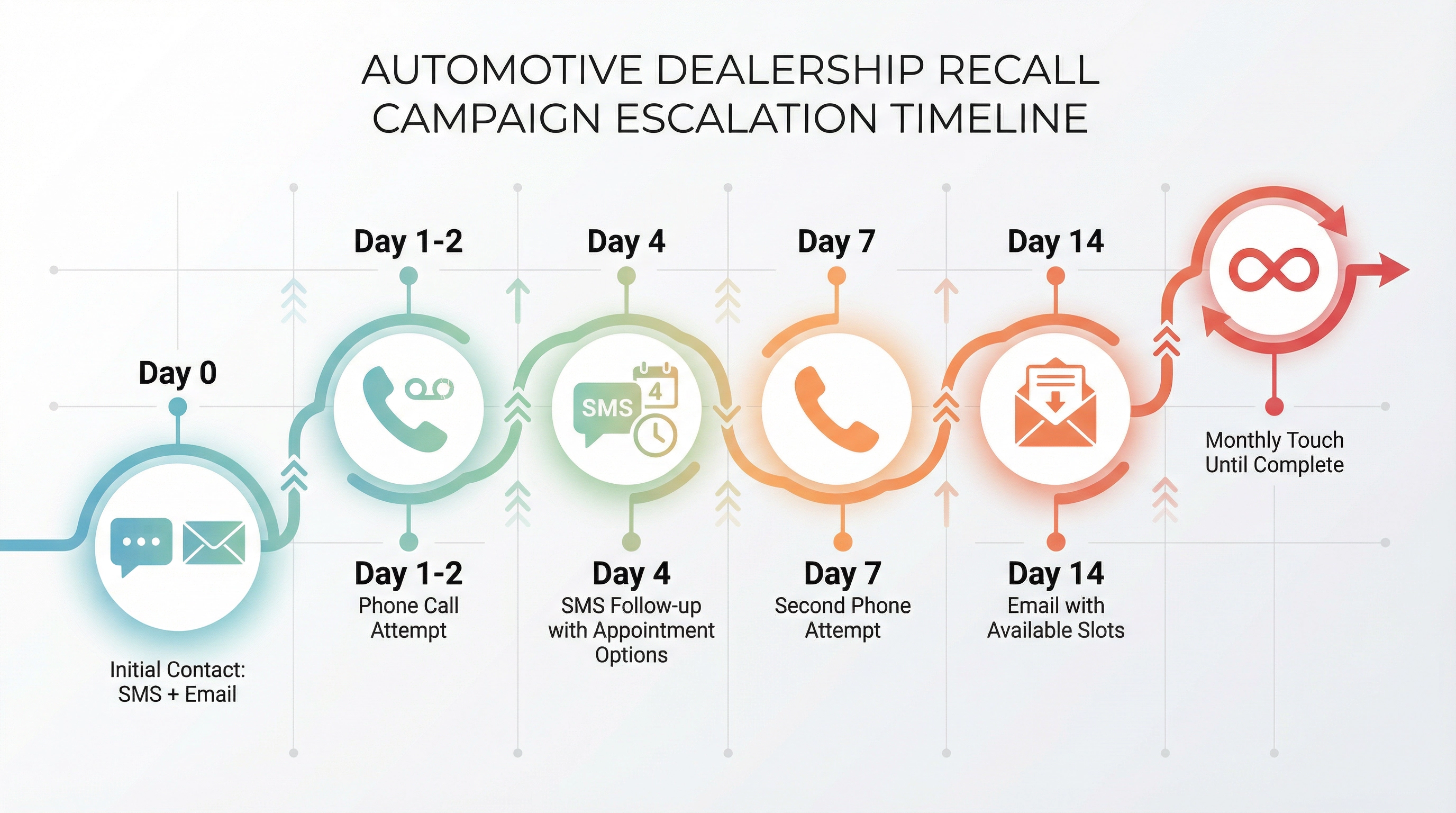
The “escalate the channel” approach:
Start gentle (email and text), then escalate to phone for non-responders. The sequence might look like:
-> Day 0: SMS + email with verification link and scheduling CTA
-> Day 1-2: Phone call attempt (one attempt, leave voicemail)
-> Day 4: SMS follow-up offering specific appointment windows
-> Day 7: Second phone attempt (different time of day)
-> Day 14: Email highlighting available recall slots
-> Monthly: One touch until completed or campaign closed
For Tier 1 recalls (do-not-drive), compress this. SMS and call on the same day. Daily follow-up until scheduled.
For Tier 3 recalls (parts not ready), don’t over-contact. One message: “We’ll notify you when parts arrive. Reply ‘waitlist’ to be first in line.” Then weekly availability updates.
What Should You Write in Recall Campaign Messages?
Your messaging needs to answer six questions in plain English:
- Is this real?
- Is my car affected?
- What’s the risk if I ignore it?
- How long will it take?
- How do I schedule fast?
- What will it cost? (Answer: free)
And you should always provide a self-serve verification path. “You can verify open safety recalls using NHTSA’s VIN lookup tool.” Just be transparent that the tool won’t show already-repaired recalls, very new recalls, or non-safety campaigns.
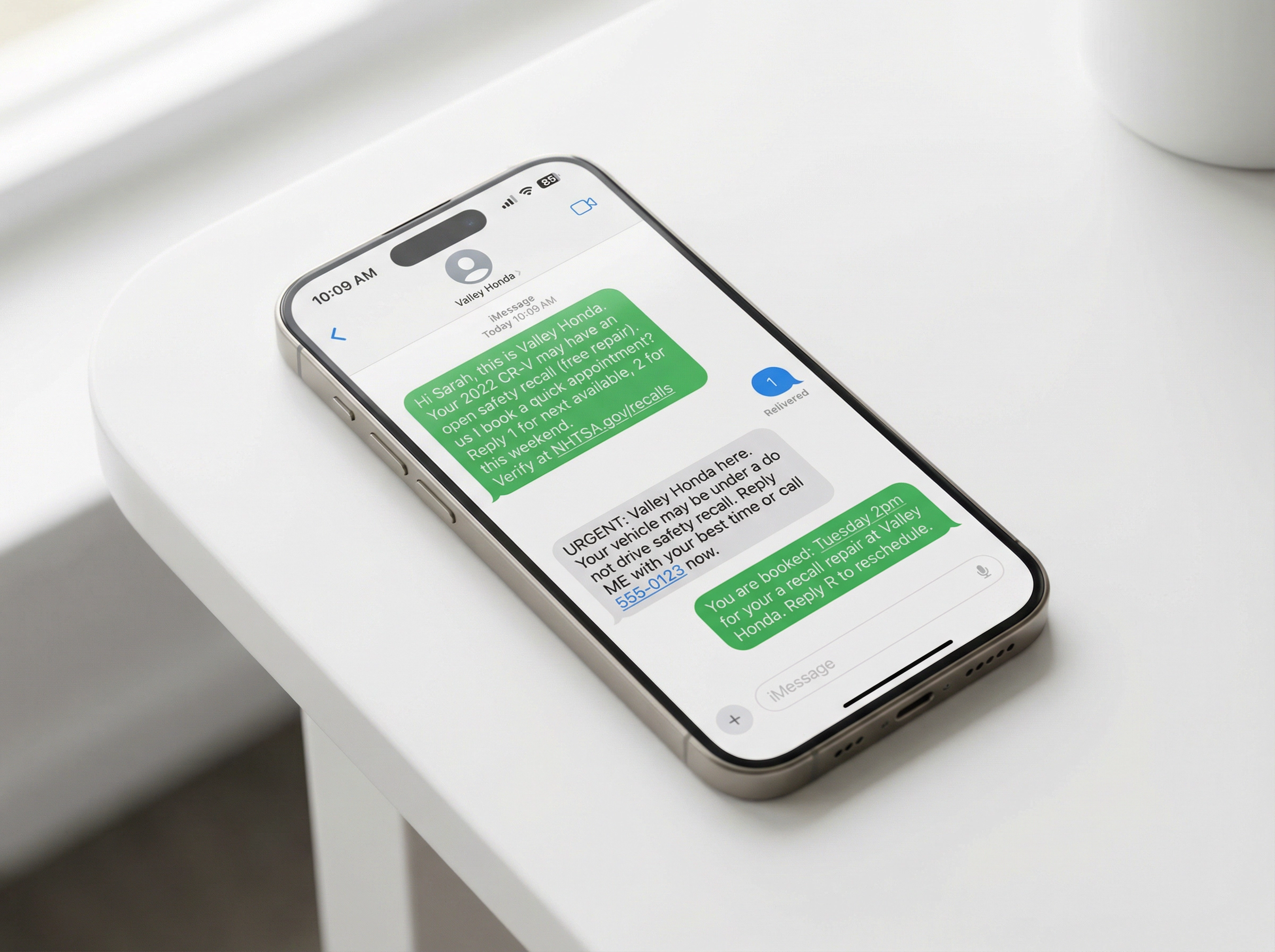
SMS Templates
Tier 2 (Standard Safety Recall, Parts Available):
Hi {first_name}, this is {dealer_name}. Your {year} {make} {model} may have an open safety recall (free repair). Want us to book a quick appointment? Reply 1 for next available, 2 for this weekend, or call {phone}. Verify recalls at NHTSA.gov/recalls.
Tier 1 (Do-Not-Drive / Urgent):
URGENT: {dealer_name} here. Your vehicle may be under a “do not drive” safety recall. We can help schedule the free recall remedy ASAP. Reply “call me” with your best time or call {phone} now.
Tier 3 (Remedy Not Yet Available):
Hi {first_name}, {dealer_name}. Your vehicle is included in a safety recall, but parts aren’t available yet. Reply “waitlist” and we’ll text you first when appointments open.
Confirmation/Reminder:
You’re booked: {day} {time} for your free recall repair at {dealer_name}. Reply “R” to reschedule.
Email Structure
Subject line: Free Safety Recall Repair for Your {Model} (VIN ending {last6})
Body should include:
- What the recall is (plain language, not technical codes)
- That the repair is free
- How long it typically takes
- Clear call to action (reply, call, or click booking link)
- Verification link to NHTSA
- Dealership address and contact info
- Opt-out if treating as marketing email (per FTC CAN-SPAM guidance)
Phone Script Framework
(1) Confirm identity: “Hi, is this {name}? I’m calling from {dealer}. Quick question: are you still driving the {vehicle}?”
(2) State purpose plainly: “There’s a safety recall on that vehicle. The repair is free.”
(3) Build credibility: “I can text or email you the recall info. You can also verify it through NHTSA’s VIN lookup.”
(4) Remove friction: “We have appointments {two specific options}. The visit usually takes about {time}. Do you need shuttle or loaner?”
(5) Book and confirm: “Great, you’re set for {day/time}. I’ll send a confirmation text.”
(6) Avoid upsell language: Do not say “and while you’re here…” during booking. That kills trust.
How to Handle Inbound Call Spikes from Recall Campaigns
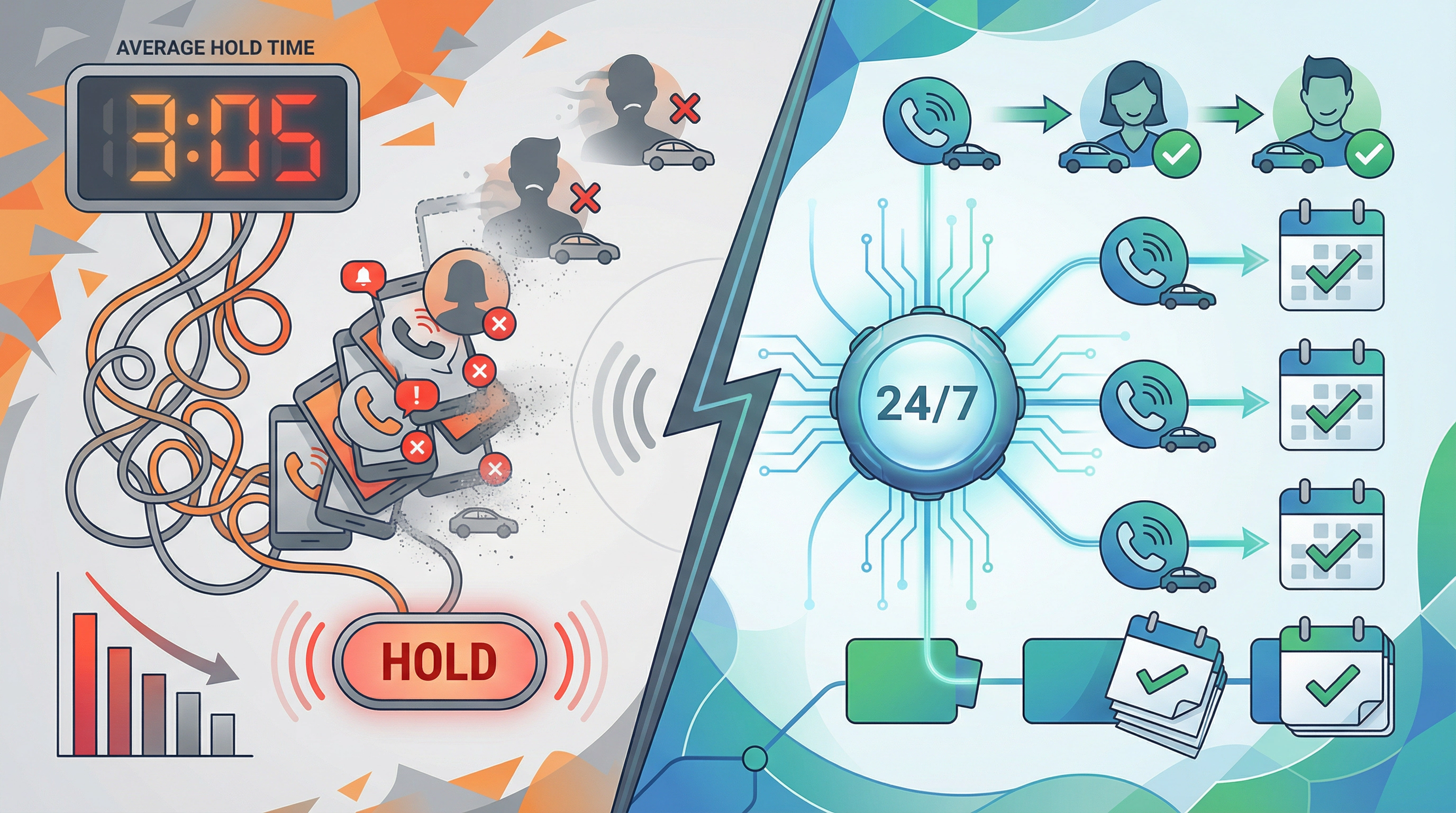
This is the ugly truth: a lot of campaigns fail because the store creates demand and then can’t answer the calls.
If your campaign increases inbound volume by 20%, your answer rate needs to increase by 20% too. Otherwise, you’re just wasting your outbound spend and frustrating customers who tried to take action.
Industry research shows that 31.8% of unconnected calls at dealerships are customers hanging up while on hold. The average hold time is over 3 minutes. And studies indicate that 60% of customers hang up after just one minute on hold, and 32% won’t wait at all.
Operational setup for inbound:
- A dedicated recall extension or queue (even if it routes to your BDC)
- Recall-specific scripts and booking flows
- Warm transfer option to service if the customer is already live
- Automatic callbacks scheduled for any missed call
If you can’t handle the inbound volume, your campaign will underperform regardless of how good your outreach is. This is exactly where AI tools like Flai become essential. We answer every call instantly, 24/7, so no customer hits voicemail or hangs up on hold.
How to Remove Customer Friction Before Launching a Recall Campaign
Owners don’t avoid recall repairs because they love danger. They avoid them because it’s annoying. Your job is to make scheduling and completing the repair as friction-free as possible.

Parts Readiness and Repair Capacity
- Confirm parts pipeline before you send volume outreach
- Set dedicated recall appointment blocks so you don’t destroy regular shop flow
- Create a “recall fast lane” repair order type if the remedy is quick
- Pre-pick parts for next day based on booked appointments
Transportation and Time Options
Offer at least one of these:
- Shuttle service
- Loaner vehicle (even limited availability helps)
- Pickup and drop-off
- Saturday hours or weekend recall clinics
According to industry data, about 60% of recalls can be completed via mobile service since many are minor repairs or software updates. Mobile service completely removes the inconvenience factor.
The “No Upsell Panic” Rule
The GAO report explicitly lists “upselling at dealership” as a factor that can impact recall response. Customers fear that “free recall” will turn into an expensive visit.
Best practice: Separate “safety fix” from “recommended maintenance”:
- During booking: Only discuss the recall and logistics. No “and while you’re here…”
- In-store: Do your multi-point inspection as normal, but lead with “Your recall is free and required. Everything else is optional.”
- Advisor language matters: Don’t bait-and-switch
When customers feel safe, they come back. When they feel ambushed, they avoid you next time.
What Are the Compliance Rules for Dealership Recall Campaigns?
We’re not lawyers, but you need basic operating standards to avoid trouble and maintain trust.
Keep Recall Outreach Informational
The moment your message becomes “come in for a recall… and also buy X,” you may create extra compliance obligations under telemarketing and email rules. Per FTC guidance, mixing promotional content with transactional messages changes the rules.
Best practice:
- Recall messages = safety and logistics only
- Marketing messages = separate campaign with its own consent and opt-outs
Email (CAN-SPAM Basics)
The FTC’s CAN-SPAM compliance guide requires:
- Clear opt-out mechanism
- Opt-out must work for at least 30 days
- Honor opt-outs within 10 business days
Even if recall messages can sometimes be “transactional,” dealerships often blur lines. Safest habit: always include a clean opt-out and keep recall-only emails focused.
Calls and Texts
47 CFR 64.1200 defines key terms including “emergency purposes” and “established business relationship” for telephone solicitations. The FTC Telemarketing Sales Rule outlines do-not-call safe harbor concepts.
Practical habits:
- Maintain an internal do-not-call list and honor it
- Don’t text people who have opted out
- For SMS, always support “STOP” style opt-out
- Log consent where possible (especially for proactive SMS at scale)
- If unsure whether something counts as telemarketing vs. informational, ask counsel and separate the campaigns
Anti-Scam Credibility Checklist
Include at least three of these in every campaign touch:
- [ ] Dealership name and location
- [ ] Call-back number that matches your website
- [ ] “Recall repairs are free”
- [ ] “Verify via NHTSA VIN lookup”
- [ ] No shortened sketchy links
- [ ] No pressure language (except for true Tier 1 urgent recalls)
How Can AI Improve Dealership Recall Campaign Results?
AI doesn’t magically raise recall completion. It fixes the two real bottlenecks:
- Reaching people at scale with the right message
- Turning that contact into a booked appointment without human delay
Where AI Helps Most
Multi-touch outreach without labor blowup. AI can run “conversation campaigns” instead of spam blasts: SMS that handles back-and-forth scheduling, voice calls that answer questions and book appointments, email follow-ups that route replies correctly.
24/7 recall call handling. A recall blast creates inbound spikes. AI can answer instantly after hours, handle basic “is my car affected?” flows, schedule directly, and warm-transfer to humans when needed.
Personalization that’s actually useful. Not just “Hello {first_name}.” Real personalization means communicating in the customer’s language preference, offering exact appointment windows you can fulfill, knowing if they’ve been in recently, and knowing if parts are ready.
Ops-safe booking. AI is only valuable if it can book in the real scheduler without creating chaos: correct op codes, correct time blocks, parts constraints honored, no double-booking.
Trust and compliance hygiene. AI systems can automatically include verification guidance, honor opt-outs, and log interactions for auditing.
Post-campaign learning. Most dealer campaigns never learn from results. AI can summarize top objections, which scripts convert, and which recall tiers are stuck because of parts vs. messaging.
What AI Can’t Fix
- Parts shortages
- Lack of bay capacity
- Bad advisor behavior in-store
- OEM delays in remedy availability
AI amplifies the system you already have. If your operations are broken, AI just books more disappointment.
How AI Platforms Help Dealerships Run Better Recall Campaigns

At Flai, we built our AI communications platform specifically for the challenges dealerships face with recalls and service scheduling.
Inbound call handling, 24/7. When your recall blast generates inbound volume, our AI answers every call instantly. No voicemail. No hold music. No customers hanging up after 30 seconds. Our voice AI sounds natural, handles conversational back-and-forth, and can answer questions like “Is my car affected?” or “How long will it take?”
Outbound recall campaigns via SMS and phone. We don’t just send blast messages. Our platform runs two-way conversational campaigns that handle replies, schedule appointments, and follow up automatically. When customers respond, they get an immediate answer, not a “we’ll call you back” promise.
Direct integration with your scheduler and DMS. Our AI books appointments directly into your existing systems. Correct recall RO type, correct time blocks, parts constraints honored. No more taking a message and hoping someone follows up.
Multi-language support. Your customers speak the languages they speak. Our AI can communicate in whatever language works best for each customer.
Turning cold outreach into warm appointments. Instead of your BDC grinding through a call list (most of which goes to voicemail), our AI handles the outreach and your staff only engages with customers who are ready to schedule. It flips the model from chasing to receiving.
Real results from real dealerships. Our case studies show profit impacts of $80,000 to $100,000+ per month at single rooftops. The Freeman Lexus case study demonstrates this perfectly: they handled over 1,100 calls with zero missed, converted 88% of bookable calls to appointments, and generated an estimated $100,000 in profit impact.
That’s what happens when you never miss a call and every interaction is handled professionally.
We’ve seen similar results at dealerships like San Leandro CDJR and Glendale Infiniti, where our AI helped capture service revenue that would otherwise be lost to missed calls and voicemails.
The customers coming in for recalls are often the exact customers who stopped servicing with you after their warranty ended. Industry data shows only about 31% of owners stay with the brand dealer after warranty. A recall is your chance to bring back the other 69%. We help you execute that opportunity at scale.
Check out our blog for more on how dealerships are using AI to transform their service operations, including our seed announcement detailing how we’re building the future of dealership communications.
Your 30-Day Plan to Launch AI-Powered Recall Campaigns
Ready to implement? Here’s a practical four-week plan.
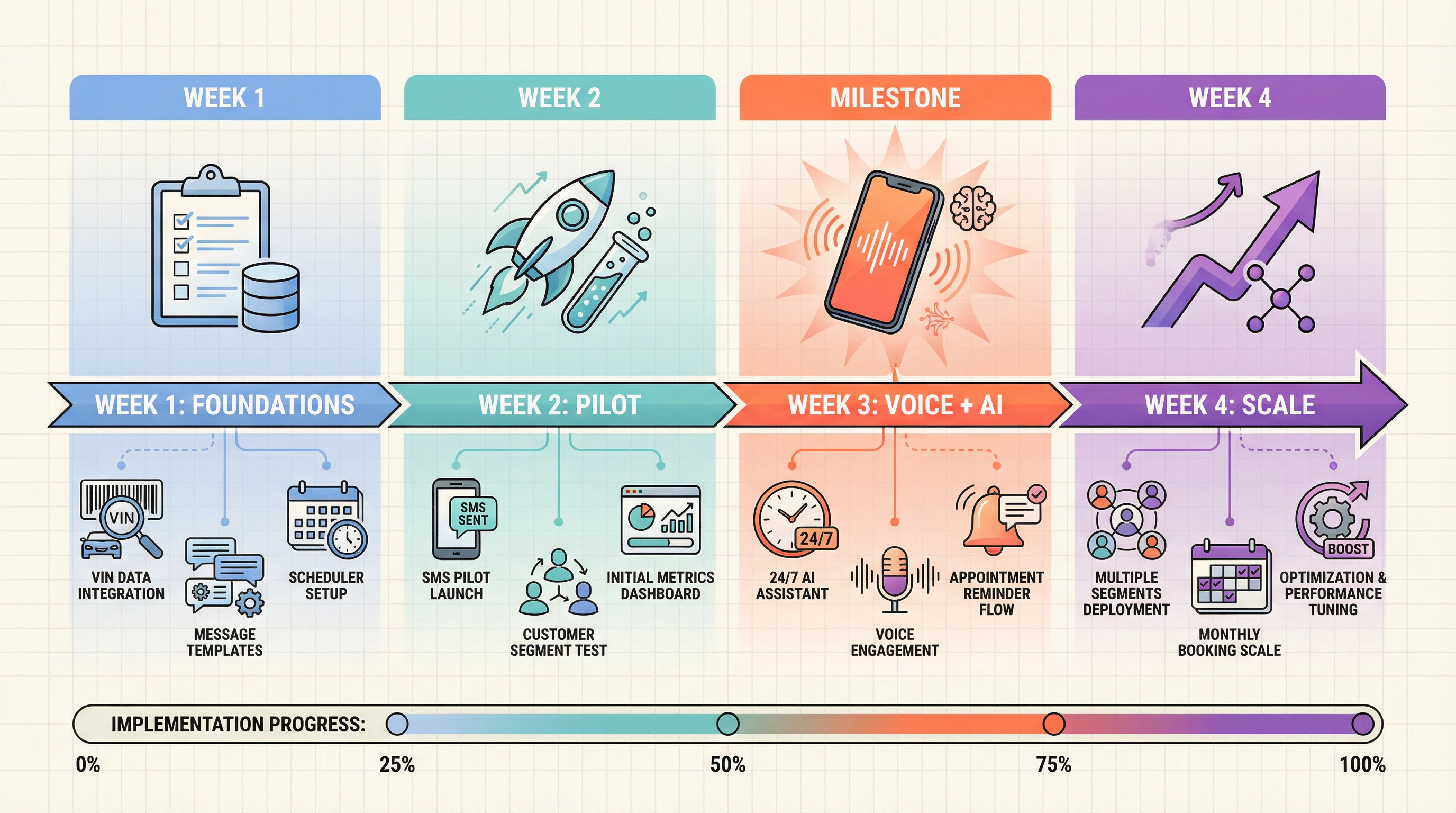
Week 1: Foundations
- Pick one recall with parts available (Tier 2)
- Build the VIN list and scrub it for accurate contact info
- Decide your cadence and customize message templates
- Set recall appointment blocks and RO types in your scheduler
Week 2: Pilot (Small, Measurable)
- Start with a single segment (e.g., customers who serviced in the last 24 months)
- Run SMS first (biggest impact)
- Route recall replies to AI scheduling with human escalation path
- Track response rates, booking rates, show rates
Week 3: Add Voice and Inbound Overflow
- Launch outbound voice attempts for non-responders
- Enable 24/7 inbound handling for recall-related calls (AI tools excel here)
- Add appointment reminders and reschedule-by-text capability
Week 4: Scale and Tighten
- Expand to lapsed customers and older vehicles with tailored tactics
- Add monthly follow-ups for persistent non-responders
- Review dashboard weekly and fix the real bottleneck (usually parts or scheduling friction)
- Iterate on messaging based on what’s working
What Metrics Should You Track for Recall Campaign Success?
Most stores accidentally measure the wrong thing. “We sent 10,000 texts” is not success.

| Funnel Stage | What to Track | Why It Matters |
|---|---|---|
| Audience Quality | VIN count, dedupe rate, bad contact rate | Bad data = wasted touches |
| Contactability | % with valid mobile, % with email, % reachable by call | Tells you which channel will work |
| Engagement | Reply rate, pickup rate, click rate | Indicates trust and relevance |
| Conversion | Appointment set rate | Your campaign's actual job |
| Completion | Show rate, repair completion rate | The only "real" win |
| Speed | Median time-to-schedule, median days-to-repair | Speed is what owners feel |
| Operations | Parts fill rate, reschedule rate | Ops bottlenecks kill completion |
The only “done” that matters: The repair is completed, the RO is closed correctly, OEM reporting is updated, and your CRM marks the VIN as completed (so you stop contacting them).
Frequently Asked Questions About Dealership Recall Campaigns
How often should I contact customers about a recall?
Use a multi-touch cadence: initial contact via SMS and email on Day 0, phone follow-up on Day 1-2, additional touches at Day 4, 7, and 14, then monthly until completed. For urgent “do not drive” recalls, compress this to daily contact until scheduled. For recalls where parts aren’t available, use a waitlist approach with weekly availability updates rather than constant outreach.
What’s the best channel for recall outreach?
SMS typically gets the highest response rates (40-50% in some campaigns), but the most effective approach uses all channels: text, email, phone, and mail. Start with SMS and email, then escalate to phone calls for non-responders. Different customers prefer different channels, so covering all bases improves your reach.
How do I avoid looking like a scam when contacting customers about recalls?
Include your dealership name and address, use a callback number that matches your website, always state that the recall repair is free, and provide the NHTSA VIN lookup link so customers can verify independently. Avoid shortened links and pressure tactics. The more professional and transparent your message, the more trust you build.
Should I offer incentives for recall completion?
Incentives can help, especially for harder-to-reach customers or older vehicles. Research suggests 81% of owners would be motivated by a $35 gift card, and 92% by a $100 incentive. Consider gas cards, service coupons, or loyalty points for prompt completion. Target incentives strategically to fence-sitters rather than customers who would have come in anyway.
How can AI help with recall campaigns?
AI solves the two biggest bottlenecks: reaching customers at scale and converting contacts to booked appointments without human delay. AI can run multi-touch SMS and voice campaigns automatically, answer inbound calls 24/7 (including after hours), book appointments directly into your scheduler, and follow up persistently without overwhelming your staff. The best AI platforms handle all of this with direct DMS integration.
What if parts aren’t available for the recall?
Don’t blast outreach for recalls you can’t service. Use a Tier 3 approach: send one message explaining parts are coming and offering a waitlist. Provide weekly availability updates. Only ramp outreach when you can actually fulfill the appointments. Booking customers and then disappointing them damages trust and makes future outreach less effective.
How do I handle the inbound call spike from recall outreach?
This is critical. If your campaign increases inbound volume by 20%, your answer rate needs to match. Set up a dedicated recall queue, use recall-specific scripts, enable warm transfers to service, and schedule automatic callbacks for any missed call. AI voice tools can answer every call instantly, 24/7, ensuring no customer hangs up on hold or hits voicemail.
What completion rate should I aim for?
Industry average is around 75% overall, but it varies significantly by vehicle age: around 83% for newer vehicles and as low as 44% for vehicles 5-10 years old. Focus on maximizing completion within each tier rather than a single aggregate number. For Tier 2 recalls with parts available, aim for completion rates above 80%.
Making Recalls Work for Your Dealership
Recalls are one of the clearest win-win opportunities in fixed operations. The customer gets a free safety repair. The OEM pays you for the work. And you get a chance to bring back customers who might not have visited in years.
The math is simple: risk perception vs. friction. Your campaign wins when you segment by urgency and parts readiness, use multi-touch outreach across every channel, make scheduling effortless, handle the inbound spikes without holds or voicemail, and close the loop to confirmed completed repairs.
AI is the force multiplier for the conversation and scheduling work. It’s not a substitute for parts availability and bay capacity. But when your operations are solid, AI amplifies everything.
Every recall sitting in your backlog is a customer who could be in your service lane. Every call that goes to voicemail is an appointment that went to your competitor. And every campaign that stops at “we sent messages” instead of “we completed repairs” is leaving money on the table.
If you’re ready to stop leaving recall revenue on the floor, talk to us at Flai. We’ll help you build the recall machine your dealership deserves.