Dealership Service Appointment Scheduling: Automation Guide (2026)
Learn how to automate service appointment scheduling at your dealership and capture the 64% of customers who still book by phone, 24/7.
Your service department’s biggest scheduling problem isn’t what you think it is.
Most dealerships assume they need a better online booking widget. They invest in website upgrades, mobile-friendly forms, and self-scheduling tools. All of which helps. But it misses the core bottleneck entirely.
According to research from CDK Global published in April 2025, 64% of service customers still book appointments by phone. Only 19% use online scheduling. If you’re automating just the web channel, you’re fixing the smallest slice of the pie while leaving the biggest one to holds, voicemails, and “we’ll call you back.”
This guide breaks down exactly how to automate service appointment scheduling across every channel, with a particular focus on phone automation (because that’s where most of the money is). We’ll cover the technology, the rollout plan, the metrics that matter, and real results from dealerships that have done it right.
Why Dealership Customers Hang Up Before Booking Service

Walk into any service department on a Monday morning around 10 AM and you’ll see it. Phones ringing constantly. Advisors juggling walk-ins while calls stack up on hold. Customers getting frustrated. Some hanging up entirely.
That anecdote matches the data. A Car Wars analysis found that 31.8% of unconnected calls at dealerships happen because customers hung up while on hold. The average hold time? Three minutes and five seconds. And Monday between 10 AM and noon is the single highest-traffic call window.
Three minutes doesn’t sound like much until you realize what happens during those three minutes.
Research from Plum Voice found that 60% of customers hang up after just one minute on hold. Even more striking: 32% of callers won’t wait at all. The moment they hear hold music, they’re gone. This pattern of dealership callers hanging up creates a massive revenue leak that most service managers don’t even see in their reports.
The real cost: When someone hits your voicemail, there’s a 70% chance they’ll call a competitor within the next 30 minutes. That’s not a typo. Seven out of ten callers who can’t reach you will be talking to someone else within half an hour. Understanding the true scope of missed call statistics at your dealership is the first step toward fixing the problem.
The retention implications are massive. Cox Automotive’s 2025 Service Industry Study reports that dealerships are handling 12% fewer service visits than in 2018. Among customers with vehicles two years old or less, only 54% returned to the selling dealership for service in 2025. That’s down from 72% in 2023.
Where are they going? The aftermarket. And not just because it’s cheaper.
J.D. Power’s 2024 Customer Service Index study found that 35% of mass market customers choose aftermarket service specifically because “they can be seen right away.” That reason now beats “lower costs” as a driver of defection. The average wait time for a dealership service appointment is 5.2 days for mass market brands, up from 4.8 days in 2023.
Convenience isn’t a nice-to-have anymore. It’s the battlefield.
What Automated Service Scheduling Actually Looks Like
Real scheduling automation isn’t just a form on your website. It’s a system that performs six distinct jobs reliably:
1. Capture demand with near-zero delay
Every request (phone call, web form, SMS, chat) gets answered immediately. No holds. No voicemails. No “we’ll get back to you.” This is why dealership voicemails kill sales. They create friction at the exact moment a customer is ready to book.
2. Triage what the customer needs
Is this an oil change or a diagnostic? Routine maintenance or a recall? Wait-while-you-work or drop-off? The system figures this out through conversation or structured questions.
3. Slot the appointment correctly
“Correctly” means: the right time duration, the right technician skill level, the right bay type, and parts availability confirmed if needed. This prevents the double-bookings and “we need your car another day” surprises that tank customer satisfaction.
4. Confirm and reduce no-shows
Instant confirmation via SMS and email. Then reminder sequences at 72 hours, 24 hours, and day-of. With easy options to reschedule by text rather than calling in.
5. Prep the visit
Before the car arrives, the system captures VIN, mileage, concern description, warranty status, transportation needs, and preferred contact method. No scrambling when the customer shows up.
6. Close the loop
After service, outcomes get logged, follow-ups get sent, and the next appointment gets prompted. The relationship continues automatically.
If you only do job #1 (web form) or only do job #3 (calendar booking), you don’t have automation. You have a leaky front-end that creates work for your team instead of eliminating it.
Here’s a useful mental model: think of scheduling automation as having distinct layers.
| Layer | What It Includes | Why It Matters |
|---|---|---|
| Truth Systems | Scheduler, DMS, CRM | Where appointments and customer records actually live |
| Intake Channels | Phone, web, SMS, email | How customers reach you |
| Orchestration Brain | Business rules, identity matching, routing, fallbacks | What decides what happens next |
| Measurement | Answer rate, conversion, show rate, utilization | How you know if it's working |
Your automation solution needs to connect all four layers. A standalone web scheduler that doesn’t talk to your DMS or phone system isn’t automation. It’s another silo.
Why Phone Automation Is Your Biggest Lever
We’ve established that 64% of service bookings happen by phone. But let’s go deeper on why the phone matters so much.

Customers still call because calling feels faster for complex requests.
Online schedulers work great for straightforward stuff: oil changes, tire rotations, brake pads. But when a customer has a weird noise, an intermittent issue, or isn’t sure what service they need, they call. They want to talk it through with someone.
The problem is your “someone” can only handle one call at a time. And they go home at 6 PM. Understanding what an AI BDC is and how it automates dealership calls helps explain why modern dealerships are moving beyond traditional staffing models.
After-hours is where the real opportunity sits.
Industry data indicates that over 60% of dealership leads arrive after business hours. Think about that. The majority of people trying to reach you are doing so when you’re closed.
What happens to those calls today? They hit voicemail. And seven out of ten of those callers will call someone else within half an hour.
Customers want text updates, but they still book by phone.
J.D. Power found customers are 4x more likely to want service updates via text (68%) than via phone call (16%). But those same customers still predominantly use the phone to initiate the service relationship. They want the convenience of texting after they’ve booked, not before.
This is why automation that only covers digital channels misses the point. You need to automate the phone channel specifically, because that’s where the demand is and where the friction is highest.
The best dealerships answer at an 85% rate. Most don’t come close.
Top-performing service departments achieve 85%+ call connection rates according to Car Wars benchmarking data. The average is around 65%. That 20-point gap represents an enormous amount of lost business.
With proper phone automation, you can effectively answer 100% of calls, 24/7. Not “eventually” via callback. Actually answer them in real-time and book appointments on the spot.
The Step-by-Step Guide to Getting This Done
Ready to actually do this? Here’s the practical roadmap.
Step 1: Define your appointment types like an engineer
Your automation is only as good as your taxonomy. Create 6 to 10 appointment types that map to how your shop actually operates:
- Express maintenance (oil, tires, basic inspections)
- Maintenance packages (30K/60K services)
- Diagnostic (customer concern, check engine, intermittent issues)
- Recall (VIN-based, parts-dependent)
- Heavy line (transmission, engine, complex jobs)
- Wait vs. drop-off with loaner/ride needs
For each type, define:
- Minimum information required to book
- Default duration ranges (start conservative)
- Required resources (technician skill class, bay type, advisor availability)
- Constraints (parts required? recall needs VIN check? loaner required?)
This taxonomy becomes the backbone of your automation logic. Scheduling errors create delays, comebacks, and angry customers. J.D. Power data shows customers who have a poor repair experience are significantly less likely to return.
Step 2: Build a capacity model your automation can respect
You’re not booking “time.” You’re booking capacity.
At minimum, your system needs rules for:
- How many diagnostic jobs can start per hour
- How many waiters can be handled concurrently
- Express lane caps
- Advisor load caps (to prevent check-in pileups)
- First-appointment buffer (don’t book the first 10 minutes of opening)
McKinsey’s fixed ops research emphasizes that convenience drives loyalty. Aligning availability to customer needs (sometimes adjusting hours or shifts) directly impacts retention.
Step 3: Instrument the current mess
Before you automate, get 14 days of baseline numbers:
- Percentage of calls answered live
- Average hold time
- Abandoned calls
- Appointments booked per day by channel (phone/web/SMS)
- Lead time to appointment (days out)
- No-show rate
- Reschedule rate
If you can’t see that a huge portion of your “unconnected calls” is just hold abandonment, you’ll blame low demand instead of dropped demand. You can’t fix what you can’t measure.
Step 4: Automate the biggest channel first (the phone)
You have three options, from worst to best:
Option 1: Voicemail + callback. The customer leaves a message. Someone calls them back eventually. By then, many have already called a competitor.
Option 2: Outsourced answering service. Better coverage, but agents often lack dealership context. Results in message-taking rather than actual booking. And quality varies wildly. This is precisely why dealerships are replacing outsourced call centers with AI.
Option 3: Real-time automation that can actually book. An AI system that answers immediately, understands what the customer needs, checks real availability, and books directly into your scheduler. Only escalates when necessary.
What “good” phone automation looks like:
- Answers within seconds (not rings)
- Confirms customer identity via phone number match
- Captures essential information through natural conversation
- Offers 2-3 specific appointment options (not “when works for you?”)
- Books directly into the scheduler
- Sends instant SMS confirmation
- Escalates with full context when needed (safety issues, angry customers, complex questions)
Pro tip: Don’t put people on hold. If a live advisor isn’t immediately available, offer a specific callback window and let the customer keep their day.
Step 5: Make web scheduling and SMS actually usable
For customers who prefer self-service:
- Web scheduling should take under 2 minutes
- Keep the first page simple: service type + preferred day/time + contact
- Collect detailed info after the slot is held
- Always allow change/cancel via text reply, not by calling
Cox Automotive’s data shows customers value digital scheduling. Most dealership setups are just clunky enough to push people back to the phone. Be the store that’s actually easy.
Step 6: Automate confirmation, reminders, and “save the appointment”
Most no-shows aren’t flaky customers. They’re predictable friction:
- Forgot the appointment
- Got busy
- Can’t arrange transportation
- Original time no longer works
- Didn’t understand what would happen at the visit
Build a standard sequence:
- Immediate: Confirmation via SMS + email
- 72-48 hours: Reminder with “reply to reschedule” option
- 24 hours: Reminder + transportation check (“Need a loaner or ride?”)
- Day-of: “We’re ready for you” + check-in instructions
Automated reminders reduce no-shows by 30-50% across industries. J.D. Power’s findings on text preference support making SMS your primary operational channel.
Step 7: Automate pre-visit prep
Before the car arrives, capture:
- VIN (or at minimum year/make/model)
- Current mileage
- Concern description (structured + free text)
- Warranty/maintenance plan indicator
- Recall status and parts availability
- Transportation needs
- Preferred update channel (default to text)
The goal: fewer “we need the car another day” surprises and faster check-in.
Step 8: Connect scheduling to MPI, approvals, and payment
This is where scheduling automation turns into throughput gains.
J.D. Power reports that when advisors share photos/videos supporting multi-point inspection results, satisfaction improves significantly. Their data shows a 31-point lift in satisfaction when media is included versus not.
Automation should position you to:
- Send MPI media automatically
- Request approvals via text
- Accept digital payments
- Keep customers informed without them calling to check status
This reduces inbound “where’s my car?” calls, which frees advisors to sell and produce.
A 30-Day Rollout Plan That Won’t Wreck Operations
Nobody wants to flip a switch and watch chaos unfold. Here’s how to do this incrementally.
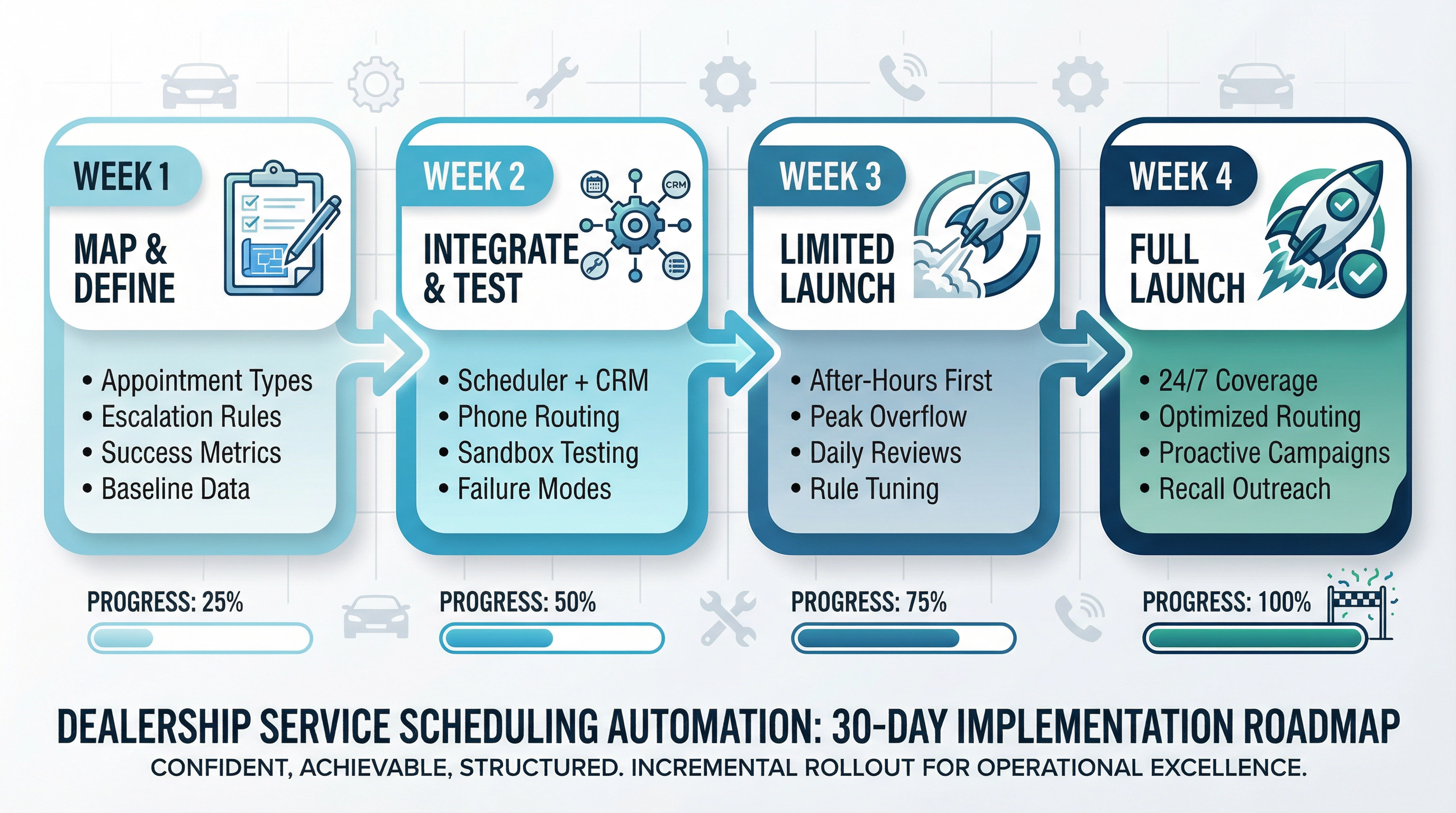
Week 1: Map and Define
- Finalize appointment types and booking rules
- Define escalation triggers (what always goes to a human)
- Establish success metrics and targets
- Document current baseline numbers
Week 2: Integrate and Test
- Connect scheduler, CRM, and phone routing
- Run sandbox testing with real scenarios
- Test failure modes: What happens when the DMS is down? When no slots are available? When a customer is angry?
Week 3: Limited Launch
- Start with after-hours calls only (lowest operational risk, highest value)
- Expand to overflow during peak hours (Monday late morning is a great stress test)
- Daily review of transcripts and tickets
- Tune rules based on what you learn
Week 4: Full Launch and Optimization
- Expand coverage across all hours
- Fine-tune appointment mix caps and triage logic
- Start proactive scheduling campaigns: maintenance due, recall outreach, no-show recovery
KPIs That Actually Matter (And the Fake Ones to Ignore)
Track these metrics weekly once you’re live.
Booking Funnel KPIs
| Metric | What to Target |
|---|---|
| Call answer rate | 95%+ (by hour/day) |
| Abandoned calls | Under 5% (track hold abandonment specifically) |
| Booking conversion rate | 80%+ of "bookable" contacts result in appointments |
| Time to first available | Under 4 days |
| Show rate | 85%+ |
| Reschedule save rate | Track how many cancellations you recover |
Productivity KPIs
- Advisor time on phone per RO (should decrease)
- RO count by day + bay utilization
- Effective labor hours per RO (watch quality alongside volume)
Retention KPIs
- Service revisit rate at 90/180/365 days
- “Selling dealer” retention rate
- CSI/NPS scores, especially for “service initiation” and “communication” categories
Reynolds’ 2024 Fixed Ops Golden Metrics report shows average profit per customer-pay RO in the mid-$200s range. Even capturing 10-20 extra ROs per week adds up fast.
Real-World Results: AI Phone Automation in Action
We built Flai specifically to solve the phone scheduling problem for dealerships. Here’s how it works.

Our platform answers every inbound call immediately, 24/7. No hold queues. No voicemails. An AI voice agent picks up within seconds, talks naturally with the customer, and handles the full scheduling conversation. It collects vehicle information, understands the service need, checks real availability in your scheduler, and books the appointment on the spot.
Direct integration with your existing systems. Your scheduler. Your DMS. Your CRM. The platform doesn’t create a separate silo. It reads from and writes to the same systems your advisors use. The appointment that gets booked shows up exactly where it should, with all the context attached.
The voice quality is different. Most AI phone systems sound robotic or have awkward pauses. We built our voice infrastructure from scratch specifically for dealership conversations. The result is natural, fast responses that actually feel like talking to a helpful person. Customers often don’t realize they’re speaking with AI.
When the AI isn’t the right fit, it escalates intelligently. Safety concerns, angry callers, complex warranty disputes, or customers who explicitly want a human all get warm-transferred to your team with full context. The system passes along a summary of the conversation so your advisor can pick up seamlessly.
SMS and email follow-ups are built in. Confirmations, reminders, and rescheduling all happen automatically across text and email. Customers can reply to texts to change their appointment instead of calling back.
Dealership Case Studies
The results speak for themselves. You can explore all Flai case studies on our blog, but here are the highlights:
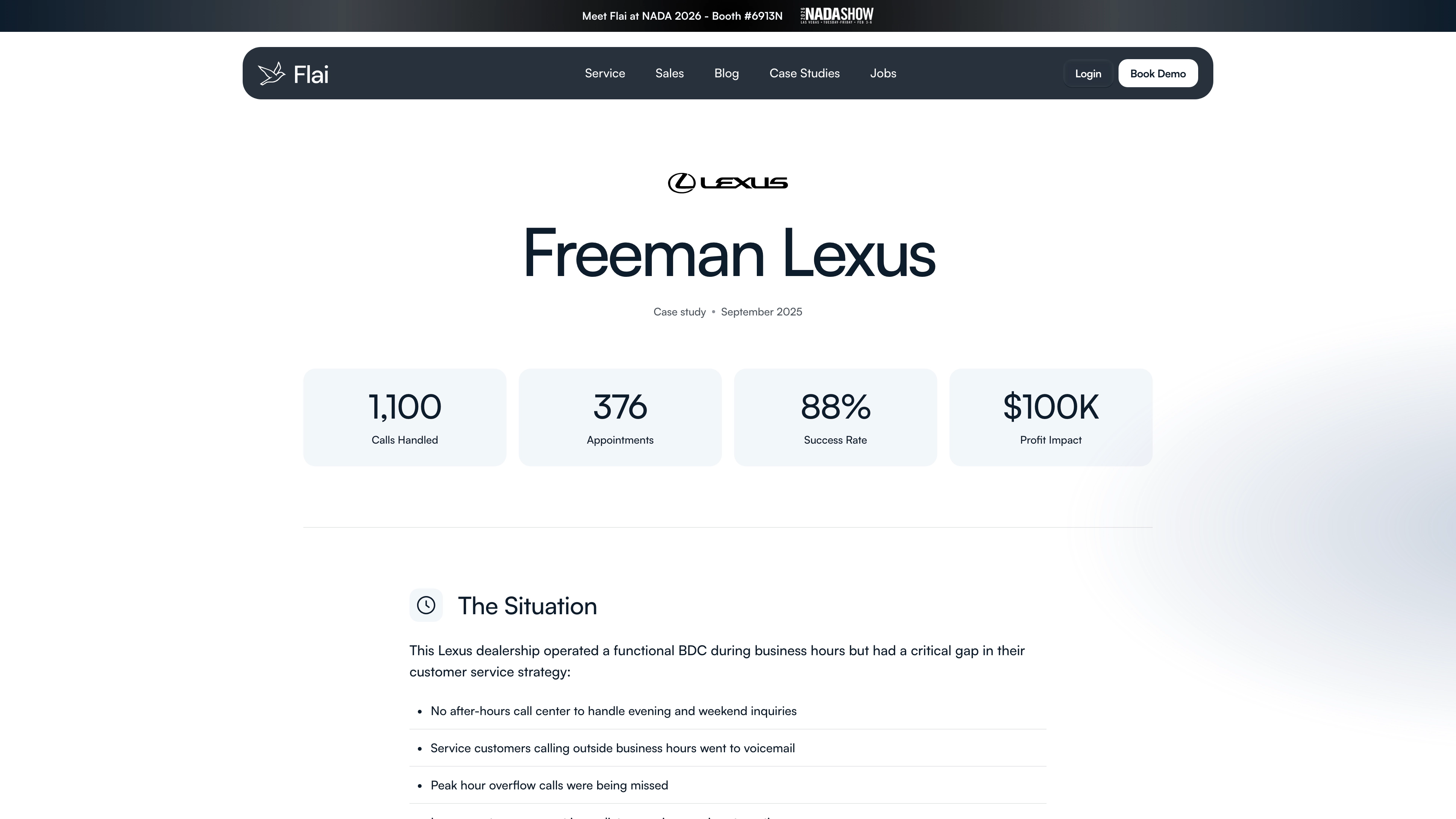
| Metric | Result |
|---|---|
| Total calls handled | ~1,100 |
| Missed calls | Zero |
| Bookable calls | 426 |
| Appointments booked | 376 |
| Conversion rate | 88% |
| Estimated profit impact | $100,000 |
Previously, their after-hours calls went to voicemail. Now every single one gets answered and handled.
| Metric | Before | After |
|---|---|---|
| Monthly service appointments | 205 | 448 |
| Calls handled by AI | - | 1,563 |
| Appointments booked by AI | - | 304 |
| Missed calls | Many | Zero |
| First month profit impact | - | $83,000 |
That’s more than doubling their appointment volume. This CDJR dealership had no dedicated BDC team before implementation. Service advisors were juggling phone calls while helping customers in the shop.
Toyota dealership
- 1,053 calls handled
- 358 appointments booked
- $94,000 profit impact
Another luxury dealership seeing dramatic results: 1,800+ calls handled monthly, 160+ service appointments booked automatically, and 20% staff time savings. Their General Manager noted that the AI “had the ability to be nimble enough and to adjust to everything.”
Across dealerships using this approach, the pattern is consistent: tens of thousands of dollars in additional monthly profit from calls that would have otherwise gone to voicemail or been lost to hold abandonment.
Vendor Selection Checklist: What to Demand Before Signing

If you’re evaluating scheduling automation solutions, use this as your checklist.
Booking and Integration
- Can it book directly into YOUR scheduler (not a separate calendar)?
- Does it identify existing customers and avoid duplicates?
- Can it handle recalls, loaners, and diagnostic vs. maintenance correctly?
- What happens when your DMS or scheduler goes down?
Call Performance (if phone automation is included)
- What’s the speed to answer?
- Can it handle multiple concurrent calls?
- Does it offer warm transfers with context?
- Are call summaries and tagging available for staff review?
Customer Experience
- Multi-language support (if your market needs it)
- Two-way SMS for confirm/reschedule
- Clear opt-out and consent handling
Security and Compliance
- Encryption, access controls, and audit logs
- SOC 2 Type II certification (or clear roadmap)
- Documented data retention policy
- TCPA and CAN-SPAM compliance features
Important: Talk to your legal team about compliance requirements. Don’t wing it.
Frequently Asked Questions

Will customers actually accept talking to an AI?
Many already prefer it. CDK Global research found that 31% of service customers said they prefer booking with an AI assistant if it means avoiding hold times. Among Gen Z customers, that number exceeds 50%. What customers hate isn’t AI. It’s waiting. If your automation is fast and effective, most people won’t care whether they’re talking to a person or a machine.
What happens if the AI gets confused or the caller wants a human?
Good automation knows its limits. Well-designed systems escalate specific scenarios: safety issues, angry customers, complex warranty disputes, pricing arguments, or anyone who explicitly requests a person. The AI warm-transfers the call with full context so the human advisor can pick up without the customer repeating themselves. Your goal isn’t 100% AI containment. It’s 100% of customers getting an outcome.
How long does deployment take?
Most setups go live within 1-3 days once integrations are configured. Modern AI phone solutions require no hardware and plug into your existing phone system and DMS. Week one is usually mapping appointment types and business rules. Week two is integration testing. Week three you’re live with after-hours calls.
What if my DMS or scheduler goes down?
Your automation should degrade gracefully, not pretend everything is fine. If the system can’t confirm an appointment in your systems, it collects the request, promises a specific callback window, sends a “pending” confirmation to the customer, and alerts your team with a structured ticket. No one gets ghosted.
What kind of ROI should I expect?
The math is straightforward: (missed/abandoned contacts captured) x (booking conversion rate) x (gross profit per RO) x (show rate). Most dealerships implementing AI phone automation see profit impacts between $80,000 and $100,000 per month from recovered calls alone. Even conservative estimates at smaller stores typically show the investment paying for itself within the first week.
Do I still need my BDC team?
Yes. Automation handles the repetitive, high-volume scheduling work so your human team can focus on complex situations, relationship building, and in-person service. McKinsey’s dealership research recommends this exact model: AI for routine tasks, humans for judgment calls. Most dealerships find their existing staff becomes more effective (and less burned out) rather than redundant.
What integrations are supported?
This varies by provider. Ask specifically about your scheduler and DMS combination before committing. Leading solutions integrate with major systems including CDK, Reynolds & Reynolds, Dealertrack, Xtime, Tekion, and others. The key question: can the system both read availability and write appointments in real-time?
How do I measure success?
Start with these: call abandonment rate (should approach zero), booking conversion rate (target 80%+), time to first available appointment, show rate, and advisor phone time per RO (should decrease). Compare your first month on automation to your 14-day baseline. Most stores see dramatic improvements in abandoned calls and booking conversion within the first few weeks.
Turn Scheduling Into Your Competitive Advantage
Your service department’s scheduling process is either a source of friction or a competitive moat. There’s no in-between.
Customers have options. If booking with you is annoying, they’ll go somewhere else. If booking with you is effortless (any time, any channel, no waiting), they’ll keep coming back.
The data we’ve covered makes the case clearly: dealerships using AI-powered scheduling automation are recovering tens of thousands of dollars in monthly profit from calls that used to hit voicemail. They’re booking 80-90% of incoming service requests instead of 50-60%. They’re operating with full appointment coverage 24 hours a day, 7 days a week.
The question isn’t whether to automate your service scheduling. It’s how soon you can do it.
If you’re ready to see what this looks like for your dealership, get in touch with Flai. We’ll show you exactly how many calls you’re missing today and what capturing them would mean for your bottom line.