When Do Dealerships Get the Most Calls? Peak-Hour Playbook (2026)
Peak call volume hits dealerships Monday 10-12 AM. 31.8% of customers hang up on hold. Data from 3,000 stores shows when you lose the most revenue.

Your dealership phone system is probably costing you money right now.
Not because the phones are broken or your team isn’t trying hard enough. You’re losing customers because when call volume spikes, your system turns into a bottleneck. Customers sit on hold for three minutes, hit voicemail, or get bounced between departments until they hang up and dial your competitor.

The real question isn’t “when do phones ring the most?” That’s just surface-level curiosity. What general managers, fixed ops directors, and BDC managers actually want to know is this: When are we quietly bleeding the most revenue and CSI points?
Which exact hours should you protect like a Saturday showroom rush? How do you staff and route calls so customers stop defecting to competitors? And how do you prove the cost of missed calls to leadership with real math instead of gut feel?
We’ve analyzed the most recent industry benchmarks, including data from nearly 3,000 U.S. dealerships, to answer those questions with specifics. You’ll walk away knowing exactly when peak volume hits hardest, why those windows cause customer loss, and what to do about it this week.
What Time Do Car Dealerships Get the Most Calls? Industry Data
Peak call volume isn’t just “business hours” or “whenever it feels busy.” The data from 2024 and 2025 gives you precise windows to plan around.
Why Monday Morning Is the Busiest Time for Dealership Calls

Analysis of nearly 3,000 U.S. dealerships in 2024 found that Monday is the busiest day for inbound calls, and 10:00 AM to 12:00 PM is the most active time block across peak days.
If you’re scheduling all-hands meetings during Monday late morning, you’re essentially locking the front door during your highest traffic period. This isn’t about industry rumors or anecdotal “feels busy.” This is the most reliable benchmark we have from thousands of rooftops.
When Is Peak Time for Service Calls at Dealerships?
Peak volume changes depending on which department customers are calling. While general inbound and sales inquiries spike Monday mornings, service has its own rhythm.
Competitive benchmarking data from 2024 shows that Tuesday at 3:00 PM tends to be the busiest window specifically for inbound service calls.
That split matters because if you staff “one schedule” and hope it works for both sales and service, you’re already setting yourself up to drop calls. Service customers calling Tuesday afternoon need different routing than Monday morning sales leads.
What Are the Busiest Months for Dealership Call Volume?
Call volume isn’t constant across the year. The same 2024 dealership analysis found:
- July and August had the highest inbound call volumes
- November had the lowest inbound call volume
November’s dip gives you a perfect window to lean harder into outbound follow-up campaigns, recalls, and reactivation efforts while inbound naturally slows down. July and August are when you need maximum phone coverage because customers are actively shopping and booking service before road trips.
How Many Customers Do Dealerships Lose from Missed Calls?
Most dealerships undercount how many customers they’re actually losing because they only track “phone rang and nobody picked up.”
But that’s not the real definition of a lost customer. A lost customer is anyone who didn’t complete the job they called to do. That includes:
- Hanging up while on hold
- Going to voicemail
- Getting transferred into a dead end
- Being told “we’ll call you back” and it never converting into an appointment
Your dashboard might say you answered 90% of calls, but if customers still aren’t getting scheduled because they’re bounced around or stuck waiting, you’re still losing them. The difference between “call answered” and “customer helped” is where the real revenue leakage happens.

Why Do Customers Hang Up When Calling Dealerships?
Data from nearly 3,000 dealerships breaks down exactly how customers slip through the cracks when volume spikes. Each failure mode has its own signature, and understanding them changes what you fix.
| Failure Mode | % of Unconnected Calls | What Happens | Why It Kills Conversion |
|---|---|---|---|
| Hold Abandonment | 31.8% | Customers hang up while waiting | Average 3 min 5 sec hold time; 60% bail after 1 minute |
| Voicemail Black Hole | 32.3% | Calls go straight to voicemail | 70% call competitor within 30 minutes instead of waiting |
| Message-Taking Friction | 20.2% | Person can't book, only takes message | Second step = leakage; callbacks get forgotten or delayed |
| Transfer Fumbles | 56% fail | Handoffs drop or loop back | Nobody picks up next line, voicemail again, or back to start |
How Long Do Customers Wait on Hold Before Hanging Up?
The biggest single reason customers don’t connect is simple: they hang up while waiting on hold. Almost one-third of your unconnected calls fall into this bucket.
Average hold time across dealerships sits at 3 minutes and 5 seconds. That might not sound catastrophic, but research consistently shows 60% of customers hang up after just one minute on hold, and 32% aren’t willing to wait at all.
Peak hours amplify this problem because when call volume exceeds your handling capacity, even by a small margin, hold times stack up fast. Three minutes becomes five, then seven, and customers bail.
What Percentage of Dealership Calls Go to Voicemail?
Voicemail isn’t coverage. It’s deferred abandonment. When customers hit voicemail, about 70% of them call a competitor within 30 minutes instead of waiting for you to return the call.
Nearly one-third of non-connected calls go straight to voicemail during peak windows, and most of those customers never convert. They don’t leave messages. They don’t call back. They just move on.

Why Do Message-Taking Systems Fail at Dealerships?
Even when a customer reaches a real person, if that person can only “take a message” instead of booking an appointment or answering the question, you’ve inserted a second step. And second steps leak.
About 20% of unsuccessful calls involve leaving a message with someone who then has to route it internally. Maybe the service advisor calls back in two hours. Maybe it gets forgotten. Either way, you’ve added delay and uncertainty, which means lower conversion.
How Often Do Call Transfers Fail at Dealerships?
When customers need to be transferred during peak hours, handoffs fail more than half the time. This statistic comes from Pied Piper’s 2025 research on AI voice agents, but the pattern is identical for human-to-human blind transfers.
Transfer failures happen because:
- Nobody picks up the next line
- Customers get dumped into voicemail again
- They hit another hold queue
- They get bounced back to the start
Peak hours make transfers especially brittle because everyone downstream is also slammed. This is why warm transfers with context aren’t optional. They’re peak-hour survival.
Why Do Dealership Phone Systems Break During Peak Hours?
Let’s strip this down to first principles so you understand why small overloads create huge problems.
How Do Call Center Queues Work at Dealerships?
Think of your phone system like a pipe. Calls arrive at some rate (calls per hour). Your team can handle calls at some rate (calls per hour), which depends on average handle time.
If arrival rate exceeds handling rate, a line forms. If the line forms, wait time rises. If wait time rises, hang-ups rise. That’s the whole machine. Everything else is detail.
How Much Understaffing Creates Long Wait Times?
Here’s a worked example using realistic dealership numbers:
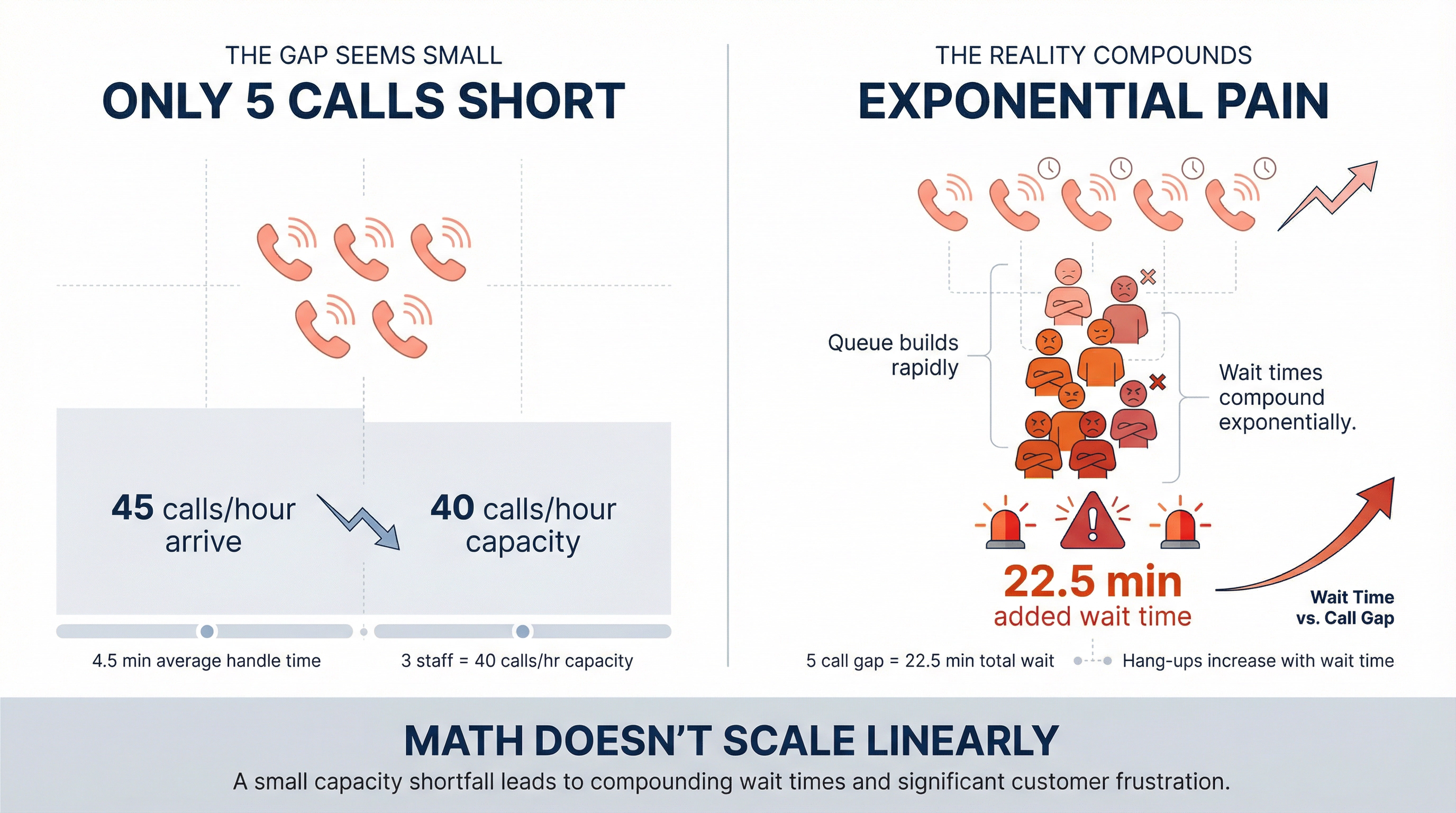
Your store gets 45 calls per hour between 10 and 11 AM on Mondays.
Average handle time (talk plus wrap-up) is 4.5 minutes.
One person can handle about 60 ÷ 4.5 = 13.3 calls per hour.
Three people on phones can cover roughly 40 calls per hour.
So you’re “only” short by 5 calls per hour. That sounds manageable, right? But once the queue forms, it’s self-reinforcing. Those 5 extra calls add 22.5 minutes of total wait time that didn’t exist before. The queue grows, customers see longer hold estimates, and abandonment spikes.
This is why peak hours feel like chaos even when you’re “just a little understaffed.” The math doesn’t scale linearly. Small gaps create exponential pain.
What Is Mission Failure Rate for Dealership Calls?
Peak volume doesn’t just reduce answer rates. It also increases what Pied Piper calls “mission failure”, meaning customers hang up without completing what they called to do.
Industry averages for mission failure were 13% in 2024 but improved to 9% in 2025. Similarly, customers placed on hold for more than two minutes dropped from 13% in 2024 to just 2% in 2025. That improvement shows it’s fixable, but it requires deliberate system design.
Peak hours push mission failure rates higher because even answered calls hit friction: advisors are rushed, transfers take longer, appointment slots feel limited, and customers sense the chaos.
Why Do Answered Calls Not Convert to Appointments?
Here’s a stat that should make every fixed ops director uncomfortable: 96% of calls to variable ops get answered, but only 22% convert to appointments. That conversion rate is down from 32% in 2023, which means dealerships are getting worse at turning answered calls into booked business.
Peak hours amplify this gap. You’re answering more calls, but your conversion process degrades under load. Service advisors are multitasking between bays and phones. Sales managers are juggling showroom traffic and incoming leads. The quality of each interaction drops, and fewer calls turn into appointments.
This is why measuring “answered percentage” alone is misleading. If you answer 90% of calls but only convert 22% of those into scheduled work, you’re still losing 70% of your inbound opportunity.
How to Separate Service Booking Calls from Status Calls
One hidden killer during peak hours: service status calls (“Is my car ready?”) cannibalize service booking calls (“I need to schedule maintenance”).
If you don’t separate them, your highest-value calls (bookings) get stuck in the queue behind low-value calls (status checks). Customers calling to book service hit long waits because someone ahead of them just wanted a quick update.
Practical fixes:
- Dedicate one phone line or menu option specifically to service status
- Use SMS updates proactively so fewer customers call for status
- Empower a lightweight handler or automation to answer status questions immediately
This frees up your service advisors to focus on the calls that actually drive revenue.
How to Handle Peak Call Volume at Your Dealership
Most articles about dealership phones either give generic call center advice or just shame you to “answer the phone.” Neither helps. Here’s an operating system you can set up this week.
How to Track Your Peak Call Hours in 30 Minutes
You need one grid: day-of-week by hour-of-day. For every hour, track:
- Calls attempted
- Calls connected
- Average hold time (or speed-to-answer)
- Voicemail rate
- Appointment set rate (track service and sales separately)
Most phone systems can export this data. If yours can’t, manually log it for two weeks. The patterns will jump out immediately.
Bonus: We’ve created a ready-to-use spreadsheet that calculates capacity, flags red hours, and estimates revenue leakage. You can download it here: Dealership Peak Call Capacity Calculator.
This heatmap becomes your north star. You’ll see exactly when you’re dropping calls, where holds spike, and which windows need protection.
Why You Should Protect Monday 10 AM to 12 PM
Until your own heatmap proves otherwise, treat Monday 10 AM to 12 PM as your universal peak window. This is backed by data from nearly 3,000 dealerships.
What “protect” means:
- No all-hands meetings scheduled
- No advisor “deep work” blocks
- No training sessions
- No “let’s just hope the BDC can handle it”
Treat it exactly like your Saturday showroom rush. You wouldn’t pull your sales team into a conference room on Saturday afternoon. Don’t do it Monday late morning either.
How to Set Up Overflow Call Routing Before It’s Needed
Most dealerships overflow by accident, which means calls bounce around randomly until someone picks up or the customer hangs up. That’s chaos, not a system.
Instead, decide your overflow path ahead of time:
→ If estimated hold time exceeds 30 seconds, route to overflow handler
→ Overflow handler must be able to do real work (book appointments, answer questions, schedule callbacks, or warm-transfer with context)
If overflow can only “take a message,” you’re just slowing down the failure. Message-taking is deferred loss, not real coverage.
How to Reduce Call Abandonment in 3 Steps
Based on the data, these are your biggest levers:
(1) Kill the hold. Customers hanging up on hold is the single biggest reason unconnected calls fail. If you can’t eliminate holds entirely, then:
- Offer callback immediately with a real time estimate
- Give customers control (“I can call you back in 3 minutes, or would you prefer to hold?”)
- Never park people and disappear
(2) Kill voicemail as a default path. Voicemail is not coverage. It’s a place where opportunities go to die. If someone calls during business hours and hits voicemail, your system failed.
(3) Kill blind transfers. Warm transfer with context, or don’t transfer at all. Blind transfers fail 56% of the time during peak volume. The person receiving the transfer needs to know who’s calling, what they need, and why they’re being transferred.
How to Route High-Value Calls First
As mentioned earlier, service status calls eat up capacity that should go to service booking calls. Sales follow-ups compete with new inbound leads. If you treat all calls the same, your highest-revenue opportunities get stuck behind low-value interactions.
Options to separate them:
| Strategy | How It Works | Best For |
|---|---|---|
| Dedicated phone lines | Separate number for booking vs. status | Stores with multiple lines |
| Menu routing | IVR directs by intent | All dealerships |
| Proactive outbound | SMS/email reduces status calls | Service departments |
The goal is simple: make sure your most valuable calls (new appointments, new leads) always get through, even during peaks.
How to Calculate Staffing Needed for Peak Hours
Here’s the formula to approximate required agents during peak hours:
Required agents ≈ (Calls per hour × Avg handle time in minutes) ÷ 60 ÷ Occupancy target
- Occupancy target: Start with 0.75 if you want peak resilience. This means agents are on calls 75% of the time and have 25% buffer for wrap-up, training, and breathing room.
- If you push occupancy near 0.90, the system becomes fragile. A tiny spike breaks it.
Example:
- Peak hour: 45 calls
- Average handle time: 4.5 minutes
- Target occupancy: 0.75
Required agents = (45 × 4.5) ÷ 60 ÷ 0.75 = 4.5 agents (round up to 5)
The spreadsheet we mentioned earlier bakes this calculation in and flags your “red hours” automatically.
How to Turn After-Hours Calls into Revenue
Peak volume isn’t just during business hours. Nights and weekends still drive real demand, but most dealerships treat after-hours like voicemail time.
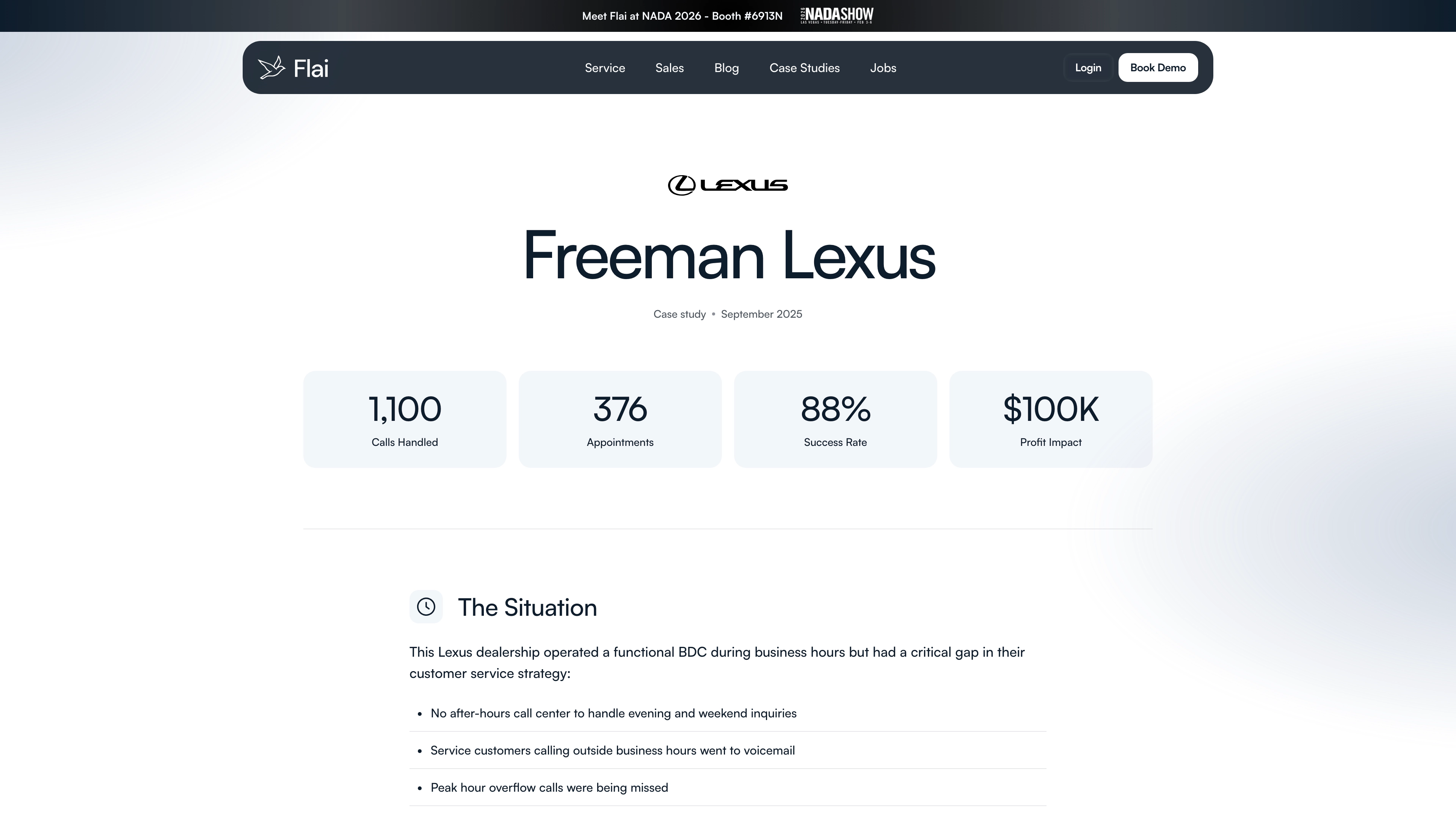
Our Freeman Lexus case study shows what happens when you stop leaving after-hours to chance:
- Roughly 1,100 calls handled after hours
- 426 bookable calls identified
- 376 appointments booked (88% success rate)
- Estimated $100,000 profit impact
Whether you use AI, a call center, or extend your staffed BDC hours, the principle is the same: if customers can reach you instantly when competitors can’t, you win.
After-hours isn’t just about answering calls. It’s about converting them into booked appointments while the customer is still engaged.
How AI Solves Peak Call Volume Problems at Dealerships

We built Flai specifically because we kept seeing dealerships lose customers during the exact moments when demand spiked. Peak hours, after-hours, and overflow windows are where traditional phone systems break down, and that’s where we make the biggest difference.
How AI Eliminates Hold Time for Dealership Calls
Remember that 31.8% of unconnected calls fail because customers hang up on hold? Our AI voice agents answer every call in under three seconds, 24/7. There’s no queue. No hold music. No “your call is important to us” loop.
Customers get immediate engagement, which means you’re not bleeding one-third of your peak volume to hold abandonment anymore.
How 24/7 AI Coverage Captures After-Hours Revenue
Most dealerships treat nights and weekends like dead zones. Calls go to voicemail, and 70% of those customers call a competitor within 30 minutes.
Flai runs 24/7 with the same quality as your best BDC rep. We answer service scheduling calls at 11 PM, handle sales inquiries on Sunday mornings, and book appointments directly into your DMS. The Freeman Lexus case study proves the math: after-hours coverage can drive six figures in monthly profit.
How to Transfer Calls Without Losing Customers
When our AI determines a call needs a human, we don’t just dump the customer into another queue. We warm-transfer with full context: who they are, what they need, and why they’re being transferred.
This eliminates that 56% transfer failure rate that plagues blind transfers during peak hours. Your service advisors and sales managers get the right calls at the right time with all the information they need.
How AI Books Appointments Directly into Your DMS
The difference between “taking a message” and “booking an appointment” is everything. We integrate directly with your dealership management system and scheduler, so when a customer calls to book service, we check real availability, reserve the slot, and send confirmation.
No second steps. No callbacks required. No leakage. The customer’s job is done on the first interaction, which is why our booking rates consistently hit 85-90% on bookable calls.
How to Set Up AI Overflow for Peak Call Hours
During your Monday 10-to-12 rush or Tuesday afternoon service peaks, we act as your designed overflow. If your human team is slammed, calls route to us automatically. We handle what we can (bookings, FAQs, routing), and only escalate what genuinely needs human judgment.
You’re not adding headcount or scrambling to cover spikes. You’re using automation to absorb the peaks while your team focuses on in-person customers and complex interactions.
Dealership Peak Call Coverage Standards (Copy This Template)
If you run a dealer group or manage multiple rooftops, publish this internally as your standard. Make it non-negotiable.
Peak Coverage Standard (Copy/Paste This)
- Monday 10 to 12 is a protected phone coverage window. No meetings, no distractions, no “we’ll make it work.”
- No meetings for phone-handlers during protected windows. If someone is responsible for answering calls during peak hours, they don’t get pulled into conference rooms.
- If holds exceed 30 seconds, calls route to overflow. Overflow must be able to book, schedule, or warm-transfer with context.
- Overflow must be able to do real work. Message-taking doesn’t count as overflow.
- No blind transfers during peaks. Warm transfers only. The receiving person gets customer name, intent, and context before the call lands.
- Voicemail is a last resort, not a normal path. If a customer calls during business hours and hits voicemail, the system failed.
- Missed calls get a callback plus SMS confirmation within 5 minutes. Don’t just call back and hope they pick up. Text them too.
- Track task completion, not just answer rate. Measure: Did the customer schedule an appointment? Did they get their question answered? Not just: Did someone pick up the phone?
Print this. Share it in your ops meetings. Hold people accountable to it.
Frequently Asked Questions

What if our peak hours differ from the industry benchmarks?
That’s fine. The Monday 10-to-12 window is the most common pattern across thousands of dealerships, but your rooftop might peak at different times depending on your market, OEM, and customer base.
Use the Peak Loss Heatmap (Step 1 in the playbook) to identify your specific red hours. Track calls attempted, calls connected, hold times, and appointment conversion for two weeks. Your patterns will become obvious fast. Once you know your unique peak windows, protect those hours the same way we recommend protecting Monday late morning.
How do we calculate required staffing for peak hours?
Use this formula:
Required agents ≈ (Calls per hour × Avg handle time in minutes) ÷ 60 ÷ Occupancy target
Start with an occupancy target of 0.75 (agents on calls 75% of the time, with 25% buffer for wrap-up and breathing room). If you push occupancy to 0.90 or higher, your system becomes fragile and small spikes break it.
Example: If you get 50 calls per hour during peak and average handle time is 5 minutes, you need (50 × 5) ÷ 60 ÷ 0.75 = about 6 agents to handle it without creating a queue.
The calculator we provide automates this math and flags your red hours for you.
Should we use AI or just hire more people?
It depends on your budget, your peak-to-trough call volume ratio, and how much after-hours demand you’re currently missing.
If your peaks are extreme (Monday mornings are 3x heavier than Thursday afternoons), hiring enough humans to cover peaks means you’re overstaffed most of the time. AI is better suited for absorbing spikes and covering nights/weekends because it scales instantly without adding fixed labor costs.
If your call volume is steady and you need nuanced human judgment for most interactions, adding trained BDC staff might make more sense. But realistically, most dealerships benefit from a hybrid: humans handle in-person customers and complex calls, AI covers overflow and after-hours.
What’s the ROI of fixing peak coverage?
The math is straightforward. If you’re losing 30% of peak calls to hold abandonment and voicemail, and each lost service call is worth roughly $270 in profit (based on industry averages), the revenue leakage adds up fast.
Example: If you get 200 calls per week during peak hours, lose 30% of them, and each lost call represents a missed service appointment worth $270, that’s 60 lost appointments × $270 = $16,200 per week or about $65,000 per month in lost service revenue alone.
The calculator we provide helps you run this math with your own numbers. Most dealerships find that fixing peak coverage pays for itself within the first month.
How do we handle after-hours differently than peak business hours?
After-hours has different requirements than daytime peaks. During business hours, you need overflow capacity to absorb spikes while your team handles walk-ins and complex interactions. After-hours, you need primary coverage because there’s no human team available.
For after-hours, your options are:
- Extend BDC hours (expensive, hard to staff consistently)
- Outsourced call center (cheaper but often lower quality and conversion)
- AI voice agents like Flai (24/7 availability, high booking rates, integrates with your systems)
The key metric for after-hours isn’t “answered rate,” it’s booking rate. If you answer calls but can’t schedule appointments because systems aren’t integrated or agents can’t access availability, you’re still losing. Our Freeman Lexus case study shows 88% booking rate after-hours because we integrate directly with scheduling systems.
What metrics should we track weekly to know if we’re improving?
Track these six metrics every week:
- Answer rate during peak windows (calls connected ÷ calls attempted)
- Average hold time during peaks (should trend toward zero)
- Voicemail rate (calls to voicemail ÷ total calls)
- Appointment conversion rate (appointments set ÷ calls answered)
- Transfer success rate (successful transfers ÷ attempted transfers)
- Mission failure rate (calls where customer hung up without completing task)
If those numbers are improving week over week, your peak coverage is getting better. If they’re flat or declining, something in your system is broken. For a deeper dive into BDC metrics, check out our guide on BDC metrics every dealership should track in 2026.
Can small dealerships afford to fix peak coverage?
Yes. The playbook steps don’t require massive capital investment. Building your Peak Loss Heatmap is free (just export data from your phone system). Protecting Monday 10-to-12 is a scheduling decision, not a budget item. Designing overflow paths and warm transfer protocols costs nothing but planning time.
The bigger question is: can you afford NOT to fix it? If you’re a single-rooftop store losing 30 calls per week to hold abandonment and voicemail, and each call is worth $270 in service profit, you’re bleeding $3,200+ per week. That’s over $160,000 per year just from peak-hour failures.
Even small dealerships can justify AI coverage when you frame it as “capturing revenue we’re already losing” rather than “adding new expense.”
How does Flai integrate with our existing phone system and DMS?
We connect to your existing phone system through call forwarding or direct integration (no hardware changes needed). When a call comes in, it routes to our AI voice agents either as primary coverage (after-hours) or overflow (during peaks).
For DMS integration, we work with the major platforms (CDK, Reynolds & Reynolds, Tekion, DealerTrack) to pull customer data, check scheduler availability, and write appointments directly into your system. The integration means our AI can book real appointments, not just take messages.
Setup typically takes 1-2 weeks depending on your systems, and we handle the technical work. Your team doesn’t need to learn new software or change workflows. If you want to learn more about how AI BDCs work at the system level, check out our guide on what is an AI BDC.
Last updated: February 15, 2026
Peak call volume isn’t just a staffing challenge. It’s a revenue protection problem. The dealerships that thrive are the ones that treat their busiest hours like the high-stakes windows they are and build systems that capture every customer, even when phones are ringing nonstop. Start with your heatmap, protect your peak windows, and design overflow paths that actually work. The customers are calling. Make sure you’re ready.