What Is a BDC at a Dealership? Roles & Value
Learn what a BDC in a car dealership does, why dealers use them, and how AI is changing the game. Plus real results from top dealers.

Your dealership phone is ringing at 9 PM. A customer wants to book a service appointment for tomorrow morning.
They called three other dealerships first, but got voicemail. You answer on the second ring, book them in for 8 AM, send a confirmation text, and they show up.
That’s what happens when you have a proper Business Development Center.
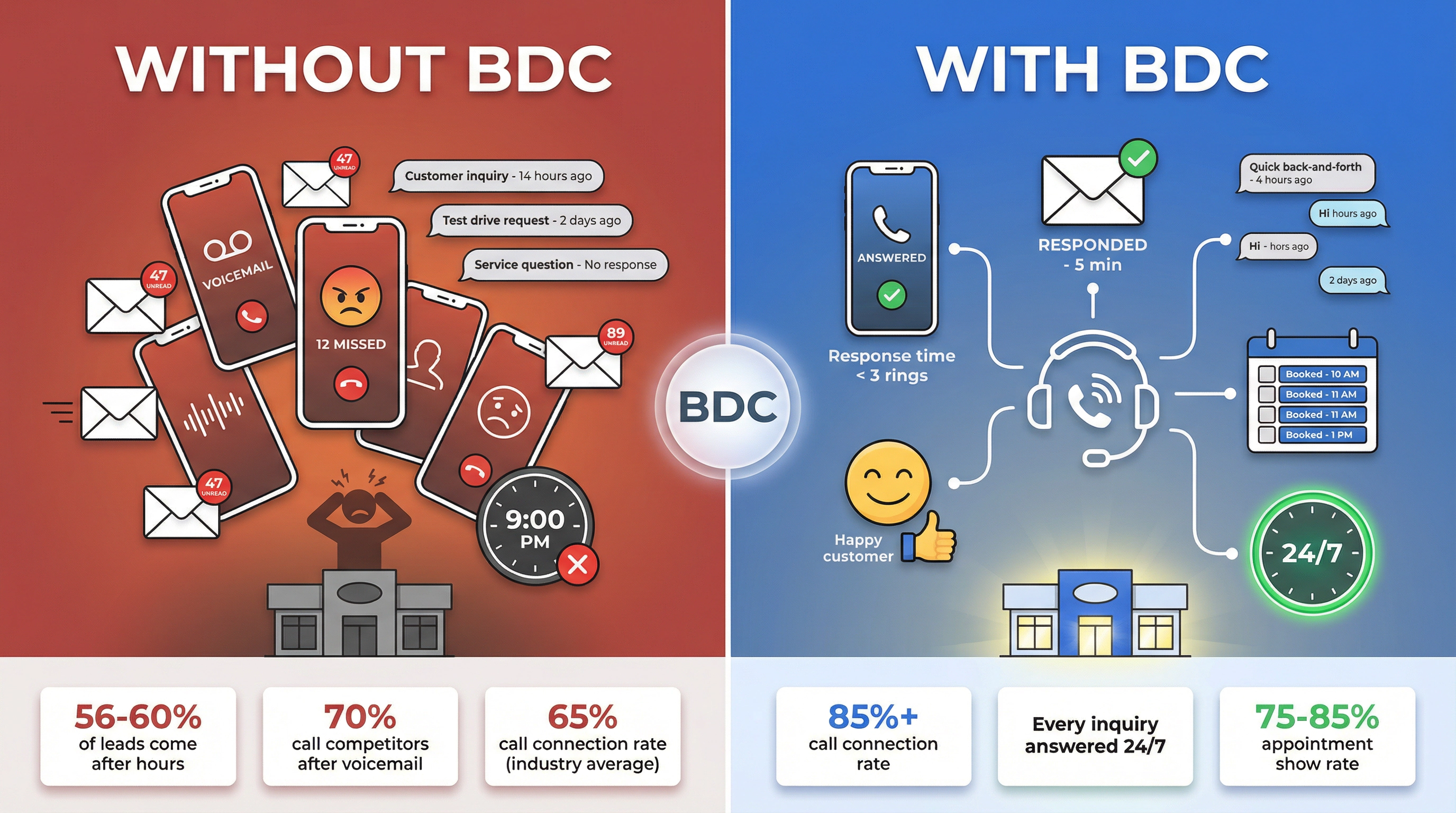
A BDC (Business Development Center) is a specialized team that handles all your dealership’s customer communications. Phone calls, texts, emails, web chats. The goal is simple: never miss a customer. Every inquiry gets answered, every lead gets followed up, and every qualified prospect gets an appointment booked.
Industry research shows that 56-60% of dealership leads come in after business hours. Without a BDC (or an AI solution handling after-hours), those leads hit voicemail. And roughly 70% of people who hit voicemail will call a competitor within 30 minutes.
This guide covers everything you need to know about dealership BDCs: what they do, why they matter, how to run one effectively, and how AI is changing the game entirely.
How BDC Teams Handle Dealership Communications
A dealership BDC isn’t just a call center. It’s the central hub for all customer interactions before someone walks into your showroom or service bay.
Unlike generic call centers, automotive BDCs are deeply integrated with dealership operations. They know your inventory, understand your service processes, and can book appointments directly into your systems.
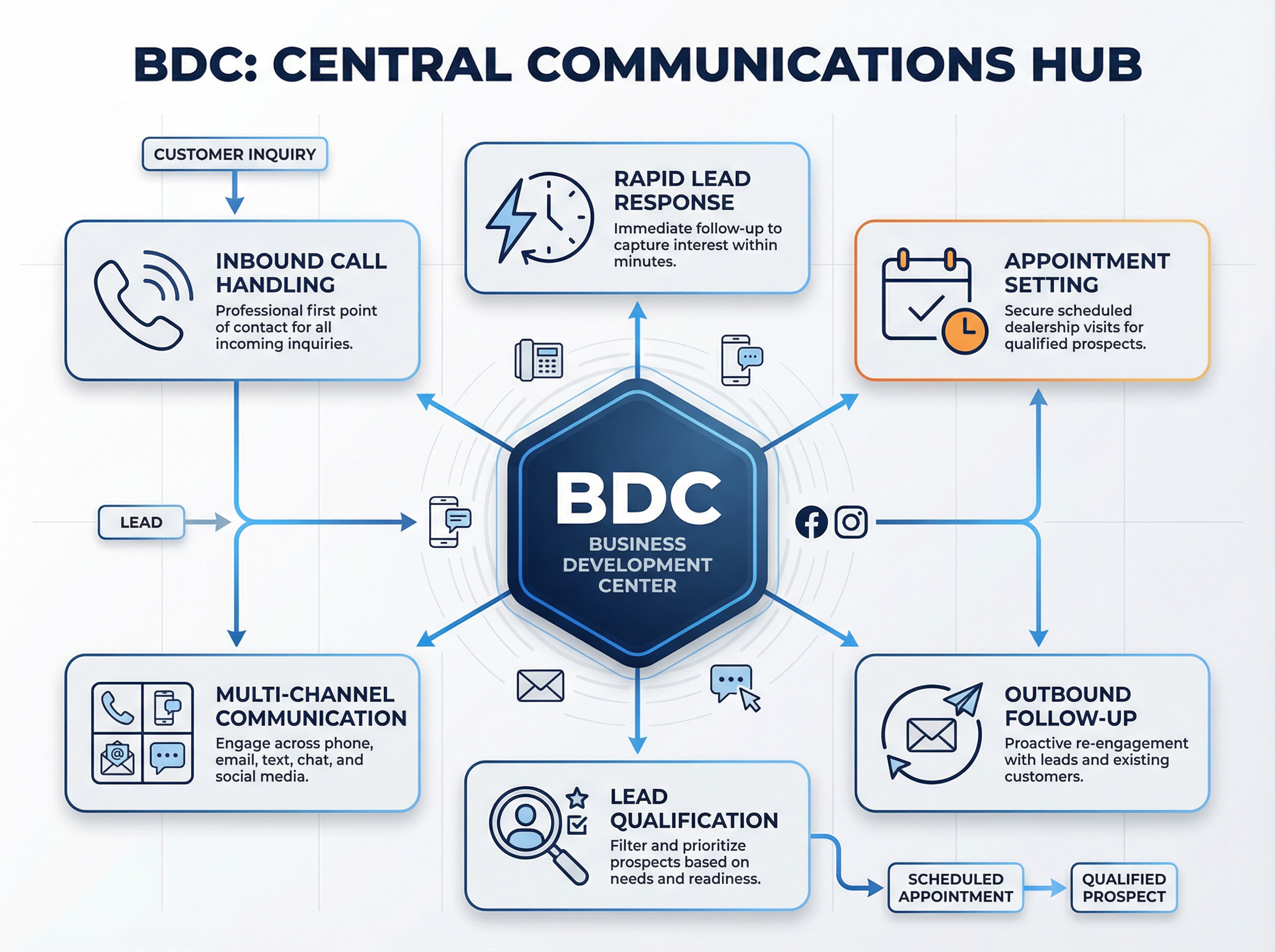
Core BDC functions:
Inbound call handling
Answering phones immediately. No hold music, no voicemail. Customers calling about inventory, pricing, service appointments, or general questions get a live human who can help right away.
Rapid lead response
When someone fills out a website form at 11 PM, your BDC (or AI assistant) responds within minutes, not the next morning. Research proves that contacting a lead within 5 minutes makes you 100x more likely to connect compared to waiting 30 minutes.
Appointment setting
This is the primary KPI. BDC reps schedule test drives for sales prospects and service appointments for customers. They don’t sell cars over the phone. They sell the appointment.
Outbound follow-up
Calling back missed leads, following up with prospects who haven’t scheduled yet, reaching out for recall campaigns, reminding customers about overdue maintenance. Systematic follow-up that salespeople rarely have time for.
Lead qualification
BDC teams ask the right questions to understand customer needs, timeline, budget, trade-in situation. This intel gets logged in the CRM so when the customer arrives, your sales team already knows what they’re looking for.
Multi-channel communication
Modern BDCs respond to emails, text messages, website chat, social media DMs. Customers can start on one channel and continue on another without repeating themselves.
The BDC owns everything that happens before the customer shows up. They create the first impression that determines whether that lead becomes an appointment.
Why Car Dealerships Need a BDC
Speed matters more than you think.
When a customer calls your dealership and gets put on hold, 60% will hang up after just one minute. Another 32% won’t wait at all.
Those aren’t just statistics. That’s real revenue walking out the door while your phones ring unanswered.
The Core Problem BDCs Solve
Missed opportunities everywhere
Salespeople are busy with showroom customers. Service advisors are juggling cars in the bays. Nobody’s answering phones consistently. Internet leads sit in the CRM for hours. By the time someone follows up, the customer’s already scheduled elsewhere.
After-hours is a black hole
More than half your leads arrive when you’re closed. AI-powered BDC solutions help dealerships capture these after-hours calls that would otherwise go to voicemail, converting them into booked appointments 24/7.
Follow-up falls through the cracks
A sales lead usually requires 3-5 contact attempts before you reach them. Busy salespeople make one call, then forget. BDCs systematically follow up until they get a response or the lead goes cold.
Peak times create chaos
Monday mornings, lunch rushes, promotion days. Call volume spikes but staffing doesn’t. A BDC handles overflow smoothly because that’s their only job.
The Business Impact
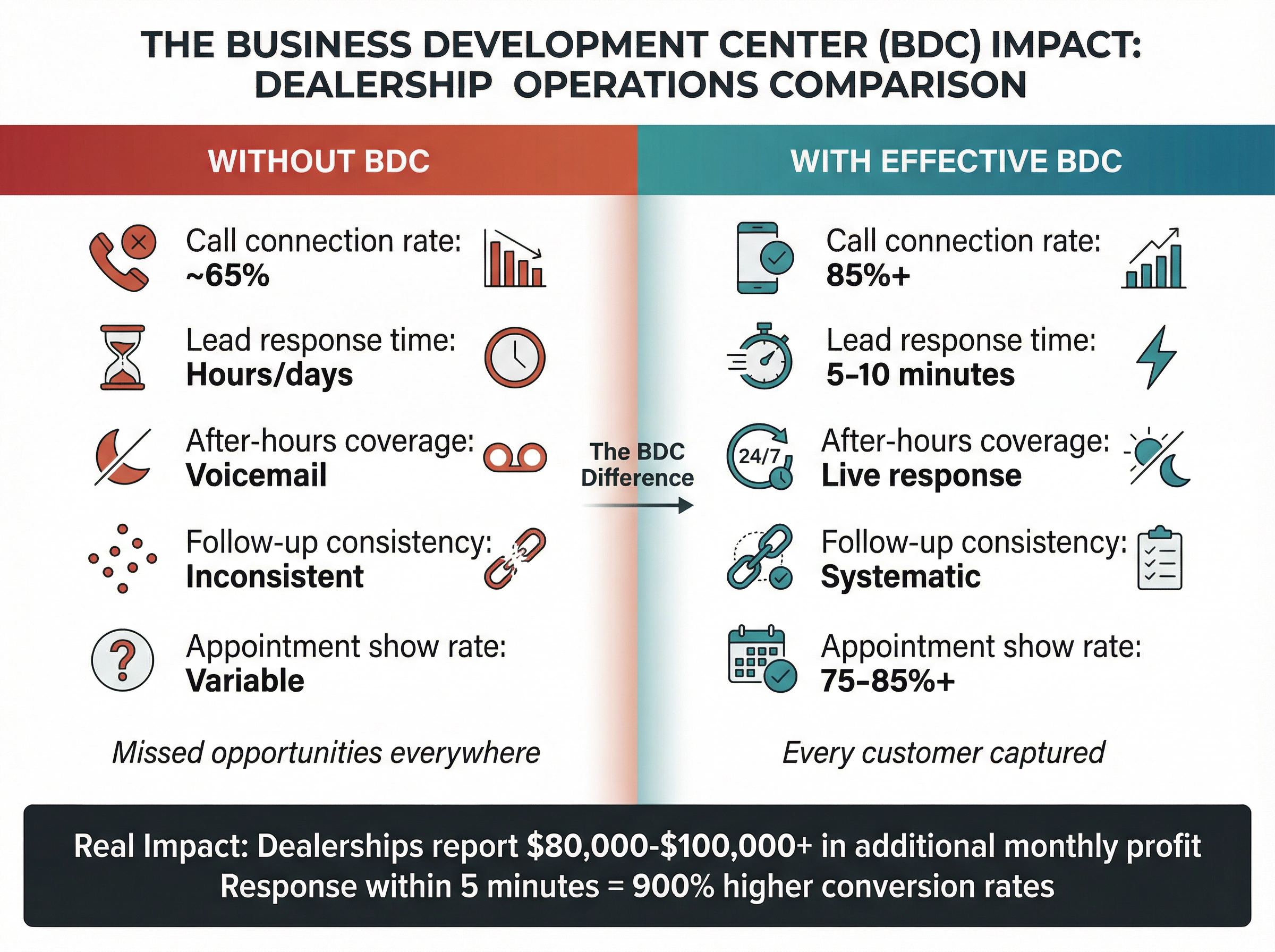
| Metric | Without BDC | With Effective BDC |
|---|---|---|
| Call connection rate | ~65% | 85%+ |
| Lead response time | Hours/days | 5-10 minutes |
| After-hours coverage | Voicemail | Live response |
| Follow-up consistency | Inconsistent | Systematic |
| Appointment show rate | Variable | 75-85%+ |
Real numbers tell the story. One Bay Area CDJR store went from 205 monthly service appointments to 448 after implementing an effective BDC solution. That’s $83,000 in additional profit in one month.
Another luxury dealership implementing a 24/7 AI BDC captured 426 bookable calls with an 88% conversion rate, generating $100,000 in profit because those customers actually showed up instead of disappearing to voicemail.
Critical insight: Responding within 5 minutes can boost conversion rates by up to 900%. Your BDC makes that speed standard, not occasional.
Customer Experience and Team Efficiency
When someone calls and actually gets a helpful person immediately, it completely changes their perception of your dealership. No hold music. No voicemail. No waiting until tomorrow.
Dealerships with strong BDC operations typically see higher CSI scores. That satisfaction translates directly to loyalty and referrals.
By handling initial communications, BDCs free up salespeople and service advisors to focus on what they do best: working with customers face-to-face. Sales reps work pre-qualified appointments the BDC has already warmed up. Service advisors focus on diagnosing cars instead of constantly interrupting to answer phones. The right people do the right jobs.
Sales BDC vs Service BDC: Which Does Your Dealership Need?
Many dealerships split their BDC into two specialized teams:
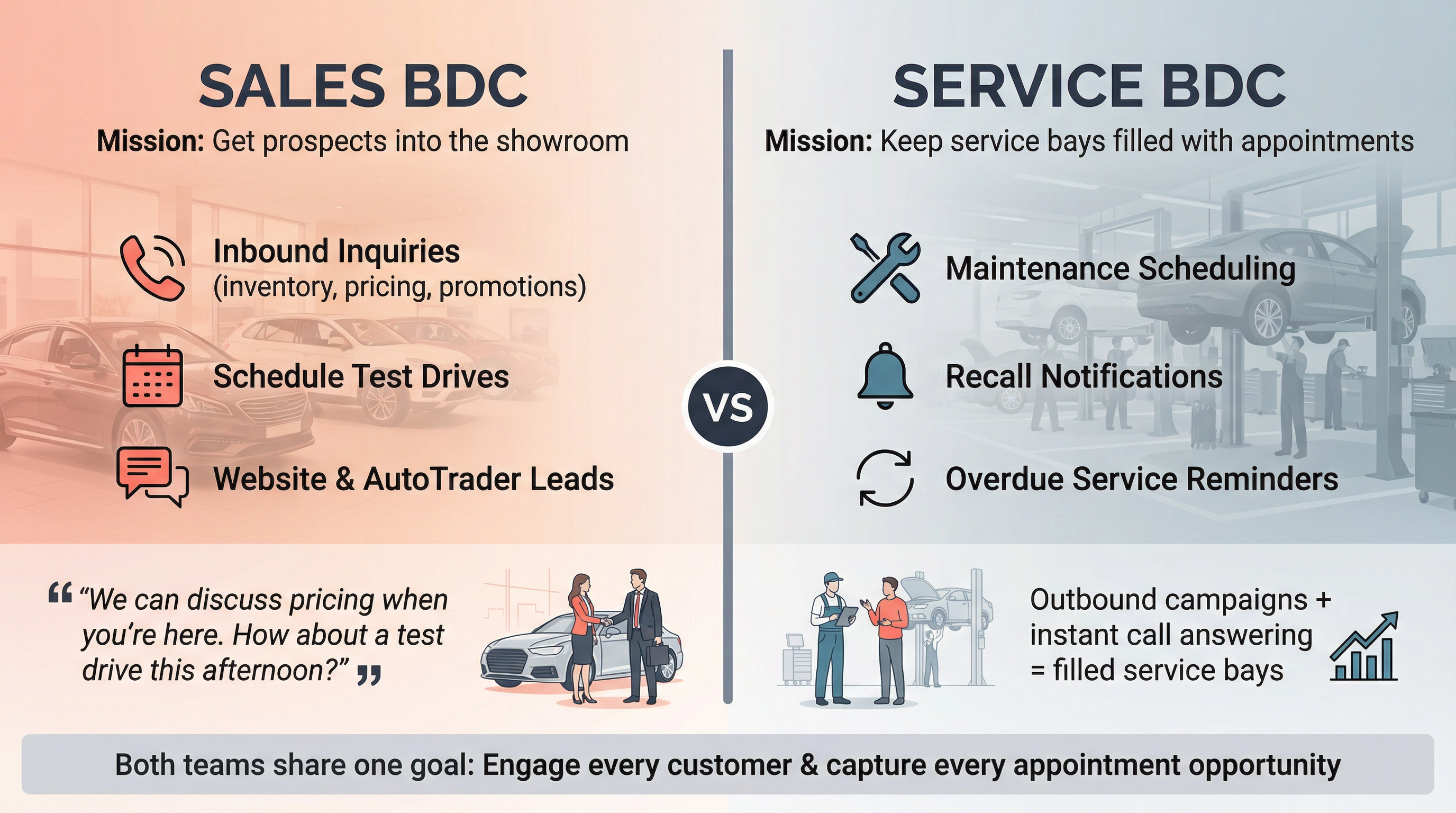
Sales BDC
A sales BDC is the team focused on converting vehicle inquiries into showroom visits — handling inbound sales calls, web leads, and third-party listing inquiries, then booking test drives and consultations. Mission: Get prospects into the showroom for test drives and consultations.
Sales BDC reps handle inquiries about vehicle inventory, pricing, financing basics, current promotions. They field calls from your website, third-party sites like AutoTrader, chat on listing pages.
Key strategy: They don’t sell cars over the phone. They sell the appointment. When a customer asks about price, they give an accurate answer, then pivot:
“We can discuss all pricing details and current incentives when you’re here. How about I schedule you for a test drive this afternoon?”
This works because cars are sold in person, not through phone negotiations.
Service BDC
A service BDC is the team that handles all service department communications at a car dealership — booking maintenance and repair appointments, answering pricing and status questions, and running outbound campaigns for recalls and overdue maintenance. Mission: Keep service bays filled with scheduled appointments.
Service BDC teams handle all service department communications. Customers calling to book maintenance, asking about repair status, inquiring about pricing.
They also run outbound campaigns: recall notifications, overdue maintenance reminders, follow-ups on declined repairs. AI-powered systems can run these campaigns automatically, calling customers with overdue oil changes and scheduling hundreds of appointments that would’ve never happened otherwise.
Smaller Stores: Combined BDC
Not every dealership needs both. Smaller operations might have one team covering sales and service leads. Larger dealer groups often separate them completely.
The structure doesn’t matter as much as the execution. Whether combined or separate, the principle is identical: dedicated people making sure every customer is engaged and every appointment opportunity is captured.
How to Build an Effective BDC Team
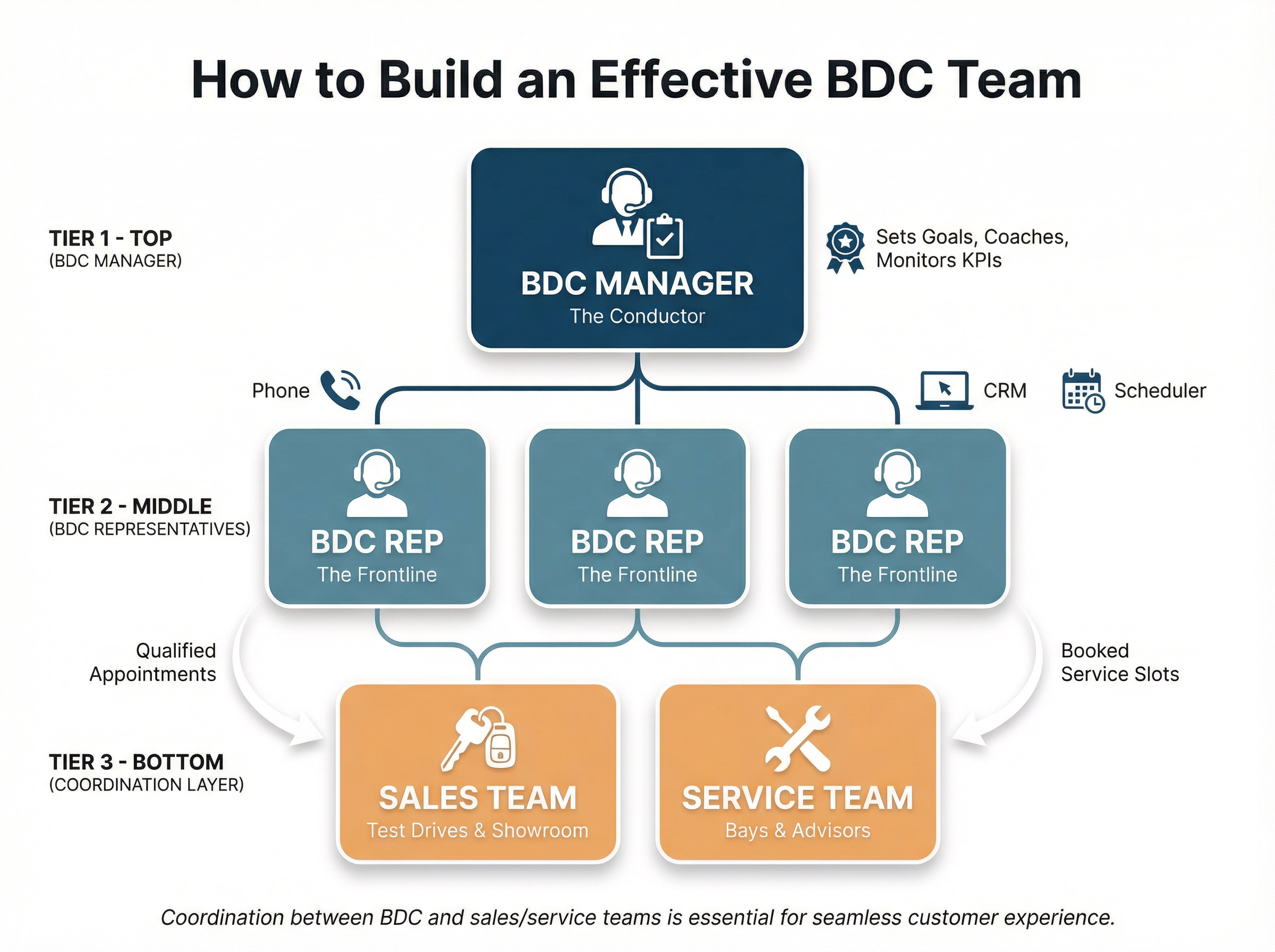
A typical dealership BDC has a few key roles:
BDC Representatives (The Frontline)
A BDC representative (also called a BDC agent) is the frontline rep at a car dealership who handles inbound and outbound calls, texts, and emails — qualifying leads, answering customer questions, and booking appointments. They toggle between phone, CRM, scheduling software, and your knowledge base all day.
What makes a good BDC rep:
Excellent communication skills – Both phone and written. They need to sound friendly and professional without reading from a script robotically.
Customer service mindset – They’re helpers, not pushers. The goal is making customers feel comfortable scheduling, not pressured.
Dealership knowledge – They should know your inventory, services, policies, pricing structure. When a customer asks if you have a 2024 Accord in blue, they need to check and answer accurately.
Persistence without annoyance – Following up 3-5 times takes finesse. You want consistent contact, not harassment.
BDC reps are measured on calls made, contacts reached, appointments set, and show rates.
BDC Manager (The Conductor)
A BDC manager is the person who runs a car dealership's BDC team — setting goals, training and coaching reps, monitoring performance, and coordinating with sales and service managers.
Daily responsibilities:
- Pull reports on response times, conversion rates, call outcomes
- Listen to recorded calls for quality coaching
- Adjust staffing based on call volume patterns
- Ensure smooth handoffs between BDC and showroom/service
- Handle escalations and train new reps
In smaller dealerships, the Sales Manager might double as BDC Manager. Larger stores need someone dedicated full-time.
Coordination and Training
BDC staff must work hand-in-hand with sales and service teams. When a BDC rep sets a sales appointment, they assign it to a specific salesperson and ensure that person knows what the customer wants. Some dealerships have morning huddles where BDC reviews appointments with sales managers.
When the customer arrives, the salesperson greets them by name with the vehicle already pulled up. That seamless transition from phone to in-person creates a great experience.
Training is equally critical. Reps need extensive preparation in phone etiquette, objection handling, your technology systems, and deep knowledge of inventory and services. The difference between a mediocre rep and an excellent one can be thousands of dollars in monthly revenue.
In-House vs Outsourced BDC: Costs and Benefits
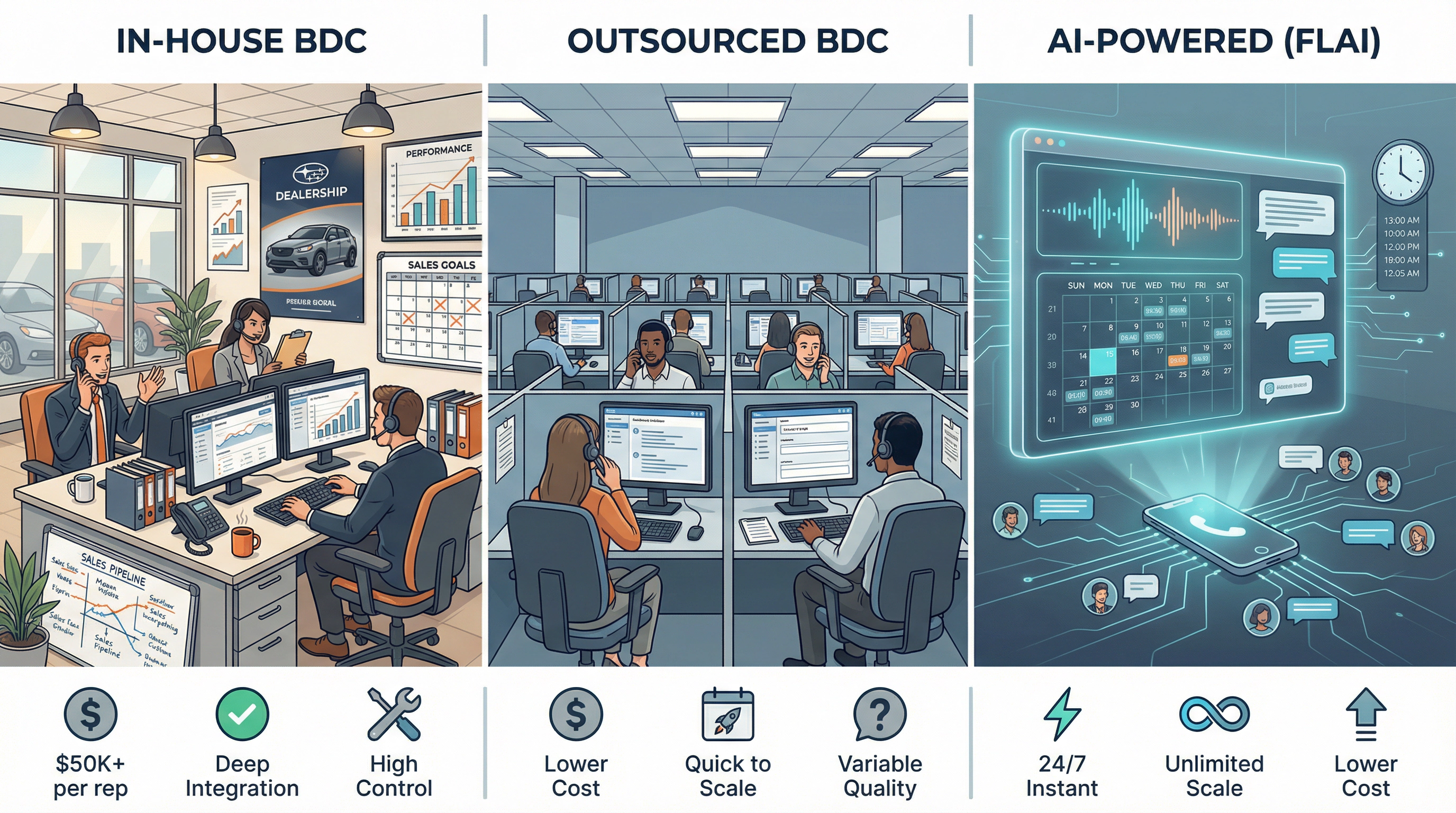
When you’re ready to implement a BDC, you face a fundamental choice: build your own team or hire an outside service.
| Feature | In-House BDC | Outsourced BDC |
|---|---|---|
| Control | Complete (your employees, your training) | Limited (vendor's processes) |
| Cost | $50,000+ per rep annually | Shared resources, often lower |
| Integration | Deep (direct system access) | Varies by vendor |
| Flexibility | High upfront, slow to scale | Quick scaling up/down |
| Quality | Depends on your hiring/training | Depends on vendor |
| Knowledge | Deep dealership familiarity | Generic unless automotive-specific |
In-House BDC: Maximum Control
Your BDC reps are your employees, working at your dealership. They become intimately familiar with your inventory, policies, culture, and staff. They access your internal systems, attend sales meetings, and get to know your salespeople personally, creating better handoffs.
The tradeoff: You bear all costs. Recruiting, hiring, training, salaries, benefits, equipment. A single BDC rep can exceed $50,000 annually when you factor everything in. If someone quits (and BDC turnover can be high), you’re scrambling to replace them. Scaling takes significant lead time.
Outsourced BDC: Flexibility and Expertise
Outsourced services offer immediate access to trained automotive communication specialists without the operational headaches. You can scale coverage based on needs: after-hours only, overflow during peak times, or complete handling of all communications.
The flexibility is huge. If your lead volume doubles during summer sales, an outsourced BDC can allocate more agents within days.
The tradeoff: External teams won’t know your dealership as intimately. Quality varies significantly between vendors. Some provide excellent service; others have reps who sound unenthusiastic or can’t answer basic questions.
The Hybrid Approach
Many dealerships use both. In-house BDC during business hours for maximum control, then an outsourced service or AI solution for after-hours and overflow.
If you outsource, choose carefully:
- Look for providers with automotive-specific experience
- Ask about performance metrics: What’s their average lead response time?
- Request references and case studies with real results
- Ensure they integrate with your CRM so all activities are logged
- Get transparency: Can you listen to calls? Do they provide detailed reports?
The Third Option: AI-Powered 24/7 BDC
Modern AI solutions offer a completely different approach: AI voice agents that answer every call, book appointments, and follow up automatically.
These platforms handle inbound calls 24/7, speak naturally in any language, book appointments directly into your systems, and follow up via text and email.

The advantages:
- Zero missed calls (AI handles unlimited simultaneous conversations)
- Instant response (no hold times ever)
- 24/7 availability without hiring night shifts
- Lower cost per interaction than human staffing
- Perfect consistency (AI follows your process every single time)
Early adopters report capturing 100% of after-hours calls, converting 88% of bookable calls into appointments, and generating $100,000 in additional profit in one month.
AI-powered BDCs integrate with your existing DMS, CRM, and scheduling systems. When a customer calls at 11 PM to book service, the AI answers, checks availability, books the appointment, sends a confirmation text, and logs everything in your CRM. All automatic.
This isn’t generic chatbot technology. Modern AI BDC platforms use custom voice infrastructure built from the ground up for real dealership conversations. The AI knows your inventory, services, and availability in real-time.
Most dealerships use AI to complement human BDC teams: AI handles after-hours and overflow, humans handle complex situations and hot leads. Some smaller stores skip building a human BDC entirely and go straight to AI.
Want to see what these numbers actually look like for your store? Plug in your dealership's call volume and deal values. The calculator runs the math for all three approaches.
How Much Revenue Is Your Dealership Losing?
Enter your numbers to see what missed calls actually cost you, and which BDC approach delivers the best ROI.
BDC Best Practices That Drive Results
Implementing a BDC is step one. Making it effective requires following proven best practices:
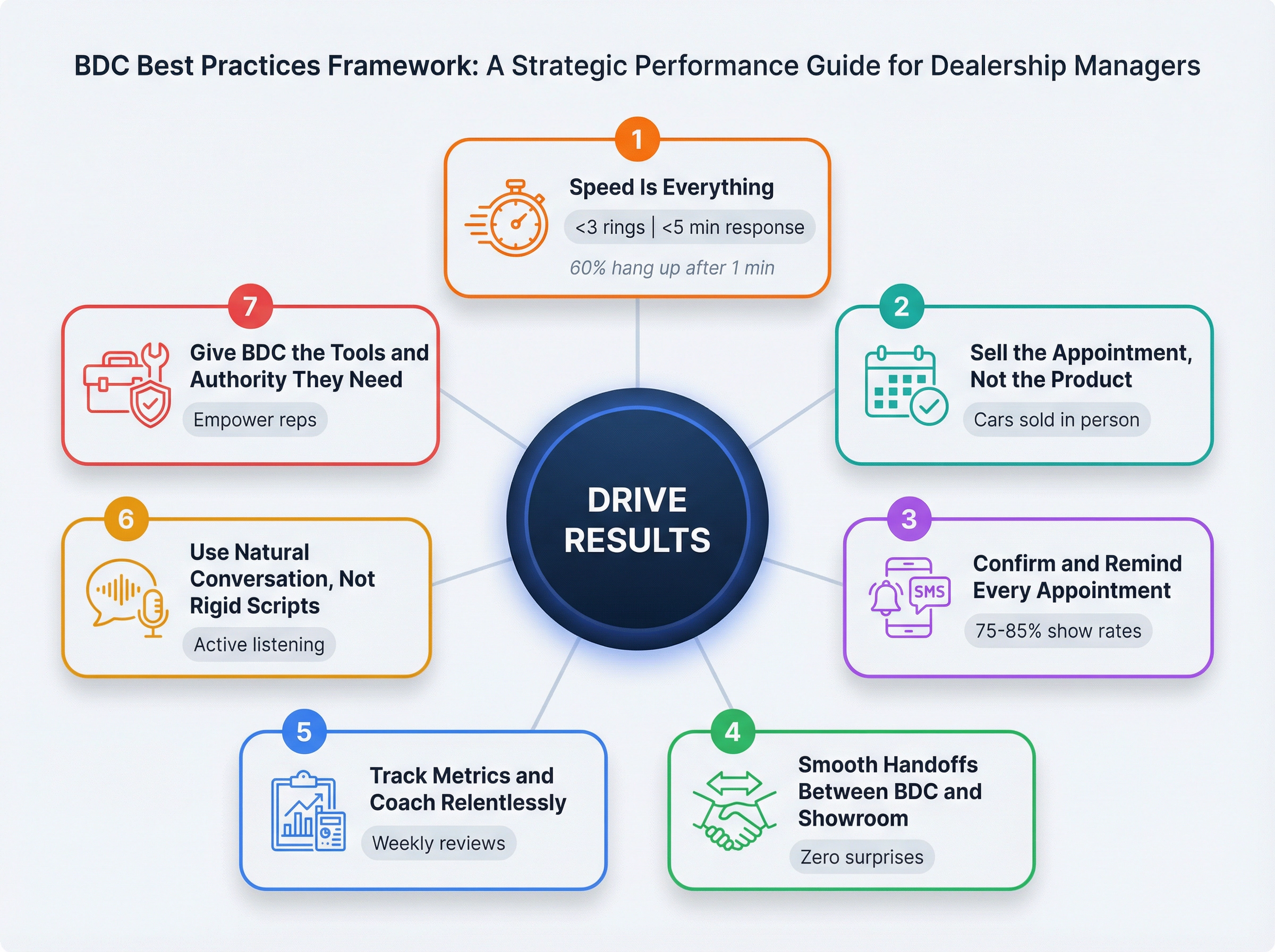
1. Speed Is Everything
Answer calls within 3 rings. Respond to digital leads within 5 minutes. Research proves this can boost conversions by 900% compared to waiting longer.
60% of customers hang up after one minute on hold. Speed to lead is the top predictor of BDC success.
2. Sell the Appointment, Not the Product
“Cars are sold in person, not over the phone.”
BDC reps should answer customer questions, but guide toward scheduling:
“That 2024 Camry is a great choice. We have one in silver right here. Can you stop by this afternoon, or would tomorrow morning work better?”
Don’t dive into pricing, financing, or trade appraisals on the phone. Those conversations happen in person. The BDC’s goal: Get qualified prospects through your door.
3. Confirm and Remind Every Appointment
Setting appointments is only half the battle. You need customers to actually show up.
Immediately after booking: Send confirmation with all details: time, location, who to ask for, what to bring.
Day before: Send a reminder text or quick confirmation call.
“Hi John, this is Sarah from XYZ Motors. Just confirming your 3 PM test drive tomorrow. Reply Y to confirm or let me know if you need to reschedule.”
Dealerships with robust confirmation processes typically see show rates of 75-85%+, compared to much lower when customers are left to remember on their own.
4. Smooth Handoffs Between BDC and Showroom
When an appointment shows up, your team better know about it. The assigned salesperson gets an alert with the customer’s info and needs. They greet the customer by name with the vehicle (or service bay) ready.
Some stores have morning huddles where BDC and sales managers review the day’s appointments together.
Poor handoffs ruin the goodwill BDC creates. A customer arrives expecting a warm welcome and finds confused staff who don’t know why they’re there. That destroys the professional impression you built.
5. Track Metrics and Coach Relentlessly
What gets measured gets improved. Track these:
- Incoming lead count
- Response time (average and by rep)
- Contact rate (leads actually reached)
- Appointment set rate
- Appointment show rate
- Conversion from appointment to sale/service
Review weekly. Record calls for quality purposes. Managers should do weekly call reviews with each rep, highlighting wins and areas to improve.
6. Use Natural Conversation, Not Rigid Scripts
Scripts are useful training tools. But actual calls should feel conversational. Customers can tell when someone’s reading robotically. Encourage reps to internalize the scripts, then adapt based on how the conversation flows.
Train them to actively listen. If a customer says “I’m just looking, not ready to come in,” a skilled rep adapts:
“I totally understand. How about this: I can send you some info on the models you’re interested in. By the way, we do no-pressure test drives where you can just see how you like the car. Would that interest you sometime?”
7. Give BDC the Tools and Authority They Need
Equip your reps with:
- Real-time inventory access (what’s in stock, pricing)
- Service scheduling system (available times, technician capacity)
- CRM with full customer history
- Good dialing software or VoIP for efficient calling
Give them enough authority to solve minor issues without always escalating. If a customer is upset nobody called them back, empower the rep to apologize genuinely and maybe offer something small (free car wash, priority scheduling).
How AI Is Transforming Dealership BDCs
Technology is fundamentally changing how dealership BDCs operate.
AI Voice Agents That Actually Work
Modern AI can handle customer inquiries via phone or text conversationally. These systems answer common questions, book appointments by checking your scheduler, and capture lead information. All automatically.
AI is available 24/7, responds instantly, and handles multiple conversations simultaneously. If five customers call at midnight, AI converses with all five at once.
Leading AI BDC platforms answer every call immediately, speak naturally in the customer’s preferred language, book appointments directly into your DMS, and send confirmation texts. All without human intervention.
These aren’t crude chatbots. Modern AI uses advanced natural language processing built for real dealership conversations. The AI understands free-form customer speech and responds naturally with dealership-specific knowledge: your inventory feeds, service menus, CRM data.
AI as a Performance Coach
AI can analyze calls in real-time to help human reps perform better. It detects customer sentiment, buying signals, and frustration. It might alert a manager if a call is going south, or provide reps with on-screen suggestions like: “Customer asked about warranty – mention the current extended warranty special.”
It’s like having a silent assistant manager monitoring every call.
Predictive Lead Scoring
With all the data in your CRM, AI can do predictive lead scoring: analyzing which leads are most likely to convert based on source, behavior, and past patterns. This lets BDCs prioritize follow-up intelligently rather than treating all leads equally.
The Blended Future
Despite all this technology, human BDC reps won’t disappear. The model is shifting to AI + human together.
AI handles repetitive tasks, easy questions, after-hours, and high-volume situations. Human reps focus on complex cases and hot leads. Customers get immediate response for simple things, plus the option to talk to a person when needed.
The AI must be good, though. If it misunderstands frequently or sounds robotic, it frustrates people. Quality matters enormously.
Common BDC Problems and Solutions
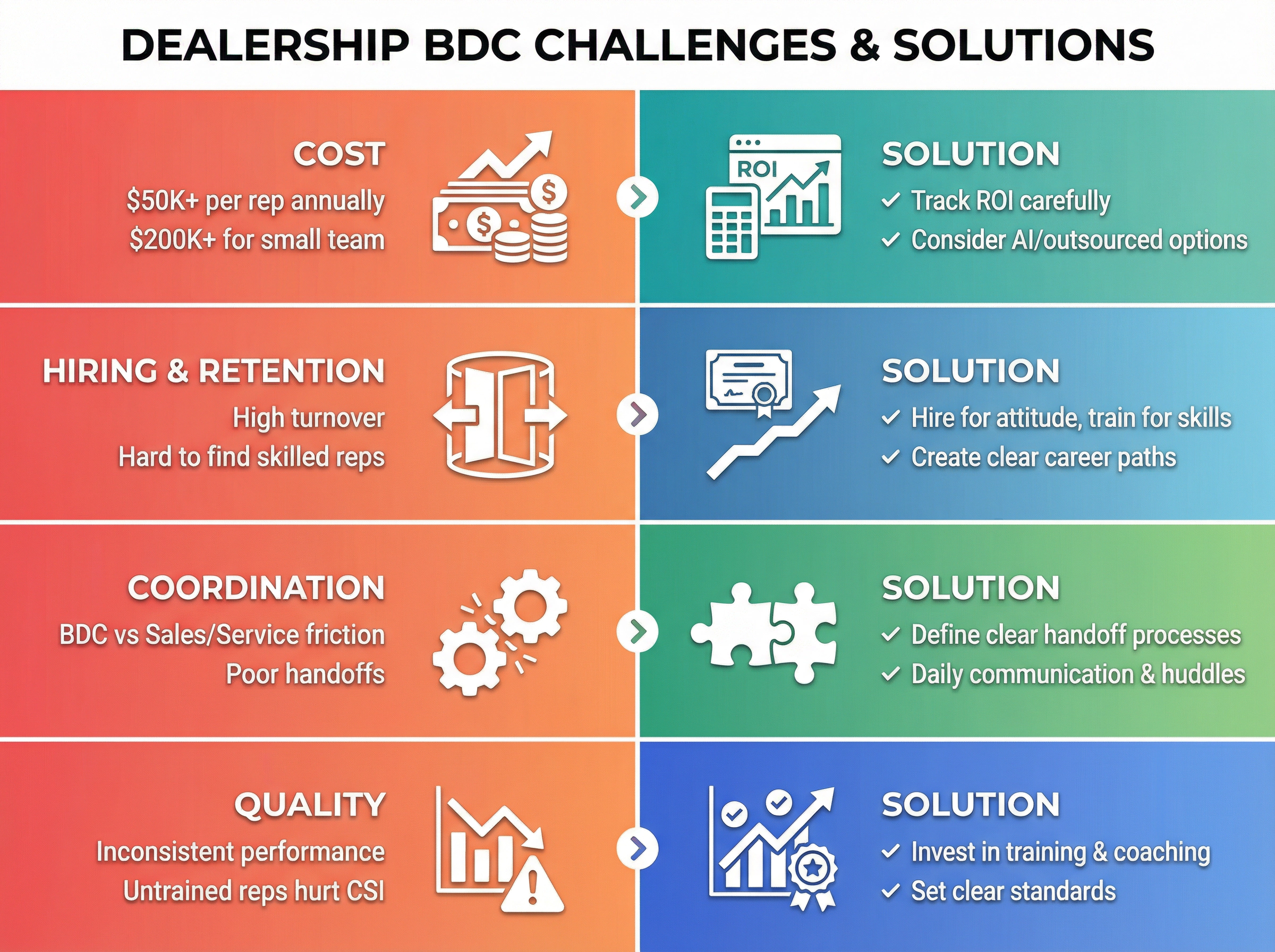
While BDCs offer huge advantages, they come with real challenges:
Challenge 1: Cost
Running a BDC isn’t cheap. Recruiting, training, and retaining a single rep can exceed $50,000 annually. For a team of 4 plus a manager, you’re looking at $200k+ yearly.
Solution: Track ROI carefully. Many dealerships find a good BDC pays for itself many times over. For smaller stores, outsourced services or AI solutions provide BDC benefits at a fraction of the cost.
Challenge 2: Hiring and Retention
Finding skilled reps is hard. The role requires salesmanship plus customer service, tolerance for repetitive tasks, and ability to handle rejection. Turnover can be high because the job is stressful and often entry-level pay.
Solution: Hire for attitude, train for skills. Pay competitively. Create career paths into sales or BDC management. Invest in ongoing coaching so people feel they’re developing.
Challenge 3: Coordination Between Departments
BDC can create friction if not managed well. Salespeople complain about “bad appointments.” Service advisors don’t like outsiders booking their schedules.
Solution: Define clear handoff processes. Daily communication between managers. Morning huddles. Align incentives so everyone benefits when appointments show and close.
Challenge 4: Maintaining Quality
Untrained reps who fail to handle calls effectively can actually hurt customer impressions.
Solution: Invest in training, record and review calls weekly, set clear performance standards, and continuously refine processes. A BDC isn’t set-it-and-forget-it.
BDC Questions Car Dealers Actually Ask
What does BDC stand for in a car dealership?
BDC stands for Business Development Center. It’s a specialized team managing all customer communications with the goal of converting every inquiry into a scheduled appointment.
What’s the difference between a BDC and a call center?
A dealership BDC is specialized for automotive operations. Unlike generic call centers, BDC teams understand your inventory, DMS, service processes, and can book appointments directly into your systems.
Can small dealerships benefit from a BDC?
Absolutely. Even 1-2 dedicated reps (or an AI solution) can dramatically improve lead response times and capture after-hours business. Many small dealerships see significant ROI because they’re finally answering calls and following up systematically.
Should I hire in-house or outsource?
Choose in-house if: You want maximum control and can invest in hiring and training.
Choose outsourced if: You need flexibility, 24/7 coverage, or want to test BDC without major upfront investment.
Choose AI if: You want instant response 24/7, perfect consistency, and lower cost than human staffing.
Many dealerships use hybrid approaches: in-house during business hours, outsourced or AI for after-hours and overflow.
How does AI BDC compare to human BDC?
AI advantages: Available 24/7, instant response, unlimited simultaneous conversations, perfect consistency, often lower cost.
Human advantages: Better at complex situations, builds personal rapport, can improvise creatively, handles upset customers more effectively.
The future is blended: AI handling routine tasks and initial contact, humans focusing on high-value interactions.
How to Stop Missing Dealership Leads Today
A proper BDC (whether staffed by humans, AI, or both) ensures you never lose another lead to voicemail, slow response, or inconsistent follow-up.
In an industry where competitors are just one phone call away, speed and consistency in customer communication determine who wins the business.
The numbers prove it: Responding within 5 minutes makes you 100x more likely to connect with a lead. Dealerships implementing strong BDC operations are seeing $80,000-$100,000+ in additional monthly profit simply by capturing business that used to fall through the cracks.
Whether you build an in-house team, outsource to specialists, or implement AI voice agents, the core principles remain:
Fast, friendly, and relentless follow-up wins customers.
You rarely get a second chance with a lead. A well-tuned BDC ensures that first chance is all you need.

At Flai, we built our AI communications platform specifically for car dealerships after visiting 450+ stores and seeing the same problems everywhere. Our AI answers and makes calls, texts, and emails like your best BDC rep. Instantly, 24/7, in any language.
We handle inbound service scheduling, sales inquiries, outbound recall campaigns, and follow-ups with leads. Everything integrates with your existing DMS, CRM, and scheduler. And we never miss a call.
If you’re ready to stop losing leads to voicemail and start capturing every opportunity, book a demo with Flai. Let us show you how AI can transform your dealership’s customer communication.