Car Dealership Hold Times: How They Cost You $10K/Month
Dealership hold times cost $10K+ monthly in lost profit. 60% of customers hang up after one minute. Here's how to fix it for good.
Every time your phone plays hold music, your dealership is spending money. Not a vague, theoretical kind of spending. Real dollars, leaking out of your fixed ops and sales departments one frustrated caller at a time.
Most dealership leaders know hold times aren’t great. But very few have ever calculated what those minutes of silence are actually costing them. That’s what this piece is about: turning “we’re busy” into a number you can take to your next ops meeting, then giving you a clear path to fix it.
We built this for fixed ops directors, BDC managers, GMs, and dealer principals who want hard data, not guesswork. Everything below draws on 2024 and 2025 industry benchmarks (the most recent publicly available), plus real dealership case studies from stores that have eliminated hold times entirely.
Why Most Dealerships Measure Hold Time Wrong
Most stores talk about “hold time” like it’s a single number. In reality, there are three distinct time sinks that get lumped together, and confusing them makes it nearly impossible to fix the right problem.
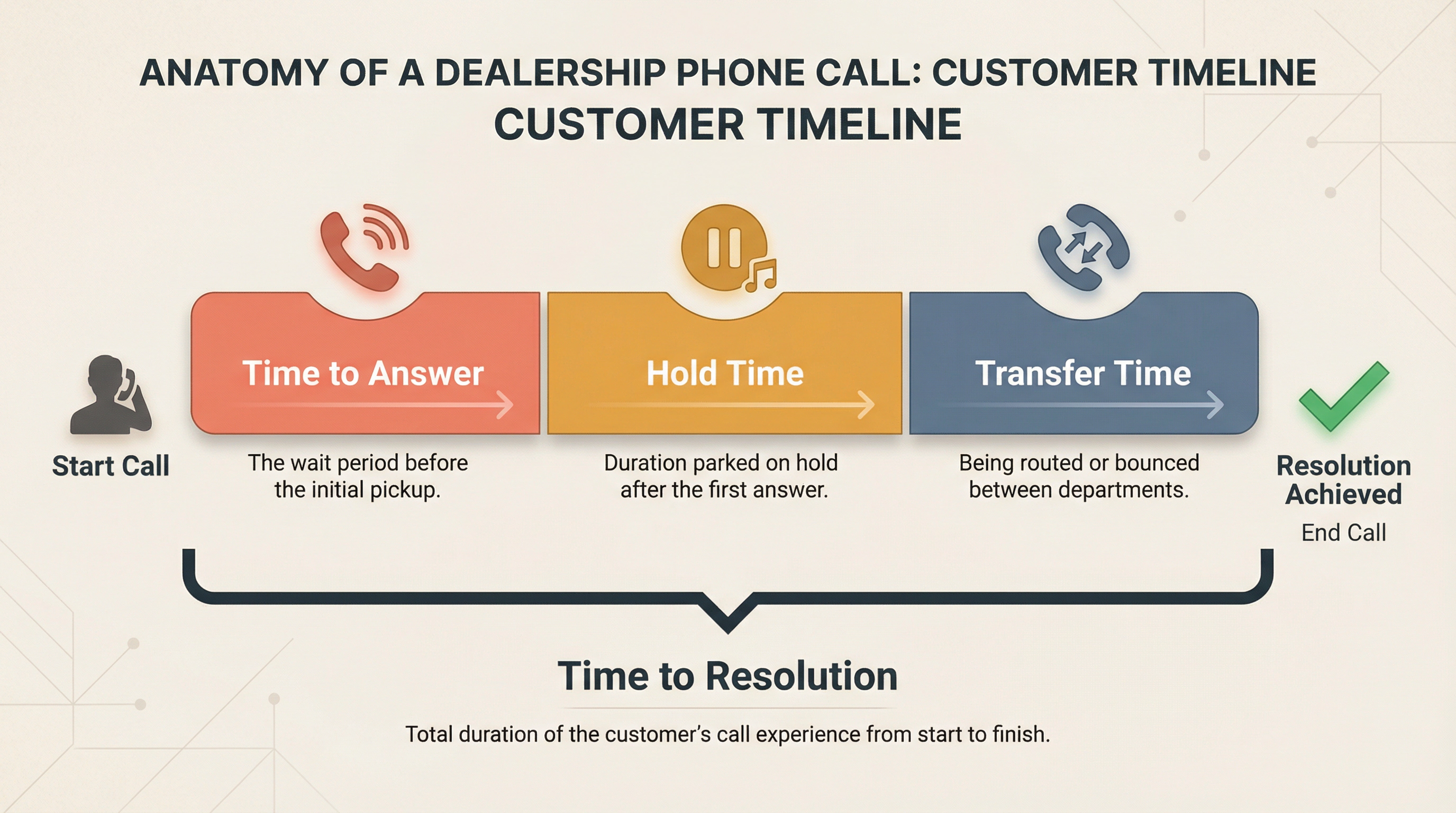
Time to answer is how long it takes for anyone (a person, an IVR, anything) to pick up the call. Hold time is what happens after someone answers but then parks the caller with “can you hold for a moment?” And transfer time is the delay when a caller gets bounced between departments, extensions, or queues.
This distinction matters because two dealerships can both claim “our hold times are fine” while one has short holds but brutal transfer loops, and the other answers quickly but parks callers for three minutes at a stretch. If you’re only measuring one of these, you’ll keep patching the wrong leak.
The metric your customers actually feel is what you might call time to resolution: how long it takes from the moment they dial to the moment they get what they called for (appointment booked, question answered, or routed to the right person with context). That’s the number worth tracking. If you want to understand which metrics actually move the needle, our guide on BDC metrics every dealership should track breaks down the full framework.
What Is the Average Car Dealership Hold Time? (2024 Data)
The data on dealership phone performance isn’t just bad. It’s specific enough to show exactly where calls go to die.
A 2024 analysis of nearly 3,000 dealerships by Car Wars paints a sharp picture of what happens when calls don’t connect:
| What Happened to Unconnected Calls | Share |
|---|---|
| Customers hung up while on hold | 31.8% |
| Went to voicemail | 32.3% |
| Left a message with a person | 20.2% |
The average hold time across these dealerships was 3 minutes and 5 seconds. Monday was the busiest inbound day, with 10:00 AM to 12:00 PM being the highest-traffic window. July and August had the highest call volumes. The overall average connection rate was just 65.2%, meaning roughly one in three callers never reached a qualified person.
That connection rate gap is significant. Car Wars’ benchmarks also show that the top 20% of dealerships achieve 85% connection rates on service calls. So the best-performing stores aren’t just marginally better. They’re capturing 20 percentage points more of their incoming demand.
The customer patience threshold is shockingly low.
Research shows that 60% of customers will hang up after just one minute on hold, and 32% of callers aren’t willing to wait at all. A third of your callers will abandon the call the instant they hear hold music.
Industry analysis adds another layer: 18% of automotive service calls are abandoned, and 80% of those abandoned calls are never returned. Studies estimate dealers can lose 14% of revenue simply by not answering the phone. The recommended benchmark for reaching a customer on hold is 30 seconds.
There’s some good news in the trendlines, though. Pied Piper’s 2025 Service Telephone Effectiveness study found that customers were placed on hold for more than two minutes only 2% of the time in 2025, down from 13% in 2024. And the share of customers who disconnected before the service department offered an appointment fell from 13% to 9%. Progress, but still a lot of leakage.
The phone isn’t failing randomly. It fails predictably, at predictable peaks, in predictable ways. And that predictability is actually the opportunity. We dig deeper into exactly how much revenue dealerships lose from missed calls in a separate analysis.
Why Hold Times Hurt Car Dealerships More Than Other Businesses
Hold time is annoying everywhere. But it’s uniquely destructive at dealerships because of three properties that make every missed connection expensive.
Your callers are high-intent, right now. Nobody calls a dealership for fun. They’re calling because they want to book service, check on a recall, confirm availability, ask about pricing, or schedule a test drive. When you put them on hold, you’re not slowing down a casual browser. You’re stalling someone who was ready to transact.
Switching costs are basically zero. The “effort” required to try another dealership is: open Google, tap the next listing, call. Your customers aren’t choosing between you and “nothing.” They’re choosing between you and the next phone call. About 70% of people who hit voicemail call a competitor within 30 minutes, and hold is often worse than voicemail because at least voicemail sets an expectation.

Fixed ops is a compounding asset. A single booked service appointment isn’t just one repair order. It’s future maintenance, upsell opportunities, warranty and recall retention, loyalty, and eventually the next vehicle purchase decision. This compounding effect is why fixed ops is the profit anchor for most franchise dealerships.
And that anchor is under pressure. A 2025 study from Cox Automotive found that only 54% of owners with vehicles two years old or newer returned to their purchase dealership for service, down from 72% in 2023. When service retention is declining industry-wide, every phone interaction matters more, not less.
What a Single Missed Service Call Costs Your Dealership
To understand what hold time costs, you need to know the value of what you’re losing.
NADA’s 2024 annual data shows the average franchised dealership wrote 15,924 repair orders that year (about 1,327 per month) and averaged $9.23 million in annual service and parts sales. The average revenue per customer repair order was $466 in 2024, rising to $470 in the first half of 2025.
Revenue isn’t profit, though. For a gross margin anchor, public dealer group benchmarks show fixed operations produced $9.4 billion in gross profit on $18.2 billion in revenue in 2024. That’s a gross margin of roughly 52%, making fixed ops the largest gross profit contributor even though it’s a smaller slice of total revenue.
Putting those together: $470 average RO revenue at a 52% gross margin gives you roughly $244 in gross profit per repair order. That’s the immediate value of a single service visit.

And it doesn’t account for the downstream value of keeping that customer in your service lane for years.
So when a caller hangs up because they were on hold too long, you’re not just losing a phone call. You’re losing $244 today, plus the compounding value of that relationship over the next several years.
To put it in annual terms: if your store loses just 40 appointments per month to hold-related hang-ups (a conservative estimate based on the benchmarks above), that’s roughly $9,760 per month, or over $117,000 per year in direct gross profit. And that’s before you factor in the lost lifetime value of those customers defecting to another service department.
For multi-rooftop groups running five, ten, or twenty stores, multiply accordingly. The numbers get uncomfortable fast. To see what this looks like in practice, our Freeman Toyota case study shows how one dealership recovered $93,870 in profit impact in a single month by eliminating missed calls entirely.
Calculate Your Hold Time Cost Using This 3-Step Formula
This is the part most “phone stats” articles never give you: a way to turn your hold time into a specific dollar amount using your own call logs.
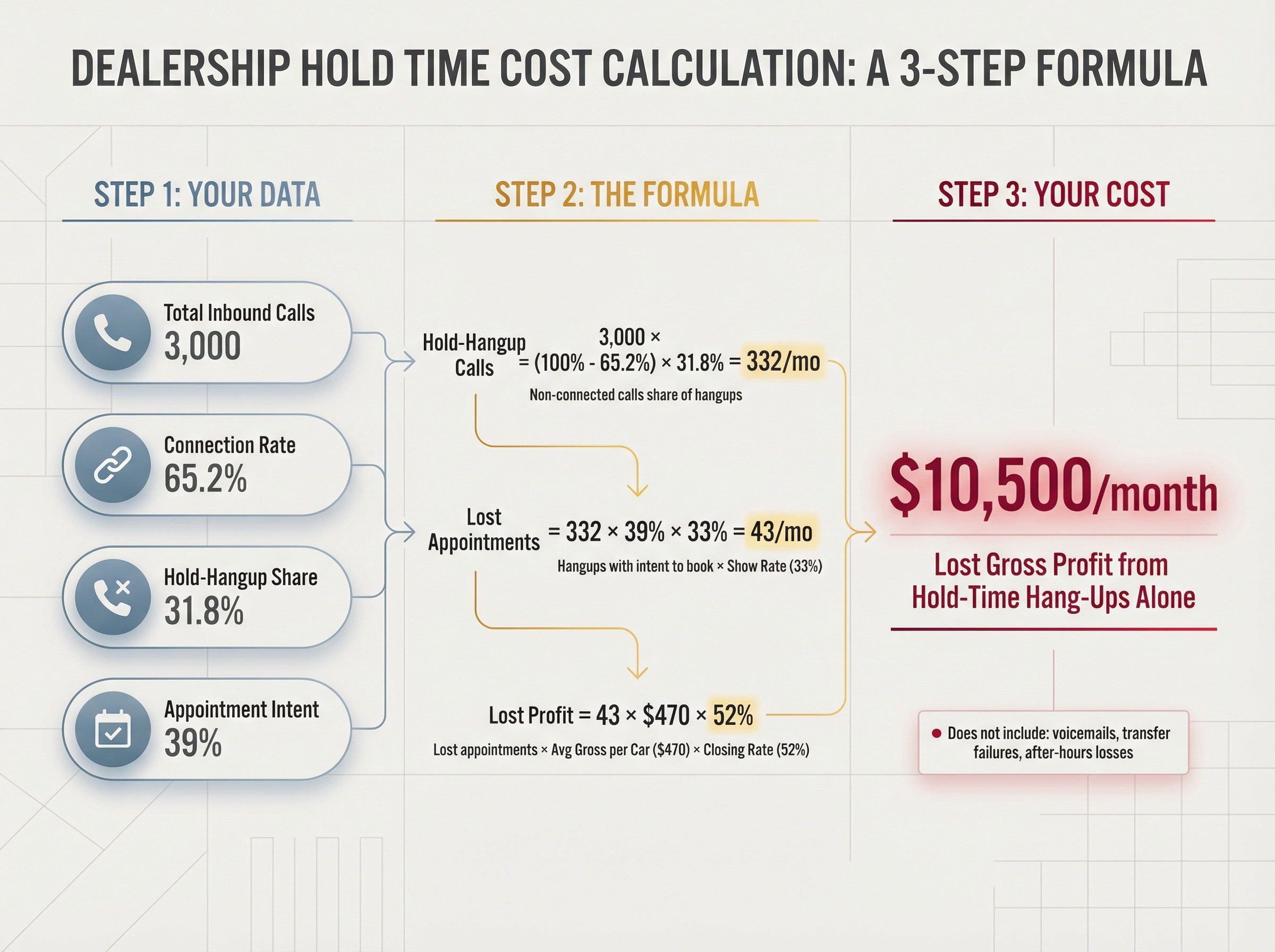
Step 1: Pull Four Numbers From Your Last 30 Days
You need:
- Total inbound calls (monthly count)
- Connection rate (the percentage of calls that connect to a live person or successful handler)
- Hold-hangup share (what percentage of your unconnected calls are people who hung up while on hold)
- Appointment intent rate (what percentage of inbound calls were actually trying to schedule service)
That last number is the blind spot for most stores. You can estimate it, but the best method is tagging calls using your call tracking tool, dispositions, or transcripts. For a reference point: in our Freeman Lexus case study, 426 of roughly 1,100 calls were “bookable calls” (customers wanting to schedule service), about 39% of total inbound volume.
Step 2: Run the Formula
Hold-hangup calls per month = Total inbound calls x (1 minus connection rate) x (hold-hangup share of unconnected calls)
Lost booked appointments = Hold-hangup calls x appointment intent rate x appointment set rate
Lost gross profit = Lost booked appointments x average RO revenue x gross margin
For the inputs you might not have from your own data:
- Average RO revenue: use $470 as the current NADA benchmark
- Gross margin: use ~52% from public dealer group benchmarks
- Appointment set rate: call monitoring benchmarks suggest many stores convert at around 25%, with stronger operations hitting 33% or higher
Step 3: A Worked Example Using Industry Averages
Assume:
| Input | Value | Source |
|---|---|---|
| Monthly inbound calls | 3,000 | Moderate-volume store |
| Connection rate | 65.2% | Car Wars 2024 average |
| Hold-hangup share | 31.8% | Car Wars 2024 |
| Appointment intent | 39% | Flai Freeman Lexus case study |
| Appointment set rate | 33% | Industry benchmark |
| Avg RO revenue | $470 | NADA H1 2025 |
| Gross margin | 52% | Public dealer group benchmarks |
Result:
- Hold-hangup calls: ~332 per month
- Lost appointments: ~43 per month
- Lost gross profit: approximately $10,000 to $11,000 per month
And that’s only the “hung up while on hold” bucket. It does not include voicemails that never get returned, calls that connect but fail due to transfers, after-hours calls that go unanswered, or the long-term retention losses from a bad phone experience.
Which is why hold time is usually a symptom of a bigger phone system problem, not the whole disease.
The Hidden Cost Most Dealers Miss: Transfer Failures
Even when customers don’t hang up on hold, they can still fail to get what they called for. And this is where most dealerships have a massive blind spot.
Pied Piper’s 2025 study revealed a painful dynamic: AI systems successfully handled 91% of service calls without needing an employee. But when AI tried to transfer a call to a human, that transfer failed 56% of the time.
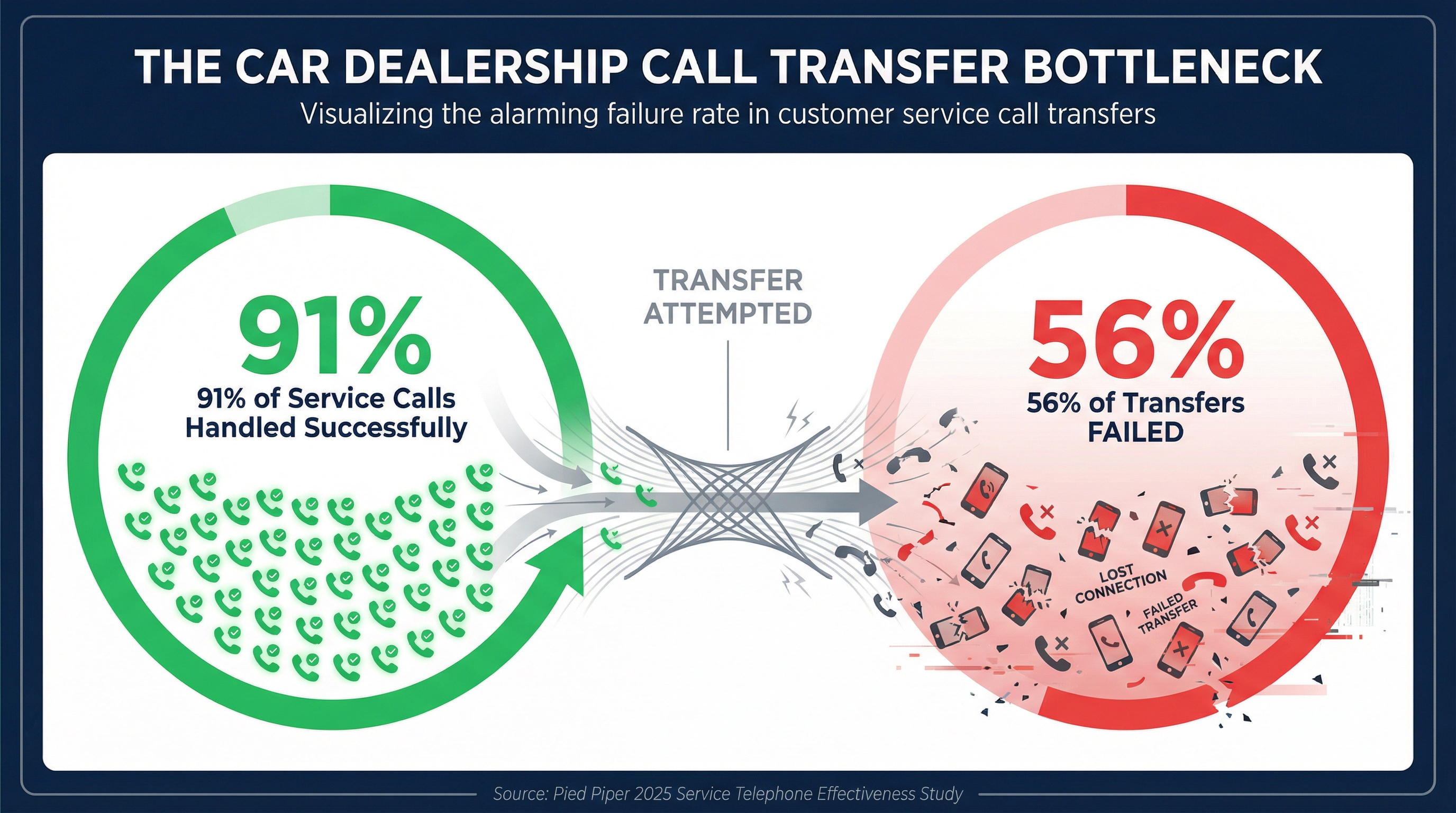
The takeaway isn’t that AI is bad. It’s that any phone handling strategy (human, AI, or hybrid) that still depends on transfers inherits the transfer problem. If your service calls require bouncing the customer to another person or department to get resolved, you’re building in a failure point that affects more than half of those handoffs. This is exactly why Flai was built to resolve calls on the first touch rather than routing them elsewhere. Our AI BDC guide explains how modern AI agents handle the full interaction without needing transfers.
A University of Chicago study analyzing 1.3 million calls found that caller patience isn’t fixed. It decreases when people face confusing routing or poor experiences. So transfers don’t just add time. They actively drain the goodwill your caller showed up with.
The real enemy isn’t hold time in isolation. It’s “handoff without resolution.” And the most effective solutions are the ones that can resolve the caller’s need on the first touch, without transferring them at all.
Why Hiring More Staff Won’t Fix Hold Times
The instinctive reaction to hold time problems is: “We need more staff on the phones.” It makes sense on the surface, but it runs straight into a queueing problem that more bodies alone can’t solve.
Your phone system is a queue. Calls arrive in unpredictable spikes. Your staff can handle one call at a time. If calls arrive faster than they can be served, a line forms. That part is obvious. What’s less obvious is how the math behaves at the edges.
When staff utilization gets near 100% (which managers often aim for, because they want their people “busy”), even small randomness creates massive delays. A longer-than-usual call, a VIN lookup that takes an extra minute, a warranty question that requires checking with parts, someone walking up to the advisor in the lane. Suddenly the queue doesn’t just grow a little. It stacks exponentially.
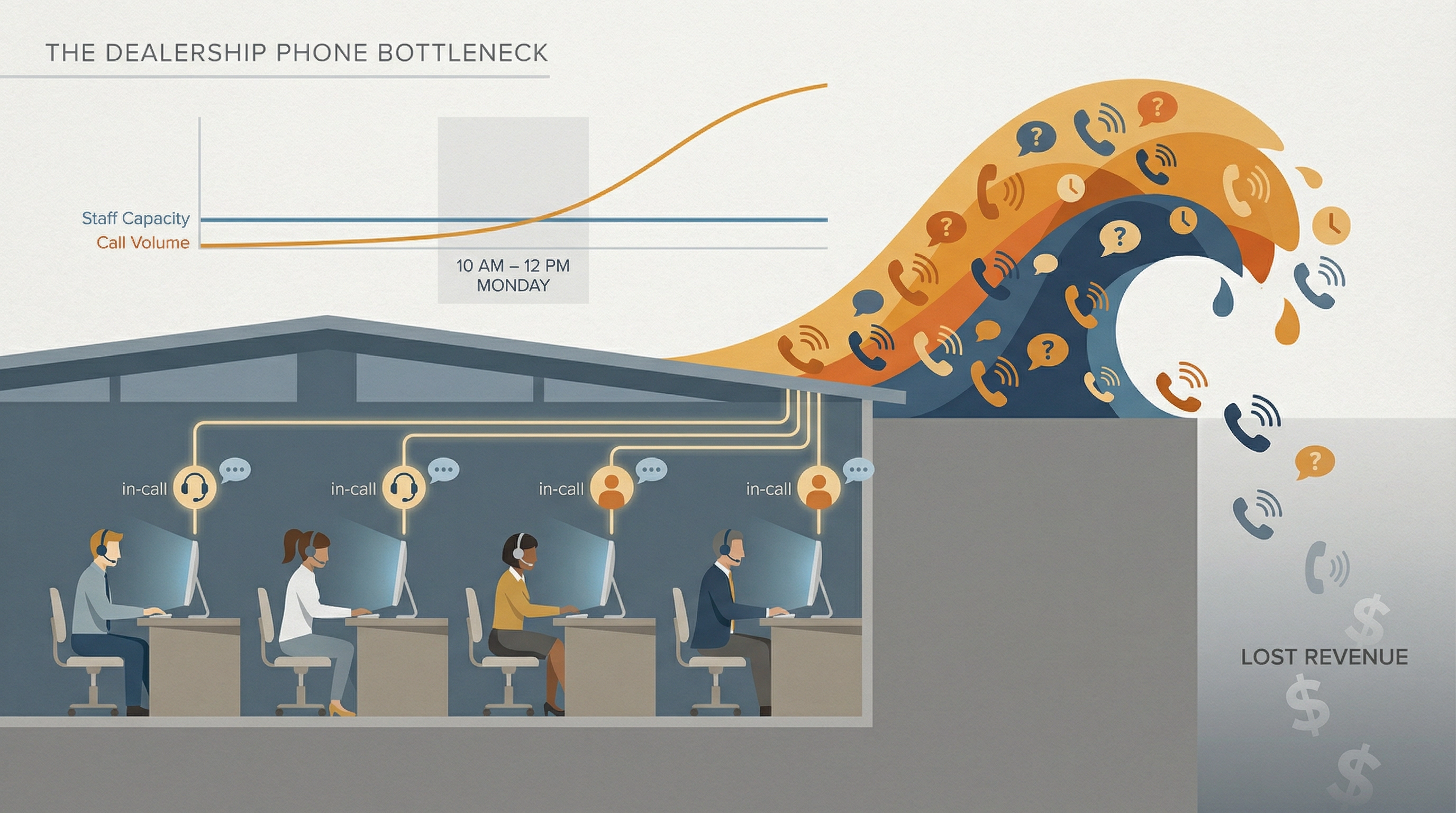
This is why the peak window matters so much: Monday, 10 AM to 12 PM is where your system is most likely to hit that utilization cliff. And the thing about utilization cliffs is that you can’t “effort” your way past them. You need actual additional capacity, and that capacity needs to be available instantly when the spike arrives.
Hiring more staff adds capacity, but it adds it in fixed chunks that are expensive during slow periods and still insufficient during peaks. What you actually need is capacity that scales with demand.
Research also makes the point that frequent use of hold often signals deeper training or process gaps within the team, not just a headcount shortage. If your advisors are constantly parking callers to look things up, adding a fifth advisor doesn’t solve the underlying workflow issue. It just gives you five people putting customers on hold instead of four. That’s why many dealerships are now replacing outsourced call centers with AI that can scale instantly during peak hours without adding fixed labor costs.
5 Proven Strategies to Reduce Dealership Hold Times
If you want less hold time, you need fewer moments where “no one is available to resolve this.” That means pulling on multiple levers at once.
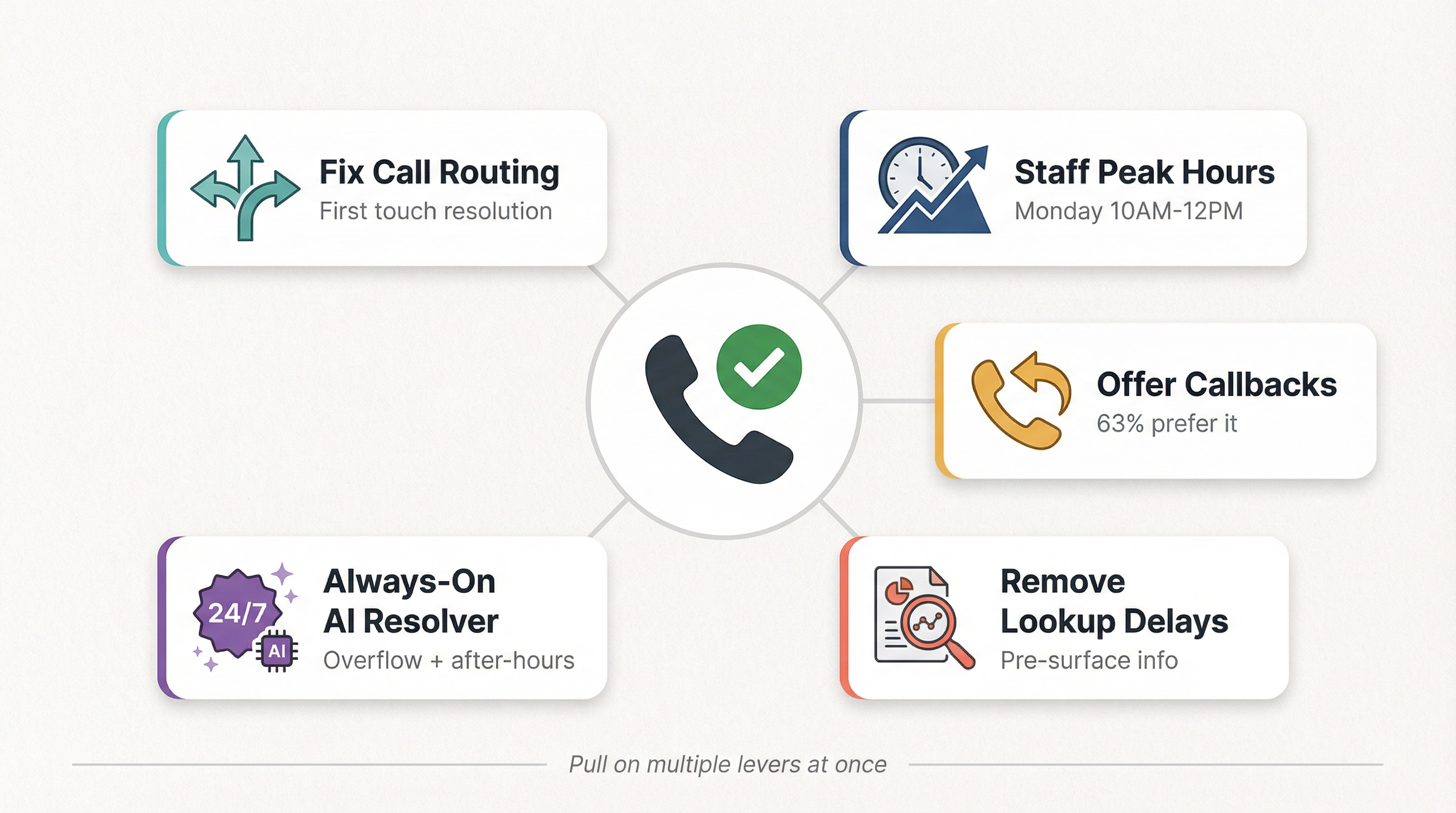
Fix routing so the first person can finish the job. Most holds happen because the person who answered can’t complete the request. Route “schedule service” calls directly to whoever can actually book in the system, not whoever happens to pick up. Split “quick questions” (hours, directions, service status) away from “needs an appointment booked.” Fewer transfers means fewer holds.
Engineer your peak hours like you’d staff a sales event. You already adjust showroom staffing for a Saturday blowout. Do the same for phones. Industry data suggests Monday 10 AM to 12 PM is consistently the highest-traffic window. Add overflow coverage for those hours. Pre-assign a “phone quarterback” whose only job during peaks is getting callers to resolution.
Offer callback as a default, not a last resort. Industry benchmarks recommend a 30-second threshold for reaching callers on hold. If you can’t consistently hit that, stop pretending hold is acceptable and offer an alternative: “I can call you back in five minutes, or I can text you a booking link right now.” Research shows 63% of consumers actually prefer a callback over staying on hold. This single change reduces abandonment without adding headcount.
Reduce handle time by removing lookup work during the call. Holds often exist because your staff is doing scavenger hunts mid-call: checking DMS for customer history, hunting for available slots, looking up recall eligibility, checking advisor availability. If your systems allow it, pre-surface the most-needed information so advisors don’t need to park the caller.
Add a true always-on resolver for overflow and after-hours calls. If your store deals with after-hours voicemails, peak-hour overflow holds, or transfer loops, the most cost-effective move is often not “hire more” but “add capacity that scales with demand spikes.” Industry research shows that unanswered calls, long holds, and confusing phone trees all damage NPS, and that customers increasingly prefer AI-powered scheduling experiences over dead ends like voicemail. An AI BDC platform can serve as that always-on capacity layer, answering calls instantly even when your human team is fully occupied.
How Flai Eliminates Dealership Hold Times Entirely
We built Flai because we’ve seen the problem from the inside. Our founding team visited over 400 dealerships in person, working from service bays and back offices to understand exactly how calls fall through the cracks. What we found is that most hold time isn’t a people problem. It’s a system design problem.
Flai is an AI communications platform built specifically for car dealerships. We answer every inbound call instantly, 24/7, with AI voice agents that sound natural and can actually book appointments directly into your scheduler, DMS, and CRM. No hold music. No voicemail. No transfers that fail half the time.

The results speak for themselves. In our Freeman Lexus case study:
- ~1,100 calls handled with zero missed calls
- 426 bookable calls identified
- 376 appointments booked (an 88% conversion rate on bookable calls)
- $100,000 estimated profit impact in a single month
At a CDJR dealership in the Bay Area, we saw monthly service appointments jump from 205 to 448 in the first month. Flai handled 1,563 calls with zero missed calls and zero wait times, booking 304 appointments and generating $83,000 in profit impact.
What makes Flai different from a typical call center or IVR is that we built our own voice AI infrastructure from the ground up. We don’t stitch together off-the-shelf components. That means faster response times, fewer awkward pauses, and conversations that actually feel human. And because we integrate directly with your existing systems (scheduler, CRM, DMS), the AI doesn’t just answer the phone. It resolves the call.
If a customer wants a Tuesday 5:30 PM oil change, Flai checks your actual availability, books the slot, confirms with the customer, and sends a follow-up text. No human required.
For after-hours and overflow, that’s where the math really changes. Instead of sending those calls to voicemail (where 80% will never call back), Flai handles them the same way it handles a call at 10 AM on a Tuesday. Your customers get served. Your schedule fills up. Your revenue stops leaking.
At Freeman Toyota, the AI worked alongside a 6-person BDC team to handle overflow and after-hours calls, generating $93,870 in profit impact without replacing a single human role. At Glendale Infiniti, Flai handled over 1,800 calls per month across all departments with zero missed calls and booked 160+ service appointments automatically.
14-Day Hold Time Audit You Can Run Without Buying Anything
If you do nothing else after reading this, run this audit. It’ll expose the exact failure modes creating hold time at your store, and it costs nothing but time.
Days 1 to 2: Pull Raw Call Data
From your phone system, call tracking tool, or BDC platform, pull:
- Inbound call count
- Answer rate (connection rate)
- Average time to answer
- Hold time distribution (not just the average, you want the spread)
- Abandonment rate
- Voicemail rate
- Transfers per call
Days 3 to 6: Categorize Your Top 200 Calls
Listen to or review transcripts of 200 recent calls. Tag each by intent: schedule service, status update, parts inquiry, sales/inventory, finance, other. Then tag each outcome: booked, resolved without booking, transferred successfully, transferred unsuccessfully, abandoned during hold, or went to voicemail.
Days 7 to 10: Identify Your Hold Triggers
For every call that hit hold, ask: Was the hold caused by a lookup issue, a routing problem, a staffing gap, or a process failure? Did the caller drop? Did resolution happen eventually?
Days 11 to 14: Apply the Cost Calculator
Take your actual numbers (call volume, real hold-hangup rate, real appointment intent rate, real booking rate) and run them through the formula above. Don’t estimate. Don’t round generously. Use your data. Guessing is how this problem stays invisible for years.
By day 14, you’ll have a specific monthly dollar figure for what hold time is costing your store, and you’ll know exactly which failure modes are driving it.
This audit often surfaces surprises. Stores that think they have a staffing problem discover they actually have a routing problem. Stores that think after-hours is fine realize 30% of their missed opportunities happen between 6 PM and 9 AM. The data won’t lie to you the way intuition sometimes does.
Dealership Hold Time FAQs: What You Need to Know
Is Hold Time Actually Worse Than Voicemail?
They’re different flavors of the same problem: both create delay, both lose callers, and both cost you appointments. The key difference is psychological. Voicemail at least sets an expectation (“leave a message and we’ll call back”). Hold is pure uncertainty (“maybe someone comes back, maybe not”).
Car Wars’ 2024 data shows both are massive contributors to unconnected calls, each representing roughly a third of the unconnected bucket. Neither is acceptable as a default. We break down the full scope of what missed calls cost your dealership in a dedicated analysis.
Our Service Drive Is Slammed. Isn’t Hold Unavoidable?
Unavoidable at peak moments, possibly. Acceptable as a baseline condition, no. The fix isn’t magic; it’s engineering: peak-hour overflow capacity, fewer transfers, shorter handle time, callback options as standard practice, and automated resolution for straightforward requests. Plenty of high-volume stores have cut hold times dramatically by treating phone capacity the same way they treat bay capacity.
What Should My Hold Time Target Be?
Industry benchmarks recommend reaching callers within 30 seconds when on hold. But a time-based target misses the real goal. A better target is outcome-based: “90%+ of appointment-intent calls get booked or resolved without a transfer.” If you’re hitting that, your customers are getting served regardless of whether anyone technically sat on hold for 15 seconds.
How Fast Do Customers Really Call Competitors After a Bad Phone Experience?
Fast. Data shows about 70% of people who hit voicemail call a competitor within 30 minutes. And research indicates 32% of callers won’t wait on hold at all. The switching cost for a customer is practically zero: one Google search and one tap. You’re not competing against “later.” You’re competing against the next listing.
What’s the ROI of Using AI to Handle Dealership Calls?
The ROI depends on your volume and current miss rate, but the case studies are striking. At a Lexus store, Flai generated a $100,000 profit impact in a single month from roughly 1,100 calls, with an 88% booking rate on eligible calls. At a CDJR store, monthly service appointments more than doubled (from 205 to 448), with an $83,000 profit impact.
The math is straightforward: if each booked repair order is worth roughly $244 in gross profit, you only need to recover a handful of lost appointments each month to cover the cost of an AI BDC system.
Can AI Really Handle Complex Dealership Service Calls?
The best AI systems handle the high-volume, structured interactions that make up the bulk of service calls: booking appointments, answering hours and availability questions, processing recall inquiries, and collecting customer information. Pied Piper’s 2025 data shows AI successfully handled 91% of service calls without needing an employee.
Where AI falls short (and where good systems like Flai are designed for this) is knowing when to escalate. The key isn’t whether AI can handle every call. It’s whether AI can handle enough calls to free your team for the ones that genuinely need a human, while making sure no caller gets lost in the handoff.
How Do I Know if Hold Times Are a Problem at My Dealership?
Run the 14-day audit outlined above. But for a quick gut check: if your phone system sends any calls to voicemail during business hours, if you have a hold queue during Monday mornings, or if your BDC team regularly can’t return missed calls the same day, hold time is costing you real money. The BDC metrics framework we published is a good starting point for building ongoing visibility into your phone performance.
Does Hold Time Affect CSI Scores?
Absolutely. Customer Satisfaction Index scores are directly tied to the phone experience, especially in service. When a customer calls to book an oil change and waits three minutes on hold, gets transferred, waits again, and eventually gives up, that’s a negative impression that carries into their next survey response (if they even stay your customer long enough to fill one out).
Industry research explicitly connects unanswered calls and confusing phone trees to lower NPS scores. The phone is often the first touchpoint in the service experience, and first impressions set the tone for everything that follows.
What’s the Difference Between a Call Center and an AI Phone Agent for Dealerships?
A traditional outsourced call center puts a human on the line, but that person typically can’t access your scheduler, DMS, or CRM. They take a message. Maybe they promise a callback. The caller doesn’t leave with a booked appointment.
An AI phone agent like Flai integrates directly with your dealership systems. It checks real availability, books the appointment during the call, and confirms the details before hanging up. The difference isn’t just technology; it’s resolution. The caller gets what they called for instead of a promise that someone will call them back. If you’re weighing these options, we cover exactly why dealerships are replacing outsourced call centers with AI.
Hold time is one of those problems that’s easy to ignore because it’s invisible. Nobody hands you an invoice for “calls lost to hold music.” But the dollars are real, the data is clear, and the solutions are more accessible than they’ve ever been.
Whether you start with the 14-day audit, restructure your peak-hour staffing, or explore AI-powered call handling with Flai, the most important step is the first one: stop treating hold time as an unavoidable cost of doing business, and start treating it as the revenue leak it actually is.