How to Reduce Missed Calls at Your Dealership (2026 Playbook)
Learn how to never miss a customer call at your dealership with proven systems that turn every inbound call into booked appointments and revenue.
Your dealership’s phone is ringing right now. The question isn’t whether customers are calling. It’s whether anyone is picking up.
Across the industry, phone performance data from Car Wars (analyzing nearly 3,000 dealerships during 2024) paints a rough picture. 31.8% of unconnected calls were customers who just hung up while sitting on hold. The average hold time? Three minutes and five seconds. And 32.3% of non-connected calls ended with customers leaving a voicemail that may or may not get returned.
The full scope of missed call revenue loss is staggering once you see the numbers across an entire year.
That’s not a people problem. It’s a systems problem. And it’s one you can fix.

This guide walks through exactly how to build a “never miss a call” system at your dealership. We’ll cover everything from auditing your current phone setup to fixing routing, staffing for peak demand, converting answered calls into booked appointments, and plugging the after-hours gap that bleeds revenue every single night. Along the way, we’ll share the specific data, the practical steps, and real dealership results that prove this approach works.
Why Missed Calls Cost Dealerships More Than You Think
Most managers know missed calls are bad. Few realize just how much money walks out the door (or never walks in) because of a phone that rings too long.
The phone is still the primary way customers book service. CDK’s 2024 research found that 64% of service customers prefer scheduling by phone, compared to just 19% who go online. Even for sales appointments, 44% of shoppers still prefer picking up the phone over visiting a website or using an app.
Think about what that means. Your phone system is handling the highest-intent demand your dealership gets. Someone who picks up the phone and dials your service number is ready to book. They’ve already decided to come in. The only thing standing between that intent and a booked appointment is whether someone answers.
When nobody does, you don’t just lose one RO. The damage compounds over time.
Cox Automotive’s 2025 Service Industry Study found that dealerships now handle 12% fewer service visits than they did in 2018. Service loyalty for vehicles two years old or newer dropped to 54% in 2025, down from 72% just two years earlier. That’s a massive erosion of your customer base, and phone experience is a big piece of it.
Customers who service at the dealership are 74% more likely to buy their next vehicle from the same store. Every missed service call chips away at a relationship that could have been worth tens of thousands of dollars in future purchases, referrals, and lifetime value.
These customer experience statistics paint a clear picture of what’s at stake.
Your phone isn’t just a communication tool. It’s your dealership’s front door. And right now, for many stores, that door is half-shut.
What “Never Miss a Call” Means for Dealerships
Before you can fix the problem, you need a clear definition. “Never miss a call” sounds straightforward, but operationally it requires precision. Without a shared definition, you can’t build a system, you can’t measure progress, and you can’t hold anyone accountable.

A call is “saved” when one of these happens:
- The customer gets their question answered and their issue resolved (hours, directions, service status)
- The customer gets a booked appointment
- The customer is warm-transferred to the right person, with context passed along so they don’t have to repeat themselves
- The customer schedules a real callback slot (not voicemail) and your team actually completes it
A call is “missed” when any of these happen:
- The caller hears ringing until voicemail kicks in, or they hang up first
- The caller sits on hold long enough to give up
- The caller gets transferred into a dead end (another voicemail box, an endless ring group, or a line that nobody is monitoring)
- The caller leaves a voicemail and never receives a timely callback
- The caller reaches a person who can’t take action because they don’t have scheduling access or authority to help
Notice that “missed” isn’t just about whether the phone was picked up. A call that gets answered but leads nowhere is still a miss in every way that matters. Understanding why 32% of dealership callers hang up helps you see that the problem runs deeper than just not picking up the phone.
For real-world benchmarks, Pied Piper’s 2025 Service Telephone Effectiveness study found that hold time over two minutes occurred only 2% of the time in 2025 (down from 13% in 2024), and “mission failure” (a customer hanging up without being offered an appointment) was at 9%, down from 13%. These aren’t theoretical targets. They’re observed performance across real dealerships, and they give you a concrete bar to measure against.
How to Audit Your Dealership’s Call Coverage
Most dealerships are guessing about their phone performance. The first step toward never missing a call is to stop guessing and start measuring.
You can run a basic call coverage audit in about 60 minutes, and it will reveal exactly where calls are falling through the cracks. Knowing which BDC metrics to track will help you focus your audit on the numbers that actually matter.
How to Map Your Dealership Call Routing
Call your own store the way a customer would. Try every number you have: main line during business hours, main line after hours, service direct line, parts direct line, sales direct line, and any tracking numbers you use in ads or on your website.
For each number, document the following:
- Time to a human voice (in seconds)
- Whether you hit a phone menu and how many steps it takes
- Whether you got put on hold and for how long
- What happens when you’re transferred
- What happens after hours (voicemail, answering service, or something that can actually resolve the call)
- Whether anyone captures your name and number for follow-up
This exercise is revealing because it shows you exactly what your customers experience. Most managers haven’t called their own store’s after-hours number in months, and what they find is often worse than they expect.
How to Stress Test Your Dealership Phone System
Have three people call at the same time from different phones. Do you get busy signals? Does the system queue callers? Do calls roll to voicemail? Do they bounce between ring groups with no resolution? This takes five minutes and exposes bottlenecks that phone reports won’t show you.
How to Analyze 14 Days of Phone Data
At minimum, you need total inbound calls, abandonment and hang-up counts, voicemails left, transfers completed, average speed to answer, average hold time, and time-of-day patterns.
If your data is fragmented and hard to piece together, you’re not alone. Cox Automotive’s 2024 Power of Data study found that 83% of dealers have data dashboards, but fewer than one-third are satisfied with how they work. And 54% say they still get conflicting data from different sources.
One important blind spot to watch for: many stores track “leads” but don’t track “calls.” Calls are often your highest-intent demand. A person who dials your service number is further down the decision funnel than someone who fills out a web form. If you’re not measuring call performance, you’re flying blind on your most valuable channel.
How to Fix Dealership Call Routing Issues
Most missed calls come from predictable failure modes that live in your call routing setup. No overflow path, bad transfer logic, too many phone numbers with no clear ownership, after-hours dead ends, and service advisors doubling as the phone system.
Before you hire, train, or automate anything, fix the plumbing.
Best Call Routing Setup to Never Miss Calls
During business hours, every inbound call should hit a “first responder” layer right away: your front desk, a BDC reception line, or a department-specific BDC line. If that layer doesn’t answer quickly, the call rolls to an overflow resolver (a backup BDC agent, a call center, or an AI receptionist that can actually book appointments or route intelligently). Only after the overflow resolver should voicemail be an option, and even then, you should treat any call that reaches voicemail as a system failure worth investigating.
After hours, your main number needs to route to something that can do at least one of these things: book an appointment, capture the customer’s intent and schedule a callback slot, or send a text confirmation with next steps. Voicemail as the default after-hours experience is how dealerships quietly lose thousands of dollars in revenue every month.
Call Routing Rules to Stop Losing Revenue
No blind transfers. Blind transfers are voicemail traps. If the person you’re transferring to doesn’t pick up, the caller lands in a black hole. Warm transfers (where the receiving party is alerted and context is passed) prevent these dead ends.
Overflow should trigger before customers rage-quit. Car Wars performance data shows long holds directly cause unconnected calls. Your overflow needs to kick in within 30 to 45 seconds, not after three minutes when the customer has already hung up. Having a reliable call overflow solution in place is what separates stores that capture revenue from those that watch it walk out the door.
One owner per call category. When “service calls belong to everyone,” they belong to no one. Assign clear ownership by department and time block so there’s always a named person or system responsible for answering.
Stop making the service lane your phone system. When service advisors are your first-line phone coverage, callers wait while advisors juggle check-ins, and in-store customers get a distracted advisor who keeps glancing at the ringing phone. That’s not a motivation problem. It’s a structural one, and no amount of coaching fixes a broken structure.
How to Staff Your BDC for Peak Call Volume
Calls don’t come in evenly. They spike in patterns, and if you staff for the average, you’ll fail during every spike.
The spikes are where the money is.
Car Wars data shows Monday is the busiest day for inbound calls, and 10 AM to 12 PM is the most active window across peak days. That’s not unpredictable weather. It’s a staffing design problem with a clear solution.

BDC Staffing Formula for Dealerships
Here’s a straightforward way to estimate how much phone coverage you need:
Required agent minutes per hour = Calls per hour x Average handle time
Industry operational data reported the average service call lasted 4 minutes and 32 seconds, with over 4.1 million firm service appointments set across major dealer networks that year.
So if you get 35 calls per hour during Monday morning peak and your average handle time is 4.5 minutes, that’s 157.5 agent-minutes of talk time per hour. Dividing by 60 gives you roughly 2.6 agents of pure phone time. In practice, you need at least 3 agents during that window (accounting for breaks, wrap-up time, and complexity), plus an overflow plan for when volume spikes even higher.
If you staff “just enough” to survive average load, you’ll fail during peaks. And peaks are when the most revenue is on the line.
Proven BDC Staffing Strategies That Work
-> Micro-shifts for peaks: Schedule extra phone coverage specifically for 10 AM to noon, the lunch hour, and 4 PM to 6 PM
-> Phone captain rotation: Assign one person to own inbound calls for 60 to 90 minute blocks, so responsibility is crystal clear
-> Cross-trained backup: Parts and service BDC agents can backstop each other during surges
-> Overflow resolver: A call center or AI system handles overflow during peak hours and covers after-hours entirely
How to Turn Every Answered Call into a Booked Appointment
Answering the phone is only half the job. A “connected call” that ends with “I’ll have someone call you back” is still a missed opportunity. The goal isn’t just to pick up. It’s to resolve. The whole point is to increase service appointments by turning every answered call into a concrete outcome.
Why the First 90 Seconds of a Call Matter
Your first responder (whether a BDC agent, receptionist, or AI system) needs to do two things fast: confirm what the customer wants and move to a concrete next step. If they can’t identify the intent and offer an appointment or a warm transfer within 90 seconds, the call starts to stall, and stalled calls bleed conversions.
Service Appointment Booking Script That Works
Whether your first responder is human or AI, the talk track should follow the same logic:
- Confirm intent and vehicle: “Are you calling to schedule service? What vehicle are we working on?”
- Identify the reason: “Are we looking at maintenance, a warning light, a noise, or something else?”
- Ask about constraints: “Any day or time that works best for you?”
- Offer two specific slots: “I can do Tuesday at 5:30 or Thursday at 6:00. Which works better?”
- Confirm and lock: “Great, I’ve got you for Thursday at 6:00. What’s the best number to text your confirmation?”
- Set expectations: “You’ll get a confirmation text now, and we’ll send a reminder the day before.”
The critical principle is what you might call the “offer rule.” If the caller’s intent is schedulable, they should be offered an appointment. Not a vague promise to call back. Not a transfer to someone who might be available. An actual appointment offer. Automating your service appointment scheduling is one of the most effective ways to make this happen consistently.
Pied Piper’s 2025 study defines “mission failure” as exactly this: a customer hanging up without being offered an appointment. That failure rate averaged 9% across all dealerships studied in 2025. Your target should be to make appointment offers automatic for every schedulable call that comes in.
How to Handle After-Hours Dealership Calls
Customers call when they have time, not when your dealership is staffed. Evenings, weekends, lunch breaks. And if they can’t get through, they move on.
This isn’t just theory. Cox Automotive’s data shows service loyalty is already eroding industry-wide, with dealerships handling 12% fewer visits than in 2018 and loyalty among newer-vehicle owners dropping from 72% to 54% in just two years. Making it hard to book an appointment doesn’t just cost you one RO. It costs you the future relationship, since customers who service at your store are 74% more likely to buy their next vehicle from you.

After-Hours Call Options for Dealerships
| Option | What You Get | What You Lose |
|---|---|---|
| Voicemail + next-day callbacks | Cheapest to run | Leakiest channel. Car Wars data confirms voicemails make up a large share of non-connected outcomes, and many never get returned quickly enough. The data on why voicemails kill dealership sales makes a compelling case for eliminating them entirely. |
| Outsourced answering services | Better than voicemail | Quality varies widely. Too often these become glorified message-takers. More dealers are discovering why replacing outsourced call centers with AI produces better outcomes at lower cost. |
| Extended BDC hours | Highest quality human coverage | Significant cost and real burnout risk unless shifts are carefully designed. |
| AI-powered systems that can actually book | Instant pickup 24/7, handles overflow without hiring | Only delivers value if deeply integrated with your scheduler, CRM, and DMS. Without those connections, AI becomes just another message-taker. Understanding what an AI BDC actually does helps separate real solutions from marketing hype. |
How Flai Solves the Missed Call Problem
This is where we come in.
At Flai, we built an AI communications platform specifically for car dealerships because we watched this problem from the inside. Our founders visited over 400 dealerships in person, spent time working out of service bays and back offices, and saw firsthand how calls get dropped, hold times pile up, and after-hours demand goes completely unanswered. Our $4.5M seed round backed by First Round Capital and Y Combinator gave us the resources to build the solution from the ground up.

Flai answers every inbound call instantly, 24 hours a day, 7 days a week. No hold time. No voicemail. No “we’ll call you back.” Our AI voice agents sound natural and handle real dealership conversations: booking service appointments, answering FAQs about hours and directions, capturing lead information for sales, and routing calls to the right person when a human touch is needed.
What sets Flai apart from generic AI tools is the depth of integration. We connect directly to your scheduler, CRM, and DMS, which means our AI doesn’t just take messages. It checks real availability, books the appointment, confirms details with the customer, and writes everything back into your systems automatically. That’s why we have the highest bookable rate in the industry. When integrations are shallow, AI breaks mid-flow and falls back to message-taking. When they’re deep (like ours), more schedulable calls end as actual booked appointments.
And it’s not just about inbound calls. Flai manages outbound communication too: recall campaigns, appointment reminders, and sales lead follow-up via SMS and email. Every channel shares the same intelligence, so a customer who started on the phone can continue the conversation over text without losing context. No lead goes dark. No follow-up falls through the cracks. We even offer multilingual customer service so every caller gets helped in their preferred language.
Flai Case Studies: Real Dealership Results
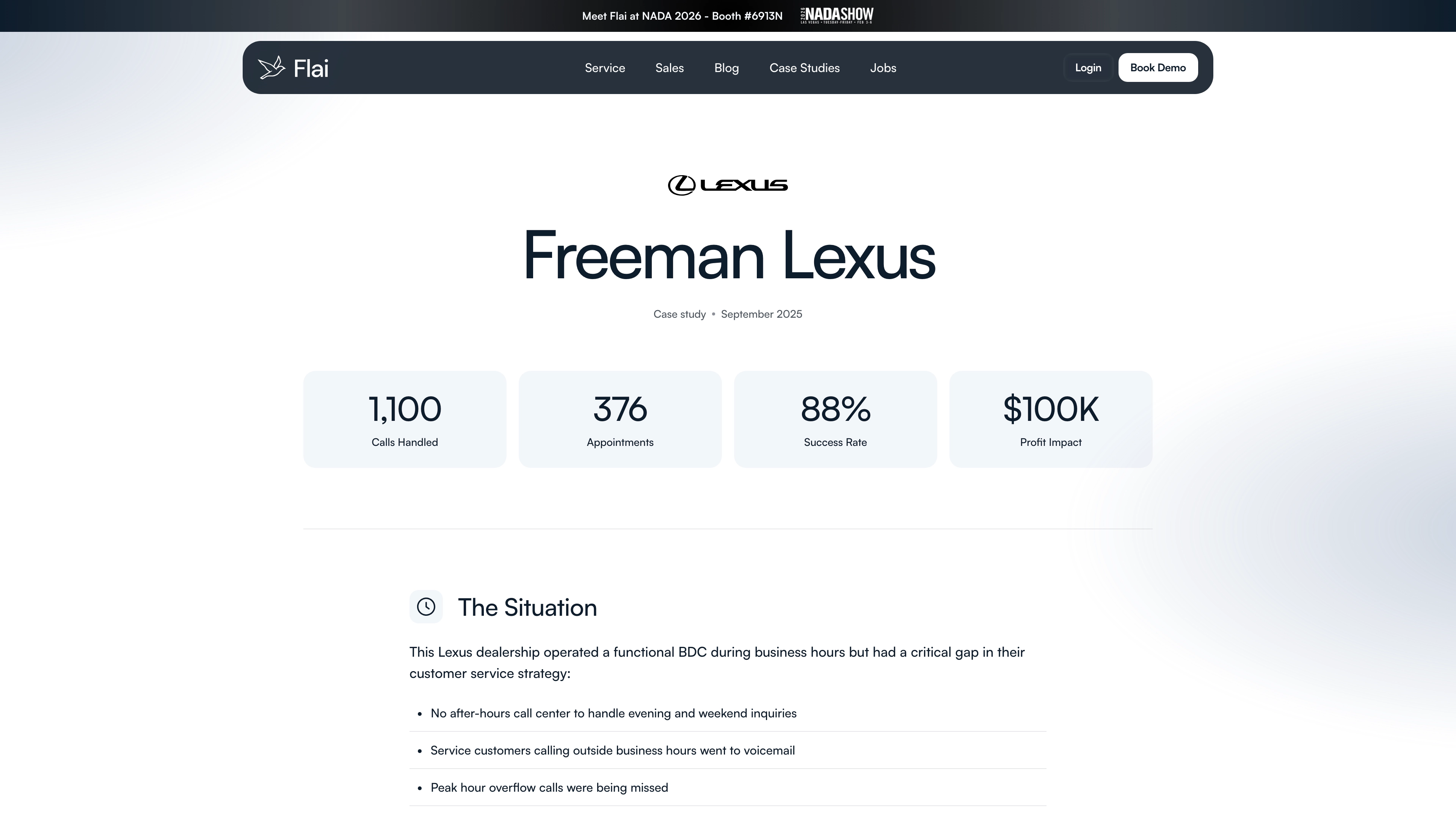
| Dealership | Calls Handled | Appointments Booked | Profit Impact | Missed Calls |
|---|---|---|---|---|
| Lexus dealership | ~1,100 | 376 (88% conversion on bookable) | $100,000 | Zero |
| CDJR in San Leandro | 1,563 | 448 monthly service appts (up from 205, a 119% increase) | $83,000 | Zero |
| Toyota dealership | 1,053 | 358 | $94,000 | Zero |
Every single call was answered right away with no wait time.
You don’t need to rip out your existing phone system or retrain your staff. Flai plugs into what you already have, requires no new hardware, and starts working right away.
How to Build a 3-Layer Call Coverage System
If you want true reliability, you need redundancy. No single layer of phone coverage is perfect on its own. Staff call in sick, call volume spikes unexpectedly, and systems occasionally glitch. The dealerships that genuinely never miss calls build three layers of protection.
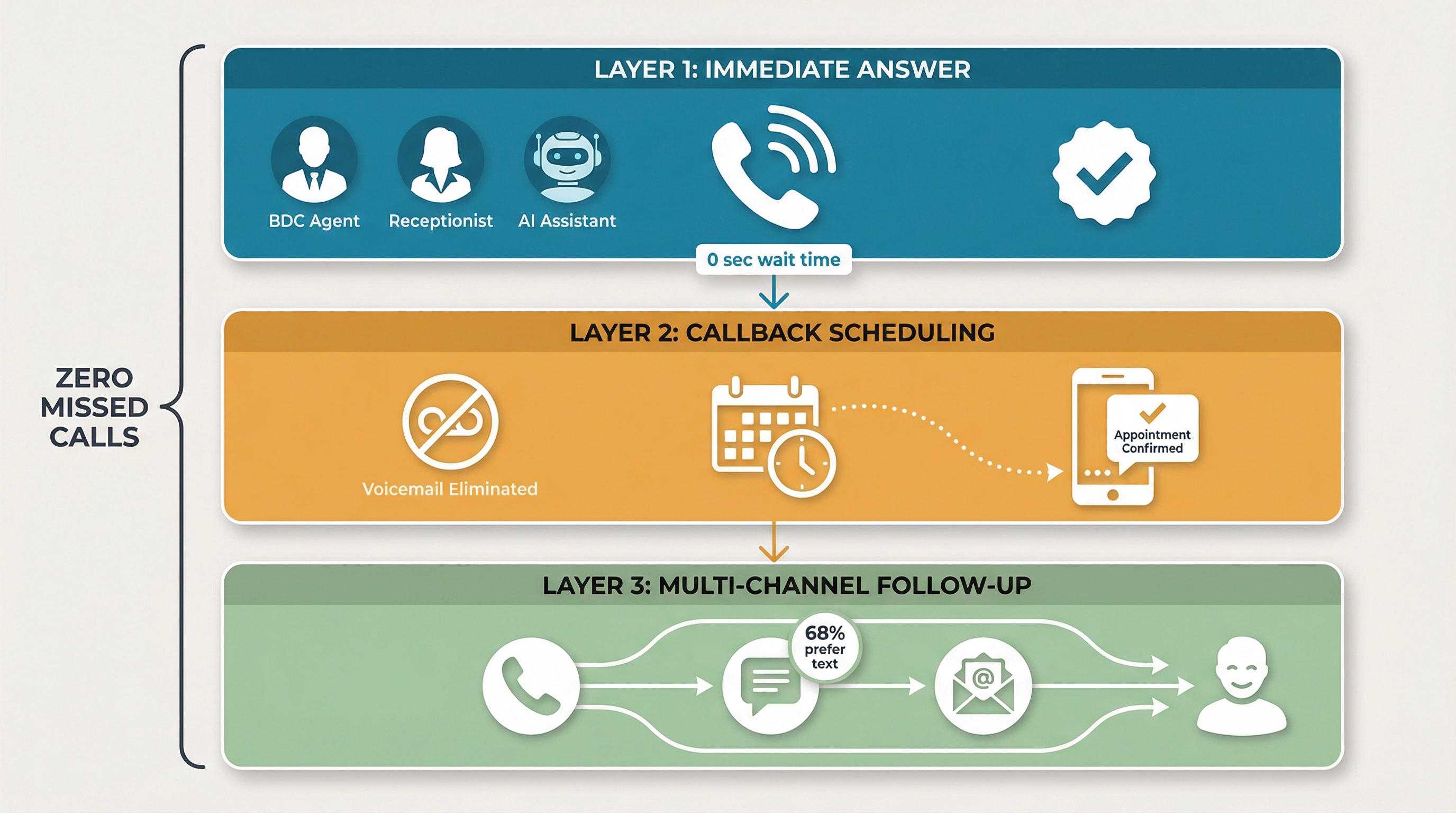
Layer 1: Immediate answer. This is what prevents abandonment and competitor-shopping. Whether it’s a BDC agent, a front desk receptionist, or an AI system like Flai, the call gets picked up fast and the customer starts getting helped right away. The goal is zero rings to voicemail and zero extended holds.
Layer 2: Callback scheduling (not voicemail). If waiting is genuinely unavoidable, don’t dump callers into a voicemail box. Offer a specific callback time window and confirm it via text. The customer keeps control of their time, you keep the lead alive, and your team gets a structured follow-up queue instead of a pile of voicemails to sort through.
Layer 3: Multi-channel follow-up. Even if a call doesn’t connect perfectly, the conversation should continue through text or email. J.D. Power’s 2024 CSI study found that customers are four times as likely to prefer service updates via text (68%) compared to phone calls (16%). That same preference applies to missed-call recovery. A quick follow-up text (“We saw you called. Want to book service for your RAV4? Here are available times.”) is often the fastest way to re-engage someone who couldn’t get through by phone. The broader customer experience data confirms that multi-channel communication is now the baseline expectation, not a bonus.
When all three layers work together, you create a system where it’s genuinely difficult for a customer to fall through the cracks, even on your busiest Monday morning.
Key Call Metrics Every Dealership Should Track
You can’t manage what you don’t measure. But you also can’t drown in dashboards with numbers that don’t connect to revenue.
Our BDC metrics framework lays out a clean funnel for tracking phone performance: inbound demand, connection, qualification, offer, appointment set, appointment kept, outcome, and value. If you only track one number, make it kept appointments created per inbound demand, broken out by service and sales.
Essential Dealership Call Center Metrics
Access metrics tell you whether callers can actually reach you:
- Answer rate
- Abandonment rate
- Average speed to answer
- Hold time distribution (look at the spread, not just the average, because averages hide spikes)
- Transfer-to-voicemail rate (your target here is as close to zero as possible)
Conversion metrics tell you whether answered calls produce results:
- Appointment offer rate (are you actually offering appointments on schedulable calls?)
- Appointment set rate
- Show rate for kept appointments
Coverage metrics reveal your weak spots:
- After-hours answer rate
- Peak-hour answer rate, especially during the 10 AM to noon window, lunch, and end of day
Understanding where your call overflow bottlenecks occur is the first step toward fixing them.
Quality metrics close the feedback loop:
- First-call resolution (did the customer call back within 24 to 48 hours for the same issue, which suggests the first call didn’t actually solve it?)
- QA scores from call reviews covering script adherence, empathy, and concrete action taken
Tracking these quality indicators is directly tied to improving your CSI scores over time.
30-Day Plan to Stop Missing Dealership Calls
You don’t have to overhaul everything overnight. Here’s a realistic four-week plan that builds momentum without overwhelming your team.
Week 1: Make missed calls visible. Run the call coverage audit described earlier. Map your routing and transfer failure points. Pull 14 days of phone data. Identify your top three leak points (usually hold times, after-hours gaps, and blind transfers).
Week 2: Fix routing and overflow. Set up overflow rules so calls roll to a backup before customers abandon. Remove blind transfers across all departments. Ensure after-hours calls route to a resolver (not voicemail). Assign clear “first responder” ownership for service and sales lines.
Week 3: Staff for peaks and train for conversion. Add micro-shifts for the Monday 10 AM to noon window. Start phone captain rotations so ownership is clear. Deploy the service and sales talk tracks with your team. Begin a daily 10-minute standup reviewing missed calls from the previous day and the reasons behind each one.
Week 4: Add automation where humans can’t scale. Deploy callback scheduling to replace voicemail during overflow. Add multi-channel follow-up (text and email) on abandoned calls. If call volume demands it, deploy AI coverage for overflow and after-hours. This is where a platform like Flai fits naturally into the picture, handling the volume that your human team simply can’t cover without burning out. The way AI is transforming dealership service departments makes this less of an experiment and more of a proven playbook.
Call Recording Laws and Compliance for Dealerships
Two things to keep in mind as you build your call strategy.

Call recording consent varies by state. Most dealerships handle this with an automated notice (“calls may be recorded for quality purposes”), but the specific rules differ depending on where you operate. The Reporters Committee’s Recording Guide is a solid starting reference for understanding state-by-state consent requirements.
AI-generated voices for outbound calls face tighter rules. In 2024, the FCC ruled that AI-generated voices in robocalls count as “artificial or prerecorded voice” under TCPA, meaning prior express consent requirements apply. Violations can carry serious penalties. If you’re running outbound campaigns with AI voices, build compliance into the process from day one.
This article isn’t legal advice. But ignoring these rules is a risk no dealership should take.
Dealership Missed Calls: FAQs
How many calls does the average dealership miss per day?
It depends on store size and staffing, but Car Wars data from nearly 3,000 dealerships found that 31.8% of unconnected calls were customers who gave up while on hold. For a dealership handling 100 to 150 calls per day, even a 10% to 15% miss rate means 10 to 20+ lost opportunities daily. Our breakdown of missed call statistics shows what that adds up to over a month and a year.
What’s the single most impactful time to add extra phone coverage?
Monday mornings between 10 AM and noon, consistently. It’s the highest-volume window across dealerships, and it’s also when your staff is most likely to be overwhelmed with check-ins and overnight backlog. If you can only add coverage for one time block, start there.
Can AI actually handle service scheduling calls well enough?
Yes, but only if the AI is deeply integrated with your scheduling system, CRM, and DMS. Without those connections, AI becomes another message-taker that doesn’t save anyone time. Platforms like Flai connect directly to your existing systems to check real availability, book the appointment, and send confirmations during the call itself. Our guide on what an AI BDC is and how it works explains the technology in more detail.
How does Flai work with my existing phone system?
Flai connects to your current setup without requiring new hardware or changes to your existing telephony. Calls route to our AI when your team is unavailable or after hours, and we handle everything from scheduling to warm transfers back to your staff when a human conversation is needed. Think of it as a virtual receptionist that never takes a break and never lets a call go unanswered.
What kind of ROI can I expect from fixing missed calls?
The profit impact is meaningful and well-documented. A Lexus dealership saw $100,000 in profit impact from roughly 1,100 calls handled, while a CDJR store added $83,000 from 1,563 calls in a single month. An Infiniti dealership handled over 1,800 calls monthly with zero missed and saved 20% of staff time. Each booked service appointment carries real margin, so even modest improvements in answer rate and conversion translate directly to revenue.
Will customers be put off by talking to AI instead of a person?
When the alternative is three minutes on hold or hitting voicemail at 8 PM, customers prefer something that can actually help them. Flai’s voice AI sounds natural, responds fast, and resolves calls quickly, which is what customers care about most. The Pied Piper 2025 study actually found that AI often outperforms human staff on key service appointment metrics. And when dealerships improve their CSI scores by providing faster, more consistent phone experiences, the loyalty and retention benefits compound over time.