What Is Fixed Operations? Dealer Fixed Ops Profit Guide
Fixed operations (fixed ops) drives 50% of dealership profit. Learn what it is, why it matters, and how to maximize service and parts revenue in 2026.
If you’ve been in automotive retail for any length of time, you’ve probably heard the term “fixed operations” thrown around. But what does it actually mean, and why should it matter to your bottom line?
Fixed operations (often shortened to “fixed ops”) refers to the service, parts, and body shop departments of your dealership. These departments generate steady, predictable revenue long after the customer drives their new car off the lot. While vehicle sales grab the headlines, fixed ops quietly powers your profitability.
A customer might buy a car from you once every five years. But during those five years, they’ll visit your service department multiple times for oil changes, brake jobs, tire rotations, and repairs. Each visit is an opportunity to generate profit and strengthen the relationship.
Industry data shows that service and parts departments contribute about 50% of a dealership’s total gross profit. Half your profit comes from the operations that many dealers still treat as an afterthought.
And unlike vehicle sales, which can collapse during recessions or inventory shortages, fixed ops revenue keeps flowing because people still need their cars maintained. That stability is what makes fixed operations the financial foundation of any successful dealership.
Fixed Operations vs Variable Operations: What’s the Difference?
To understand fixed operations, you first need to understand how it differs from the other half of your business.
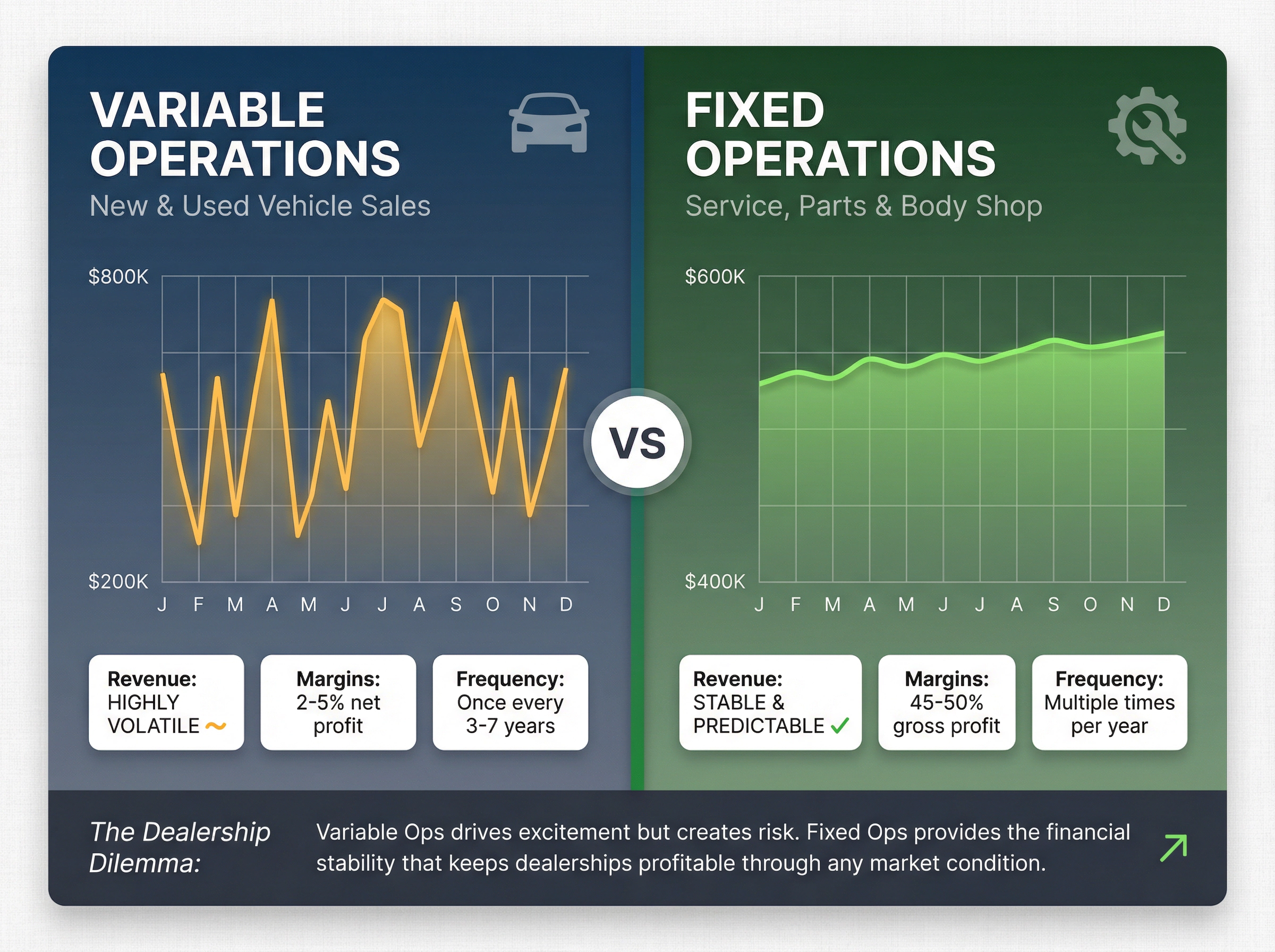
Variable operations covers your new and used vehicle sales, along with F&I products. Revenue fluctuates wildly based on market conditions, inventory availability, and consumer demand. One month you might sell 150 cars, the next month only 80.
Fixed operations covers the revenue streams that remain relatively stable. This includes:
- Service Department: Oil changes, warranty work, repairs, maintenance, recall campaigns
- Parts Department: Parts sales to your service department, retail parts sales, wholesale parts to independent shops
- Body Shop (Collision Center): Accident repairs, paintwork, vehicle reconditioning (if your dealership has one)
The term “fixed” doesn’t mean the revenue never changes. It means the revenue is far more predictable and consistent than vehicle sales. Customers need routine maintenance regardless of economic conditions. People still need oil changes during a recession. They still need brake repairs when the economy is booming. That consistency is what separates fixed ops from the feast-or-famine cycle of car sales.
| Aspect | Variable Operations (Sales) | Fixed Operations (Service/Parts) |
|---|---|---|
| Revenue Stability | Highly volatile, swings monthly | Relatively stable and predictable |
| Profit Margins | Typically single-digit percent | 45-50% gross margins |
| Customer Frequency | Once every 3-7 years | Multiple times per year |
| Inventory Dependency | High (need vehicles to sell) | Low (sell labor and parts) |
| Economic Sensitivity | Very sensitive to recessions | More recession-resistant |
Fixed ops acts as your financial cushion. During slow sales periods, your service and parts business keeps revenue flowing. Dealerships with strong fixed ops can survive and even thrive when car sales crater. Those without it are far more vulnerable to market swings.
Why Fixed Operations Drives Dealership Profitability
Fixed ops isn’t just a profit center for your dealership.
It’s often the profit center.

The Profit Math: Why Service Beats Sales
Pre-pandemic data from 2019 showed that fixed operations contributed 50.5% of total dealership gross profit on average. Even though service and parts represented only about 12% of total revenue, they delivered half the profit because of their exceptional margins (typically 45-50% gross profit on service labor and parts sales).
Compare that to vehicle sales, where you might make 2-5% net profit per unit. Selling an hour of technician labor at $150 (where your cost might be $50) is far more profitable than selling a $40,000 car and netting $800.
During the pandemic inventory shortages of 2020-2022, dealerships with strong fixed ops weathered the storm far better than sales-dependent stores. Vehicle margins temporarily spiked during that period, but as inventory normalized, margins compressed back to historical norms. Fixed ops margins stayed consistent throughout.
Service Absorption: The Number That Tells You Everything
Dealerships track a metric called service absorption (also called fixed absorption), which measures what percentage of your total operating expenses are covered by fixed ops gross profit alone.
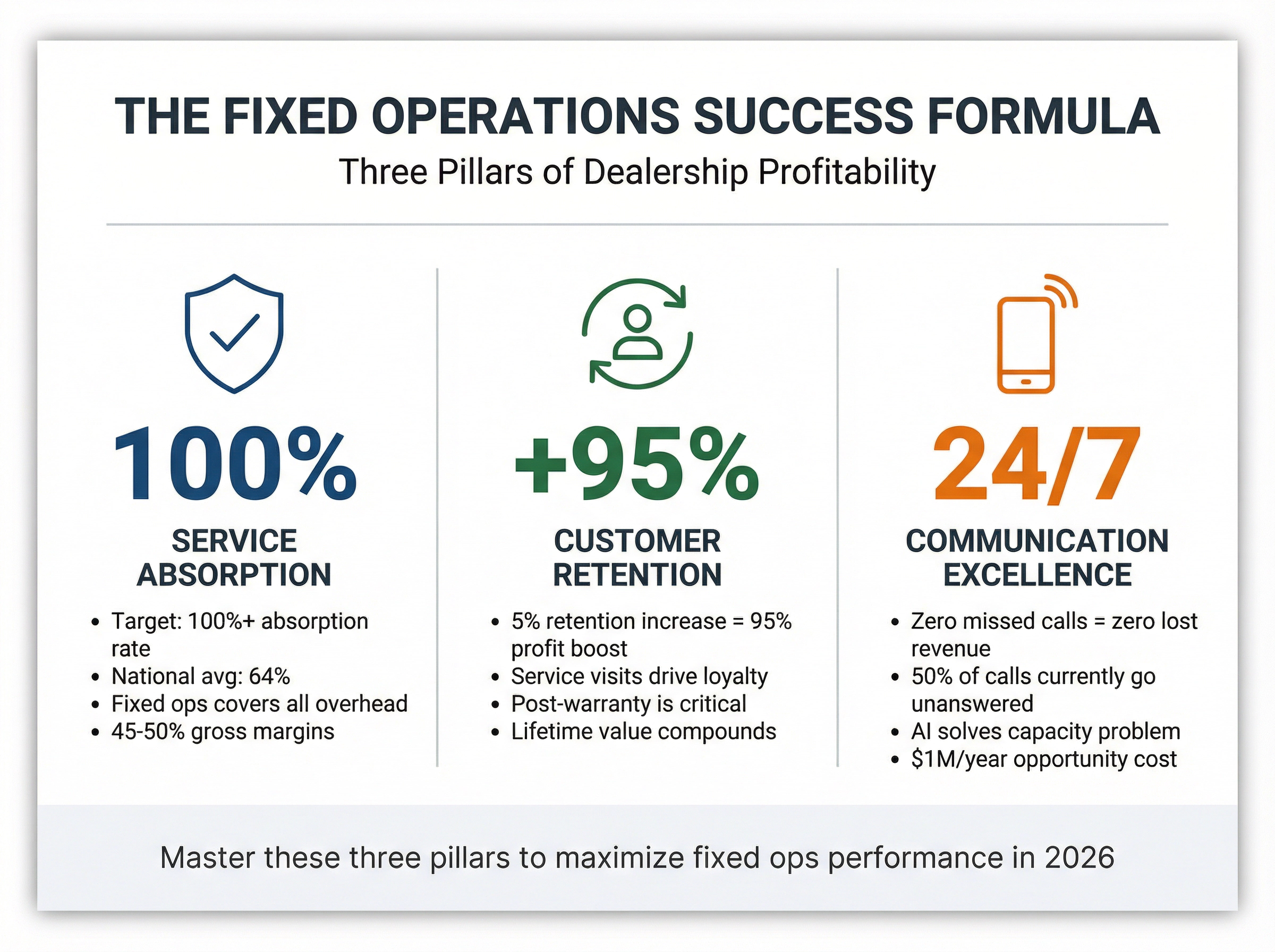
A 100% service absorption rate means your service and parts departments generate enough gross profit to pay all your dealership’s overhead. Rent, utilities, salaries, insurance, everything. At that point, vehicle sales become pure incremental profit.
According to NADA data from late 2025, the national average absorption rate sits around 64%. Top-performing dealerships routinely exceed 100%. The gap between average and elite is massive in dollar terms. For a dealership with $500,000 in monthly overhead, moving from 64% to 85% absorption means an extra $105,000 per month in fixed ops profit.
Critical insight: Sales might get a customer through the door once, but service keeps them coming back for years.
Research shows that a service advisor has 10 times more customer interactions per month than a salesperson who sells 10 cars. Each interaction is a chance to build loyalty or lose it forever. Studies found that increasing customer retention by just 5% can boost profits by up to 95% over time.
That retention math is powerful. A single loyal service customer can be worth $20,000 or more in lifetime revenue through regular maintenance, repairs, parts purchases, and eventually another vehicle sale.
The 3 Key Components of Fixed Operations
Fixed ops is actually three distinct but interconnected businesses working in harmony.
Service Department: Your Primary Revenue Driver
Your service department is where customers bring vehicles for maintenance and repairs. Revenue comes from labor sales (technician time billed at your labor rate) plus the parts markup on items installed during repairs.
The service department handles everything from quick-lube oil changes to complex engine diagnostics, transmission rebuilds, and warranty recall campaigns. Most dealerships also perform state inspections, alignments, and tire work. The range of services creates multiple revenue entry points for different customer needs.
The key to service profitability is productivity: how many labor hours can you bill per day? How efficient are your techs? How well do advisors recommend needed work? A strong service department maximizes effective labor rate (what you actually collect per hour) while keeping technician utilization high.
Industry research shows that about two-thirds of all vehicle service visits happen outside dealerships at independent shops. Once factory warranties expire, many customers defect to independent mechanics. This represents massive lost revenue and is one of the biggest challenges in fixed ops.
Parts Department: The High-Margin Profit Center
Your parts department sells to three main customer groups:
- Internal service department (the biggest customer, supplying parts for repairs)
- Retail customers (DIYers and walk-ins buying parts directly)
- Wholesale accounts (independent repair shops, body shops, fleets)
Parts carry excellent gross profit margins, often 50%+ on many items. The challenge is inventory management: stock too little and you slow down repairs, stock too much and you tie up cash.
Online OEM parts sales are projected to reach $25 billion by 2024, and wholesale parts sales to local independent shops can generate significant recurring revenue.
Body Shop: How Collision Centers Fit Into Fixed Ops
Not every dealership operates a collision center, but for those that do, it’s a meaningful revenue stream. Body shops handle accident damage repairs, paintwork, dent removal, and vehicle reconditioning for used car inventory. Revenue comes from insurance claims, customer-pay work, and internal reconditioning charges.
Body shops also keep customers in your ecosystem. If someone’s car gets wrecked and you handle the repair, they’re more likely to return for service later. The collision repair itself generates parts revenue, and the relationship extends the customer’s loyalty to your dealership for future maintenance and their next vehicle purchase.
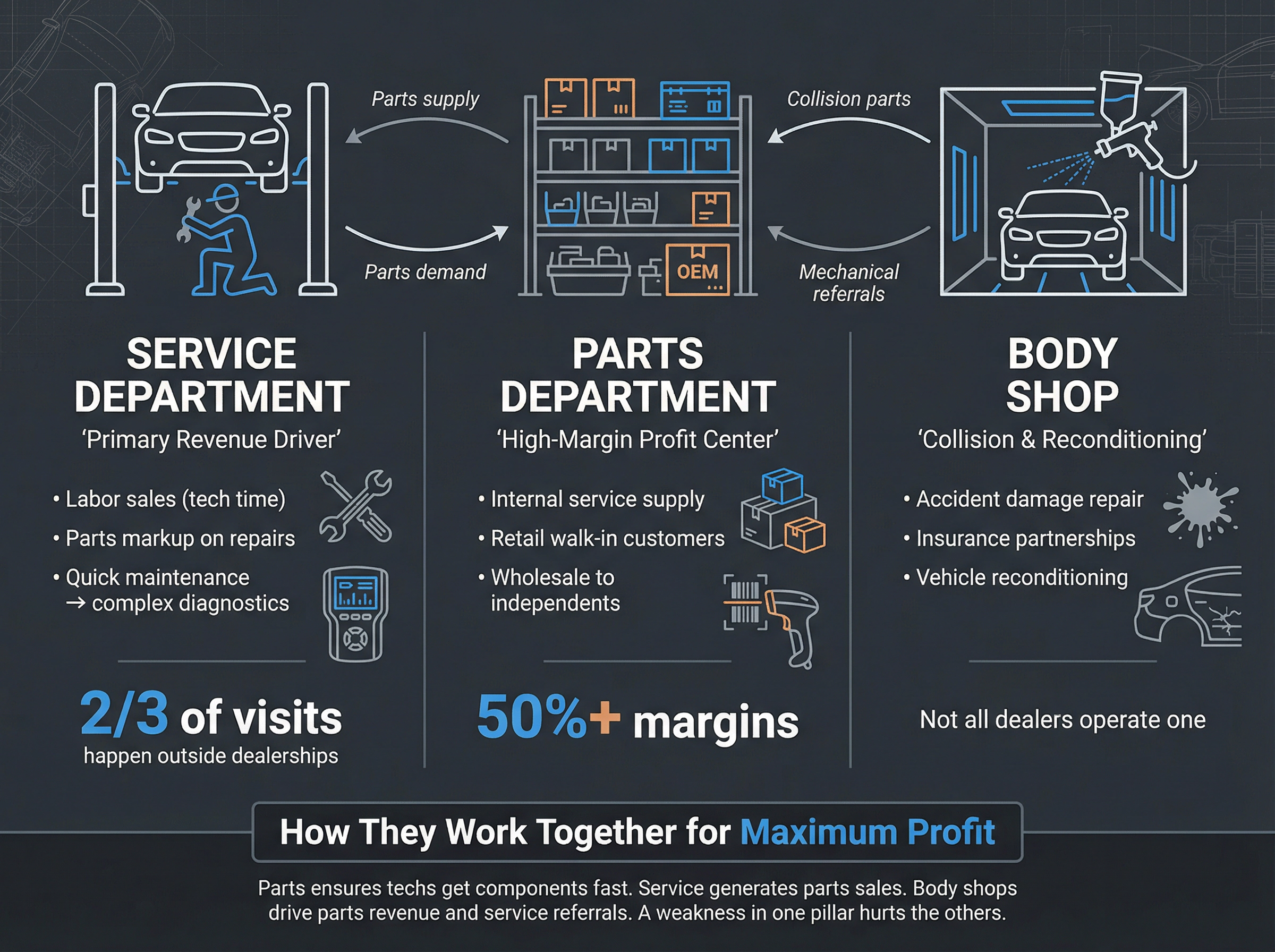
These three divisions must collaborate seamlessly. Parts ensures service technicians get needed components quickly. Service generates parts sales with every repair. Body shops rely on parts for collision repairs and may refer customers to service for mechanical issues. A weakness in one pillar hurts the others.
Fixed Operations Metrics: What Numbers Actually Matter
You can’t improve what you don’t measure. Here are the key metrics every dealer should track in fixed ops.
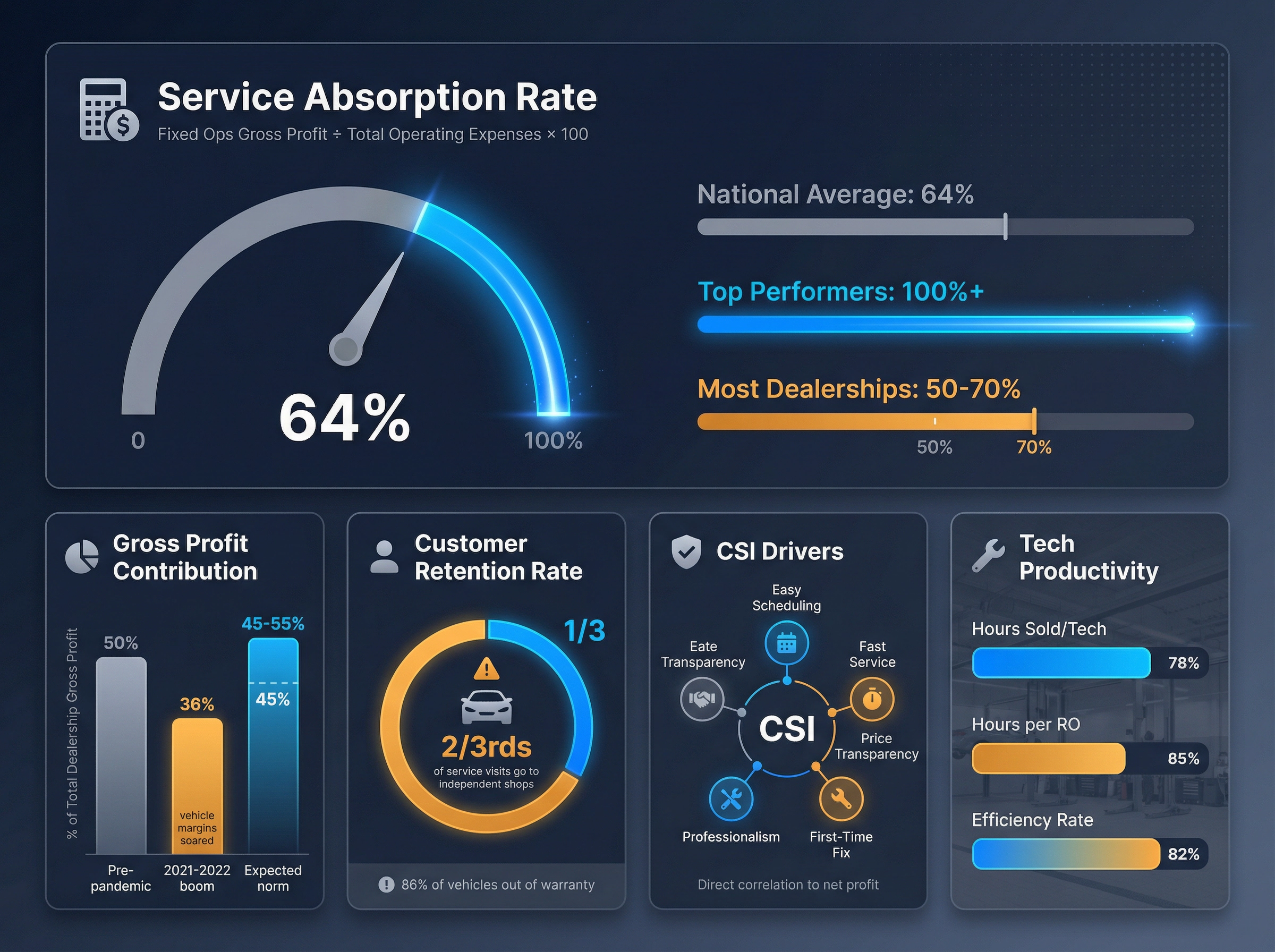
| Metric | What It Measures | Benchmark |
|---|---|---|
| Service Absorption Rate | % of overhead covered by fixed ops profit | National avg: ~64%, Elite: 100%+ |
| Gross Profit Contribution | % of total profit from fixed ops | Pre-pandemic: ~50%, Expected: 45-55% |
| Customer Retention | % of buyers returning for service | Only ~1/3 of visits at dealerships |
| CSI Scores | Customer satisfaction surveys | Directly linked to repeat business |
| Tech Productivity | Hours sold per tech, hours per RO | Low metrics signal lost revenue |
Improving even 5-10 percentage points on absorption can mean hundreds of thousands in additional profit annually.
A few additional metrics worth watching closely:
- Hours per repair order (RO): The average number of labor hours sold on each work order. Higher hours per RO mean advisors are doing thorough inspections and recommending legitimate work. Low hours per RO usually indicate missed opportunities.
- Effective labor rate: What you actually collect per hour of labor sold, factoring in discounts, coupons, and warranty rate shortfalls. Many dealerships have a $175 door rate but an effective rate of $140 after discounts. Closing that gap is free profit.
- Parts-to-labor ratio: Healthy service departments maintain a consistent ratio of parts revenue to labor revenue. If the ratio drops, it could signal that techs are doing labor-only work without selling the associated parts.
Industry Trends Shaping Fixed Ops in 2026
Vehicle age is hitting record highs. The average vehicle on U.S. roads reached 12.6 years old in 2024, an all-time high. Older cars generally need more repairs, creating service opportunities.
EVs are coming (slowly). Electric vehicles require less routine maintenance (no oil changes, fewer moving parts). As EV adoption grows, it could reduce per-vehicle service revenue. But EVs still need tires, brakes, and repairs. And not all independent shops are EV-ready, giving dealers an advantage. Industry data shows 66% of dealerships already offer some EV service.
Warranty periods are lengthening. Many brands now offer 4-year/50k or even 100k powertrain warranties. This gives dealers a captive service customer for longer, but the post-warranty drop-off can be steep without a retention strategy.
The Biggest Fixed Operations Challenges in 2026
Running profitable fixed ops means navigating a unique set of challenges.
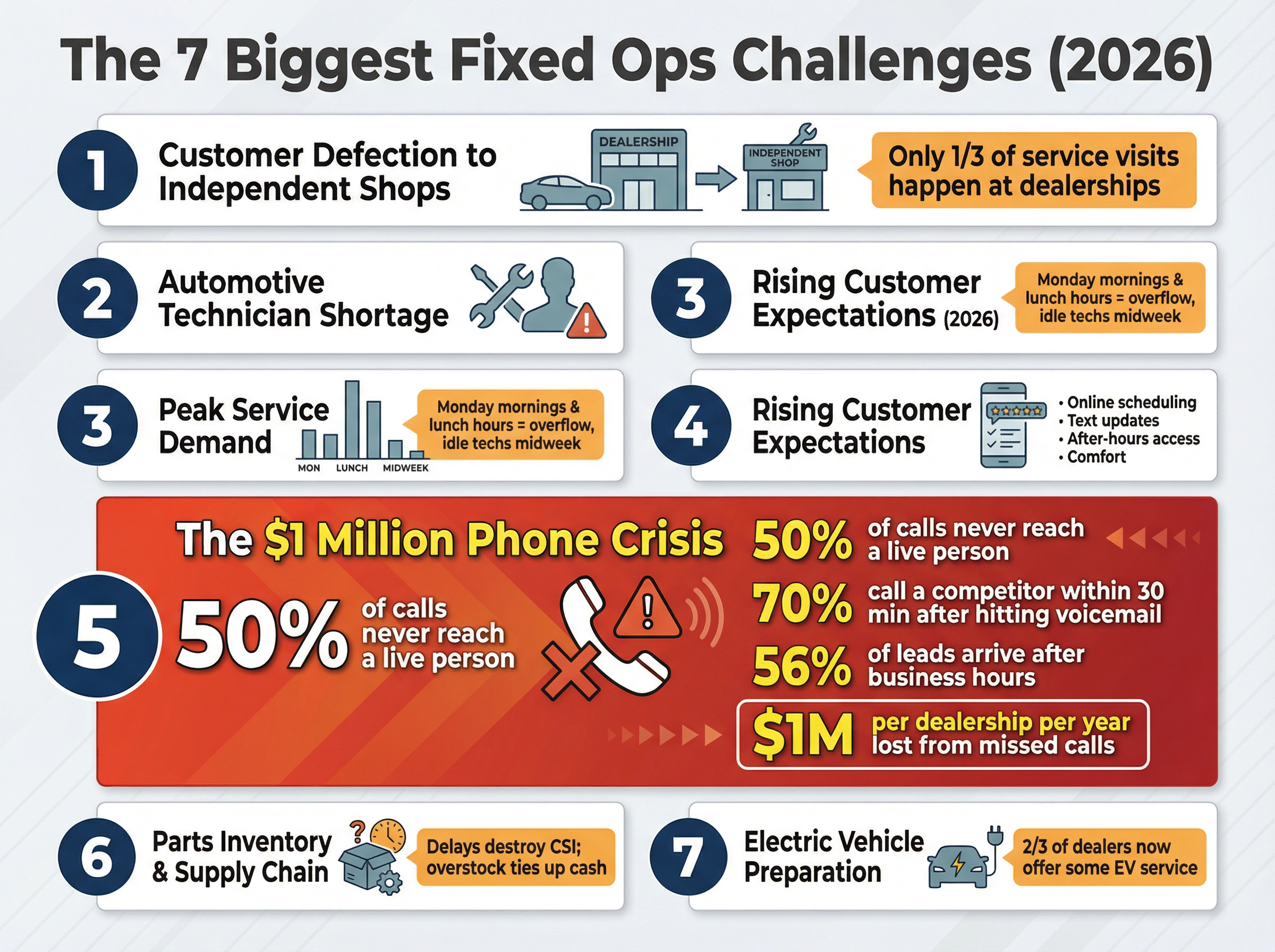
Customer defection to independents. Once factory warranty expires, many customers leave for independent mechanics, quick-lube chains, or tire shops. Only about one-third of service visits happen at dealerships industry-wide. Independents target your customers with competitive pricing and convenience. If you’re not proactively marketing and making service easy, you’re handing revenue to competitors.
The technician shortage. There’s a well-documented shortage of skilled automotive technicians across the country. The existing workforce is aging, with many experienced techs approaching retirement, and fewer young people are entering the trade compared to previous decades. Training programs can’t keep up with demand.
If you’re short on techs, you simply can’t generate the labor hours (and revenue) you could with a full team. Every unfilled bay is lost capacity. And the problem compounds: overworked techs make more mistakes, quality drops, comebacks increase, and CSI scores suffer. High turnover among service advisors is equally damaging to customer relationships and consistency.
Peak demand management. Service demand isn’t constant. You get rush periods (Monday mornings, lunch hours) and slow periods (midweek afternoons). If not managed properly, peak times result in ringing phones going unanswered, packed waiting rooms, and customers on hold. Meanwhile, midweek afternoons might see techs sitting idle.
Smart scheduling and staggered appointments help, but the phone is often the first bottleneck. If you can’t answer calls during peak demand, you can’t book the appointments that fill your bays.
Rising customer expectations. Today’s consumers expect the same convenience from their car dealership that they get from every other service provider. That means online scheduling with real-time availability, text updates on their car’s status, after-hours access to booking and questions, and comfortable waiting areas with good WiFi and refreshments. Dealerships that haven’t modernized are seen as outdated and lose customers to independents that have.
Parts inventory and supply chain. Balancing parts inventory is a constant challenge. Stock too little and you’ll have vehicles sitting in bays waiting for parts, which slows down repairs, ties up lifts, and frustrates customers. Stock too much and you tie up cash in slow-moving inventory. Supply chain disruptions in recent years made this even harder, with some parts taking weeks to arrive.
The $1 Million Phone Crisis
Your dealership is probably losing millions in revenue right now because of poor phone coverage.
Industry analysis reveals that about 50% of incoming calls to dealerships never reach a live person. When customers hit voicemail, 70% will call a competitor within 30 minutes. And 56% of dealership leads come in after business hours.
Studies estimate each dealership loses around $1 million per year just from missed calls and inadequate phone coverage. This isn’t a people problem. It’s a capacity problem. You can’t have enough staff on hand every hour of every day to answer every call instantly.
How AI Communication Platforms Solve the Phone Crisis
Modern AI communication platforms built specifically for automotive dealerships ensure you never miss another call, text, or opportunity.

Why AI Beats Traditional Call Centers for Fixed Ops
Traditional approaches to the phone problem don’t really work. Hiring more staff is expensive and still doesn’t solve after-hours coverage. Outsourced call centers handle basic routing but can’t book appointments or answer technical questions about your specific dealership. Voicemail is a dead end because most customers won’t leave one.
AI communication platforms solve the problem at its root. They provide unlimited capacity, 24/7 coverage, and the ability to actually complete tasks (not just answer and transfer).
How AI Voice Agents Handle Every Dealership Call
These platforms use advanced AI voice agents that answer every phone call, SMS, and email instantly, no matter the time of day.
Answer calls immediately (zero wait time, no voicemail, no hold music). When a customer calls at 8 PM on a Sunday, the AI picks up on the first ring with a natural, helpful voice.
Book appointments seamlessly. The AI accesses your scheduling system, checks availability, and books service appointments on the spot. Customers get confirmation instantly via text or email.
Handle common questions. Pricing inquiries, service hours, directions, whether you service specific makes/models. The AI is trained on your dealership’s information and answers accurately.
Escalate complex issues. If a situation requires human judgment, the AI smoothly transfers to the right person or schedules a callback during business hours.
Capture every lead. Even if the AI can’t fully resolve the inquiry immediately, it captures the customer’s contact info and reason for calling so your team can follow up first thing the next morning.
Real Dealership Results
| Metric | Result |
|---|---|
| Calls handled per month | 1,800+ calls (zero missed) |
| Conversion rate on bookable calls | 88% |
| Additional appointments booked | 376 per month |
| Customer satisfaction | Dramatically improved |
One dealership using Flai handled 1,800+ calls every month via AI voice agents, with zero missed calls. That’s 376 additional service appointments booked per month compared to previous call-handling performance.
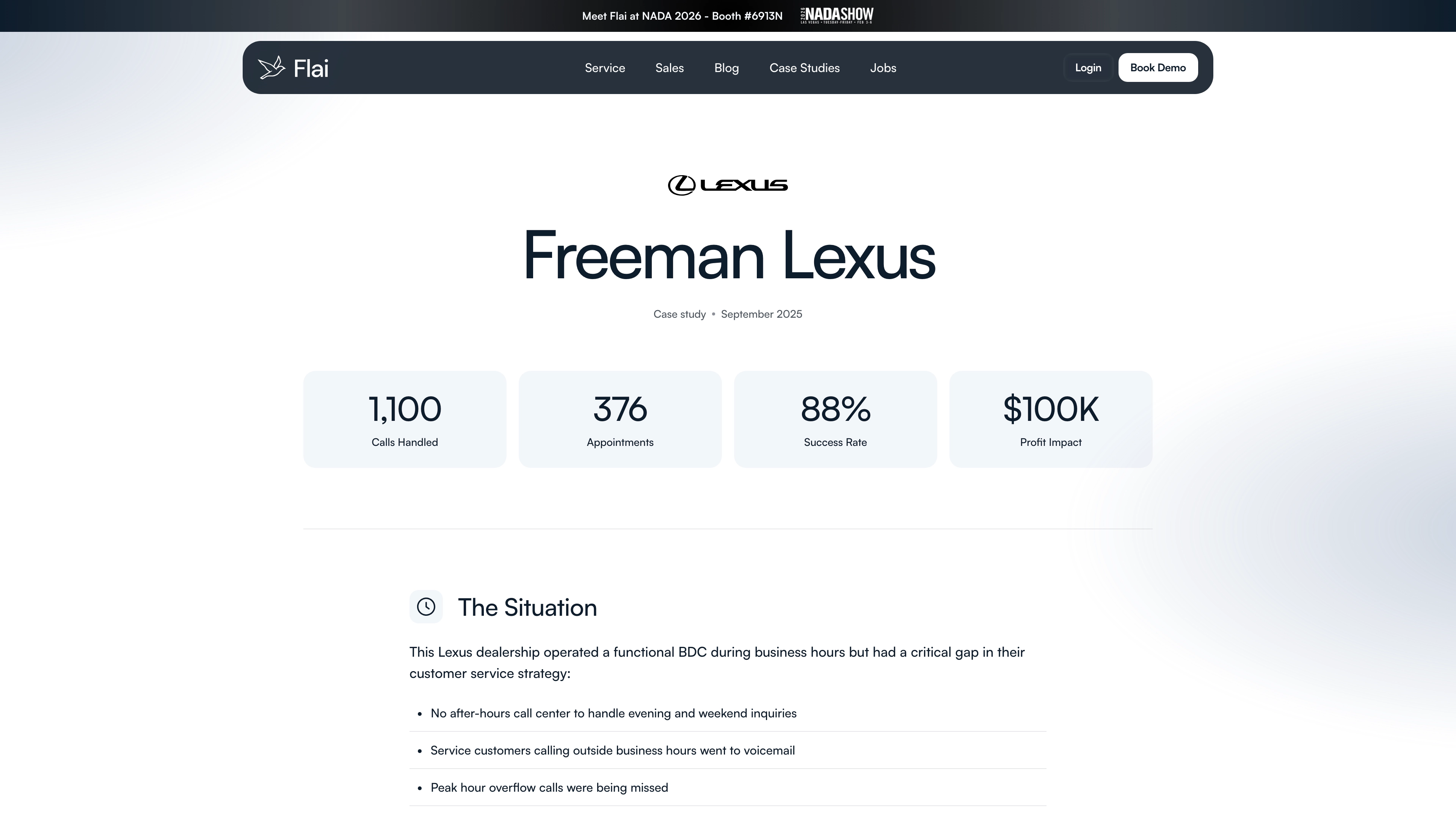
With hundreds of extra service appointments monthly, dealerships saw massive fixed ops revenue growth. Those aren’t just numbers on a screen. They’re real customers in service bays, generating labor sales and parts revenue that compounds month after month.
The ROI math is straightforward: if the average service visit generates $300-500 in revenue, and AI booking adds 376 appointments monthly, that’s $113,000 to $188,000 in additional monthly revenue from a platform that costs a fraction of one employee’s salary.
Ready to explore AI communication for your dealership? Schedule a demo to see how AI voice agents can transform your fixed ops phone coverage.
Strategies to Maximize Fixed Ops Performance
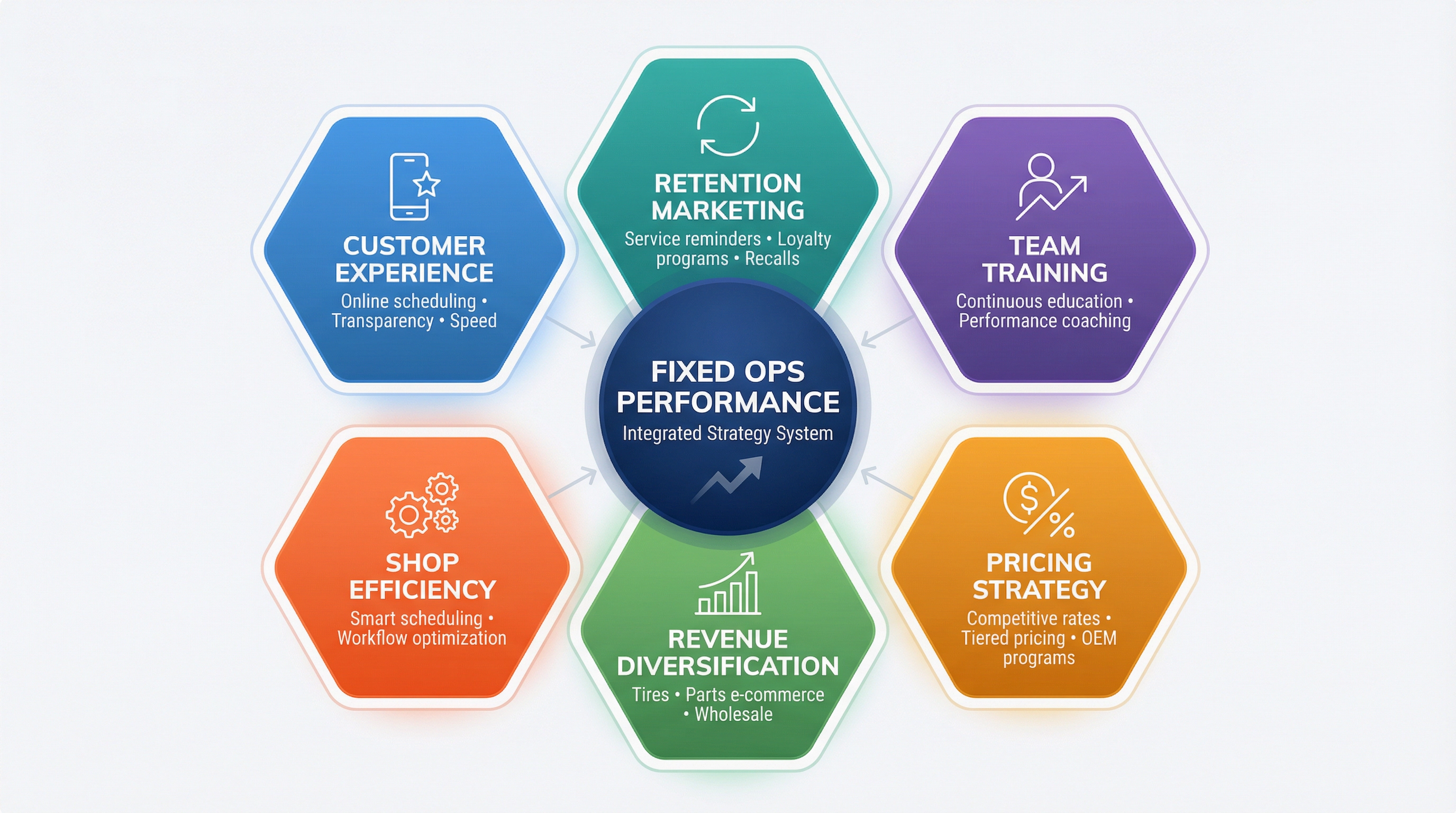
Make Customer Experience Your Priority
If you want customers to choose your service department over independent shops, you must make doing business with you effortless.
Offer convenience at every step. Online scheduling with real-time availability. Night drop-boxes for keys. Vehicle pick-up and delivery when possible. Extended service hours into evenings or weekends to capture after-hours demand via AI communication platforms.
Speed matters. For routine maintenance, consider express service lanes with guaranteed quick turnarounds (30-45 minutes for oil changes). Customers hate waiting 2 hours for simple jobs.
Transparency builds trust. Post maintenance prices online. Use vehicle inspection videos/photos to show customers why they need a repair. Customers who see the problem are far more likely to approve the work.
Retention Marketing: Keep Customers Coming Back
Given the challenge of post-warranty defection, proactive retention is essential.
- Send regular service reminders via email and text at appropriate intervals. Include an easy way to schedule (online link or “text YES to book”).
- Run targeted campaigns for customers who haven’t visited in 12+ months, or who declined previous work.
- Leverage every recall as a guaranteed reason for return. Treat recall visits as retention opportunities with complimentary inspections.
- Consider loyalty programs. Simple rewards (every 5th oil change free) incentivize repeat business. Prepaid maintenance packages lock customers into dealer service for years.
Studies show that raising customer retention by just 5% can boost profits by nearly 95% over time.
Train Your Team and Optimize Shop Efficiency
Continuous training is non-negotiable. Techs need certification on new models, hybrids, EVs, and diagnostic equipment. The vehicles coming into your bays today are dramatically more complex than what techs trained on ten years ago, and the pace of change is accelerating.
Train advisors in consultative selling to explain the value of a service in terms customers care about (safety, reliability, long-term cost savings). An advisor who says “your brakes are at 3mm, which means they could fail in wet conditions” is far more effective than one who just says “you need brakes.”
Track performance and coach. Monitor metrics by individual advisor and tech (average revenue per RO, CSI scores, tech productivity, hours flagged vs. hours available). When everyone knows their numbers are tracked, performance naturally improves. Managing by data creates accountability and helps you identify who needs coaching and who deserves recognition.
Use smart scheduling tools. Modern systems help fill available hours without overbooking. Stagger appointments so you don’t have 15 cars arriving at 7 AM and then nothing at 10 AM. Streamline workflow with electronic dispatch and parts runners so techs don’t waste time walking to the counter or waiting for parts.
Compensation matters. Top technicians can work anywhere. If your pay plan isn’t competitive, you’ll keep losing your best people to the dealership across town or to independent shops. Invest in retention through fair pay, sign-on bonuses for certified techs, and career development paths.
Diversify Your Revenue Streams
Capture tire sales. Research shows 75% of customers buy tires from the first place that recommends them, yet dealerships only account for ~8% of tire market share. That’s massive lost opportunity. When your tech does a multi-point inspection and sees tires at 4/32, that’s a tire sale waiting to happen. Make it easy for the customer to say yes right there.
Perform multi-point inspections on every visit. Thorough inspections uncover legitimate work customers may not be aware of. Share results with photos and videos so customers can see the worn brake pads or the leaking gasket for themselves. Digital vehicle inspections with photos have been shown to dramatically increase approval rates because customers trust what they can see.
Grow parts e-commerce and wholesale. Online OEM parts sales are projected to hit $25 billion. If you’re not selling parts online, you’re leaving money on the table. Identify local independent repair shops and fleet operators who need a reliable OEM parts supplier. Wholesale accounts generate recurring revenue month after month without heavy marketing spend.
Market your fixed ops. Most dealerships spend their marketing budget almost entirely on vehicle sales. Devote real budget to promoting service. Google ads for “oil change in [City],” social media posts about service specials, email campaigns with specific maintenance offers. Your service department needs marketing just as much as your showroom does.
The aftersales market is over $125 billion in the U.S. There’s plenty of opportunity to grow your slice.
Building Your Fixed Ops Action Plan
Fixed operations is the engine that keeps your dealership running. It contributes roughly half your gross profit, provides stability through market swings, and builds customer relationships that drive lifetime value.
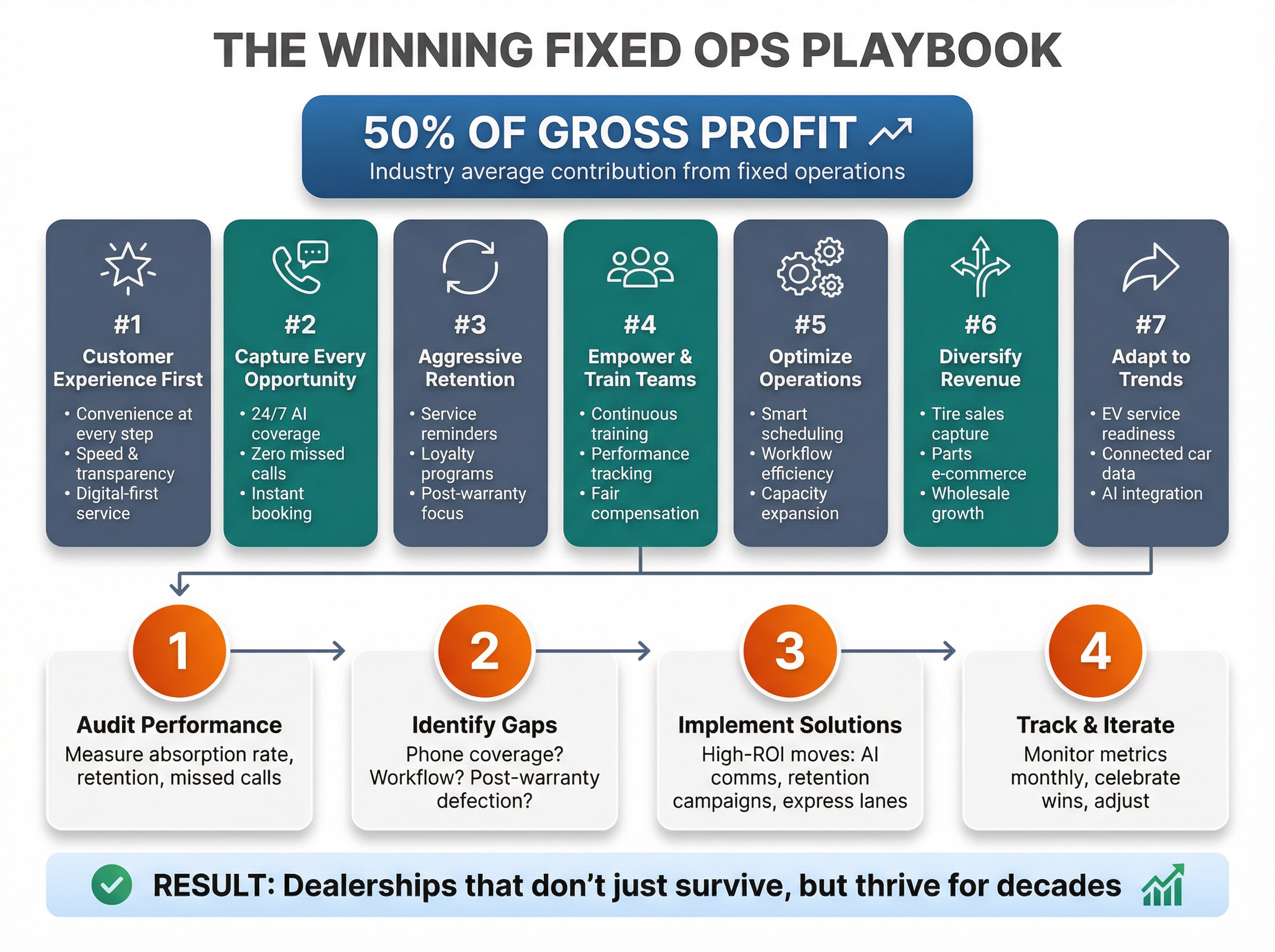
Your action plan:
- Audit your current fixed ops performance. Where’s your service absorption rate? Customer retention? How many calls are you missing?
- Identify the biggest gaps. Is it phone coverage? Customer defection after warranty? Low hours per RO? Inefficient shop workflow?
- Implement solutions systematically. Start with high-impact, high-ROI moves like solving the communication crisis with AI platforms, launching retention campaigns, or adding express service lanes.
- Track results and iterate. Monitor metrics monthly. Celebrate wins. Adjust strategies based on what the data tells you.
Even incremental improvements (a few more calls answered, a slight uptick in retention, an extra 0.2 hours per RO) compound into massive revenue and profit gains when scaled across thousands of customers per year.
The dealerships that will thrive in 2026 and beyond are the ones treating fixed operations as a strategic priority, not just a support department. They’re investing in their people, their processes, and their technology. They’re measuring what matters and acting on the data.
Fixed ops might not grab headlines like record vehicle sales months. But it’s the steady, reliable profit machine that will keep your dealership strong through any market condition.
Fixed Operations FAQ
What does fixed operations mean in a dealership?
Fixed operations refers to the service, parts, and body shop departments. These departments generate stable, recurring revenue from vehicle maintenance, repairs, parts sales, and collision work. It’s called “fixed” because the revenue is relatively predictable compared to vehicle sales, which fluctuate significantly.
What is a good service absorption rate?
A 100% absorption rate or higher is the gold standard, meaning your service and parts departments alone generate enough profit to cover all dealership overhead. The national average sits around 64%, with top-performing dealerships routinely exceeding 100%.
What is the profit margin for fixed operations?
Fixed operations typically achieves 45-50% gross profit margins on service labor and parts sales. While fixed ops might represent only 12% of total revenue, it often contributes 50% or more of total gross profit because of these exceptional margins. Service labor is especially profitable since the primary cost is the technician’s wage, and well-trained techs can produce significantly more revenue per hour than their labor cost.
How will electric vehicles affect dealership fixed ops?
EVs don’t need oil changes, have fewer moving parts, and require less frequent brake service. This means fewer visits per EV customer. But EVs still require tire replacements (actually wear them faster), occasional repairs, and specialized service that many independent shops can’t provide. Dealerships that invest early in EV training and equipment can capture this work.
How do I improve customer retention in my service department?
Focus on making every interaction convenient and transparent. Send automated service reminders at appropriate intervals. Offer online scheduling. Use digital vehicle inspections with photos so customers see why work is recommended. Follow up after every visit to confirm satisfaction. And critically, make sure you answer every phone call, because a customer who can’t reach you will call someone else. Consider loyalty programs or prepaid maintenance packages to lock in repeat visits.
What is a fixed operations manager or director responsible for?
A fixed operations manager (or director) oversees the service, parts, and body shop departments. Their job is to maximize revenue and profitability across all three departments while maintaining high customer satisfaction scores. They track key metrics like service absorption rate, hours per RO, effective labor rate, customer retention, and technician productivity. They’re responsible for staffing, training, pricing strategies, marketing the service department, and ensuring smooth collaboration between service, parts, and body shop teams.
How can I reduce missed calls in my service department?
The most effective modern solution is implementing an AI voice agent platform, which answers every call instantly 24/7, books appointments automatically, handles common questions, and never misses an after-hours opportunity. Dealerships using AI platforms have achieved zero missed calls while booking hundreds of additional service appointments monthly.