AI Follow-Up Automation for Car Dealerships: Close More Leads
AI follow-up helps car dealerships close more leads by responding faster, persisting longer, and booking more appointments. See real case studies.
If you run sales at a dealership, you already know the uncomfortable truth: you don’t have a lead generation problem. You have a lead leakage problem.
Your store is paying for web traffic, form submissions, chat widgets, inbound calls, and third-party leads. And then you’re watching a significant chunk of those leads vanish into thin air because the follow-up system is too slow, too inconsistent, too generic, or just stops entirely.
This isn’t a new problem. But now there’s a new solution that’s actually working.
AI-powered follow-up is changing the math for dealerships across the country. Not the chatbot-dumps-a-canned-response version. Not the email-drip-pretending-to-be-personal version. The real version: intelligent systems that respond instantly, stay in touch across multiple channels, answer real questions with real inventory context, and hand off cleanly to your sales team when the moment is right.
This guide covers exactly what’s happening, why AI follow-up matters right now, and how to implement it in a way that books more appointments and sells more cars.
Why Do Sales Leads Die at Car Dealerships?

A sales lead “dies” when one of several things happens. And almost all of them trace back to execution, not lead quality.
How Fast Response Times Impact Lead Conversion Rates
Buyers are shopping multiple dealers simultaneously. Multiple tabs. Multiple texts. Every minute you wait, you’re competing against the “try the next dealership” button.
The data on this is brutal.
Research from DAS Technology’s 2025 Lead Response Study (covering Q3-Q4 2024 inquiries across 1,700 dealerships) found that 61% of dealers responded within 15 minutes. That sounds okay until you realize 19% took over an hour to respond. And other industry analyses have found average response times stretching to 42-47 hours in some cases.
Why does this matter so much?
According to automotive lead generation research, around 78% of car shoppers end up purchasing from the first dealership that responds. You’re not just racing against the clock. You’re racing against every other dealer they contacted.
The same research shows you’re 21 times more likely to qualify a lead by responding within 5 minutes versus waiting 30 minutes. Conversion rates can be 8-10x higher in the first 5 minutes compared to an hour later.
The headline statistic: Most dealers respond fast-ish. But a significant minority still responds late enough to lose the deal before the first real conversation even starts.
What Makes a Fast Response Unhelpful?
Speed alone doesn’t close deals if the reply is basically “when can you come in?”
The DAS Technology study found massive gaps in response quality:
| Missing Element | % of Responses |
|---|---|
| Payment details | 91% |
| Multiple photos | 90% |
| Price quotes | 74% |
| Alternative vehicles | 89% |
A lot of “responses” are technically responses. They just don’t actually help the buyer decide or move forward. Industry reporting confirms that many dealers respond with generic replies that fail to answer the customer’s specific question or include key information that would help seal the deal.
Why Single-Channel Follow-Up Loses Leads
Buyers ignore emails. Buyers ignore calls. Buyers ignore texts. Not because they hate you. Because they’re busy and overloaded.
Pied Piper’s 2025 Internet Lead Effectiveness (ILE) study measured dealer responses across 4,023 dealership websites, evaluating email, phone, text, and chat over 24 hours. The findings:
- 85% of dealers responded through at least one channel
- But only 49% used multiple channels (email + phone + text)
- Pied Piper explicitly calls multi-channel response the behavior “mathematically most likely to boost auto sales”
The study also notes that historically, dealers improving from an ILE score under 40 to over 80 sell 50% more units from the same quantity of internet leads.
That stat should stop you cold. The leads weren’t the limiting factor. Execution was.
How Many Follow-Ups Does It Take to Close a Sale?
Most dealerships stop following up far too early. Reps hate chasing. Managers get distracted. And leads that need nurturing get abandoned.
But sales research shows a completely different reality about what actually closes deals:
- Only 2% of sales happen on the first contact
- 80% of sales require 5-12 follow-up touches
- 44% of salespeople give up after just one follow-up
- 60% of customers say “no” four times before eventually saying “yes”
That disconnect explains a lot of lost deals. Your sales team makes two attempts, hears nothing, and moves on. The customer eventually buys from someone who stayed in touch.
What Happens When Callers Are Put on Hold?
Follow-up isn’t only about web leads. Phone calls remain the highest-intent channel in automotive.
Industry research shows that in 2024, the average hold time was 3 minutes and 5 seconds. That’s an eternity for a service customer or a hot sales lead.
Research from Plum Voice paints an even more concerning picture:
- 60% of customers hang up after just one minute on hold
- 32% aren’t willing to wait at all
- 63% prefer a callback over staying on hold
- 31.8% of unconnected dealership calls involve customers hanging up while on hold
If a prospect calls about a car and hits three minutes of hold time, your follow-up system might never even get a chance. You lost the lead before you captured it.
How Many Leads Come in After Business Hours?
More than half of car-shopping leads come in when dealerships are closed.
According to industry research, 56% of new sales leads are submitted after business hours. Yet only about 37% of dealerships respond to those after-hours leads within even one hour. Research shows roughly 40% of customer inquiries hit the dealership when staff isn’t around.
The rest typically wait until the next business day. By which time the customer might have moved on, contacted competitors, or lost their motivation entirely.
What Changed in 2024-2026 for AI Dealership Follow-Up?
Two shifts are colliding right now that make AI follow-up a “do it now” decision rather than a “maybe later” experiment.
Why Car Buyers Expect Omnichannel Experience Now
Cox Automotive’s 2024 Car Buyer Journey Study shows that satisfaction is being driven by better digital tools and a smoother blend of online and in-store steps. Their findings:
- 75% overall satisfaction with the shopping experience among new-car buyers
- 81% dealership satisfaction (a historic high)
- The purchase process took more than 13.5 hours in 2024, with more time spent in research and discovery
Buyers are doing a lot before they ever show up. And your follow-up has to meet them where they are: fast, digital, and contextual.
Are Dealerships Actually Using AI in 2025-2026?
Cox Automotive’s 2025 AI Readiness Study notes that dealers who fully embrace and optimize AI report outcomes like increased revenue and improved operational efficiency.
This isn’t theoretical anymore. AI is moving from gimmick to operations layer.
Industry surveys show 76% of dealership executives plan to increase AI budgets for sales and lead response in 2026. The industry is recognizing this as a fundamental shift in how customer communication works.
How Does AI Follow-Up Close More Leads?
When we talk about “AI follow-up,” we mean something very specific. Not a chatbot that dumps a canned response and dies. Not an email drip pretending to be personal. Not a robocaller that nukes your reputation.
Real AI follow-up is a system that:
- Responds fast (including nights and weekends)
- Keeps the conversation going across SMS, email, and phone
- Answers real questions with real inventory context
- Moves the customer toward a next step (appointment or test drive)
- Hands off cleanly to a human when the moment is right
AI doesn’t replace sales. It replaces “lead rot.”
Here are the five mechanisms that make this work.
How AI Improves Speed-to-Lead for Dealerships
Humans are inconsistent. AI is boringly consistent.
Research on AI response times shows that dealerships using AI assistants respond to customers in about 2 minutes on average, whereas a typical human team might take 2 hours or more. For a deeper benchmark on what fast looks like across the industry, see our speed to lead guide for automotive dealerships.
This directly attacks the 19% “over an hour” response bucket in the DAS study. When a lead comes in at 11:30 PM or Sunday morning, AI can respond within seconds. The instant acknowledgment engages the customer while their interest is highest and prevents them from filling out forms on five other dealer sites.
How AI Makes Follow-Up Persistence Automatic
Most dealerships stop too early because reps hate chasing or are drowning in other tasks.
AI follow-up can run a disciplined cadence automatically:
- Same-day multi-touch
- Day 2-3 follow-up
- Week 2 nurture
- Month-long “still looking?” check-ins
- Reactivation when inventory changes
Dealerships using AI-powered CRMs report achieving 100% consistent follow-up. No missed opportunities. No uncontacted leads. The AI contacts every lead multiple times (day 5, day 8, day 11, etc.) and never misses a beat on nights or weekends.
You don’t need “perfect” reps to get consistent effort. You need a system that never forgets.
Why Multi-Channel Outreach Works Better
The Pied Piper data shows multi-path response is still not the norm (only 49% of dealers). But top-performing dealers have found that contacting leads through multiple paths greatly improves reach rates.
AI can orchestrate:
- Text first, email with details, call when high intent is detected
- Swap channels mid-conversation (customer replies by text after ignoring email)
- Keep context so the customer doesn’t have to repeat themselves
This omnichannel persistence ensures the lead is engaged on whichever communication method works best for them. It’s the kind of thorough, coordinated approach that’s hard for an individual rep to execute consistently.
How AI Maintains Consistent Response Quality
The DAS study found huge gaps in content quality (pricing, payment info, photos, alternative vehicles).
AI can be designed to always include:
- A direct answer to the customer’s question
- Confirmation of availability (or a clear alternative)
- Next steps with specific times
- Optional financing/payment estimate language
- Trade-in next step
The key difference: it’s not just fast. It’s useful. Every single time.
What Makes the AI-to-Human Handoff Work?
AI follow-up works best when it does the early work and triggers humans at the right moment:
When AI escalates to human reps:
- Customer asks for a buyer’s order or out-the-door price
- Customer wants to negotiate
- Customer confirms time to come in
- Credit complexity, negative equity, or payoff questions
- Fleet or commercial deals
What the AI passes along:
- Summary of what customer wants
- Vehicle(s) discussed
- Objections surfaced
- Appointment preference and urgency
- Full transcript and contact info
This turns “call me when they reply” into “here’s a warm lead with context.”
As one dealership BDC director put it: “The sweet spot is having AI be the leading point, and then humans take over when needed.”
What’s the Best AI Follow-Up Strategy for Dealerships?
Below is a practical cadence that works across new and used vehicles. Adjust based on lead source and inventory velocity.
Phase 1: First 10 Minutes (Start a Real Conversation)
What AI does:
- Responds instantly with 2 questions max:
- Confirm the vehicle (or ask what they’re looking for)
- Propose 2 appointment windows (specific times)
- Offers one “easy win” detail the buyer cares about:
- Availability confirmation
- Condition/mileage highlight
- Link to photos, window sticker, or Carfax
What humans do (optional):
- If buyer replies fast and wants to come in today, jump in immediately
Phase 2: Same Day (Make Contact and Set Appointment)
AI cadence example:
- T+0: SMS + email response
- T+30 min: SMS nudge if no reply (“Want me to hold it for you?”)
- T+2 hrs: Quick call attempt (or AI call if enabled)
- Late afternoon: Second appointment offer with new time windows
Phase 3: Days 2-7 (Overcome Silent Leads)
What AI does:
- Rotates value, doesn’t repeat “just checking in”
- Uses micro-commitments:
- “Should I send a quick out-the-door estimate?”
- “Are you trading anything in?”
- “Is this for you or someone else?”
- “What day this week is easiest?”
Phase 4: Weeks 2-4 (Stay Alive Without Being Annoying)
What AI does:
- 1-2 touches per week max
- Triggers on events:
- Price drop on vehicle of interest
- Vehicle sold (offer 2 alternatives)
- New similar unit arrived
- Incentive changes (OEM)
Phase 5: 30-90 Days (Reactivate or Recycle)
What AI does:
- Sends “Are you still shopping?” (yes/no format)
- If “yes”: Restart Phase 2 with updated inventory options
- If “no”: Ask why (bought elsewhere / paused / still deciding) and tag CRM
AI Follow-Up Templates That Convert Leads
Use these as starting points. Keep them short. Ask one clear question. Always make the next step easy.
SMS Templates for Dealerships
1. Instant Response
Hey {first_name}, it’s {rep_name} at {dealer}. Yep, that {year} {make} {model} is available. Would you rather come by today at {time_a} or {time_b}?
2. Question Answering
Good question. {Answer in 1 sentence}. If you want, I can also send a quick breakdown and set a time to see it. What’s easiest: {time_a} or {time_b}?
3. Trade-In Hook
Are you trading something in? If you text me the year/make/model + miles, I can ballpark it and tighten the numbers.
4. No-Response Nudge
Quick one: are you still interested in the {model}, or should I send a couple similar options that fit your budget?
5. Inventory Shift Trigger
Update: that exact unit just got sold. Want the 2 closest matches in stock right now?
Email Templates for Auto Sales
6. Answers + Next Steps Format
Subject: Re: {vehicle} quick answers + two times
Your question: {restate}
Answer: {answer}
Next step: I can have it ready for you. Does {time_a} or {time_b} work?
7. 3-Option Email (Reduces Decision Paralysis)
Subject: 3 options for {make/model}
- Option 1: {vehicle} (why it’s a fit)
- Option 2: {vehicle}
- Option 3: {vehicle}
Want me to hold one for a quick drive? What day works?
Call and Voicemail Templates
8. 15-Second Voicemail
Hey {first_name}, this is {name} at {dealer}. Calling about the {vehicle}. I can answer your question and set a quick time to see it. I’ve got {time_a} or {time_b}. I’ll also text you so it’s easy to reply.
9. Permission-Based Opener
Hey {first_name}, it’s {name} at {dealer}. Did I catch you at a bad time? I can be quick. Just want to make sure I get you the right info on the {vehicle} and see if you want to set a time.
Revival Templates for Dead Leads
10. Week 2 Check-In
Still shopping for a {make/model}, or did you already pick something up?
11. Win/Loss Tagger
Super quick: did you end up buying, or are you still deciding? Either way, I can stop following up or help you finish this.
What Results Are Dealerships Seeing With AI Follow-Up?
The evidence is building rapidly. Dealerships embracing AI follow-up are seeing measurable improvements.
45% Lift in Lead Conversion Rates
Industry data shows that across thousands of businesses (including many dealerships), those using AI agents saw about a 45% lift in lead conversion rates on average. The same data showed an associated ~30% increase in revenue.
When nearly half again as many leads turn into customers, that’s transformative for any dealership’s bottom line.
How One Auto Group Cut Time-to-Contact in Half
One auto group handling about 4,500 internet leads per month across two stores (with only six BDC staff) struggled to respond quickly enough. After implementing AI follow-up, their average time-to-contact was cut in half. The BDC director credited the improvement to the AI’s rapid, around-the-clock responsiveness.
3-Point Conversion Increase Worth 12 Appointments/Month
615 Auto Sales, an independent used-car dealer in Tennessee, documented their results after implementing AI-driven follow-up. Their lead-to-appointment conversion rate rose from 25% to 28% in the first couple of months.
That 3-point increase meant 12+ additional appointments every month that weren’t happening before. If even half of those appointments turned into car sales, that’s 6 more deals a month without any extra advertising spend or staff hires.
The dealership attributed this lift directly to the AI’s consistent follow-up: contacting every lead multiple times and never missing a beat on nights or weekends.
How After-Hours AI Changes the Revenue Game
With AI follow-up, leads that arrive at midnight or Sunday afternoon get near-instant replies. Dealers often report that the system “paid for itself on a single Sunday” because just a handful of car sales on what used to be a dead day more than cover the cost.
Research shows AI can respond to after-hours messages in about 2 minutes versus the 2+ hours it typically takes a human the next business day. Customers who inquire Saturday night might have an appointment set for Monday instead of having bought elsewhere by Monday.
What Makes AI Follow-Up Work in Car Dealerships?
AI follow-up only works if your system is wired correctly. This is where most deployments fail. Not because “AI is bad,” but because the store’s plumbing is bad.
CRM Hygiene Requirements for AI
You need these fields clean, or AI will sound uninformed:
- Lead source + lead type (OEM, third-party, website, chat, call)
- Vehicle of interest (VIN if possible)
- Desired purchase timeline (today/this week/this month)
- Preferred contact method (if known)
- Opt-in/consent status for text and calls
Why Real-Time Inventory Integration Matters
If AI says “yes it’s available” and it’s sold, you lose all credibility.
Minimum requirement:
- Near-real-time inventory feed
- “Sold/reserved” state updates
- Alternative vehicle matching logic
How AI Appointment Booking Should Work
The point of follow-up is to book. Your AI should:
- Offer specific times
- Respect store hours and rep schedules
- Confirm location and what to bring
- Send confirmation + reminder sequence
When Should AI Escalate to Humans?
Define these upfront:
- When to warm-transfer or notify a rep
- What counts as high intent
- What topics require humans (financing edge cases, negotiation, complaints)
AI Follow-Up Compliance Rules
- Don’t text people who didn’t opt in (or where consent is unclear)
- Always include opt-out language in SMS (“Reply STOP to opt out”)
- Throttle messaging (especially after hours)
- Respect do-not-call lists and quiet hours
- Log everything (messages/calls) in the CRM
AI follow-up should make you more compliant, not less. Because it’s consistent.
What Makes an Effective AI Follow-Up Platform
We built Flai for exactly this “don’t let leads die” problem.
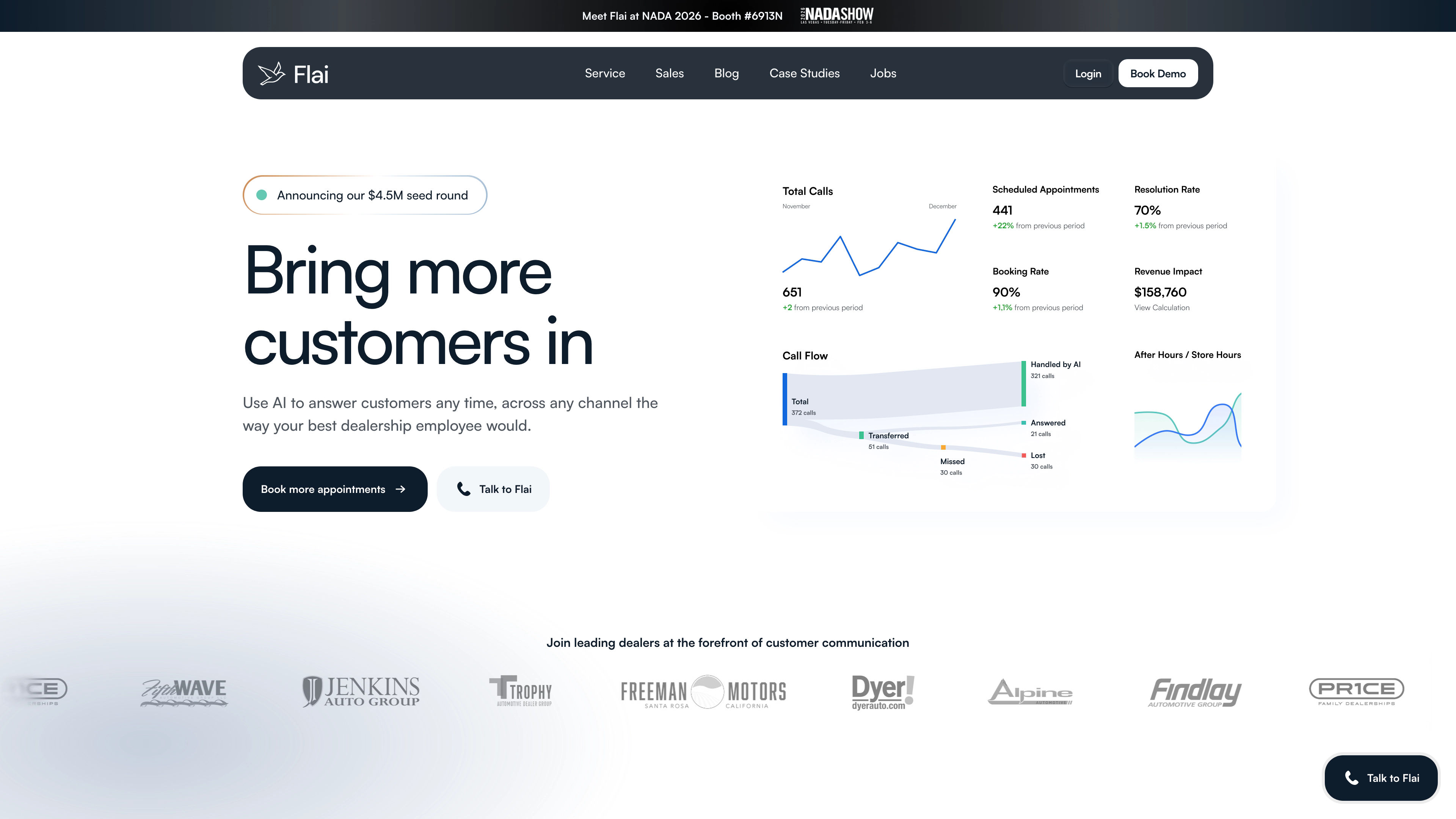
We’re an AI communications platform specifically designed for car dealerships. Our AI handles:
- Sales lead follow-up via SMS and email, keeping the conversation going until the appointment is booked
- After-hours call capture so leads don’t vanish when the store is closed
- Inbound and outbound communication across voice, text, and email
- Direct integration with your DMS, CRM, and scheduler so appointments actually get booked (not just promised)
Key Differentiators in AI Follow-Up Platforms
Built from scratch for dealerships. We didn’t just wrap a generic voice AI API and call it a product. We built our own voice stack and dealership-specific logic. That’s why conversations sound natural, responses are fast, and the AI handles real dealership conversations without awkward pauses or confusion.
Deep system integration. We integrate with your existing scheduler, CRM, and DMS so Flai can actually take action in real time: booking a service appointment, updating a lead, or setting a test drive. Not “we’ll call you back.” Actual resolution.
Multi-channel coordination. The same AI handles phone calls, SMS, and email. Customers can start on one channel and finish on another while the AI stays aware of the conversation history.
24/7 availability. Nights. Weekends. Holidays. We answer every call and respond to every lead. No more after-hours black hole.
Multi-language support. The AI can communicate in whatever language your customers speak.
Real Results from Dealership AI Implementations
Our dealership customers are seeing $80,000 to $100,000+ in monthly profit impact. Here’s what dealerships using Flai have achieved:
| Dealership Type | Calls Handled | Appointments Booked | Estimated Profit Impact |
|---|---|---|---|
| San Leandro CDJR | 1,563 | 304 | $83,000 |
| Toyota | 1,053 | 358 | $94,000 |
| Lexus Bay Area | ~1,100 | 376 | $100,000 |

The math is straightforward: appointment profit clusters around $260-$270 per booked appointment. Even with moderate conversion rates, the profit per incremental appointment is so high that perfect performance isn’t required. You just need to not let calls die.
No hardware or training required. We plug into your existing phone system and go live quickly. The founding team has visited over 450 dealerships in person to understand real workflows. We built the product inside the chaos, not in a quiet office.
What Metrics Prove AI Follow-Up ROI?
Don’t drown in 40 metrics. Track the ones that actually change sales.
Speed and Contact Metrics to Track
- Median time to first response (by lead source, by hour of day)
- Contact rate within 24 hours (any two-way reply or live call)
- Multi-channel attempt rate (email + text + call)
Pipeline Movement Metrics That Matter
- Appointment set rate
- Appointment show rate
- Sold rate (lead to sold, and appointment to sold)
- Days-to-sale distribution (do you win fast deals only, or also slow deals?)
How to Score AI Follow-Up Quality
Run a simple quality check on a random sample of conversations:
- Did we answer the question?
- Did we confirm availability (or offer alternatives)?
- Did we ask for the appointment?
- Did we capture trade-in or financing intent?
- Did the handoff summary make sense?
AI Follow-Up FAQ for Car Dealerships
Will customers know they’re talking to AI?
Modern AI voices and messaging are remarkably natural. Many customers don’t realize they’re interacting with AI, especially for straightforward conversations like scheduling appointments. The goal isn’t to deceive; it’s to provide instant, helpful service. When conversations get complex or customers specifically request a human, the AI hands off smoothly.
Does AI follow-up replace my BDC team?
No. AI handles the early work (instant response, persistent follow-up, qualification) so your human team can focus on closing deals and handling complex situations. Think of it as adding capacity without adding headcount. Your BDC team shifts from chasing leads to closing warm opportunities that AI has teed up. For a side-by-side cost and ROI breakdown, see AI vs traditional BDC.
How long until I see results?
Most dealerships see impact within the first month. The immediate change is response time (instant instead of hours). Within 30-60 days, you should see measurable improvement in appointment set rates and lead-to-sale conversion. The compounding effect grows as AI nurtures leads that would have otherwise died.
What about compliance (TCPA, do-not-call)?
A well-designed AI system actually makes you more compliant because it’s consistent. We include opt-out handling, quiet hours, throttling, and complete audit trails. Every interaction is logged. You can review exactly what was said to every customer.
How does pricing typically work?
AI follow-up solutions generally charge per-store monthly fees, sometimes with usage components. At Flai, we price based on the value we deliver, with clear ROI tracking. Most dealers see payback within the first few weeks based on incremental appointments alone.
Can AI handle complex questions or objections?
AI handles straightforward questions excellently: availability, pricing ranges, appointment scheduling, directions, hours. For complex financing questions, negotiation, or frustrated customers, well-designed AI knows when to escalate. The handoff includes full context so the human rep picks up without missing a beat.
What if AI makes a mistake (says something is available when it’s sold)?
This is why integration quality matters. AI should pull from real-time inventory data. We integrate directly with dealer management systems so availability is accurate. When integrations are mediocre, AI breaks mid-flow. Stronger integrations mean fewer failures.
The Bottom Line on AI Follow-Up
Dealerships don’t lose sales leads because buyers “aren’t serious.”
They lose them because follow-up is:
- Slow when humans get busy
- Inconsistent when process isn’t enforced
- Generic when reps don’t have time
- Single-channel when buyers aren’t
- Invisible when managers can’t see what’s happening
AI follow-up fixes this by turning follow-up into a system: fast, persistent, multi-channel, and measurable.
And when you combine that with a clean handoff to humans at the right moment, you don’t just “respond faster.”
You close more deals from the same leads.
The technology has matured. The results are proven. Industry analysts are calling AI “table stakes” for dealerships, noting that “early movers are already creating competitive gaps that late adopters might not be able to close.”
If you’re ready to stop losing leads to slow follow-up, we can help. We’re an AI communications platform built specifically for car dealerships, handling voice, SMS, and email 24/7 so every lead gets the follow-up it deserves.
Book a demo at useflai.com to see how much revenue you’re currently leaving on the table.