How to Increase Dealership Service Appointments (2026)
Recover $1M+ in lost service revenue. Capture 56% of after-hours leads, answer every call in 3 seconds, and increase appointments 40%+ with AI automation.
Your service bays should be packed. But most dealerships are bleeding appointments through gaps they don’t even track.
We’re not talking about getting a few more oil changes. We’re talking about recovering the $1 million+ in annual revenue most dealerships lose from missed after-hours calls alone. About converting the 56% of service leads that come in when your staff is off the clock. About turning the 65% connection rate (meaning one-third of callers never reach you) into something closer to 100%.
This guide breaks down exactly where appointments leak, why it happens, and how to fix it. No fluff, no theory. Just the operational changes that turn missed opportunities into revenue.

Why Most Dealerships Lose Service Appointments (And Don’t Even Know It)
The Phone Problem Nobody Wants to Admit
Industry research shows 31.8% of unconnected calls are customers hanging up while on hold. The average hold time sits at 3 minutes and 5 seconds. In that time, customers are making decisions.
Not “I’ll call back later” decisions. “I’ll call the shop down the street” decisions.
Research indicates 60% of customers hang up after one minute on hold. Another 32% won’t wait at all. When you put someone on hold for a simple oil change appointment, you’re basically asking them to take their business elsewhere.
The consequences compound. Research from dealership operations found 70% of people who hit voicemail call a competitor within 30 minutes. Not days. Not hours. Minutes.
Why After-Hours Calls Are Your Biggest Revenue Leak
Your dealership is closed more hours than it’s open. During those hours, demand doesn’t stop.
Analysis of dealership lead patterns shows 56% of leads arrive after business hours. Most dealerships handle these with voicemail or don’t handle them at all. The cost? An estimated $1 million per year in lost revenue for the average store.
Think about Sunday evening. A customer realizes they need service before work Monday. They call. Voicemail. They text a buddy who recommends an independent shop that answers. By Monday morning, the appointment is booked somewhere else.
You were never in the running.
What Is a Mission Failure and Why Should You Care?
The 2024 Pied Piper dealer group study tracks something called “Mission Failures” (when customers try to schedule but hang up before booking). The industry average hit 13% in 2024, up from 11% the prior year.
That’s 13 out of every 100 service calls ending with no appointment because of how the call was handled.
Long holds. Transfers to the wrong department. Confusion about available slots. Each one represents revenue that almost happened but didn’t.
How Service Appointment Growth Actually Works
Most dealerships focus on marketing (top of funnel) or CSI scores (bottom). The middle is where money leaks.
Demand → Connection → Booking → Show → Completed Work → Retention
Each stage has a conversion rate. Small improvements multiply.
Take a store handling 2,000 calls monthly:
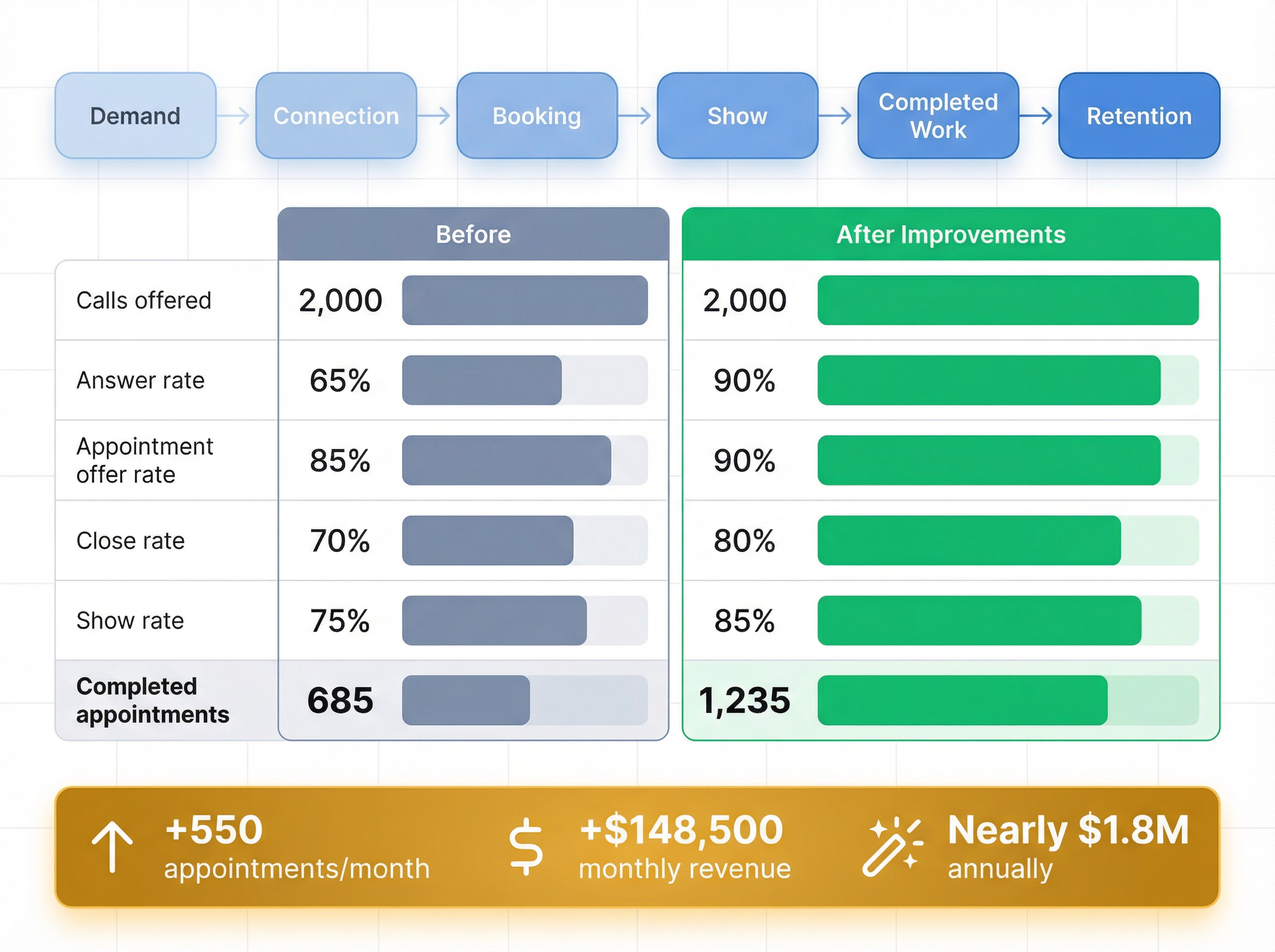
| Metric | Before | After Improvements |
|---|---|---|
| Calls offered | 2,000 | 2,000 |
| Answer rate | 65% | 90% |
| Appointment offer rate | 85% | 90% |
| Close rate | 70% | 80% |
| Show rate | 75% | 85% |
| Completed appointments | 685 | 1,235 |
That’s 550 more completed appointments monthly without buying a single extra lead. At an average RO value of $270 (conservative for service), that’s $148,500 in additional monthly revenue. Nearly $1.8 million annually.
The math is straightforward. The execution requires fixing specific bottlenecks.
How to Diagnose Where You’re Losing Service Appointments
Before implementing solutions, run a one-week baseline to identify your biggest leak.
Critical metrics to track:
- Answer rate: Percentage of calls actually connected to a human
- Speed to answer: Average time before someone picks up
- Hold abandonment: Calls lost while on hold over 2 minutes
- Mission failures: Calls ending without an appointment offered
- Days to next available slot: How far out you’re booking
- No-show rate: Percentage of appointments that don’t materialize
- After-hours call volume: Demand you’re currently missing
Most DMS/phone systems can pull these numbers. If yours can’t, spend a week manually logging.
Benchmarks for context:
According to Pied Piper’s analysis, top-performing dealer groups achieve:
- Answer in under 40 seconds
- Virtually zero calls held over 2 minutes
- Mission failure rates under 2%
- Average appointment wait time: 3 days
If you’re substantially worse than these numbers, you’ve found where to focus.
How to Never Miss a Service Call Again
The highest-leverage fix is eliminating missed calls entirely.
How to Handle Peak Call Volume Without Adding Staff
Industry data shows Monday 10AM to 12PM is the highest-volume window. If you staff flat across the week, you’re drowning during peaks and idle during valleys.
Staffing alignment matters. One BDC for a dealership handling 300+ service calls weekly creates bottlenecks. Either expand capacity during known peaks or implement overflow routing.
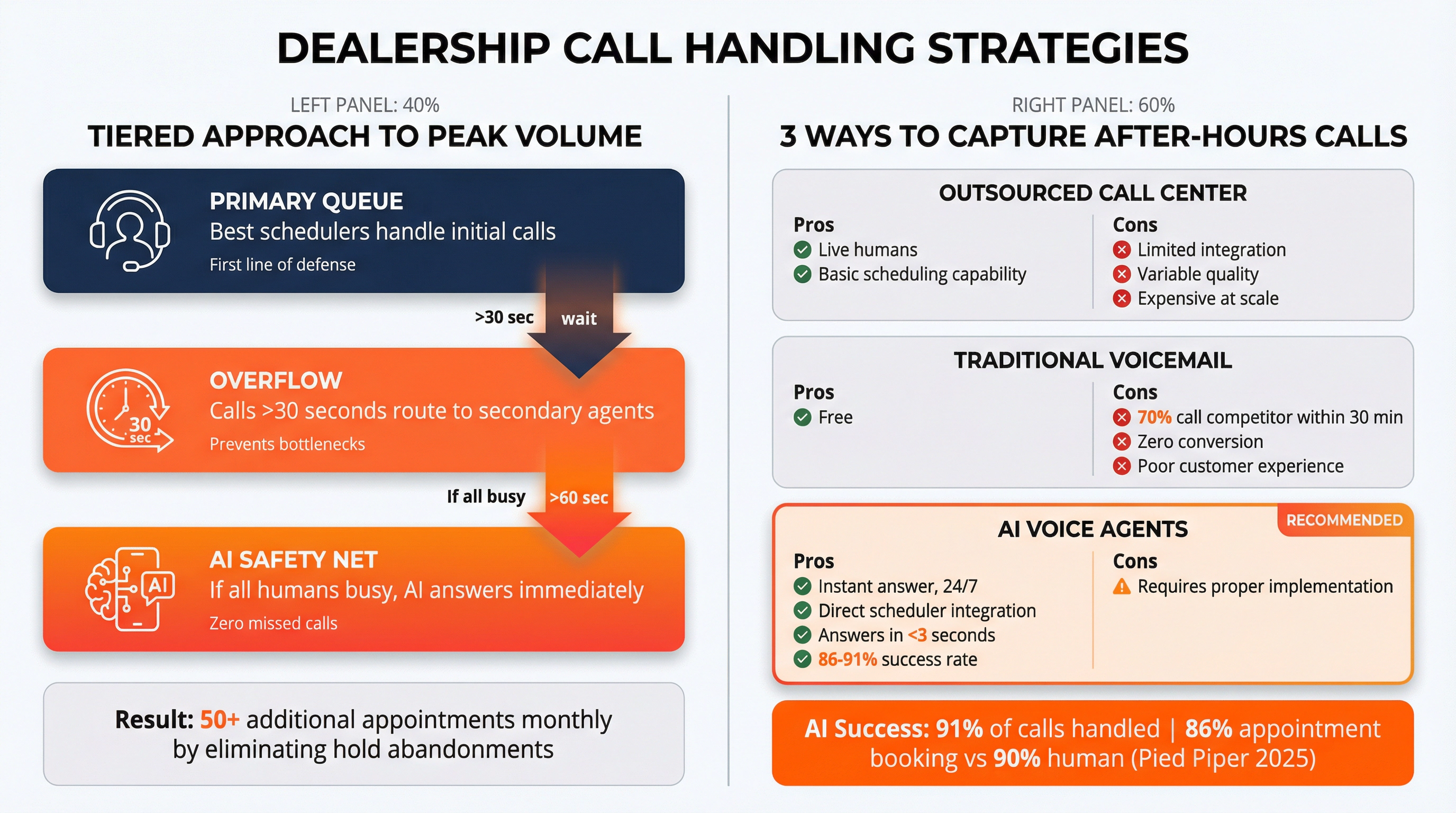
Consider a tiered approach:
→ Primary queue: Your best schedulers handle initial calls
→ Overflow: Calls ringing over 30 seconds route to secondary agents
→ AI safety net: If all humans are busy, AI answers immediately
This isn’t theory. Dealerships using this approach report converting 50+ additional appointments monthly just by eliminating hold-induced abandonments.
3 Ways to Capture After-Hours Service Calls
You need something answering calls when your team isn’t there. Three options:
| Option | Pros | Cons |
|---|---|---|
| Outsourced call center | Live humans, can handle basic scheduling | Limited integration, variable quality, expensive at scale |
| Traditional voicemail | Free | 70% call competitors within 30 minutes of hitting voicemail |
| AI voice agents | Instant answer, 24/7 availability, direct scheduler integration | Requires proper implementation |
The data on AI is getting compelling. Pied Piper’s 2025 research found AI successfully handled service calls 91% of the time, with appointment booking success at 86% vs. 90% for humans.
Not identical, but close enough that the coverage gap (answering every call vs. missing half) makes the ROI obvious.
How AI Voice Agents Answer Every Call in Under 3 Seconds
Modern AI voice platforms pick up every call in under 3 seconds, handle appointment scheduling directly through your DMS, and manage SMS/email follow-up the way your best BDC rep would.

A Lexus dealership using this approach handled 1,100 calls in one month, including heavy after-hours volume. Result: zero missed calls, 376 appointments booked (88% conversion on bookable opportunities), and an estimated $100,000 profit impact.
Many of those appointments came from calls that previously would have hit voicemail.
How to Make Service Booking Easy Across Every Channel
Research shows 64% of service customers still prefer calling. But preferences shift by generation and situation.
The winning play isn’t “phone vs. online.” It’s unified booking.

How to Set Up Online Appointment Scheduling That Actually Works
Studies indicate 69% of customers are more likely to choose a business offering online booking. Nearly 60% will pick a competitor if they can’t schedule online.
Your online scheduler needs to:
- Show real availability (not “request an appointment”)
- Book directly into your DMS/scheduler
- Work flawlessly on mobile
- Be findable (prominently linked on your homepage and Google Business Profile)
If your current tool requires three clicks to find or doesn’t show actual slots, you’re losing appointments to shops with better interfaces.
Why Text Message Scheduling Is Essential in 2026
Consumer preference data shows 90% of people now prefer text for business communication. Text messages have a 98% open rate and typically get read within minutes.
Enable SMS booking by:
- Providing a dedicated service text line
- Training your team to schedule directly via text
- Using automated responses for common questions
One dealership implementing text scheduling saw service phone volume drop 35% as customers self-served via text instead. Those interactions still generated appointments without tying up phone lines.
AI-powered solutions handle text scheduling out of the box. Customers can text a request, get available slots, and confirm, all without a phone call. The best systems maintain context across channels, so a text conversation can shift to a call if needed without starting over.
How to Generate Service Appointments Proactively
Waiting for calls is leaving appointments on the table. The best service departments generate demand.
How to Mine Your DMS for Ready-to-Book Appointments
Your DMS contains hundreds of ready-to-book opportunities right now:
- Customers due for maintenance based on time/mileage
- Customers who haven’t visited in 12+ months
- Customers who declined recommended work last visit
- Lease-end approaching (one final service opportunity)
Dealerships actively mining customer data consistently fill 10 to 15% more slots monthly than those waiting for inbound.
Simple outbound call script: “Hi [Name], your vehicle is due for the 30,000-mile service. We have slots Tuesday at 2PM or Thursday morning. Which works better?”
Even 5 to 10 successful calls daily compounds to 100 to 200+ additional monthly appointments.
How to Turn Recalls Into Service Revenue
Average recall completion rate is only 75%. The other 25% represent available appointments if you reach out.
Better yet, data shows the average recall RO is $695 vs. $335 for non-recall work. Why? Customers often approve additional maintenance while the car’s in for recall service.
Personal outreach (call or text) dramatically outperforms mail-only campaigns. One Texas dealer using AI-driven recall outreach reported “effectively zeroing out” their recall list by proactively contacting every affected customer.
How to Use Connected Car Data to Schedule Service
If you have access to telematics data (OnStar, connected services), use it. When a customer’s check engine light triggers or they hit a service interval, you can reach out before they even think to call.
Dealers responding to connected-car alerts within 10 minutes see significantly higher appointment booking rates than those relying on generic “time for service” letters.
Pro tip: AI voice agents can run these outreach campaigns automatically through voice, SMS, and email, tracking responses and booking appointments directly. It’s like having a dedicated BDC focused solely on outbound, running 24/7.
How to Increase Service Appointment Show Rates
Industry show rates vary wildly. Some stores see 50% no-show rates with poor reminder systems. Top performers hit 80 to 90%.
The difference is systematic communication.
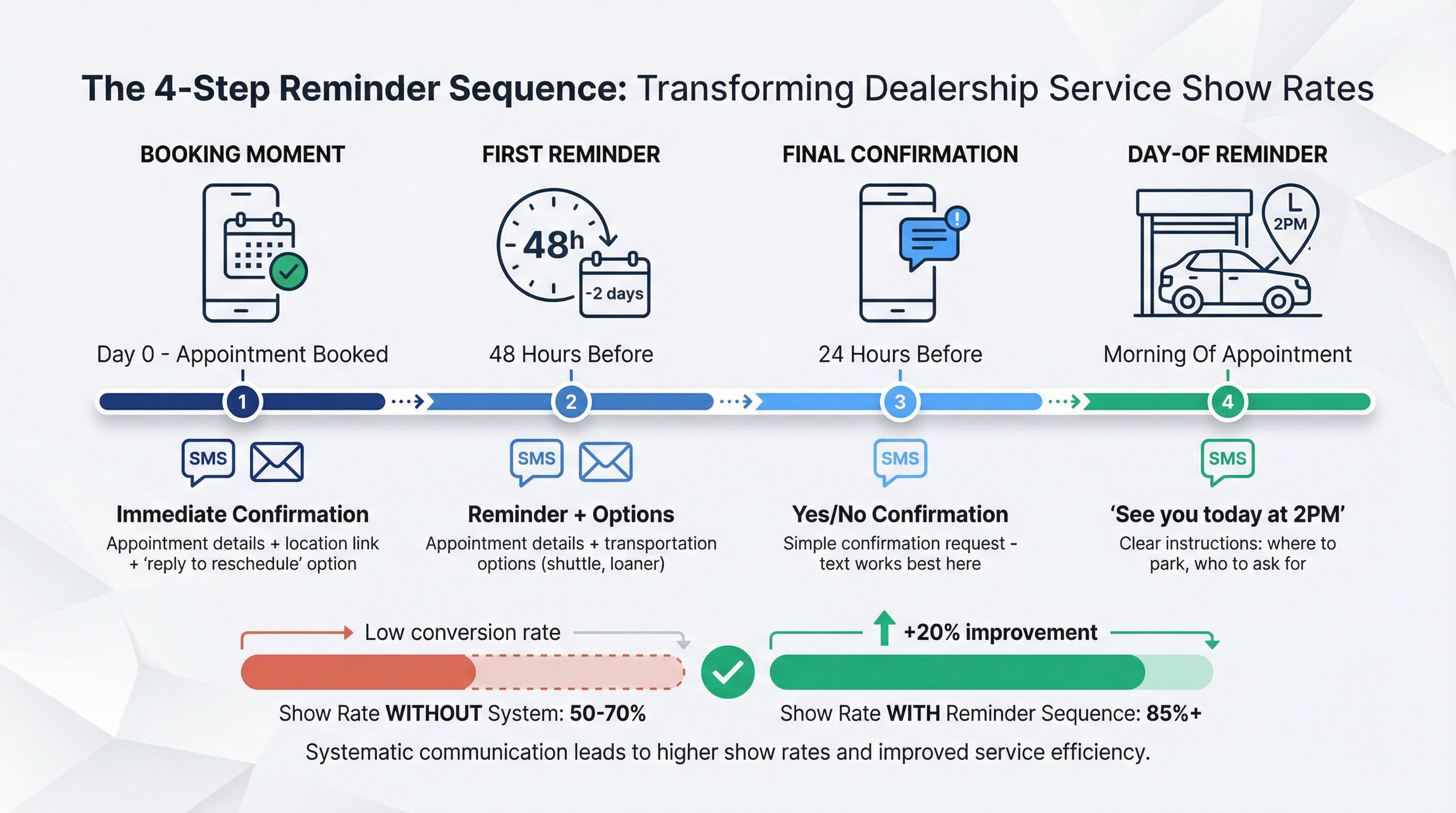
The Reminder Sequence That Boosts Show Rates by 20%+
As soon as an appointment books:
Immediate: Confirmation via text and email with appointment details, location link, and “reply to reschedule” option
48 hours prior: Reminder with appointment details and transportation options (shuttle, loaner, etc.)
24 hours prior: Final reminder (text works best here) with simple yes/no confirmation
Morning of: “See you today at 2PM” message with clear instructions (where to park, who to ask for)
Simple reminder texts can raise show rates dramatically because people genuinely forget. A text nudge saves the appointment.
How to Make Rescheduling Easy (So Customers Don’t Ghost)
Life happens. Rather than no-shows, encourage early rescheduling. Every reminder should include: “Need to change your appointment? Reply or call us.”
Customers who can reschedule easily remain customers. Those who feel trapped might ghost the appointment entirely.
How to Salvage No-Show Appointments
When someone doesn’t show, reach out within 10 minutes:
“Hey [Name], we had you scheduled today and didn’t see you. Everything okay? Want me to grab you the next available slot?”
Salvage rates on same-day follow-up are surprisingly high. Many no-shows are miscommunications, not intentional.
How to Increase Service Department Capacity
Sometimes the limiter isn’t demand. It’s your ability to accommodate it.
How to Reduce Wait Time for Service Appointments
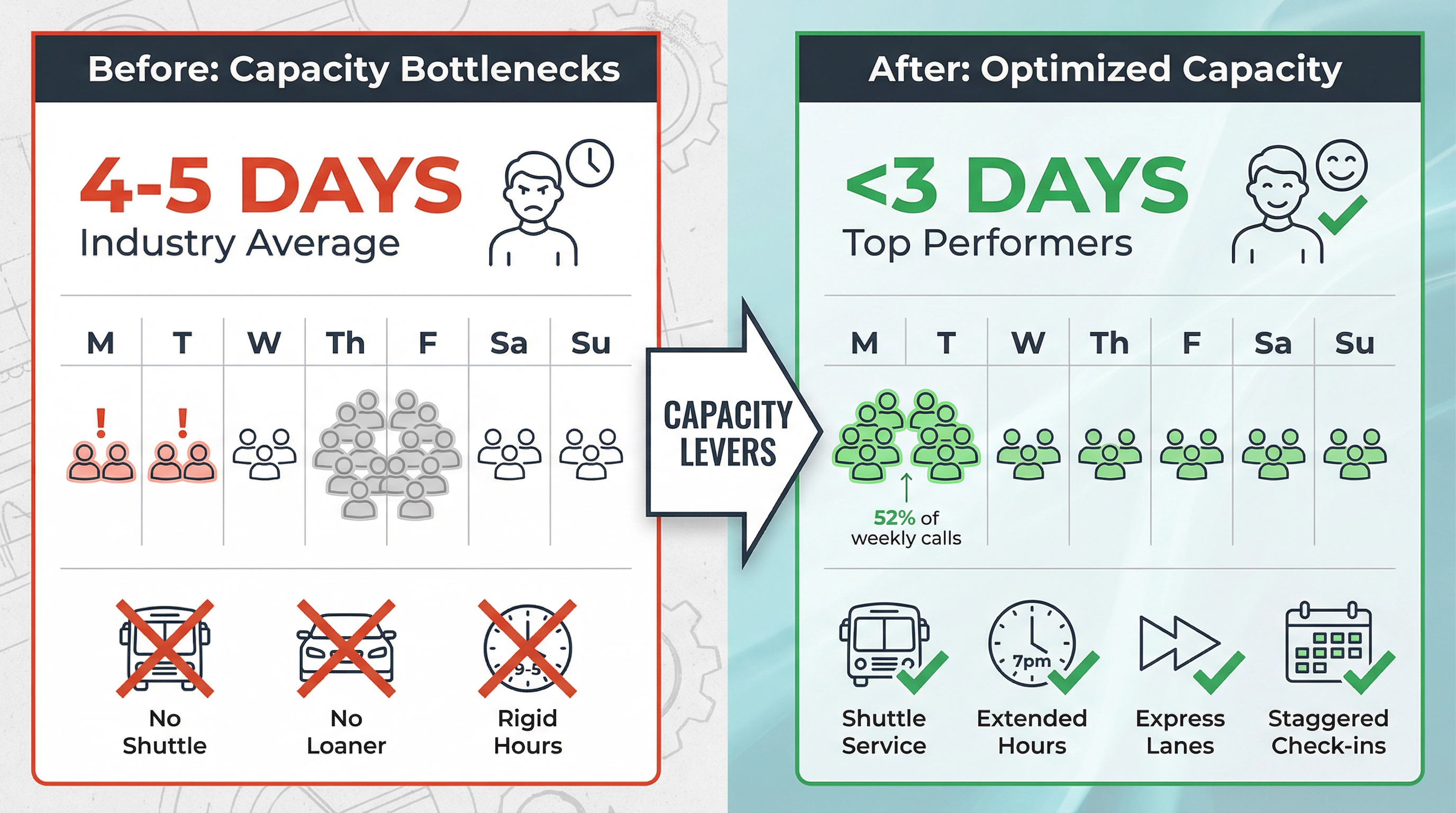
Industry average wait time is 4 days. Top dealer groups average 3 days or less.
When a customer calls Monday needing service and you’re booked until next week, there’s a real risk they shop around. Competitors quoting next-day appointments win by default.
Capacity levers to pull:
- Extend hours slightly (one late evening per week captures customers who can’t come during regular hours)
- Add Saturday morning slots if not currently open
- Create express lanes for quick services (oil changes shouldn’t consume full appointment slots)
- Use staggered check-ins instead of 8AM pile-ups
How to Match Staffing to Service Call Patterns
Industry data shows Mondays and Tuesdays account for 52% of weekly service calls, with peak volume 8:00 to 11:30AM.
If you staff flat across the week, you’re either overstaffed Thursday afternoon or drowning Monday morning. Neither is optimal.
Consider flex staffing, part-time help during peaks, or shifting an advisor’s schedule to cover high-volume windows.
Convenience Features That Drive More Service Appointments
Customers book where it’s easy. Offering shuttle service, loaners, or pickup/delivery removes friction.
Some luxury dealers implementing valet pickup/dropoff see appointment volume spike because busy professionals suddenly can get service without disrupting their day.
Even basic shuttle service matters. “We’ll get you to work and pick you up when your car’s ready” converts hesitant bookers into confirmed appointments.
How to Get Service Customers to Come Back
The most sustainable appointment growth comes from retention. One-time customers are expensive. Repeat customers are profitable.
Why Service Experience Drives Future Appointments
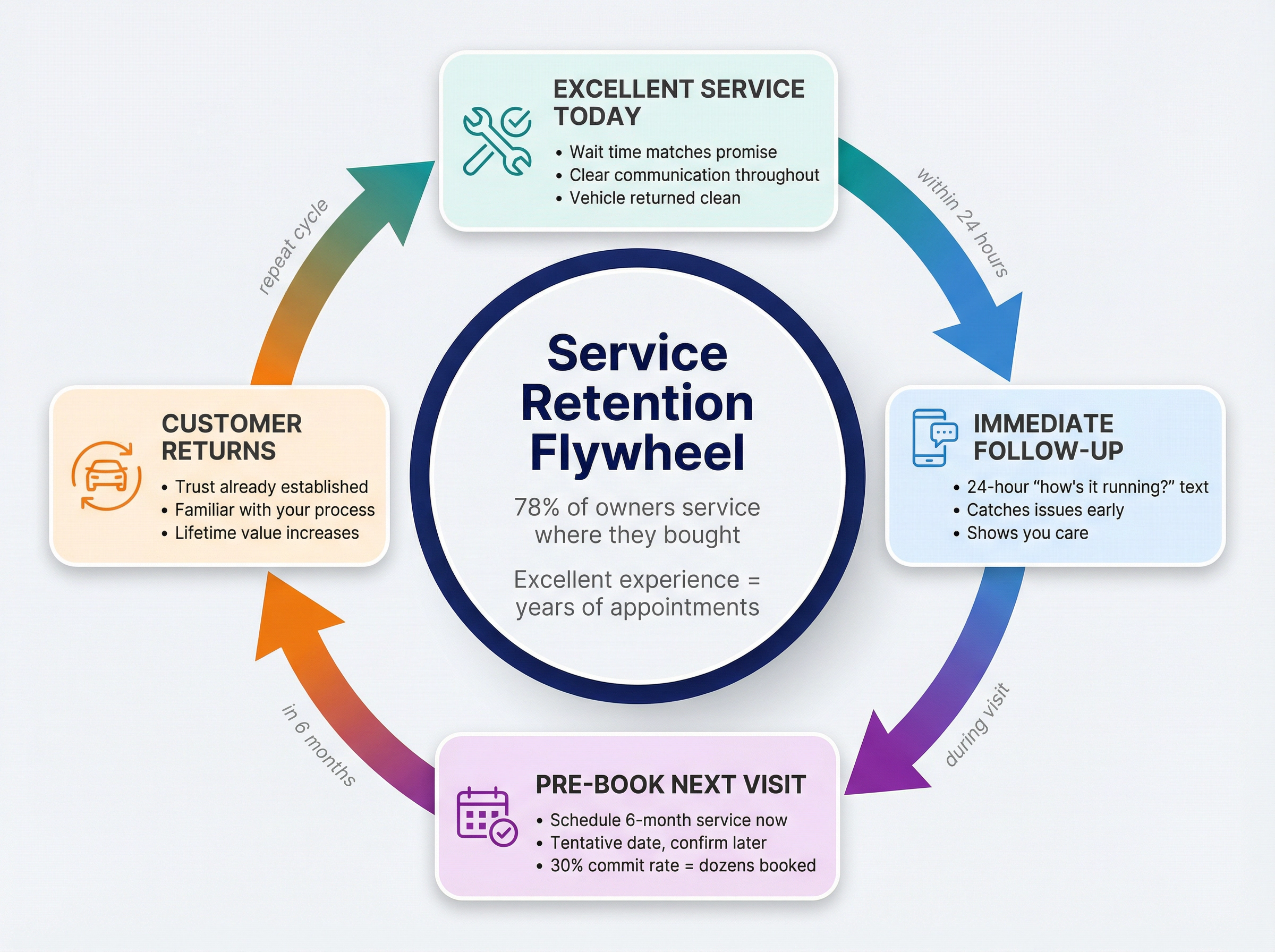
Customer satisfaction research shows 78% of car owners service at the dealership where they bought, and positive service experiences dramatically increase likelihood of buying the next vehicle there too.
The math is simple: excellent service today generates appointments for years.
Track these experience drivers:
- Wait time (actual vs. promised)
- Communication during service (updates if taking longer, explaining recommendations clearly)
- Vehicle cleanliness on delivery
- Accurate estimates
Small details compound. A quick “we just started on your vehicle, should be done by 2PM as expected” text reduces anxiety and builds trust.
How to Pre-Book the Next Service Appointment
Dental offices do this routinely. Service departments should too.
After a 30,000-mile service: “Your next maintenance is in 6 months or 5,000 miles. Let’s tentatively schedule that now for April. We’ll confirm as it gets closer.”
Many customers appreciate this. Even if 30% commit, that’s dozens of pre-booked appointments that otherwise would require outbound calls or wait for the customer to remember.
The Post-Service Follow-Up That Builds Loyalty
A simple text 24 hours later: “Thanks for trusting us with your vehicle. Everything running well?”
This catches issues early (before they become bad reviews) and leaves a positive impression. Customers who feel appreciated return more often.
AI automation handles this automatically. After every appointment, the system sends follow-up messages, tracks responses, and can even schedule the next service based on customer replies.
Service Appointment Metrics That Matter
Track improvements through these KPIs:
| Metric | Typical Before | Target After |
|---|---|---|
| Call answer rate | 65% | 95%+ |
| Speed to answer | 3+ minutes | <40 seconds |
| Mission failures | 13% | <2% |
| Show rate | 50 to 70% | 85%+ |
| Days to next slot | 4 to 5 days | <3 days |
| After-hours capture | 0% | 80%+ |
Even modest improvements across these metrics compound into substantial revenue gains. A store improving answer rate from 65% to 90% while boosting show rates from 65% to 85% can see 30 to 40% more completed appointments without additional marketing spend.
When to Use AI vs Humans for Service Scheduling
AI isn’t a magic fix, but it’s becoming essential for coverage gaps.
When AI makes sense vs. when you still need humans:
| Situation | Best Solution |
|---|---|
| After-hours coverage (humans can't be there 24/7) | AI |
| Overflow during peak periods (everyone's busy, but calls keep coming) | AI |
| Outbound campaigns at scale (recalls, due service reminders) | AI |
| Routine scheduling that doesn't need human judgment | AI |
| Complex diagnostics discussions | Humans |
| Warranty disputes | Humans |
| High-value customer relationships | Humans |
| Edge cases AI can't handle | Humans |
Research from 2025 shows AI booking rates approaching human performance (86% vs. 90%), and when AI can’t handle something, it should warm-transfer to humans with context.
The key: AI shouldn’t replace good service. It should ensure nobody falls through the cracks.
Dealerships using AI voice solutions typically see them as an “always-on BDC.” The AI handles the volume (thousands of calls), and your team focuses on in-person customers and complex situations. It’s not one or the other. It’s both working together.
Your 90-Day Action Plan to Increase Service Appointments
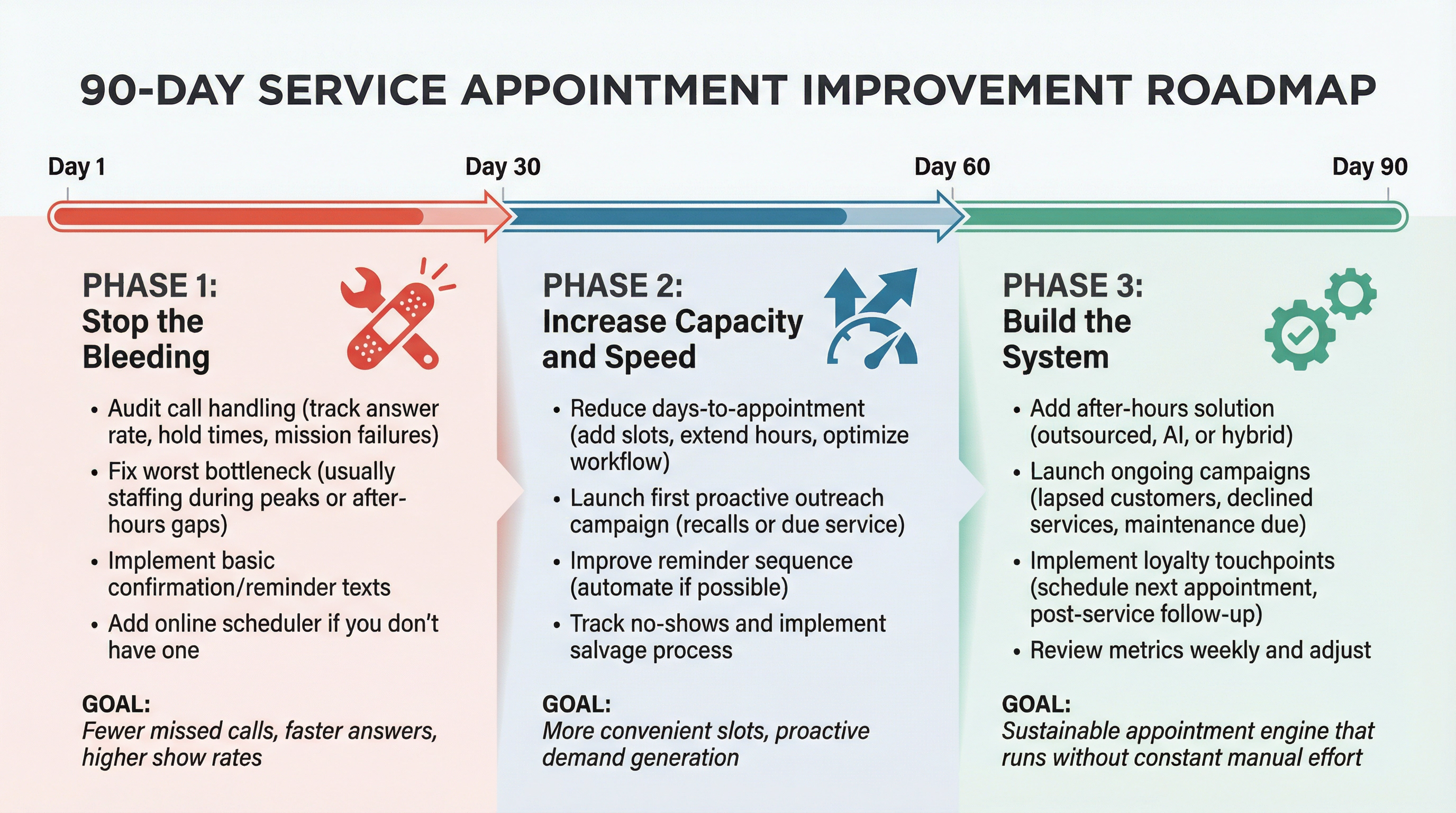
Days 1 to 30: Stop the bleeding
- Audit call handling (track answer rate, hold times, mission failures)
- Fix worst bottleneck (usually staffing during peaks or after-hours gaps)
- Implement basic confirmation/reminder texts
- Add online scheduler if you don’t have one
Goal: Fewer missed calls, faster answers, higher show rates
Days 31 to 60: Increase capacity and speed
- Reduce days-to-appointment (add slots, extend hours, optimize workflow)
- Launch first proactive outreach campaign (recalls or due service)
- Improve reminder sequence (automate if possible)
- Track no-shows and implement salvage process
Goal: More convenient slots, proactive demand generation
Days 61 to 90: Build the system
- Add after-hours solution (outsourced, AI, or hybrid)
- Launch ongoing campaigns (lapsed customers, declined services, maintenance due)
- Implement loyalty touchpoints (schedule next appointment, post-service follow-up)
- Review metrics weekly and adjust
Goal: Sustainable appointment engine that runs without constant manual effort
Service Appointment FAQs
How much does missed call recovery really impact revenue?
Industry research estimates dealerships miss 158 calls monthly on average, translating to $1.17 million in lost annual revenue per dealership. Capturing even half of those missed calls adds $500K+ yearly. The ROI on phone coverage improvements (whether AI, staffing, or outsourced) typically pays back within 60 to 90 days.
What’s the actual success rate of AI scheduling vs. humans?
Pied Piper’s 2025 study found AI handled 91% of service calls successfully, with appointment booking at 86% vs. 90% for humans. That 4-point gap narrows when considering AI answers every call instantly, while humans miss 30%+ during busy periods. The coverage advantage typically outweighs the conversion difference.
Does online scheduling actually reduce phone volume?
Yes, but not as dramatically as you might expect. Customer preference data shows 64% still prefer calling for service appointments. Online scheduling captures the other 36% who prefer self-service, plus after-hours demand. One dealer saw 35% phone reduction after adding text and online, but calls didn’t disappear entirely. Think of it as expanding capacity across channels, not replacing phones.
How can I improve show rates without annoying customers?
Research indicates customers want reminders because they genuinely forget. A confirmation immediately after booking, reminder 48 hours prior, and final text 24 hours before is helpful, not annoying. The key is making rescheduling easy (“reply to change”) rather than trapping them. Stores using this sequence see show rates jump from 60 to 70% to 85%+.
What’s the fastest way to increase appointments this month?
Fix your phones first. If you’re missing 30% of calls due to holds, voicemail, or after-hours gaps, that’s the highest-leverage fix. Dealerships implementing 24/7 coverage report 50+ additional monthly appointments within the first month. Everything else (online scheduling, outbound campaigns, reminders) compounds over time, but phone fixes deliver immediate results.
How do I justify the cost of AI or additional staff?
Calculate your current leak. If you miss 56% of after-hours leads (industry average) and handle 100 after-hours calls monthly, that’s 56 lost appointments. At $270 average RO (conservative), that’s $15,120 monthly, or $181,440 annually. Most AI solutions cost a fraction of that. ROI is straightforward: every 10 recovered appointments typically pays for the entire system.

What if my service department is already at capacity?
Capacity constraints are good problems (real demand exists). But turning customers away loses them permanently. Short term: optimize scheduling (stagger appointments, add express lanes, extend hours slightly). Medium term: hire techs or cross-train. Long term: expansion. Meanwhile, capture appointments for later dates rather than losing customers entirely. Even booking 5 days out beats “we’re full, call back later.”
How important are recalls for driving appointments?
Very. Recall ROs average $695 vs. $335 for non-recall work, and recall customers often approve additional maintenance. But completion rates average only 75%, meaning 25% of recall opportunities go uncaptured. Proactive outreach (calls, texts, automated campaigns) can push that completion rate to 90%+, adding dozens of high-value appointments monthly.
Can I implement these changes without dedicated BDC staff?
Yes, though some tactics require coordination. Service advisors can handle inbound scheduling during business hours if call volume is manageable. For after-hours, weekends, and overflow, you’ll need a solution (AI, outsourced, or rotating staff coverage). Outbound campaigns work best with dedicated time, even if it’s one advisor spending 30 minutes daily on calls. The key is consistency, not necessarily headcount.
How can AI voice agents help with these strategies specifically?
AI BDC platforms handle the coverage gaps that lose appointments:
- Answers every call in under 3 seconds (no holds, no voicemail, no missed calls)
- Books appointments directly into your DMS/scheduler with real-time availability
- Manages text, email, and phone across all channels, maintaining context
- Runs outbound campaigns (recalls, due service, lapsed customers) automatically
- Sends reminders and follow-ups to boost show rates
- Works 24/7, covering after-hours and overflow when your team is busy

The Freeman Lexus case study shows the impact: 1,100 calls handled, zero missed, 376 appointments booked at 88% conversion, generating $100,000 in estimated profit in one month. That’s AI voice technology working end-to-end.
The Bottom Line on Increasing Service Appointments

Most dealerships don’t have a demand problem. They have a capture problem.
Customers call, but nobody answers. They try to book online, but the tool is buried or broken. They need after-hours service, but you’re closed. They forget appointments because reminders are inconsistent.
Each friction point bleeds revenue.
The good news? Every friction point is fixable. Not with massive capital investment or total reorganization. With systematic improvements to how you handle phones, schedule appointments, and communicate with customers.
Start with phones. Get your answer rate to 95%+. Eliminate long holds. Cover after-hours. This alone will recover 30 to 40% more appointments in most stores.
Then add convenience. Online scheduling. Text options. Faster appointment availability. Make booking easy.
Then get proactive. Outbound recall campaigns. Due maintenance reminders. Lapsed customer outreach. Create demand instead of waiting for it.
Then optimize the funnel. Better reminders for higher show rates. Post-service follow-up for retention. Loyalty programs to keep customers returning.
The dealerships winning in service aren’t doing anything magical. They’re just not losing the appointments that most stores leak every day. They answer every call, make booking simple, and follow up consistently.
That consistency compounds into packed service bays, better CSI scores, and substantially more profit.
Your service bays should be packed. Now you know how to make that happen.