Call Center Overflow Solutions for Car Dealerships, Compared
Stop losing $853K annually from missed calls. Compare call overflow solutions for dealerships and learn how AI handles every call 24/7 in 2026.
Your dealership phone is probably ringing right now. Maybe it’s a service customer ready to book that 10,000-mile maintenance. Maybe it’s someone calling about the vehicle they saw online. Or maybe it’s sitting in voicemail because every staff member is already helping someone else.
Call overflow isn’t just an inconvenience. It’s revenue walking out the door.

When phones ring but nobody answers, customers don’t wait patiently. Research shows that 60% of callers hang up after just one minute on hold, and about 32% won’t wait at all. In the dealership world, where switching costs are near zero, that frustrated caller is probably dialing your competitor within 30 minutes.
The stakes are real. Recent analysis found that average dealerships miss about 158 service calls per month, translating to roughly $853,000 in annual revenue lost. Top-quartile stores are missing even more because they’re busier.
This isn’t a staffing problem you can train your way out of. It’s a system design problem. And in 2026, you have better options than ever before.
What Is Call Center Overflow and Why Dealerships Struggle With It
Call center overflow — sometimes shortened to just *call overflow* — happens when more customers are trying to reach your dealership than your team can answer in an acceptable timeframe. It’s not one moment of chaos. It’s a recurring operating condition that looks different throughout your day.
Peak-time overload hits hardest during predictable windows. Monday mornings between 8-11 AM when service appointment calls surge. The lunch hour when half your team is away. End-of-day rushes. Industry data shows that over 50% of weekly service calls come in by Tuesday in many stores.
After-hours demand creates another gap entirely. Most dealerships are open roughly 9-to-7 on weekdays with limited weekend hours, yet industry research indicates that a majority of dealership leads arrive outside business hours. Without coverage, all those calls end up in voicemail.
The third problem is staff focusing on in-person customers. Service advisors are on the drive with a customer while their desk phone rings. Salespeople are out on test drives. Even receptionists get pulled into tasks. When someone is face-to-face with a customer, the ringing phone becomes second priority.
Your goal isn’t to answer every call with a human. Your goal is to ensure every call gets handled in a way that preserves the customer’s intent and produces an outcome. That might be a booked appointment, a warm transfer, or a callback that actually happens.
Why Traditional Solutions Keep Failing
Most dealerships have tried the obvious fixes. They’ve added staff, set up phone trees, or outsourced to call centers. These approaches help, but they all hit the same fundamental limits.

Why Hiring More Staff Won’t Solve Call Overflow
You can’t hire three extra receptionists just to cover a one-hour daily spike. Even with a BDC, overflow still happens when volume temporarily exceeds capacity. One luxury dealer noted that before fixing overflow, staff across all departments were constantly interrupted by ringing lines, which hurt both call handling and the in-person experience.
The math is brutal. When your team utilization hits 80-95%, a small spike creates a queue. Once a queue forms, hold times rise, callers hang up, and your staff spends the rest of the day in catch-up mode.
Why IVR Phone Systems Don’t Fix Call Overflow
IVRs help route calls to the right department, but they can’t answer detailed questions or book appointments. If the call gets routed to a department where everyone is busy, the customer still ends up waiting or in voicemail.
And customers hate complex phone trees. You don’t want them solving your org chart just to schedule service.
Why Outsourced Call Centers Miss Appointments
The biggest issue with traditional outsourced services: many can’t actually book appointments in your real scheduler. They collect information and promise callbacks, which turns them into expensive voicemail. If the agent can’t access your scheduling system with your rules, conversion suffers because those “perishable” callers won’t wait for a callback.
Studies show that 63% of consumers prefer a callback rather than staying on hold. But if that callback takes hours or lacks context, you’ve just wasted the customer’s patience twice.
The Real Cost of Missed Calls
Let’s talk numbers because this is where call overflow stops being an operations issue and becomes a revenue issue.
| Performance Tier | Missed Service Calls/Month | Lost Revenue per Year |
|---|---|---|
| Top quartile stores | ~216 calls | Over $1.1 million |
| Average dealerships | ~158 calls | ~$853,000 |
| Even 8 missed calls/day | ~240 calls | ~$48,000/month |
What makes it worse: these numbers only account for service calls. They don’t include lost sales opportunities, parts inquiries, or the compounding effect on customer loyalty.
When a customer calls and can’t get through, they:
→ Call a competitor (70% within 30 minutes based on automotive data)
→ Never return for service (franchise dealers were handling 12% fewer service visits in 2025 than in 2018)
→ Buy their next vehicle elsewhere (customers who service at the dealer are 74% more likely to buy there)
You’re not just losing today’s appointment. You’re leaking the future sales funnel.
The Five Call Overflow Solutions That Actually Work
How to Optimize Your Dealership Phone System Routing
Your phone system has capabilities you’re probably not using. Hunt groups, ring groups, skills-based routing, time-of-day rules, and overflow thresholds can dramatically improve how calls flow through your dealership.
| Aspect | Reality Check |
|---|---|
| When it works | You have enough trained people to answer if calls are routed cleanly. Your main issue is calls landing in the wrong place. |
| Where it breaks | Routing can't create capacity. It can only redistribute it. A cleaner queue is still a queue if everyone is busy. |
Best practices:
- Keep IVR short and simple
- Set overflow rules based on time-to-answer thresholds (20-30 seconds max)
- Add hard failover paths so calls never hit dead ends
- Always include an option to reach “the next available person”
How to Use Virtual Hold and Callbacks to Reduce Abandonment
Instead of making customers sit on hold, offer them a callback. Consumer research shows that the majority of consumers prefer a scheduled callback over waiting on hold, and many will hang up within minutes anyway.
| Aspect | Virtual Hold/Callback |
|---|---|
| When it works | Your bottleneck is temporary peaks, not chronic understaffing, and you can reliably fulfill callbacks with context and speed |
| Where it breaks | If callbacks are late or lack context, it becomes voicemail with extra steps |
| Dealership rule | Confirm via SMS, capture reason + preferred time, create a task someone is measured on |
Should You Expand Your BDC to Handle Call Overflow?
A Business Development Center with staff dedicated solely to handling calls can dramatically improve answer rates during business hours.
(1) The Advantage:
Top-performing dealerships achieve 80-85%+ call connection rates versus the ~65% industry average.
(2) The Reality Check:
People are expensive and don’t scale infinitely. You can’t realistically staff 24/7 internally unless you’re running a round-the-clock contact center.
(3) The Hidden Challenge:
If you finally answer every call but your scheduling and capacity management are sloppy, you can book more appointments than your shop can deliver smoothly. That hurts CSI in a different way.
How to Choose an Outsourced Call Center for Your Dealership
Third-party call centers can handle overflow and after-hours calls when your internal team is unavailable. Some specialize in automotive and can book service appointments directly.
When it works: You need 24/7 coverage fast, your calls are mostly simple scheduling and FAQs, and you have a clean process for handoffs.
Where it breaks: Unless the service integrates with your scheduler, they degrade into message-taking. Quality varies by agent turnover and training. If they can’t book directly in your system with your rules, conversion suffers.
Key question to ask: Can they book in your real scheduler (CDK, Reynolds, Xtime, etc.) with your actual availability and rules, or are they just collecting info for callbacks?
How AI Voice Agents Handle Call Overflow 24/7
This is where things get interesting. Modern AI voice agents can answer every call instantly, handle multiple simultaneous conversations, and actually book appointments in your scheduling system.
When it works:
- You need elastic capacity (10 calls at once is fine)
- You want after-hours booking instead of message-taking
- You want consistent handling with full reporting
Where it breaks:
- If the system can’t integrate with your scheduler and CRM
- If escalation is clumsy
- If the voice quality feels robotic
How AI Solves Call Overflow Differently Than Traditional Methods
We built Flai specifically for dealerships because we saw the same problems everywhere: calls going to voicemail, customers on hold, staff overwhelmed, and opportunities slipping away.
Our AI communications platform acts as a 24/7 front desk assistant that answers every call instantly, books appointments directly into your scheduler, and handles overflow without ever putting customers on hold.
Why AI Booking Outperforms Traditional Call Centers
We actually book appointments. Our platform integrates directly with your DMS, CRM, and scheduling system. When a customer calls to schedule service, the AI checks real availability, books the appointment, confirms the details, and writes it back into your systems. No message-taking. No callbacks required.
We handle unlimited simultaneous calls. If 10 customers call at once during a Monday morning rush, the system spins up 10 parallel conversations. No busy signals. No hold music. Every caller gets immediate attention.
We work after hours when you’re closed. Industry research shows that a majority of dealership leads arrive outside business hours, yet most stores have no coverage at night. Our AI answers every call at 11 PM just as professionally as at 11 AM.
We speak any language automatically. In diverse markets, multilingual handling isn’t a bonus. It’s essential. The system detects what language the customer is speaking and responds naturally.
Call Overflow Case Studies: Real Dealership Results
Freeman Lexus used our AI platform to cover after-hours and overflow calls. They captured 1,100 calls that would have gone to voicemail, converted 88% of bookable opportunities into actual appointments, and saw approximately $100,000 in incremental profit.
San Leandro CDJR moved from service advisors juggling phones to AI handling all calls. In 30 days, we handled 1,563 calls, booked 304 appointments, and generated $83,000 in profit impact.

Glendale Infiniti deployed our AI solution as a full receptionist across their entire dealership. They now handle 1,800+ calls per month with zero missed calls, freeing up 20% of staff time that used to be spent on phones.

These aren’t isolated success stories. They’re examples of what happens when you eliminate the bottleneck entirely.
How to Build a Call Overflow Strategy for Your Dealership
The best approach usually combines multiple solutions. Here’s how to think about it:
How to Analyze Your Dealership Call Patterns
Pull 30 days of call data and identify your worst three hours of the week. Look for:
→ Peak 15-minute windows when calls spike
→ Missed call patterns and abandonment rates
→ Transfer failure patterns
→ After-hours volume
What Call Center Metrics Should Dealerships Track?
Pick metrics that match your brand:
[Table 4]
How to Combine Multiple Call Overflow Solutions
Business hours: Optimized routing + trained BDC + virtual hold options
Overflow periods: AI handling or outsourced service that can actually book
After-hours: AI coverage or specialized answering service with scheduler access
Complex escalations: Clear paths to transfer to humans with context
Why System Integration Is Critical for Call Overflow Solutions
Overflow without integration becomes expensive message-taking. Your solution must connect to:
(1) Your scheduler for service and test drives
(2) Your CRM for lead capture and follow-up
(3) Your phone system for seamless routing
How to Track and Improve Your Call Answer Rate
Track these KPIs weekly:
- Answer rate and speed to answer
- Transfer success rate
- Appointment set rate and show rate
- Profit per booked appointment
Use the data to continuously refine. If abandonment is still high, calls might be routing incorrectly. If appointment conversion is low, your team (or AI) might not be offering appointments consistently.
Common Mistakes to Avoid
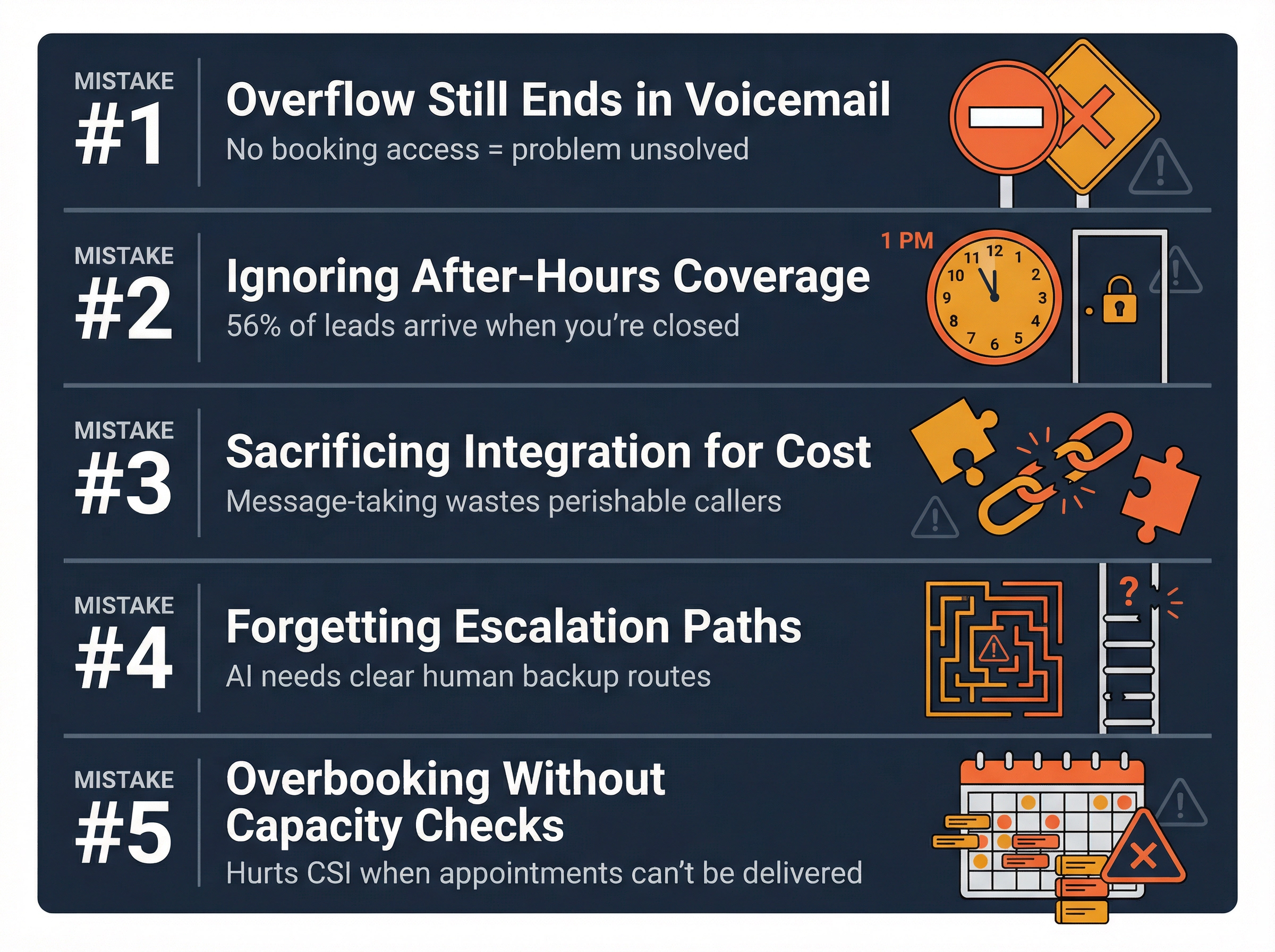
Don’t let “overflow” still end in voicemail. If your solution can’t handle the call or doesn’t have booking access, you haven’t solved the problem.
Don’t ignore after-hours. More than half your opportunities come when you’re closed. That gap is costing you hundreds of thousands annually.
Don’t sacrifice integration for cost. A cheap service that just takes messages wastes those perishable callers who won’t wait for callbacks.
Don’t forget about escalation paths. Even the best AI needs a clear way to involve humans for complex or emotional situations.
Don’t overbook without capacity visibility. Answering every call is great, but booking appointments you can’t deliver hurts CSI in a different way.
How Customer Expectations Changed Dealership Call Handling in 2026
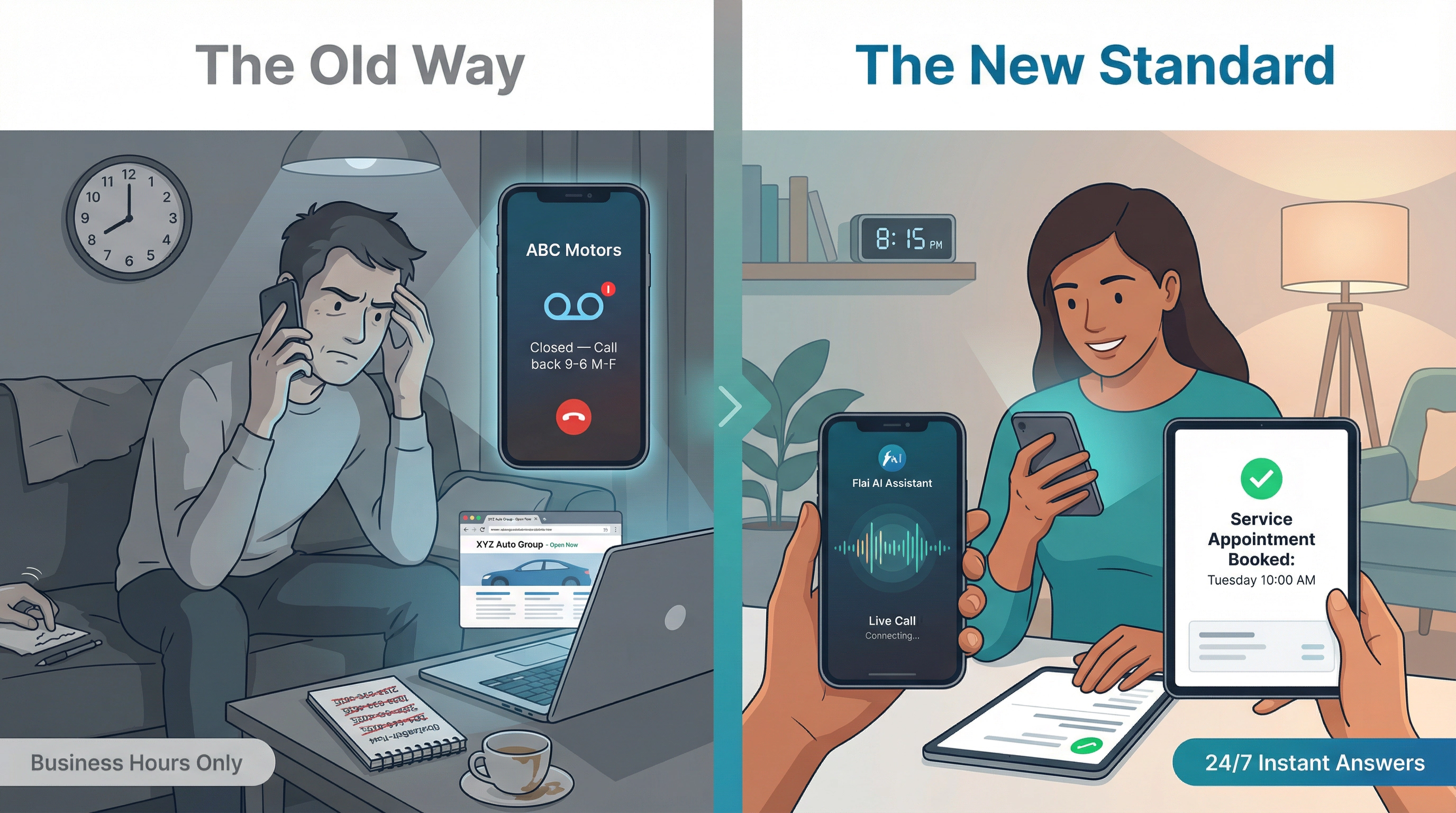
Your customers expect instant answers and easy scheduling. They don’t care that your team is busy or that it’s Sunday evening. They have a question or need service, and if you can’t help them right now, someone else will.
Google has tested features where AI can call local businesses to ask for pricing and availability. The direction is clear: customers expect instant answers, and your overflow strategy is actually your customer experience moat.
Dealerships that embrace modern call handling solutions are turning what was once a weakness into a competitive strength. By never missing a call, you’re effectively never missing a customer.
How to Get Started with Call Overflow Solutions Today
If you want to fix call overflow this month, start here:
(1) Audit your current state. Pull call data for the last 30 days. Identify missed calls, hold times, and abandonment patterns.
(2) Calculate your cost. If you’re missing 150 calls per month at $250 profit per appointment, even a 20% recovery rate is $7,500 monthly.
(3) Pick your biggest gap. Is it after-hours? Peak-time overflow? All of the above?
(4) Choose solutions that can actually book. Whether it’s AI, outsourced BDC, or expanded internal team, integration with your scheduler is non-negotiable.
(5) Start with one department and measure. Service usually has highest ROI. Track results weekly and refine.

At Flai, we’ve helped dozens of dealerships solve call overflow by handling thousands of calls and booking thousands of appointments. Our platform works 24/7, never puts customers on hold, and integrates directly with your existing systems.
Because in 2026, every missed call is a missed opportunity. And you don’t have to miss any of them.
Learn more about how we can help your dealership or read our latest insights on the blog.
Frequently Asked Questions
What is call overflow in a dealership context?
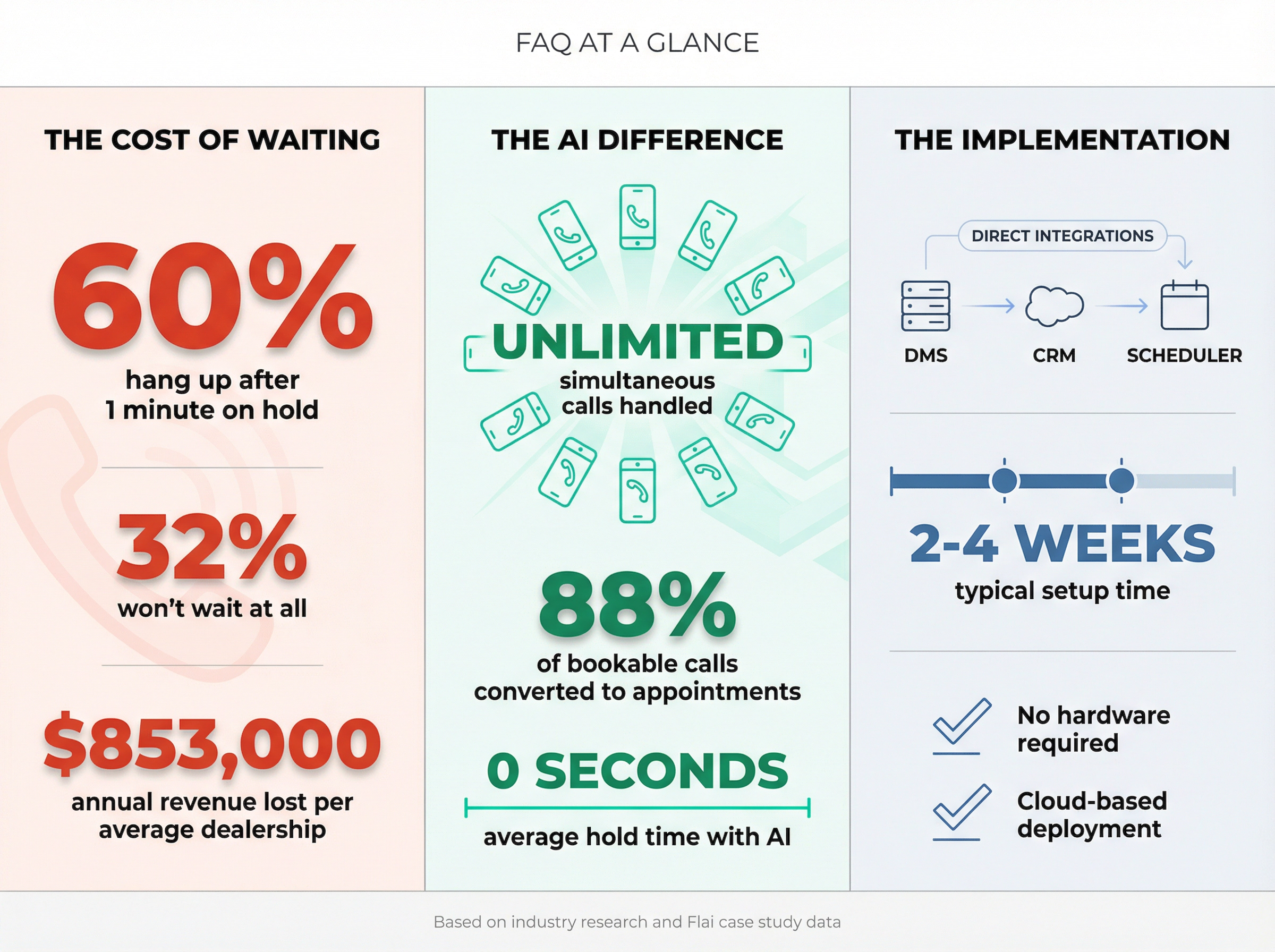
Call overflow happens when your dealership receives more inbound calls than your available staff can answer within an acceptable timeframe. This includes peak-time spikes (Monday mornings, lunch hours), after-hours calls when you’re closed, and situations where your team is tied up with in-person customers. The result is customers on hold, in voicemail, or hanging up to call competitors.
How much revenue do dealerships lose from missed calls?
Analysis of dealerships found that average stores miss about 158 service calls per month, translating to roughly $853,000 in annual lost revenue. Top-quartile dealerships miss around 216 calls monthly, representing over $1.1 million per year. These figures only account for service calls and don’t include lost sales opportunities or the long-term impact on customer retention.
What’s the Difference Between Answering Services and AI Call Solutions?
Traditional answering services typically take messages or provide basic information but can’t access your systems to book appointments. They’re essentially expensive voicemail. Modern AI solutions integrate directly with your DMS, CRM, and scheduler to actually complete transactions. They book appointments in real-time, confirm details, and sync everything to your systems without requiring callbacks.
How quickly do customers hang up when placed on hold?
Consumer research shows that 60% of callers hang up after just one minute on hold, and 32% won’t wait at all. In the dealership world, industry data shows an average hold time of over 3 minutes, with 31.8% of callers abandoning while on hold. When customers hit voicemail, 70% call a competitor within 30 minutes.
Can AI voice agents handle multiple calls simultaneously?
Yes, and this is one of their key advantages. AI systems can handle unlimited parallel conversations. If 10 customers call at once during a morning rush, the system spins up 10 simultaneous voice sessions. Every caller gets immediate attention without busy signals or hold queues. This elastic scalability is something no human BDC can match without massive staffing.
What happens when a call is too complex for AI to handle?
Quality AI systems recognize when they need human help and seamlessly transfer the call. The best platforms perform warm transfers, passing context to your team member so the customer doesn’t have to repeat themselves. For example, if a caller is upset or has a unique warranty question, the system immediately involves the appropriate person with full call context.
Do AI Call Systems Integrate with Dealership DMS Software?
Yes. Leading AI platforms integrate with major scheduling platforms, DMS systems, and CRMs used by dealerships. They check real-time availability in your scheduler, book appointments according to your rules, and write everything back to your systems. No hardware installation required - everything works through cloud phone integration.
How long does it take to set up an AI overflow solution?
Setup typically takes 2-4 weeks and involves integrating with your systems, customizing call flows for your dealership’s needs, and training the AI on your specific processes. The technical work is handled by the provider while your team focuses on defining how different call types should be handled. Many dealerships start with after-hours coverage or one department before expanding to full deployment.