Dealership Customer Experience Statistics (2026)
Dealership customer experience stats that matter in 2026. Real numbers on phone performance, lead response, service retention, and what works.
Customer experience in dealerships isn’t a soft concept. It’s the mechanical system that converts demand into appointments, repair orders, and sold units. Every missed call, every voicemail, every customer sitting on hold is revenue walking out the door.
If you run service, sales, or operations at a dealership, you already know something’s not working. Phones ring unanswered. Leads disappear. Service customers defect to independent shops.
This guide gives you the numbers that matter: specific benchmarks for phone handling, lead response, service retention, in-store experience, and reputation management. We’ve pulled together the most recent data (2024-2025 research, reviewed in January 2026) and broken down what each number actually means for your operation.

Why Dealerships Are Losing Customers Through Experience Gaps
Most dealerships are hemorrhaging revenue through customer experience gaps they can’t even see.
The invisible losses happen in three places. First, the phone problem. Calls go to voicemail after hours, customers sit on hold during peak times, and by the time someone calls back, the customer has already called your competitor. Research shows that 56% of dealership leads arrive after business hours, and most stores have no real system to capture them. The cost? Over $1 million per year per store just from missed service calls.
Second, the lead response problem. Your marketing generates demand, but your internal processes lose it in the last ten yards. Leads don’t make it into the CRM. Follow-ups don’t happen. Responses arrive fast but contain nothing useful.
Third, the service retention crisis. Customers who bought from you aren’t coming back for service, and when they don’t come back for service, they won’t buy their next vehicle from you either.
The dealerships that will win in 2026 aren’t necessarily the ones with the biggest marketing budgets. They’re the ones that answer every call, respond to every lead with substance, and keep service customers coming back.
Dealership Phone Performance Statistics and Benchmarks
Your phone system is probably the single biggest revenue leak in your dealership. A phone call is high intent plus high urgency. Service customers need a time slot. Sales leads want confirmation about availability or pricing. They’re ready to act now. But if your system adds friction, the switching cost is zero. They can call the next dealership in seconds.
How Long Will Customers Wait on Hold Before Hanging Up?
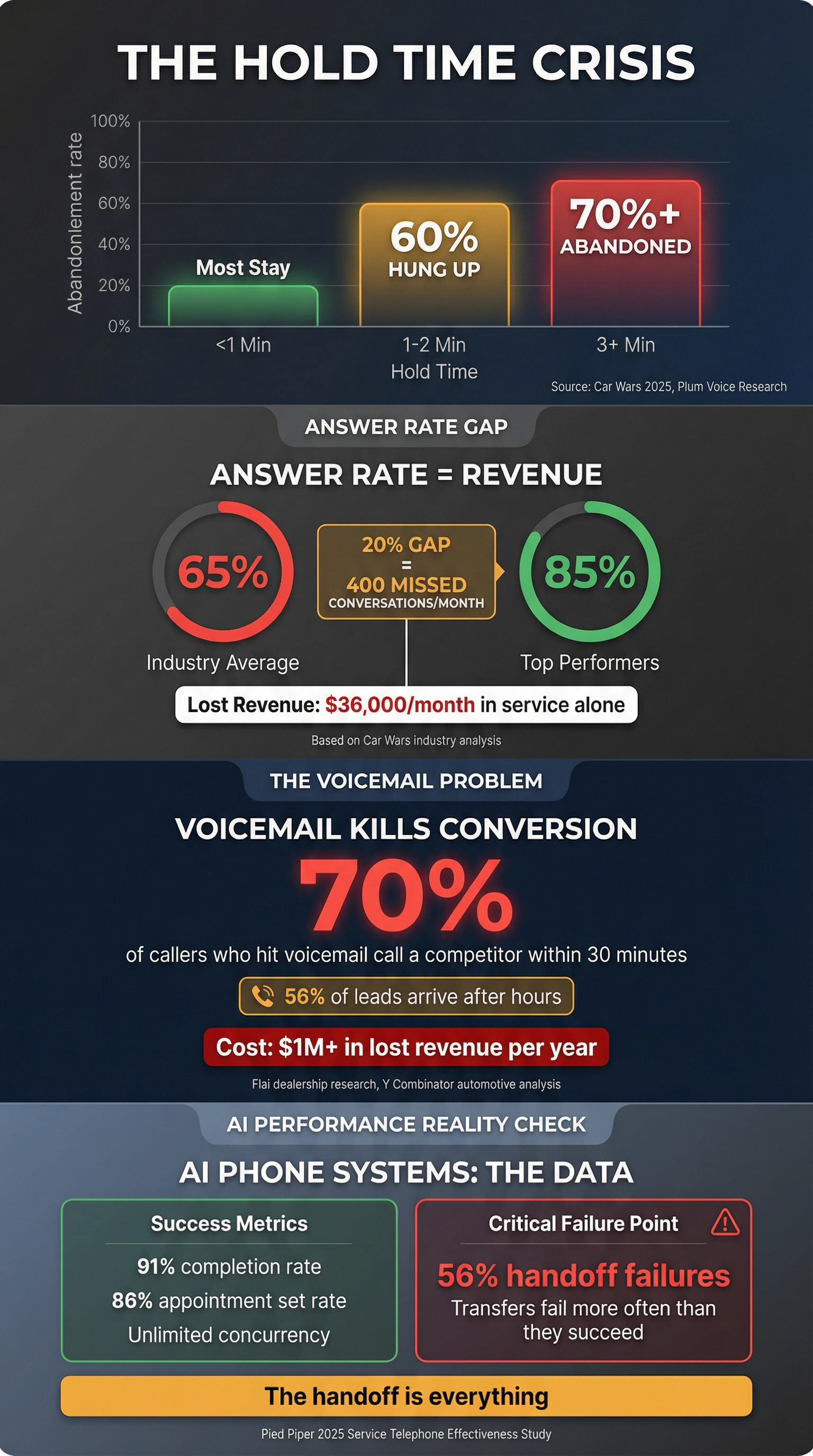
Industry phone performance data from Car Wars, released in early 2025, found the average hold time was 3 minutes and 5 seconds. The consequences: 31.8% of callers who weren’t connected to a person hung up while on hold.
It gets worse. Research from Plum Voice found that almost 60% of customers will hang up if they’re on hold for one minute, and about one-third won’t wait at all.
| Hold Time | Customer Response |
|---|---|
| Under 1 minute | Most customers stay on the line |
| 1-2 minutes | 60% have already hung up |
| 3+ minutes | 70%+ have abandoned the call |
Every minute on hold exponentially increases the chance a customer simply gives up or dials a different dealership. This isn’t a patience problem. This is a system design problem.
What top dealers do differently: The best phone operations minimize holds entirely. They use overflow handling (human or AI voice agents) during peak windows, route calls intelligently, and treat “speed to answer” as a primary KPI. Pied Piper’s 2025 Service Telephone Effectiveness Study showed that calls with hold times longer than 2 minutes dropped to just 2% at top-performing stores (down from 13% industry-wide in 2024).
What Percentage of Dealership Calls Go Unanswered?
Most dealerships think they’re “pretty good” at answering calls. The data says otherwise. Industry analysis from Car Wars shows the average dealership connects with roughly 65% of inbound callers. One out of every three calls doesn’t reach a qualified person.
Top-performing dealerships achieve connection rates around 80-85%. If your store handles 500 calls per week and you’re at 65% vs 85%, that’s 100 additional conversations per week that top stores are having and you’re not.
The math is simple. Say 30% of those missed calls were bookable service appointments at $300 average ticket. That’s 120 lost appointments per month, or $36,000 in monthly service revenue just from improving your answer rate.
What causes the answer rate gap?
- Staff are busy with in-person customers
- Peak call volume overwhelms the team
- After-hours calls have no coverage
- Transfers fail and customers get dropped
Why Voicemail Is Costing Dealerships Money
Industry research on dealership call patterns found that 70% of people who hit voicemail will call a competitor within 30 minutes. By the time you return that voicemail three hours later (or the next morning), they’ve already booked with someone else.
Why? Customer intent is perishable. When someone decides “I need to schedule service,” that motivation has a short half-life. The first dealer who actually answers and handles the request wins.
The after-hours problem compounds this. 56% of dealership leads arrive after business hours. If your phones go straight to voicemail after 7pm, you’re effectively unavailable for the majority of incoming demand. Y Combinator estimates that missing after-hours calls alone costs the average dealership over $1 million in lost revenue per year.
Data from the Car Wars analysis shows that 32.3% of inbound calls that don’t reach a live person end up in voicemail. That’s nearly a third of your call volume going to a black hole that customers increasingly don’t trust.
Do AI Phone Systems Actually Work for Dealerships?
Given everything above, it’s no surprise that dealerships are turning to AI voice agents to handle calls.
Pied Piper’s 2025 Service Telephone Effectiveness Study measured dealerships using AI for service scheduling:
- AI completed interactions successfully 91% of the time
- Appointment set rate was 86% with AI versus 90% with human staff
- That 4-point gap is negligible when you consider AI handles unlimited concurrent calls
But most AI setups fall apart at handoffs: transfers failed 56% of the time. When the AI needed to transfer a caller to a human, the transfer didn’t complete successfully more often than it did.
If you deploy AI, your real KPI isn’t “does the AI book appointments.” It’s “when the AI can’t handle something, does it hand off cleanly to a human who has full context?”
The best AI solutions solve this by passing full context to humans during handoff, using warm transfers, and tracking handoff success as a primary metric. AI works when it’s integrated deeply enough to act on customer requests and gracefully escalate when needed.
What to ask when evaluating vendors:
- What’s your completion rate? (Target: 90%+)
- What’s your handoff success rate? (Target: 90%+, not 44%)
- How fast is first spoken token? (Target: under 1 second)
- Can you show me call recordings of failed scenarios?
Lead Response Statistics: How Fast Do Dealerships Respond?
You spend thousands per month driving traffic to your website, running ads, and generating leads. Then your internal process loses those leads in the final ten yards. For the tactical playbook on response time, see our speed to lead guide for dealerships.

How Fast Should Dealerships Respond to Leads?
The Foureyes 7th Annual Automotive Dealer Industry Benchmarks Report, published in March 2025, found some troubling patterns:
43.2% of dealership sales leads were mishandled. Mishandled means missed calls, not logged into the CRM, lapsed follow-up, or slow responses.
Breaking it down:
- 14.1% of leads were never logged into the CRM at all. You can’t follow up on leads you don’t know exist.
- Of leads who came back to the website after reaching out, 65% didn’t hear back within 24 hours, and 61.6% weren’t contacted until 8+ days later.
The urgency data makes this worse: the same report found that 60% of buyers purchased within the first three days. If you’re taking 8+ days to follow up, you’re showing up after the transaction already happened.
DAS Technology’s Automotive Lead Response Study, analyzing Q3-Q4 2024 data across 1,700 dealerships, showed:
- 61% responded within 15 minutes (up from 55% in 2022)
- But 19% took over an hour
| Response Time | What's Actually Happening |
|---|---|
| Under 5 minutes | Lead still in "car shopping" mindset; high engagement |
| 15-60 minutes | Attention has shifted; competing with other priorities |
| 1-3 hours | Lead is cold; they've likely contacted other dealers |
| 24+ hours | You're too late; 60% have already decided or purchased |
What Should Be Included in a Dealership Lead Response?
Speed without substance creates a second failure mode. You respond fast, but the response is worthless.
The DAS Technology study found that even with improved response times, quality remained weak:
| Element Missing from Responses | Percentage |
|---|---|
| Payment details | 91% |
| Multiple photos | 90% |
| Price quotes | 74% |
| Alternative vehicles | 89% |
A complete response includes:
- Confirmation of the specific vehicle they asked about
- Photos (multiple angles, interior/exterior)
- Price context or range
- Alternative options if the exact vehicle isn’t available
- Clear next step (test drive, phone call, additional questions)
Your BDC or sales team is responding fast because that’s what they’re measured on, but they’re not taking the 5 extra minutes to make the response useful because that’s not what they’re measured on. Fix the measurement, fix the behavior.
Foureyes data also shows that follow-up durability is weak. Most dealerships do heavy touches on day 0 and day 1, then activity drops off sharply. But 60% of buyers purchase within the first three days. Your follow-up needs to last past day 3.
Service Retention Statistics: Why Customers Stop Coming Back
Service isn’t just fixed ops revenue. Service is your most reliable predictor of where customers buy their next vehicle. Lose the service relationship, lose the customer for life.
What Percentage of Customers Return to Dealerships for Service?
Cox Automotive’s 2025 Service Industry Study, released in November 2025, revealed a retention crisis:
- Dealerships handled 12% fewer service visits in 2025 compared to 2018
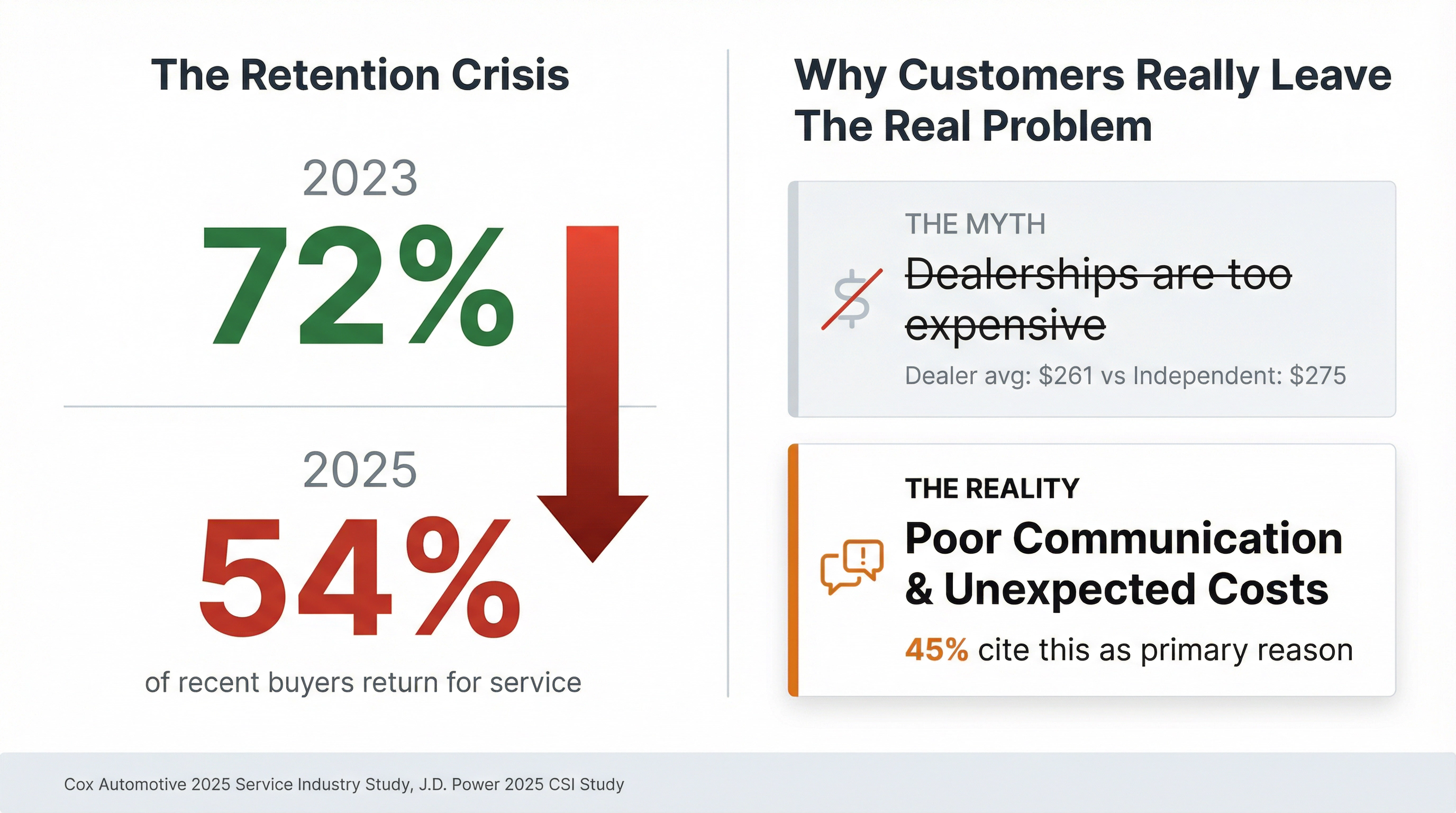
- Only 54% of owners of vehicles 2 years old or newer returned to the selling dealership for service in 2025 (down from 72% in 2023)
In just two years, you went from retaining nearly three-quarters of recent buyers to barely keeping half. Why does this matter beyond service revenue? Because the same Cox research found that customers who service at a dealership are much more likely (74%) to buy their next vehicle from the same place.
It’s not about price. Cox found that the average dealership repair cost in 2025 was $261 versus $275 at general repair shops. Dealerships are actually less expensive on average.
So why are customers leaving? Communication and trust. Nearly 45% of customers were dissatisfied due to unexpected costs and poor communication. Even if your price was fair, the surprise created dissatisfaction.
You’re not losing service on price. You’re losing it on experience, trust, and communication. Fix how you communicate estimates, updates, and completion times, and retention will improve even if pricing stays the same.
How Long Do Customers Wait for Dealership Service Appointments?
J.D. Power’s 2025 Customer Service Index Study found that mass-market vehicle owners waited about 5.2 days on average for a service appointment (up from 4.8 days the year prior). Luxury owners waited around 5.4 days.
J.D. Power found that 35% of mass-market customers now take their vehicle to an independent shop specifically because they can get service immediately. Meanwhile, Pied Piper’s research showed independent service centers offered appointments 1 day out on average, while dealer groups offered 4 days.
Strategies to mitigate:
- Reserve some walk-in/next-day slots (don’t book 100% in advance)
- Extend hours to spread demand
- Communicate wait times honestly + offer loaner/shuttle
- Proactively reach out during slower periods to fill gaps
What Is Dealership First-Time Fix Rate?
J.D. Power’s 2025 CSI Study found that 12% of repairs were not completed correctly the first time. One out of every eight service visits ends with the customer coming back.
Of those who experienced a botched repair, 50% returned to the same facility and 5% went to an aftermarket provider. You don’t lose all of them immediately, but you’ve damaged trust.
J.D. Power emphasized that top satisfaction drivers are communication-related:
- Greeting the customer immediately when they arrive
- Explaining what work will be done and why
- Providing cost estimates before starting work
- Giving status updates during the service
- Walking through completed work at pickup
Two levers to improve service satisfaction:
- Fix it right the first time. Train technicians well, use proper diagnostics, don’t rush jobs.
- Communicate proactively. Tell customers what to expect before work starts, update them if anything changes, and don’t surprise them at pickup.
In-Store Customer Experience Benchmarks for Dealerships
Digital is where people research. The store is where people decide. That’s why in-store experience still matters, and chaos in the showroom or service lane directly impacts whether a customer buys or books.
How Important Is the Dealership Greeting to Customer Satisfaction?
First impressions predict the outcome.
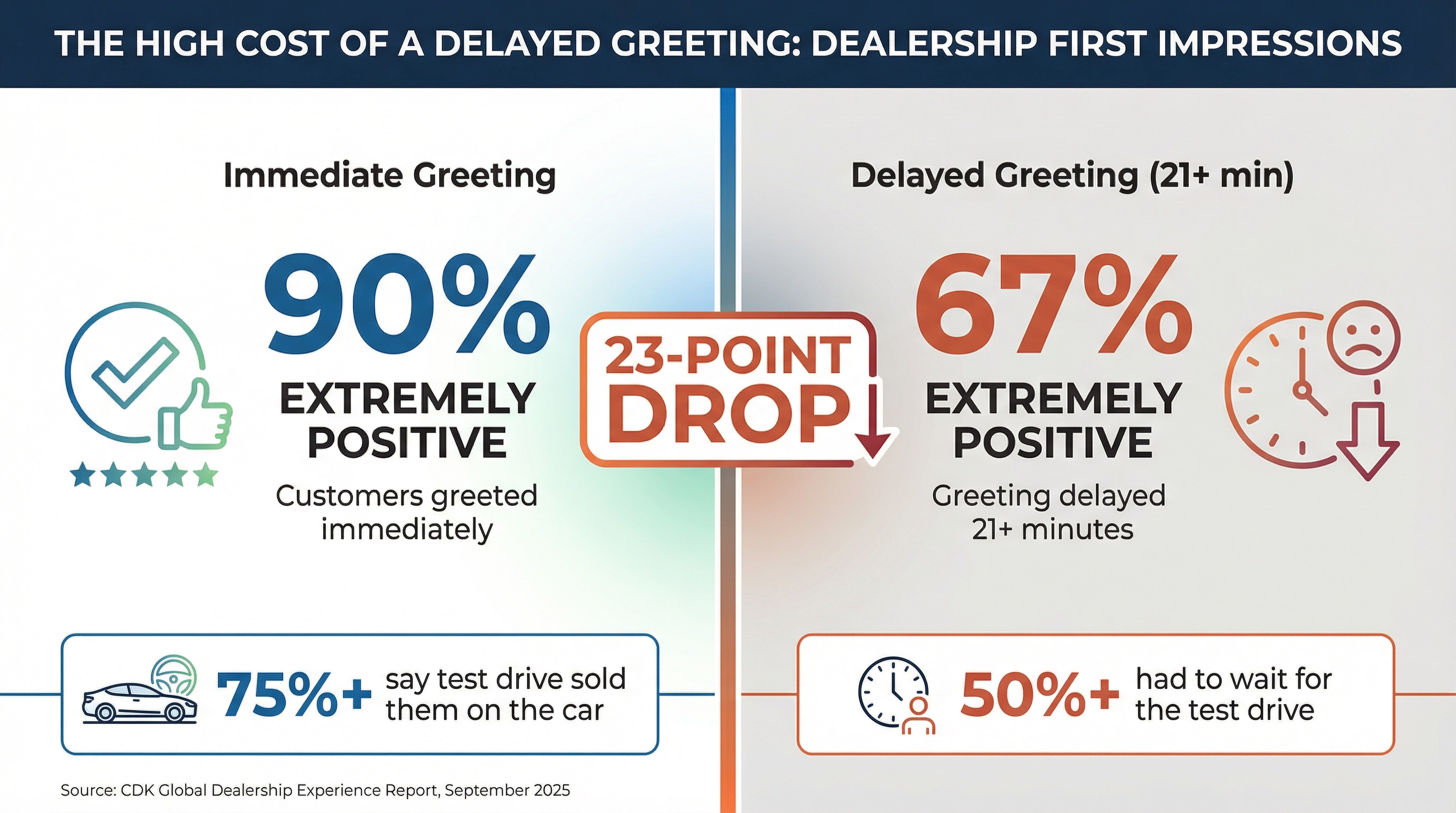
CDK Global research, published in September 2025, found that 9 out of 10 customers who were greeted immediately rated their visit “extremely positive.” When the greeting was delayed 21 minutes or more, only 67% rated it that way. A 23-point satisfaction drop purely from waiting to be acknowledged.
The same CDK research found that over three-quarters of shoppers said the test drive alone sold them on the car, yet over half said they had to wait for one. The single most powerful sales tool you have is being undermined by wait time.
Interestingly, CDK also found that customers who spent under 2 hours had lower NPS than those who spent 2-3 hours, but satisfaction drops again after 3 hours. People don’t want a rushed experience. They want a smooth one. Waiting is where time feels wasted. Conversations and test drives are where it feels productive.
How top dealers handle this:
- Dedicated greeter role during peak hours
- Proactive communication: if you can’t help immediately, acknowledge the customer and give an ETA
- Test drive priority: keys prepped, cars positioned for fast access
Dealership Review Statistics and Reputation Management
Reviews are your invisible showroom. They’re working 24/7, influencing decisions before customers ever call or visit.
How Many Stars Do Dealerships Need to Maintain?
BrightLocal’s Local Consumer Review Survey 2024 found that 71% of consumers would not consider using a business with an average rating below 3 stars. Three stars is the credibility threshold.
Trust in reviews is also declining. BrightLocal’s 2025 survey showed that only 42% of consumers now trust reviews as much as personal recommendations (down from 79% in 2020). What does earn trust?
- Volume (20-99 reviews minimum)
- Recency (old reviews suggest you’re no longer active)
- Specificity (detailed reviews feel real; generic ones don’t)
- Photos (customer-uploaded photos signal authenticity)
The FTC finalized a rule banning fake reviews and testimonials (announced August 14, 2024; effective October 21, 2024), enabling civil penalties for knowing violations. Don’t buy reviews. Don’t gate reviews. Build a process that earns them legitimately.
How to earn reviews without gaming the system:
- Ask every customer, not just happy ones
- Make it easy (text with a direct link, not “go find us on Google”)
- Respond to all reviews, especially negative ones
- Fix the underlying issues so fewer negative reviews appear over time
How Technology Can Fix Dealership Customer Experience Problems
Every statistic above points to the same fundamental problem: your current patchwork system (humans + voicemail + outsourced call center + manual follow-up) can’t reliably handle the volume and complexity of modern dealership communication.
Training helps with quality (better phone manner, clearer communication). Technology helps with capacity and consistency (answer every call, respond instantly, never miss a follow-up). You need both, but if you’re only training and not improving systems, you’ll keep losing revenue to gaps your team can’t physically cover.
Where AI and automation add value:
- Overflow: when your team is maxed out, AI catches the calls that would otherwise drop
- After-hours: when nobody’s staffed, AI provides full coverage instead of voicemail
- Consistency: AI never forgets to follow up, never has a bad day, never misses a callback
- Scalability: AI handles unlimited concurrent conversations during spikes
Where AI still needs humans:
- Complex edge cases (angry customers, weird warranty situations)
- Relationship building (high-value accounts, repeat customers)
- Judgment calls (approving discounts, handling escalations)
The best systems use AI to handle the high-volume, repeatable interactions and reserve human capacity for conversations that actually require judgment and empathy.
Case Study: How AI Voice Technology Improved Freeman Lexus Performance
We built Flai specifically to solve these problems. Not as a generic call center or a basic chatbot, but as an AI communications platform designed from the ground up for car dealerships.
Our platform integrates with your existing systems (phone, scheduler, DMS, CRM) and uses AI voice agents to answer every call 24/7, book appointments directly, and follow up across phone, text, and email.

Freeman Lexus case study (September 2025):
| Metric | Result |
|---|---|
| Total calls handled | ~1,100 |
| Missed calls | Zero |
| Bookable calls | 426 |
| Appointments booked | 376 |
| Conversion rate | 88% (376 out of 426) |
| Estimated profit impact | $100,000 |
Every call answered. No voicemail. No hold times. An 88% conversion rate on bookable calls, which is higher than most human BDCs achieve during business hours. The AI checks availability in real-time, offers specific slots, books the appointment, and sends confirmation.
Remember that Pied Piper stat about AI handoffs failing 56% of the time? Our platform solves this by treating transfers as a first-class feature: warm transfers with full context, and handoff success tracked as a core metric.
Action Plan: How to Improve Dealership Customer Experience

Data is only useful if you do something with it. Here’s a practical plan to improve customer experience in the next 30 days.
What Customer Experience Metrics Should Dealerships Track?
If you only track two things, track answer rate and appointment set rate. Those two metrics tell you whether you’re capturing demand and converting it into revenue. For a deeper breakdown, see our guide on the 12 BDC metrics that drive dealership revenue. A practical weekly dashboard:
Phones and scheduling:
- Speed to answer (seconds)
- Hold time distribution (track 90th percentile, not just average)
- Abandon rate (hang-ups before resolution)
- Transfer success rate
- Appointment set rate (appointments booked per bookable callers)
Lead handling:
- Speed-to-lead SLA compliance (5 min, 15 min, 1 hour)
- CRM logging rate
- Follow-up durability (touches across days 1-7)
Experience outcomes:
- First-time fix proxy (comeback rate)
- Review velocity + response rate
30-Day Customer Experience Improvement Plan for Dealerships
Days 1-7: Baseline with real numbers
- Pull a week of call logs: measure hold time, abandonment, transfer failures
- Pull a week of lead logs: measure response time distribution
- Audit: how many leads never got into the CRM
Days 8-14: Fix “physics problems”
- Reduce holds and unnecessary transfers (route calls better, add overflow handling)
- Add overflow handling during known peak windows (AI or human backup)
- Tighten routing logic so customers don’t bounce between departments
Days 15-21: Fix “system problems”
- Enforce speed-to-lead SLAs and coach the misses
- Standardize what a “good response” contains (photos, price context, alternatives)
- Build follow-up sequences that last past day 3
Days 22-30: Prevent regression
- Start a weekly 30-minute “CX review” meeting: listen to 10 calls, review 10 leads, read 10 reviews
- Celebrate compliance, not heroics
- Update staffing and scheduling based on demand patterns you’ve discovered
FAQ Section
Q: What’s the #1 customer experience metric dealerships should track?
Answer rate. What percentage of inbound calls connect with a qualified person who can help. Industry average is around 65%. Top performers hit 80-85%. Every point you gain means dozens more conversations per month that turn into revenue.
Q: Can AI really handle complex dealership conversations?
Yes, if it’s built right. Pied Piper data shows AI completing service scheduling interactions successfully 91% of the time, with an 86% appointment set rate. The real failure mode is handoffs (56% failure rate at most vendors). The best AI communications platforms solve this with warm transfers, full context passed to humans, and handoff success tracked as a primary metric.
Q: How do the best-performing dealerships achieve 85% call answer rates?
They treat the phone as a priority and design systems around it:
- Rigorous phone duty assignments
- Overflow handling for peak periods (AI, backup staff, or smart routing)
- Minimal transfers (route correctly the first time)
- Clear KPIs measured and reviewed weekly
The gap between 65% and 85% isn’t about hiring more people. It’s about designing a system where calls get answered reliably.
Q: What’s more important: speed or quality in lead response?
Both, but in sequence. Speed gets you into the conversation while the customer still cares. Quality keeps them engaged. Industry data shows 61% of dealers respond within 15 minutes, but 91% exclude payment details and 74% don’t offer price quotes. Speed without substance still fails.
Q: How can we improve customer experience without burning out our team?
Stop asking humans to do things systems should handle. Invest in systems that handle the high-volume, repeatable stuff (answering every call, booking appointments, automated follow-ups) so your team can focus on interactions that actually require human judgment. Modern AI communications platforms handle the majority of routine interactions automatically, freeing staff to do what they do best.
Final thoughts: Customer experience gaps are expensive, but they’re also measurable and fixable. The dealerships that win in 2026 won’t necessarily be the biggest or the oldest. They’ll be the ones that answer every call, respond to every lead with substance, communicate clearly throughout service, and build systems that support their team instead of overwhelming them.
Start with the metrics above. Measure what’s actually happening. Fix the physics problems (holds, transfers, voicemail), then the system problems (follow-up, response quality, scheduling). And seriously consider whether your current patchwork approach can deliver the experience today’s customers expect, or if it’s time to invest in infrastructure that makes excellence automatic.
If you want to see how Flai can help your dealership answer every call, book more appointments, and capture revenue you’re currently losing, reach out to our team.