
Privacy Policy
Terms of Service
Security
Status
Blogs & Guides
Service department marketing fails when campaigns work but phone calls don't. The 90-day fix for dealerships: 8 segments, 12 campaigns, every call captured.
May 3, 2026
Service department marketing fails in a specific way, and it’s not the one most managers expect.
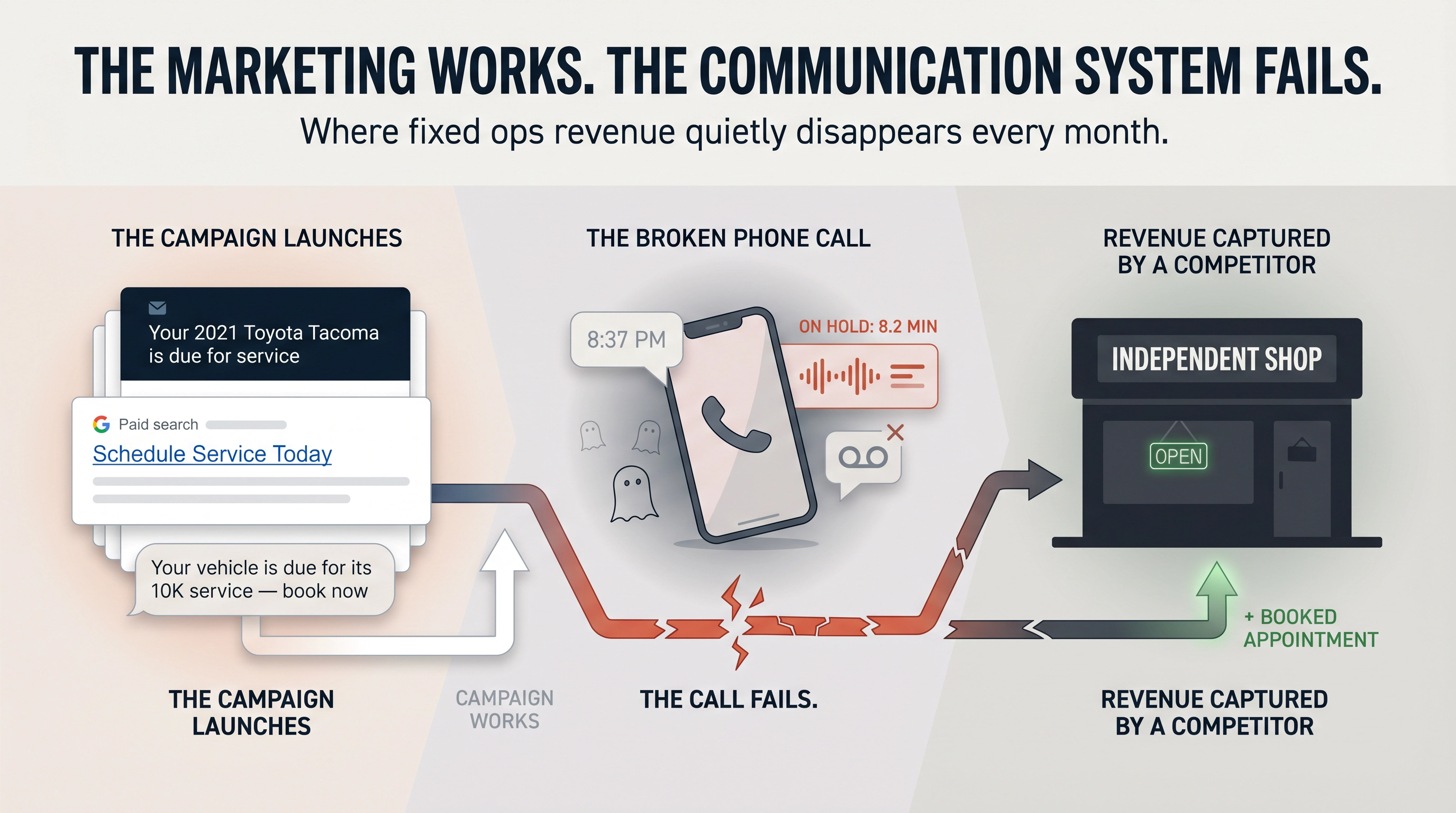
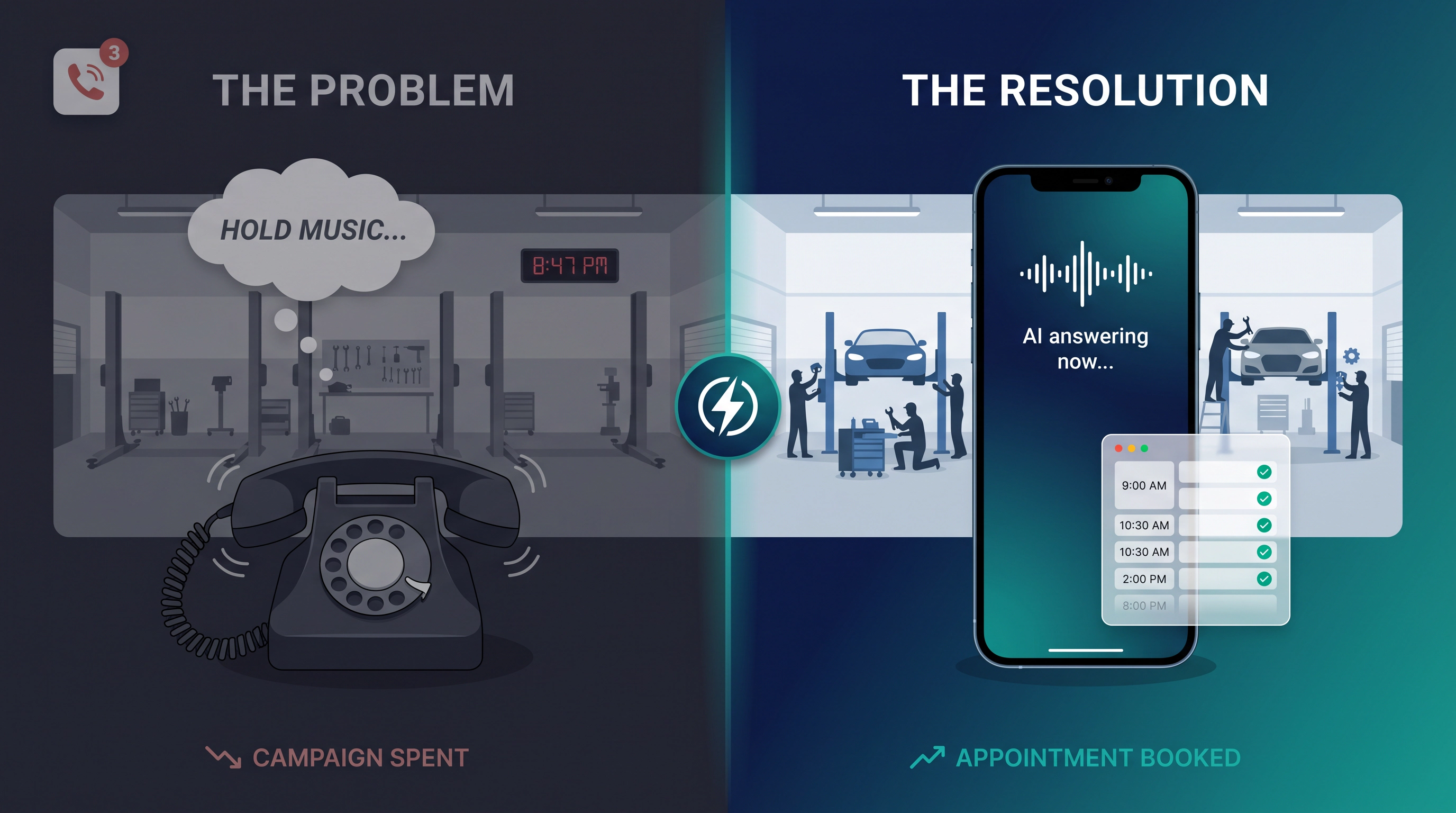
You launch a campaign. Email goes out, maybe some paid search runs, the OEM pushes its reminder sequence. Customers respond. They pick up the phone. And then, they wait. Hold music. Transfer to a voicemail box. Nobody picks up after 7 PM. The customer hangs up and calls the independent shop two miles away, and your campaign generated revenue for your competitor.
This is the pattern we’ve seen inside hundreds of dealerships. The marketing works. The communication system fails. And the gap between those two things is where fixed ops revenue quietly disappears every month.
This guide is for service directors, fixed ops directors, and BDC managers who want to close that gap. You’ll get a clear framework: which customer segments to prioritize, what campaigns to run, and a 90-day plan to fix and scale the system.
Most dealerships think about service marketing as a monthly coupon calendar. Oil change specials in February, tire campaigns in October, maybe a battery push before winter. That’s not a marketing program. That’s a list of promotions.
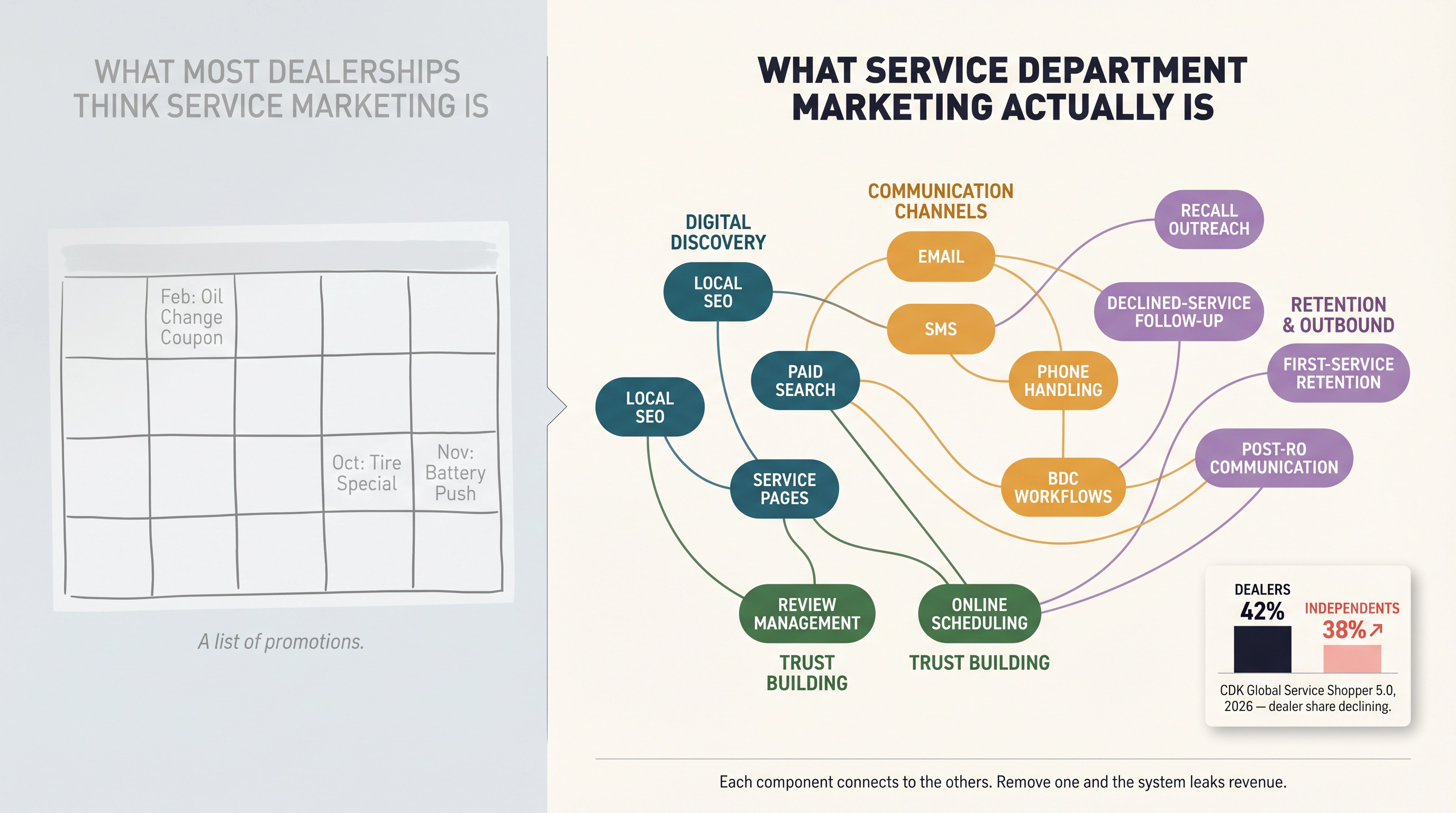
A real service department marketing program is the system that turns vehicle ownership into profitable, trust-building repair orders. It includes local SEO, service pages, paid search, email, SMS, outbound campaigns, recall outreach, declined-service follow-up, first-service retention, review management, online scheduling, phone handling, BDC workflows, and post-RO communication. Each piece connects to the others.
The stakes are substantial. NADA’s 2025 full-year report shows that franchised U.S. dealerships wrote more than 276 million repair orders and generated over $164 billion in service and parts revenue in 2025. And Cox Automotive’s 2026 fixed ops analysis makes the retention case even stronger:
Customers who returned to the selling dealership for service were far more likely to repurchase there (74%) compared with just 44% of buyers who didn’t return for service.
The problem is that independents are gaining. CDK Global’s Service Shopper 5.0, published in April 2026, found that independents now handle 38% of service visits, up from 32% the prior year. Dealers still led at 42%, but that number was down from 47% a year before.
The winning strategy in 2026 isn’t to be cheaper. It’s to be easier to find, easier to trust, and easier to schedule than the shop down the street.
The place most service directors overlook is what happens after campaigns work.
CDK Global’s appointment research, published in 2025, surveyed nearly 800 new-car buyers and more than 2,500 service customers. The finding that should be on every service director’s wall: 64% of service customers called to schedule an appointment. Only 19% scheduled online. And 40% of service callers encountered some kind of trouble getting through. The average service caller who was put on hold waited 8.2 minutes, and that hold time cost 19 NPS points and real revenue the average store can’t afford to give away.
It gets worse when you look at what happens to calls that don’t connect. Car Wars’ industry data shows the average dealership connection rate is 65.2%, meaning roughly 1 in 3 service callers never reaches anyone. The data on how missed calls cost the average dealership $850K+ a year makes that painfully concrete. Of those unconnected calls, 31.8% were customers who gave up while sitting on hold. Not wrong numbers, not spam calls. Customers waiting to spend money, who got tired of waiting.
Research on hold behavior adds context:
The reasons service customers abandon calls before you get a chance to help them go deeper than just hold time.

What this means for service marketing is simple and uncomfortable. Every campaign you run will eventually funnel a customer to a phone call. If that call goes unanswered, sits in voicemail, or grinds through 8 minutes of hold music, the campaign was wasted. You paid to drive a customer to a competitor. The dealership customer experience benchmarks show how consistently this pattern plays out across stores of every size.
Missed calls aren’t a phone department problem. They’re marketing waste.
That framing matters because it changes where you invest. Fixing phone capture isn’t “an ops thing.” It’s the highest-leverage marketing investment most dealerships aren’t making. We built Flai specifically to close this gap: answering every inbound service call instantly, 24/7, and booking the appointment directly into the dealership’s scheduler without the customer ever hitting voicemail.
More on that shortly. First, a closer look at who you’re actually trying to reach.
A service department doesn’t have one customer list. It has multiple revenue pools inside fixed operations, each with different needs, different objections, and different lifetime values.
New buyers who haven’t completed first service. This is the most important retention handoff in the dealership, and most stores handle it inconsistently. Cox Automotive’s 2026 analysis found that 80% of new buyers want to service at the selling dealership, but only 30% had a first service appointment scheduled. That gap is enormous. The same research found that after a customer’s first dealership service visit, 89% considered returning for future service. The first visit is the tipping point. The playbook for increasing service appointment volume starts here. The message these customers need isn’t “10% off your first service.” It’s: “We already know your vehicle, your warranty, and your maintenance schedule. When would Tuesday or Thursday work?”
Active service customers. They already trust you. Keep them on schedule, make the next visit easy, and make sure declined recommendations don’t disappear. Maintenance reminders by mileage and time, seasonal campaigns for tires and batteries, and next-appointment scheduling before pickup are the core tools. Post-service review requests belong here too, and how service reviews and follow-up affect CSI is one of the cleaner data stories in fixed ops.
Lapsed customers. No RO in 12, 18, or 24 months. They probably went to an independent, moved, had a bad experience, or just forgot you were an option. Lead with expertise and convenience, not discounts. “We still have your service history for your [vehicle]” outperforms “We miss you!” because it’s specific and demonstrates value without price-cutting. How AI follow-up handles lapsed customer re-engagement has changed what’s operationally possible for this segment.
Open recall customers. High intent, but they don’t act because the process feels like a hassle. NHTSA reported 997 recalls in 2025 covering more than 29 million vehicles, with millions of recalled vehicles going unrepaired annually. The combined weighted average recall completion rate for 2018-2022 recalls was only 62.1%, meaning over a third of recall customers never show up. A structured recall outreach strategy changes that math. These customers need three things: clarity (the repair is free), specificity (two available times offered directly), and immediacy (book in the same conversation).
Declined-service customers. Often the highest-ROI campaign in the building, and one of the most underused. The customer was already in the lane. An advisor already recommended the work. They said “not today.” That’s not a dead lead. It’s a timed re-engagement opportunity with full context already in your DMS. The follow-up message should match the reason they declined: education for something they didn’t understand, urgency framing for safety items, financing options for large repairs.
High-mileage and older-vehicle customers. S&P Global Mobility reported in 2025 that the average age of U.S. light vehicles hit 12.8 years. Vehicles from the 2015-2019 model years are entering prime service demand periods: tires, brakes, batteries, fluids, suspension, diagnostics. Campaign focus: reliability and safety, not discounts.
Tire, brake, battery, and alignment customers. Dealerships lose these categories to independents on convenience perception, not actual price. The fix is transparent pricing on service pages, express service messaging, and proactive campaigns triggered by prior inspections and mileage estimates.
Service-to-sales candidates. Cox Automotive’s data shows that only 14% of service customers were offered a trade-in or upgrade during service, while 33% were highly interested. And by 2024, 47% of consumers facing high repair costs preferred replacing their vehicle rather than repairing it, with an average threshold around $3,195. When an estimate climbs toward that range and the vehicle fits desirable inventory needs, the service visit is also a vehicle acquisition opportunity.
Each of these segments needs a different message, a different channel mix, and different timing. All of them need the same fundamental thing: a dealership that picks up the phone and makes booking easy.
Once you understand your segments, the campaigns become obvious. The challenge is running them as a connected system rather than one-off blasts, and how inbound and outbound BDC work together determines whether your campaigns actually close or just generate noise.
Here are the 12 campaigns that should anchor a complete service marketing calendar:
| Campaign | Target | Trigger | Primary Channel |
|---|---|---|---|
| First-service appointment | Recent buyers | Sale date, mileage | In-store, SMS, phone |
| Maintenance due | Active customers | Time/mileage interval | SMS, email, phone |
| Recall + maintenance | Open-recall VINs | Recall list | Phone, SMS, mail |
| Declined service | Deferred work customers | Declined recommendation | SMS, email, phone |
| No-show rescue | Missed appointments | Missed appointment | SMS, phone |
| Lapsed customer win-back | No RO in 12-24 months | Inactivity | Email, mail, phone |
| Tire campaign | Mileage/inspection trigger | Mileage, season | Paid search, email, SMS |
| Brake campaign | Brake recommendation | Inspection or mileage | SMS, email, phone |
| Battery campaign | Age, weather, test result | Season or inspection | SMS, email |
| High-mileage reliability | Older vehicles | Vehicle age/mileage | Email, mail, phone |
| Service-to-sales | Large estimate, desirable vehicle | Repair cost, equity | Advisor, SMS |
| Review and referral | Completed ROs | Pickup/post-service | SMS, email |
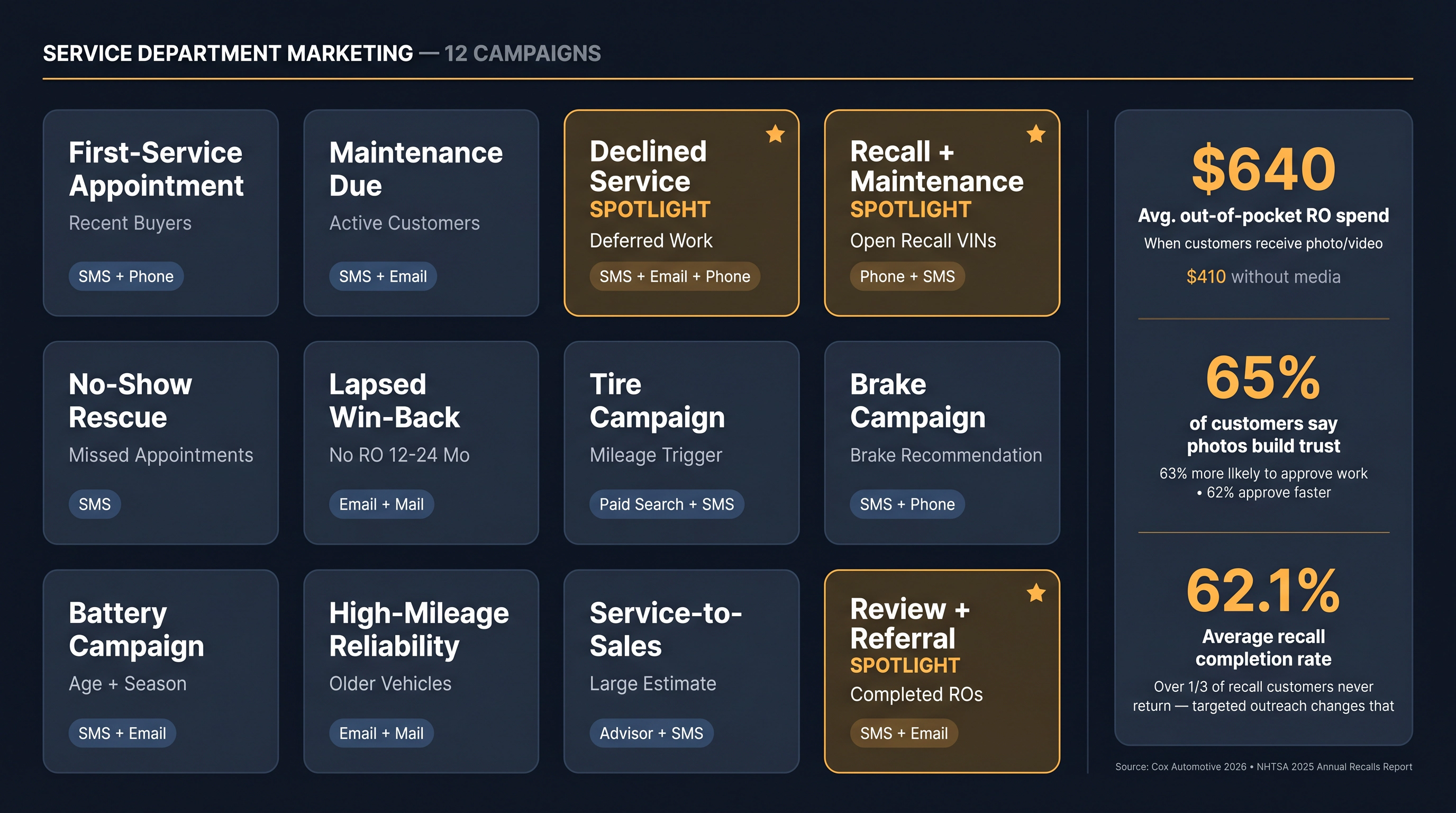
Three of these deserve special attention because they’re the most underused relative to their ROI.
Declined-service follow-up has no equivalent in terms of lead quality. The customer, vehicle, specific recommendation, and advisor context are already in your DMS. There’s no cold outreach. You have everything you need to send a message that’s genuinely relevant. The follow-up cadence matters:
What makes automotive email campaigns convert in the context of declined service comes down to specificity and timing.
Photo and video make a real difference. Cox Automotive’s 2026 research found that customers who received photos or video of their vehicle during service spent $640 out of pocket per RO, compared with $410 among those who didn’t. And:
Despite this, J.D. Power’s 2026 Customer Service Index Study found that 64% of customers wanted a photo or video of their multi-point inspection. Only 26% of mass-market customers actually received one.
Recall campaigns fail when they’re vague. “You may have an open recall. Call us.” doesn’t work. What works: name the vehicle, confirm the recall is on their VIN, state the repair is free, and offer two specific times. The complete recall campaign playbook covers the details. Combining the recall visit with overdue maintenance turns one appointment into a higher-value RO.
The tactical challenge with all 12 of these campaigns is the same: what happens when the customer responds?
Building demand through organic search, email, and SMS requires a different mindset than running campaigns. These channels are infrastructure, not one-offs.
Local SEO for service departments starts with your Google Business Profile. Local results depend mainly on relevance, distance, and prominence, per Google’s own guidance. For service departments: separate service hours from sales hours, use a direct service phone number, include an appointment link, and add photos of the drive and waiting area. Build service-specific pages for high-intent searches:
Put the phone number and online scheduling near the top of each page, not buried at the bottom.
Email works when it’s triggered, not when it’s a newsletter. The automotive email sequences that actually book service appointments are triggered by specific events: purchase date plus mileage estimate, prior RO, declined service, open recall, warranty expiration, lapsed activity. A subject line like “Your 2021 Tacoma may be due for factory-recommended maintenance” outperforms “Monthly Service Newsletter” because it’s about the customer’s specific vehicle. The structure is: why you’re receiving this, why the dealership is the right choice, transportation options, and one clear booking CTA. FTC CAN-SPAM guidance requires honoring opt-out requests within 10 business days and is particularly nuanced for mixed marketing/transactional messages, so worth reviewing with your compliance team.
SMS converts when it’s short, specific, and genuinely helpful. Use it for appointment confirmations, vehicle-ready notifications, repair status updates, declined-service follow-ups, and no-show reschedules. A service SMS should feel like a useful note from a person, not a promotional blast. The FCC’s January 2026 guidance requires documenting consent and honoring opt-outs through any reasonable method. Treat SMS as the compliance-sensitive channel it is.
One principle governs all three of these channels: they’re wasted if the response path is broken. Every email, every SMS, every GBP click that generates a phone call needs to reach someone (or something) that can answer immediately. How dealership call tracking reveals exactly where service marketing breaks down is the layer most service marketing programs overlook entirely.
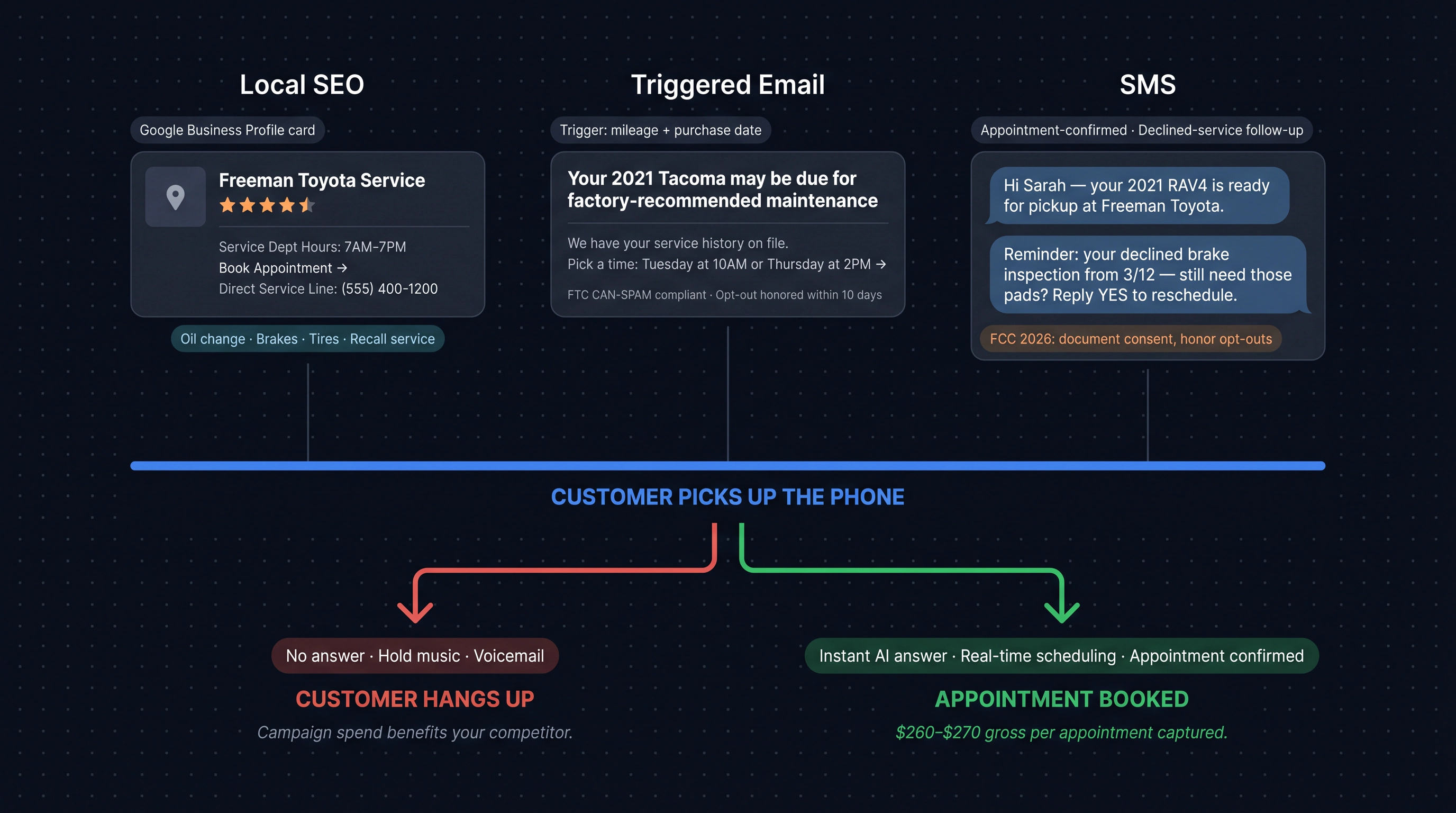
Marketing can create demand with precision. Campaigns can reach exactly the right customer, at exactly the right mileage interval, with exactly the right message. And then the customer calls, sits on hold for four minutes, gets transferred to a voicemail box, and leaves.
That’s the gap we built Flai to close.

The problem isn’t that dealerships don’t care about phone handling. It’s that the math makes staffing for complete coverage nearly impossible. Call volume doesn’t arrive evenly. It spikes Monday mornings, lunch hours, around closing, on promotion days, and after hours when no one is working, and after-hours coverage that actually books service appointments instead of missing them is where most dealerships leak the most revenue. You can’t hire for every spike. You can’t put service advisors on phones when they’re working in the drive. And voicemail is not an acceptable answer for a customer who’s trying to spend money.
What a properly designed AI BDC platform does is solve the scale problem. It answers every inbound service call instantly. Not after a transfer chain. Instantly. It gathers vehicle information, checks real-time availability in your scheduler, and books the appointment directly into the slot. Not taking a message. Not promising a callback. Booking the appointment.
Flai’s platform handles this across voice, SMS, and email, with integrations into the dealership’s DMS, CRM, and scheduler. Our founders spent time physically inside service bays at hundreds of dealerships to understand how these conversations actually go: the noisy environments, the specific vocabulary, the way customers describe symptoms without knowing part names. We built our own voice stack from scratch rather than stitching together off-the-shelf components, which is why calls feel natural rather than robotic. That matters for a luxury Lexus customer who expects premium quality from the first second on the phone.
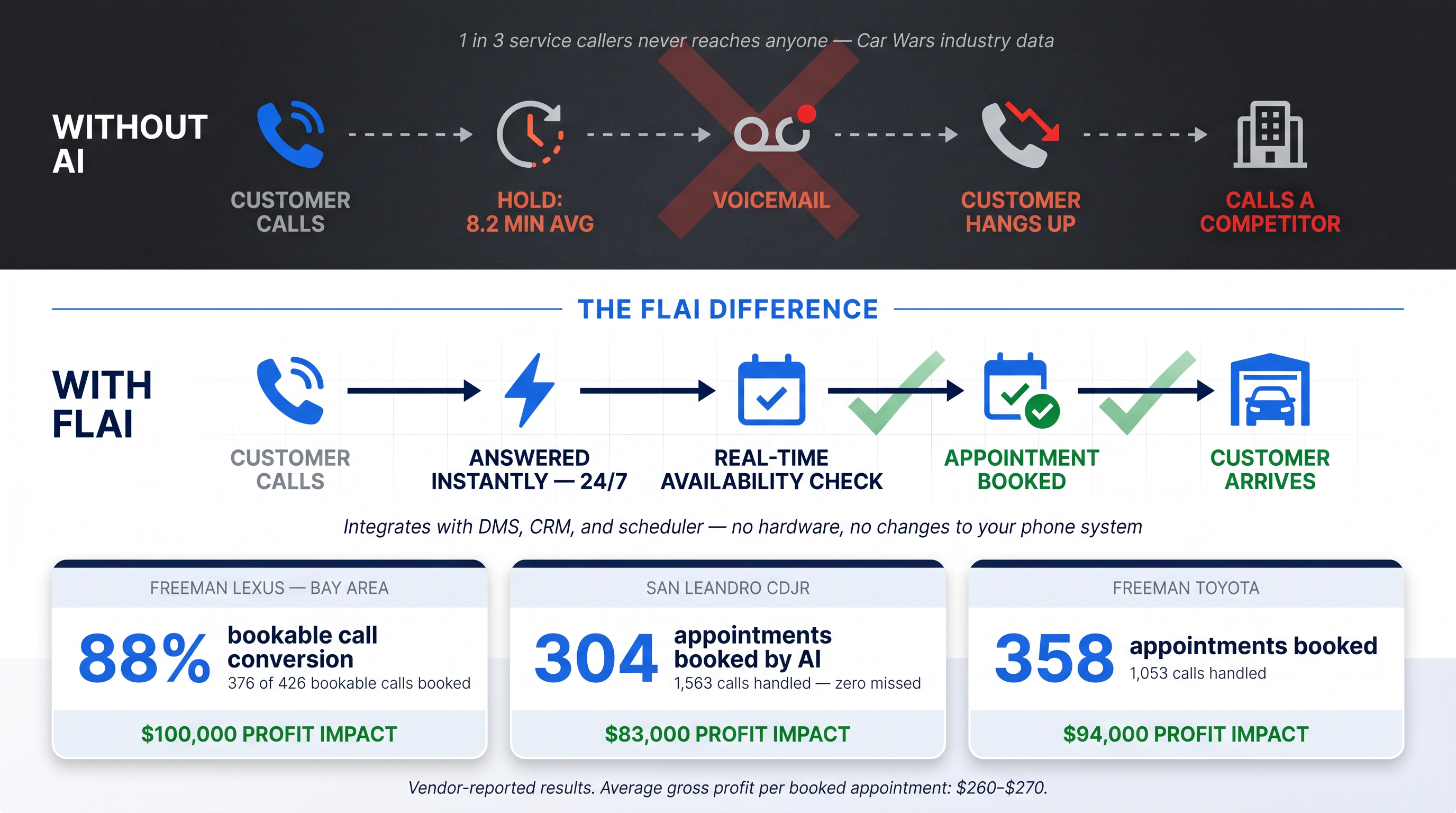
The results from our early deployments are consistent across three dealerships:
| Dealership | Calls Handled | Appointments Booked | Conversion Rate | Profit Impact |
|---|---|---|---|---|
| Freeman Lexus (Bay Area) | ~1,100 | 376 of 426 bookable | 88% | $100,000 |
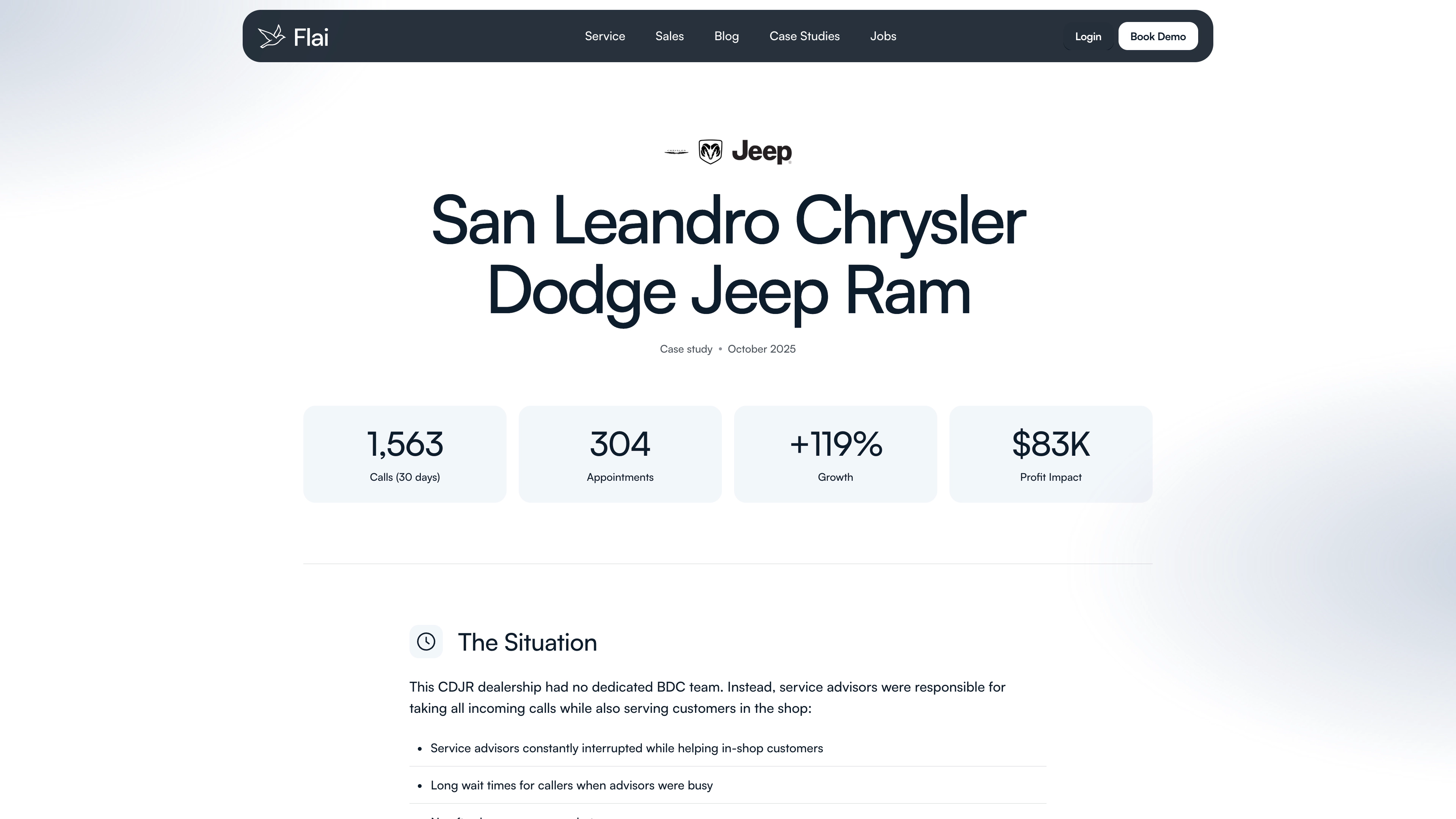
| San Leandro CDJR | 1,563 | 304 (205 → 448 monthly) | N/A | $83,000 |
| Freeman Toyota | 1,053 | 358 | N/A | $94,000 |

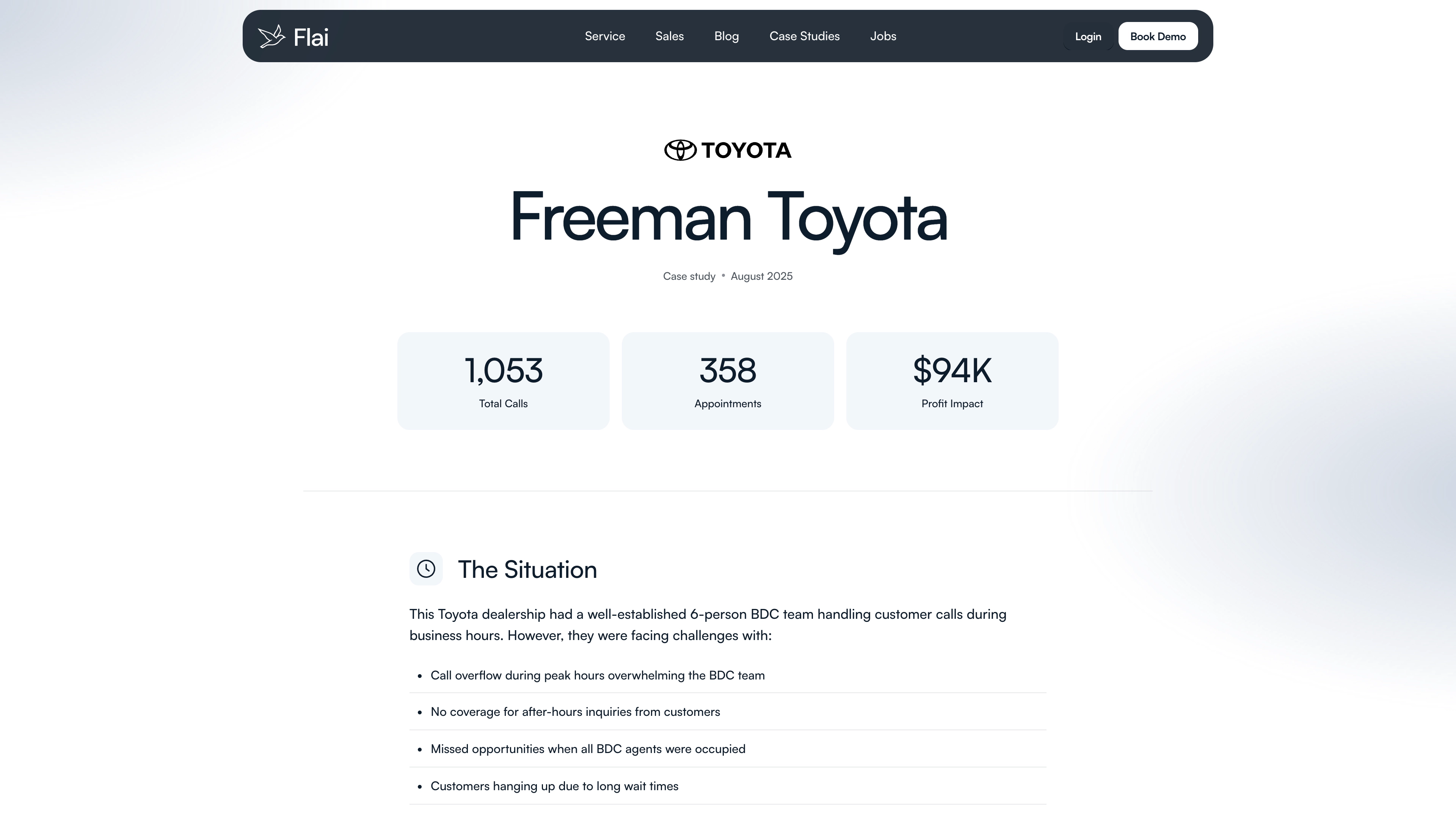
These are vendor-reported numbers from our own case studies. But the direction is consistent, and the unit economics make sense: the average booked appointment generates $260-270 in gross profit, so you don’t need to convert every call perfectly. You just need to stop letting good calls die.
Flai also handles the outbound side: recall campaigns via SMS or phone with AI that confirms VIN eligibility and books directly, declined-service re-engagement via two-way text conversations, and lapsed customer outreach that reads like a note from the advisor. No new staff, no hardware, no changes to your existing phone system or DMS.
The distinction between this and other AI tools in the market comes down to integration depth. Some tools answer calls but fall back to message-taking when it’s time to actually schedule. Ours checks real availability, books the real slot, and writes it back to your systems. That’s the difference between a call that “ended with a booking” and a call that actually became an appointment in your scheduler. We have the highest bookable rate in our category because the integrations work. What AI is actually doing inside dealership service departments in 2026 goes deeper on how this plays out in practice.
A word on what AI should and shouldn’t own: the repetitive, high-volume communication that leaks revenue when humans can’t keep up. Judgment calls, complex escalations, and the relationship moments that build loyalty belong to your team. AI takes the mechanical volume off their plates so they can focus on work that actually requires them.
Most service marketing programs measure activity. How many emails were sent. What the open rate was. How many clicks came from paid search. Those numbers tell you what you did. They don’t tell you whether it worked.
A serious scorecard ties marketing activity to business outcomes. The framework has three levels:
Demand generation: GBP calls, direction requests, service page sessions, email and SMS reply rates, recall list penetration, lapsed reactivation rate. These tell you whether you’re reaching the right customers.
Communication capture: Answer rate, abandonment rate, speed to answer, hold time, voicemail rate, after-hours bookings, appointment set rate, bookable-call conversion. The most important hidden metric is phone leakage: abandoned calls plus missed calls plus voicemail-only calls plus failed transfers. Dealership call tracking that reveals phone leakage tells you exactly how much demand you’re generating versus how much you’re capturing. That’s actual customers who tried to give you money and couldn’t.
RO and retention outcomes: Customer-pay ROs, gross per RO, first-service completion rate, 12- and 24-month retention, declined-service recovery rate, review volume and rating, CSI/NPS. The 12 BDC metrics that tie communication performance to revenue give you the full dashboard across all three levels.
J.D. Power’s 2026 Customer Service Index Study found that all 10 major service KPIs were met together only 26% of the time. When all 10 were met, satisfaction reached 979 out of 1,000. When only three were met, it dropped to 632. The gap is largely a communication and coordination problem.
For measuring whether your communication layer is working, the incremental gross formula is straightforward:
Incremental gross = additional booked appointments × show rate × RO conversion rate × average gross per RO
If fixing phone capture generates 100 additional booked appointments monthly, and your show rate is 80%, RO conversion is 90%, and average gross is $250, that’s $18,000 in incremental monthly gross from the communication fix alone, before any campaign improvement. How AI BDC compares to traditional BDC on this math shows why the ROI calculus shifts quickly once you run real numbers.
Most service marketing programs fail not because they lack campaigns, but because they scale campaigns before fixing the fundamentals. This sequence matters.
Start with what’s actually happening before you change anything.
Pull your last 12 months of ROs: customer-pay, warranty, recall, and internal. Calculate:
Compare your numbers against the revenue benchmarks for missed calls across dealerships to understand where you stand.
Then mystery-shop your own store. Call during peak hours. Call after 7 PM. Call on Saturday. Try booking online. Submit a website form. Ask about recall scheduling. Ask about transportation options. Ask for a brake quote. Every point of friction you find is a campaign that’s currently burning money without converting.
Do not pour more demand into a broken system.
The most important fixes are usually:
The call overflow solutions that work during peak hours are worth setting up before any campaign scaling happens.
This is also the right moment to set up an AI communication layer. Flai can be live in days with no hardware and no changes to your existing phone system, and getting this infrastructure right first means every campaign you launch afterward captures its full value, not half of it.
Once capture is working, start with the campaigns closest to revenue.
Priority order:
For each campaign, define: audience, trigger, message, offer if any, channel, booking path, owner, compliance requirements, source code for tracking, and your appointment, RO, and gross KPIs. Don’t launch without a booking path. Every campaign should answer: “What happens when the customer responds?”
Now you have data. Compare campaigns by cost per booked appointment, cost per RO, and gross per RO. Scale what works. Add the longer-horizon programs: paid search for high-intent services, model-specific SEO pages, lifecycle automations, service-to-sales triggers, and review generation.

Generic coupons sent to everyone. Discounts have their place, but they’re a lazy substitute for relevant communication. A first-service customer needs onboarding. A declined-service customer needs education. A recall customer needs clarity. Generic offers train customers to wait for discounts rather than respond to genuine outreach.
Ignoring phones. CDK’s 2025 appointment research makes the point clearly: phone is the dominant service scheduling channel, and call friction directly affects satisfaction scores. If your paid search campaign drives calls and those calls go to hold music, you’ve spent money to hurt your NPS. What happens to service customers when calls go to voicemail is a revenue story, not an ops story.
Treating online scheduling as a complete solution. CDK’s same research found 69% of service customers still wanted a human (or something that responds) involved in scheduling. Offering online booking without also fixing the phone doesn’t close the coverage gap. A phone performance playbook that closes the coverage gaps completes the picture.
Running recall campaigns without confirming capacity first. Generating 200 appointment requests before confirming parts and technician availability frustrates customers and overloads advisors. Confirm supply before you launch.
Letting declined services disappear. The customer context, vehicle, specific recommendation, and advisor notes are all already in your DMS. Most stores still have no structured follow-up for it. The work needs to happen. It’s just a timing and trust problem.
Overpromising convenience. Don’t market “fast, easy service” if appointments run long without updates. Don’t market “easy scheduling” if customers can’t get through. The operational fixes that move CSI scores are direct: the promise made in marketing must match the experience in the drive. When they don’t align, CSI suffers, reviews suffer, and retention suffers.
Measuring marketing without RO data. Open rates don’t matter. Even appointments don’t fully matter unless you’re tracking which campaigns generate ROs, gross profit, and repeat visits. If your reporting stops at clicks and opens, you’re optimizing for the wrong thing.
Service department marketing isn’t complicated. It’s connecting the right message to the right customer at the right moment, and then making sure the path from that message to a booked appointment is clear and frictionless.
Most dealerships have the marketing pieces. What they’re missing is the connection: the communication layer that catches a customer the moment they’re ready to act, day or night, and converts that moment into an appointment in the scheduler.
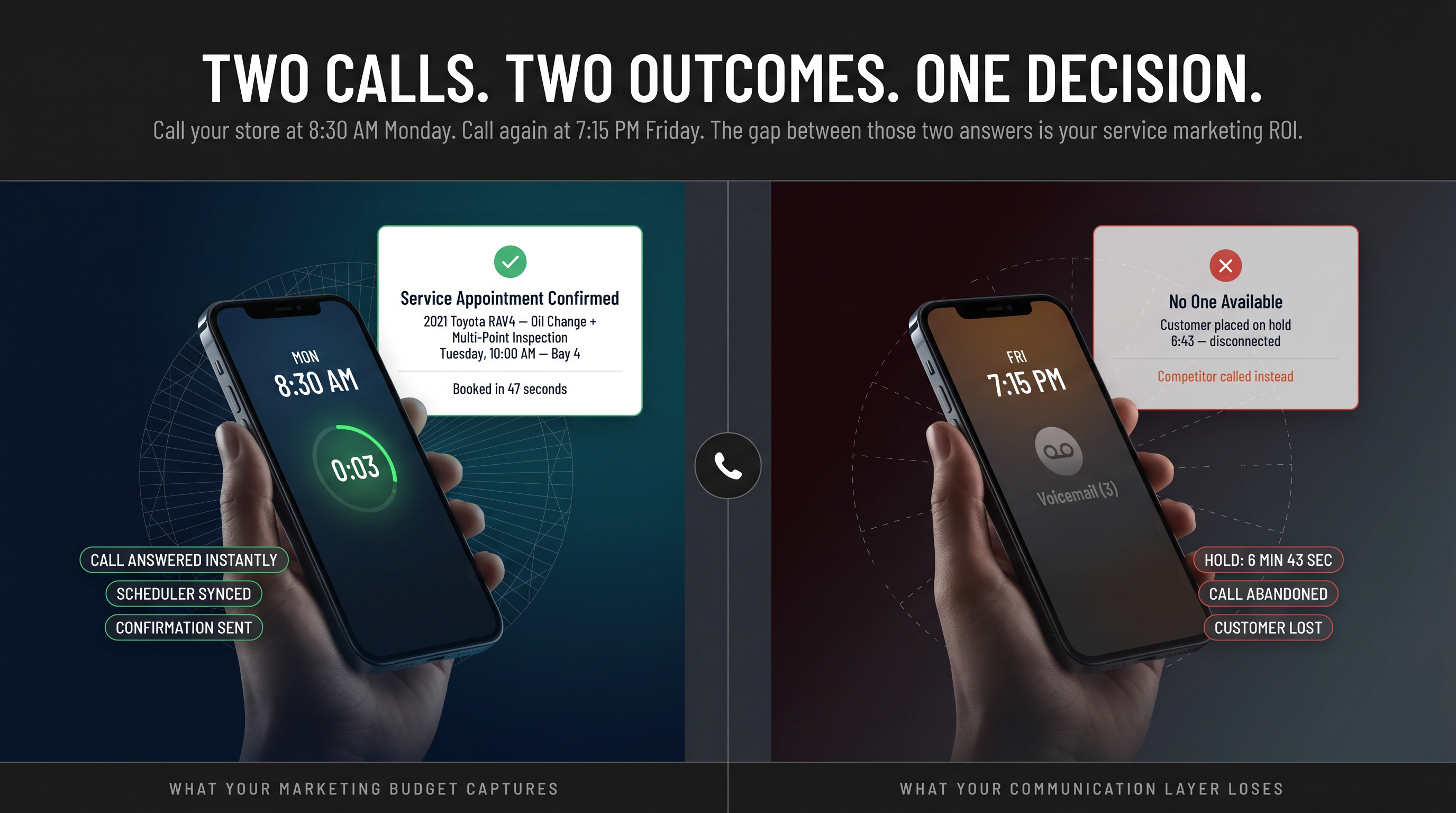
The fastest way to see where your program stands: call your own store at 8:30 AM on Monday, and again at 7:15 PM on Friday. Those two calls will show you more about your service marketing ROI than any dashboard.
If those calls don’t go the way they should (hold music, voicemail, no one to answer), that’s the fix that unlocks everything else. Flai is built to make that fix simple: AI that answers every inbound call instantly, books appointments directly into your scheduler, runs recall and re-engagement outreach, and integrates with your existing DMS and CRM with no hardware required.
The dealers who get this right fill more bays, recover more declined work, complete more recalls, retain more owners, and build a business where the service lane actually feeds future vehicle sales.
What are the most important KPIs for service department marketing?
The most meaningful KPIs connect marketing activity to business outcomes rather than stopping at activity metrics. On the communication side: answer rate, abandonment rate, voicemail rate, after-hours booking rate, and bookable-call conversion rate. On the outcome side: customer-pay ROs, gross per RO, first-service completion rate, 12- and 24-month retention, declined-service recovery rate, and CSI/NPS trends. The BDC metrics that tie communication performance to revenue outcomes are the reporting layer that turns raw call data into business decisions.
How do we handle after-hours service calls without hiring more staff?
The straightforward answer is AI. Most dealers currently route after-hours calls to voicemail, which effectively sends those customers to competitors. About 70% of customers who hit voicemail will call another shop within 30 minutes. An AI communication platform like Flai answers every after-hours call instantly, gathers vehicle information, checks real availability in the scheduler, and books the appointment. No additional staff, no hardware, no change to your existing phone system. After-hours answering that actually books service appointments is now a solved problem for dealerships that want to capture that demand.
What’s the ROI of improving phone handling in the service department?
The math is fairly direct. If the average booked service appointment generates $260-270 in gross profit, and your current connection rate is around 65% (the industry average per Car Wars data), capturing even 50 additional calls per month means roughly 30-35 additional shown appointments and $7,500-$9,000 in incremental monthly gross. The broader dealership customer experience benchmarks show how these numbers vary by store size and service mix. At scale, across multiple rooftops, the numbers compound quickly.
How often should we contact service customers?
Frequency depends on context. For maintenance reminders, once per trigger is enough. For declined-service follow-up, a four-touch cadence (same day, 7-14 days, 30 days, 60-90 days) works well, with each message serving a different purpose. How AI follow-up handles the timing of declined-service re-engagement removes the manual burden. For lapsed customers, one thoughtful annual reactivation outperforms repeated generic blasts. Every message should have a specific reason to exist. If you’re not sure why you’re sending it, the customer won’t be either.
What makes recall campaigns fail?
Most recall campaigns fail because they’re vague. “You may have a recall. Call us to learn more.” requires the customer to research, call, wait, and schedule. That’s four steps when the goal is one. What works: name the vehicle, confirm the recall is open on their VIN, explain the repair is free, and offer two specific times in the same message. Response rates climb when the customer can reply “Tuesday works” rather than starting a whole new process. The complete recall campaign best practices guide covers VIN-specific outreach, combining recall with overdue maintenance to increase RO value, and how to run this at scale without manual effort.
Should service marketing and sales marketing be handled separately?
Operationally yes: different audiences, messages, booking paths, and KPIs. But they should share data and infrastructure. The service lane is one of the best sources of vehicle acquisition opportunities, and the sales floor often has the best picture of warranty expiration and equity position. How inbound and outbound BDC handle both departments without letting customers fall through the cracks is the operational model that prevents both sides from running in silos.
How do we compete with independent repair shops on price perception?
Price perception is partly an education problem and partly an access problem. Dealers have real advantages (factory-trained technicians, OEM parts, recall knowledge, warranty compliance) but customers often assume dealer service is expensive without checking. Transparent pricing on service pages, convenience messaging (shuttle, loaner, express lanes), and a scheduling experience that’s genuinely easier than the shop down the street all help. If the independent answers on the first ring and your dealership puts the customer on hold, the independent wins on access alone regardless of price.
Flai is an AI communications platform for car dealerships. We answer every inbound call 24/7, book service appointments directly into your scheduler, and handle outbound recall and re-engagement campaigns, all without hardware or changes to your existing systems. If you want to see what this looks like for your store, you can book a demo at useflai.com.
As seen in