Automotive Email Marketing for Dealerships: Templates & ROI (2026)
10 automotive email marketing templates, real ROI formulas with worked examples, and 2026 deliverability rules every dealership needs.
Email still delivers one of the highest returns of any marketing channel. Industry research consistently finds that the average email program returns $36 for every $1 spent, with 35% of marketing teams earning 36:1 or better. For dealerships, the opportunity is even sharper. Cox Automotive research showed that mostly digital buyers saved 41 minutes at the dealership and reported better satisfaction with the purchase process. And in fixed ops, studies found that 74% of customers who returned to the dealer for service in the prior 12 months were likely to repurchase there, compared to just 44% of those who didn’t.
But 2026 isn’t 2023. Google and Yahoo now require authenticated mail, low complaint rates, and clean unsubscribe behavior. Google treats you as a bulk sender once you cross roughly 5,000 personal Gmail messages in a 24-hour window, and that classification sticks. Apple Mail Privacy Protection inflates open rates, making them unreliable as a primary metric. The dealerships winning at email in 2026 optimize for what actually moves the business: clicks, replies, booked appointments, show rates, repair orders, and gross profit.
This guide gives you 10 copy-ready email templates, the segmentation model behind high-ROI programs, deliverability rules you can’t ignore, concrete ROI formulas with worked examples, and a 90-day plan to get it all running.

How Dealership Email Marketing Drives Revenue
At a dealership, email has four real jobs. If your emails aren’t doing at least one of these, they’re probably noise.
It reduces uncertainty. Customers want to know whether the vehicle is available, what the numbers look like, when they can come in, how long service will take, what the technician found, and what something will cost. Good email answers those questions before the customer has to call and ask. The dealership customer experience statistics are stark: communication failures, not pricing, drive most customer experience problems.
It asks for one concrete next step. The best dealership emails don’t “just check in.” They ask for a scheduled appointment, an approval on a repair estimate, a reply, or a simple yes/no. One action, clearly stated.
It creates continuity across channels. Industry data shows average live phone connection rates around 65%, with heavy inbound peaks around 10 a.m. to noon. That means email can’t live on an island. It has to work alongside phone and text, especially when the customer is high-intent or time-sensitive. (We’ll talk about how Flai handles the real-time side of that equation later.)
It protects retention. Speed, communication, and transparency are the biggest drivers of a better-than-expected service experience. Customers show strong interest in digital scheduling, service tracking, and digital payment. Good email delivers exactly those things. For a full picture of what drives service appointment bookings and retention, the patterns are consistent: communicate proactively, remove friction, and give customers a clear next step.
So here’s a simple way to think about it:

- Sales email should create or recover an appointment
- Service email should fill the lane, reduce friction, and protect loyalty
- Reactivation email should wake up dead demand without sounding desperate
- Operational email should make the customer feel informed, not ignored
That’s the whole game.
The 10 Highest-ROI Automotive Email Campaigns
The biggest gains rarely come from a monthly inventory newsletter. They come from triggered workflows that fire at the right moment for the right person. Segmented campaigns consistently outperform unsegmented ones, and automated and triggered emails consistently beat newsletters on opens and clicks across benchmark data.
Here are the 10 campaigns that usually produce the most money for dealerships:
- New lead response (web leads, third-party leads, lead forms)
- Price/payment follow-up (shoppers who asked for numbers but didn’t commit)
- Unsold showroom or test-drive follow-up (visited, drove, then disappeared)
- Service due reminders (fill bays before customers drift to independents)
- Appointment confirmation and reminders (reduce no-shows and reschedules)
- Repair status and estimate approvals (cut inbound status calls, speed approvals)
- Declined service recovery (pull deferred work back into the shop)
- Recall outreach (safety, retention, and additional service opportunities)
- Service-lane trade or equity emails (customer is already engaged and open to change)
- Lost lead and dormant customer reactivation (extract value from records you already paid to acquire)

Don’t overlook service-lane trade emails. Research shows that 33% of consumers are highly interested in getting a trade-in value during a service visit, and the average repair bill where consumers start thinking about trading instead of repairing was $3,195. That’s a sales opportunity hiding inside your fixed operations lane.
10 Automotive Email Marketing Templates (Copy-Ready)
Use these as working templates, not sacred text. Keep them short. Use one CTA. Offer two specific times when you want an appointment. Use a monitored reply-to address. Pull live inventory, scheduler, and customer data wherever your system allows. For the templates that trigger inbound calls, make sure you have a plan for how those calls get answered, especially after hours. Never missing a dealership call is the operational foundation that makes email marketing pay off.
1. New Internet Lead Response
Best for: New inbound sales lead | Primary KPI: Reply rate, booked appointment rate
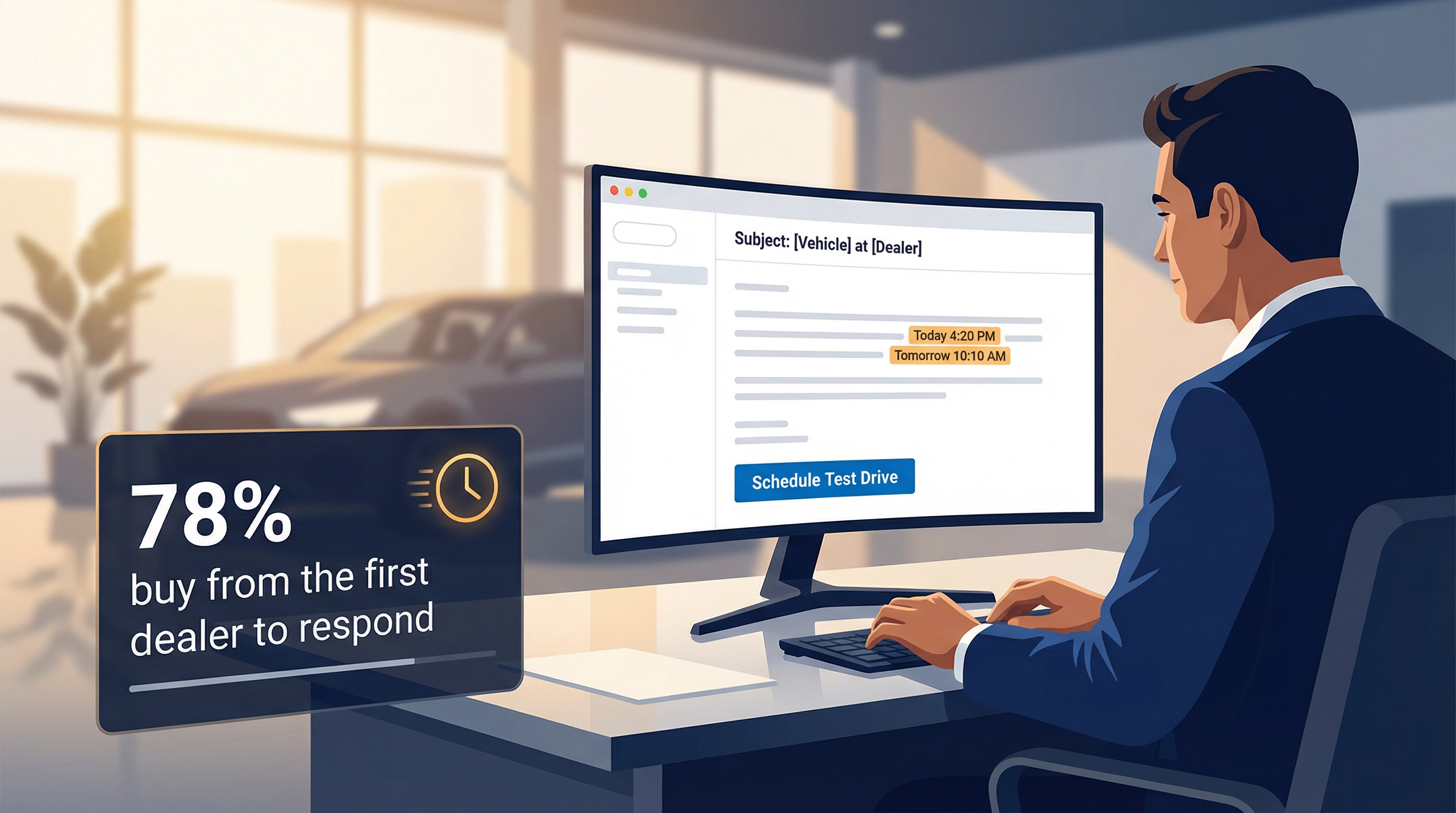
Subject: [Vehicle] at [Dealer]
Hi [First Name],
Thanks for reaching out about the [Year Make Model].
It is [available / just sold, but I have a very similar option]. The fastest next step is to get you in front of the right car without wasting your time.
I can have it ready at [Today 4:20 PM] or [Tomorrow 10:10 AM]. Which works better?
If you want numbers first, reply with one word: cash, finance, lease, or trade and I’ll send the cleanest version instead of generic ranges.
[Rep Name] | [Dealer] | [Direct Line]
Notice the odd appointment times. “4:20 PM” feels more real than “4:00 PM” and signals this is a specific, reserved slot. Speed matters enormously here. AI follow-up for dealerships data shows 78% of car shoppers purchase from the first dealership that responds, and conversion rates are 21 times higher when dealers respond within five minutes versus thirty.
2. Price or Payment Follow-Up
Best for: Quote request, payment shopper | Primary KPI: Reply rate, quote-to-appointment rate
Subject: Numbers on the [Vehicle]
Hi [First Name],
I can send accurate numbers on the [Year Make Model], but I don’t want to guess wrong.
Reply with the option that matters most:
- Cash price
- Finance payment
- Lease payment
- Trade-in + payment
If you send your rough down payment and zip code, I can make it even cleaner.
Or, if it’s easier, I can walk you through it in 10 minutes at [time 1] or [time 2].
[Rep Name]
This template works best when paired with a fast phone response. Customers who reply via text or call after receiving a pricing email are high-intent. Understanding why dealership callers hang up and how to prevent it is essential before scaling this workflow.
3. Unsold Showroom or Test-Drive Follow-Up
Best for: Visited, drove, then disappeared | Primary KPI: Re-engagement rate, return visit rate
Subject: Still interested in the [Vehicle]?
Hi [First Name],
Good meeting you at the store.
Based on what you liked, I pulled the [Vehicle they saw] plus one similar option that may fit even better. I can have either ready for a quick drive at [time 1] or [time 2].
Reply with the better time and I’ll reserve it for you.
If something changed (budget, trade, timing, or model), just tell me that directly and I’ll adjust.
[Rep Name]
For unsold showroom leads, persistence matters. Industry research shows 80% of sales require 5 or more follow-up touches, but most sales reps give up after one. Systematic email sequences close that gap.
4. Service Due Reminder
Best for: Mileage or time-based maintenance | Primary KPI: Click-to-schedule rate, booked RO rate
Subject: Time to schedule service for your [Vehicle]
Hi [First Name],
Your [Year Make Model] is due for [service] around [mileage/date].
We currently have openings on [day/time] and [day/time]. Most visits take about [time estimate].
Reply with the slot you want and I’ll lock it in.
Need a shuttle, loaner, pickup/drop-off, or a waiter appointment? Just reply with what’s easiest for you.
[Advisor Name] | [Dealer Service]
Service due reminders are the backbone of fixed ops retention. For a deeper look at the systems behind automating service appointment scheduling, the key is combining proactive email outreach with a phone/text layer that catches the customers who prefer to call.

5. Service Appointment Confirmation
Best for: Immediately after booking | Primary KPI: Confirmation rate, show rate
Subject: Confirmed: [Day] at [Time]
Hi [First Name],
You’re confirmed for [service] on [day, date] at [time] for your [vehicle].
Expected visit length: [time estimate]
To make drop-off easier, you can use this link: [check-in link]
Need to reschedule? Just reply here with a better time and we’ll adjust it.
[Advisor Name] | [Dealer Service]
6. Service Appointment Reminder
Best for: 24 hours before visit | Primary KPI: Show rate, late-cancel recovery
Subject: Reminder for tomorrow at [Time]
Hi [First Name],
Quick reminder that your [vehicle] is scheduled for [service] tomorrow at [time].
Reply C to confirm, or send a better time and I’ll move it for you.
Running late tomorrow? Reply here instead of calling and we’ll help.
[Advisor Name]
Confirmation and reminder emails alone can materially improve CSI scores because they directly address the “communication” and “being kept informed” dimensions that OEM surveys measure.
7. Repair Status and Estimate Approval
Best for: In-progress RO, approval needed | Primary KPI: Approval speed, inbound-call reduction
Subject: Update on your [Vehicle]
Hi [First Name],
We completed the inspection on your [vehicle].
Our technician found: [short plain-English issue]
- Recommended work: [service 1 / service 2]
- Estimated total: [amount]
- Added time if approved: [time]
You can review photos/video and approve here: [link]
If you’d rather talk it through, reply CALL and we’ll ring you.
[Advisor Name]
This template directly reduces inbound phone volume. Improving CSI scores research shows that customers prefer status updates via text over calls, and that proactive communication is one of the highest-leverage CSI drivers available to service departments.

8. Declined Service Follow-Up
Best for: Deferred work after prior visit | Primary KPI: Recovered ROs, deferred-work conversion
Subject: About the [Declined Service] on your [Vehicle]
Hi [First Name],
During your last visit, we recommended [service] for your [vehicle].
It wasn’t completed that day, but it’s still worth addressing because [simple consequence].
We have openings at [time 1] or [time 2] this week. Want me to reserve one?
If budget is the issue, reply and I’ll send the shortest path forward.
[Advisor Name]
Declined service recovery is one of the highest-ROI opportunities in fixed operations. The work is already diagnosed, the customer relationship is established, and the revenue is deferred, not lost, until you reach them.
9. Recall Outreach
Best for: Open recall with available scheduling | Primary KPI: Booked recall appointments
Subject: Open recall for your [Year Make Model]
Hi [First Name],
Your [vehicle] has an open recall for [short issue].
There’s no charge for recall work. We currently have recall appointments on [day/time] and [day/time].
Reply with the better option and I’ll schedule it.
If you want to confirm by VIN first, send the last 8 digits and I’ll verify it for you.
[Dealer Service Team]
Recall outreach is one of the highest-value email triggers in the dealership toolkit. An estimated 54.6 million vehicles on U.S. roads carry at least one unrepaired recall, a massive pool of scheduled appointments waiting to be booked. For a complete playbook on running these campaigns effectively, including multi-channel sequencing and AI-powered outbound calling, see our guide to dealership recall campaign best practices.
10. Service-Lane Trade or Equity Email
Best for: High repair estimate, aging unit, service customer open to upgrading | Primary KPI: Trade appraisal requests, sales appointments
Subject: Want a trade value on your [Vehicle]?
Hi [First Name],
While your [vehicle] is in for service, I can also get you a live trade value and show what newer options would look like.
This is useful when someone wants lower miles, a different payment, or would rather avoid a larger repair later.
No pressure. If you want, I can send 2 or 3 clean options based on your current vehicle and budget.
Reply VALUE and I’ll put it together.
[Sales Manager Name]
For more on running a complete dealership communication program that complements these email templates, see how Flai’s AI BDC handles the phone and text layer that email can’t cover.
How to Segment Dealership Email for Maximum ROI
The wrong question is, “What’s our average email performance?” The right question is, “Which workflow, for which customer, at which moment, produces the most appointments and gross?”
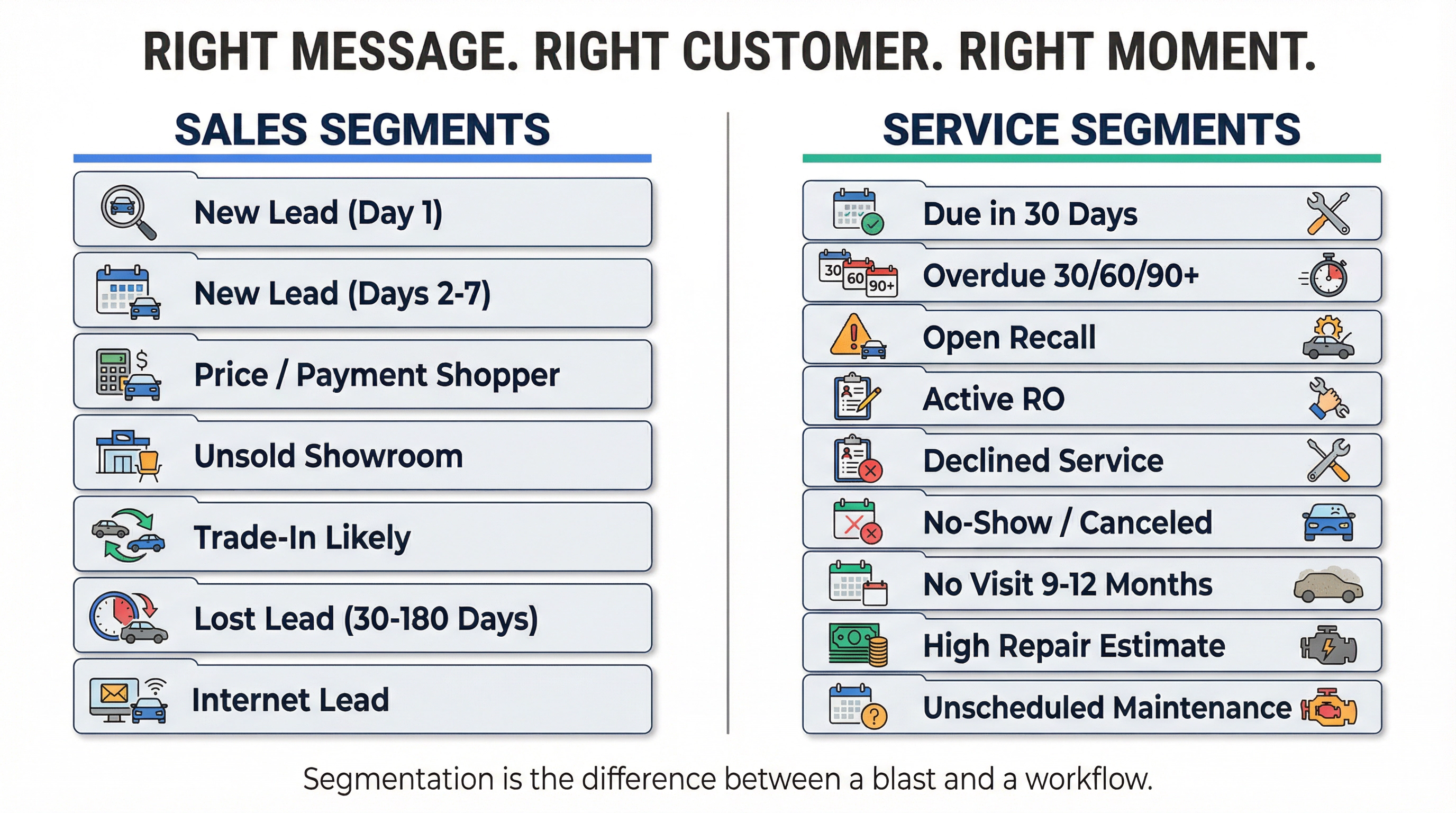
At minimum, you should be segmenting by these buckets:
Sales segments:
- New lead (first 24 hours)
- New lead (days 2 through 7)
- Price/payment shopper
- Unsold showroom or test-drive
- Trade-in likely
- Lost lead (30 to 180 days)
- Internet lead by make/model/body style
Service segments:
- Due in 30 days
- Overdue 30 / 60 / 90+ days
- Open recall
- Active RO, awaiting update or approval
- Declined service by urgency and dollar value
- No-show or canceled appointment
- No service visit in 9 to 12 months
- High repair estimate, possible trade candidate
The data fields that matter most: vehicle owned or requested, service due or declined line items, last visit date, appointment history, trade status, payment sensitivity, response behavior by channel, store/rooftop, and advisor or rep owner.
This is where generic email programs fall apart. Segmentation isn’t decoration. It’s the difference between a blast that gets ignored and a workflow that books appointments. The BDC metrics that matter most map directly onto segmentation. Appointment set rate, contact rate, and profit per kept appointment all improve when you’re communicating with the right person at the right moment.
Automotive Email Marketing Metrics to Track in 2026
Ignore most “average automotive open rate” articles. Between Apple MPP inflating opens and wildly different list quality across stores, public open-rate numbers are noisy. Use your own segment history and care more about click-to-appointment and gross per 1,000 delivered.
Here’s what to track instead:
| Metric | Benchmark | Source |
|---|---|---|
| Spam complaint rate | Below 0.3% | Google / Yahoo |
| Click-through rate (CTR) | ~2.3% global average (use as floor) | Industry benchmark |
| Click-to-open rate (CTOR) | 10% to 15% healthy | Industry benchmark |
| Unsubscribe rate | Below 0.5% | Industry benchmark |
| Triggered email CTR | Up to 11.07% for best flows | Benchmark data |
| Open rate | Directional only (Apple MPP distorts) | Note: unreliable metric |
Those benchmarks are useful, but for dealerships, four operator metrics matter even more:
- Appointments per 1,000 delivered emails
- Reply-to-appointment rate
- Gross profit per 1,000 delivered emails
- Reactivated customers per 1,000 dormant records
Those four tell you whether the program is actually helping the store make money. For a complete framework for tracking the full funnel from email to revenue, the 12 BDC metrics every dealership should track framework is directly applicable. Most of these metrics flow from the same customer interactions email triggers.
How to Calculate Automotive Email ROI
The basic formula is straightforward: (marketing value minus marketing cost) divided by marketing cost. But dealerships should use versions tailored to their actual revenue streams.
Service email ROI formula:
Service ROI = ((Booked appointments x Show rate x Gross profit per RO) - Total email cost) / Total email cost
Sales email ROI formula:
Sales ROI = ((Booked appointments x Show rate x Close rate x Avg front + back gross) - Total email cost) / Total email cost
What to include in “total email cost”: email platform cost, CRM or automation cost, data cleanup and enrichment cost, copy and creative time, AI tooling cost, and staff time handling replies and approvals.
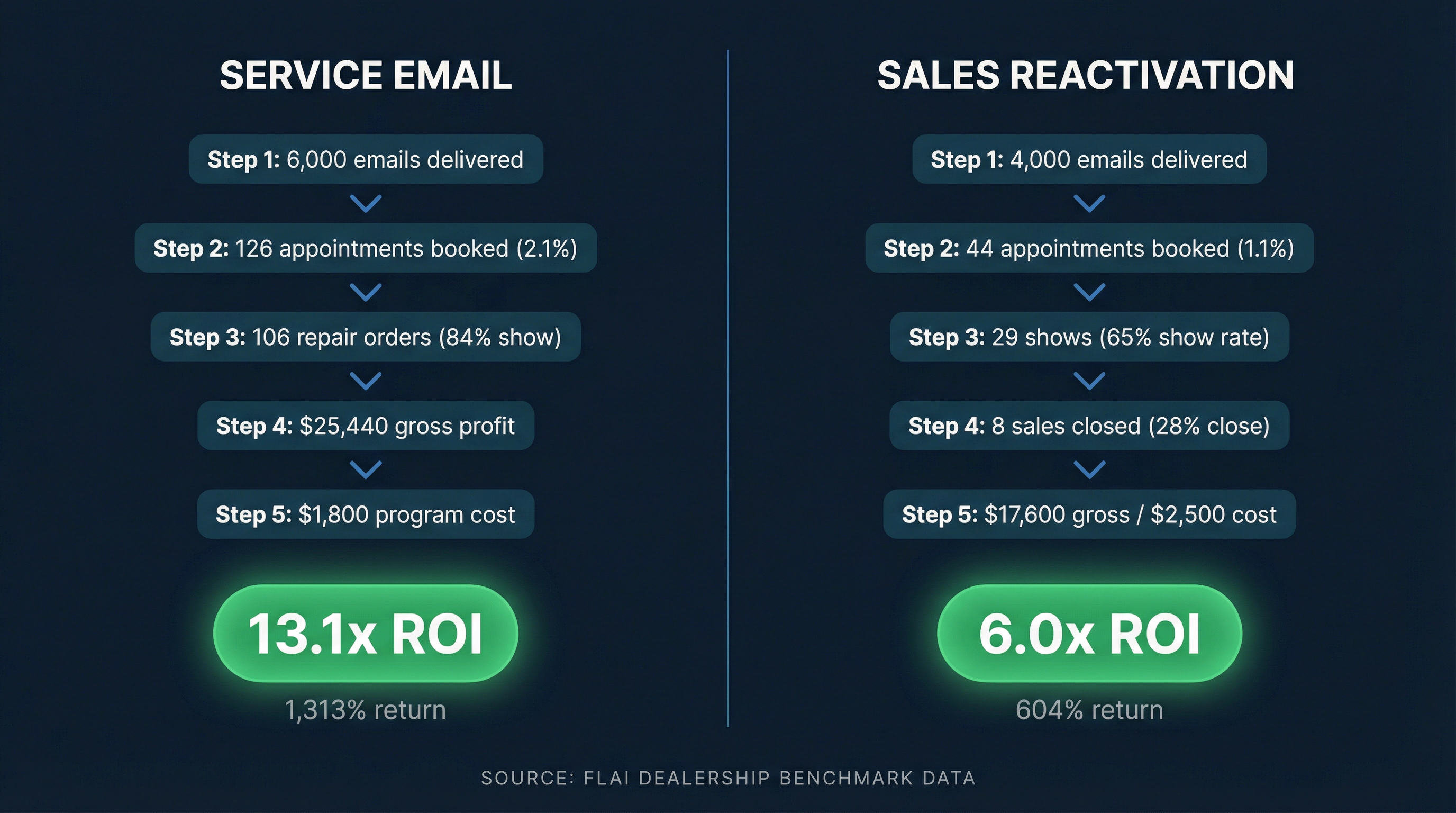
Service Email ROI Example
A dealership sends service-due emails to 6,000 customers in a month.
- 6,000 delivered
- 2.1% book an appointment = 126 bookings
- 84% show rate = 106 ROs
- Average gross profit per RO = $240
- Attributed gross profit = $25,440
- Total monthly email program cost = $1,800
ROI: ($25,440 - $1,800) / $1,800 = 13.1x (a 1,313% return)
Sales Reactivation Email ROI Example
You send reactivation emails to 4,000 dormant sales leads.
- 4,000 delivered
- 1.1% book an appointment = 44 appointments
- 65% show = 29 shows
- 28% close = 8 sales
- Average front + back gross = $2,200
- Attributed gross profit = $17,600
- Program cost = $2,500
ROI: ($17,600 - $2,500) / $2,500 = 6.0x (a 604% return)
The biggest ROI mistake dealerships make? They count opens, maybe clicks, and sometimes sold units. They don’t count recovered service appointments, saved no-shows, faster estimate approvals, reactivated dead leads, staff time saved, or the retention value from service customers who come back to buy. That’s how dealership teams consistently understate email’s real value.
Email Deliverability Checklist for Dealerships (2026)
Before you scale a single campaign, lock down the basics. Getting this wrong means your templates never reach the inbox.
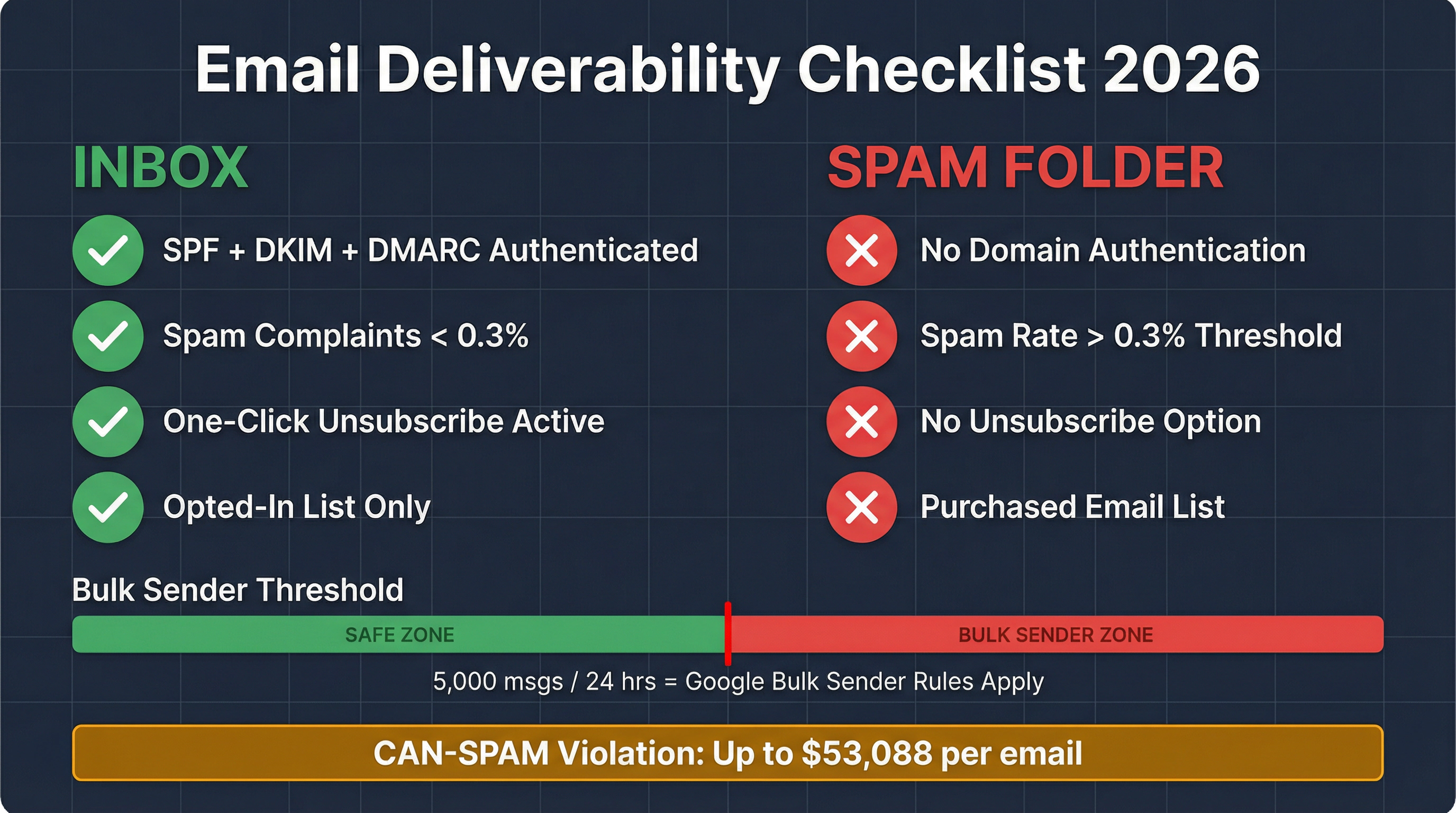
Authenticate your domain. Google and Yahoo require senders to use SPF or DKIM at minimum. Bulk senders should use both plus a valid DMARC policy. Google recommends 2048-bit DKIM keys.
Keep spam complaints under 0.3%. That threshold matters at both Google and Yahoo. Cross it and your deliverability tanks.
Use valid DNS and TLS. Both providers expect valid forward and reverse DNS and transport-layer encryption.
Know when you’re a bulk sender. Google says once you send roughly 5,000 messages to personal Gmail accounts in 24 hours, you’re treated as a bulk sender. That classification continues to apply after the threshold is reached.
Offer one-click unsubscribe for marketing mail. Google requires it for subscribed messages, and Yahoo expects easy unsubscription.
Don’t buy lists. Google explicitly warns against sending to people who didn’t opt in.
Warm up new domains and IPs slowly. Google recommends ramping volume gradually.
Keep message categories separate. Don’t mix promotional content into receipts or confirmations. Use consistent From addresses by message type. Recall and appointment confirmation emails that stay operational and transactional also reduce customer friction, one of the top drivers of better dealership customer experience scores.
Follow CAN-SPAM. The FTC requires accurate header information, non-deceptive subject lines, a valid physical postal address, and a clear opt-out mechanism. Opt-outs must be honored within 10 business days. The current maximum civil penalty is $53,088 per violating email.
Treat recall emails carefully. The FTC says messages about warranty, recall, safety, or security information can qualify as transactional messages. But if you load that email with promotional content, it becomes commercial mail. Keep operational emails operational.
How AI Communication Boosts Dealership Email ROI
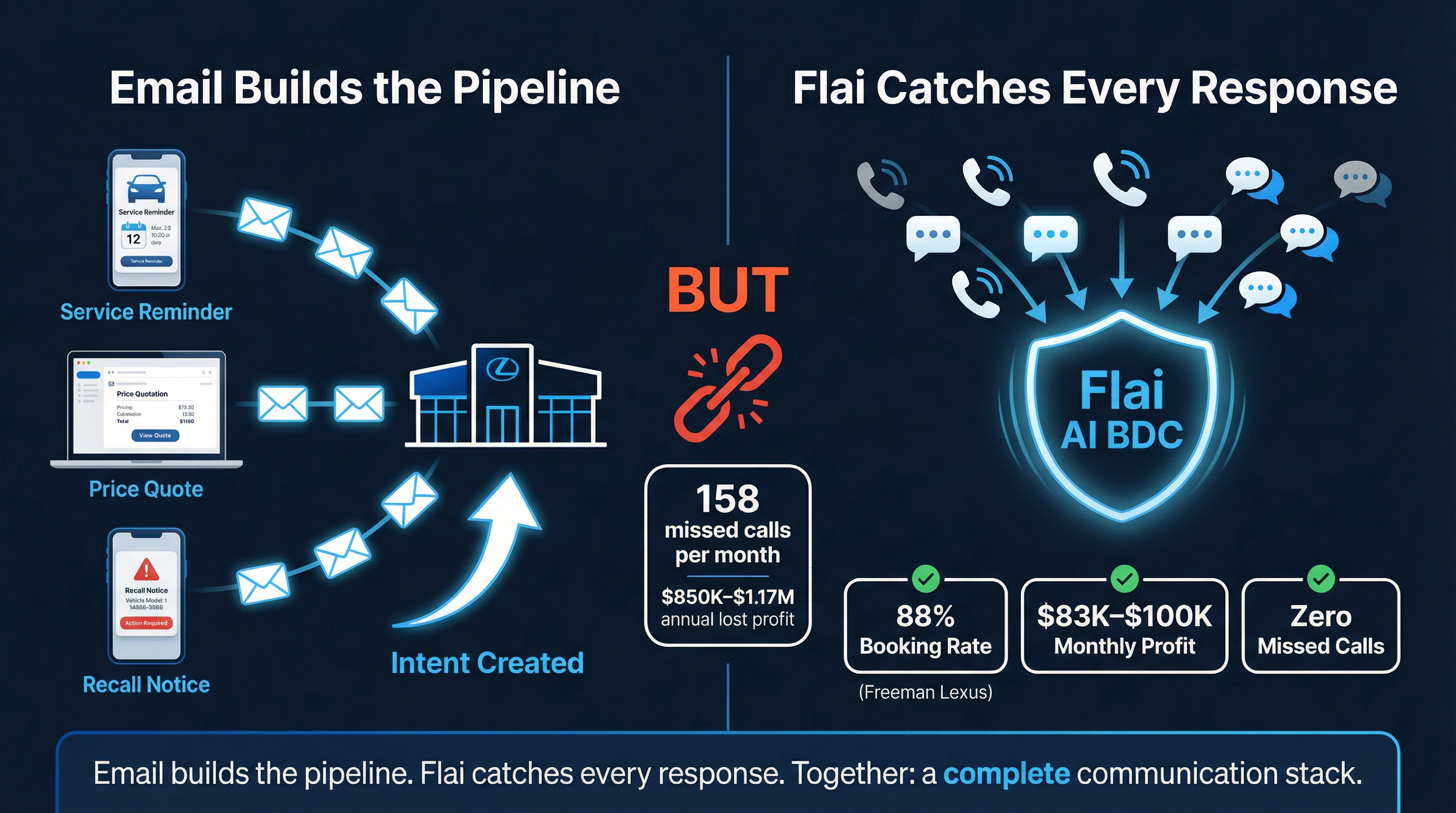
Email is excellent for pricing context, service reminders, repair updates, estimate approvals, recall notices, and reactivation. It gives customers time to read, compare, and decide. But email has a blind spot. It can’t handle the moments that require real-time response: the customer who picks up the phone after reading your price quote, the after-hours service call from someone with a warning light on, or the lead who texts back “can I come in today?” at 8 PM.
This is exactly where missed revenue hides. The average dealership misses approximately 158 service appointment calls per month, and missed call revenue data shows that translates to $850,000 to $1.17 million in annual lost profit per location. Email drives intent; a missed phone response erases it.
This is where Flai fits in.
Flai is an AI communications platform built specifically for car dealerships. It works as a 24/7 AI BDC that answers every inbound phone call instantly, books appointments directly into your scheduler and DMS, follows up with leads via SMS and email, and handles FAQs like hours, directions, and recall checks. When your email campaign drives a customer to pick up the phone or send a text, Flai makes sure that response never goes to voicemail. For more on how AI follow-up fits into nurture sequences and reply handling, see our guide on AI Follow-Up for Dealerships: Close More Leads.

The numbers back this up. Our case studies show $83,000 to $100,000 in monthly profit impact per dealership, driven by captured calls that would otherwise go unanswered. A CDJR store in the Bay Area went from 205 monthly service appointments to 448 in the first month. A Freeman Lexus hit an 88% booking rate on every answered call with zero missed calls.
Think of it this way: email builds the pipeline. Flai catches every response that comes back through phone and text. Together, they form a complete dealership communication stack where nothing falls through the cracks. You can dig deeper into how AI is transforming dealership service departments in the stores already running it.
Dealership Email Marketing Mistakes That Kill Performance
Most bad dealership email comes from the same handful of errors. Customer frustrations center on delays and lack of price transparency, while better-than-expected experiences come from speed and clear communication. Email is one of the easiest places to fix both.
Here are the mistakes we see most often:
- Sending one generic blast to the entire CRM
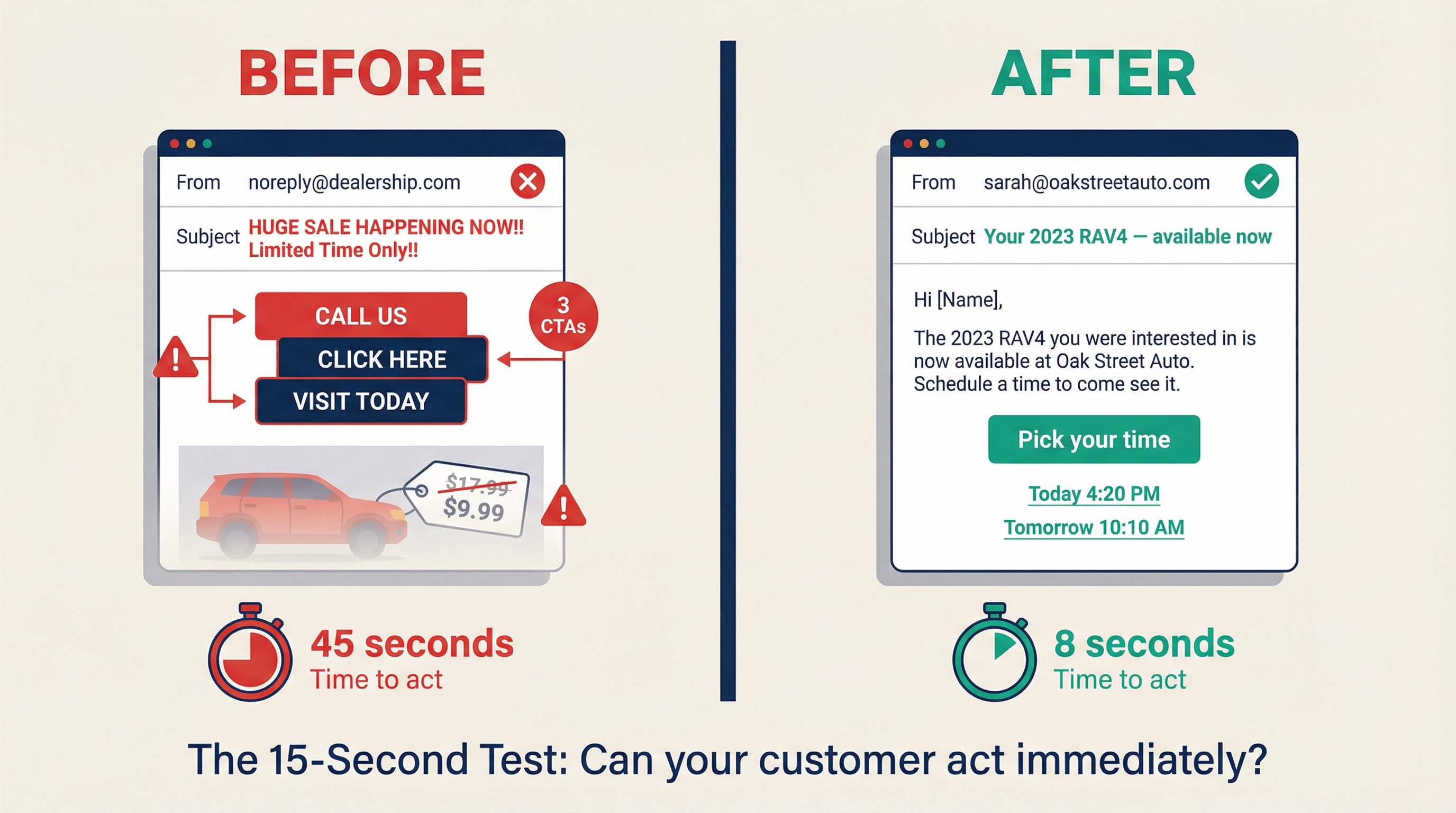
- Asking the customer to “call us” instead of offering two specific times
- Sending from a noreply@ address
- Cramming three different CTAs into one message
- Sending stale inventory or outdated service information
- Mixing promotional content into operational emails
- Measuring success by opens instead of appointments and gross
- Never escalating to SMS or phone when urgency is high
- Failing to write outcomes back to the CRM
- Letting replies sit in a shared inbox with no owner
A simple test: after reading your email, could the customer act in under 15 seconds? If the answer is no, the email probably needs work. The “never escalating to phone” mistake is particularly costly.
Understanding when your phones are busiest helps you design email workflows that hand off to live or AI phone coverage at the right moment.
The last two mistakes are especially costly. When voicemails kill sales at the phone layer and inbox chaos kills opportunities at the email layer simultaneously, the revenue leak compounds fast. A proper multi-channel communication stack eliminates both failure modes. Email handles structured communication, and an AI virtual receptionist handles the real-time phone and text responses that email can’t.
For attribution and tracking the phone responses generated by email campaigns, understanding the full BDC metrics framework covers the measurement side in detail, including how to track calls driven by email back to appointment and revenue outcomes.
How to Launch Dealership Email Marketing in 90 Days
Days 1 to 30: Build the Foundation
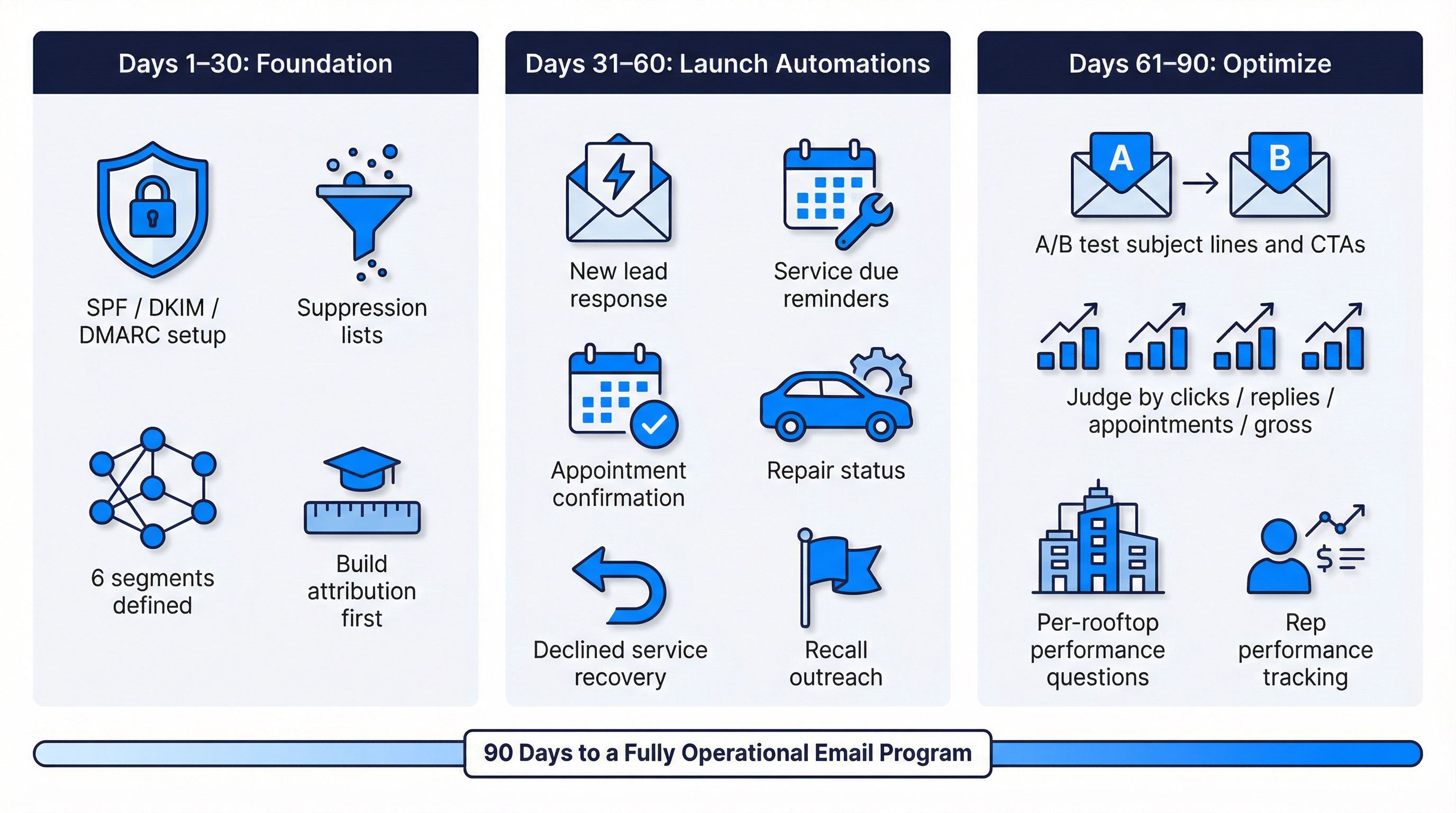
Set up SPF, DKIM, DMARC, suppression lists, unsubscribe handling, and monitored reply routing. Then define your first six segments: new lead, unsold lead, service due, appointment reminder, declined service, and dormant customer. Build attribution before you build volume. If you can’t measure what an email campaign produces in appointments and gross, you’re flying blind.
During this phase, it’s also worth locking down your phone operations. Most dealerships don’t realize how much demand their email campaigns generate that then evaporates at the phone layer. Understanding when dealerships get the most calls (Monday mornings and Tuesday afternoons are peak) helps you staff appropriately when email-driven intent converts to inbound calls.
Days 31 to 60: Launch the Highest-Value Automations
Turn on:
- New lead response
- Service due reminders
- Confirmation and reminder emails
- Repair status and estimate approval emails
- Declined service recovery
- Recall outreach (where relevant)
Don’t wait for “perfect creative.” Operational workflows usually beat polished newsletters. A plain-text email that offers two appointment times will outperform a designed HTML blast that says “call us” with no specific ask.
This is also when you should layer in call overflow solutions for the phone traffic your email campaigns generate. Email-driven leads who call after hours are especially high-intent. They read your message, they’re engaged, and if they hit voicemail, they’re gone. That hold time cost is real: industry data shows 60% of customers hang up after just one minute on hold, and 70% call a competitor within 30 minutes of reaching voicemail.
Days 61 to 90: Optimize What Actually Matters
Test subject lines, CTAs, send order, and escalation paths. Judge winners by clicks, replies, appointments, show rate, and gross, not opens. (Apple MPP is exactly why.)
At this point, start asking the questions that separate good programs from great ones:
- Which rooftop gets the highest gross per 1,000 delivered?
- Which template recovers the most declined service dollars?
- Which lead segment needs SMS or phone faster?
- Which advisor or rep converts replies into appointments best?
The last question points to a BDC metrics discipline: tracking reply-to-appointment rate by rep lets you identify who closes conversational leads versus who loses them, and coach accordingly.
If your store is already handling multilingual customers, this is the phase to audit your email segmentation by language preference. Spanish-speaking buyers represent nearly one in four new car sales in the U.S., and most dealerships are leaving significant revenue on the table by sending English-only email sequences to these customers.
If you’re also evaluating whether to build out a full AI BDC for your dealership, this 90-day period is typically when dealers see the ROI clearly enough to make that investment decision.
Automotive Email Marketing FAQ

What’s a realistic ROI for dealership email marketing?
It depends on your segments and workflows, but the math works out well even with conservative numbers. A service-due campaign hitting 6,000 customers per month can produce 13x ROI when you account for show rates and average RO gross. Sales reactivation typically runs 5x to 8x.
How often should a dealership send marketing emails?
There’s no universal answer, but triggered emails based on behavior (service due, recent visit, abandoned lead) consistently outperform scheduled blasts. Most dealerships get the best results by running automated workflows that fire when the timing makes sense for the customer, plus occasional targeted campaigns for inventory pushes or seasonal promotions.
Do I need a dedicated email platform, or can I use my CRM?
Most CRMs have basic email capability, but they’re rarely built for the kind of segmentation and automation that drives real results. The answer depends on what your CRM actually supports. If it can handle triggered workflows, segmentation by service history and lead status, and proper deliverability controls (SPF, DKIM, DMARC), you may be fine. If it can’t, a dedicated platform pays for itself quickly. A Tekion integration is one example of how modern CRM/DMS systems are being connected to AI communication platforms for tighter workflow automation.
How do I handle Apple Mail Privacy Protection messing up my open rates?
Stop relying on open rate as a primary metric. Apple MPP pre-loads tracking pixels, so open rates are inflated and unreliable for Apple Mail users. Focus instead on click-through rate, reply rate, booked appointments, and gross profit per campaign. Open rate is still directional, but it shouldn’t drive decisions.
Should email replace phone follow-up at a dealership?
No. Email and phone serve different purposes. Email works best for detailed pricing, service reminders, repair updates, and reactivation. Phone is better for high-urgency moments, objection-heavy conversations, and missed appointments. The strongest dealership communication programs use both, with AI tools like Flai covering the phone and SMS side so nothing gets missed while email handles the structured, low-urgency communication. For a detailed breakdown of what traditional BDC operations cost versus an AI alternative, the AI vs. traditional BDC cost comparison lays out the math clearly.
What’s the fastest way to improve dealership email deliverability?
Start with domain authentication (SPF, DKIM, DMARC). Then check your spam complaint rate and make sure it’s below 0.3%. Clean your list by removing hard bounces and long-inactive addresses. And don’t buy lists. Those three steps solve the majority of deliverability problems for dealerships.
Can small dealerships with limited staff run effective email marketing?
Absolutely. The templates in this guide are designed to be plug-and-play. Once you set up the triggered workflows (especially service due reminders, appointment confirmations, and new lead response), they run automatically. The initial setup takes effort, but the ongoing maintenance is minimal. Pair automated email with an AI communications platform like Flai to cover phone and text, and even a small team can run a professional multi-channel operation. If you want to understand whether a full AI BDC makes sense for your store, start with the economics: how many calls are you missing, what does each missed appointment cost, and what would recovering even 30% of those calls produce in gross profit? The answer is usually compelling, and you can book a demo to see it in action.