
Privacy Policy
Terms of Service
Security
Status
Blogs & Guides
Car dealership marketing in 2026 isn't a traffic problem. It's a conversion problem. Fix call handling, speed-to-lead, and service retention to grow revenue.
May 3, 2026
Car dealership marketing in 2026 looks deceptively simple on the surface: run ads, generate leads, sell cars. But the dealerships that actually grow their revenue know something different. The biggest money doesn’t leak at the top of the funnel. It leaks in the middle, after a customer has already raised their hand.
Consider what NADA’s 2025 full-year data tells us about the industry’s scale: U.S. franchised dealerships sold 16.2 million light-duty vehicles, generated more than $1.3 trillion in total sales, and wrote more than 276 million repair orders. The demand is enormous. The question is how much of it actually gets captured.
Car Wars data reported by CBT News shows that out of roughly 53 million inbound service calls tracked in 2025, there were about 19 million missed opportunities. That’s not a traffic problem. That’s a conversion problem, and the dealership customer experience benchmarks that separate top performers from average stores reflect exactly this gap. This is why every car dealership marketing strategy worth following has to treat marketing not as a lead factory but as a complete revenue system.
At Flai, we’ve worked inside hundreds of dealerships, often literally in the service bay or back office, observing the real gap between the demand marketing creates and the revenue that actually gets captured. This guide reflects what we’ve seen work, built on the most current data available from NADA, Cox Automotive, J.D. Power, Car Wars, and others.
Here’s the framework that ties it all together:
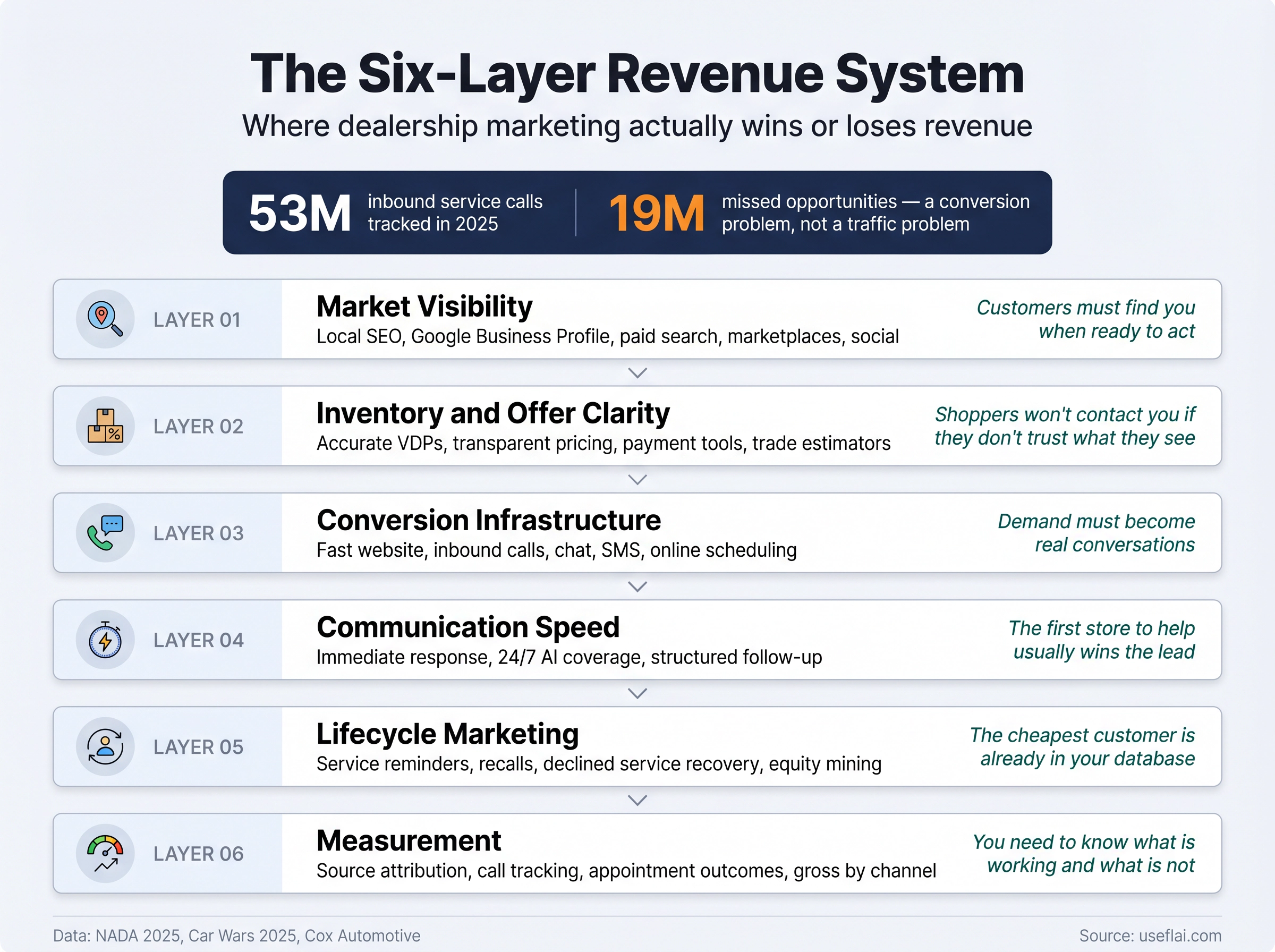
| Layer | What It Means | Why It Matters |
|---|---|---|
| Market visibility | Local SEO, Google Business Profile, paid search, marketplaces, social | Customers have to find you when they're ready to act |
| Inventory and offer clarity | Accurate VDPs, pricing, payments, trade tools | Shoppers won't contact you if they don't trust what they see |
| Conversion infrastructure | Fast website, calls, chat, SMS, online scheduling | Demand has to turn into real conversations |
| Communication speed | Immediate response, 24/7 coverage, follow-up | The first store to help usually wins |
| Lifecycle marketing | Service reminders, recalls, declined service, equity mining | The cheapest customer to acquire is already in your database |
| Measurement | Source attribution, call tracking, appointment outcomes | You need to know what's working |
What follows is a practical guide to executing each layer.
The buying journey is hybrid, and it’s not changing back. Cox Automotive’s 2025 Car Buyer Journey Study, released in January 2026, found that 63% of shoppers prefer an omnichannel process that mixes online and offline steps. Only 7% completed the entire purchase fully online. Buyers use the internet to narrow choices, compare pricing, read reviews, and decide which store is worth their time, but they still want to touch the car and talk to a human before signing. Your digital presence has to reduce friction before the visit; your team still has to close the deal in person.
AI is now part of the shopping process. The same Cox study found that 19% of 2025 vehicle buyers used AI tools during shopping, with usage notably higher among new-vehicle buyers. Cars.com reported in November 2025 that 44% of consumers used AI-powered car search tools. Shoppers are arriving with better pre-research, more specific questions, and less tolerance for vague answers.
Forms are declining; calls and chats are rising. Shift Digital’s March 2026 analysis found that form completions dropped 18% by Q4 2025, while calls and chats per website lead rose from 2.0 to 2.7. Customers are still interested. They just want real-time answers, not a form submission and a callback sometime tomorrow.
This is the most important structural shift in dealership marketing right now. It makes call tracking a first-class marketing measurement tool, and it reshapes how every channel should be measured.

For most dealerships, local SEO isn’t about writing blog posts or building backlinks from automotive publications. It’s about being visible when a nearby customer is ready to act: searching “Toyota service near me” on a Saturday morning, or “used trucks under $30,000 near me” during their lunch break.
Google’s local ranking guidance is straightforward: local results are based on relevance, distance, and prominence. Keep your Google Business Profile complete and accurate. Update hours (including department-specific hours), add real photos, respond to reviews, and make it obvious which departments you have and how to reach each one.

The underused opportunity on most dealer websites is service content. A generic “Service Center” page with a phone number and an OEM banner isn’t enough. Build dedicated pages for oil changes, brake service, tire replacement, battery service, recalls, EV service, and anything else your service lanes handle. Each page should answer the five things a service customer wants to know:
Reviews deserve more strategic attention than most dealers give them. A high star rating matters, but so does review quality and recency. Build a process around capturing reviews after smooth deliveries, completed service visits, and resolved complaints. Don’t wait until your rating drops to start asking. Respond to every negative review specifically and professionally.
Your reviews and reputation management strategy has a direct impact on your CSI scores. The response is written for the next potential customer reading it, not just for the person who left it. One compliance note: the FTC’s consumer reviews rule, which took effect October 2024, prohibits fake reviews, certain paid reviews without disclosure, and review suppression.
Most dealer websites have one of two problems: too much friction or too little trust. Both have the same result. The shopper goes back to Google and calls a different store.
CDK Global’s March 2025 research on how shoppers use dealership websites found that 88% of buyers who started online said photos enticed them to take the next step. More than 70% checked whether a vehicle was actually on the lot. 56% calculated payments online. These aren’t shoppers browsing casually. They’re actively qualifying whether your store is worth their time.

A high-converting VDP needs to do four things:
The stores that do this well don’t get calls from shoppers asking “is this still available?” because the answer is already on the page.
Beyond the VDP, the website has to make it easy to reach someone. A phone number buried in the footer isn’t a call-to-action. Every high-intent page (VDPs, service pages, model pages) should have a visible phone number, a text option, and a scheduling tool. If a shopper has to hunt for a way to contact you, some percentage of them won’t bother.
Paid search remains one of the highest-value dealership marketing channels because it captures demand that already exists. A shopper searching “2026 Honda CR-V lease near me” isn’t browsing; they’re shopping.
WordStream’s 2025 Google Ads benchmarks, based on more than 16,000 campaigns, show how the two main automotive categories perform:
| Category | Avg. Conversion Rate | Avg. Cost Per Lead |
|---|---|---|
| Automotive: For Sale | 7.76% | $38.86 |
| Automotive: Repair, Service and Parts | 14.67% | $28.50 |
Your numbers will vary based on market, brand, and competition, but the pattern is clear: service campaigns often convert at nearly twice the rate of sales campaigns, and they’re cheaper per lead.
The strategic mistake most dealerships make in paid search is treating it as one undifferentiated bucket. Segment by intent: model-specific campaigns send clicks to the right SRP or VDP. Service campaigns send clicks to the right service page with a scheduling option. Trade-in campaigns send clicks to an equity tool. Competitor campaigns use different ad copy and landing pages than brand defense campaigns. Each intent requires a different offer and a different conversion path. Tracking which campaigns actually produce appointments, not just clicks, is the only way to know where your budget is working.
For inventory advertising, Google Vehicle Ads can be a strong lower-funnel channel when the feed is clean: accurate prices, high-quality photos, updated mileage, availability confirmed. Setting them up correctly requires linking Google Ads, Merchant Center, and your Google Business Profile, along with clean inventory data. The risk is simple: if a customer clicks on a car that’s already sold or a price that changes at the desk, the campaign metrics look fine while the store loses trust.
One compliance note: the FTC warned 97 auto dealers in March 2026 about deceptive pricing practices, including advertising discounts not available to all consumers, excluding required fees from advertised prices, and advertising vehicles that aren’t available. Paid ads are the wrong place for ambiguity.
This is where most dealership marketing strategies break down. Stores spend heavily to make the phone ring, then treat what happens next as an operations problem rather than a marketing problem.

It’s not. It’s the most expensive conversion failure in the business.
Car Wars data tracked by CBT News covering roughly 53 million inbound service calls in 2025 paints a clear picture of the problem:
What those missed calls actually cost in annual revenue is striking. And what hold times actually cost per month adds up to more than most managers realize.
Peak call windows by day and hour show a predictable pattern: Monday mornings from 10 a.m. to noon are the highest service call traffic window of the week. That’s exactly when most service desks are slammed from overnight messages and walk-ins. The bottleneck is predictable and preventable.
For sales, the stakes are just as high. About 70% of people who hit voicemail will call a competitor within 30 minutes, and voicemail’s real cost to your pipeline is often the single biggest revenue leak a store has. 56-60% of dealership leads come in after business hours, when most BDCs are closed. A Friday night or Sunday afternoon lead that doesn’t get followed up until Monday morning has often already bought from someone else.
The top 20% of dealerships achieve service call connection rates above 85%, compared to the 65.2% industry average. The gap is real, and it translates directly into revenue. A dealership that improves its call connection rate by 10 percentage points without changing ad spend is getting more out of every dollar already invested. There are proven systems for capturing every inbound call, from smart call routing to AI coverage, that the top performers use.
Tracking phone performance should be part of every marketing review: total inbound calls, answer rate, hold time, voicemail rate, missed calls, after-hours calls, appointment set rate from calls, and bookings from after-hours calls. These are marketing metrics, not just operations metrics.
This is where AI communications tools earn their ROI. Flai was built specifically to handle this layer: answering inbound calls 24/7, booking appointments directly into the dealership’s scheduler, handling call overflow during peak windows, and following up with missed calls. No hold music. No voicemail. Every caller gets an immediate, natural-sounding response that can actually schedule an appointment or route them to the right person.
More leads won’t fix a slow follow-up process. If anything, more volume makes the problem worse. There’s more to miss.
Shift Digital’s March 2026 report found that slower response times, inconsistent follow-up, and missed inbound calls continue to hurt conversion. The dealers who outperform focus on speed, accurate inventory information, personalized video, and verified pricing. The difference isn’t budget. It’s process.
The standard for a first response in 2026 has to be immediate, multi-channel, and specific to the actual request. Not this:
“Thank you for your inquiry. Someone will contact you shortly.”
More like this, using word tracks like these in your first response:
“Hi Maria, the white 2025 RAV4 XLE you asked about is still available. I can hold a time for you today at 5:30 or tomorrow at 10:15 for a test drive. Which works better?”
For service, scripts that turn callers into booked appointments sound like this:
“Hi James, we can help with the recall on your Accord. I have openings Tuesday at 8:20 or Wednesday at 3:40. Would either work?”
The specific details matter. Vehicle name, actual availability, real times. That response signals that someone actually looked at the request, and it gives the customer a reason to reply instead of calling somewhere else.

A practical follow-up cadence for sales leads:
(1) Immediate (within 1 minute): Contact by phone, SMS, and email campaigns tied to specific vehicle details.
(2) By 10 minutes: Second reach-out if no response. Personalized video or a VDP link builds trust on day one.
(3) Days 2-7: A mix of call, SMS, email, and a manager touchpoint, each tied to something specific: payment info, trade value, new availability, or a simple yes/no question that restarts the conversation.
(4) Past two weeks: Message shifts to useful updates: price drops, new arrivals, trade market changes.
How AI follow-up sequences keep leads moving through this cadence without gaps is one of the most consistent ROI wins in the business.
One important note on outbound texting and calling: FCC rules require that consumers can revoke consent through any reasonable means, and dealers must honor opt-out requests within 10 business days. Compliance here isn’t optional, and a good follow-up system has consent management built in from the start.
The fixed ops department often gets treated as separate from “marketing.” That’s a missed opportunity.
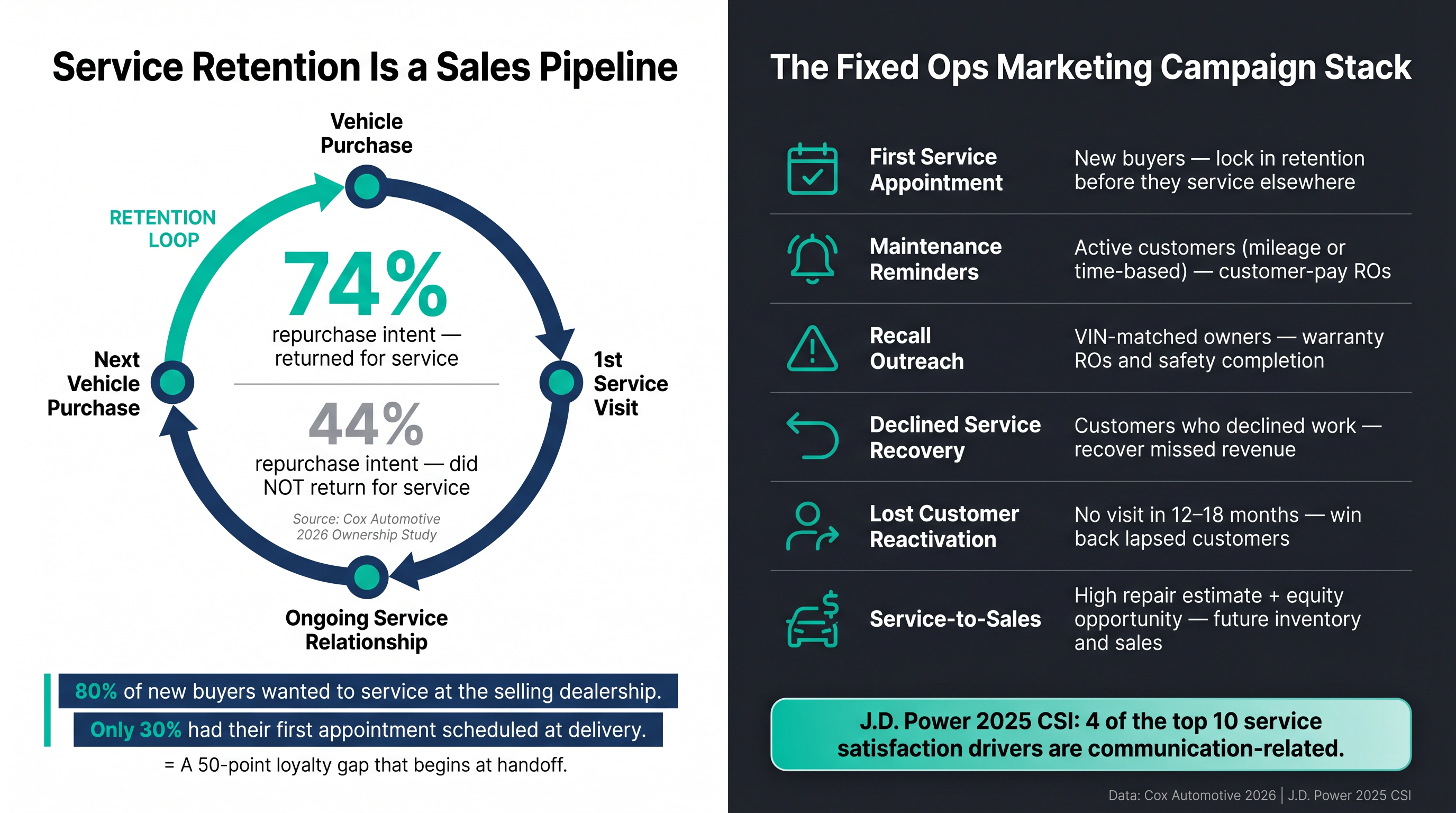
Cox Automotive’s 2026 fixed ops research found that buyers who returned to the selling dealership for service were nearly twice as likely to say they’d buy their next vehicle there: 74% versus 44% among those who didn’t return for service. Service retention is a sales pipeline. But the same research found that while 80% of new buyers wanted to service at the selling dealership, only 30% had their first service appointment scheduled at delivery. That gap represents massive lost customer loyalty before it has a chance to form.
Scheduling the first service appointment at delivery is probably the highest-ROI marketing action available to most dealerships. It takes 60 seconds, it creates a tangible next step, and it starts a retention relationship on the best possible terms. Every delivery should include it. For strategies for increasing service appointment volume beyond the delivery process, there are proven approaches that produce real gains at every stage.
J.D. Power’s 2025 Customer Service Index Study found that four of the top ten most influential service satisfaction drivers are communication-related: focusing on customer needs, keeping customers informed, having the advisor meet the customer immediately, and following up after service. Communication is a marketing strategy in the service department, not just the BDC. And how AI is raising the bar for service department communication is now one of the most consequential decisions a fixed ops director makes.
The fixed ops marketing system should run these campaigns consistently:
| Campaign | Audience | Goal |
|---|---|---|
| First service appointment | New buyers | Lock in retention before they service elsewhere |
| Maintenance reminders | Active customers (mileage/time-based) | Customer-pay ROs |
| Recall outreach | VIN-matched owners | Warranty ROs and safety completion |
| Declined service recovery | Customers who declined work | Recover missed revenue |
| Lost customer reactivation | No visit in 12-18 months | Win back lapsed customers |
| Service-to-sales | High repair estimate + equity opportunity | Inventory and future sales |
For recall outreach specifically, a comprehensive recall campaign playbook covers the cadence, timing, and AI-assisted outreach that gets vehicles back in the service lane. Cox Automotive’s research also found that consumers who received photos and videos from service advisors spent more per repair order and said visual proof made them more likely to approve work. A quick 30-second video of tire wear or brake pad condition converts declined service at higher rates than a verbal recommendation. It also builds the trust that drives repeat visits.
AI in dealerships has gotten a lot of vendor hype and a fair amount of reasonable skepticism. The skepticism is earned. Plenty of tools promise to “transform the customer experience” and end up adding a new inbox that nobody checks.
What actually works is narrower and more specific: AI applied to the repetitive, high-volume communication workflows where humans are the bottleneck. That means inbound call answering, service appointment scheduling, sales lead follow-up, recall campaigns, and missed-call recovery. Not glamorous use cases, but that’s where real money gets left on the table every day. Understanding what an AI BDC is and why dealers want one is the starting point for evaluating whether the technology is right for your store.
Cox Automotive’s 2026 fixed ops research found that 63% of dealers said investing in AI now is critical, and that 83% of consumers said AI-like technology will impact vehicle buying over the next ten years. The question isn’t whether to use AI. It’s which problems it actually solves. For the full guide to AI tools that actually work for dealerships, covering everything from voice AI to follow-up automation, the landscape is clearer than the vendor pitches suggest.
Here’s what that looks like in practice with Flai.

Flai was built from the ground up specifically for car dealerships, not adapted from a generic call center platform, but designed with the actual workflows of service and sales in mind. The founders spent time physically inside hundreds of dealerships before writing a line of product code, because dealership communication nuances don’t show up in a product spec. They show up in a service advisor pulled off a walk-in to answer the phone, or a BDC rep who can’t keep up with Monday morning volume.
The result is an AI that handles the pre-visit communication arc: answering every inbound call with a natural voice (no obvious bot pauses or confusion), booking appointments directly into the dealership’s scheduler with real availability checks, sending confirmations via SMS, and routing to a human when the conversation needs it. It also runs outbound: recall campaigns, service reminders, and sales lead follow-up across voice, SMS, and email. Understanding how AI BDC costs compare to a traditional BDC makes the ROI calculation straightforward for most stores.
The results across dealerships are consistent:

| Dealership | Calls Handled | Appointments Booked | Estimated Profit Impact |
|---|---|---|---|
| Lexus Bay Area | ~1,100 (zero missed) | 376 (88% booking rate) | $100,000 |
| CDJR Bay Area | 1,563 | 304 (from 205 to 448/mo) | $83,000 |
| Toyota (Freeman) | 1,053 | 358 | $94,000 |
The 88% booking rate at the Lexus dealership matters: it’s not just about answering calls, it’s about completing them as scheduled appointments. Read the full Freeman Lexus case study to see the breakdown.

Poor system integrations are where most AI tools fall apart. Flai’s integration with the scheduler, DMS, and CRM is what keeps the bookable rate high. The full San Leandro CDJR case study and the Freeman Toyota results follow the same pattern.

The right way to think about AI in dealership marketing is not “AI replacing people” but AI protecting revenue from the moments when people can’t respond fast enough, which is why more dealerships are replacing outsourced call centers with AI. Every Friday night after closing, every Monday morning spike, every moment when all four service lines are ringing at once: those are the moments Flai covers. No hold music. No voicemail. The customer gets helped, the appointment gets booked, and the staff finds out in the morning.
Most dealership marketing reviews stop at cost per lead. That’s a useful number, but it’s incomplete, and it can actively mislead by rewarding volume over quality.
A dealership that gets 300 leads at $15 each and converts 5% to appointments is spending more per appointment than a dealership that gets 150 leads at $30 each and converts 15% to appointments. Cost per lead hides that difference. Cost per appointment exposes it.
Track this instead:
Executive dashboard (what leadership needs to see every week):
Sales funnel (what drives contact-to-close):
-> Speed to first response
-> Contact rate
-> Appointment set rate
-> Appointment show rate
-> Sold rate and gross by source (Understanding inbound vs outbound BDC performance benchmarks helps you attribute correctly.)
Service funnel (what protects fixed ops revenue):
The core numbers here are service call answer rate, missed service calls (track these as lost revenue), first-service-at-delivery rate, declined service recovery rate, and return service rate. Set up a call tracking setup that captures appointment outcomes and these numbers surface automatically.
The missed-call revenue estimate is worth calculating explicitly. If the average repair order is $400 and the store misses 200 calls per month with a 30% booking rate, that’s $24,000/month in service revenue that didn’t happen. That number makes the business case for fixing call handling more tangible than any vendor pitch.
You can’t fix everything at once. The stores that actually improve their marketing do it in phases.
Days 1-30: Diagnose and fix the conversion layer. Before increasing any spend, audit what’s already happening with the demand you’re generating. Run the numbers on call answer rate, missed calls, after-hours calls, lead response time, appointment set rate, and appointment show rate. Most dealerships find at least four revenue leaks in the first 30 days: missed peak-hour calls, after-hours leads not contacted before morning, weak initial follow-up, and service customers not retained after purchase. Fix these first. Improving phone routing, covering after-hours gaps with AI or a BDC service, adding a virtual receptionist to handle overflow, rewriting first-response templates, and scheduling first service at delivery can all be done within 30 days and produce immediate gains without additional media spend.
Days 31-60: Optimize your traffic sources. Now that the conversion layer is functional, improve what feeds it. Segment paid search by intent. Fix inventory feed quality for Vehicle Ads. Build high-intent service landing pages. Refresh VDP photos and descriptions. Audit which marketplaces are producing appointments vs. just leads. Launch local SEO pages for your major service lines. Start or improve your review request process. Build retargeting audiences from VDP viewers for social.
Days 61-90: Scale what converts and prune what doesn’t. Increase budget on campaigns that are producing appointments and gross. Reduce spend on sources with poor show and sold rates. Launch recall outreach, declined service recovery, and lease maturity campaigns. If you added AI communications coverage in phase one, review what the data shows about after-hours bookings and peak-time overflow. Build a weekly marketing dashboard that shows the full funnel from source to revenue, and review it every week.
The 90-day goal isn’t a perfect system. It’s a measurable one, so you can see which channels create revenue and where the next bottleneck is.
What is car dealership marketing?
Car dealership marketing is everything a dealership does to attract, convert, and retain customers across vehicle sales, service, parts, and trade acquisition. It includes advertising (paid search, social, display), local SEO, inventory merchandising, website conversion, CRM follow-up, call handling, email, SMS, reputation management, and customer lifecycle programs. In 2026, it also increasingly includes AI-assisted communication for lead follow-up, appointment scheduling, and after-hours coverage.
What’s the most important car dealership marketing strategy in 2026?
No single tactic wins in isolation. The dealerships that outperform combine visibility (local SEO, paid search, marketplaces) with fast, consistent conversion (call handling, speed-to-lead, online scheduling) and strong retention (first-service scheduling, service reminders, declined service recovery). If one area has to be prioritized first, fix the conversion layer before adding traffic: improve call handling and lead response time before buying more clicks. There are proven systems to capture every call that high-performing stores set up in the first 30 days.
How should a dealership measure marketing success?
Move beyond cost per lead. Track cost per appointment, appointment show rate, cost per sold unit, gross by source, service ROs from marketing, missed-call revenue, return service rate, and review trends. The goal is connecting marketing spend to real outcomes, not just lead volume. The full BDC metrics framework covers all 12 metrics that drive dealership revenue.
Why are phone calls so critical in dealership marketing?
Because most customers who are ready to act will pick up the phone. The industry’s average connection rate is 65.2%, meaning one in three callers never reaches a qualified person. For sales, about 70% of people who hit voicemail call a competitor within 30 minutes. Calls aren’t just a channel. They’re often the final conversion step before a customer books or goes elsewhere. Car Wars tracked roughly 53 million inbound service calls in 2025 and found approximately 19 million missed opportunities, which shows the scale of the problem.
How can fixed ops marketing drive more revenue?
Start with first-service scheduling at delivery. Cox Automotive’s 2026 research found that buyers who return to the selling dealer for service are nearly twice as likely to buy there again, but only 30% had their first appointment scheduled at delivery. Then run consistent campaigns for maintenance reminders, recall outreach, declined service recovery, and lost-customer reactivation. For a step-by-step approach to growing service bookings at each stage of the customer lifecycle, there’s a proven playbook. Video from service advisors showing repair needs also increases approval rates.
How can AI help with dealership marketing?
The highest-value AI applications are tied to specific communication bottlenecks: answering inbound calls 24/7 so no lead hits voicemail after hours, booking service appointments during peak overflow, following up on sales leads consistently across phone, SMS, and email, and running recall or reactivation campaigns at scale. Understanding how an AI BDC handles these workflows clarifies what you’re actually buying. AI earns its ROI when it’s solving a measurable problem, not when it’s deployed as a gimmick.
What makes Flai different from other AI tools for dealerships?
Flai was built from scratch for automotive, not adapted from a generic call center platform. The voice AI sounds natural because the team built its own voice infrastructure instead of stitching together off-the-shelf components. The system integrates directly with the dealer’s scheduler, CRM, and DMS, which is why the bookable rate (the percentage of calls that actually end as scheduled appointments) is consistently high. Most AI tools break down at the integration layer and fall back to message-taking; Flai actually completes the booking. Before choosing any AI solution, run through the 12 questions worth asking any AI voice vendor to make sure you’re evaluating what actually matters. The platform also handles outbound: recall campaigns, sales lead follow-up, and service reminders, all coordinated across voice, SMS, and email.
How much should a dealership spend on marketing?
There’s no universal formula. Budget should reflect sales volume, inventory mix, OEM support, market competition, and gross targets. A rough starting framework for sales: 30-45% to paid search and Vehicle Ads, 20-30% to marketplaces, 10-20% to retargeting and social, 10-15% to website/SEO, and 10-15% to CRM and AI communications. For fixed ops: 30-45% to service retention campaigns, 20-30% to local service search, 10-20% to recall outreach, and 10-20% to AI scheduling and call coverage. The real rule: budget should follow profitable conversions, not lead volume.
The best car dealership marketing strategy in 2026 isn’t running more ads. It’s building a system that connects every part of the customer journey, from the first search to the first service appointment to the second vehicle purchase.
Most dealerships already generate enough demand to significantly grow revenue. The gap is usually in the middle: calls going unanswered, leads going cold overnight, service customers who never get their first appointment scheduled, and follow-up that’s generic instead of specific. Those are fixable problems. The fix often comes from better process and better tools, not more budget.

If your biggest opportunity is in the communication layer (calls, after-hours coverage, lead follow-up, recall campaigns), Flai is built specifically for that. We’ve seen the Lexus, CDJR, and Toyota results above repeat consistently across dealerships when the pre-visit conversation gets handled the way it should. Browse our full library of case studies to see the results across different store types and brands, or see how it works for your store.
The stores that win don’t treat marketing, phones, service, CRM, and reputation as separate functions. They manage them as one connected revenue machine. That’s the standard worth building toward.
As seen in