Privacy Policy
Terms of Service
Security
Status
Blogs & Guides
Dealership phone performance playbook: 60-minute audit, 12 KPIs, 2026 benchmarks, and a 30-day plan to lift answer rate and bookings.
March 20, 2026
If you’re searching for how to improve dealership phone performance, you’re probably not looking for advice on saying “please” and “thank you.” You’re trying to solve something much more specific: high-intent customers are calling your store ready to book, and too many of them are hitting voicemail, sitting on hold, or getting transferred into a black hole.
That costs real money. Industry data shows that 56% of dealership leads arrive after business hours, and missed after-hours calls alone can cost the average dealership over $1 million annually in lost revenue. A large phone performance analysis covering nearly 3,000 dealerships during 2024 found the average hold time was 3 minutes and 5 seconds, with 31.8% of unconnected calls being people who simply hung up while on hold.
This guide is the operating system for your dealership phones. We’ll walk through what to measure, what to fix first, and how to turn more phone calls into booked appointments, kept appointments, and revenue.
A phone call to your dealership isn’t a casual browse. When someone picks up their phone and dials your number, they’re trying to complete a job right now: book service, confirm a recall, ask about availability, schedule a test drive, get parts pricing, or check on a vehicle’s status. These are customers with immediate intent and real urgency.
And the uncomfortable reality is that switching dealers is completely frictionless. One bad hold experience, one voicemail, and they can tap “call” on the next dealership in their search results. There’s no switching cost. There’s no loyalty penalty. They just leave.
So when your phones underperform, the root problem is almost never “my team doesn’t care.” It’s almost always a system design problem. Demand comes in spikes that your fixed staffing can’t absorb. Routing is messy, sending callers into ring groups nobody owns. After-hours is a dead zone where voicemail goes to die. And nobody has a clean scoreboard to even see the problem happening.
Fix the system, and phone performance jumps. It really is that straightforward.
Think of it this way: if your best BDC rep takes a week of vacation and calls fall apart, the problem was never your team’s effort. It was that your phone system had a single point of failure. The goal of this guide is to build a phone operation that performs consistently regardless of who’s at the desk on any given day.
Most stores track the wrong thing. They track: “Did we answer the call?” But customers don’t care if you answered. They care if you helped.
A call is “saved” if it ends in one of these outcomes:
A call is “missed” if any of these happens:
This distinction matters because it changes what you optimize. You stop chasing “pickup rate” and start optimizing for completed outcomes.
The Dealership Phone Funnel
If you want real control over phone performance, think of it as a funnel:

Most dealerships leak hardest at steps 2 and 4. Step 2 is the access problem: hold, voicemail, after-hours, routing failures. Step 4 is the conversion problem: staff answers but doesn’t offer real appointment times, punts to “someone will call you back,” or lacks access to the scheduler. Your improvement plan should follow that same order: fix access first, then fix conversion.
Tracking the right numbers is the difference between guessing and actually improving. Here’s a complete KPI framework broken into three categories.
Access KPIs (Can customers reach you?)
| KPI | What It Measures |
|---|---|
| Answer rate | Answered calls / inbound calls |
| Abandonment rate | Hang-ups before answer / inbound calls |
| Average speed to answer (ASA) | Seconds from first ring to human (or AI) voice |
| Hold time distribution | % of calls held > 60s, > 120s (don't trust averages) |
| Transfer-to-voicemail rate | Any transfer ending in voicemail = system failure |
| After-hours answer rate | Separate scoreboard from business hours |
Conversion KPIs (Do answered calls turn into outcomes?)
| KPI | What It Measures |
|---|---|
| Bookable rate | Bookable calls / connected calls |
| Appointment offer rate | Calls offered an appointment / bookable calls |
| Appointment set rate | Appointments set / bookable calls |
| Show rate | Appointments kept / appointments set |
Quality KPIs (Are you building trust?)
| KPI | What It Measures |
|---|---|
| First call resolution proxy | Repeat callers within 48 hours for the same issue |
| QA score | Score from structured call reviews (script adherence, empathy, next steps, data capture) |
If you only track one number, track this: kept appointments created per 100 inbound calls, split by service versus sales. That single metric forces you to fix both access and conversion problems, not just “phone manners.” For a deeper breakdown of which BDC metrics every dealership should track, we’ve published a full guide on building your scoreboard.
You need targets that are strict enough to drive action but grounded enough to actually hit. Here are reference points from recent industry data.
Research shows that 64% of service customers still prefer making a phone call to schedule their appointment (versus 19% who prefer online scheduling). That means your phone system isn’t just a convenience; it’s the primary scheduling channel for most of your service revenue. Industry data also shows that hold time can impact your dealership’s Net Promoter Score by up to 19 points, which is a massive hit to customer satisfaction over something entirely fixable.
Practical targets you can put in place today:
| Metric | Target |
|---|---|
| Average speed to answer | Under 15 seconds during business hours |
| Overflow trigger | 30 to 45 seconds (before callers rage-quit) |
| Hold time | Rarely exceeds 60 seconds; treat > 2 minutes as a critical incident |
| Answer rate | 85%+ overall, 90%+ during business hours |
| After-hours | "Answered by a resolver" (human or automation) instead of voicemail |
Don’t obsess over hitting the perfect number. Obsess over your trend line and your biggest leak. If hold time is your worst problem, fix that first. If after-hours is a black hole, start there.
You can’t fix what you can’t see. Here’s a fast audit that will expose most of your phone problems in about an hour.
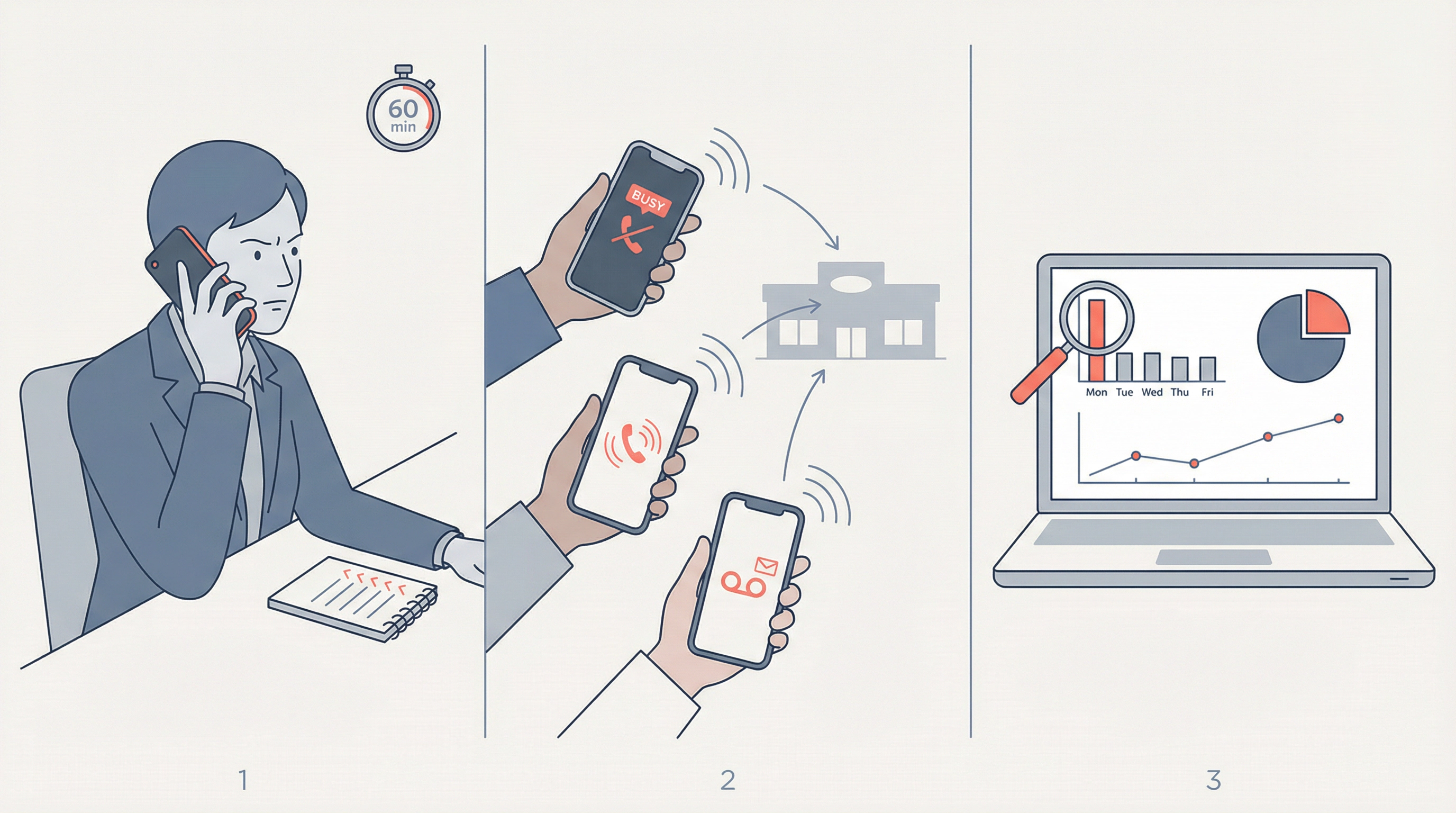
1. Call your own store like a real customer.
Pick up your personal phone and call every number a customer might dial: your main number during business hours, main number after hours, service direct line, sales direct line, parts line, and any tracking numbers on your website and ads.
For each call, write down:
2. Stress test concurrency.
Have three people call your store at the same time. You’re looking for busy tones, calls dumping to voicemail, callers bouncing between ring groups, and “phantom answered” calls that are actually dead ends where nobody picks up.
3. Pull 14 days of call tracking data.
At minimum, you need:
You’ll almost always discover the same pattern industry research has revealed: Monday is brutal, with sharp late-morning spikes that overwhelm staffing levels designed for average volume.
Most dealerships have never done this exercise. When they do, they’re often surprised at how different the experience is from what they assumed. You might find that your after-hours greeting hasn’t been updated in two years, or that your service direct line rolls to a voicemail box nobody checks. These are the kinds of invisible leaks that cost real money every week.
If your routing is wrong, staffing and training won’t save you. We see this constantly: dealerships throw money at hiring or coaching when the real problem is that calls are going to the wrong place, or no place at all.
The “First Responder + Overflow Resolver” Model
This routing architecture consistently wins across the dealerships we work with. The concept is simple: every call passes through at least two layers of live response before voicemail is even an option.
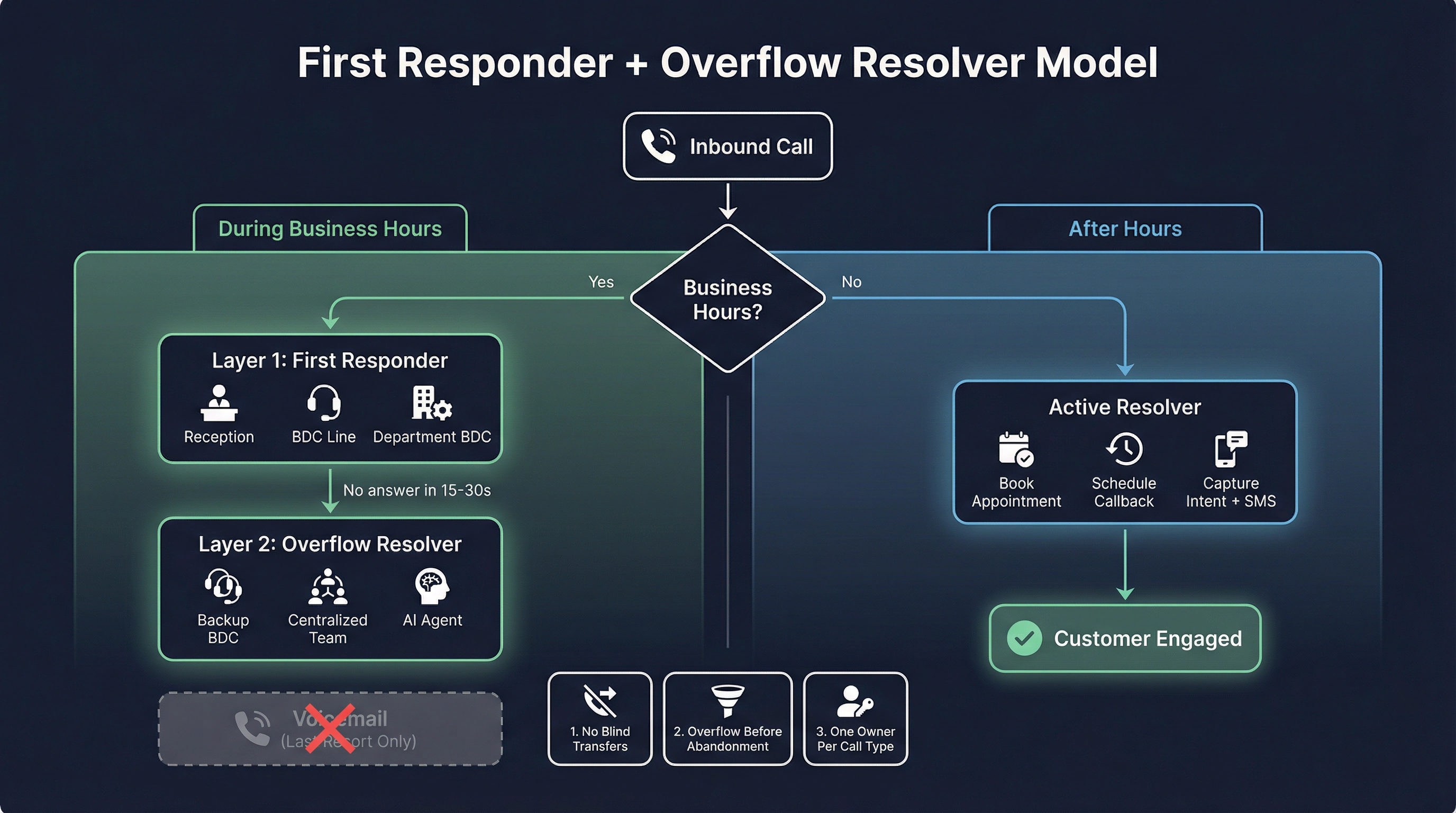
During business hours:
Every call hits a first responder layer immediately (reception, BDC reception line, or department BDC). If nobody answers quickly, the call rolls to an overflow resolver: a backup BDC team, a centralized team, a qualified call center, or an AI agent that can actually book appointments. Only after both layers fail should voicemail even exist as an option.
After hours:
Calls route to something that can do at least one of the following: book an appointment, schedule a callback slot, or capture the customer’s intent and send a confirmation text with next steps. If “after hours equals voicemail,” you are choosing to leak demand on purpose.
Three routing rules that stop the bleeding:
Phone volume is spiky. Staffing is expensive. So you need a simple capacity model instead of guessing.
The staffing formula:
Required agent minutes per hour = calls per hour x average handle time
Here’s a real example. Say your Monday 10am-to-noon spike hits 35 calls per hour, and your average handle time is 4.5 minutes. That’s 157.5 minutes of pure talk time per hour. Divide by 60 and you need 2.6 agents of continuous talk time. But in the real world, once you add wrap-up time, breaks, complexity spikes, and transfers, you need at least 3 agents to reliably cover that window.
High-impact staffing patterns that don’t require new hires:
A surprising number of dealerships answer calls perfectly well and still lose the appointment. The failure mode is always the same: the customer wants to schedule, the person on the phone doesn’t offer real times, they punt to “someone will call you back,” and the customer disappears.
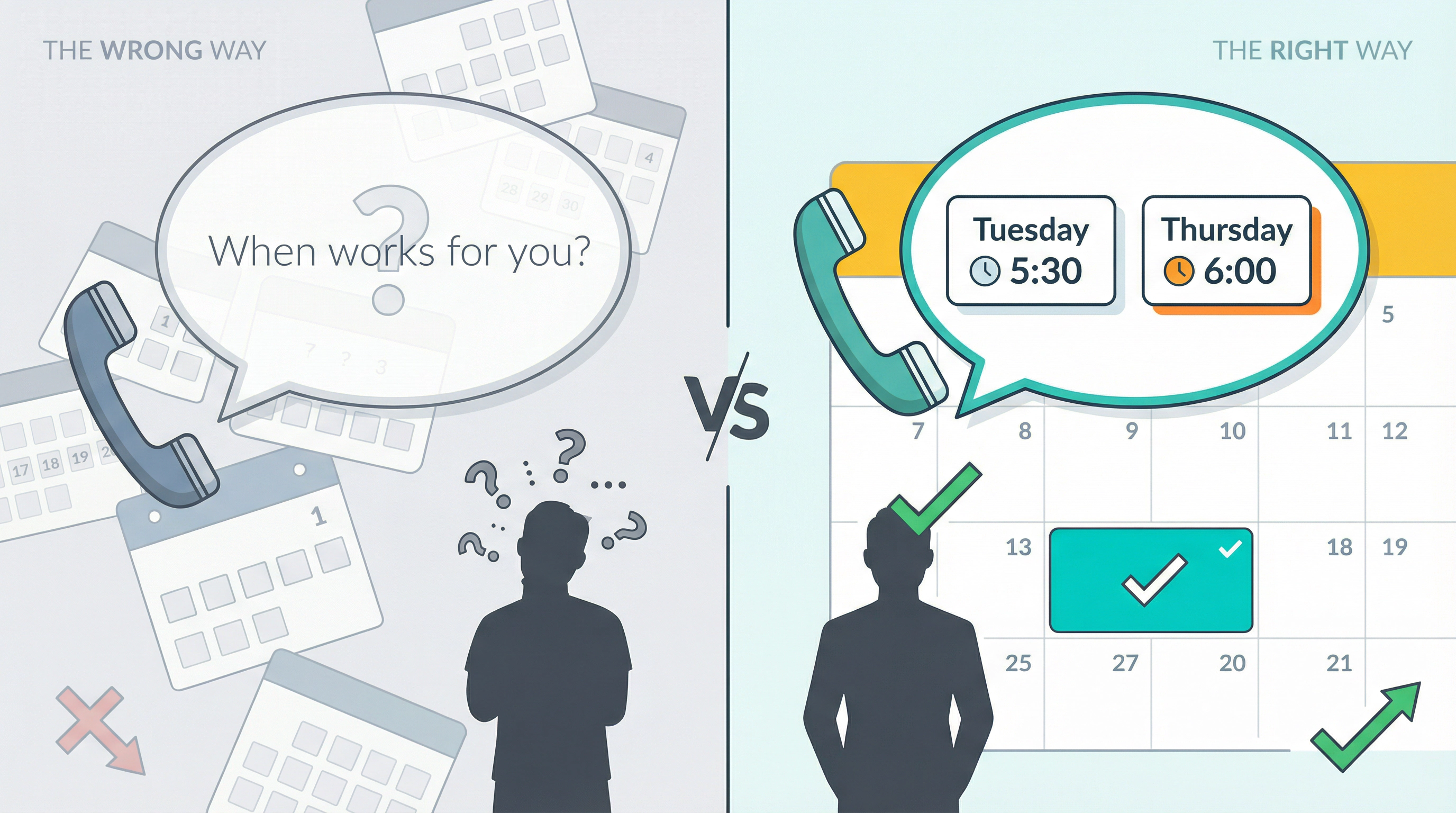
The “Offer Rule”
If the call is schedulable, the caller gets two specific appointment options. Not “What day works for you?” Not “Can I have an advisor call you?” Two concrete times. Then confirm.
Service booking talk track (copy/paste ready):
Sales appointment talk track:
This works because it matches how humans actually make decisions: pick between two options rather than inventing a plan from scratch. Open-ended questions (“When works for you?”) create decision paralysis. Two concrete choices create momentum.
And sales calls go sideways less often when your team focuses on getting the customer into the store with a clean handoff, not trying to “close the sale” over the phone. The phone call’s job is to create a kept appointment. Everything else happens in person. For a deeper look at how AI follow-up helps dealerships close more sales leads, we’ve broken down the full process.
Voicemail feels cheap. It is actually expensive. Industry research shows that 32.3% of non-connected calls ended in voicemail. That’s not a follow-up plan. That’s a delay mechanism where most of those leads quietly die. For a full breakdown of the data, see our analysis of why dealership voicemails kill sales and what to do about it.
Replace voicemail with “callback appointments.”
Instead of “leave a message,” train your team to say: “I can have our service team call you back. What time works: 11:20 or 12:10?” Then actually call at that time. Then log the outcome.
This single change often increases recovered appointments without adding headcount, because you’re converting a passive “maybe they’ll call back” into a scheduled commitment. The customer has a time on their calendar. Your advisor has a task. And someone is accountable for the outcome instead of hoping a voicemail gets checked.
You can’t coach your way out of being closed. Industry data shows that 56% of dealership leads arrive after business hours. Even if your store runs lower than that industry figure, after-hours is still significant.
Here are your options, with honest tradeoffs:
| Option | Coverage | Conversion | Cost |
|---|---|---|---|
| Voicemail + next-day callbacks | Cheapest | Worst | $ |
| Outsourced answering service | Better | Often just message-taking | $$ |
| Extended BDC hours | Best human experience | Expensive, burnout-prone | $$$ |
| Automation that can actually resolve calls | 24/7 if it can book, confirm, and log | Works only if integrated with scheduler | $$ |
One stat worth remembering: 64% of service customers prefer calling to schedule. So after-hours coverage isn’t a “nice to have.” It’s a revenue channel that’s open or closed. If you’re evaluating options, our guide to how to never miss a customer call at your dealership walks through each approach in detail.
Many dealerships are also finding that replacing outsourced call centers with AI solves both the coverage gap and the quality gap at the same time, since AI agents can actually book appointments rather than just take messages.
Improving phone performance gets a lot easier when your whole team sees the math.
From NADA’s 2025 mid-year report: service and parts sales per customer repair order averaged $470, and the average mechanical labor rate was $179 (both figures from the first half of 2025). These are averages across franchised dealerships, but they make one point very clear: every single kept service appointment is worth real money.
A simple missed-call revenue model (use your own store’s data):
Missed calls per month x % that are bookable x appointment set rate if answered x show rate x gross profit per RO (use your actual numbers, not an industry guess)
Even conservative assumptions usually produce numbers that are hard to ignore. Here’s a quick example: if your store misses 200 calls per month, and 40% of those are bookable service requests, that’s 80 potential appointments. If you could convert half of those with a proper phone system, and 70% of those customers actually show up, you’re looking at 28 additional kept ROs per month. At $470 per RO, that’s over $13,000 in recovered monthly revenue from phone fixes alone. For a more detailed look at how these numbers stack up, our post on missed call statistics and revenue lost at your dealership breaks it all down.
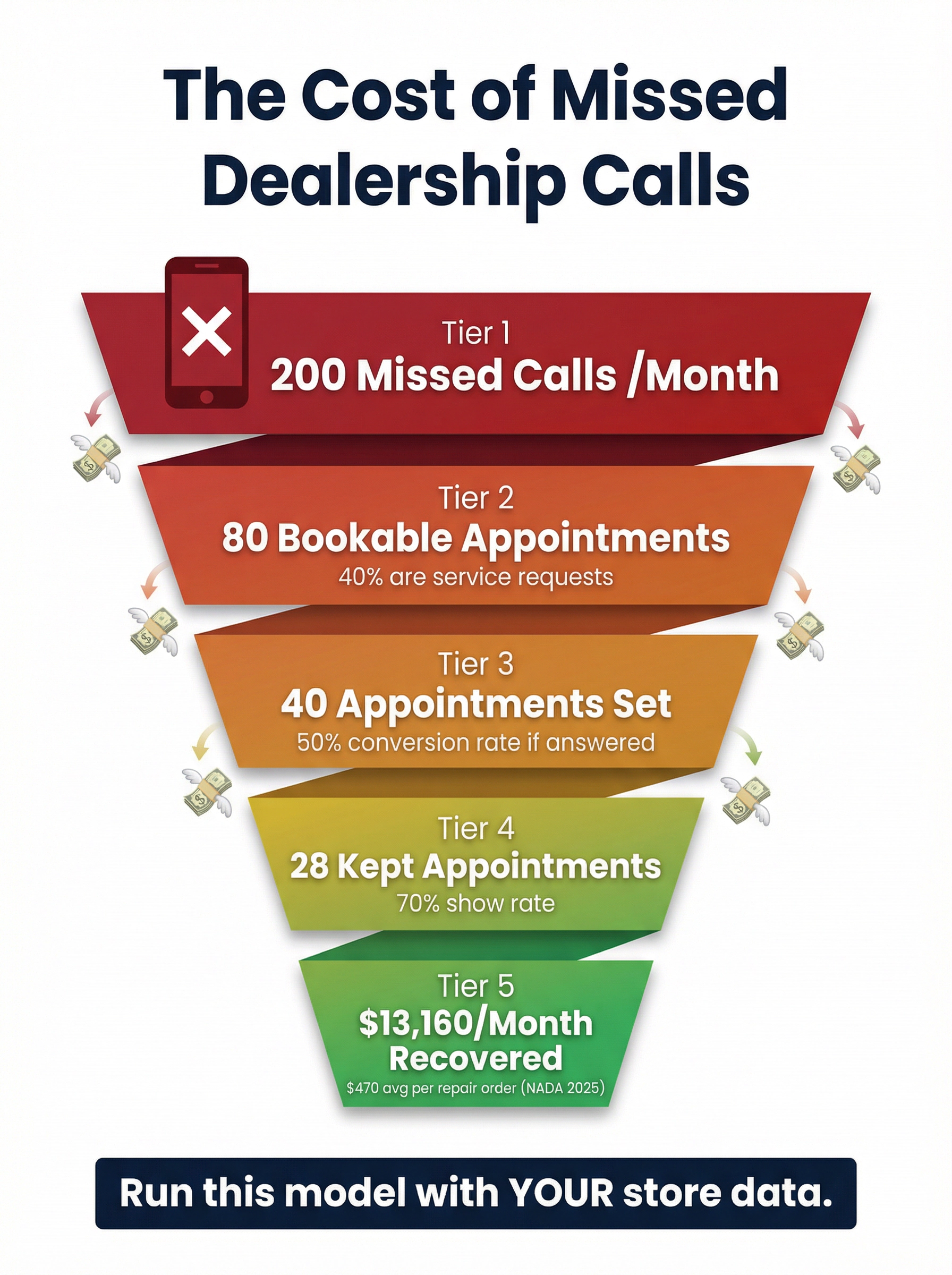
Run this with your last 30 days of call data and share the result with your team. Nothing motivates process change like seeing revenue walk out the door.
Phone performance decays without a feedback loop. You can fix everything in this guide and still slide backwards if nobody’s watching the scoreboard.
The 30-minute weekly phone meeting:
A simple call QA scorecard (rate each 1 to 5):
This does two things at once: it creates a standard everyone can see, and it makes improvement measurable week over week. Without a QA loop, even great processes drift. With one, your team gets better every week because they know exactly what “good” sounds like and they’re hearing real examples together. Tracking these alongside the right dealership customer experience statistics gives your team context for where they stand relative to the industry.
You don’t need six months to see results. Here’s a realistic week-by-week plan that focuses on the highest-impact changes first.
Week 1: Make missed calls visible. Run the 60-minute phone audit described above. Map your current routing. Pull 14 days of call data. Identify your top 3 leak points (these are almost always hold time, after-hours, and routing dead ends).
Week 2: Fix routing + overflow. Remove blind transfers. Set overflow to trigger at 30 to 45 seconds. Fix after-hours routing so it goes somewhere other than voicemail. Assign clear ownership for every phone line. Explore call overflow solutions for dealerships to find the right fit for your store.
Week 3: Staff peaks + deploy talk tracks. Add micro-shifts for your Monday late-morning peak. Set up phone captain rotation. Roll out the service and sales booking scripts from this guide. Start a daily 10-minute standup with one question: “Why did we miss calls yesterday?”
Week 4: Replace what humans can’t scale. Switch from voicemail to callback scheduling. Set up SMS confirmations and reminders for every booked appointment. Deploy overflow coverage for spikes and after-hours, whether that’s a centralized team, a call center, or AI that can actually book appointments.
By the end of 30 days, you should see measurable improvement in answer rate, service appointments set, and (most importantly) appointments kept. The trend line matters more than hitting a perfect number in month one. And once you have the data flowing, you’ll know exactly where to invest next, whether that’s more staffing, better scripts, or technology that extends your capacity beyond what any human team can cover alone.
If you’ve already fixed routing, staffing, and scripts, and you still can’t reliably cover after-hours calls, peak-hour spikes, and callbacks, the problem isn’t training anymore. It’s capacity. Your team physically cannot answer every call at every hour, and that’s where an AI BDC model starts to make real sense.
Flai is our AI communications platform built specifically for car dealerships. We provide AI-powered voice, SMS, and email agents that function as a 24/7 BDC. But the key difference is that we don’t just take messages. Our AI agents book directly into your real scheduler, integrate with your DMS and CRM, and log every outcome so you can see exactly what happened on each call.
Here’s what that looks like in practice. Our Freeman Lexus case study (September 2025) shows Flai handling 1,100 calls with 376 appointments booked, an 88% success rate, and a $100,000 profit impact in a single month. And our case studies page includes additional results across multiple brands and months, including Freeman Toyota ($93,870 profit impact) and San Leandro CDJR (119% growth in monthly appointments).

If you’re evaluating any AI or overflow solution (including Flai), here are the five questions that matter:
We built Flai to answer “yes” to all five. No hardware installation. No staff training required. Flai plugs into your existing phone system and starts handling calls immediately, speaking naturally in any language and handing off to your team with full context when a human touch is needed.
The real test is simple: can your AI solution book a real appointment into your scheduler at 9pm on a Saturday, send the customer a confirmation text, and show you the outcome on a dashboard Monday morning? If yes, it’s solving the capacity problem. If it’s just taking messages for someone to return on Monday, it’s a more expensive voicemail box. Ready to see it in action? Book a demo and we’ll show you exactly how it works with your setup.
What is the biggest reason dealerships lose phone leads?
It’s not bad phone skills. It’s a combination of hold time, voicemail, and after-hours gaps. Industry data shows that hold was the single largest driver of unconnected calls across nearly 3,000 dealerships. Customers will hang up and call your competitor before they’ll sit on hold for three minutes.
How many calls does the average dealership miss per month?
It varies widely by store size and staffing, but the pattern is consistent: peak hours and after-hours are where most calls slip through. Run the 60-minute audit in this guide with your own data, and you’ll have a real answer for your store within a day.
Do customers actually still prefer calling over scheduling online?
Yes, especially for service. Research shows that 64% of service customers prefer making a phone call to schedule, versus just 19% who choose online booking. The phone isn’t going away anytime soon.
When should a dealership consider AI phone solutions?
Once you’ve fixed your routing, staffing, and appointment scripts, and you still can’t cover after-hours or absorb peak spikes. At that point, the bottleneck is raw capacity, and that’s exactly what AI voice agents are built to handle. Flai works alongside your existing team, covering the calls they physically can’t get to.
How quickly can a dealership see results from improving phone performance?
Most stores see measurable improvement within 30 days if they follow a structured approach. The 30-day plan in this guide focuses on the highest-impact fixes (routing and overflow) in weeks 1 and 2, with training and technology layered in during weeks 3 and 4.
What’s the ROI of fixing dealership phone performance?
Use the revenue model in this guide with your own numbers. But as a benchmark, NADA data shows the average service RO is worth $470. If you’re missing even 10 bookable calls per week and could convert half of those into kept appointments, that’s over $60,000 in annual service revenue recovered. The math scales fast.
As seen in