Privacy Policy
Terms of Service
Security
Status
Blogs & Guides
1 in 3 service calls still go unanswered at the average dealer. The 2026 automotive customer experience trends for dealers—and what to do about them.
May 3, 2026
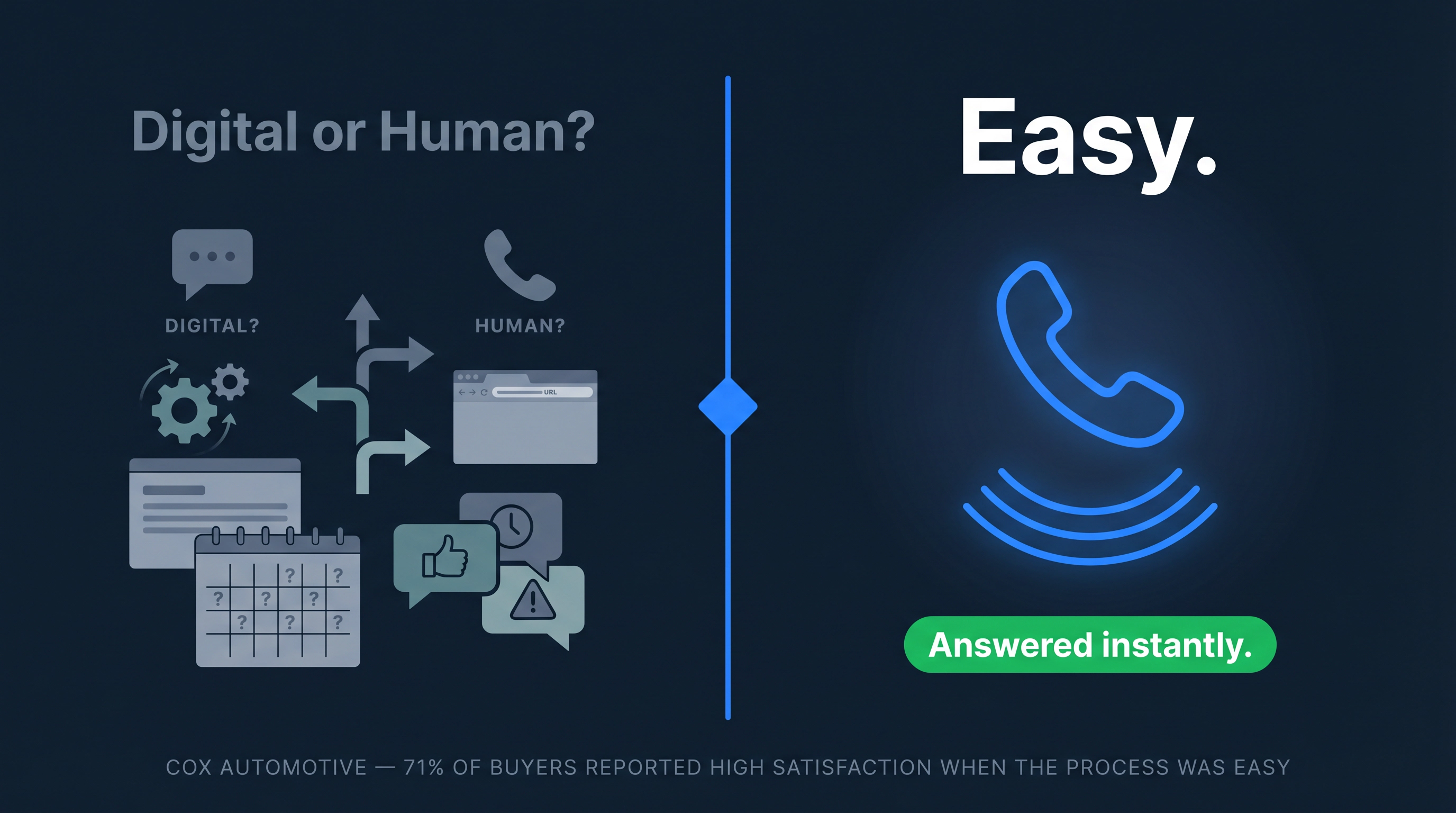
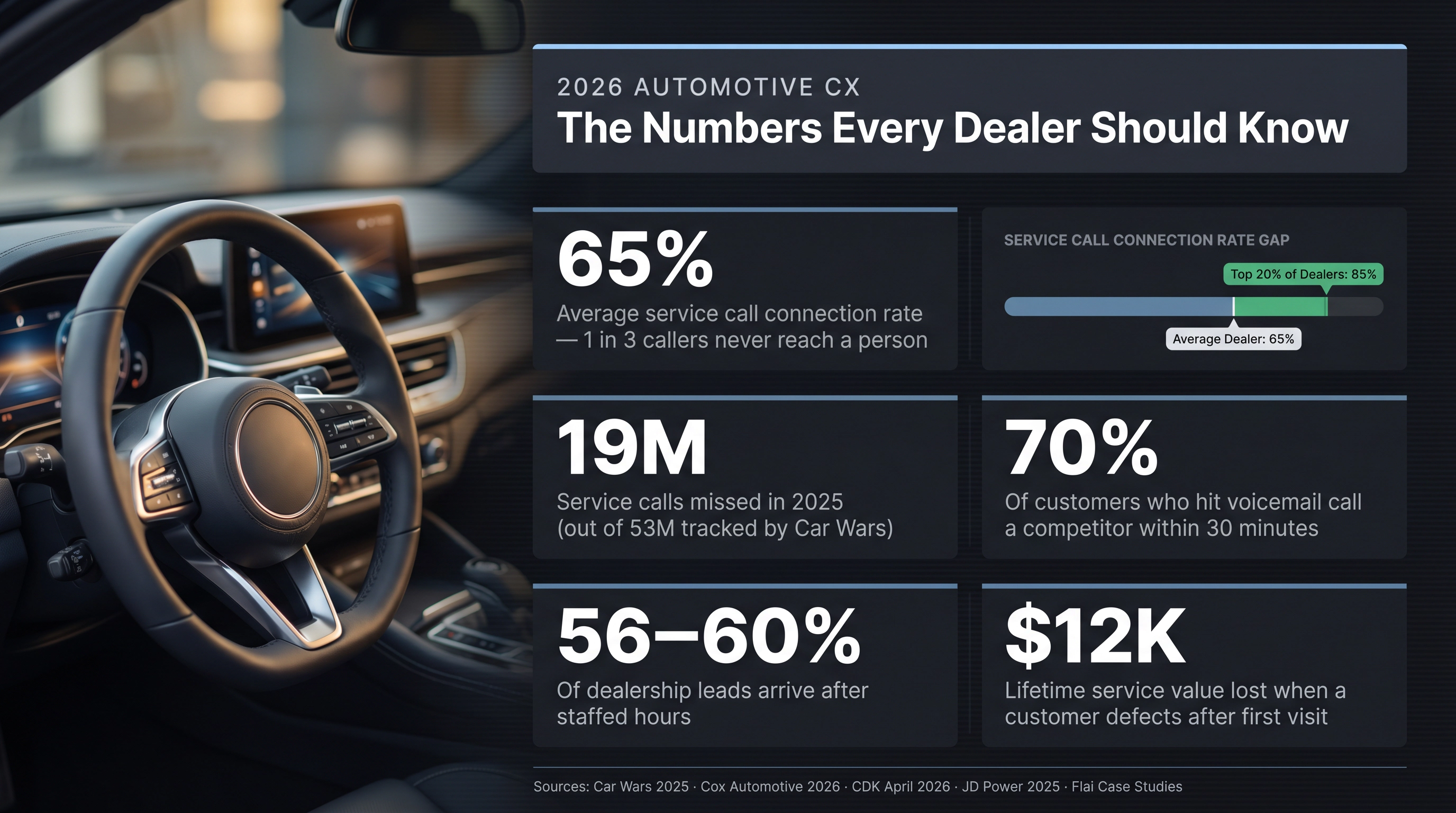
The average dealership connects on about 65% of its inbound service calls. That’s the industry benchmark from Car Wars’ 2025 tracking data, based on roughly 53 million inbound service calls. Which means 1 in 3 callers (customers with buying intent, service appointments to book, recall questions to resolve) never reach a live person. Of the calls that don’t connect, 53% land in voicemail and another 29% abandon after being put on hold.
None of this is new information. Dealers have known about the phone gap for years. What’s changed in 2026 is that customers are less willing to absorb the friction than they used to be.
This guide covers the automotive customer experience trends that actually matter this year. Not the buzzwords, but the specific patterns showing up in Cox Automotive, JD Power, CDK, and Car Wars data. We’ll be direct about where Flai fits into this picture, because we’ve seen these trends play out across dozens of real dealerships and we built our platform to solve exactly the problems the data keeps surfacing.
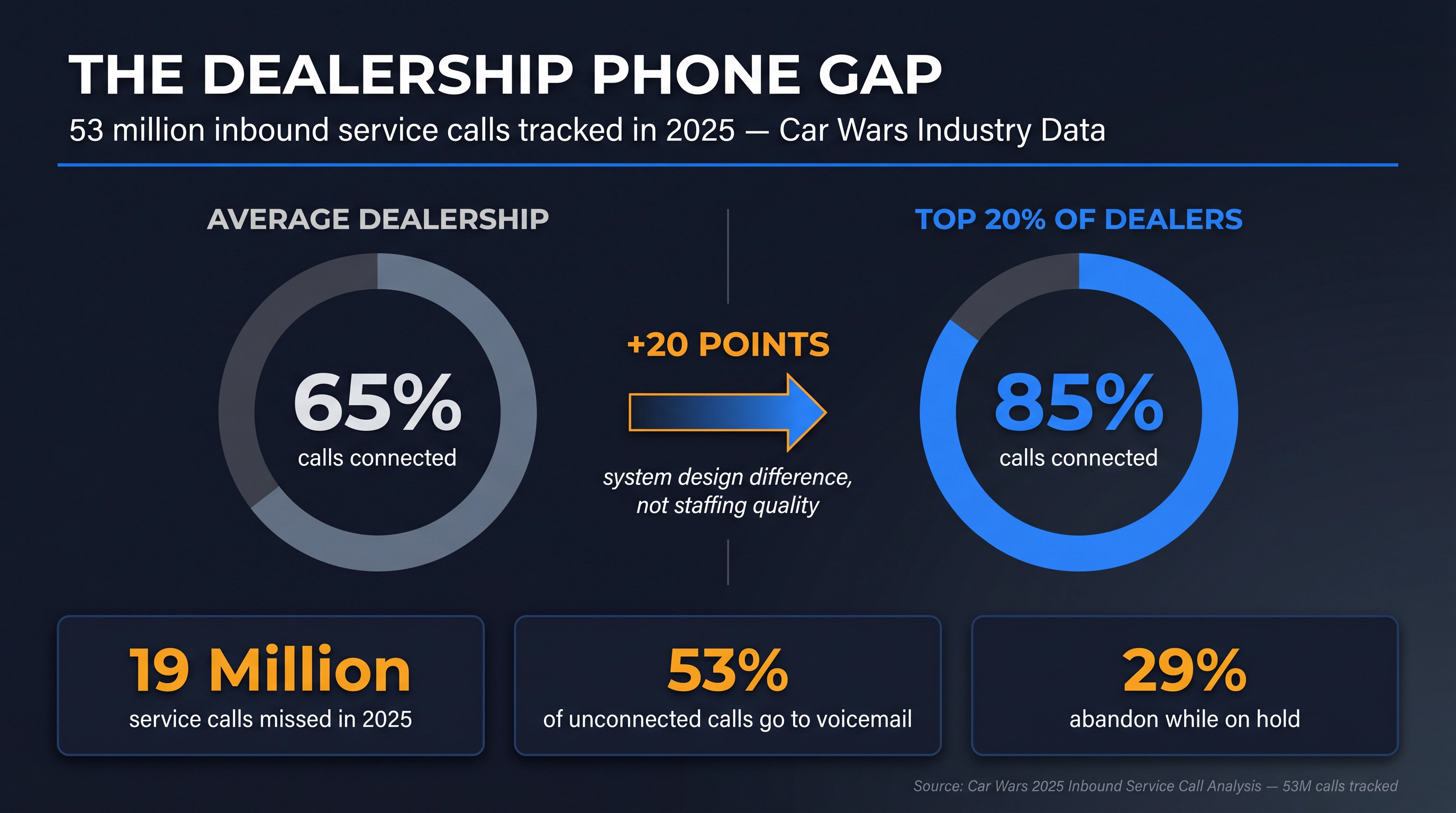
Before going trend by trend, one framing cuts through everything: in 2026, the best automotive customer experience isn’t “digital” or “human.” It’s easy.
Cox Automotive’s 2025 Car Buyer Journey Study, released in January 2026, found that 71% of all buyers and 76% of new-vehicle buyers reported high satisfaction with the buying process. That same study found 63% preferred a mix of online and in-person steps, and only 7% completed the purchase entirely online. Customers aren’t asking dealerships to become e-commerce platforms. They’re asking them to work like competent service businesses: ones that answer the phone, remember who you are, and don’t make you start over every time you switch channels.
That gap between what customers want and what most dealerships deliver is where the CX opportunity lives in 2026. The trends below are organized around the areas where dealers consistently leak revenue, loyalty, and satisfaction. Some are fixable in weeks. Others require longer structural change. All of them are real.
If you want to find the single highest-ROI CX fix in your store, start with the phone. Not because it’s the most innovative, but because the dollar value of missed calls is concrete and large.
Car Wars’ analysis of 2025 inbound service calls tracked roughly 53 million calls and found about 19 million missed opportunities. What those missed calls cost in real revenue adds up faster than most dealers realize. These aren’t people calling to complain or ask general questions. They’re customers calling to book service, check availability, ask about recalls, or schedule test drives. When they don’t connect, most don’t wait around. Research cited on Flai’s website shows about 70% of customers who hit voicemail call a competitor within 30 minutes, and roughly 56-60% of dealership leads arrive after business hours, when most stores have reduced or no phone coverage.
The problem compounds at predictable times. Car Wars found that Mondays from 10am to noon see the week’s highest call traffic, and that pattern repeats across nearly every store in their dataset. Service drives get busy, advisors get pulled onto the floor, and calls queue up or get dropped. The top 20% of dealerships hit 85% service call connection rates. The average is 65%. That 20-point gap is a system design difference, not a staffing-quality difference.
CDK’s April 2026 fixed-ops analysis reinforced this: roughly 60% of dealership service customers still book by phone. Not chat. Not the online scheduler. The phone. And research shows that 60% of customers hang up after just one minute on hold, with 32% not willing to wait at all. Those are numbers that translate directly into why callers abandon and what to do about it.
The root cause isn’t that dealers don’t care about phone handling. It’s that call volume is spiky and staffing is linear. Phones ring unevenly (Monday mornings, lunch windows, campaign days, end-of-month rushes) and human coverage can’t scale up and down by the hour. The traditional patchwork of service advisors, BDC reps, voicemail, and occasional outsourced coverage works when volume is moderate and everyone is available. It breaks when demand spikes, which is exactly when it needs to work most.
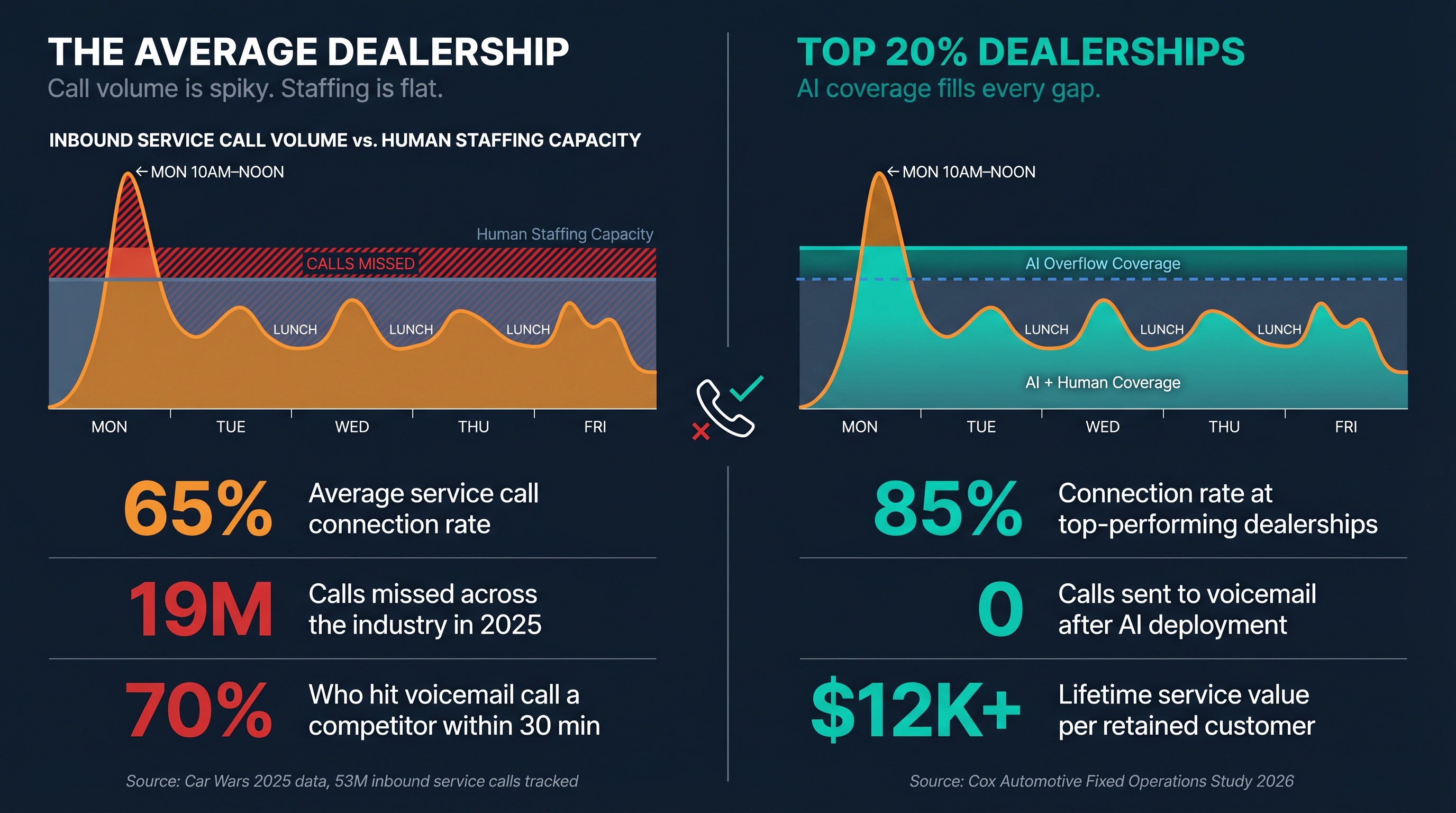
They treat phone handling as a system design problem, not a staffing problem. The question isn’t “how many reps do we have?” It’s: how many calls come in by hour and day, how many are answered live, how many hit voicemail, how many abandon after hold, and what happens when five calls arrive simultaneously on Sunday night?
The phone workflow the top 20% runs looks something like this:
No step in that flow requires waiting for an advisor to become available. The system handles the routing. Humans handle the judgment calls.
This is precisely where AI voice agents built specifically for dealership call flows create immediate and measurable ROI. We’ll cover how Flai fits into this picture in a dedicated section below. First, the rest of the CX landscape that’s shaping 2026.
Sit with this tension for a moment: dealer service revenue is at record levels, and dealer service market share is declining at the same time.
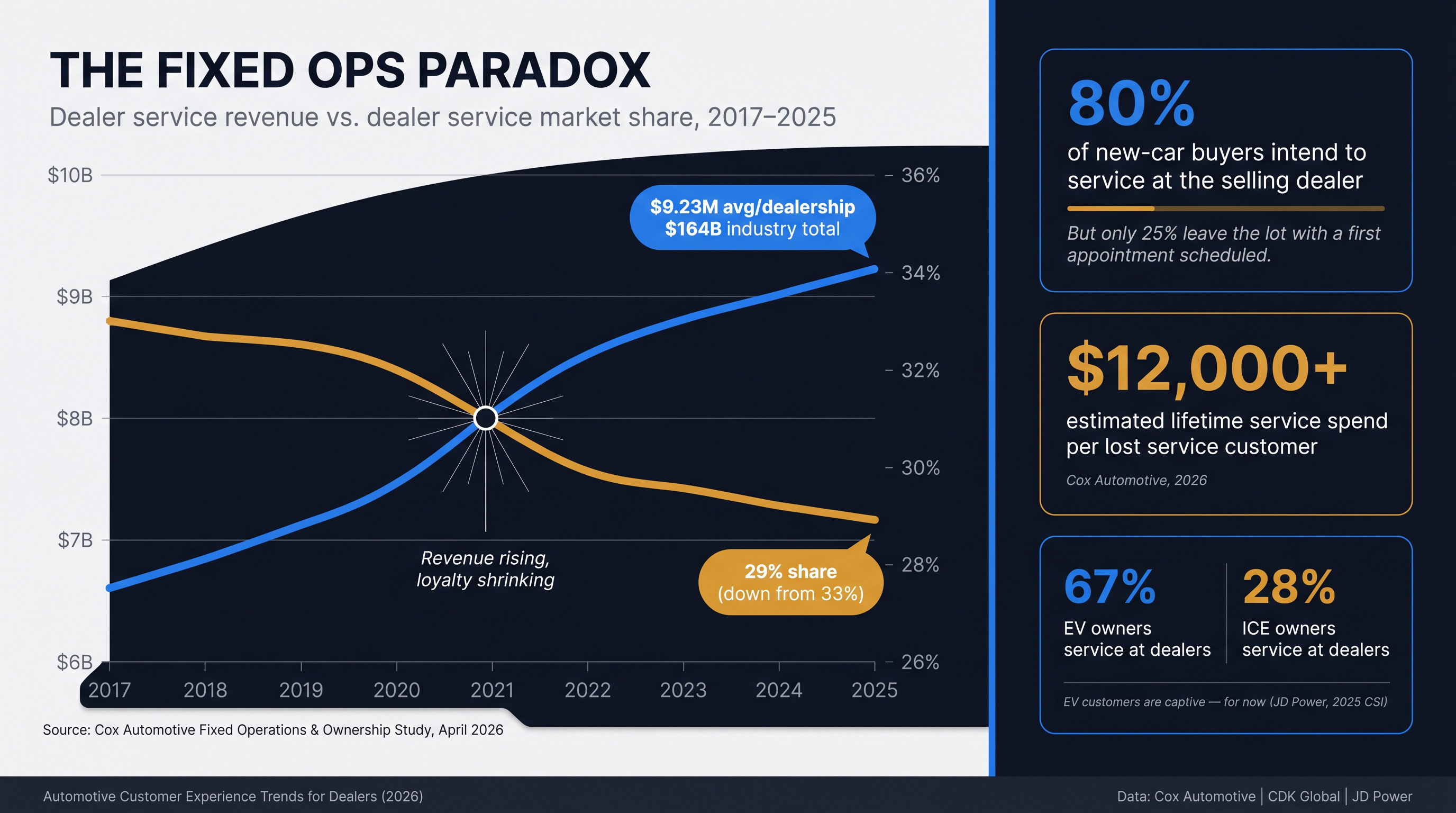
Cox Automotive’s April 2026 Fixed Operations and Ownership Study found service and parts revenue averaged about $9.23 million per dealership in 2025, up 33% over eight years. Franchised dealers collectively wrote more than 276 million repair orders and generated more than $164 billion in service and parts sales. At the same time, dealer share of service visits fell from 33% to 29%. Understanding what drives fixed operations revenue (and why that share is shrinking) is the first step to protecting it. Revenue is up because vehicles are getting more expensive to service and more customers own more vehicles. But the pool of loyal service customers is shrinking.
The reason isn’t expertise. Dealer service departments still have OEM knowledge, recall capability, specialized tools, and trained technicians. CDK’s April 2026 Service Shopper research found independent service providers gained share from 32% to 38% as the most often used provider, while dealer service dropped from 47% to 42%. CDK found that independent-shop customers often cite location and price as their reason. Dealer customers cite staff knowledge and parts access as advantages. The dealer wins on quality. It’s losing on ease.
This matters most at the first service visit. Cox’s data found that 80% of new-car buyers are likely to service at their selling dealership, but only about 25% had their first service appointment scheduled at the point of purchase. That means 75% of customers most likely to become loyal service customers leave the lot without a committed return date. Cox estimates that losing a service customer represents more than $12,000 in potential lifetime service spend, making every strategy to increase service appointment capture worth serious investment.
The first service appointment should be treated with the same energy as the delivery. Automating the service scheduling process before the customer leaves protects the loyalty relationship. That means confirmations in the days after delivery, automatic reminders, and painless rescheduling, without depending on manual effort. Cox also found that nearly two-thirds of owners now keep vehicles for five years or more, up from 54% in 2024. Vehicles staying on the road longer is good news for service volume. But only if the dealer captures the relationship from the start.
JD Power’s 2025 Customer Service Index Study identified communication shortfalls and appointment wait times as the primary limits on service satisfaction. Four of the ten key performance indicators in the study were communication-related. Greeting customers immediately when they arrive was the least frequently performed KPI, happening only about half the time. CDK’s April 2026 fixed-ops analysis found that dealership service NPS dropped from +59 to +47 in 2025, and 58% of shoppers experienced a problem at the dealership (up from 47% the year before). Knowing what actually moves CSI scores before those numbers fall further is worth the time to study.
Service customers aren’t usually upset because their car needs work. They’re upset because they feel uninformed. They don’t know who their advisor is. They don’t know when diagnosis will start. They don’t know what the estimate means. They have to call to find out if their car is ready, because no one proactively told them.
Cox’s fixed-ops data found that customers who received photos or videos during service had repair orders averaging $230 higher, and 49% said photos or videos made them more likely to approve recommended services. CDK found that when multipoint inspections were reviewed with customers, 86% said advisors clearly explained services and 80% said the advisor earned their trust. Nearly three-fifths purchased at least some recommended work. This is exactly the kind of service department transformation AI is enabling, giving advisors the capacity to communicate proactively instead of reactively.
The operational rule that should govern service: no customer should have to call for a status update your store already knows.
EV customers currently service at the dealer at dramatically higher rates. Cox found EV owner dealer service share at 67% vs 28% for ICE owners and 50% for hybrid owners. But JD Power’s CSI research found EV service satisfaction trailed ICE satisfaction by 51 points in the mass-market segment and 57 points in the premium segment, citing issues with EV-trained personnel and front-line knowledge gaps.
EV customers are captive right now because the independent service network for EVs is still developing. That won’t last. Dealers that build clear EV service communication, route EV questions to trained advisors, and explain battery health, charging concerns, and software update timelines clearly will hold this advantage. Dealers that don’t will lose it as independents catch up.
Customers don’t think in channels. They think in tasks. They want to check inventory availability, book a service appointment, ask about a trade-in value, or confirm a recall fix. They don’t particularly care whether that happens through your website, a phone call, a text, or at the service drive. The dealership that wins is the one that doesn’t lose the thread when they switch.
Cox Automotive’s 2025 Car Buyer Journey Study found 63% of buyers preferred a mix of online and in-person steps. The same study revealed meaningful gaps between what buyers want to do online and what they actually do:
CarGurus’ December 2025 Consumer Insights Report found a similar pattern: 83% of buyers preferred to do more from home, but 86% still wanted to see the vehicle in person.
The implication isn’t that dealers should build more digital checkout steps. The implication is that friction between digital intent and physical execution is where buyers drop off. A customer who fills out a trade-in appraisal form and then has to re-explain everything to the salesperson over the phone hasn’t experienced omnichannel. They’ve experienced two disconnected systems. That’s why speed to lead and consistent follow-up matter as much as the digital tools themselves.
A growing share of shoppers use AI to research before they ever contact a dealership. Cox Automotive’s January 2026 data showed 19% of all buyers and 25% of new-vehicle buyers used AI sites or AI-generated overviews during the buying process. Cars.com’s November 2025 survey found 44% of consumers used AI-powered car search tools, with 97% saying AI would influence their purchase decision. CarGurus found 80% of shoppers open to AI, with the top uses being comparing vehicles, finding listings, and summarizing dealership reviews.
What this means practically: your customer experience now starts in an AI-generated summary, not on your VDP. Understanding which AI solutions for dealerships actually deliver ROI is increasingly part of managing your public-facing CX infrastructure. If your inventory data is stale, your reviews are thin, or your service pages don’t answer common questions clearly, AI tools will form buyer expectations based on incomplete information. The customer may arrive with mismatched assumptions, or not arrive at all. Treat your public-facing data as part of your CX infrastructure, not just your marketing stack.
In 2026, price-sensitive customers and active regulators are applying pressure from both directions. These aren’t separate problems. They stem from the same failure: inconsistent, unclear communication across the deal.
KBB data released by Cox Automotive in April 2026 showed the average new-vehicle transaction price at $49,275, up 3.5% year over year, with average MSRP above $50,000 for the twelfth consecutive month. Cox’s April 2026 Vehicle Affordability Index reported an estimated average payment of $752 and an average new-auto loan rate of 9.50%. Cox’s January 2026 Car Buyer Journey research found that 62% of buyers felt leasing or owning a vehicle had become too costly.
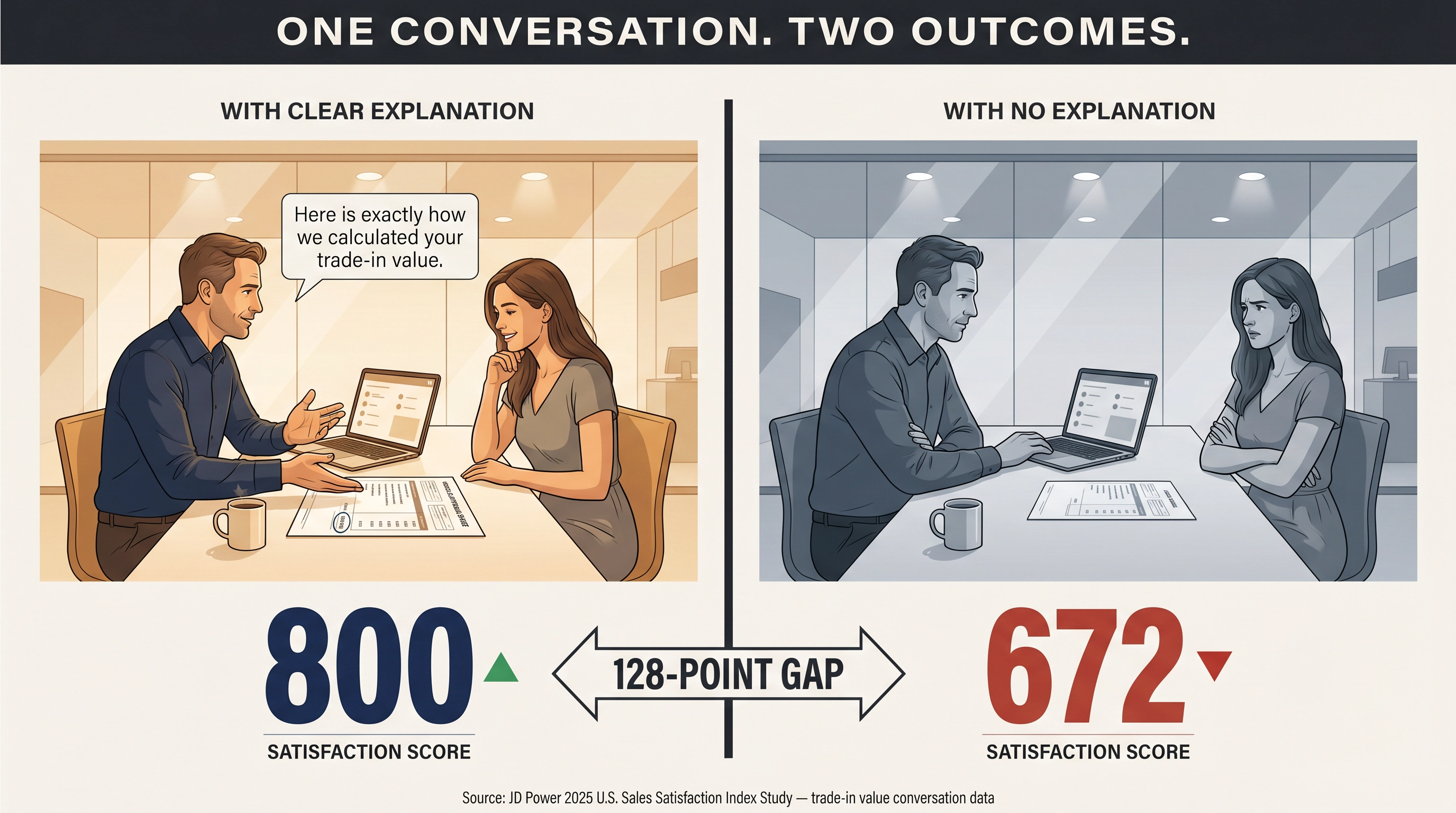
When customers feel financially stretched, they’re more sensitive to anything that feels like a surprise: an unexplained fee, a trade-in value lower than expected, a service estimate with no breakdown. JD Power’s 2025 U.S. Sales Satisfaction Index Study put a number on this:
When trade-in value came in lower than expected, satisfaction scored 800 when the dealer provided a clear explanation, and dropped to 672 when no explanation was given. That 128-point gap came from one conversation.
On the regulatory side, the FTC sent warning letters to 97 auto dealer groups in March 2026, emphasizing that advertised prices must include all mandatory fees and warning against practices like conditioning prices on dealer financing or advertising unavailable vehicles. The FCC’s April 2025 order on TCPA consent revocation, with a related provision that took effect in April 2026, clarified that when a consumer uses a reasonable method to revoke consent, callers must stop. This isn’t legal advice, but the CX implication is clear: customers should never feel trapped, misled, or unable to opt out.
The discipline that prevents compliance problems is the same discipline that builds customer trust. Your advertisement, your website, your AI assistant, your BDC rep, your salesperson, your F&I manager, and your service advisor should all tell the same pricing story. When they don’t, it’s both a CX failure and a compliance exposure. If you’re using AI in any of those touchpoints, it should never invent pricing, incentives, financing terms, or warranty coverage it doesn’t have verified access to.
Most dealers spend heavily to close a sale and relatively little to cement the relationship after the customer drives off the lot. That’s a strategic mismatch.
JD Power’s November 2025 Sales Satisfaction Index Study found that 22% of buyers wanted a follow-up explanation of vehicle features and controls. Of those buyers, 53% never received it. Modern vehicles aren’t simple. Infotainment systems, driver assistance features, mobile apps, charging equipment, over-the-air updates, and connected services all have learning curves. When the customer doesn’t understand the vehicle, they often blame the vehicle or the dealership rather than the missing tutorial.
The follow-up gap connects directly to first service retention. Cox’s data showing that losing a service customer can represent more than $12,000 in lifetime service spend makes post-delivery communication a straightforward ROI calculation. A structured automated follow-up cadence doesn’t require heroic individual effort from salespeople. It requires a system that handles routine scheduling and follow-up automatically and surfaces the customers who need human attention. Here’s what that cadence looks like:
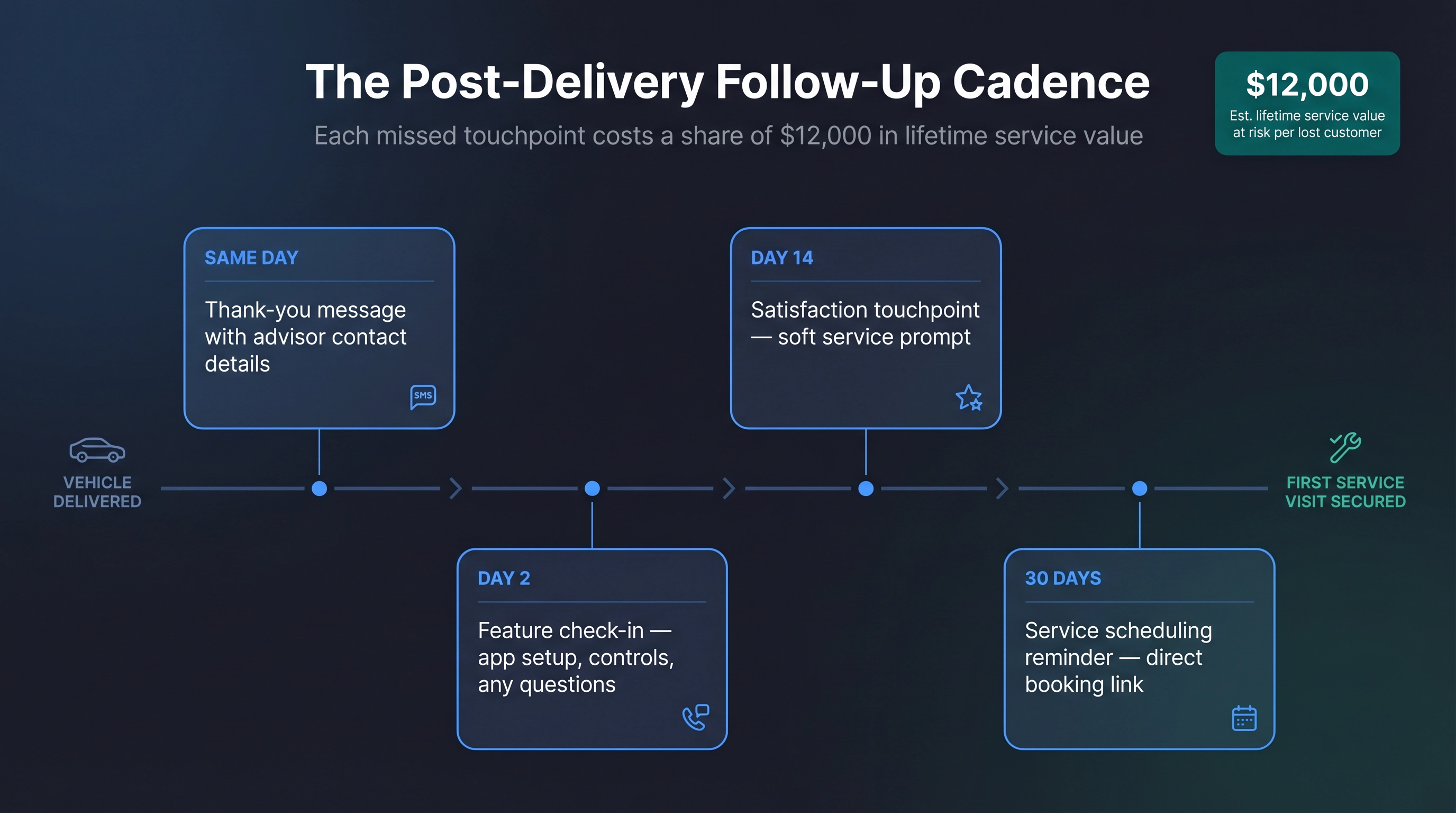
Dealers that treat post-delivery as someone else’s job will keep losing customers to the natural drift that happens when there’s no structure to keep the relationship alive.
Every trend in this guide converges on the same moment: the communication gap between the customer’s intent and the dealership’s response. Before anyone walks through the door, before the service drive fills up, before the test drive is booked, there’s a phone call, a text, an email, or an after-hours inquiry that either gets captured or gets lost.
That’s the problem Flai was built to solve.
We answer every inbound call immediately, 24/7. Not a menu, not a hold queue, not voicemail. An AI voice agent that sounds like a person, understands dealership-specific requests, and takes action in real time. It books service appointments directly into the scheduler, pushes leads to the CRM, runs recall outreach, follows up with sales leads by phone, SMS, and email, and warm-transfers to a live person when a human is needed. The platform handles inbound and outbound across all three channels from a single system, integrated with the store’s DMS, CRM, and scheduler. Evaluating AI voice agents for your dealership starts with understanding what separates genuine integration from a glorified answering machine.
We built Flai from the ground up rather than stitching together off-the-shelf voice APIs. We built our own voice infrastructure specifically for dealership call environments. The practical difference: fewer awkward pauses, more natural conversation flow, and tighter integration with the scheduling and booking workflows that complete a call instead of just taking a message.
The results we’ve seen in real stores bear this out, though we’ll note these are vendor-reported numbers and each dealership’s economics will vary.
| Dealership | Calls Handled | Appointments Booked | Key Result |
|---|---|---|---|
| Freeman Lexus (Sep 2025) | ~1,100 | 376 (88% of bookable) | $100,000 est. profit impact, zero missed calls |
| San Leandro CDJR (Oct 2025) | 1,563 | 304 by Flai (205 → 448 total/month) | $83,000 est. profit impact |
| Glendale Infiniti (Nov 2025) | 1,800+/month | 160+ per month | 20% staff time saved, zero missed calls |
| Freeman Toyota | N/A | N/A | $94,000 est. monthly profit impact |
The pattern across all four: AI handles the volume that human staff can’t absorb consistently (after-hours calls, Monday morning spikes, simultaneous rings) and converts them into booked appointments at a rate that directly impacts RO throughput and monthly revenue.
The Freeman Lexus case study is a representative example of what this looks like when the deployment runs cleanly — 1,100 calls handled, 376 appointments booked, and a documented $100K profit impact in a single month, all with zero missed calls.

Cox’s AI Readiness Study from October 2025 found that 81% of dealership leaders believe AI is here to stay, but only about 15% were embedding it into actual workflows. CDK’s January 2026 report put dealer AI adoption at roughly 40%, up from 28%, but fixed operations remains underserved with only 25% using AI, which means the opportunity to transform dealership service departments with AI is still largely uncaptured. The practical question isn’t “Should AI replace our people?” It’s: which customer conversations are we currently failing to answer, schedule, route, or follow up on consistently? That’s the gap Flai fills.
The data is useful. A plan is better. Here’s the sequence that tends to produce real results.
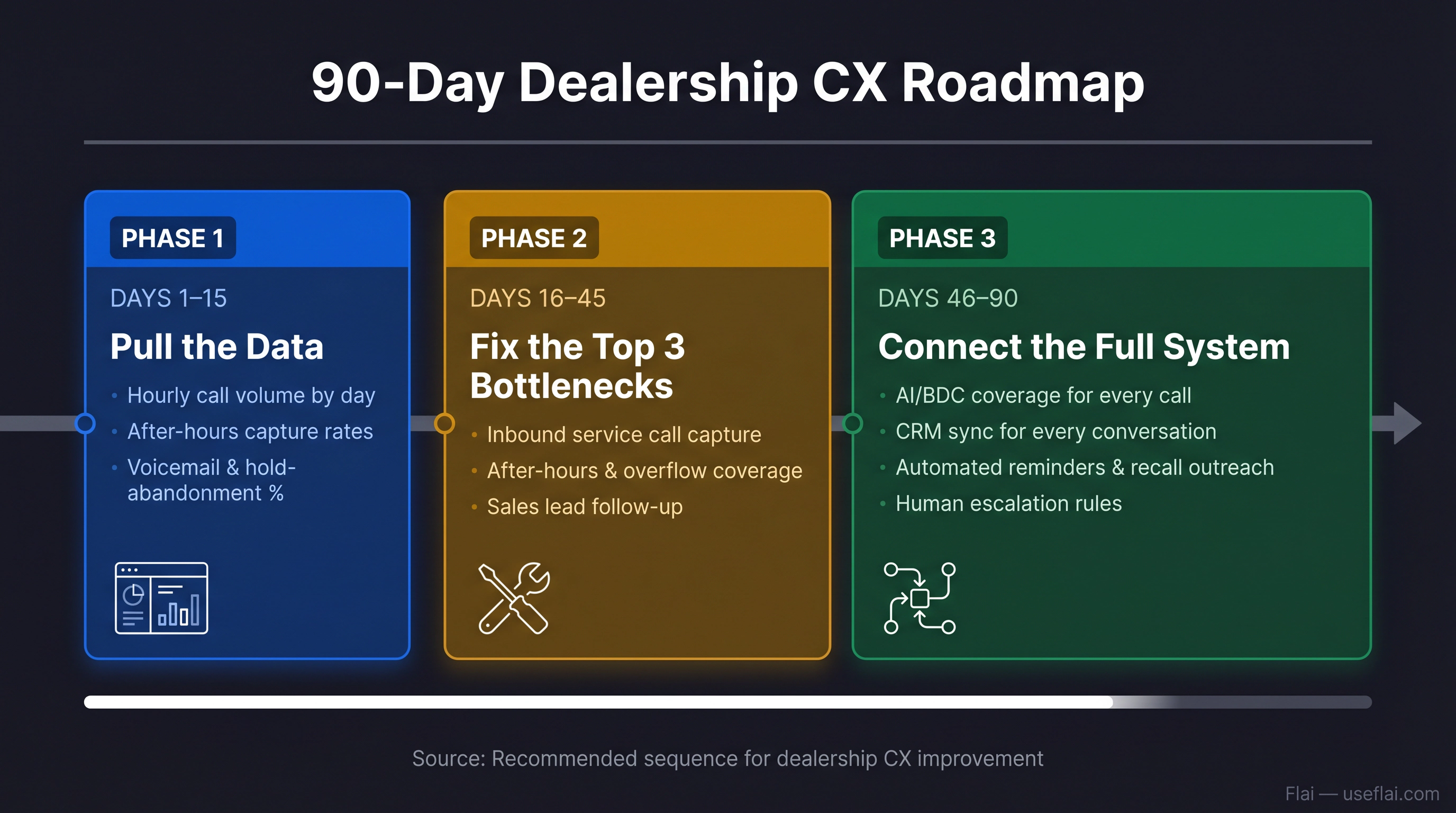
(1) Days 1-15: Pull the data you probably don’t have
Most dealer principals don’t have clean visibility into hourly call volume, after-hours call capture rates, bookable-call conversion, or missed-call frequency by department. Get it. Pull the last 60-90 days of call data by hour and day. The BDC metrics that reveal your biggest revenue leaks are the place to start. Look at voicemail volume, hold-abandonment rates, and what percentage of after-hours calls convert to anything. Listen to real calls. You’ll find patterns in the first hour, and they’ll tell you where the biggest leaks are.
(2) Days 16-45: Fix the three highest-value bottlenecks first
For most stores, those are inbound service calls, after-hours and overflow coverage, and sales lead follow-up. These workflows are high-volume, directly revenue-tied, and measurable. The CDK fixed-ops data from April 2026 is explicit that phone-driven service booking is still dominant, which means phone capture improvements show up immediately in appointment volume. Stop sending high-intent customers to voicemail. The five proven systems that fix this are worth reviewing before you redesign anything.
(3) Days 46-90: Connect the full operating system
Once the obvious leaks are patched, build the communication layer that sustains the improvement: AI or BDC coverage for every inbound call, CRM updates for every sales conversation, automated appointment reminders, recall outreach workflows, service status messaging, visual MPI process, and human escalation rules for sensitive calls. The goal is that every customer communication has an owner, context, and a next step. Not a follow-up task that depends on someone remembering to do it.
An average dealership will add more tools this year. A great dealership will redesign its communication layer so that every customer interaction feels like the store has its act together.
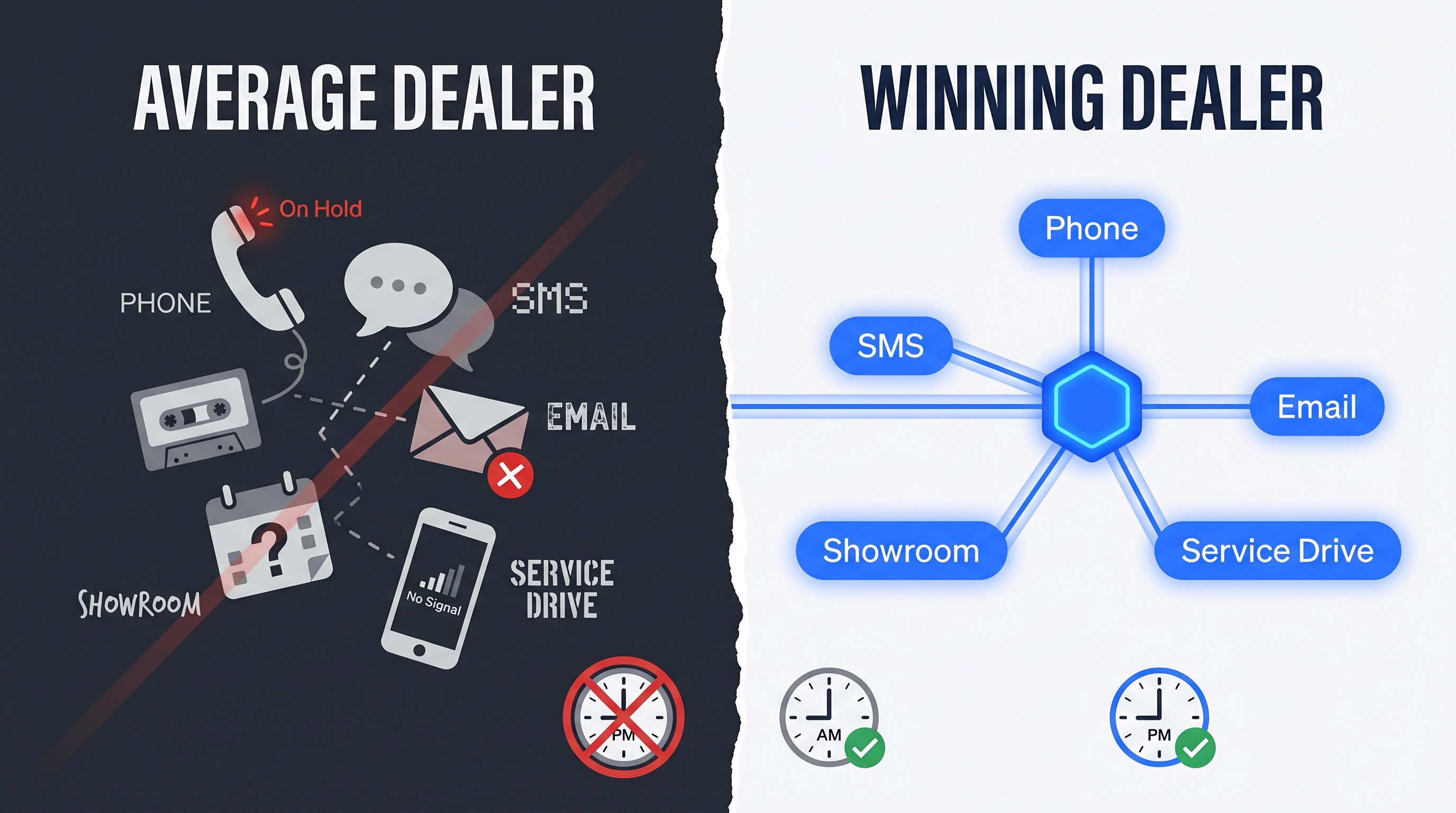
The bar customers are setting isn’t abstract. They want calls answered. They want appointments booked without hold music. They want to know who their advisor is and when their car will be ready. They want pricing that makes sense and follow-up that actually happens. Those aren’t luxury expectations. They’re the same expectations customers have for any service business that respects their time.
The dealers that meet those expectations consistently (across phone, SMS, email, showroom, and service drive, at 9am and 9pm) are the ones that win service retention, CSI scores, and the repurchase cycle. Everything else is downstream of getting the communication layer right.
That’s what we built Flai to do. If you want to see how it works in a store like yours, you can explore it at useflai.com.
The shift from channel-based CX to outcome-based CX. Customers don’t evaluate your dealership by how many digital tools you offer. They evaluate it by whether they got helped quickly, without friction, when they needed it. How fast you respond, and whether that response actually completes the next step, is the standard they’re measuring against. Responding first, remembering context, and completing the next step (booking, scheduling, approving, following up) is the bar.
Some are, but it’s still a small share of total transactions. Cox Automotive’s January 2026 Car Buyer Journey Study found that only 7% of buyers completed the entire process online, while 63% preferred a mix of online and in-person steps. The better question for most dealers isn’t “How do we put more of the sale online?” It’s “How do we make sure the customer who starts online doesn’t feel like they’re starting over when they call us?” And having the right dealership phone infrastructure is a big part of that answer.
Still the dominant service booking channel. CDK’s April 2026 Service Shopper research found roughly 61% of dealership service customers book by phone. Car Wars tracked 53 million inbound service calls in 2025, with about 19 million of them missed. What those missed calls cost in annual revenue is a number every dealer should know. Even as digital scheduling grows, the phone remains where high-intent service and sales customers show up when they want something done now.
Start where the ROI is clearest: high-volume, structured workflows directly tied to revenue. Understanding which AI applications for dealerships deliver real results beats jumping to AI tools that aren’t tied to measurable outcomes. The clearest starting points: inbound service calls, after-hours coverage, service scheduling, sales lead follow-up, recall outreach, appointment reminders, and no-show recovery. CDK’s analysis found that fixed operations is still only 25% penetrated by AI, which means most dealers haven’t yet automated the workflows with the most obvious return.
On convenience and price perception, not expertise. CDK’s April 2026 research found independents rising from 32% to 38% as the most often used service provider, while dealers dropped from 47% to 42%. Independents aren’t winning on technical knowledge or recall access. They’re winning because they’re easier to reach and faster to schedule, and clearer on pricing. Dealers can compete on all of those dimensions without giving up their genuine advantages in expertise.
Fix after-hours call handling. Roughly 56-60% of dealership leads arrive outside staffed hours, and most stores send those customers to voicemail. The customers who hit voicemail frequently call a competitor within minutes. Installing 24/7 call coverage (whether through a properly resourced BDC, an outsourced service, or an AI voice agent like Flai) is one of the few CX changes that shows up directly in appointment volume, often within weeks.
It’s not a separate topic. The FTC’s March 2026 warning letters to 97 dealer groups and the FCC’s TCPA consent rules are consequences of the same underlying breakdown: customers didn’t get a consistent, honest experience across the deal. The CX discipline that prevents compliance problems (consistent pricing, clear fees, opt-out handling, AI guardrails on pricing claims) is the same discipline that builds customer trust. They reinforce each other.
Three things. First, we built our own voice infrastructure rather than stitching together third-party APIs. That means faster response, more natural conversation, and fewer moments where the AI breaks or hands off awkwardly. Second, our integrations are deep: Flai checks real scheduler availability, books the appointment, and writes back into the DMS and CRM. The AI doesn’t just take a message. It completes the action. Third, we cover the full communication workflow: inbound voice, outbound recall and re-engagement campaigns, SMS, and email from a single platform. Knowing the right questions to ask when evaluating AI voice agents will help you understand exactly why this matters. Most alternatives handle one piece. Flai handles the full pre-visit communication layer.
As seen in