Speed to Lead Automotive: 2026 Benchmarks, SLAs & Scripts
Dealerships that respond within 15 minutes close 50% more leads. Get 2026 benchmarks, SLAs, templates, and a 30-day speed to lead automotive plan.

If you searched “speed to lead automotive,” you’re probably trying to fix one of these problems: internet leads go cold because the first real reply takes hours, your phones technically ring but customers hit hold or voicemail and disappear, your BDC looks busy all day but appointments aren’t improving, or after-hours and peak-time spikes are quietly destroying your connection rates.
This guide is built as a complete operating manual, not a list of tips. We’re covering benchmarks from 2025-2026 research across thousands of dealerships, the SLAs you should actually be running in your store right now, ready-to-use templates that convert, and a realistic 30-day plan to deploy all of it. Whether you’re managing a single rooftop or a multi-store group, the mechanics here are the same.

What Does Speed to Lead Mean in Automotive?
Most people define speed to lead as “time from lead creation to first contact.” That’s a start, but it misses the point.
In dealerships, speed to lead only matters when it creates speed to outcome. A lead is alive when two things are true at the same time: the customer still wants help, and they still believe your dealership is the easiest path to getting that help. The moment either of those breaks, the lead is functionally dead regardless of what your CRM says.
The most important reframing is this: a dealership can “respond” and still miss the lead entirely. Picture this scenario. An auto-email goes out the instant someone submits a VDP form. Your CRM marks “responded within 5 minutes.” The customer asked “Is this vehicle available and what’s the out-the-door price?” The email says “Thanks for reaching out, we’ll contact you soon.” The customer buys elsewhere. That’s not speed to lead. That’s speed to disappointment.

This is why modern research on lead responsiveness measures both speed and quality, not just timestamps. The Pied Piper ILE study specifically calls out “digital handoff risk,” where automation creates the illusion of coverage while the actual customer experience fails. Your dashboard can look clean while the customer is already at the next dealership. Dealership customer experience statistics confirm exactly how quickly customer intent evaporates when responses are slow or unhelpful.
Speed to lead in automotive means: how long does it take you to move a customer from “shopping around” into a concrete next step — a scheduled appointment, a quote conversation, a confirmed test drive, or a warm transfer to the right person? Understanding what a BDC is in a car dealership and how it’s supposed to manage this process is the starting point for building a real speed-to-lead system.
Why Speed to Lead Actually Works in Automotive
Three basic mechanics explain why speed to lead matters. None of these are sales theory. They’re just how humans behave.
Attention decays fast. When someone submits a form or calls your store, they’re at a local peak of intent. Every minute that passes, they either keep shopping and find a better path, or they emotionally cool off and stop wanting to deal with it today. Research from MIT and InsideSales.com found that waiting from 5 minutes to 30 minutes reduced the odds of contacting a lead by 100x and reduced qualifying odds by 21x. The exact multiplier probably differs in automotive, but the shape of the curve holds.
Switching costs are near zero. If you don’t answer, the customer doesn’t have to break up with you. They just open another tab or dial the next store on Google Maps. There’s no loyalty at the research stage, and customers know it. Dealership customer experience statistics are unambiguous: once a customer reaches a competitor who answers, they rarely come back.
The first helpful responder wins mindshare. Speed matters because it creates a perception: “This dealership is organized. They’re going to take care of me.” In automotive, where customers fully expect friction, removing friction feels like differentiation. It’s one of the easiest competitive edges you can build because most dealerships are still slow. AI follow-up systems now make it possible to be that first helpful responder around the clock, not just during business hours.
4 Dealership Lead Types and When the Clock Starts
One of the biggest blind spots is treating all leads the same. They’re not. The clock starts at different moments, and the failure modes are completely different.
-> Phone calls (sales and service): The clock starts when the phone rings. If the customer is on hold, the clock is still running. Car Wars phone performance data analyzed across nearly 3,000 dealerships found that the average hold time was 3 minutes and 5 seconds, and 31.8% of unconnected calls were customers hanging up while waiting on hold. That’s not a “response time” problem. That’s a failure-to-connect problem, and it’s expensive. The true cost of dealership hold times goes far beyond what most managers see in their dashboards.
-> Website and internet leads: The clock starts at form submit. But “clock-stopper” emails that say nothing useful don’t count as contact in the customer’s mind. A 2025 Maritz FAQ for dealership teams explicitly flags clock-stoppers as outdated during business hours, noting they exist to satisfy OEM timing mandates rather than actually help customers. Tracking the right BDC metrics — specifically first helpful response time, not just first response time — is how you catch this gap.
-> Third-party leads (CarGurus, KBB, OEM sites): The clock starts when the lead lands in your CRM. Speed here requires good plumbing underneath: the lead needs to land correctly, be owned by a specific person, and actually be worked. Many speed-to-lead failures on third-party leads aren’t about willingness, they’re about leads sitting in a queue nobody owns. An AI BDC solves this by ensuring every inbound touchpoint gets an immediate, substantive response without relying on a human to pick it up first.
-> After-hours inquiries: The clock starts immediately, but your options change. Human coverage is expensive and hard to staff consistently. Automation and AI coverage works if it can actually complete the task (not just send an acknowledgement) and hand off cleanly when humans come back on. What matters is not “Did we send something?” It’s “Did the customer get what they needed without waiting until tomorrow?” Understanding when your dealership gets the most calls and mapping that against your current coverage reveals where your after-hours strategy is costing you most.
Speed to Lead Benchmarks for Dealerships in 2026
You can’t manage what you don’t benchmark. Here are the most recent, dealership-specific data points to use as your starting line.
Are Dealership Internet Lead Response Times Getting Better?
The 2026 Pied Piper PSI Internet Lead Effectiveness study (the 15th year of the study) measured secret shopper inquiries across 3,290 franchise dealerships and scored speed plus quality across email, phone, text, and chat over 24 hours. Franchise dealers averaged a score of 71 out of 100, a 6-point jump from 2025.
Key results worth building into your own SLA thinking:
- 51% of dealers delivered a “perfect response” (answering the question through multiple channels including email, text, and phone) within 15 minutes
- Text usage to answer questions rose to 54% (from 38% in 2025)
- Phone calls rose to 75% (from 66% in 2025)
- 62% used both phone plus email/text, up from 49% the year before
And the warning you shouldn’t ignore: when inquiries required human involvement, scores were 9 points lower and customers were twice as likely to receive no personal response at all. That’s the “digital handoff risk” problem in practice. Dealership customer experience statistics confirm that these handoff failures are among the most common reasons customers defect to competitors.
Why 15-Minute Response Time Is Now the Dealership Standard
DAS Technology released a nationwide study at NADA 2025 based on over 1,700 dealerships across Q3-Q4 2024. Their findings: 61% of dealerships responded within 15 minutes (up from 55% in 2022) and only 19% took over an hour. But the quality gaps are the real story. 91% excluded payment details. 74% didn’t offer price quotes. 89% included no alternative vehicle options. Speed is improving. Quality is not keeping pace. This is why tracking BDC metrics requires measuring response quality alongside response time. Raw timestamps tell you almost nothing about whether a lead was actually worked.

What Top-Performing Dealer Groups Do Differently
WardsAuto’s summary of the 2025 Pied Piper Dealer Group Study identified the pattern at top-performing dealer groups: respond via email or text within one hour, then follow up with a phone call ideally within 15 minutes. In the top-performing groups, 90% responded by email or text within an hour, 96% followed up by phone, and three-quarters of those calls happened within 15 minutes.
The ROI implication is worth sitting with: improving ILE performance from below 40 to above 80 is associated with a 50% increase in unit sales from the same volume of website leads. You don’t need more leads. You need to work the ones you already have. AI follow-up systems can automate the multi-channel early-response sequence that drives this outcome, ensuring every lead gets the high-performer treatment without depending on rep availability.
Why OEM Response Benchmarks Are Just the Starting Point
Maritz points out that many dealers aim to hit OEM 30-minute response benchmarks, but the highest-performing dealerships combine speed with quality. OEM compliance is the floor. Your local market competitive position is the actual game. Understanding when your dealership gets the most calls gives you the data to staff and automate around your specific peak windows rather than generic industry averages.
Speed to Lead SLAs Every Dealership Should Set in 2026
You need SLAs that reflect how customers actually behave and how your store actually operates. Below is a practical framework. Use it as a starting point and tighten it as your team proves they can hit it consistently.
Phone Response SLAs for Sales and Service
| Level | Answer Time | Hold Time |
|---|---|---|
| Minimum | Within 60 seconds | Under 2 minutes |
| Competitive | Within 20 seconds | Under 60 seconds |
| Top tier | No hold for simple tasks | Overflow path that still resolves the call |
The reason to be aggressive here: Car Wars’ call data shows the average hold time is over 3 minutes and that’s where a huge chunk of calls die. Hold is not neutral waiting time. It’s active abandonment risk. The true cost of dealership hold times goes well beyond the obvious. Every second of hold is eroding a buying relationship you already paid to generate. And why 32% of dealership callers hang up before they ever reach a human is the exact problem these SLAs are designed to solve.
Internet Lead Response SLAs
| Level | First Response |
|---|---|
| Minimum | Helpful first reply within 30 minutes |
| Competitive | Helpful first reply within 15 minutes |
| Top tier | Multi-channel attempt within 15 minutes (text or email plus a call when appropriate) |
“15 minutes” appears in multiple recent studies because it’s becoming the line between serious dealership and slow dealership in customers’ experience. To consistently hit multi-channel within 15 minutes for every internet lead, AI follow-up automation is the only reliable path at scale. Human teams can’t do it consistently across every shift, every day.
After-Hours Lead Coverage SLAs
| Level | Standard |
|---|---|
| Minimum | Immediate acknowledgement with a specific next step and a promised callback time |
| Competitive | Immediate helpful response that answers questions and books the appointment if possible |
| Top tier | Full 24/7 task completion: book, confirm, update, route |
If you can only make one after-hours improvement this quarter, make it this: turn “we’ll call you tomorrow” into “you’re booked.” That single change closes the biggest speed-to-lead gap most dealerships still have. Automating service appointment scheduling at the after-hours level is where the ROI is clearest: you’re capturing appointments that currently go to voicemail and die.
How to Build a Speed to Lead System That Actually Works
If your plan is “tell reps to respond faster,” you’ll get a short spike and then decay back to baseline. That’s how motivation works. A real speed-to-lead system has five parts:
- Capture — every lead lands somewhere reliable
- Route — the right lead gets to the right owner instantly
- Engage — the first response answers the question and offers a next step
- Persist — follow-up continues long enough to match real buying timelines
- Cover — you don’t collapse after hours or during peak periods

Here’s how each piece becomes concrete.
Step 1: Audit Your Real Response Time (Not Your CRM’s)
Most dealership dashboards measure activity, not customer experience. Pied Piper explicitly warns that breakdowns often don’t show up in CRM dashboards because the system can log activity even when the customer got no real answer.
Run this audit today: pull 20 fresh leads across sources (OEM, VDP, third-party). For each one, answer when it arrived, when the customer received their first helpful answer, whether a next step was offered, whether a second channel was tried within an hour, and whether the customer was forced to repeat themselves. Do this once a week for a month. The BDC metrics every dealership should track make this audit systematic rather than a one-off exercise.
Step 2: Define What a Valid First Response Actually Looks Like
A first response only counts if it does at least one of the following:
- Answers the specific question asked
- Confirms availability with a clear next step
- Offers two specific appointment times
- Asks exactly one clarifying question that unlocks the next step
- Warm-transfers to the right department with context
What doesn’t count: “Thanks for reaching out,” “We’ll contact you soon,” or “What’s the best time to call?” asked as a stall rather than a real scheduling offer. DAS Technology’s research confirms that most responses still omit core buying information like price quotes and payment details. Fast is wasted if it’s vague. Improving your CSI scores is directly tied to this: customers who get helpful, substantive first responses have dramatically better satisfaction scores.
Step 3: Build a Lead Routing Model That Matches Your Reality
Most speed-to-lead failures aren’t caused by lazy reps. They’re caused by leads landing in a place where nobody owns them. To fix this, you need three things.
First, a single owner per lead — not “the sales team,” not “the internet department,” but a specific person or a named queue with a manager accountable for it. Second, a fast path for high-intent leads: phone calls (especially service), trade-in value requests, “in stock” vehicle questions, and appointment requests are the closest to action and should get priority routing. Third, a clean overflow rule. Car Wars data shows Monday 10am to 12pm is consistently your highest-traffic window. If you don’t have an overflow plan, your peak demand will always be when you respond slowest. Call overflow solutions turn a reactive routing model into a proactive one.
Step 4: Automate the Multi-Channel Response Sequence
Decide once, bake it in, and stop thinking about it. Use the dealer-group formula from Pied Piper’s 2025 work: email or text within one hour, phone call ideally within 15 minutes. Then compress that window as much as your store can sustain. The industry shift in 2026 is toward multi-channel early, not single-channel late. AI follow-up automation is how high-performing groups operationalize this without burning out their teams. The sequence runs automatically regardless of who’s in the building.
Step 5: Fix After-Hours and Peak-Time Coverage Gaps
There are two consistent speed traps in every dealership. After-hours: if you wait until tomorrow morning, you’re competing against every dealership that actually responded the night before. And peak-time spikes: the window when the store is busiest is also the window when customers are most likely to hit hold and give up. Car Wars phone data makes the cost of this explicit. Solving both requires either better staffing models, overflow coverage, or technology that can handle the volume when humans can’t. A virtual receptionist for car dealerships is increasingly how forward-thinking stores handle after-hours and peak-time coverage without scaling headcount.
Dealership Response Scripts and Templates That Convert
The goal of these templates isn’t to be clever. It’s to remove friction. Copy, adapt, and deploy.

Template 1: First text message (sales lead)
Hi [first_name], this is [rep_name] at [dealership]. Yes, [vehicle] is available right now. Quick question so I can give you the most accurate numbers: are you paying cash, financing, or leasing?
Why this works: it answers the availability question, asks one clarifying question that unlocks the next step, and doesn’t ramble. Two sentences of actual value beat three paragraphs of pleasantries.
Template 2: First email (sales lead)
Subject: [Vehicle] availability + next steps
Yes, it’s available as of [time].
Two options to move this forward today:
Option A: I send you numbers (cash, finance, or lease) Option B: I hold a time for you to see it (today at [time1] or [time2])
One question: cash, finance, or lease?
Template 3: Service scheduling request
Thanks for reaching out. I can book your service appointment. What are we working on, and what day works best? If you tell me “weekday mornings” or “after 5pm,” I’ll give you two specific time options.
This sets the expectation that booking is happening (not “I’ll have someone call you”), moves directly to appointment logistics, and still collects the info needed. For automating service appointment scheduling at scale, this conversational pattern is what AI handles most effectively.
Template 4: Missed call recovery text
Hi [first_name]. Sorry we missed you. I can help now. What were you calling about: service, sales, parts, or something else?
The goal is simple: get them back into a live thread. A live recovery text like this, sent within seconds of a missed call, recovers a significant portion of leads that would otherwise be lost to a competitor. Why dealership voicemails kill sales explains why this step is so high-leverage.
The Speed to Lead Scoreboard Every Dealership Should Run
If you want speed to lead to stick, track it the same way you track gross and CSI. Here are the metrics that matter.
For sales:
- Median time to first helpful response (by lead source)
- Percentage of leads touched within 15 minutes
- Percentage of leads touched within 60 minutes
- Contact rate (two-way conversations divided by total leads)
- Appointment set rate
- Appointment show rate
- Close rate from kept appointments
For service:
- Average speed to answer
- Average hold time
- Abandon rate (hang-ups before resolution)
- Voicemail rate
- Appointment set rate from calls
- Mission failure rate (caller didn’t get an appointment or resolution)
Speed affects contact, contact affects appointments, and appointments are where revenue happens. If you’re only tracking “first response time,” you’re watching the first domino and ignoring everything after it. BDC metrics every dealership should track covers this full chain in detail and explains how to build a scoreboard so managers can see the truth rather than just activity. For service-specific tracking, how AI is transforming dealership service departments shows what top-tier visibility looks like when every call and booking is automatically logged.
30-Day Speed to Lead Implementation Plan for Dealerships
Here’s how to deploy this without blowing up your team.
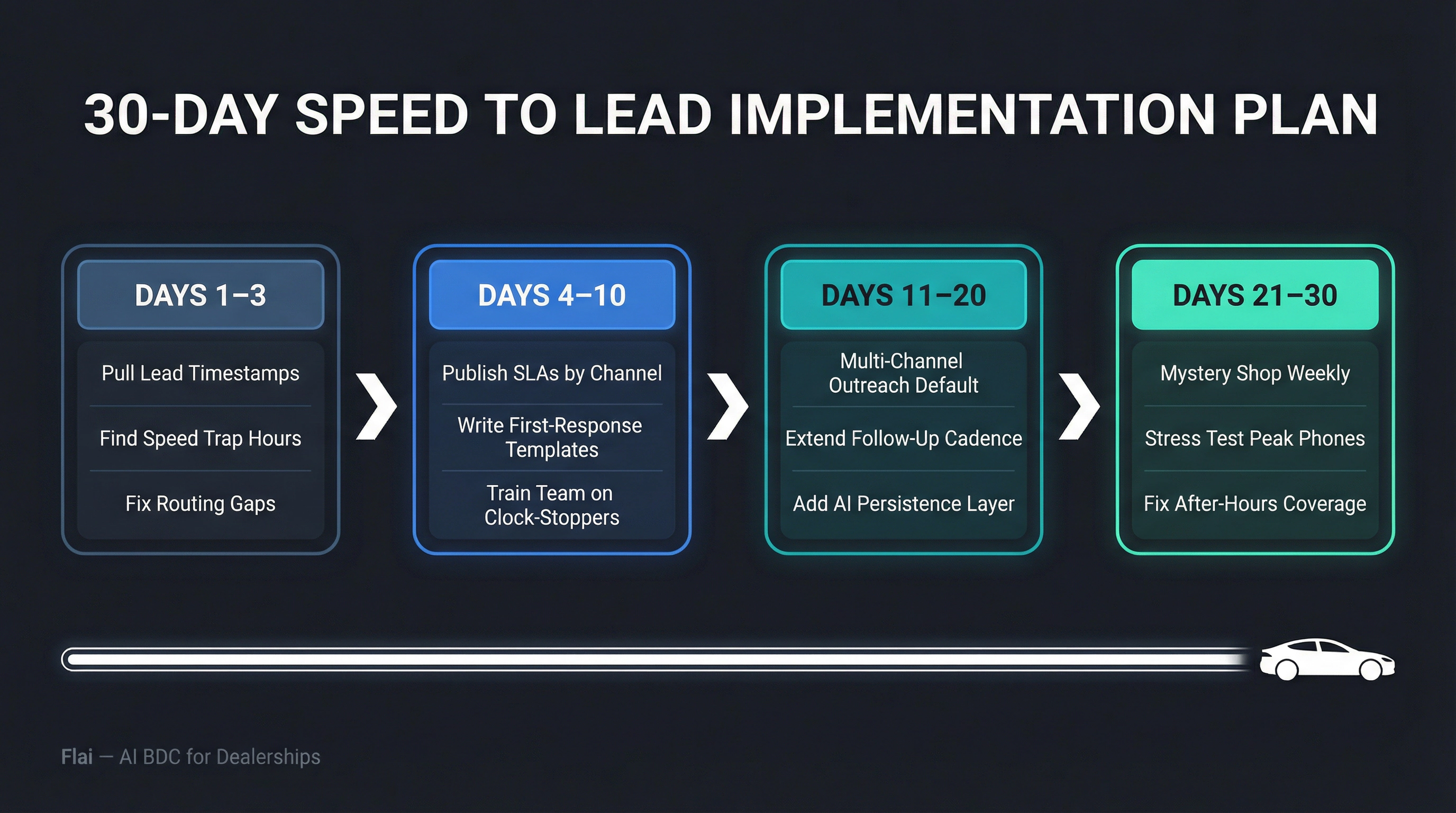
Days 1-3: Baseline and plumbing
Pull the last 14 days of lead timestamps and first-response timestamps. Identify your top three lead sources by volume and by close rate. Find your “speed trap” hours (start with Monday 10am to 12pm). Fix routing ownership gaps where leads land in a shared inbox or unassigned queue. When your dealership gets the most calls is your baseline for where routing failures cost you most.
Days 4-10: SLAs and scripts
Publish SLAs by channel so everyone knows what “good” looks like. Write your first-response templates based on the frameworks above. Train the team on the difference between a “helpful response” and a “clock stopper” — Maritz makes clear most teams don’t actually know the difference. Connect BDC metrics to your new SLAs so the scoreboard reflects what you’re asking the team to hit.
Days 11-20: Multi-channel and persistence
Make multi-channel outreach the default for high-intent leads — not something reps do when they feel like it. Add a follow-up cadence that extends well beyond 24 hours. Maritz notes that buyers convert much later than most teams expect, which means follow-up length directly affects deals closed. How AI follow-up helps dealerships close more leads explains how to build persistence without burning out your team.
Days 21-30: Coverage and stress testing
Mystery shop yourself weekly. Stress test the phones by calling three lines at once during your peak window. Fix after-hours coverage for one specific use case — service scheduling is usually the cleanest place to start. Automating service appointment scheduling is the highest-volume use case where 24/7 automation produces the clearest ROI. Call overflow solutions address the parallel challenge during peak hours.
Speed to Lead Mistakes Most Dealerships Make
Even dealerships with good intentions get stuck on these three patterns.

Trap 1: Celebrating fast replies that don’t answer the question. Your customers don’t care that your CRM clock stopped. They care that you helped. DAS Technology’s research found that even as response times improve, most dealers still fail to include price quotes, payment details, or alternative vehicle options in their first response. Faster vague replies are still losing leads. Dealership customer experience statistics document this gap in detail.
Trap 2: Assuming automation solves handoffs. Automation helps significantly, but Pied Piper’s 2026 study highlights what they call “digital handoff risk” — where system-to-system failures and AI-to-human transitions create hidden breakdowns. The customer submits a form, automation fires, a human is supposed to follow up, the handoff breaks, and the customer gets nothing. The fix is to measure outcomes, not activity. Did the customer get an appointment? Did they get their question answered? Those are the only metrics that matter. What is an AI BDC and how it automates dealership calls explains how properly designed AI systems handle handoffs differently from rule-based automation.
Trap 3: Ignoring phone leads because “internet is everything.” A phone call is often your highest-intent lead. If customers are hanging up on hold, your marketing dollars are literally paying to generate calls you don’t convert. Car Wars’ analysis of nearly 3,000 dealerships should remove any doubt: nearly a third of callers abandon on hold, and 32% end up in voicemail. These are not people who didn’t want to buy. They’re people you didn’t get to in time. Why 32% of dealership callers hang up and what to do about it is one of the highest-impact improvements most dealerships can make this quarter.
How Flai Solves the Speed to Lead Problem for Dealerships
Everything in this guide points to the same structural challenge: dealerships have predictable, recurring windows where leads arrive and humans can’t keep up. After hours. Peak-time spikes. Monday mornings. Service scheduling surges. The fix isn’t hiring more BDC reps for every conceivable scenario. It’s building a system that’s already working when the customer tries to reach you.
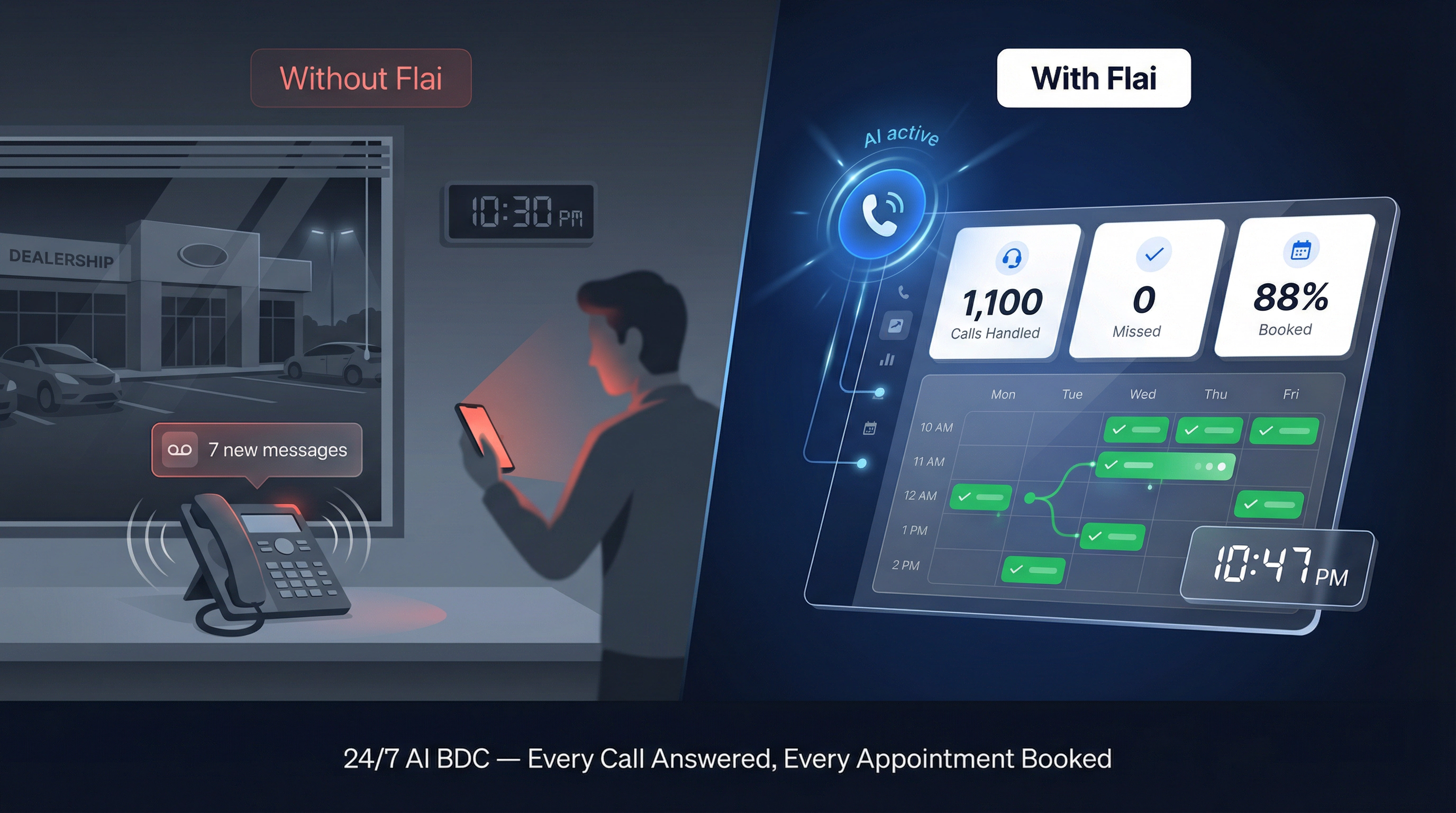
That’s what Flai is built to do. It’s an AI communications platform built specifically for car dealerships, functioning as a 24/7 AI BDC that handles every inbound call, text, and email regardless of time of day or call volume. When a customer reaches out at 10pm on Sunday or during a Monday morning spike when every phone line is ringing, Flai picks up, has a real conversation, and books the appointment directly into the scheduler. Not a voicemail. Not a message for someone to call back. An actual booked slot.
The key distinction is integration depth. Flai connects directly to your DMS, CRM, and scheduler, which means it can check real availability and confirm a booking in the same conversation. This is why the conversion numbers from actual Flai deployments are meaningful rather than theoretical. A Lexus dealership in the Bay Area went from zero after-hours coverage to handling approximately 1,100 calls with zero missed, converting 88% of bookable calls to appointments, and generating roughly $100,000 in monthly profit impact. A CDJR dealership in the same region saw monthly service appointments jump from 205 to 448 in the first month, with Flai booking 304 of those appointments and contributing approximately $83,000 in profit impact in 30 days.

Consider the statistic that 56-60% of dealership leads arrive after business hours. And that roughly 70% of people who hit voicemail call a competitor within about 30 minutes. If your after-hours coverage is a voicemail box, you’re not just slow. You’re handing that business to the next store in their search results. Replacing outsourced call centers with AI is the strategic shift that closes this gap permanently. Unlike outsourced services, AI actually books the appointment rather than just taking a message.
Flai also handles the peak-time overflow problem. During your Monday 10-12 spike, when your human team is at capacity and calls start going to hold, Flai acts as call overflow coverage that resolves calls rather than just taking messages. Warm transfers happen with context (not blind transfers that force customers to repeat themselves). Follow-up on sales leads happens via phone, text, and email as real two-way conversations.
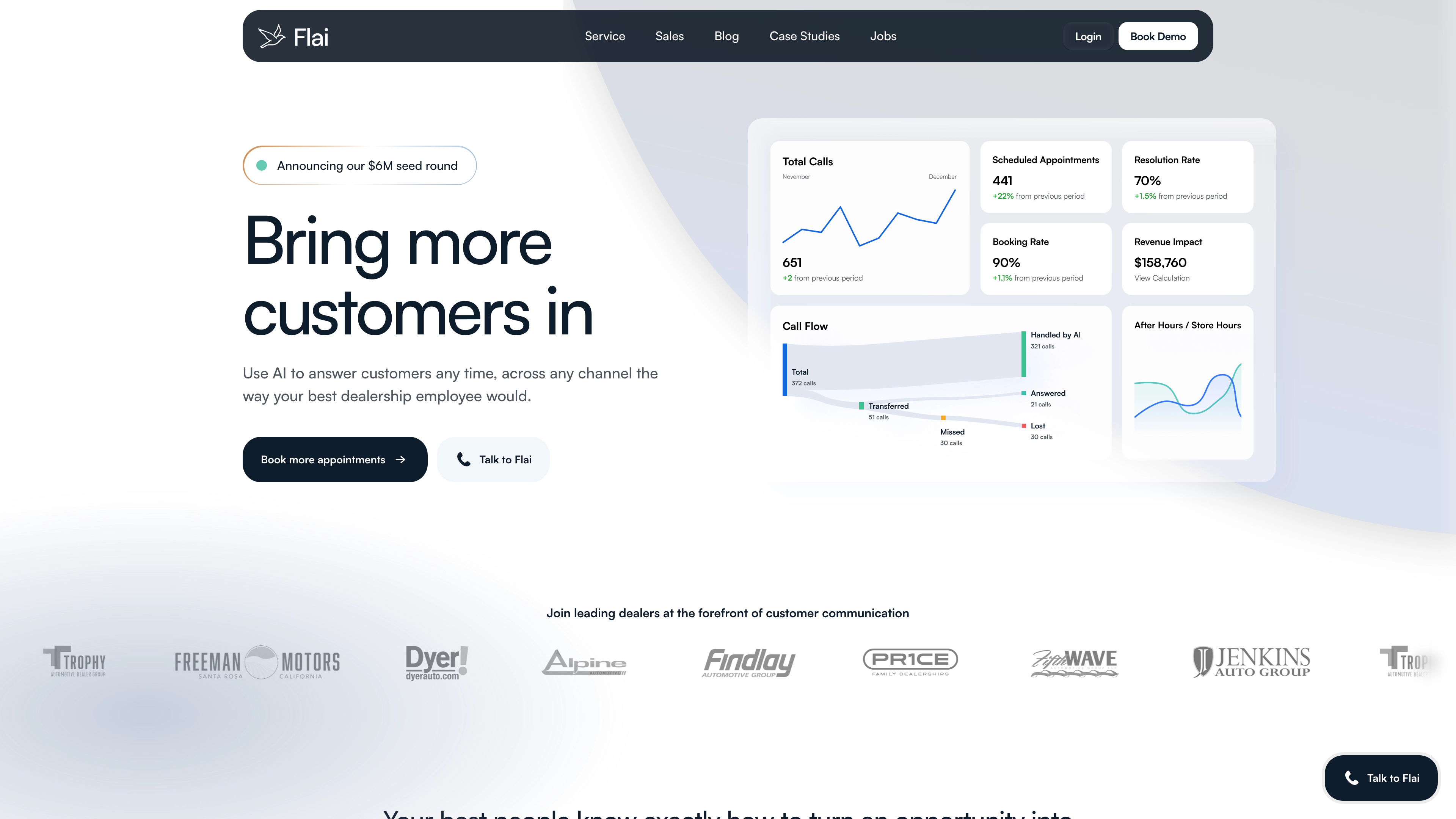
Beyond coverage, Flai gives you visibility. Every call handled, every appointment booked, every outcome logged. So instead of guessing what your Monday 10-12 connection rate looks like, you can see it. This is the kind of data that makes BDC performance tracking actionable rather than theoretical.
If the question you want to be able to answer “yes” to is “when a customer reaches out, do they feel like we’re the easiest path to getting it done?”, Flai is how you make that true around the clock. Book a demo to see exactly how it works at a store like yours.
Frequently Asked Questions

What’s the ideal response time for dealership internet leads?
Based on the most recent 2026 research, 15 minutes is the competitive benchmark for a helpful first response to website and internet leads. The Pied Piper ILE 2026 study found that 51% of franchise dealers achieved a “perfect response” within 15 minutes. DAS Technology’s analysis found 61% responding within that window. Under 15 minutes for a substantive, helpful response is competitive. Over 30 minutes, you’re losing to dealerships that are faster. Tracking BDC metrics by lead source shows you exactly where your current performance falls relative to these benchmarks.
Why do dealerships lose so many phone leads?
Car Wars’ analysis across nearly 3,000 dealerships found that 31.8% of unconnected callers hang up while on hold, the average hold time is over 3 minutes, and 32.3% of non-connected calls go to voicemail. These aren’t customers who changed their minds. They’re customers who ran out of patience before reaching a human. The biggest fix is reducing or eliminating hold for simple tasks like service scheduling and general questions. Why 32% of dealership callers hang up gives a full breakdown of root causes and specific fixes organized by impact.
How should dealerships handle after-hours leads?
At minimum, after-hours inquiries need an immediate acknowledgement with a specific promised callback time (not just “we’ll call you”). Competitively, the response should answer questions and book the appointment if possible. Top tier is full 24/7 task completion: booking, confirming, updating records, and routing to the right person when staff return. Research shows roughly 56-60% of dealership leads arrive outside business hours, so this window isn’t a minor edge case. It’s where a majority of leads first try to reach you. A virtual receptionist for car dealerships is the most scalable solution for full 24/7 task completion without expanding your human team.
How does AI help dealerships improve speed to lead?
AI tools like Flai solve the structural problem that human staffing can’t solve: coverage during after-hours windows and peak-time spikes. An AI BDC answers every call and message immediately regardless of time, has real conversations, books appointments directly into the scheduler, and hands off to humans with context when needed. This eliminates the two biggest speed-to-lead gaps in most stores: after-hours black holes and peak-period hold abandonment. The practical effect isn’t theoretical. Flai deployments at real dealerships show 88% conversion rates on bookable calls and $80,000-$100,000+ in monthly profit impact per rooftop. Review the full case studies to see results from specific dealership types.
How to Build a Dealership Customers Keep Coming Back To
Speed to lead isn’t a metric to optimize in isolation. It’s a proxy for something bigger: whether your dealership feels organized, responsive, and worth doing business with. Customers shopping for a car or booking a service appointment are running a quick mental test. They reach out, they see how fast and helpfully you respond, and they decide whether you’re the kind of operation they trust with a purchase that might be tens of thousands of dollars.
The dealerships winning on speed to lead in 2026 aren’t doing anything exotic. They’ve defined their SLAs, trained their teams on what a real first response looks like, built overflow coverage for the hours where humans can’t keep up, and started measuring outcomes instead of just activity.
When a customer reaches out to your dealership, do they feel like you’re the easiest path to getting it done? That’s the only question that matters. Build your answer around it.

Further reading from our team at Flai on adjacent topics: