Car Dealership Phone System: Complete Guide (2026)
Your car dealership phone system is a revenue system. Learn how to stop losing calls, cut hold times, and turn every inbound call into a booked appointment.

If you’re searching for “car dealership phone system,” you’re probably not wondering which desk phones to buy. You want to know how to stop losing service and sales revenue because callers can’t reach the right person fast enough, and how to build a phone setup that actually converts calls into booked appointments.
This guide is built for Dealer Principals, GMs, Fixed Ops Directors, BDC Managers, and IT leads who are tired of watching revenue leak out of a phone system that technically “works” but functionally doesn’t. We’re going to walk through exactly how dealership phone systems fail, what a properly designed one looks like, what it costs, how to set it up in 30 days, and where AI fits into the picture in 2026.
No fluff, no vendor pitches disguised as advice. Just the blueprint, the numbers, and a checklist you can hand to any vendor or take into your next ops meeting.
What a Dealership Phone System Really Does
A dealership phone system is not one product. It’s a stack of five layers that have to work together:
- Phone service (carrier, trunks, numbers)
- Call control (PBX or cloud VoIP: ring groups, extensions, routing rules)
- Customer flow (IVR menus, queues, transfers, callback, after-hours handling)
- Measurement (recordings, transcripts, reports, missed-call reasons)
- Outcome systems (scheduler, CRM, DMS, texting, follow-up)
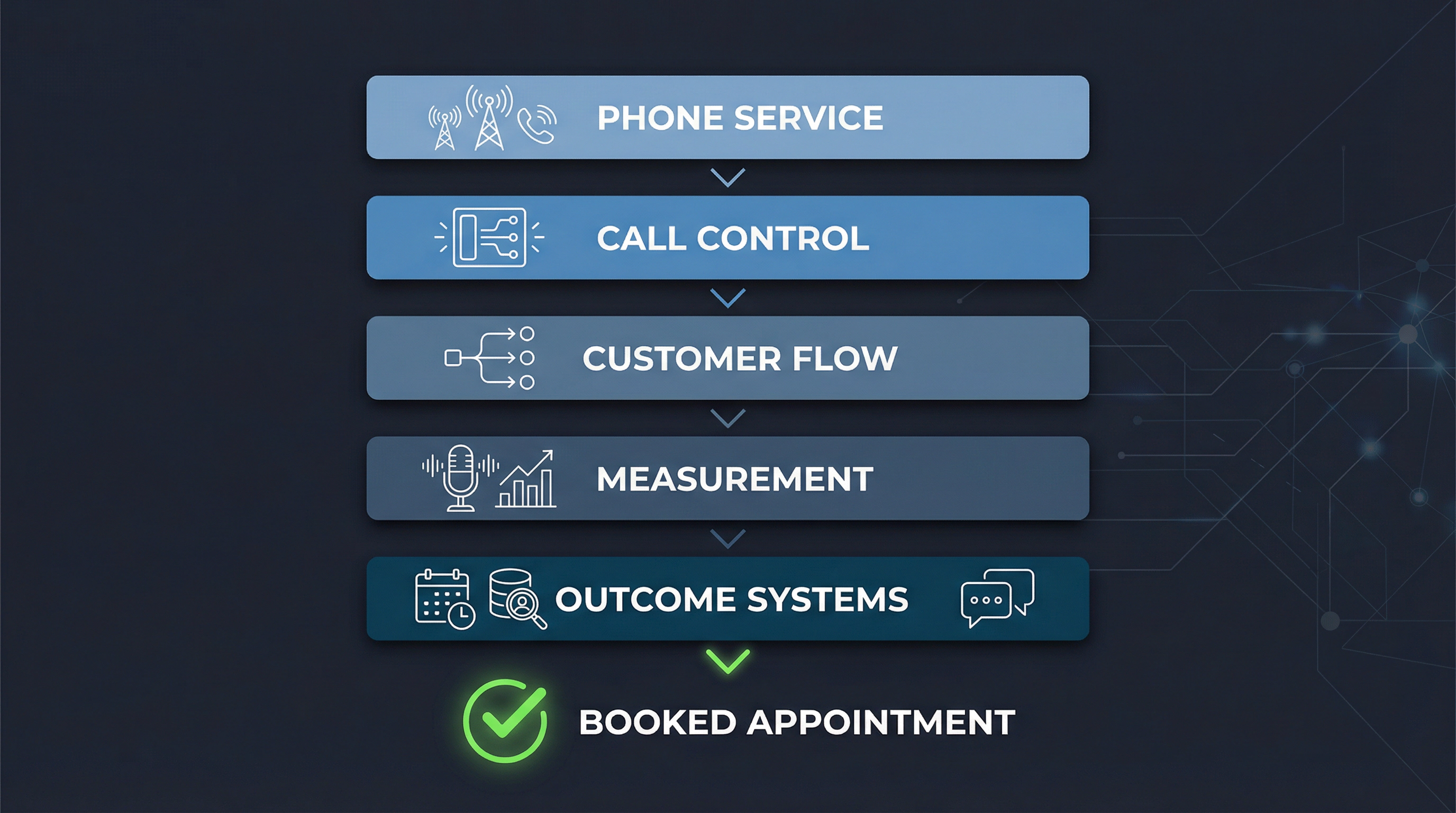
Most dealerships “have a phone system” and still lose revenue because their setup is optimized for telephony, not customer outcomes. Your callers don’t care whether you use SIP, UCaaS, or a legacy PBX. They care if they can book service, confirm parts availability, schedule a test drive, get a price, or reach a human who can actually solve the problem.
If your setup can’t reliably produce those outcomes, it’s not really a dealership phone system. It’s a dial tone.
Why Standard Phone Systems Fail at Dealerships
Dealerships aren’t normal businesses, and generic phone solutions tend to collapse under the weight of how dealerships actually operate. Here’s what makes them different.
You have multiple mini-businesses sharing one reputation. Sales, service, parts, collision, F&I, used cars, fleet. Callers get bounced between departments because they’re siloed internally, but customers experience it as one brand. When someone calls about a recall and gets transferred three times, they don’t blame “the service department.” They blame your dealership.
Call volume is spiky, not smooth. Monday morning isn’t “slightly busier.” It’s chaos. Car Dealership Guy reported that Monday was the busiest day for inbound calls in 2024, and the 10:00 AM to 12:00 PM window was the most active across peak days. Your phone system needs to handle a tidal wave of demand in a two-hour window, then taper off. Most systems are sized for averages, not peaks. Understanding when dealerships get the most calls is the first step to solving this.
The money sitting on the other side of the phone is enormous. According to NADA’s full-year 2024 report, franchised dealers wrote over 270 million repair orders, with service and parts sales exceeding $156 billion. In just the first half of 2025, NADA reports 137+ million repair orders and service and parts revenue exceeding $81 billion. Fixed operations is the engine of dealership profitability. Your phone system isn’t an IT line item. It’s a revenue system.

How Dealership Calls Actually Fail: The Data
Most dealerships track “missed calls” as: phone rang, nobody picked up. That undercounts the problem by a huge margin.
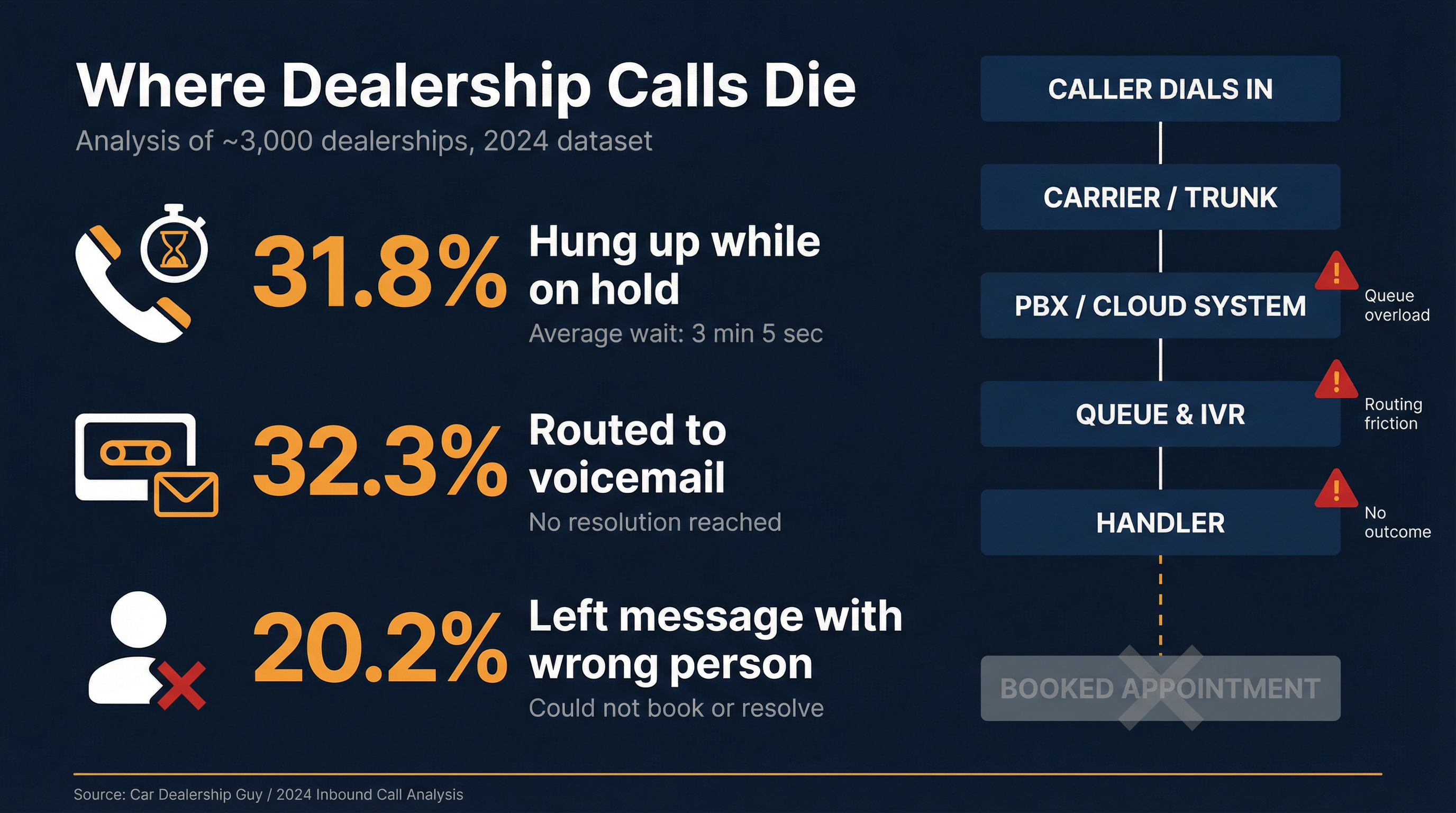
A large 2024 dataset analyzing nearly 3,000 dealerships (reported by Car Dealership Guy) shows how calls fail before anyone can help:
- 31.8% of unconnected calls: customer hung up while on hold
- 32.3% of non-connected calls: went to voicemail
- 20.2% of non-connected calls: customer left a message with a person who couldn’t help
The same data showed the average hold time was 3 minutes and 5 seconds. Three minutes doesn’t sound long until you’re the customer sitting in a parking lot with your check engine light on, wondering if you should just call the shop down the road instead. The true cost of dealership hold times goes far beyond the call itself. It’s appointments not booked and customers lost to competitors.
If those numbers are even directionally true for your store, you can be “answering calls” and still losing a significant chunk of customers because the caller never reaches the person who can complete the job.
Where Calls Break Down in Your Dealership Phone System
When a call hits your dealership, it follows a basic path: customer dials in, reaches your carrier, hits your PBX or cloud system, enters a queue or IVR, gets routed to a handler (human or automated), and ideally ends with an outcome logged in your scheduler, CRM, or DMS.
Most “phone problems” come from one of five points in that chain:
- Queue math: demand exceeds capacity, so wait times explode
- Routing friction: too many menus, wrong departments, cold transfers
- No outcome: someone answers but can’t book, so they just take a message
- After-hours black hole: voicemail or outsourced message-taking with no real resolution
- No visibility: you can’t see why calls failed, so you can’t fix them
A new phone vendor can fix routing friction and some visibility gaps. But it doesn’t automatically fix queue math and outcome problems. Those are process and capacity issues, and they need different solutions.
This is exactly why choosing a dealership phone system isn’t just about picking a vendor with better features. You need to understand where your specific calls break down, then match the right tool to each failure point. Sometimes that’s a configuration change. Sometimes it’s a staffing adjustment. And sometimes it’s an AI layer that can absorb the demand your team can’t cover.
How to Build a Dealership Phone System That Works
This is the part that actually matters. A properly designed dealership phone system should do five things reliably: answer instantly (or offer a callback fast), route based on intent rather than department names, avoid dead-end transfers, complete the job (book, quote, confirm, or escalate), and log everything so you can improve it.
Here’s how to build that.

Route Calls by Customer Intent, Not by Org Chart
Callers don’t think in “Fixed Ops vs Variable Ops.” They think: “I need an oil change.” “My check engine light is on.” “Do you have this car in stock?” “What’s the price?” “I need parts for a 2020 F-150.”
Your IVR should match how customers speak, not how your org chart is drawn. When you build menus around customer intent, you reduce transfers, shorten hold times, and get callers to the right person on the first try. This intent-based approach is exactly how a well-configured AI BDC triage system operates: routing by what the customer needs, not by which department button they press.
How to Keep Your Dealership IVR Short
Bad IVR makes you feel “organized.” Good IVR makes you feel “easy.”
A strong dealership menu is usually just: Sales, Service, Parts, and an Operator option. “Press 0” should always work. Anything beyond that tends to create drop-off, especially on mobile where people are impatient and often driving. That’s why customers hang up: complexity and wait time compound each other to drive abandonment.
Why Warm Transfers Matter for Your Dealership
If you transfer callers during peak hours to a line that rings forever, you create a miserable loop: hold, transfer, hold, voicemail, competitor. To break that cycle, you need three things:
-> Presence awareness: Is the destination actually available before the transfer goes through?
-> Maximum ring time: 15 to 20 seconds is standard. After that, overflow kicks in.
-> An overflow plan: Queue, callback, or alternate handler. Something with an actual outcome.
How to Handle After-Hours Calls at Your Dealership
After-hours isn’t “extra.” It’s a structural chunk of your demand. If you can’t actually handle calls after hours, your system is effectively closed during the exact window when many buyers and service customers are deciding where to go.
This is one of the highest-impact areas to fix, and it’s exactly where AI solutions like Flai can pick up calls, answer questions, and book appointments 24/7 without relying on voicemail or a third-party answering service. See how leading dealerships never miss a customer call even outside business hours.
How to Build a Call Overflow Plan for Every Department
You should be able to answer this question for service, sales, and parts: “If we can’t handle the call right now, what exactly happens next, and how does the customer still get the outcome?”
Good overflow strategies:
-> Offer a scheduled callback
-> Route to a central BDC
-> Route to an AI agent that can book (like Flai)
-> Route to an after-hours team with scheduler access
Strategies that don’t work: voicemail, “leave a message and we’ll call you back,” or a blind transfer to a busy extension. There are proven call overflow solutions for dealerships that fix this exact problem without requiring you to hire more staff.
Dealership Phone System KPIs That Actually Matter
A dealership phone system should be managed like a revenue funnel, not a telecom utility. Here are the metrics that matter, grouped by what they actually measure:
| Category | What to Track | What It Tells You |
|---|---|---|
| Speed | Time to answer (seconds), average hold time, callback offered rate, callback completion rate | Whether callers are waiting too long before they get help |
| Connection quality | Connection rate, abandonment rate, transfer success rate | Whether callers are reaching the right person |
| Outcome | Appointment set rate (service + sales), first-call resolution rate (parts), no-show rate | Whether calls are actually turning into revenue |
| Operational | Calls per hour by daypart, average handle time, wrap/notes time | How to staff and plan capacity correctly |
The KPI that lies the most is “answered call rate.” You can answer a call and still completely fail the customer. Car Dealership Guy’s data shows that huge leakage happens before connection and during hold or voicemail. If your dashboard only shows “answered,” you’re missing what’s really happening. The dealership customer experience statistics paint a clear picture of the gap between industry average and top-performer benchmarks.
Dealership Phone System Options in 2026: On-Prem, Cloud, and AI
Think of these as layers, not competitors. Most dealerships end up combining two or more.
| System Type | Strengths | Weaknesses | Best For |
|---|---|---|---|
| On-prem PBX (legacy) | Extreme control, works with existing sunk costs | Weak on flexibility, analytics, remote work, speed of change | Stores locked into existing hardware |
| Cloud VoIP (UCaaS) | Multi-location support, mobile apps, easier admin, modern routing | Add-ons get expensive fast; doesn't "book" anything by itself | Most businesses actively modernizing |
| Contact center (CCaaS) | Real queues, agent tools, coaching, advanced reporting | Complex setup, training required | BDCs and multi-rooftop groups |
| Call tracking/coaching | Marketing attribution, recordings, coaching, scripts, scoring | Doesn't solve staffing or booking gaps | Marketing ROI and rep training |
| AI answer-and-book layer | After-hours, overflow, appointment booking, follow-up | Backfires if it sounds robotic or can't access scheduling | Capacity and outcome gaps |
Many dealerships have found that replacing outsourced call centers with AI is both faster and more cost-effective than traditional CCaaS deployments. Before you evaluate AI vendors, read our AI voice agents for dealerships buyer’s guide to understand exactly what to look for and what questions to ask.

Dealership Phone System Cost in 2026
TechRepublic’s 2026 guide puts typical business phone service pricing at $15 to $45 per user per month, depending on provider and features. They list starting prices for common providers including RingCentral, Nextiva, Ooma, Dialpad, Zoom Phone, and Vonage.
But that base price is just the beginning. Dealerships routinely forget to budget for:
- Call queue and contact center features (usually add-ons)
- Call recording storage
- Analytics and reporting
- Desk phones (if you want physical handsets)
- Network upgrades (QoS, bandwidth, redundancy)
- Setup costs (number porting, training)
- Outcome tooling (scheduler integration, CRM logging, follow-up)
Instead of asking “How much does a phone system cost?”, ask: What is the cost per incremental booked appointment that the system helps capture? If your current system is producing 3-minute holds and voicemail leakage, the ROI math gets brutal fast.
URL: https://www.techrepublic.com/article/best-business-phone-systems/ Location: Dealership Phone System Cost section Reason skipped: CIKB prohibition — the TechRepublic page prominently displays competing phone system vendor names (RingCentral, Nextiva, Ooma, Dialpad, Zoom Phone, Vonage) in favorable context. This blog is published on behalf of Flai; featuring a screenshot that foregrounds competitor branding would work against Flai’s positioning. The inline citation already gives readers access to the source. This screenshot was deliberately skipped rather than captured.
How AI Fits Into Your Dealership Phone System (And Where It Backfires)
A lot of dealers are testing AI right now. The key insight is that AI isn’t a “nice-to-have.” It’s a capacity tool and an outcome tool.
CDK Global data offers a useful reality check. For sales appointments, 66% of new car shoppers said they’d prefer scheduling with an AI assistant over talking to a human. For service appointments, 69% still want to talk to someone. That doesn’t mean AI can’t work for service. It means the bar is higher: the AI must feel natural, resolve the actual job, and avoid robotic dead ends.
CDK also reports that among new car shoppers who called ahead, 81% experienced some kind of issue with transfers, holds, phone menus, calling back, or nobody picking up. So the demand for a better phone experience is real and significant. The full picture of dealership customer experience statistics confirms this: the gap between average stores and top performers is largely driven by phone handling quality.

3 AI Use Cases That Win First for Dealership Phone Systems
- After-hours answering and booking. This is the lowest-risk, highest-impact starting point. Calls that would hit voicemail instead get answered, and appointments get booked. Our own data at Flai shows that peak calling windows and after-hours demand create enormous opportunity for dealerships that can capture those calls. Read our guide on how to increase service appointments at dealerships to see the math on what capturing after-hours calls is worth.
- Peak-hour overflow. Monday 10 AM to noon is a classic pain window. When your BDC is maxed out, AI can catch the overflow and handle routine scheduling, so your human reps focus on complex conversations.
- Missed-call recovery. Instantly calling back or texting back every missed call so no lead goes cold. We’ve written about why dealership callers hang up, and the pattern is clear: if you don’t reach them within minutes, they’ve already moved on. AI follow-up systems can close that gap automatically.
Where AI Backfires in Dealership Phone Setups
AI falls apart in predictable ways. Watch for these failure modes:
- Can’t access the scheduler, so it has to “take a message” (defeating the entire purpose)
- Transfers blindly without confirming the destination can pick up
- Has long latency so people talk over it
- Can’t handle edge cases like angry customers, tow requests, or warranty disputes
The right way to deploy AI is the same as deploying anything else in your phone system: define the failure mode, define the fallback, then monitor it. Our complete AI for car dealerships guide covers exactly how to evaluate, deploy, and monitor AI so it actually performs.
How Flai Transforms Your Dealership Phone System
We built Flai specifically to solve the problems outlined in this guide. Not as a generic AI tool bolted onto your phone system, but as an AI communications platform designed from the ground up for car dealerships.
Flai functions as a 24/7 AI-powered BDC that handles inbound and outbound customer communications across voice, SMS, and email. When a call comes in that your team can’t answer (whether that’s after hours, during a Monday morning rush, or because someone’s on another line), Flai picks up. And it doesn’t just take a message. It actually books the appointment, answers questions about service availability, and logs everything in your DMS.
The screenshot below shows Flai’s real platform dashboard — total calls tracked, appointments scheduled, a 90% booking rate, and $158,760 in revenue impact are visible alongside the customer logos of dealerships already live on Flai.

Here’s what makes this different from a generic chatbot or virtual receptionist service:
Deep DMS integration. Flai connects to your dealership management system so it can actually check availability, book real appointments, and confirm them via text or email. No “someone will call you back” dead ends.
Natural conversation, not a phone tree. Our AI voice agents handle calls the way your best BDC rep would. Callers get a natural conversation, not a robotic script. That’s critical for service customers, where CDK’s data shows the bar for phone experience is especially high.
Covers every failure mode. After-hours black hole? Flai answers. Peak-hour overflow? Flai catches it. Missed call recovery? Flai follows up instantly via call and text. No-outcome calls? Flai books the appointment instead of taking a message.
Real dealership results. Founded by former HappyRobot engineers and a Netflix data scientist, Flai emerged from Y Combinator’s Summer 2025 batch and raised $4.5 million in a seed round led by First Round Capital. We’re live in dozens of dealerships across the United States, including groups like Findlay Auto Group and New Century Auto Group, with case studies showing $80,000 to $100,000+ in monthly profit impact per dealership. See how Freeman Lexus achieved an 88% booking conversion rate and $100,000 in monthly profit impact.
The point isn’t to replace your phone system. It’s to plug the gaps that no phone system, no matter how well configured, can cover on its own: the nights, the overflow, the follow-up, and the outcome. If you’re evaluating dealership phone system options and wondering where AI fits, Flai is worth a look because it was built to solve exactly these problems rather than being a generic AI tool adapted for automotive.
The 30-Day Dealership Phone System Rollout Plan
Most dealership phone projects fail for one reason: nobody wrote down the call flows. Here’s a rollout sequence that avoids that mistake.

(1) Week 1: Map reality (not what you wish was true)
Create a “number map” listing every public number (main, sales, service, parts, collision, Spanish line), where each routes today, business hours vs after-hours routing, overflow rules, and which lines are recorded. Then run a mystery shop: call service at 10:30 AM Monday, call sales at 6:30 PM, call parts at lunch, and call after hours. Document the time to answer, holds, transfers, and whether you can actually book anything. If your dealership serves Spanish-speaking customers, also evaluate your multilingual customer service capabilities during this audit. Language barriers are an invisible revenue leak.
(2) Week 2: Design the blueprint call flows
Write down your IVR script (keep it short), routing rules by department, maximum ring time before overflow, callback rules, after-hours strategy, and escalation rules for angry customers, safety issues, tow requests, and similar edge cases.
(3) Week 3: Configure, pilot, and test hard
Pick one rooftop or one department first. Port a subset of numbers. Test E911. Test failover (simulate an internet outage). Test transfers when the destination is busy. Break things intentionally so you find the gaps before your customers do.
(4) Week 4: Launch and manage it like a revenue system
For the first two weeks after launch, review daily: abandoned calls by hour, hold times by hour, transfer failures, “message taken” outcomes, and appointment outcomes. Then tune. This isn’t a set-it-and-forget-it project.
The dealerships that get the most out of new phone systems are the ones that treat Week 4 like the beginning, not the end. The data you collect in those first two weeks will show you exactly which call flows need adjustment, which departments need overflow help, and where an AI layer like Flai could fill the remaining gaps. Use these BDC metrics as your ongoing management dashboard once you launch.
Dealership Phone System Reliability and Compliance Requirements
VoIP Internet and Network Requirements for Dealerships
With VoIP, if your network is weak, your phones are weak. The minimum practical steps are business-class internet, QoS configured properly, a redundant internet connection (second ISP or cellular failover), and power backup for your networking gear. Skipping any of these is like buying a great car and putting cheap tires on it.
E911 Compliance for Dealerships: Kari’s Law and RAY BAUM’s Act
If you use multi-line telephone systems (MLTS), you need to know about these even if you’re not a hospital or hotel.
Kari’s Law (effective February 16, 2020) requires direct dialing of 911 from multi-line systems and notification to a central location with callback number and location info. RAY BAUM’s Act Section 506 emphasizes providing dispatchable location information with 911 calls so emergency services can locate callers within a building or complex.
The practical dealership takeaway: if someone dials 911 from parts, or the service drive, your system should not send responders to “123 Main St” with no suite or building info. Confirm current requirements with your telecom provider and compliance team. (Note: the 911.gov guidance page was last updated March 8, 2023; the laws remain in effect.)

Call Recording Laws and Consent Requirements
Recording laws vary by state. Don’t wing it. Put your recording disclosure in the right place in your call flow, and confirm the rule set with counsel.
Dealership Phone System Vendor Evaluation Checklist
Use this to evaluate any dealership phone system vendor.
Call handling and routing:
- Can we build multi-level IVR that stays short?
- Can we route by intent (service scheduling vs. service status vs. parts)?
- Can we set max ring time and overflow rules?
- Can we use warm transfer behavior instead of blind transfers?
- Can we offer callback from queue?
Reporting and visibility:
-> Can we see hold time, abandonment, and transfer failures by hour?
-> Can we tag calls by department and outcome?
-> Can we pull recordings easily?
-> Can we export data (and do we own it)?
Outcome integrations:
- Does it integrate with our scheduler, CRM, DMS, or at least log outcomes?
- Can it trigger confirmation SMS/email?
- Can it create tasks for follow-up?
Reliability:
-> What’s the uptime SLA?
-> What happens if internet goes down?
-> Can we route to cell phones automatically?
-> Is there geo-redundancy?
Compliance and security:
- E911 and dispatchable location support (MLTS compliance)
- Call recording controls and retention
- Admin access controls, MFA, audit logs
- Data storage and security posture
Total cost:
- Per user or per line cost
- Setup fees
- Add-ons (queues, recording, analytics, integrations)
- Hardware
- Contract length and early termination terms
Frequently Asked Questions About Dealership Phone Systems

What is a car dealership phone system? A car dealership phone system is a stack of technology and processes that handles how customer calls get answered, routed, and resolved across sales, service, and parts departments. It includes your phone service (carrier/trunks), call control (PBX or cloud VoIP), customer flow (IVR, queues, transfers), measurement (recordings and reports), and outcome systems (scheduler, CRM, DMS). The goal isn’t just connecting calls; it’s converting them into booked appointments and revenue.
How much does a dealership phone system cost? Base phone service typically runs $15 to $45 per user per month for cloud VoIP, according to TechRepublic’s 2026 pricing guide. But the real cost includes add-ons like call queues, recording storage, analytics, desk phones, network upgrades, setup, and outcome tooling (scheduler and CRM integrations). Rather than focusing on per-seat cost, smart dealerships calculate cost per incremental booked appointment.
What percentage of dealership calls go unanswered? It’s worse than most dealers realize. An analysis of nearly 3,000 dealerships found that among non-connected calls, 31.8% of callers hung up on hold, 32.3% went to voicemail, and 20.2% left a message with someone who couldn’t resolve their issue. The average hold time was over 3 minutes. See our breakdown of missed call statistics and the revenue lost from this leakage.
Should I switch from an on-prem PBX to cloud VoIP? It depends on your situation. Cloud VoIP is where most businesses are moving because it offers easier admin, better multi-location support, mobile apps, and modern routing features. But if you have a well-maintained on-prem system and it’s meeting your needs, the priority should be fixing call flow and outcome problems first. A cloud migration is a big project. Make sure you’re solving the right problem before you start swapping hardware.
How long does it take to switch dealership phone systems? A realistic timeline is about 30 days when done right. Week one is mapping your current setup and running mystery shops. Week two is designing call flows. Week three is configuration, piloting with one department or rooftop, and hard testing. Week four is full launch with daily monitoring. The biggest risk isn’t the technology. It’s skipping the planning phase and going live with call flows nobody documented.
Can AI replace a dealership BDC? AI works best as a supplement, not a full replacement. It excels at handling after-hours calls, peak-hour overflow, and missed-call recovery. Flai, for example, functions as a 24/7 AI BDC that can answer calls, book appointments, and follow up via text. But complex negotiations, escalated complaints, and relationship-driven sales conversations still benefit from human reps. The smartest approach is using AI to handle the volume so your human team can focus on the high-value interactions.
Do customers actually want to talk to an AI when they call a dealership? It varies by department. CDK Global’s research shows 66% of new car shoppers would prefer scheduling with an AI assistant. For service, 69% still prefer talking to someone, but that bar gets cleared when the AI sounds natural, can actually book the appointment, and resolves the issue without transfers or dead ends. If you’re concerned about how AI affects the overall customer experience, improving CSI scores is another area where getting phone handling right pays dividends.
What’s the most important KPI for a dealership phone system? Appointment set rate, not “answered call rate.” You can answer every call and still fail customers if nobody books. Track speed to answer, connection rate (did they reach a qualified handler?), and outcome rate (did the call result in a booked appointment?) to get the full picture. Our complete BDC metrics guide covers all 12 metrics you should be tracking.
Your dealership phone system is a revenue system. If it can’t reliably turn peak-hour and after-hours calls into booked appointments, it’s not doing the job, regardless of how modern the vendor logo looks. Start by mapping your current call flows, identify where calls fail, build a system that produces outcomes (not just connections), and plug the gaps with the right combination of technology, process, and AI. If you want to see how Flai can close those gaps for your store, book a demo and we’d love to show you what that looks like in practice.