



Privacy Policy
Terms of Service
Blogs & Guides
Ready-to-use car dealership phone scripts for service and sales, plus a QA scorecard and the proven word tracks that turn callers into booked appointments.
March 5, 2026
If your mental model is “customers book online now,” the data is blunt.
According to a CDK Global survey published in April 2025, 64% of service customers still choose to call to book their appointment, while only 19% book online. For sales, calling and web booking are closer (44% vs 39%), but the phone still leads. Pied Piper’s 2025 Service Scheduling Effectiveness study confirms the same reality: two-thirds of service customers rely on the telephone to book, even as online scheduling options expand.

The stakes are enormous. NADA data shows U.S. dealerships wrote 270 million-plus repair orders in 2024, with service and parts sales exceeding $156 billion. Every one of those repair orders started with someone trying to get through to the store.
“Getting through” is harder than it sounds. A Car Wars analysis across nearly 3,000 dealerships in 2024 found that 31.8% of unconnected calls were customers hanging up while on hold (not going to voicemail, not asking for a callback, just leaving). Average hold time: 3 minutes and 5 seconds. That’s an eternity when the customer has four other dealerships to call with one tap.
Our research on missed call statistics makes the revenue math clear: a handful of missed calls per day compounds fast. Phone scripts don’t fix the coverage problem (more on that later), but they’re the most powerful lever you have to make every answered call count.
A dealership phone call is a real-time decision under pressure. The customer is simultaneously pursuing a goal, testing your competence, and deciding whether the effort is worth continuing. The hold button, an unnecessary transfer, a vague “let me check on that”: each one chips away at their willingness to stay.
A script works because it reduces cognitive load for the rep, reduces friction for the customer, and keeps the conversation moving toward the one outcome that matters: a specific appointment with a date and time.
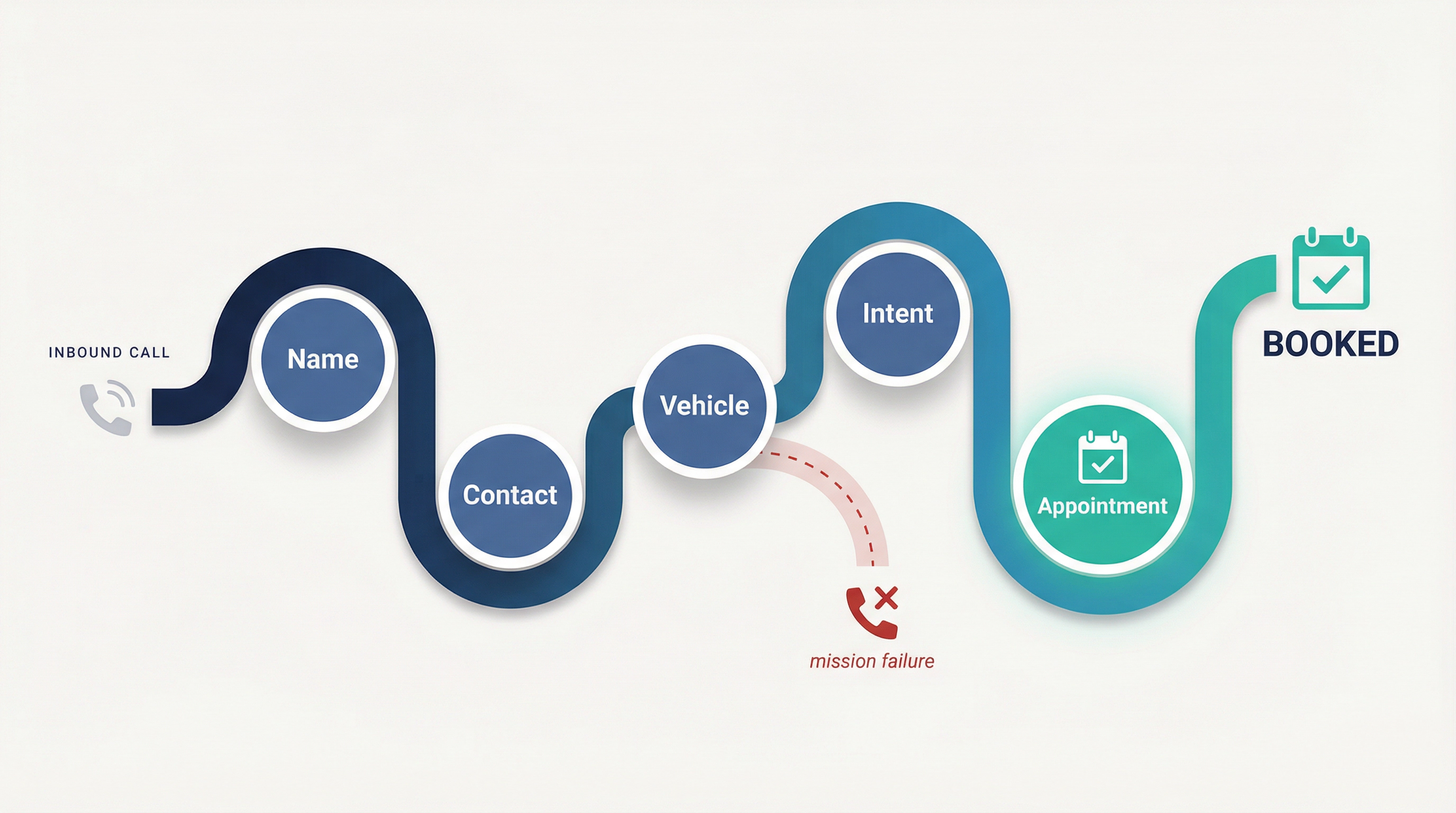
A script is not a monologue. It’s a conversation map with required checkpoints (name, contact, vehicle, intent, appointment offer) and flexible language that keeps you on track without sounding robotic. Pied Piper’s research defines the failure state as “mission failure”: the caller hung up without ever being offered an appointment. That’s what scripts prevent.
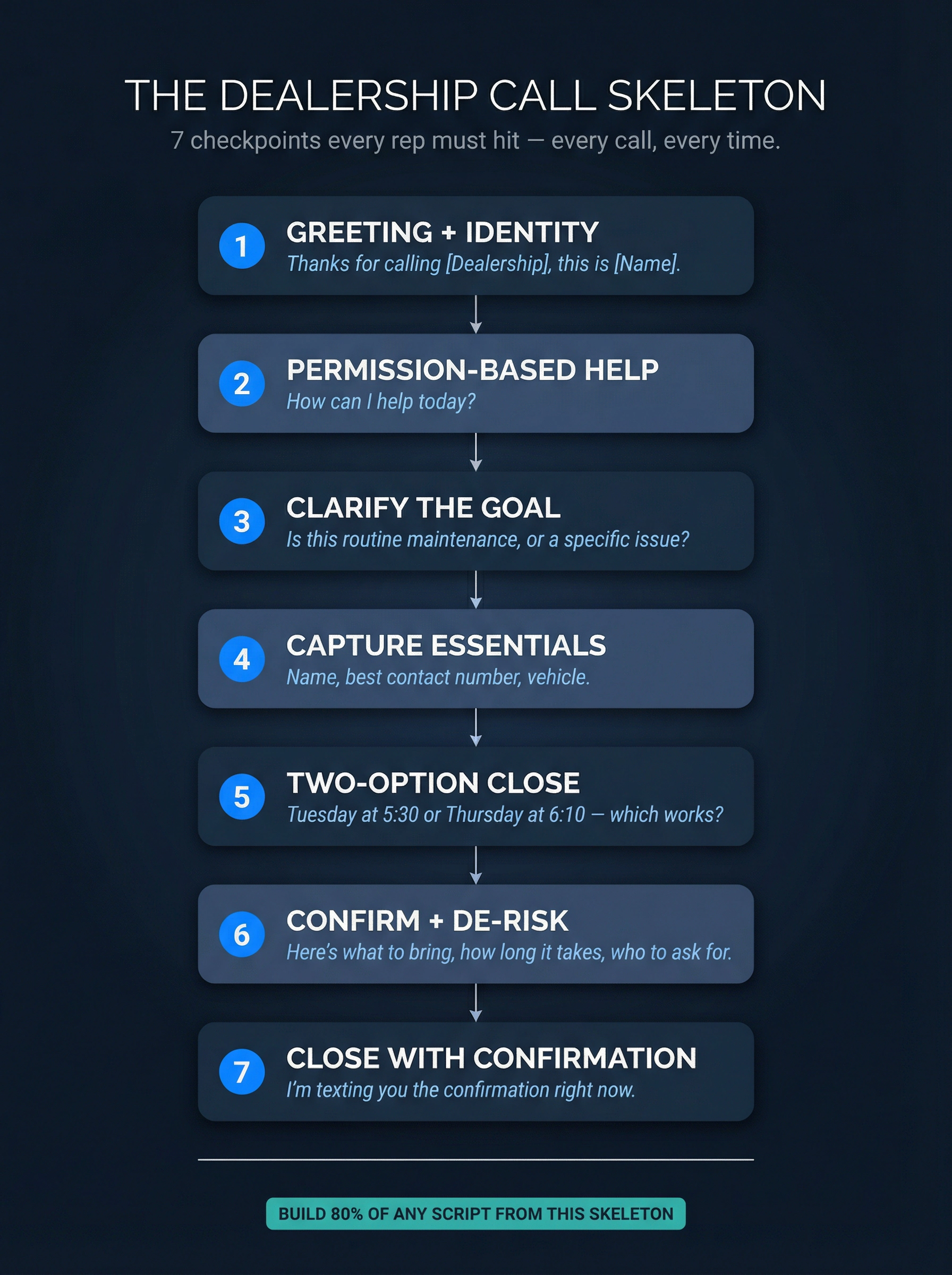
You can build 80% of your scripts from the same skeleton. Whether it’s a service call or a sales call, the structure is the same:
Greeting + identity: fast and confident, never uncertain
Permission-based help: “How can I help today?” beats “What do you need?”
Clarify the goal: one direct question to identify service vs. sales, maintenance vs. diagnostic
Capture essentials while you work: name, best contact number, vehicle
Offer two concrete time slots: not “what works for you?” but “I have Tuesday at 5:30 or Thursday at 6:10. Which one works better?”
Confirm and de-risk: what to bring, how long it takes, loaner availability, who to ask for
Close with confirmation: “I’m going to text you the confirmation right now. Anything else I can help with?”
Every script in this guide runs on this skeleton. Knowing which checkpoints your reps skip is half the battle. Our guide on BDC metrics every dealership should track walks through the numbers that reveal exactly where call quality breaks down.
Six specific moments where word choice matters most.
For name capture (without sounding like you’re filling out a form): “And who do I have the pleasure of helping today?” or “What’s your name, just so I don’t make you repeat yourself?”
For contact capture (framed as value, not paperwork): “What’s the best number to text you the confirmation and directions?” or “In case we get disconnected, what number should I call you right back on?”
For intent clarification (the one question that prevents chaos):
Service: “Is this routine maintenance, or are you noticing a specific issue?”
Sales: “Are you looking for a specific vehicle you saw online, or are you still comparing options?”
For the two-option close: “I can do Tuesday at 5:30 or Thursday at 6:10. Which one works better?”
It turns an open-ended scheduling puzzle into a binary decision. No need to think about the whole week. Just pick one.
For the no-hold fallback: “I can check that. If it takes more than 30 seconds, I’ll call you right back. What’s the best number?”
This beats “can you hold?” every time. The true cost of dealership hold times is something most stores underestimate.
For warm transfer setup: “I’m going to connect you with my service advisor. Before I do, let me quickly summarize so you don’t have to repeat anything.” Then one sentence. Done.
Goal: Book a specific date and time. Non-negotiables: name, phone, vehicle (year/make/model), services needed, transportation preference.

Rep: Thanks for calling [Dealership] Service, this is [Name]. How can I help today?
Customer: I need an oil change.
Rep: Perfect, we can take care of that. And who am I helping today?
Customer: [Name]
Rep: Thanks, [Name]. What’s the best number to text you your appointment confirmation?
Customer: [Phone]
Rep: What vehicle are we servicing? Year, make, and model?
Customer: [Vehicle]
Rep: Got it. For the oil change, are you also due for tire rotation or a multi-point inspection, or are we keeping it simple today?
Customer: [Answer]
Rep: Perfect. I can get you in [Option A] or [Option B]. Which works better?
Customer: [Chooses]
Rep: You’re all set for [Day] at [Time]. Pull up to the service drive and we’ll get you checked in. Do you need a waiting appointment, shuttle, or loaner?
Customer: [Answer]
Rep: Great. I’m texting you the confirmation now. Anything else I can help with while I have you?
If they ask how long it takes: “For most oil change and rotation visits, plan for about [your store’s timing]. If anything unexpected comes up, we’ll call or text before doing anything.”
For stores looking to increase routine visit volume, our guide on how to increase service appointments at dealerships covers script tactics and scheduling infrastructure together.
Goal: Book the right appointment type without diagnosing over the phone. The frame: you’re selling certainty and speed, not technical brilliance.
Rep: Thanks for calling [Dealership] Service, this is [Name]. How can I help?
Customer: My check engine light is on.
Rep: Understood. We can help with that. First, what’s your name?
Customer: [Name]
Rep: Thanks, [Name]. What’s the best number to text your appointment confirmation and reach you if we have questions?
Customer: [Phone]
Rep: What vehicle is it? Year, make, and model?
Customer: [Vehicle]
Rep: Quick question so we schedule you correctly: Is the vehicle driving normally, or is it running rough, flashing the light, or losing power?
Customer: [Answer]
Rep: Got it. The best next step is to get you in for a diagnostic so we can pinpoint it quickly. I have [Option A] or [Option B]. Which works better?
Customer: [Chooses]
Rep: Perfect, [Day] at [Time]. If the light starts flashing or it feels unsafe to drive, don’t push it. Call us back and we’ll talk next steps. I’ll text you the confirmation right now.
This triage-and-book flow is exactly where AI in dealership service departments runs consistently, even when your advisors are tied up in the lane.
Goal: Book the recall and bundle additional services where appropriate.
Rep: Thanks for calling [Dealership] Service, this is [Name]. How can I help today?
Customer: I got a recall notice.
Rep: Got it. We can take care of that. What’s your name?
Customer: [Name]
Rep: Thanks, [Name]. Best number for your confirmation text?
Customer: [Phone]
Rep: Do you have the VIN handy, or should we look it up by license plate or last name?
Customer: [Provides info]
Rep: Perfect. Let me confirm the recall details. [Confirm.] I have availability [Option A] or [Option B]. Which works better?
Customer: [Chooses]
Rep: You’re set. I’ll text the confirmation. While I have you: are there any other concerns you’d like us to check while the car is here?
Recall customers are already committed to coming in, and many will add “since I’m there anyway” services. Asking the question is a service, not a pitch. Our guide on dealership recall campaigns and AI covers outbound outreach so you’re not always waiting for the customer to call first.
Goal: Convert a price question into an inspection appointment. The core insight: they want certainty, not trivia. A price without a diagnosis is a trap for everyone.
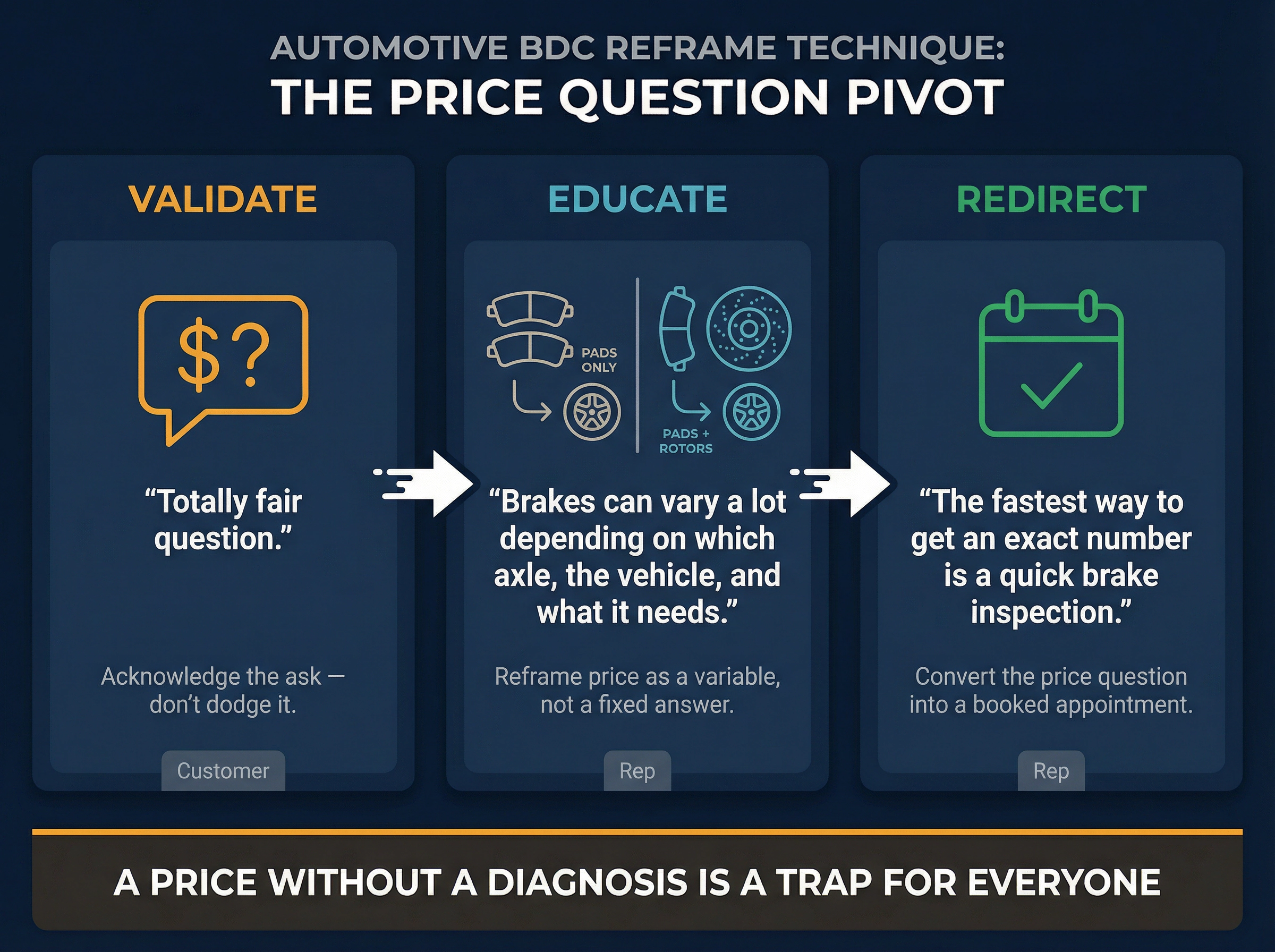
Customer: How much is it to replace brakes?
Rep: Totally fair question. Brakes can vary a lot depending on which axle, the vehicle, and whether it’s pads only or pads and rotors. If you tell me your year, make, and model, I can give you a ballpark. The fastest way to get an exact number is a quick brake inspection. What vehicle do you have?
Customer: [Vehicle]
Rep: For that vehicle, you’re usually looking at [range] per axle. Would you like to come in for a quick inspection so we can confirm exactly what it needs and give you a firm quote?
Customer: [Yes/Maybe]
Rep: I can do [Option A] or [Option B]. Which works better?
If they still won’t commit: “No problem. I can text you that range and our earliest inspection times so you have it when you’re ready.” You still get the contact and a reason to follow up.
Goal: Save the relationship even when you can’t deliver the appointment they want.
Customer: Can you get me in today?
Rep: I’ll do my best. What’s going on with the vehicle?
Customer: [Issue]
Rep: Got it. And what’s your name?
Customer: [Name]
Rep: If we can’t do today, what’s your earliest acceptable time? Tomorrow morning, tomorrow afternoon, or later this week?
Customer: [Preference]
Rep: Here’s what I can do: I have [soonest realistic option] or [next option]. Which works better? If it becomes unsafe to drive before then, call me back and we’ll talk tow-in options.
The customer is stressed. Match their urgency, redirect it toward a specific solution. When volume spikes, automating routine service scheduling frees your human team for urgent situations like this one.

Goal: Resolve quickly. Do not bounce them between departments.
Rep: Thanks for calling [Dealership] Service, this is [Name]. How can I help?
Customer: I’m checking if my car is ready.
Rep: Absolutely. What’s the name on the repair order?
Customer: [Name]
Rep: Thanks. Do you have the RO number, or the best phone number on the account?
Customer: [Info]
Rep: I’m pulling that up now. [Check.] Here’s what I see: [status in plain English]. Your advisor is [Name]. The next update should be by [timeframe]. Do you want me to have [advisor] text you as soon as it’s ready, or would you prefer a call?
Status calls are a significant share of daily volume. Handling them fast and clearly has a direct effect on CSI scores.
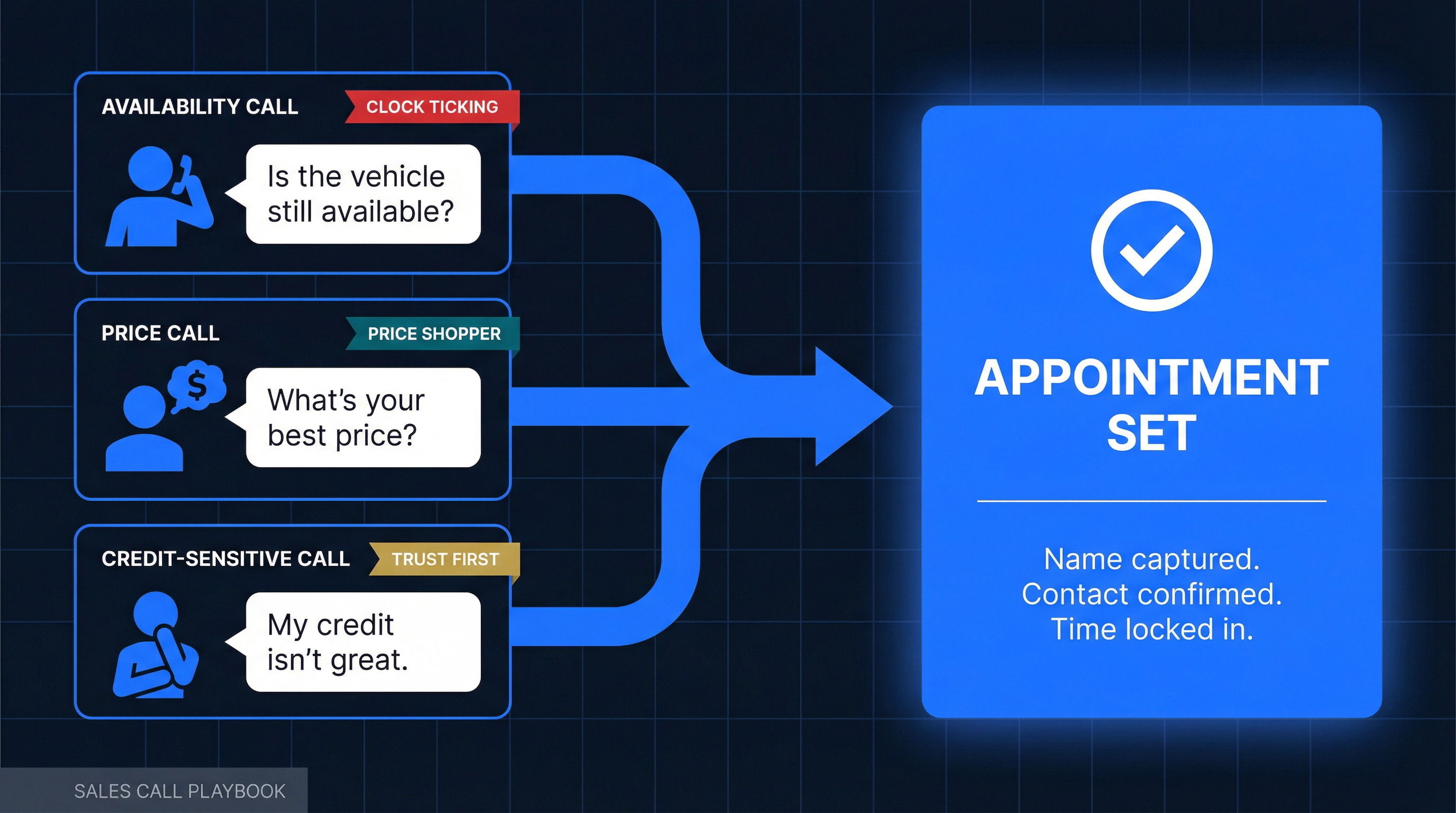
Goal: Confirm availability, then set the appointment before they call the next store. The clock starts the moment they ask the question.
Rep: Thanks for calling [Dealership], this is [Name]. How can I help?
Customer: Is the [Vehicle] still available?
Rep: I can help with that. Just so I’m looking at the exact one: is it [color/trim] and did you see it online?
Customer: [Yes/No]
Rep: And who am I helping today?
Customer: [Name]
Rep: Thanks, [Name]. Best number to text you the link and confirm availability?
Customer: [Phone]
Rep: Give me one second to confirm it’s here and not already being shown. [Confirm.] Good news, it’s available right now. The easiest next step is to reserve a time for you to see it and take a quick drive. I have [Option A] or [Option B]. Which works better?
Customer: [Chooses]
Rep: Perfect. I’ll text you the address and your appointment time. Quick question: are you planning to trade anything in, or is this a straight purchase?
Appointment before trade question. Run a long qualification interview first and you lose momentum. Commit them to the visit, then gather details. For follow-up after the call, how AI follow-up closes more sales leads shows the compounding impact of consistent outreach.
Goal: Move from “best price” to “best next step” without dodging or frustrating them.
Customer: What’s your best price on the [Vehicle]?
Rep: Totally fair. The best price depends on the exact vehicle and whether there are any incentives you qualify for. If you tell me the trim or stock number you’re looking at, I’ll make sure we’re talking about the same one and I can text you a detailed out-the-door quote. First, what’s your name?
Customer: [Name]
Rep: Thanks, [Name]. Best number to text the quote to?
Customer: [Phone]
Rep: Are you looking at [trim/stock], and are you planning to trade anything in?
Customer: [Answer]
Rep: Great. Two ways we can do this fast: I can text you an out-the-door quote once I confirm the exact unit and incentives, or if you’re close by, I can set a 20-minute visit so you can drive it and we finalize numbers in one shot. What’s easier, coming in [Option A] or [Option B]?
This avoids two classic mistakes: refusing to discuss numbers at all, and quoting something vague that blows up later.
Goal: Keep their dignity intact, reduce fear, and route them to the right team.
Customer: I’m interested but my credit isn’t great.
Rep: Thanks for being upfront. You’re not alone, and we work with customers in all kinds of situations. The fastest path is a quick conversation with our finance team and picking the right vehicle. What’s your name?
Customer: [Name]
Rep: Thanks, [Name]. Best number to reach you?
Customer: [Phone]
Rep: Are you looking for a specific vehicle type, and do you have a trade?
Customer: [Answer]
Rep: Perfect. Let me set you a time to come in and we’ll build a plan around what you’re comfortable with. I have [Option A] or [Option B]. Which works better?
Call back in minutes, not hours.
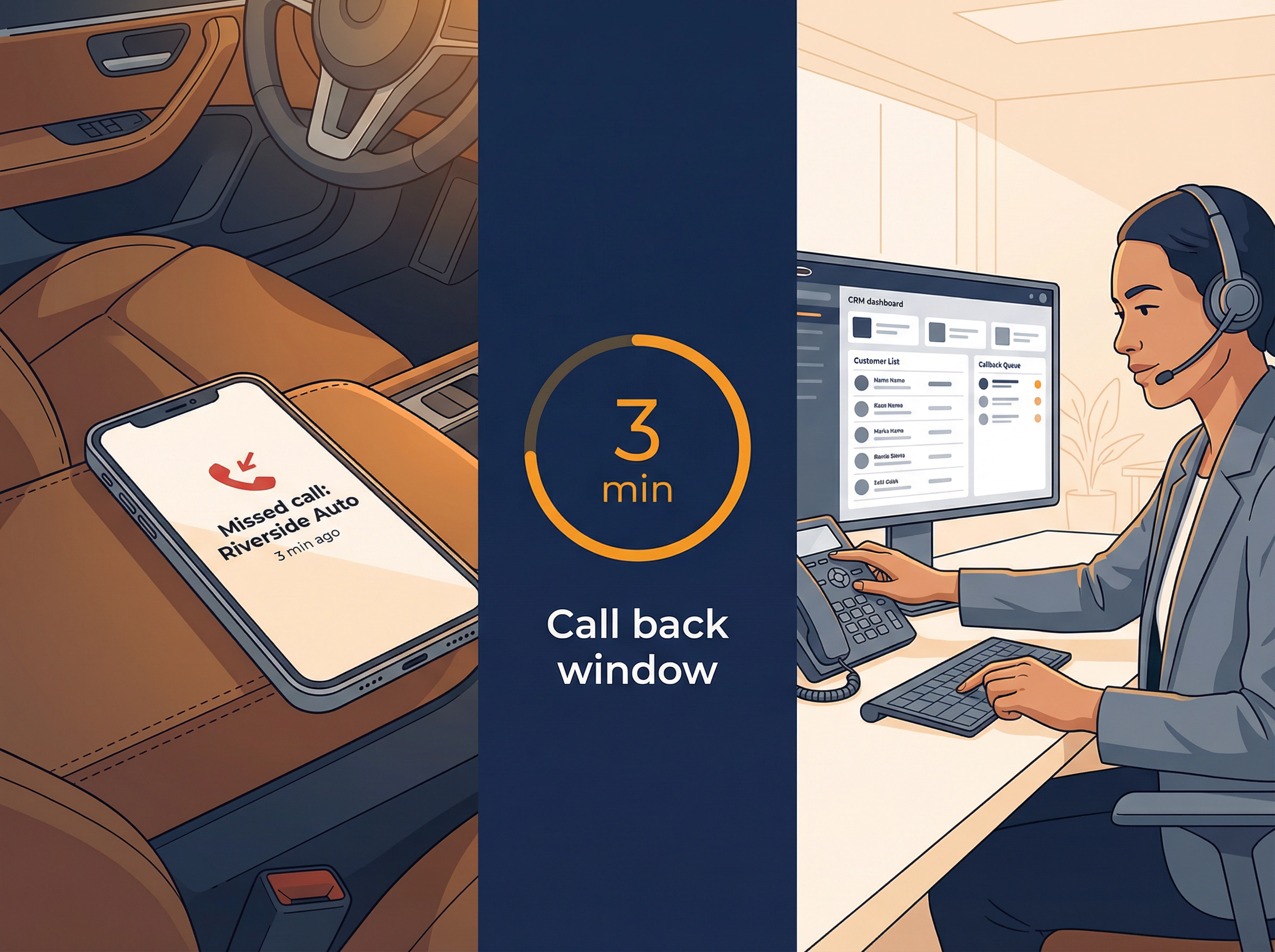
Rep: Hi [Name], this is [Name] from [Dealership]. You called a few minutes ago and I didn’t want you to have to chase us. How can I help you today?
Then route directly into the correct inbound script.
The speed of the callback matters. Our research on why dealership voicemails kill sales documents why voicemail is a direct competitor referral in disguise, and what to do instead.
Rep: Hi [Name], this is [Name] from [Dealership] Service. I’m calling because our system shows your vehicle may have an open recall. It’s usually a quick visit, and I can help you schedule it now. Would you prefer [Option A] or [Option B]?
Hi [Name], this is [Name] at [Dealership]. I’m calling about the [Vehicle] you asked about. Good news, I have an update for you. Call me at [number], or just reply to my text and I’ll help you lock in a time to see it. Again, [Name] at [Dealership], [number].
Hi [Name], this is [Name] from [Dealership] Service returning your call. I can get you scheduled quickly. Call me at [number], or reply to the text I’m sending now with your preferred day and time.
Understanding when dealerships get the most calls helps you focus outbound cadence around windows where inbound demand is highest.
-> “I don’t want to give my number.”
“No problem. The only reason I ask is so I can text you the confirmation and you don’t have to remember anything. What’s the best number?”
If they still decline: “Totally fine. Let’s still get you a time. If anything changes, just call us back.” You’ve kept the appointment path open. Don’t make it a confrontation over contact info.
-> “I’m just calling around.”
“Makes sense. Most people do. The fastest way to compare is to lock a time so you can actually see it and get real numbers. I have [A] or [B]. Which works better?”
-> “I’ll call back.”
“Absolutely. Before you go, what’s the one thing you want to be sure about so I can have it ready when you call back?”
That question converts “I’ll call back” from a soft exit into a next step with a real objection you can address.
-> “Do you have anything earlier?”
“The earliest I can guarantee is [time]. If something opens up sooner, do you want me to text you?”
A lot of scheduling pushback traces back to prior hold-time experiences at other stores. Our analysis of the true cost of dealership hold times shows how much of that resistance disappears when your team picks up quickly and moves efficiently.

Score every call from 0 to 2 on each dimension:
[Table 1]
0 = missed, 1 = partial, 2 = nailed it. A perfect call is 20 points.
This works as a coaching tool because you can be precise. “You scored 0 on the two-option close. You asked ‘what time works for you?’ instead of giving two options.” That’s useful feedback. “Try harder” is not.
Your scorecard data should feed into the BDC metrics your dealership should be tracking week over week. A trend in a specific dimension signals a training issue you can address before it shows up in appointment rates.
Call quality is also one of the most controllable variables for CSI scores. Customers who felt heard and efficiently handled are significantly more likely to rate the experience highly.
Most dealership scripts fail for a predictable reason: they were written for a perfect caller. Real callers interrupt, ask three questions at once, are driving, are annoyed, or want something you can’t do today. Building scripts that survive real conversations requires thinking like a product team, not a training coordinator.
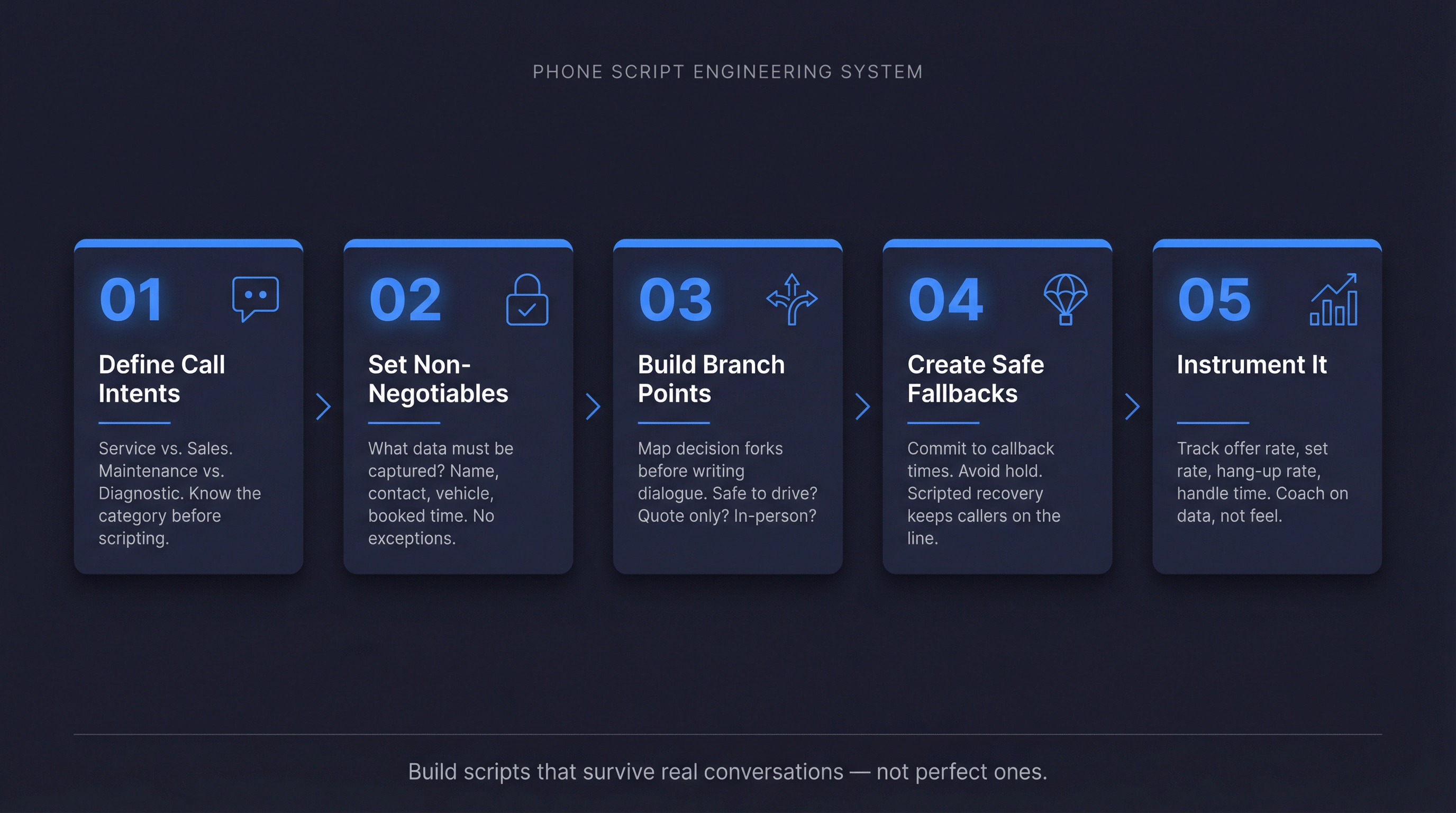
(1) Define your call intents. Service: routine maintenance, diagnostic, recall, status check, pricing, tow/emergency, warranty. Sales: availability, pricing, trade-in, test drive, credit/finance, internet lead callback. Every script starts with knowing which category you’re in.
(2) Set non-negotiables for each intent. What data, if missing, means the call failed? For a diagnostic call, that’s name, contact, vehicle, and a booked date/time. If you ended the call without those, the interaction wasn’t finished.
(3) Build branch points. A diagnostic call branches at “is it safe to drive?” A pricing call branches at “open to coming in, or do they want a quote only?” Map branches before scripting dialogue. Otherwise the script won’t survive real conversations.
(4) Create safe fallbacks. If you need to check something, commit to a callback time. “I can have that for you in five minutes. What’s the best number?” beats “Can I put you on hold?” Our breakdown of call overflow solutions for dealerships covers how to handle volume spikes that make fallback scripts essential.
(5) Instrument it. Track: appointment-offered rate, appointment-set rate, transfer rate, hang-up rate, and average handle time by outcome (booked vs. not). Without these numbers you’re coaching on feel. With them, you can see exactly where calls break down.
Everything covered above assumes a trained, script-following human is available to answer the phone. That assumption breaks in predictable ways. After 7pm when the last BDC rep clocked out. Monday morning between 10am and noon when three calls arrive simultaneously and two go to hold. Saturday when your service advisor is juggling a full bay and a lobby. Our research on missed calls walks through exactly where dealerships lose calls and why the pattern repeats.
Scripts solve the quality problem. Coverage solves the availability problem. You need both.
That’s where Flai comes in. We built an AI communications platform specifically for car dealerships, built from the ground up around dealership workflows, call types, and integration requirements. When a call comes in, Flai answers instantly, runs the same script logic your best reps use, and books directly into your scheduler, DMS, and CRM in real time.

Pied Piper’s 2025 research on AI phone handling found that AI handled 91% of service calls successfully, with an 86% appointment scheduling success rate (compared to 90% for human-handled calls). That 4-point gap is worth acknowledging: AI isn’t identical to your best human rep. But it’s available at 11pm on a Sunday when your best human rep is not.
The piece Pied Piper flags as the biggest risk is transfer failure. 56% of the time, when AI couldn’t handle a call and tried to hand off to a human, that handoff failed. Flai addresses this specifically with warm transfer protocols that include a context summary before the human picks up, so the customer doesn’t have to explain themselves again. That one piece of process engineering changes the experience entirely.
The results across our dealerships make the ROI concrete:
[Table 2]
The math across all three: roughly $260-$270 in profit per incremental appointment booked.

At that number, even a modest increase in call capture pays for the system quickly. The consistency compounds over time. You can see the full breakdowns in our Flai case studies section.
For dealer groups running five or more rooftops, Flai enforces the same conversation quality, checkpoints, and booking logic across every store, every shift, every language. That standardization without management overhead is often the biggest benefit for fixed-ops directors managing multi-location groups. For the full picture, our AI for car dealerships guide (2026) covers it in depth.
If you want to see how Flai works in practice before committing, you can book a demo and walk through a live scenario with a real dealership workflow.
A booked appointment that isn’t confirmed properly isn’t really booked. Pied Piper’s 2025 SSE study found that fewer than half of customers received both an email and text confirmation for online scheduling requests, and confirmation texts were sent only 48% of the time on average. The lesson generalizes across all appointment channels: if you booked and didn’t confirm, you’ve created a show-rate problem.
The confirmation text should be immediate, specific, and include everything the customer needs to show up without calling back.
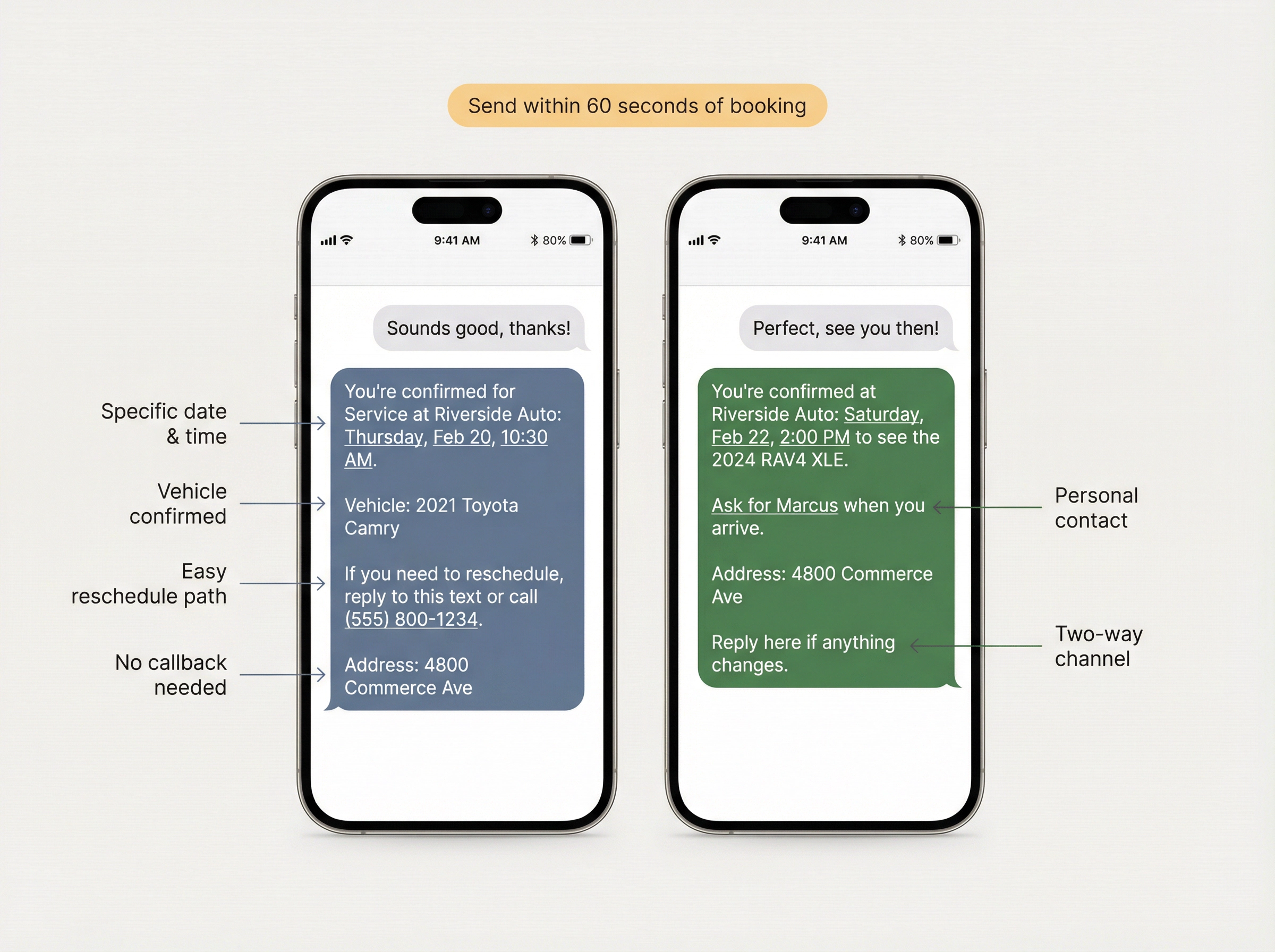
Service confirmation:
You’re confirmed for Service at [Dealership]: [Day], [Time]. Vehicle: [Year Make Model] If you need to reschedule, reply to this text or call [number]. Address: [address]
Sales confirmation:
You’re confirmed at [Dealership]: [Day], [Time] to see the [Vehicle]. Ask for [Name] when you arrive. Address: [address] Reply here if anything changes.
Send it within 60 seconds of booking. If a reminder 24 hours out is in your process, send that too. Show rates respond to confirmations. It’s one of the easiest wins in the scheduling pipeline.
For how confirmations fit into a broader AI-driven reception workflow, our overview of virtual receptionist solutions for car dealerships walks through the full picture.
If you’re recording calls, using AI voice agents, or sending automated text follow-ups, there are rules worth knowing.

The FCC has clarified that TCPA restrictions on “artificial or prerecorded voice” apply to AI-generated voices in robocalls. An update effective April 11, 2025 also changed consent revocation rules, per the Federal Register.
Practical guidance, not legal advice: if you text, make opt-out easy. If you record, disclose in a way that fits your state’s rules (some require two-party consent). Run your practices by counsel. The regulations move fast.
How long should a car dealership phone call typically last?
Routine service bookings run two to four minutes with a solid script. Diagnostic calls run four to six minutes. Sales calls vary from three minutes (quick availability check and appointment) to ten or more for customers weighing multiple options. The goal is efficiency without skipping the checkpoints that make appointments stick.
What’s the best way to handle a caller who refuses to give their phone number?
Frame the ask as a service: “The only reason I ask is so I can text you the confirmation and you don’t have to remember anything.” Most people who resist are just suspicious of how it’ll be used. If they still decline, don’t fight it. Keep the appointment path open: “Totally fine. Let’s still get you a time. Just call us back if anything changes.” You’ve kept them engaged without making contact info the battleground.
Should we use AI to handle dealership phone calls, or stick with humans?
Both. Pied Piper’s 2025 research puts AI appointment scheduling success at 86% vs 90% for trained humans. AI handles 91% of service calls successfully overall. The practical split: AI for after-hours, peak overflow, and routine calls; humans for calls that need judgment, empathy, or negotiation. The transfer protocol matters: a warm handoff with context is very different from a cold drop. Our AI voice agents for dealerships buyers guide gives a framework for evaluating which calls belong where.
How do I measure whether our phone scripts are working?
Four numbers: appointment-offered rate (what % of relevant calls included an offer?), appointment-set rate (of those offered, how many accepted?), show rate (of those set, how many showed up?), and transfer rate. Run these weekly, broken down by rep and call type. A drop in appointment-offered rate is usually a training issue. A drop in show rate usually means confirmations are inconsistent.
What’s a realistic appointment-set rate for a trained phone rep?
Pied Piper’s research puts top performers at around 90% for service scheduling. Most stores land between 65-80% depending on call type and rep experience. Price-shopper and same-day calls naturally run lower than routine maintenance. The gap between your current rate and 80%+ is usually one or two specific script breakdowns you can pinpoint with the QA scorecard.
How do after-hours calls fit into a phone script system?
After-hours calls are the most underserved category. 56-60% of dealership leads arrive after business hours, and roughly 70% of people who hit voicemail call a competitor within 30 minutes. Your script system needs a clear answer for calls at 8pm on a Friday: a human answering service, an AI platform, or voicemail (which the data treats as a competitor referral). For dealer groups, after-hours AI coverage is often the fastest ROI improvement available. Read why dealerships replace outsourced call centers with AI for the economics and quality comparison.
Stats and regulatory references in this guide are based on sources published in 2024 and 2025. If you’re operationalizing compliance rules around TCPA, call recording, or consent, verify with counsel. Enforcement and interpretations change.
As seen in