

Privacy Policy
Terms of Service
Blogs & Guides
Copy-ready BDC automotive scripts for every call type, plus SMS and email templates. Built around the 7-block system that converts phone leads at 75%.
March 5, 2026
If you’re searching for BDC automotive scripts, you probably don’t just want “a script.” You want a system that gets more appointments booked, fewer callers lost to hold or voicemail, and a consistent customer experience across your entire team, including nights, weekends, and the Thursday afternoon rush when half your staff is at lunch.
That’s what this guide delivers. We built it as a field manual and script vault: ready-to-use scripts you can copy and customize today, plus the reasoning behind each one so your reps understand the why and can adapt on the fly. Every script covers phone, SMS, and email because in 2026, single-channel BDCs are leaving money on the table. If you’re still getting up to speed on what a BDC actually does in a car dealership, start there first.
We’ve organized it so you can skip straight to the scripts you need, or read the whole thing to understand the system behind them. Either way, you’ll walk away with something you can put to work this week.
Two numbers tell the whole story.
Industry benchmarks through April 2025 found that phone leads set appointments at roughly 75%, compared to about 40% for internet leads. That gap is enormous. If your phone conversations are sloppy or inconsistent, you’re burning your highest-converting lead source.
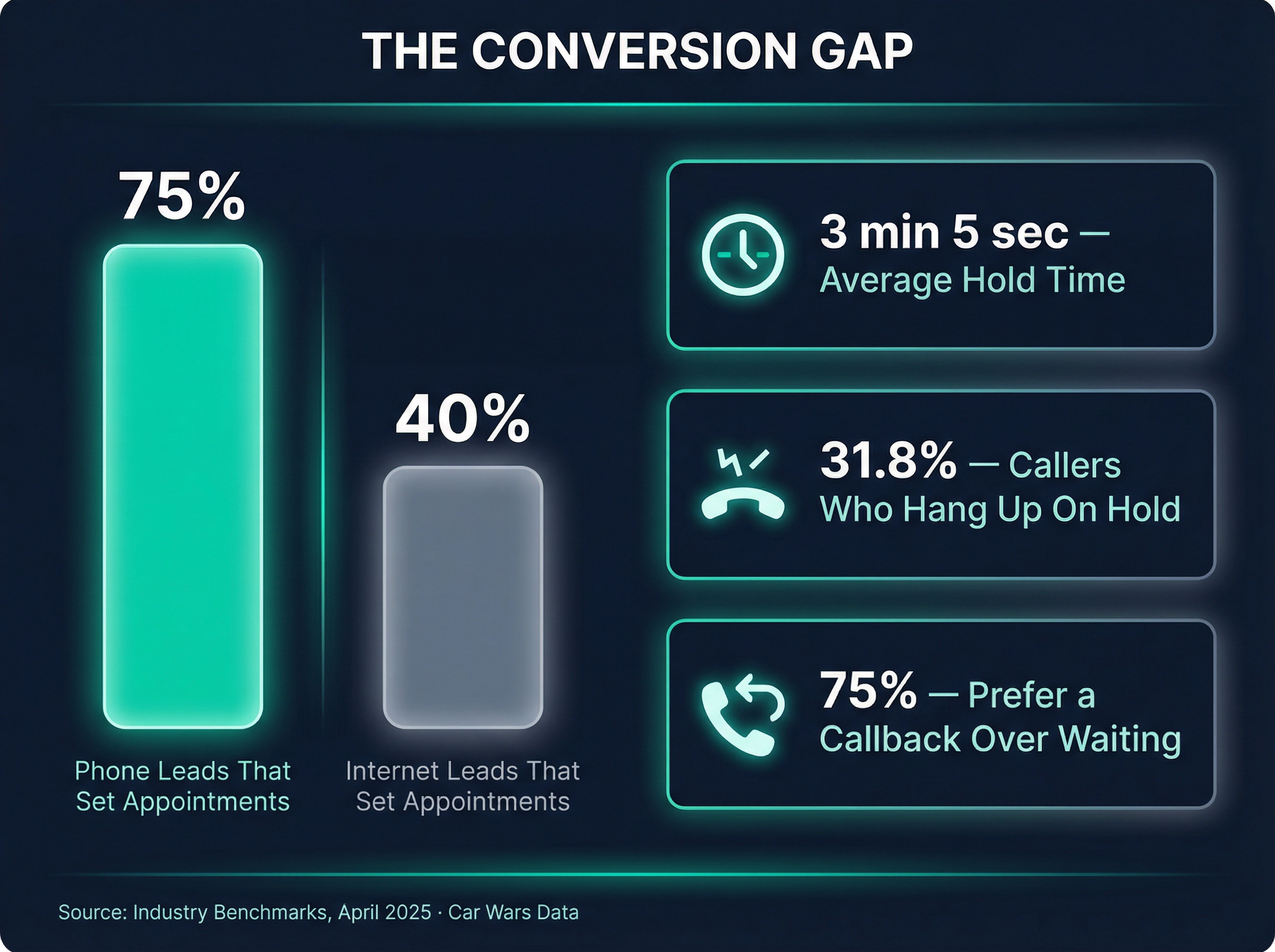
The problem is that customers won’t wait for you to get it right. Car Wars data summarized on the Flai blog shows the average hold time sits around 3 minutes and 5 seconds, and 31.8% of unconnected calls are customers who just hang up while on hold. Research backs this up: 75% of callers say they’d prefer a callback rather than waiting on hold. So every second your team fumbles through an unstructured call, you’re pushing revenue out the door. In fact, those hold minutes add up to a staggering cost that most GMs underestimate.
And it’s not just phone anymore. The 2026 Pied Piper Internet Lead Effectiveness study found that dealers used texting to answer the customer’s question 54% of the time (up from 38% the year before), and 62% of dealers now use both channels, answering via email or text and calling. If your BDC automotive scripts are phone-only, you’re fighting the current. The playbook below covers all three channels.
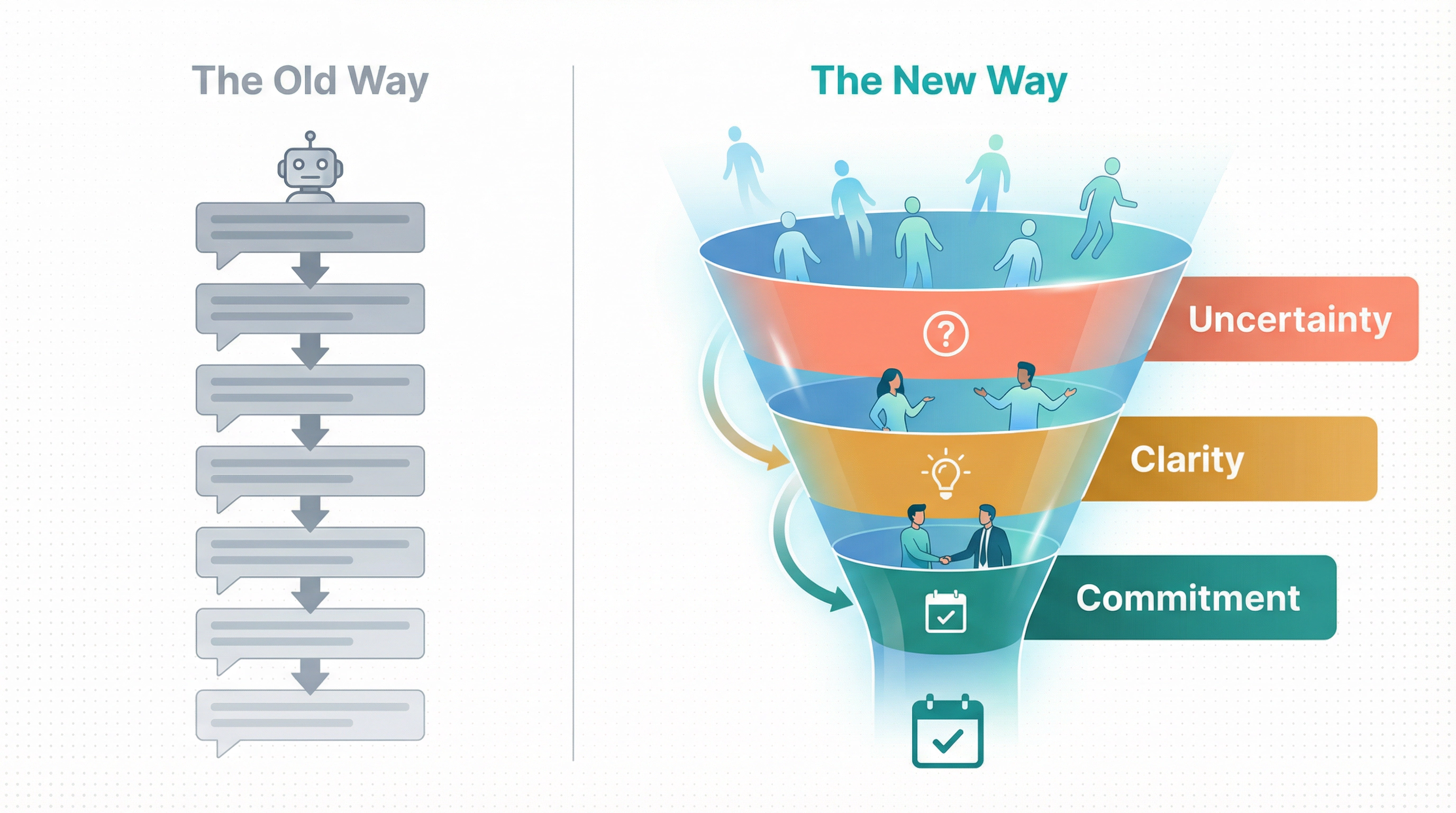
Most dealership scripts fail for one reason: they’re written like a play. Memorize these lines, say them in order, pray it works. Real calls don’t follow a script. They follow a decision funnel.
Every BDC conversation, whether it’s sales or service, is trying to move the customer through three stages:
Uncertainty > Clarity > Commitment
Your script isn’t “what to say.” It’s a path that reliably produces a commitment (an appointment, a scheduled RO, a confirmed next step). Once your team understands this, they stop sounding robotic and start sounding helpful.
1. The goal is a commitment, not a good conversation. In sales, that’s an appointment (test drive, appraisal, delivery). In service, it’s an RO appointment (drop-off or wait, with time and transportation plan). Everything you say should increase trust, reduce friction, or move toward that commitment. Tracking the right BDC metrics tells you whether your scripts are actually producing those commitments.
2. Ask permission before you interrogate. Customers hate being “qualified.” They like being helped. Instead of “What’s your phone number? Email? Address?” try: “So I can send you the exact details and hold the time, what’s the best number to reach you?”
3. Capture contact info early, but earn it. Calls drop. You need their number for follow-up and confirmation texts. But give a reason first (“So I can text you the confirmation and not lose you if we get disconnected…”).
4. Use the two-option close. Humans freeze on open-ended decisions (“When do you want to come in?”). They respond to simple choices: “Would 5:15 today or 10:40 tomorrow work better?”
5. Answer the question without getting trapped in it. Price shoppers and service quote calls become traps if you treat them like a spreadsheet request. The script should answer enough to feel honest, add context about what changes the price, and convert to an appointment.
6. Confirm like an airline. Repeat back the essentials: date, time, vehicle, location, what to bring, and the next step (text or email confirmation).
7. Text is your receipt. If it’s not confirmed in writing, it’s not real. The 2026 Pied Piper study confirms texting is now a primary response path, so treat SMS like the receipt after a purchase.
Think LEGO, not monolith. Instead of memorizing entire scripts, train your team on these modular blocks. They snap together for any call type.
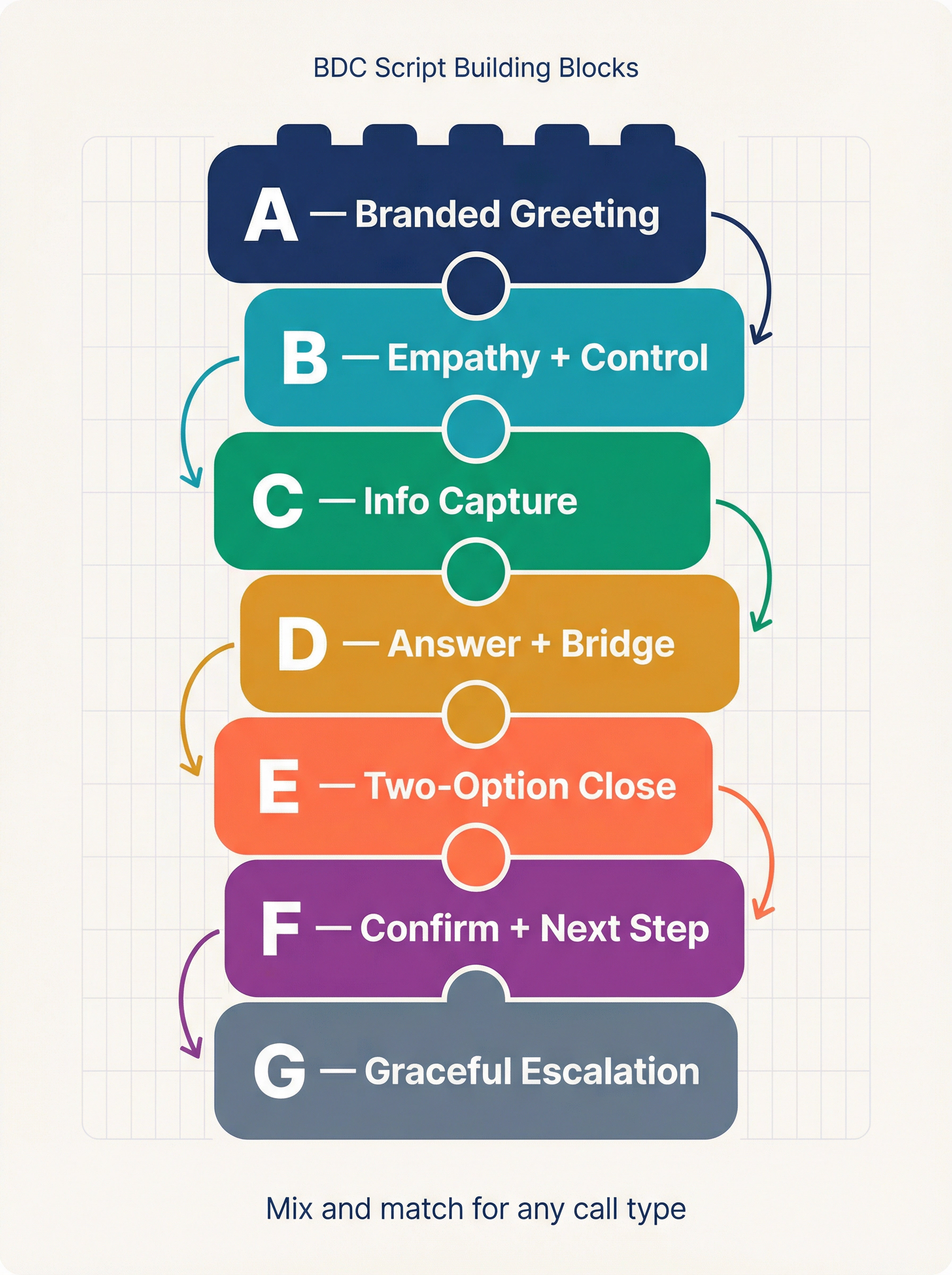
Block A: Branded Greeting confirms the customer reached the right place and sets the tone. Strong, branded greetings matter more than most teams realize, and one-word greetings like “Sales” immediately signal a lack of professionalism.
“Thanks for calling [Dealership Name], this is [Name]. How can I help today?”
Block B: Quick Empathy + Control takes the conversation from the customer’s question to your structured process.
“Totally, I can help with that. Quick question so I get you the right answer…”
Block C: Permission-Based Info Capture earns the right to collect contact details by giving a reason.
“So I can text you the details and not lose you if we get disconnected, what’s the best number?”
Block D: Answer + Bridge handles their question honestly, then pivots to the appointment.
“Yes, it’s available right now. These move fast, so the best way to make sure you don’t waste a trip is to set a time and I’ll have it pulled up front.”
Block E: Two-Option Close gives the customer a simple decision instead of an open-ended question.
“Would today at 4:50 or tomorrow at 11:10 work better?”
Block F: Confirm + Next Step locks in the appointment and sets expectations.
“Perfect. I’ve got you for tomorrow at 11:10. I’ll text you a confirmation and a quick link to directions. Who should I put this under?”
Block G: Graceful Escalation routes the customer when you can’t answer directly.
“I want to make sure you get the most accurate answer. I can bring in [Advisor/Manager] right now, or if they’re with a customer, I can have them call you back within [time]. Which do you prefer?”
Your reps learn these seven blocks, then combine them into full calls. That’s how you get consistency without the robotic feel.
These scripts use the blocks above. They’re written to sound natural, prioritize the appointment, and handle the real-world situations your team faces every day. Use placeholders like [Vehicle], [Time], [Rep Name].
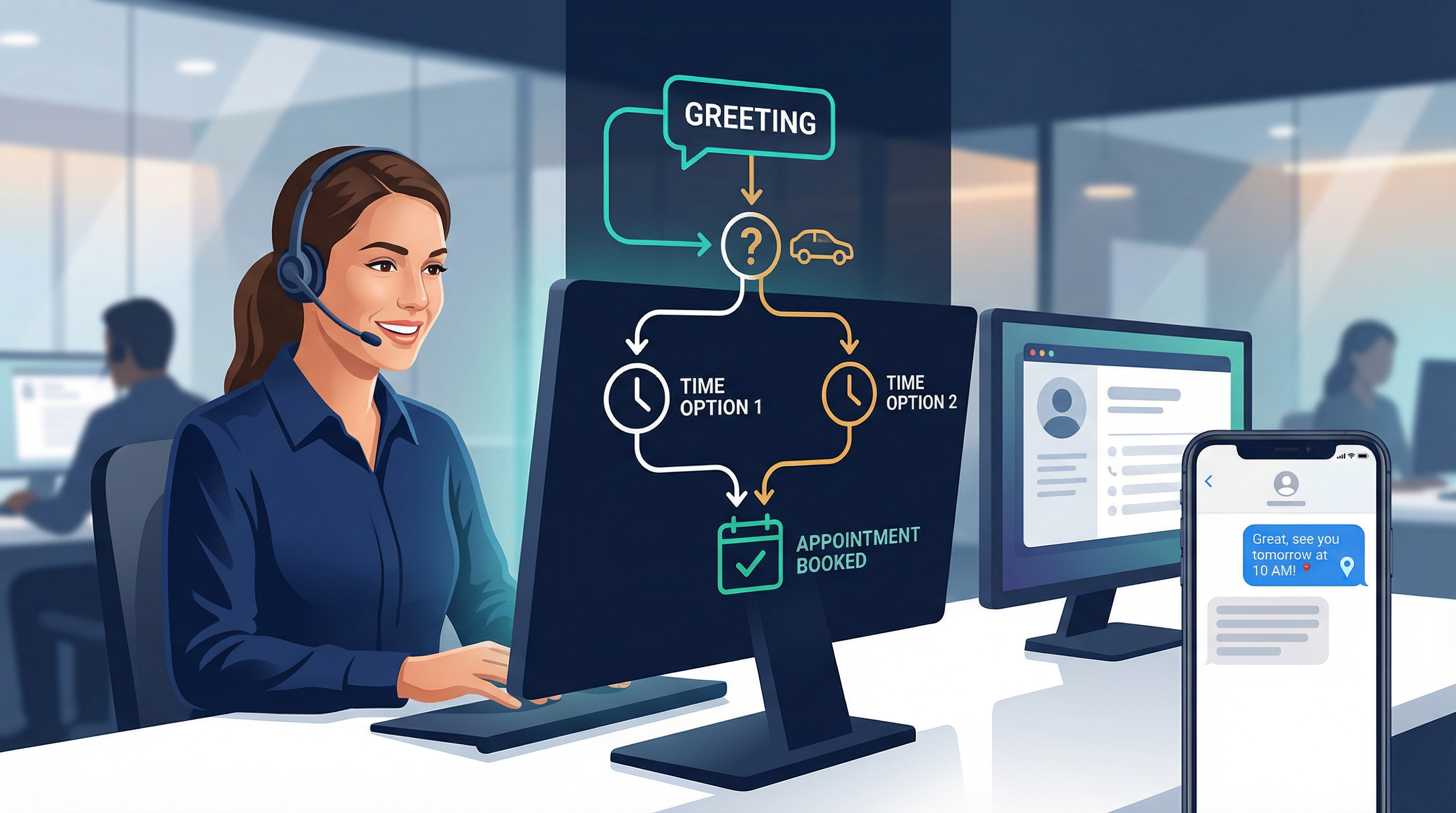
This is your highest-leverage sales call. The customer is really asking: “Can I trust your website, and can you save me time?”
REP: Thanks for calling [Dealership Name], this is [Name]. How can I help today?

CUSTOMER: Is the [Year Make Model] still available?

REP: Yes, it's available right now. Quick question so I make this easy:
are you hoping to come by today, or is tomorrow better?

[If they answer, go straight to two-option close]

REP: Perfect. I can do [Time Option 1] or [Time Option 2]. Which works better?

CUSTOMER: [Chooses time]

REP: Great. I'll have it ready for you. So I can text you the confirmation
and directions, what's the best number?

CUSTOMER: [Gives number]

REP: Awesome. And what name should I put this under?

CUSTOMER: [Name]

REP: Perfect, [Name]. You'll get a text from me in just a second.
When you arrive, ask for [Name] and we'll get you straight to the vehicle.
If they push for details immediately, use the Answer + Bridge block: “Yes, it’s still here. The fastest way to confirm it fits what you want is a quick 10-minute look and drive. Would today at 5:10 or tomorrow at 11:30 work better?”
The customer is really asking: “Can you give me certainty without me getting played?”
REP: Thanks for calling [Dealership Name], this is [Name]. How can I help?

CUSTOMER: What's your best price on the [Vehicle]?

REP: Totally fair question. Pricing depends on a couple quick things
like taxes in your zip code, trade-in, and whether you're financing
or paying cash. I can give you a clean estimate and make sure it
matches what you'll actually see in-store.

Quick question: are you local in [City/Zip]?

[They answer]

REP: Great. And do you have a trade-in?

[Yes/No]

REP: Got it. Here's what I can do right now:
1) I'll give you a baseline price range over the phone so you're not guessing.
2) Then we set a quick appointment so you can confirm the exact numbers
   and drive it.

Would [Time Option 1] or [Time Option 2] work better?
The 2025 DAS lead response study found that many dealers fail to include pricing and payment details in their responses. The fix isn’t to dump everything over the phone. It’s to be meaningfully helpful, fast, and then convert to an in-person appointment where the numbers get real.
Speed matters here, but gaps remain. That same DAS study found 61% of dealers responded within 15 minutes, while 19% took over an hour and 4% never responded at all. AI-powered follow-up can close that gap by ensuring every lead gets a response within seconds, not minutes.
REP: Hi [Name], this is [Rep] at [Dealership]. You just reached out
about the [Vehicle]. Do you have 30 seconds so I can answer your
question and save you time?

[If yes]

REP: Perfect. Two quick things:
1) Is the [Vehicle] the one you're focused on, or are you open
   to similar options?
2) Are you trying to come in today or tomorrow?

[Then two-option close]

REP: Great. I can do [Time 1] or [Time 2]. Which works better?
If they don’t answer, leave a tight voicemail (“Hi [Name], this is [Rep] at [Dealership]. You reached out about the [Vehicle]. It’s available right now. Call me at [Number], or I’ll text you the details.”) and immediately send the SMS template from the next section. Leaving voicemails that don’t convert is one of the biggest revenue killers in dealership sales.
REP: Hey [Name], it's [Rep] at [Dealership]. Everything okay?
We had you down for [Time] to see the [Vehicle], and I just wanted
to make sure you're taken care of.

If today got busy, no problem at all.
Do you want to reschedule for [Option 1] or [Option 2]?
Service calls feel different, but the physics are the same. Customers want certainty, they want to avoid waiting, and they want a plan (time, transportation, cost expectations). You’re often doing this while your advisors are completely slammed, which makes a consistent script even more important. If your service department is still losing appointments to missed calls, scripts are only half the fix; you also need reliable coverage.
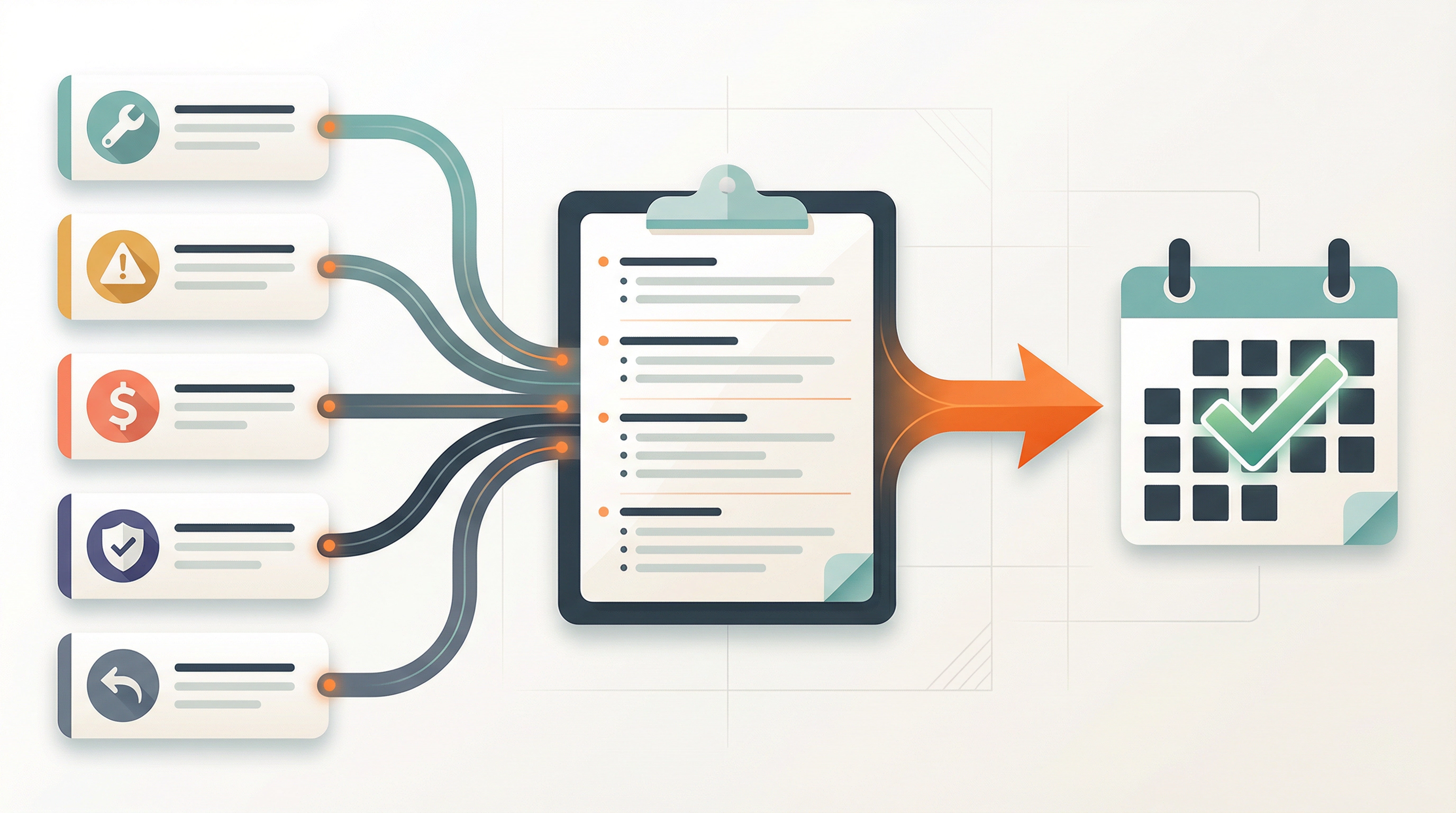
REP: Thanks for calling [Dealership Service], this is [Name].
How can I help today?

CUSTOMER: I need an oil change / maintenance.

REP: Perfect, we can take care of that. Quick question so I book
the right appointment: is it a wait appointment, or do you want
to drop it off?

[Wait/Drop]

REP: Got it. And what vehicle is it? [Year Make Model]

REP: Great. I have [Time Option 1] or [Time Option 2].
Which works better?

[Confirm contact info]

REP: Great, I've got you set. I'll text you the confirmation
and directions. What's the best number?
If transportation matters (loaner, shuttle, ride share), insert that question right after the wait vs. drop-off question. If you want to automate the scheduling process entirely, AI tools can handle these routine bookings without any hold time.
REP: Thanks for calling [Service], this is [Name]. What can I help with?

CUSTOMER: My car is making a noise / check engine light / etc.

REP: I'm sorry you're dealing with that. I'll get you taken care of.
Quick question: is the vehicle currently safe to drive, or is it
something you'd rather not drive?

[If unsafe, escalate towing guidance per store policy]

REP: Got it. What year/make/model? And can you tell me when it started
and whether any warning lights are on?

[Capture]

REP: Perfect. The next step is getting you in for a diagnostic so we
can confirm the cause and your options. I have [Time 1] or [Time 2].
Which works better?
REP: I can give you a solid estimate range, and we can also get you
scheduled to confirm it. Brake pricing depends on which axle, pad vs
rotor condition, and the exact model.

Quick question: what's the year/make/model, and is it front, rear,
or you're not sure?

[Answer]

REP: Based on that, you're typically in the range of [Range], but the
exact number depends on what we see. The quickest way to get you the
exact price is a brake inspection appointment.

Would [Time 1] or [Time 2] work better?
Flai highlights recall workflows and booking on its homepage, and for good reason: recall calls are high-anxiety for customers but relatively simple to schedule. The script just needs to reduce anxiety and move to booking. For dealers running large-scale recall campaigns, pairing scripts with AI outreach dramatically improves completion rates.
REP: Thanks for calling [Service], this is [Name]. How can I help?

CUSTOMER: I got a recall notice.

REP: Absolutely, we can help with that. The repair is typically no cost.
Quick question: do you have the VIN handy, or should we look it up
by your name and phone number?

[Lookup]

REP: Got it. The next step is booking you for the recall repair.
Do you prefer a wait appointment or dropping it off?

[Wait/Drop]

REP: Perfect. I have [Time 1] or [Time 2]. Which works better?
Customers hate holding. Car Wars hold-time data shows just how often calls die on hold. If your team can’t get to every ring, a call overflow solution keeps those customers from calling a competitor. Your callback script has to acknowledge the miss without sounding helpless:
REP: Hi [Name], this is [Rep] at [Dealership Service]. You called
a moment ago and we got disconnected. How can I help today?
For service no-shows: “Hi [Name], it’s [Rep] at [Service]. Everything okay? We had you down for [Time] today. If you still need to get in, I can reschedule you. Would [Option 1] or [Option 2] work better?”
These are meant to be short, human, and action-oriented. Copy them into your CRM and customize the placeholders.
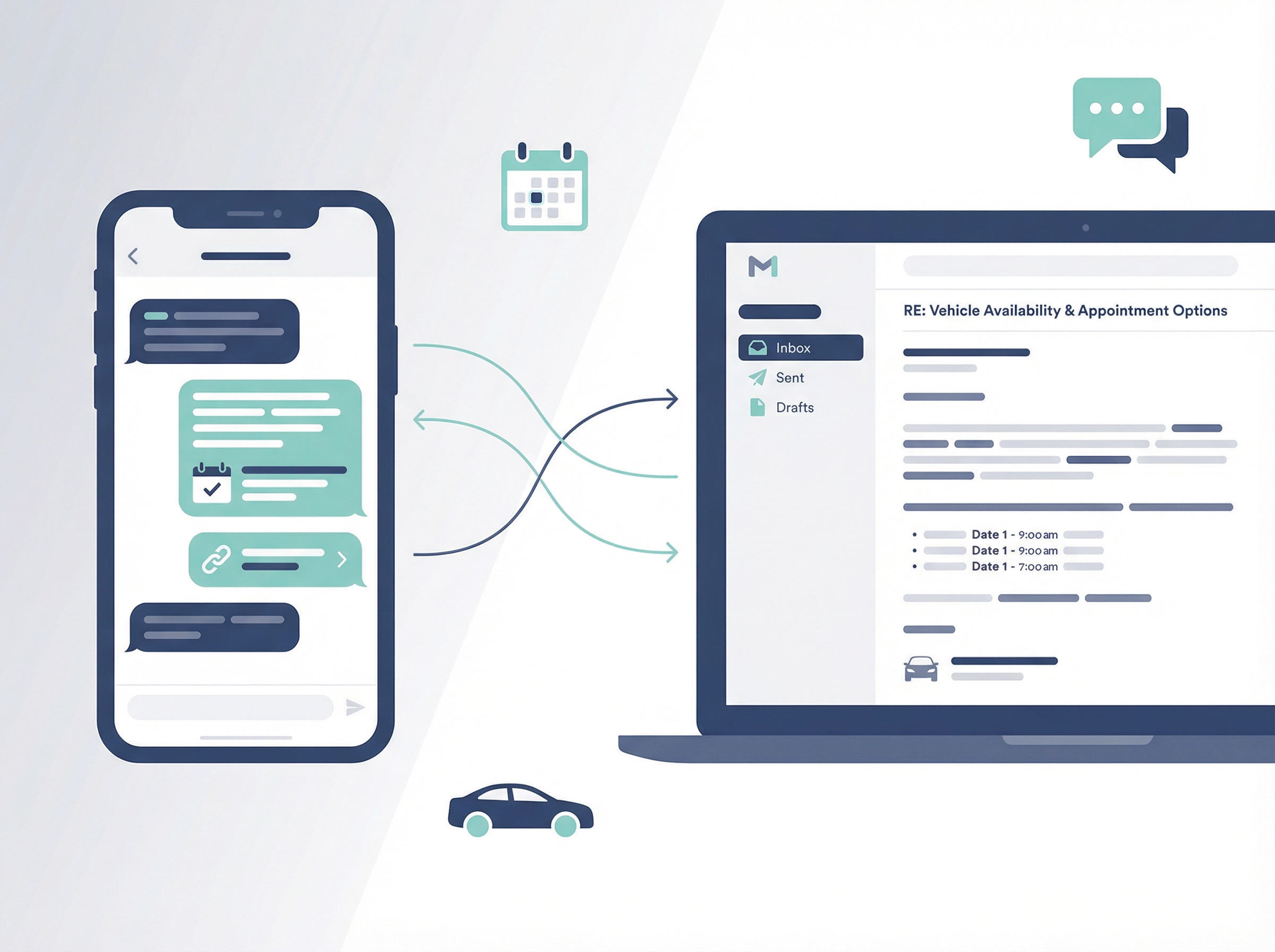
-> Missed Sales Call (immediate text)
Hi [Name] - it's [Rep] at [Dealership]. You just inquired about the
[Year Make Model]. It's available right now. Want to come by today
or tomorrow?
-> Sales Appointment Confirmation
Confirmed: [Day], [Time] at [Dealership] to see the [Vehicle].
Address: [Address]. Ask for [Rep].
Want me to send a quick directions link?
-> Service Appointment Confirmation
You're all set: [Day], [Time] at [Service] for [Service Type]
on your [Vehicle]. Reply 1 to confirm, or tell me if you need
to move it.
-> No-Show (sales or service)
Hey [Name] - everything okay? Want to reschedule for [Option 1]
or [Option 2]?
-> Recall Outreach
Hi [Name] - this is [Service] at [Dealership]. Your [Vehicle] has
an open safety recall. The repair is typically no cost. Want to book
a time this week?
Sales Lead Response (fast)
Subject: Quick question about the [Vehicle]
Hi [Name] -

It's [Rep] at [Dealership]. I saw your request on the [Year Make Model].

It's available right now. Quick question: are you trying to come in
today, or is tomorrow better?

If it helps, I can hold a time for you. I have [Time Option 1]
or [Time Option 2].

Best,
[Rep Name]
[Direct phone]
Service Scheduling Follow-Up
Subject: Service appointment options for your [Vehicle]
Hi [Name] -

It's [Rep] at [Dealership Service]. I can get you scheduled
for [Service Type].

Would you prefer [Option 1] or [Option 2]?

If you reply with the vehicle year/make/model and whether you want
to wait or drop-off, I'll lock it in.

Thanks,
[Rep]
[Service phone]
Pro tip for bilingual markets: If your store gets significant Spanish-speaking traffic, having at least a greeting and scheduling close in Spanish prevents you from losing calls immediately. Something as simple as “Hola, gracias por llamar a [Concesionario]. Soy [Nombre]. En que le puedo ayudar hoy?” can keep a customer on the line long enough to connect them with a bilingual rep. For a deeper look at handling multilingual calls at scale, see this guide to multilingual customer service for dealerships.
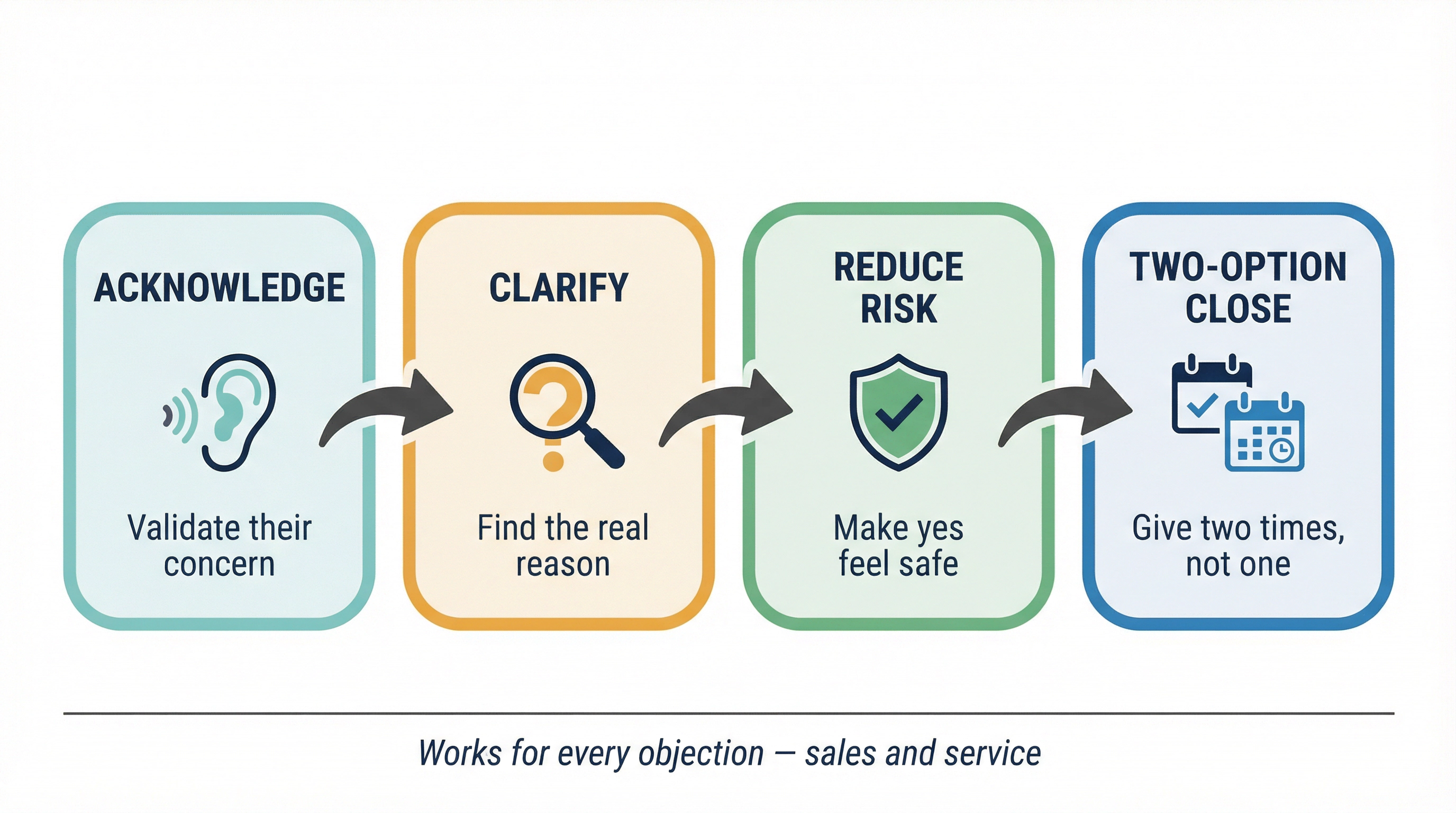
Every objection follows the same pattern when you break it down: Acknowledge > Clarify > Reduce Risk > Two-Option Close. Here’s a quick reference:
[Table 1]
The pattern stays the same. You acknowledge their concern as valid, you clarify what’s really driving it, you reduce the risk of saying yes, and you give them two options. Train on this pattern and your team can handle objections that aren’t even on this list.
Compliance isn’t optional, especially with texting, outbound calling, and AI voice.
Do Not Call awareness. The FTC reports the National Do Not Call Registry had about 258.5 million active registrations as of September 2025. That’s a lot of people who don’t want marketing calls. Make sure your outbound lists are scrubbed.
Call recording disclosure. Call recording consent varies by state, with most states using one-party consent while others require all-party consent. Cross-state calls can get tricky. Keep it simple by dropping this line at the start of every recorded call:
“Just a heads up, this call may be recorded for quality and training.”
Text opt-out. Every outbound SMS template should include “Reply STOP to opt out.” It’s standard practice and legally required for marketing texts.
AI voice and consent. If you deploy any automation (including AI voice agents), your scripts need a clean opt-out path, clear handoffs to humans, and logs that show what happened. The 2026 Pied Piper study specifically warned that automation can improve averages while creating hidden failures when handoffs break down. Compliance and good operations go hand in hand here. When evaluating AI voice platforms, this buyer’s guide for AI voice agents covers the compliance questions you should be asking.
Most stores fail here. They print scripts and hope. Do this instead.
Put scripts where reps live. Not in a PDF. Not in a binder. Put them in CRM templates, a BDC knowledge base, call coaching tools, and sticky script blocks right next to the dialer. If your reps have to go looking for the script, they won’t use it.
Train with blocks, not memorization. Run roleplays on the individual blocks (greeting, contact capture, two-option close, escalation), then combine them into full calls. This builds flexibility instead of rigidity.
Score calls with a simple rubric. You don’t need a complicated QA system. Start with five pass/fail categories:
[Table 2]
Measure the few metrics that matter. Track time to first response for web leads, answer rate for phone, appointment set rate, show rate, abandonment rate, and outcomes by call reason. For a full breakdown of which numbers to watch, see the BDC metrics every dealership should track. Industry data shows phone leads convert at roughly 75% when handled well, and DAS data shows response speed still varies wildly across dealerships.
Version your scripts like software. Every script should have a version number, an owner, a “last updated” date, and a note about what changed. When something works, you want to know why. When something breaks, you want to trace it back.
Coverage plus consistent execution is what turns missed calls into appointments and appointments into revenue.
This guide works whether you’re running a fully staffed human BDC, an outsourced team, or a hybrid setup. But if your real problem is “we can’t staff enough people to answer instantly and follow up perfectly every single time,” then you need a system that executes the playbook even when your team is busy, at lunch, or gone for the night. Many dealerships have already moved away from outsourced call centers for exactly this reason.

That’s where Flai comes in. We built Flai as an AI communications platform specifically for car dealerships. Our AI agents handle inbound and outbound calls, texts, and emails, and they book appointments directly into your DMS. They follow the same principles in this guide (branded greetings, permission-based info capture, two-option closes, text confirmations), but they do it 24 hours a day, 7 days a week, without getting tired, going on break, or letting a call ring to voicemail. To understand exactly how an AI BDC automates dealership calls, we’ve written a full explainer.
A concrete example from our Freeman Lexus case study: Flai handled approximately 1,100 calls, booked 376 appointments, achieved an 88% success rate on bookable calls, and drove roughly $100,000 in profit impact for that single store. Similar results showed up at Freeman Toyota, where the AI worked alongside the existing BDC team to book 358 appointments in a single month. And at San Leandro CDJR, service appointments doubled from 205 to 448 per month after deploying AI voice coverage.

Whether you use Flai or not, the lesson from those case studies is the same one this entire guide is built on: coverage plus consistent execution is what turns missed calls into appointments and appointments into revenue. Scripts give you the consistency. Staffing (human or AI) gives you the coverage. You need both.
If you want to see exactly what that looks like in practice, book a demo and we’ll show you.

How often should we update our BDC automotive scripts?
Review them quarterly at minimum, and immediately after any major process change (new CRM, new DMS, pricing policy update, new OEM incentive structure). Treat scripts like software: version them, date them, and note what changed.
Can the same scripts work for both small and large dealer groups?
Yes, because the blocks are modular. A single-point store uses the same greeting, two-option close, and confirmation blocks as a 20-store group. The difference is in the rollout: larger groups need standardized training materials and centralized script management, while smaller stores can iterate faster.
Should BDC reps memorize scripts word for word?
No. Train them on the blocks and the underlying principles (commitment goal, permission-based capture, two-option close). Reps who understand why the script works can adapt to unexpected situations without falling apart. Memorized scripts sound memorized.
What’s the biggest mistake dealerships make with BDC scripts?
Writing them once and never training on them. A script that lives in a PDF nobody reads is the same as having no script at all. The rollout process (embedding in CRM, roleplay training, call scoring) is what makes scripts actually change your numbers.
How do AI BDC tools handle calls that go off-script?
Good AI platforms are trained on thousands of real dealership conversations, so they can handle the natural variations in how customers ask questions. Flai, for example, uses the same decision-funnel logic in this guide: understand the customer’s intent, provide a helpful answer, and drive toward a commitment. When a conversation truly requires a human, the AI routes it to the right person with full context. The customer experience data confirms that speed and consistency matter more to buyers than whether a human or AI answers the phone.
Do these scripts work for both franchise and independent dealerships?
Absolutely. The core structure (greeting, discovery, two-option close, confirmation) is universal. Independent dealers may need to adjust language around OEM-specific programs, recalls, or certified pre-owned inventory, but the blocks snap together the same way regardless of whether you sell one brand or twenty. For franchise stores, the fixed operations guide explains why service scripts are especially critical to profitability.
How do I get my team to actually use new scripts instead of reverting to old habits?
The rollout section above covers this in detail, but the short version: make the scripts easier to use than to ignore. Embed them directly in the CRM, run weekly 10-minute roleplays focused on one block at a time, and score real calls so reps get feedback. When someone sees that using the two-option close boosts their appointment rate, they stop resisting the change. Tracking your CSI scores alongside script adherence also gives management a clear view of whether better scripts lead to better satisfaction.
As seen in