Privacy Policy
Terms of Service
Security
Status
Blogs & Guides
A practical guide to automotive SEO for dealers: local search, inventory pages, service SEO, and the operational gap that turns rankings into revenue.
April 29, 2026
Automotive SEO isn’t about getting more traffic. That’s the framing most agencies sell, and it’s why so many dealers feel like they’re paying for rankings they can’t trace to revenue.
For a dealership, traffic only matters when it becomes a call, a service appointment, a test-drive booking, or a sold unit. And the path from search result to booked appointment has a lot of places it can fall apart (most of which have nothing to do with keyword rankings).
This guide is built for marketing managers, BDC directors, and dealer principals who want SEO to produce measurable outcomes. We’ve worked directly with dealerships across the country, and we’ve seen what separates the stores that convert their organic traffic into appointments from those that don’t. The difference often isn’t search rankings. It’s what happens after someone clicks.
We’ll cover the pillars of automotive SEO for dealers that actually move revenue: local search, inventory architecture, fixed ops, technical fundamentals, and the operational gap that most SEO guides never mention.

Most SEO advice is written for content sites, e-commerce brands, or SaaS companies. Those businesses have relatively stable offerings, national audiences, and clean conversion funnels. Dealerships have none of that.
You’re optimizing a retail operation where inventory changes daily, service schedules are booked by phone, customers move between Google and third-party sites and your showroom, and a single missed call can cost you a service relationship worth thousands of dollars annually. Standard SEO playbooks don’t account for any of that.
Cox Automotive’s 2025 Car Buyer Journey Study, published January 2026 and based on a fall 2025 survey of 2,300 recent buyers, found that shoppers used an average of 4.6 websites during the buying process. Only 7% completed the entire process online. 63% said their ideal experience combines online and in-person steps. 19% of all buyers and 25% of new-vehicle buyers used AI tools or AI-generated overviews during the research phase.
That data tells you what automotive SEO is actually for. You’re not competing for clicks from national audiences. You’re competing for the attention of in-market shoppers within a geographic radius who will eventually call, drive, or walk in. The searches that matter are the ones that predict action. You can see what the research shows about dealer customer behavior across phone, digital, and in-person touchpoints.
Outranking competitors means being the most relevant, trusted, and easiest-to-contact dealership for these specific searches, not ranking #1 for “used cars” nationally. That’s the frame this guide operates in.

For most dealerships, the Google local pack and Google Maps are the highest-value SEO surface in the entire program. A shopper searching “Toyota service near me” or “Ford dealer open now” isn’t casually browsing. They’re deciding where to call, click, or drive right now.
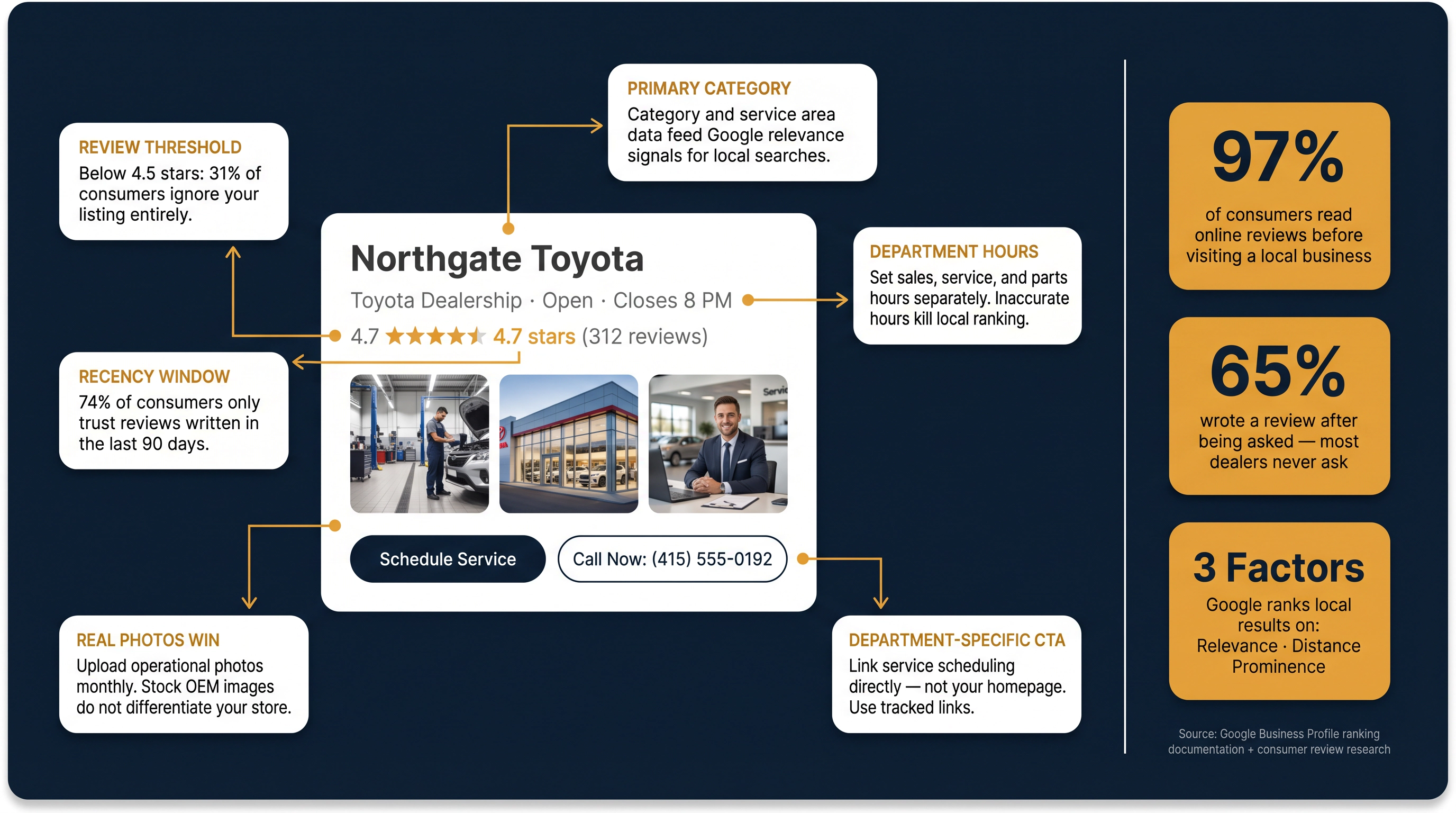
Google says local rankings depend on three factors: relevance, distance, and prominence. You can’t control a shopper’s distance from your store. But you can control relevance and prominence, and both are heavily influenced by your Google Business Profile (GBP).
The basics matter more than most dealers think. Categories, hours, phone numbers, appointment links, and service area data all feed into how Google decides which stores to surface for which searches.
Local SEO analysts have highlighted “open at the time of search” as a major local pack factor. That doesn’t mean pretending your store is open 24/7. It means your hours should be accurate, department-specific, and backed by a real process for handling after-hours calls. If your service scheduling line is handled around the clock, say so accurately. If it isn’t, don’t list hours that mislead shoppers into calling a dead phone.
Make your appointment links department-specific. A shopper who wants to schedule an oil change should land directly on service scheduling, not your homepage. A shopper who wants to test drive should get to the right vehicle or appointment page. Use tracked links so your analytics can tell you whether your GBP is driving sales traffic, service traffic, or both.
Research shows that 97% of consumers read online reviews for local businesses, 54% visit a business website after reading a positive review, and 94% of consumers are open to writing a review. 65% actually wrote one after being asked.
Those numbers should tell you something: most dealerships are leaving review volume on the table because they’re not systematically asking. Reviews aren’t a bonus; they’re local SEO infrastructure. They influence ranking, AI discovery, and buyer confidence simultaneously.
Consumer survey data also found that 31% of consumers ignore businesses below 4.5 stars, and 74% only care about reviews written in the last 90 days. Your review profile needs to be both strong and fresh, which means asking consistently, not just after a great sales month. Reviews also have a direct line to customer satisfaction scores that affect your OEM incentives.
The mechanics: ask every satisfied sales and service customer. Ask after the outcome is confirmed (vehicle delivered, repair completed), not before. Route unhappy customers to a recovery process before they hit Google. Respond to every review. Not with “Thanks for your review,” but with specific, contextual replies that mention the department, the type of service, or the customer’s actual experience. Those responses help future shoppers understand what your store does well.
Stock OEM photos are better than nothing, but they’re not enough to differentiate your store. Real photos of your service drive, waiting area, technicians, delivery moments, and staff build familiarity and reduce the uncertainty shoppers feel before they call. Upload new photos regularly. Monthly is a reasonable cadence.
A lot of dealerships approach inventory SEO the wrong way. They focus almost entirely on individual vehicle detail pages (VDPs), even though VDPs are inherently temporary. When a vehicle sells, the page disappears. Any ranking it earned disappears with it.
The stronger strategy is to build inventory architecture in layers: stable pages that survive inventory turnover combined with active VDPs that capture specific searches.

Layer 1: Model and model-location pages. Pages like “new Toyota RAV4 for sale in Austin” or “used Ford F-150 near Phoenix” match real search patterns by model, city, and condition. These pages should include current inventory modules, trim summaries, pricing context, real photos, and strong CTAs. They should survive as useful pages even when your specific inventory changes. Avoid using the same OEM boilerplate text across every dealer’s site. If your model page could run unchanged on a competitor’s site with only the city name swapped, it’s not strong enough to rank.
Layer 2: Category pages. Pages for “used SUVs,” “certified pre-owned vehicles,” “used trucks under $30,000,” or “electric vehicles” match broader shopping searches. These should be indexable when they represent real demand and actual inventory depth. Don’t index every possible filter combination. “Used blue automatic AWD SUV under $31,000 with tan interior” may be a useful filter, but it’s not a page that deserves a spot in the sitemap.
Layer 3: Active VDPs. VDPs should be built to convert and to rank for specific long-tail searches (year, make, model, VIN, stock number). They need real photos (88% of shoppers say photos entice them to the next step, according to CDK Global’s March 2025 Friction Points Study), clear pricing, availability status, payment estimators, and click-to-call and text CTAs. When a vehicle sells, redirect the VDP to the closest relevant category or model page. Don’t leave thin “this vehicle has sold” dead ends that frustrate shoppers.
One important update for 2026: Google announced in June 2025 that vehicle listing structured data would no longer be supported in search results. The special visual displays those feeds produced are gone. That doesn’t mean inventory SEO is dead. It means you should stop building your organic strategy around a deprecated feature and focus on the fundamentals: crawlable VDPs, clean model and category pages, accurate structured data where it’s still supported, and paid vehicle feeds for Google Ads programs where they apply.
The dealership SEO programs we see under-invest in fixed ops almost every time. That’s a mistake, and it’s an expensive one.
Service searches are high-intent, local, recurring, and appointment-driven. A shopper who types “brake service near me” or “Toyota oil change in [city]” already knows what they need. They’re looking for a place to schedule it now. Compare that to a shopper searching “used Toyota Camry” who is still evaluating. The service searcher is ready to act.
According to Autotrader’s April 2026 analysis of Cox Automotive’s 2025 data, 57% of buyers were likely to return to the selling dealer for service, an all-time high. Service retention is a long-term revenue compounding opportunity. A dealership that ranks well for service searches doesn’t just capture individual repair orders. It builds the base of loyal customers who return for years.
The core service pages every franchise dealer should have:

Each page should include what the service is, the symptoms that indicate the customer needs it, what certified technician service means for that brand, appointment CTAs, phone and text CTAs, real photos of the service drive, and FAQs sourced from actual service calls. “What should I bring?” “How long does this take?” “Will this affect my warranty?” Those questions come up on every service call and should be on every service page.
Recall pages deserve special attention. Recall searches come from customers with urgency and genuine uncertainty. A strong recall page explains how to check whether a vehicle has an open recall, whether the dealer performs that brand’s recall work, that recall service is typically no-cost, and exactly how to schedule. Dealers that handle this clearly and specifically win customers who might otherwise stay with a competing store.
Model-specific service pages also outperform generic ones because they match real owner intent. “Ford F-150 brake service near [city]” is a more targeted search than “brake service near me,” and if your competitor doesn’t have a model-specific page, you win it by default. Pairing strong service pages with automated service appointment scheduling is how top dealers turn that SEO visibility into actual booked revenue.
Dealer websites are often slow, script-heavy, and built around OEM platform constraints that nobody at the store controls. That’s a real competitive problem, but it’s also an opportunity, because most of your competitors have the same constraints and aren’t working to overcome them.
An analysis of 1,910 retail websites from North America’s top 50 auto groups found that 99.6% failed Google’s Core Web Vitals on at least one platform, and 95.5% failed on both. Core Web Vitals measure loading performance (LCP, or Largest Contentful Paint, should be under 2.5 seconds), visual stability (CLS, or Cumulative Layout Shift, should be below 0.1), and responsiveness (INP, or Interaction to Next Paint, should be under 200 milliseconds).
You don’t have to build the fastest site in the world. You have to be faster and easier to use than the other dealers in your specific market.
A consumer insights study found that 54% of car shoppers use phones more than desktops. Most VDP and service page traffic is mobile. If someone trying to call your dealership while driving past a competitor’s lot gets a slow-loading page with a buried phone number, you’ve lost that lead before it started.
Mobile priorities that pay off immediately: fast SRP and VDP load times, sticky click-to-call and text CTAs visible without scrolling, tap-friendly appointment buttons above the fold, short forms, and no intrusive popups blocking inventory views.
On the content side, the core principle from Google’s helpful content guidance is whether your content leaves the reader better off. In automotive, that’s a high bar, because too much dealer content is either generic OEM boilerplate or AI-generated without real dealership experience. Google’s guidance on generative AI content is clear: publishing many pages without adding genuine value risks scaled content abuse penalties.
The content that works (and that competitors can’t easily copy) comes from the dealership’s actual experience. FAQs sourced from real service calls. Model pages with local pricing context. Comparison guides written by someone who actually demos both vehicles. Staff expertise pages that reflect real team knowledge. Inventory landing pages that mention your store’s actual service differentiators, not just OEM talking points.
Google’s documentation on succeeding in AI search and AI features guidance both say the same thing: there are no special technical requirements to appear in AI Overviews beyond being indexed and snippet-eligible. Keep content crawlable, text-accessible, and genuinely useful. Build consistent entity data across your website, Google Business Profile, and major directories. AI discovery rewards the same fundamentals that traditional search rewards.
What the technical side doesn’t cover, and what almost no SEO guide addresses, is what happens after someone clicks. The phone system that receives those inbound calls is part of your conversion funnel, and most dealers aren’t measuring it.

Most SEO guides stop at the ranking. That’s exactly where the money starts leaking.
Phone performance data found that 31.8% of unconnected calls happened because customers hung up while on hold. The average hold time across dealerships was 3 minutes and 5 seconds. 32.3% of non-connected calls went to voicemail. Monday between 10 AM and 12 PM is the highest-volume call window, and also the period most likely to have overflow and hold issues.
That data is about phone performance. But it maps directly to SEO. Every organic visitor who calls your store and sits on hold is a lead your SEO program generated and your operations lost. Research shows that 60% of customers hang up after just one minute on hold, and 32% won’t wait at all. At Flai, we’ve seen that approximately 70% of callers who hit voicemail call a competitor within about 30 minutes.
The math isn’t complicated. A dealership losing over a million dollars annually from missed service calls alone isn’t losing that money because of bad rankings. It’s losing it because the calls come in and go nowhere.
You can see exactly how much dealerships lose to missed calls when you break down the revenue math by call type.
Common leaks that SEO creates and operations fail to catch:

Traditional SEO reporting never shows these leaks. Your agency dashboard shows impressions and sessions. It doesn’t show you that 28% of the calls generated by your SEO investment went to voicemail last Monday morning.
This is the gap that most automotive SEO guides don’t talk about, because it’s not really an SEO problem. It’s an operational capture problem. And solving it is what turns a good SEO program into a measurable revenue engine.
Building on everything above: the dealers who see the best return from automotive SEO aren’t just the ones with the best Google Business Profiles or the fastest mobile VDPs. They’re the ones who’ve closed the gap between the ranking and the revenue.

Flai is an AI communications platform built specifically for car dealerships. It answers every inbound call immediately, including after hours, during Monday morning peaks, and during any overflow period that would normally send callers to hold or voicemail. It books service appointments and test drives directly into the dealer’s scheduler and DMS, pushes leads into the CRM, handles sales and service FAQs, runs recall outreach campaigns, and follows up with leads by phone, SMS, and email.
The connection to SEO is direct. Every organic search that generates a call or a form lead is an opportunity. What happens to that opportunity depends on whether someone (or something) is available to handle it immediately.
Consider what happened at a Lexus dealership in the Bay Area after deploying Flai. Before Flai, after-hours service calls went to voicemail. Peak-hour overflow calls were missed. Flai handled roughly 1,100 calls, missed zero, and booked 376 appointments from 426 bookable calls, an 88% conversion rate. The estimated monthly profit impact: $100,000.

At a CDJR dealership in the Bay Area, the numbers were similar. Before Flai, the store booked 205 service appointments per month. After deployment, that number rose to 448. Flai handled 1,563 calls, booked 304 appointments, and generated an estimated $83,000 in profit impact in the first 30 days. Those aren’t leads that materialized from thin air. Many of them were callers who would have previously reached hold music or voicemail during busy periods.
The reason Flai works in this context is that it connects directly to the systems that run the dealership: the scheduler for real-time availability, the DMS for customer records, the CRM for lead tracking. This isn’t a message-taking service or an IVR tree. When a caller wants a Tuesday 5:30 PM oil change appointment, the AI checks actual availability, books the slot, confirms it, and sends a confirmation. That’s what closes the gap between SEO and revenue.
For dealers investing in SEO, Flai is the operational layer that makes organic demand actually land. It handles the part of the conversion funnel that no SEO agency touches: the moment the shopper picks up the phone.
Getting started doesn’t require fixing everything at once. Focus on impact.

Every month after that: review your SEO dashboard alongside call data (answer rate, hold time, missed calls, voicemail rate), refresh priority pages, publish two to four useful pieces of content, and respond to all reviews within 48 hours. SEO without operational follow-through doesn’t compound. The flywheel only spins when ranking, conversion, and capture all work together.
The dealership that wins automotive SEO in 2026 won’t be the one that publishes the most blog posts or builds the most VDPs. It’ll be the one that makes every part of the funnel work: showing up in local search, giving shoppers useful and honest pages, making it easy to take the next step, and then actually being there when they reach out.

We’ve seen what happens when the first two parts work and the third doesn’t. A dealer spends months earning stronger organic visibility, then loses the customer at the phone line because someone went on hold and called a competitor.
At Flai, that’s the problem we built around. It’s the piece of the automotive SEO conversation most people are still missing.

Automotive SEO is the process of improving a dealership’s visibility in organic search, Google Maps, and AI-assisted discovery so shoppers can find inventory, service options, financing, and appointment paths. For dealers, SEO should be measured by business outcomes: calls, service appointments, test-drive bookings, direction requests, and sold units. Not by rankings alone.
Some fixes show impact quickly. Correcting inaccurate GBP hours or appointment links can affect local visibility within days. Content pages and link authority take longer, typically several months before meaningful traffic gains. Google’s SEO Starter Guide notes that changes can take anywhere from hours to months to be reflected in results. The practical advice: fix technical and local issues first for fast impact, then build content and authority steadily over time.
Yes. Cox Automotive’s 2025 Car Buyer Journey Study found that 59% of buyers used dealership websites and 41% used search engines during their purchase process. CDK’s 2025 analysis showed buyers actively use dealer sites for inventory browsing, pricing, and test-drive scheduling. Organic search remains a critical channel, especially for service customers who search and call repeatedly throughout a vehicle’s lifetime.
By improving relevance and prominence, since distance is fixed by geography. Practical actions include keeping GBP data accurate and complete, using correct primary and secondary categories, setting department-specific hours, adding real photos regularly, building a consistent review request process, responding to all reviews, maintaining consistent citations across major directories, and creating local content on your site that reinforces your market position. Google’s guidance on local ranking confirms these are the primary levers.
Google announced in June 2025 that vehicle listing structured data would no longer be supported in search results. The visual rich results those feeds produced are no longer displayed. This doesn’t eliminate inventory SEO, but dealers should stop building organic strategy around that deprecated feature. Paid vehicle feeds for Google Ads programs are still relevant; that’s a separate channel from organic structured data.
Service searches are high-intent, local, and recurring. The customer already knows what they need and is looking for a place to book. Autotrader’s April 2026 analysis of Cox Automotive data found that 57% of vehicle buyers planned to return to the selling dealer for service, an all-time high. Ranking well for service searches doesn’t just drive individual repair orders. It builds the customer relationships that generate recurring revenue for years.
Start with conversion events, not rankings. Track organic calls, organic service appointments booked, organic test-drive requests, direction requests, and form submissions. Then connect those to downstream data from your CRM and DMS, including organic-sourced repair orders and organic-sourced sold units. Alongside your SEO metrics, track call performance: answer rate, hold time, voicemail rate, and missed call volume. A high organic click volume paired with a 35% voicemail rate is not a success. It’s a capture failure.
Treating SEO as a visibility project instead of a revenue project. Rankings are the means; calls, appointments, and sold units are the end. Many dealerships invest heavily in ranking improvements while ignoring the conversion and capture side. Phone performance data shows how much organic demand leaks through unanswered calls, hold times, and voicemail. Getting the SEO right and then losing the call is the most expensive mistake in dealer digital marketing.
Build a systematic process: ask every satisfied sales customer after vehicle delivery, and every satisfied service customer after a completed repair. Route unhappy customers to a recovery process before they post publicly. Respond to every review with context about what the customer experienced and what your team did well. Research shows that 94% of consumers are open to writing reviews, and 65% wrote one after being asked. The volume gap is usually a process gap, not a satisfaction gap.
Flai operates at the conversion layer, the point where SEO-generated demand (a call, a lead, an after-hours inquiry) either gets captured or lost. Flai answers every inbound call 24/7, books appointments directly into the dealer’s scheduler, handles FAQs across phone, SMS, and email, and runs follow-up outreach for missed connections and recalls. For dealerships investing in automotive SEO, Flai ensures that the organic demand those rankings produce actually turns into booked appointments, rather than ending at hold music or voicemail. See how it works at your store.
As seen in